
Tag Archives: K12 Inc.

California Virtual Academies Spotlighted Again!

3 Dec

By Thomas Ultican 12/3/2023

California Virtual Academies (CAVA) received an unfair labor practices complaint from their teachers union. As part of contract negotiations, the union requested a “K12 product list with prices for our school for both the 2021-2022 and 2022-2023 school years.” CAVA lawyers declined, saying it was “confidential, proprietary information.” On 11/2/2023, union lawyers responded with a legal action, claiming the information was their legal right.

Kristen Taketa, reporting for the San Diego Union, noted the concern of teachers over how money is being spent and wrote they “echo more wide-ranging questions about CAVA’s finances and use of public dollars that have dogged the network for more than a decade.”    

Financial records show Stride (formally known as K12) took in over $70 million from all nine CAVA schools in the 2021/22 school year. High costs, charged by Stride, kept the schools running deficits.
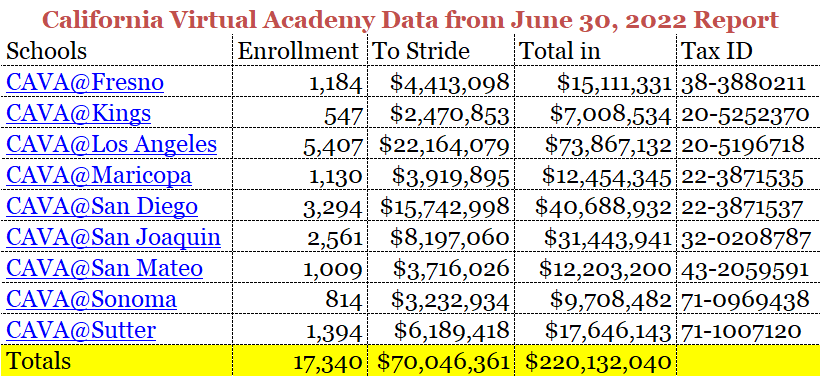
Who is CAVA

K12/Stride set up the CAVA network in 2002 that grew to nine charter schools, authorized by small districts. None of them had more than 15,000 students and four had less than 2,000. This means small cash-strapped districts get 1 to 2 percent of CAVA state funding to monitor the schools, with insufficient resources to do more than review some submitted paperwork.
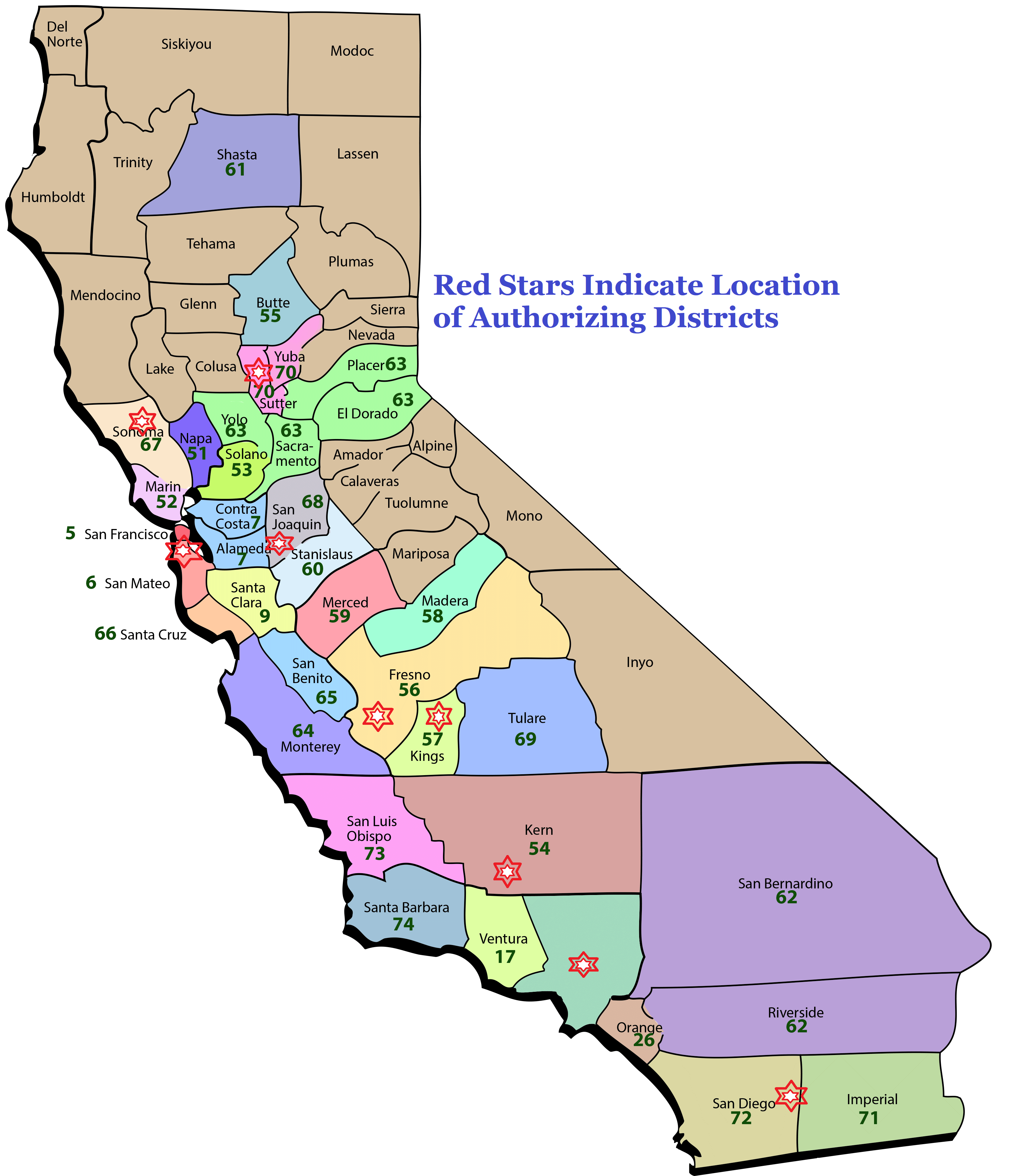
Red stars on the California county map indicate authorizing district locations. This is important because, under California law, a cyber charters can only service its authorizing county and the bordering counties. The map shows CAVA services almost all population centers in the state.

The nine CAVA schools are organized as non-profits with their own boards. California law says only non-profit organizations may operate charter schools.

A Wikipedia entry says, “California Virtual Academies follow the educational principles of E.D. Hirsch Jr.” In the debate between behaviorism and “constuctivism”, Hirch came down squarely on the side of behaviorism. Education writer, Alfie Kohn said, “E. D. Hirsch Jr.’s Dictionary of Cultural Literacy, which popularized what we might call the ‘bunch o’ facts’ approach to education, was enthusiastically endorsed in Phyllis Schlafly’s Eagle Forum newsletter.” (Page 11) In other words, the CAVA foundational philosophy of education is not widely embraced.

K12 was founded by former McKinsey & Co. consultant and banker, Ronald J. Packard. Discussions toward its founding began in 1999 and the company opened its doors in 2000, focusing on the homeschooling market. Original investors included “junk-bond king” and felon, Michael Milken, his brother Lowell, Andrew Tisch, Larry Ellison and others. Ronald Reagan’s Secretary of Education, William Bennett, was hired as the company’s first chairman of the board.

Legal and Labor Issues

Because of the close ties between K12 and CAVA, a loud objection was raised by activists, claiming the schools were little more than a front of the for-profit company. It was noted that K12 created the schools, chose the boards and holds exclusive no-bid contracts with CAVA. 

In early 2016, Jessica Calefati of San Jose’s The Mercury News reported, “Accountants and financial analysts interviewed by this newspaper, including several who specialize in school finance, say they’ve never seen anything quite like the arrangement between K12 and the public online academies.”

Many profit-minded companies in California have tried to sidestep the laws, requiring charters to be run by non-profits. LA Times reporter Howard Blume wrote:

“K12’s strategy allegedly involved driving the opening of nonprofit charters up and down the state. These schools then contracted with K12 for “substantially all of the management, technology and academic support services in addition to curriculum, learning systems and instructional services,” according to a state complaint filed last week.

“The CAVA nonprofits became shells for the activities of the for-profit corporation, according to allegations in a second, separate complaint, which was filed under the authority of the state in conjunction with whistleblower Susie Kaplar, a former CAVA teacher.”

In the same 2016 article, Blume quoted then California Attorney General, Kamala Harris, saying, “K12 and its schools misled parents and the state of California by claiming taxpayer dollars for questionable student attendance, misstating student success and parent satisfaction, and loading nonprofit charities with debt.” The non-profit charities referenced were the nine CAVA schools.

Later in July of 2016, Attorney General Harris reported:

“As part of the settlement, which is subject to court approval, K12 will provide approximately $160 million in debt relief to the non-profit schools it manages—“balanced budget credits” that were accrued by the schools as a result of the fee structure K12 used in its contracts—and will pay $8.5 million in settlement of all claims.  In addition, K12 has agreed to implement significant reforms of its contracts with the CAVA Schools, undergo independent reviews of its services for students with disabilities, ensure accuracy of all advertisements, provide teachers with sufficient information and training to prevent improper claiming of attendance dollars, and change policies and practices to prevent the kinds of conduct that led to this investigation and agreement.”

Rachel Cohen reporting in Atlantic magazine shared:

“K12 emphasized it had admitted no wrongdoing, and said the attorney general ‘grossly mischaracterized the value of the settlement just as it did with regard to the issues it investigated.’ In an email to The Atlantic, the K12 spokesperson Michael Kraft disputed the AG’s characterization of the schools as indebted.”

At the same time, the CAVA network and K12 were also developing growing dissatisfaction amongst their teacher ranks. Brianna Carroll, a fourth-year CAVA teacher, claimed, “Teachers were concerned about the instability their students were experiencing.” She said they began discussing the reality of low salaries and substandard working conditions, making it hard for CAVA to retain teachers and creating “an unstable environment for students.”

Sarah Vigrass, a 10-year CAVA teacher, observed:

“Changes in management at K12 and an increased emphasis on profits had led to changes at CAVA that shortchanged students. When I started teaching there, families would start the year getting these great boxes of art supplies, textbooks and curriculum, and teachers had time to build relationships with students and families. A lot of that went away.”

In 2013, CAVA teachers reached out to the California Teachers Association (CTA), an affiliate of the National Education Association, for help. With more than 700 teachers, working at nine campuses, spread out across California, bargaining with an anti-union K12 was tough. In 2014, despite management opposition, teachers voted overwhelmingly to be represented by California Virtual Educators United (CVEU)/CTA.

A 17-month legal battle followed, with CAVA claiming that each one of their campuses was a separate school and therefore, a separate bargaining unit. In October 2015, the Public Employment Relations Board (PERB) rejected CAVA’s arguments, granting CVEU exclusive recognition. CAVA again appealed but was rebuffed by PERB in June 2016. In September of that year, CVEU and CAVA began negotiations for their first contract. In April 2018, CVEU members voted by a 98 percent margin to ratify a contract agreement with CAVA.

One of the big concerns of teachers was the poor performance of their students. In a two-part investigationThe Mercury News reported that fewer than half of CAVA students graduate and “almost none” pass the courses required for admission to the California State University and the University of California.

John Fensterwald reporting for EdSource said:

“A study of online charters in California by the Center for Research on Education Outcomes, or CREDO, at Stanford University found that online students were far behind their classroom-based peers. Based on test scores, CAVA students on average fell a third of a year behind their peers in math.”

Even the California Charter Schools Association (CCSA) criticized K12, stating:

“CCSA condemns the predatory and dishonest practices employed by K12 Inc. to dupe parents using misleading marketing schemes, siphon taxpayer dollars with inflated student attendance data, and coerce CAVA School nonprofit employees into dubious contracting arrangements,”

Conclusion

Under a new name, Stride, K12 still profits wildly from California taxpayers. CAVA schools are the only cyber schools in America running deficits. They get full per-student money from the state, maintain and operate no buildings … why are they financially strapped???

The unfair labor practices claim filed by CVEU has potential to reveal Stride’s enormous greed and malfeasance.

California cyber charters ought to be run by large school districts with elected boards and not for-profit companies, located on the east coast.
i-Ready Sells 50-Years-Old Education Failure

23 Nov

By Thomas Ultican 11/23/2019

i-Ready sells digital math and English lessons to school districts. It provides diagnostic testing which recommends interventions for struggling students that it then provides. i-Ready’s pedagogy embraces competency based education (CBE) a theory promoted by the US Department of Education and blended learning theory also financially supported by the federal government. CBE is the latest name for an education theory that failed in both the 1970’s and 1990’s. Blended learning theory is an experiment with almost no research supporting it but lots of research pointing to its health risks. Students dislike i-Ready.

June 2018, I wrote “i-Ready Magnificent Marketing Terrible Teaching.” It received decent traffic for the first four days, but strangely the traffic never slowed. This year, it is my most accessed article averaging over 700 hits per month.

Curriculum Associates and Bad Education Philosophy

The Massachusetts based company Curriculum Associates (CA) distributes i-Ready and its related testing services. When founded in 1969, it was providing worksheets in support of Mastery Learning curriculum which is similar to today’s CBE. They are the same failed theories delivered by different mediums. CBE and Mastery Learning theory also go by many other names including outcome based education; performance based education; standards based education; high performance learning; transformational education and break-the-mold schools, among others.

Benjamin Bloom and his collaborators developed what almost all teachers in America know as “Bloom’s Taxonomy.” The taxonomy was originally conceived as a method for identifying the learning objectives that test questions addressed. At the time, Bloom was the Director of the Board of Examinations of the University of Chicago and he enlisted measurement experts from across the country to aid in his question classification project. Their final product was published in 1956 under the title, Taxonomy of Educational Objectives (Bloom, Engelhart, Furst, Hill, & Krathwohl).

David R. Krathwohl, Professor of Education Emeritus at Syracuse University, explained that Bloom saw the Taxonomy as more than a measurement tool. He says Bloom believed it could serve as a:

  • “common language about learning goals to facilitate communication across persons, subject matter, and grade levels;
  • “basis for determining for a particular course or curriculum the specific meaning of broad educational goals, such as those found in the currently prevalent national, state, and local standards;
  • “means for determining the congruence of educational objectives, activities, and assessments in unit, course, or curriculum;” (Emphasis added.)

In the late 1960’s Bloom outlined “Learning for Mastery” which was based on both the Taxonomy and the theoretical work of John B. Carroll. Carroll had proposed that if each student was allowed the time needed to learn a subject to some criterion level, then she could attain that level. In other words, almost all students could master academic subjects.

In the 1970’s “Learning for Mastery” became “Mastery Learning” and was evolving. However, critics were questioning its methods and outcomes. Many teachers started referring to it as “seats and sheets.

In 1976, James H. Block and Robert B. Burns, two education professors from the University of California Santa Barbra, published a lengthy defense of Mastery Learning. In their defense, they described the related Personalized System of Instruction (PSI) as an individually based, student-paced approach to mastery instruction wherein students typically learn independently of their classmates. They state:

“The theoretical basis for this strategy lay in B. F. Skinner’s pioneering work in operant conditioning and the application of that work in the programmed instruction movement of the 1960s. Some of the basic features of this movement have been summarized by Hartley (1974, p. 279).

  1. “The learner should be given some clear idea of where he is going, i.e., the terminal behavior.
  2. “The instruction leading to this behavior must be sequenced into small steps.
  3. “The learner should work on each step alone and at his own pace.
  4. “At each step, the learner should be encouraged to actively respond.
  5. “The learner should receive immediate knowledge of results concerning the correctness or appropriateness of these responses.” (Emphasis added.)

Mastery Learning outcomes were not encouraging. A 1982 paper in Learning by George N. Schmidt said, A city-wide elementary school reading program that emphasizes mastery learning … is blamed for the declining reading test scores of high school students there.”

When Chicago finally abandoned Mastery Learning, teacher Kenneth S. Goodman wrote in an Education Week article, “Perhaps what, more than any other factor, brought down the program was that it was imposed on teachers: …” (Emphasis added.)

As Mastery Learning was careening toward the dustbin of failed education ideas, Bill Spady, self-proclaimed father of Outcome-Based Education (OBE), was organizing a group of Mastery Learning advocates to join him in promoting OBE. Spady explained,

In January of 1980 we convened a meeting of 42 people to form the Network for Outcome-Based Schools. Most of the people who were there—Jim Block, John Champlin—had a strong background in mastery learning, since it was what OBE was called at the time. But I pleaded with the group not to use the name “mastery learning” in the network’s new name because the word “mastery” had already been destroyed through poor implementation.

Peter Greene the author of the blog “Curmudgucation” and Senior Contributor for education at Forbes discussed the demise of OBE in a 2015 Post. He noted, “This was the dawn of TSWBAT (the student will be able to…) which meant that every single objective had to be paired with some observable student behavior.” It is likely that almost all teachers in America have been plagued at one time or another by administrators insisting that a TSWBAT statement be posted for each day’s lesson.

The Clinton administration embraced OBE and its development of education curricular standards. However, the standards associated with OBE were peppered with politically charged non-cognitive objectives like:

“All students understand and appreciate their worth as unique and capable individuals, and exhibit self-esteem.

“All students apply the fundamentals of consumer behavior to managing available resources to provide for personal and family needs.

“All students make environmentally sound decisions in their personal and civic lives.”

OBE was extremely unpopular with practicing educators. However, what really killed it was the reaction from the political right. As Greene noted, “Rush Limbaugh, Bill Bennett, Pat Robertson and most especially Phyllis Schafly were sure that OBE was here to socially engineer your child into some bleeding heart gay-loving liberal twinkie.” Another OBE vulnerability was absolutely no evidence or research indicated it actually worked.

Competency Based Education (CBE) and i-Ready

CBE is OBE on a screen. The objectives have been simplified into discrete sets of small competencies that can be assessed by digital algorithm. These objectives which align with common core state standards are derived from the ideas developed through Mastery Learning and OBE.

In 2008, i-Ready’s CEO, Rob Waldron, took the reins at Curriculum Associates (CA) and steered it into the digital education business. CA became an education technology company.

The timing was good. Jeb Bush soon established a well funded campaign to promoted digital learning (students at screens). Donald Cohen, chairperson of the nonprofit, In the Public Interest release a trove of emails that brought to light the forces financing Bush’s education technology initiative. Cohen said the emails “conclusively reveal that FEE [Foundation for Excellence in Education] staff acted to promote their corporate funders’ priorities, and demonstrate the dangerous role that corporate money plays in shaping our education policy.

Lee Fan reporting for the Nation magazine said these funders included the American Legislative Exchange Council (Koch Industries), K12 Inc., Pearson, Apex Learning (launched by Microsoft co-founder Paul Allen), Microsoft, McGraw-Hill Education, Bill and Melinda Gates, Michael and Susan Dell among others. With this kind of financial and political support, the fact that educating students by putting them at screens was an untested theory was not a hindrance.

Competency Based Education has not performed as theorized. This month, an article in Ed Week shared,

“The evidence base is very weak at this point,” said Pane, who led a Gates-funded study of about 40 personalized-learning schools, finding modest gains and big implementation challenges.”

“Critics such as independent researcher Audrey Watters warn that personalized learning is a pretext for ‘massive data collection’ and surveillance of students.”

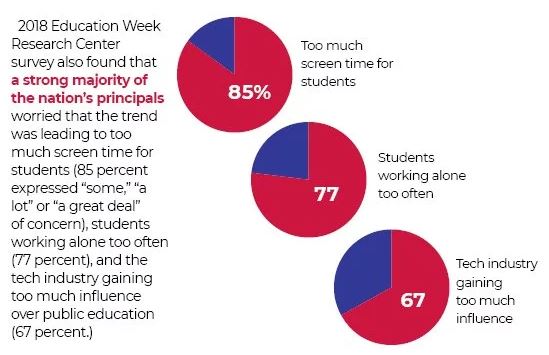
Ed Week CBE Graphic

Results of Education Weeks School Principals Technology Survey

Parents, Teachers and Students Dislike i-Ready

This Urban dictionary says, “Iready is commonly used as a form of child torture in the US education system.

This definition aptly expresses the sentiments of many respondents to i-Ready blogs:

  1. Teacher: “I got no information on iReady about my students that I didn’t already know.”
  2. Parent: “I’ve only heard teachers say that iready gave them the same information they already have about students. IOW, it has no value.”
  3. Student: “I hate I-ready, when I do it I get the same lessons every time.”
  4. Student: “i hate doing iready”
  5. Teacher: “Most kids view computer programs as games. So it changes the mind set of many students from what am I learning to how can I beat this game.”
  6. Parent: “It is abusive to a student’s rights!”
  7. Teacher: “My eighth graders deliberately answer the diagnostic test questions incorrectly because they’ve discovered this results in easier (faster) lessons.”
  8. Parent: “My son hates it.”
  9. Student: “i am a kid in 4th grade who is supposed to be doing iready not writing this but i cant and wont because it is too stupid boring and downright horrible!”
  10. Student: “yeah I am not supposed to save this but what are we kids getting out of I ready I know nothing but a f’d up way to learn nothing but sh!t”
  11. Student: “i agree it sucks”
  12. Parent: “I wonder what you’d see for responses if you asked kids if they liked school in general? Using student quotes about a program is a poor metric when most young students would rather be doing something else on a computer (like Fortnite). Wrong metric.”
  13. Student 1 Response: “well here’s a kids response school sucks but i would rather jump off a cliff than do another iready lesson!”
  14. Student 2 Response: “That isn’t true for all students like me I’m an A student but I hate iready (even though I play games a lot)”
  15. Student: “I am a gifted student in an I-ready school who hates I-ready so much that I created a rebel alliance against it.”

A Florida parent named Deb Herbage wrote a scathing account about i-Ready i-Ready?…………More Like i-SCAM and Other Deceptions.In it she excoriates Jeb Bush saying,

“We have i-Ready, IRLA, Canvas, Nearpod, ReadyGen, MobyMax and a host of other ‘experimental’ programs and software that have been deceptively deployed in our schools that our kids are actively testing and helped ‘validate’ and refine. … With all these partnerships and alliances – it can become difficult to track these companies but they all seem to point in the same direction – Jeb Bush, the Foundation for Excellence in Education, Common Core, education reform, the US DOE, the NGA, the CCSSO and the state of Florida.”

Kassia Omohundro Wedekind is an elementary math teaching specialist and the author of Math Exchanges: Guiding Young Mathematicians in Small-Group Meetings. She recently published to her blog, “Why iReady is Dangerous.” Wedekind observed, “iReady, and assessments of this nature, overwhelming identify poor students and students of color as most in need of intervention.”

Conclusions

Programmed instruction, Mastery Learning, Outcome Based Education and Competency Based Education all were imposed on teachers and mostly imposed by non-educators. Instead of learning from practicing educators, theorists turned to behaviorist philosophy to create their ideologies. In the 21st century, education technology has also been imposed on educators, but not by misguided reformers. It is being sold by some of the largest corporations in the world who are looking for profits. Not all education technology is bad but lifeless lessons delivered on screens are harming both student health and their intellectual growth.

Twitter: @tultican