Tag Archives: education

Charter School Scourge Invading Sweetwater

1 Oct

By Thomas Ultican 10/1/2016

Chula Vista, California

On Monday evening (9/26/2016), the board of the Sweetwater Union High School District (SUHSD) had petitions from three charter schools; two requesting charter renewals and one for a new school. The two renewals are co-located charters that were started by SUHSD’s previous board (four of the five resigned as part of plea deals) and the new petition is for an independent study charter.

My first teaching job was in SUHSD as a paid certificated intern, teaching 3 out of a possible 5 classes a day while completing a master’s in education at UCSD. At my new job, I was soon regaled with stories of corruption in Sweetwater instigated by superintendent, Ed Brand. I never witnessed direct evidence of this widely and firmly held belief. Brand’s first stint as SUHSD Superintendent was from 1995 to 2005.

It was surprising in 2011, when the SUHSD Board brought Brand back. He had resigned as Superintendent of San Marcos Unified in 2006, less than a year after leaving Sweetwater to assume that position.

An article in the San Diego Union speculated that Brand was pushed out in San Marcos for unethical hiring and political practices. It says in part:

“… accounts have emerged of other things not in keeping with San Marcos Unified’s image. They include Brand’s ordering the hiring of a teacher, whose husband is a state education official, even though a panel of elementary school principals in charge of hiring voted not to offer her a job; a staff party for management aboard a 112-foot historic yacht; and two outsiders infusing cash into a school board candidate’s campaign.”

The state education official was Scott Himelstein then Deputy Secretary of Education/Chief of Staff and later Acting Secretary of Education for the State of California. In that capacity he served as chief policy advisor to Governor Arnold Schwarzenegger on K-12 and higher education.

William D. Lynch was a source of outside money and according to the Union article cited above, “The High Spirits yacht, where Himelstein hosted the party, is owned by multimillionaire businessman William D. Lynch….” Lynch is an ally of Brand’s and of state Secretary of Education Alan Bersin, former superintendent of San Diego city schools. Lynch is also a philanthropist who runs the William D. Lynch Foundation for Children, which promotes literacy. Scott Himelstein is the foundation’s former president.

Given who he associates with it was not surprising to learn that Ed Brand promotes privatizing public schools. Upon returning to Sweetwater, he started working on a new charter school idea. His dream was to develop a k-16 charter system and with support from several long time cronies, he had a charter proposal written. Susan Mitchell who has an almost forty-year working relationship with Brand was the lead petitioner for the school originally named Ivy League Prep Academy but soon renamed Stephen H. Hawking Math and Science Charter School.

Like Mitchell, most of the stated charter school founders also had similar long term associations with Brand. Before the courts and voters replaced the SUHSD school board, Brand was able to open a second charter school named Stephen W. Hawking II Science, Technology, Engineering, Art and Math Charter. The schools were started as K-6 schools not through 16.

Co-Location

After the passage of proposition 13 in 1978, it became almost impossible to pass a bond issue for the construction of new school facilities in California. Amendments that gutted proposition 13’s 2/3 requirements for passing bond measures always looked popular initially but were soundly defeated come election day. In 2000, proposition 39 was narrowly written so it only reduced the requirement to pass school bonds and it required a 55% majority. A big loud political battle ensued but proposition 39 prevailed.

The charter school industry was able to slip a clause into proposition 39 that required school districts to make any excess capacity available to charter schools. This crucial point was barely noticed and not debated publically at all.

Co-location is a very disruptive unsound education policy. As Gary Cohn reported in Huffington post:

 ‘“One of the difficult things about having a charter school co-located on a district public school campus is that . . . the two schools end up competing for those things that are necessary to provide a quality education for the students,’ says Robin Potash, an elementary school teacher and chair of the United Teachers Los Angeles (UTLA) Proposition 39 Committee. ‘That includes competing for the same students.”’

 In a July 10, 2015 article for La Prensa, Susan Lazzaro wrote:

“Community advocate Maty Adato asked the Sweetwater Union High School board a provocative charter school question at the June 22 board meeting. Trustees were deliberating on the renewal of facility contracts for Stephen Hawking charters I & II. The charters are for grades K-6 and Adato wanted to know if Sweetwater, a 7 -12 district, must give up unused classroom space to a K-6 charter.”

This is a question that seems bound for the courts because besides being bad policy, in order for this co-location mandate to be hidden in proposition 39, the law had to be poorly written. Lazzaro also noted a question from one of the five new board members, Paula Hall, “What happens, she asked, if the charter schools want more of our classroom space?” Another question without an answer.

Hawking I is co-located with Castle Park Middle School and Hawking II is co-located with Southwest Middle School. This is a clear illustration of the irrationality of the charter school movement from the standpoint of the taxpayer. In these two campuses there are four administrations doing the job that two administrations did 5 years earlier. The charter school movement is driving up the education cost per student which means either class sizes must increase or school taxes must increase; probably both.

In addition, taxpayers within the school district’s boundaries obligated themselves with bonds and other taxes to pay for these schools. Now, the buildings have been partially taken out of public control and their elected representatives no longer have legal authority to represent constituent interests.

The charter school movement puts tax dollars outside of democratic control with little accountability. Even with strict public accountability, malfeasance and criminality occur. It should come as no surprise that fraud and abuse are escalating in this low accountability charter school era.

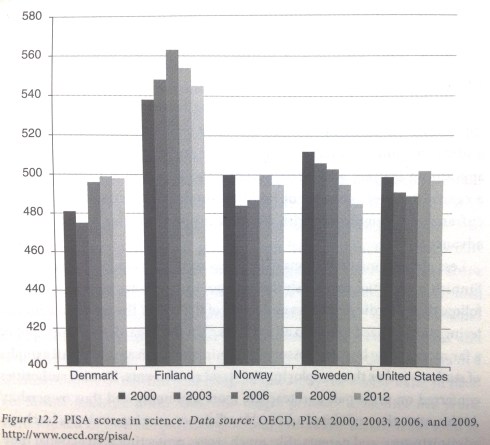
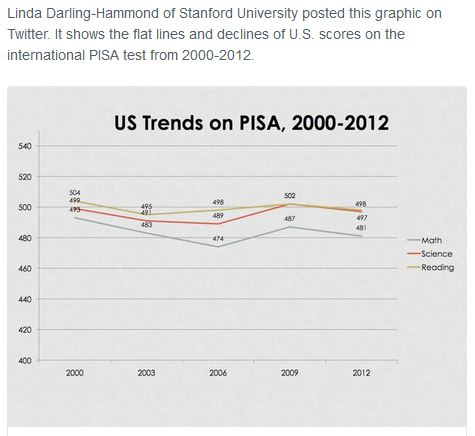
A fundamental charter school theory postulates that elected representatives developed emasculating education code depriving public schools of the opportunity for innovation and improvement. Charter schools freed from accountability promised to untie this Gordian knot and market forces were expected to drive improvement. After 20 years, we see that charter schools are better at marketing than public schools but only rarely match the public school teaching prowess. For the first time nationally, education progress appears to have slowed with the rise of charter schools.

pisa-2000-to-2012

Independent Study Charter

 Carol Burris, the Executive Director of National Public Education is currently publishing a series of articles about the charter school movement. In the second installment carried by the Washington Post she writes about independent study charters.

“Although the original intent of the independent charters may well have been to scoop up at-risk kids and give them a second chance, the lack of criteria for student placement, along with inadequate regulations have led to obvious abuses. There are now far too many independent learning charter schools whose operators, some with no background or expertise in education, make substantial salaries, ….”

The third charter school petition at Monday’s school board meeting was for a proposed new independent study charter, ACATL Leadership Academy. Their Facebook page describes ACATL’s vision:

“ACATL Leadership Academy’s (ALA) mission is to create an educational system that ensures social justice by acknowledging, understanding and healing institutionalized racism, poverty, and marginalization.

“ALA will be a non-classroom based 9-12 grade charter high school within the Sweetwater Union High School District, and will be a reed in our community known for its innovation, flexibility and strength.

“ALA will serve students 14 thru 22 years of age and will set a goal of recapturing students who have left the traditional school system. ALA will partner with students, parents and family (relatives), and community organizations to address social justice issues our youth encounter in San Ysidro, California – the San Diego International Border region of the United States.”

 This sounds great, however, taxpayers have already established Learning Centers at every high school in the SUHSD.

The public school system also provides an Adult School in San Ysidro  which is an opportunity local taxpayers are providing for “recapturing students who have left the traditional school system.” Now taxpayers are being asked to compete with themselves and support yet another facility with no real needs assessment.

In other words, publicly financed schools are already performing the same function ACATL proposes with the advantage of having highly trained experienced psychologists, councilors and certificated teachers working with students. This request for taxpayer money to be taken from Sweetwater schools to finance someone’s heartfelt dream makes little sense, but California’s charter school law pretty much guarantees ACATL will get a charter.

Carrol Burris in the article I cited above also spoke to the profit motive of these kind of schools:

“In addition, running independent learning centers can be very lucrative. One of San Diego County’s largest networks of independent learning centers is the Altus Institute. It advertises on billboards and runs ads in movie theaters and on television.  Altus operates Audeo Charter, Audeo Charter II, the Charter School of San Diego and Laurel Academy. It has a total K-12 enrollment of about 3,000 students and takes in tens of millions of dollars in state and federal revenue. Like Learn4Life, its learning centers are located in malls and office buildings. Its younger students are home-schooled.

“In 2014 compensation for Altus Institute President Mary Bixby was $371,160 — exceeding the total pay plus benefits of the superintendent of the San Diego Unified School District that serves nearly 130,000 students. Bixby is a board member of the charters, a full-time employee of one of the schools and also receives compensation for being “on-loan” to two other Altus schools. Such obvious conflicts of interest would be illegal in a public school.”

 Segregation by Choice

Last year a new charter school, Imperial Beach Charter, opened up next door to my high school. A local resident remarked to me, “the people west of 13th street don’t want their kids going to school with those kids at Mar Vista Academy.”

A blogger going by the moniker educationrealist posted this observation:

“I offer this up as opinion/assertion, without a lot of evidence to back me: most parents know intuitively that bad teachers aren’t a huge problem. What they care about, from top to bottom of the income scale, is environment. Suburban white parents don’t want poor black and Hispanic kids around. Poor black and Hispanic parents don’t want bad kids around. (Yes, this means suburban parents see poor kids as mostly bad kids.)”

 I recently reviewed Mercedes Schneider’s new book, School Choice. On page 22 she writes:

“Thus, what is clear about tuition grants, scholarships, or grants-in-aid, and the history of American public education is that these were tools used to preserve segregation. There it is: The usage of choice for separating school children into those who are ‘desirable’ and those who are not.”

This following table shows the demographic difference between the Mar Vista Academy (the public school) and Imperial beach charter.

School Hispanic or Latino White not Hispanic English Learners Free & Reduced Price Meals
Imperial Beach Charter 514 (59%) 250 (29%) 160 (18 %) 544 (62%)
Mar Vista Academy 714 (82%) 45 (5%) 277 (32 %) 679 (78%)

Conclusions:

Too often, charter schools are just rouges to make taxpayers finance private schools.

Charter schools have not shown significant educational improvements and they come with significant risks. Last year the Center for Media and Democracy reported:

“Nearly 200 charters have closed in California, nearly one of every five that have opened. Their failures have included stunning tales of financial fraud, skimming of retirement funds, and financial mismanagement, material violations of the law, massive debt, unsafe school conditions, lack of teacher credentials, failure to conduct background checks, terrible academic performance and test results, and insufficient enrollment.”

In other words, many charter schools are unstable and they have shut down with no notice even mid-way through a school year.

Charter schools increase the cost of education because of the required redundant administration for the same number of students and private sector administrative incomes are normally much higher than public employment rates.

All of the charter requests to SUHSD should be denied, but under present law if that happens either the county or the state will grant the charter. Past time for an immediate moratorium on new charter schools in California. Unwinding this unstable costly charter school system will benefit students and taxpayers.

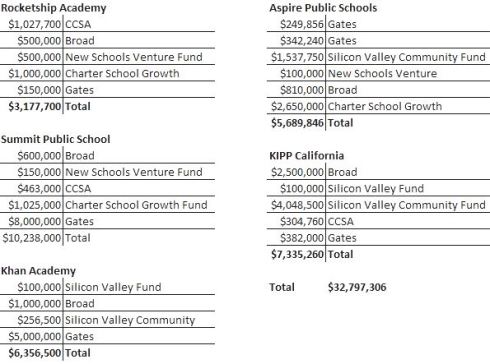
The charter school industry wasn’t an organic development. Politicians and their wealthy masters created it with massive incentives. The federal government is spending billions on promoting charters plus foundations such as the Bill and Malinda Gates Foundation, the Walton Family Foundation, the Edith and Eli Broad Foundation and the Fisher Foundation provide unimaginably large sums of money toward these privatization efforts yearly. If the elites succeed in destroying and monetizing our public education system, the opportunities for middle and working class people will significantly diminish. Just look at Detroit to see what the future holds for the poor.

The charter school movement is undemocratic and irrational. It needs to end.

Twitter: @tultican

San Diego Foundation Biased Toward Privatizing Schools

13 Jul

By Thomas Ultican 7/13/2016

San Diego Foundation was established in 1975 and has grown to almost $700 million in assets. It’s self-described purpose: “As one of the nation’s leading community foundations, The San Diego Foundation strives to improve San Diegans’ quality of life by creating equity and ensuring opportunities to be WELL (Work, Enjoy, Live & Learn).” In 2014, they gave over $10 million to educational endeavors. The following table illustrates the spending bias against public education.

 Category of Giving Amount Granted
University and College Grants and Scholarships $6,106,052
Civic education – Libraries, Camps, etc. $1,333,266
Charter School and Competency Based Education (CBE) $1,339,802
Private K-12 Schools $1,129,225
Public K-12 Schools (Not including charters) $373,628

Competency Based Education (CBE)

Peter Greene an education expert from Pennsylvania discussed CBE in terms of education reform ideas that should die. He wrote:

“Two years ago, CBE was barely on my radar, and honestly, having lived through the early-nineties disastrous fiasco that was Outcome Based Education, I’m still kind of amazed that we’re back here. But we are. What has changed since 1991? Computers, the internet, the cloud, the sheer raw data collecting and crunching power that a company like Pearson now has at its command. In a CBE world, neither teachers nor schools are necessary– just students at their computer terminal being put through their software-controlled paces, each keystroke and answer filed away (and put to all manner of uses) in their new lifelong data record. Public education and citizen privacy would all be washed away. CBE fans are ju-jitsuing themselves some support for the approach (Quick! Run away from the evil test and take refuge in this CBE sanctuary over here!) and ESSA has opened the door wide for new “personalized” and non-BSTest-based measures of student achievement. I still think there are some serious hurdles in CBE’s path, but if it clears those obstacles, we’ll be looking at a huge threat to public education in this country (and the absolute end of teaching as a career).”

The SD Foundation granted the Girard Foundation of La Jolla $550,415 which they promptly spent on CBE development. They gave Gooru $300,000 and $105,850 went to Make It Matter LLC. Gooru is creating technology that enables CBE and Make it Matter specializes in marketing computer based “1:1” education. Personalized one to one education means a child is stuck in front of a computer with no real human exchange involved. It is terrible education policy with a huge profit potential.

SD Foundation also gave Kid Spark Education of Solana Beach $550,000 dollars to work on CBE development.

Foundations Join Forces and Support Privatizing Schools

Besides sending over $200,000 to seven charter schools in San Diego County, SD Foundation gave $30,000 to Teach for America (TFA). TFA is a program that give college graduates 5 weeks of summer training and then state education leaders allow them to teach classes mostly in charter schools. They are inexpensive unqualified teachers.

SD Foundation spending on Universities is surprising. Almost 40% of that spending is on schools outside of San Diego County totaling $2,409,711. Grants and scholarships given in the county totaled $3,696,341. One would expect an organization that “strives to improve San Diegans’ quality of life by creating equity and ensuring opportunities” would spend a greater share of their education dollars in San Diego.

The largest single grant bestowed by the SD Foundation was $2,6 5 0,7 0 9 to the Jewish Community Foundation of San Diego. The JC Foundation had net assets at the end of 2014 of $171,593,990.

The Jewish Community Foundation spending on education follows a similar pattern as the San Diego Foundation. They spent $466,830 for groups working to privatize public education most of which went to TFA ($406,330). They also spent lavishly on private schools including $146,000 to La Jolla Country Day, a decidedly upscale K-12 private school.

By far the largest grant by the Jewish Community Foundation was the $25,817,228 bequeathed to University of California San Diego. A major patron of both the Jewish Community Foundation and UCSD is the Qualcomm founder and billionaire, Irwin Jacobs.

Three more grants from the Jewish Community Foundation were interesting. They gave Cornell University $5,511,000. They also gave the Goldman Sachs Philanthropy Fund $6,362,171.  The Goldman Sachs fund asset total at the end of 2013 was $1,500,395,380. And the JC Foundation gave the SD Foundation $1,515,800. Why give money back? It is like the Charter School Growth Fund giving their benefactors from Walmart $15,000,000 in 2013. Why?

Do They Understand What They Are Supporting?

There is no denying that both of these funds contribute to a host of worthy efforts. However, are these large concentrations of wealth undermining democratic governance? Are the people making grants to advance the privatization of public schools and promotion of CBE even aware of the ramifications of their grants?

The reality is that these two funds are large but not in comparison with many other funds around California and the US. Yet, they did put a combined almost $2,000,000 towards privatizing public schools in 2014 and only about $425,000 toward support for public schools which went mostly to wealthy neighborhoods.

Our neighbors up in Los Angeles have multiple huge funds. The table below lists the seven largest.

Fund Name Asset Total
Getty Trust, J. Paul $11,982,862,131
California Endowment, The $3,668,459,217
Hilton Foundation, Conrad N. $2,576,376,157
Broad Foundation, Eli & Edythe, The $1,941,410,735
Annenberg Foundation $1,663,095,893
California Community Foundation $1,457,110,000
Simon Foundation, Norton, The $1,349,804,152

The motives for today’s education reform ideology are complicated by greed and lack of understanding. Some people truly believe that America’s public schools are failing and need disruptive reform. They are wrong. For the past, 30-years public schools have been steadily improving. In a recent Atlantic Magazine article Jack Schneider wrote:

 “Finally, consider the outcomes produced by the educational system. Critics are right that achievement scores aren’t overwhelmingly impressive and that troubling gaps persist across racial, ethnic, and income groups. Yet scores are up over the past 40 years, and the greatest gains over that period have been made by black and Hispanic students. They’re right that the U.S. finishes well behind exam-oriented countries like Taiwan and Korea on international tests. But scores are roughly on par with countries like Norway, which was named by the United Nations the best place in the world to live; and students from low-poverty states like Massachusetts outscore most of their global peers. Critics are right that 40 percent of college students still don’t graduate. But almost half of all American high-school students now head off to college each year—an all-time high. And whatever the doom-and-gloom about schools failing to address workforce needs, it’s worth remembering that the U.S has the strongest economy in the world—by an enormous margin.”

 Save Public Schools and Taxpayers

It is time to support public education and stop tax dollar scammers. The main weapons in the drive to privatize schools and create new corporate profit centers are charter schools, standardized testing and CBE.

The charter industry has become fraud riddled. Being able to innovate by removing accountability has led to uncertified teachers, unsafe schools and unprofessional schools. California’s earthquake safety laws do not apply to charter schools. Many charter schools are basically publicly supported private schools. Charter schools have no accountability to taxpayers and no curricular accountability. It is time to end this dangerous, destructive and expensive experiment by immediately moving all charter schools under the management of publicly elected boards and state education laws. Anything less is to support this continued wanton and growing fraud.

Standardized testing is worthless. It does not measure student, school or teacher competence. Colleges are all well aware that the SAT is not a good indicator of student success; high school grades are better. The only valid outcomes from standardized testing are it correlates well to family wealth and it makes for good propaganda when taking over schools in poor communities. Other than that it is expensive and harmful.

CBE is the latest scheme to sell technology to schools, mine student data and sell testing services for outcome verification. It is a terrible idea if you want children to be well educated, creative and lifelong learners.

It is clear that all recent education agendas coming from corporate entities have been about what is good for the adults at those corporations. Reform has become almost exclusively about fleecing taxpayers at the expense of their children.

Soka Education and Reform

4 Jul

By Thomas Ultican – 7/4/2016

Soka Education is an education reform movement advanced by the Buddhist lay organization, Soka Gakkai or “Value Creation Society.” For more than a century, reform education advocates such as John Dewey have proposed a humanistic approach to education. Although they have shown considerable success in demonstration classrooms, there has been little general implementation of their ideas.

The Swiss psychologists, Jean Piaget called Dewey’s discovery-based approach to education “constructivism.” Piaget believed that “children play an active role in making sense of things, `constructing’ reality rather than just acquiring knowledge.”1 The philosophy of constructivism” is a move away from the educational philosophies of behaviorism and social conservatism advocated by men like B. F. Skinner and Edward K. Thorndike.

Ellen Lagemann, an education historian, writes, “One cannot understand the history of education in the United States during the twentieth century unless one realizes the Edward K. Thorndike won and John Dewey lost.”2 The same general situation in education appears to exist throughout the world. Behaviorist authoritarian models of education dominate.

It could be that the Soka Education movement is the first large scale, long term and determined effort to utilize reform or humanistic student-centered education in the world.

At the Dawn of the 20th century, the father of Soka Education, Tsunesaburo Makiguchi, an elementary school teacher and principal in Tokyo, developed a theory of education that he called “Value Creating Pedagogy.” He also gained a reputation for causing trouble of some sort wherever assigned. Mr. Makiguchi’s problems were rooted in the prevailing educational theories of his day.

The closing decades of the 19th century witnessed Japan going through huge social change. It changed from nearly seven hundred years of military rule by the samurai classes back to Imperial rule and embarked on a mad dash toward industrialization. It changed from four hundred years of self-imposed isolation to a path of international engagement.

Education policy became a debate between the forces that felt the purpose of education was to build citizens who were self-assured and of independent minds and those that advocated the development of obedient and loyal subjects for the Meiji government. Historian Dayle M. Bethel tells us that “the latter group won the debate.”3 Bethel says, “Makiguchi’s entire educational career was a protest against the production of subjects.”4

In 1928, Makiguchi converted to Nichiren Buddhism and was soon convinced that Nichiren Buddhism and his philosophy of “Value Creating Pedagogy” were synergistic. In 1930, he started an organization for educational reform called Soka Kyoiku Gakkai or “Value Creating Educators Society” based not only on his theories of education but also on Nichiren Buddhism. This organization became more and more about religion than educational reform as militarism and state sponsored Shinto enveloped Japan.

Japanese society was completely devastated during World War II. Makiguchi and all of the leaders of the “Value Creating Educators Society” were imprisoned as thought criminals in 1943. Makiguchi died in prison in 1944. After being released from prison in 1945, Makiguchi’s disciple, Josei Toda, rebuilt the organization as a Buddhist laymen’s society and renamed it Soka Gakkai or “Value Creation Society.”

Today, Soka Gakkai is the world’s largest Buddhist sect and the largest religious movement in Japan. In the 1960’s, the Soka Gakkai returned to its roots as an educator’s society and began constructing an education system based on Makiguchi’s “Value Creating Pedagogy.”

Dayle M. Bethel wrote of Makiguchi: “Out of his battles with Japanese educational structures of his time and his association with a few like-minded colleagues there emerged pedagogical views and ideas that are worthy of study by English-speaking scholars, worthy in their own right and also because these views and ideas seem likely to have significant impact on Japanese society during the years ahead.”5

Today, the leader of Soka Gakkai International (SGI) and Soka Education is Dr. Daisaku Ikeda. In a 1996 speech at Teachers College, Columbia University, he said, “Greatly influenced by the views of Dewey, Makiguchi asserted that the purpose of education must be the lifelong happiness of learners. He further believed that true happiness is to be found in a life of value creation.”6

Bethel writes, “With reference to Western scholars there is scarcely a single major figure in the fields of education and social science, from the time of Plato to the early decades of the twentieth century, to whose work he did not make some reference.”7 Makiguchi was very aware of and appreciated Western ideas about education, but he did not just accept these ideas. Makiguchi believed in the acid test of experience. Those ideas that proved of merit in actual practice were to be accepted and those that did not were to be discarded.

Although an admirer of Dewey’s ideas on education, Makiguchi perceived a flaw in the formulation of Pragmatism and offered his own refinement based on a corrected philosophy of value.

Makiguchi specified the central importance of value in pedagogy: “The object of ‘The System of Value-creating Pedagogy’ lies in searching for the law of cause and effect in guiding the life of the students. Needless to say, the object of life lies in the pursuit of value.”8

The components of value that Makiguchi postulated were good, gain and beauty as opposed to those of good, beauty and truth postulated by the neo-Kantian Pragmatists of his era. Makiguchi’s formulation replaced the Kant school’s value triad component – truth – with gain. Makiguchi asserted, “Truth is that which is expressed exactly as an object is, through observing it objectively and determining its invariable elements as its intrinsic nature. On the other hand, value is that which is produced by the relationship between object and subject, and if either of the two should change, the value will vary accordingly.”9 He stated that truth was not evaluative in nature because it was either truth or not truth.

From this, he made the point that truth was a cognitive outcome or objective and value was an emotional outcome or subjective. Therefore, a great error in understanding occurs when people mistake cognition for evaluation. Makiguchi declared, “Considering the aspect of the present world, I believe nothing is as evil as the confusion of cognition and evaluation, since the mixing of the two makes it hard for a person to understand and causes him to assume an uncertain attitude toward his choice and decision.”10

Based on his own philosophical view, Makiguchi used his experience as a classroom teacher and elementary school principal to create practical guidance for educators to use in implementing his system of “Value Creating Pedagogy.” He proposed ideas that were congruent with many of Dewey’s:

 “In-school education should be closely connected in practice with actual social life so that it can transform unconscious living into fully conscious participation in the life of society. Education integrated into the life of society will yield benefits of well-planned living, without the undesirable effect of mechanical uniformity an inherent danger in standardized education.”11

 Makiguchi opposed the type of education that emphasized cramming knowledge into the student. He advocated an experiential based learning process. He opposed high stakes testing. He said that students and teachers should be cooperative partners in a community of learners.

Looking at the development of education in the United States through the lens of Makiguchi’s “Value Creating Pedagogy” gives a fresh view of American education.

As an aside, the word soka is a neologism created by Makaguchi’s disciple, Josei Toda. It is a combination of the Japanese words sozo (creation) and kachi (value).12

The most influential figure in the early development of education in the United States was Thomas Jefferson. He viewed education as necessary for personal happiness and the wise selection of governmental leaders in a democracy.

He believed that people in general had the innate wisdom required for a representative democracy to succeed and that education was the means by which to tap that ability. He reasoned that the creator must have endowed us with a “moral sense of conscience” which “is as much a part of man as his leg or arm. In a greater or less degree it may be strengthened by exercise, as may any particular limb of the body.”13

Jefferson believed education was the mechanism by which moral virtue could be made manifest. With his Aristotelian view that happiness was attainable only if the rational part of one’s nature governed the appetites,14 he, like Makiguchi, saw the purpose of education as seeking value.

About the French Revolution, Jefferson wrote, “it has failed in its first effort, because the mobs of the cities, the instrument used for its accomplishment, debased by ignorance, poverty and vice, could not be restrained to rational action.”15

Jefferson saw education as the cause for developing from common farmers the enlightened citizenry that would take the rational action a successful republican democracy requires. Jefferson averred, “The qualifications for self government are not innate. They are the result of habit and long training.”16

In Jefferson’s era, the United States was an agrarian society with large estates in the south employing slave labor and small self-sufficient family farms in the north. Farming accounted for 90% of American economic activity.17

Into this environment, Jefferson proposed a four-tiered model of universal public education. Tier one was to be a state supported three-year elementary school for “all free children male and female.” Tier two was to be a grammar school for boys selected by merit from elementary school and kept in boarding school at state expense. These boys were to be the future leaders of society. Jefferson saw them as the “natural aristocracy” based on “virtue and talent.” Tier three was to be the university, which was to focus on liberal arts and develop cognitive skills as opposed to vocational skills. Tier four called for life-long self-education for which Jefferson proposed public libraries.18

If we examine Jefferson’s proposals from the viewpoint of Soka Pedagogy, we find general agreement. For example, Dr. Ikeda recently stated, “I believe that a liberal arts education should be the core element of the first half of every university degree course, as it provides a general understanding of humanity.”19

Certainly Makiguchi would have agreed enthusiastically with universal education. Speaking of his students who were not from upper-class families, Makiguchi protested, “Even though they may be covered with dust or dirt, the brilliant light of life shines from their soiled clothes. Why does no one try to see this?”20

Makiguchi parts ways with the proposal to use school as a sorting device for picking a “natural aristocracy.” Makiguchi was completely egalitarian and he opposed “cutthroat competition” and “examination hell.”21 Today, Makiguchi’s heirs are actively promoting education as a valuable lifelong pursuit.

Jefferson considered his successful campaign against the union of church and state as one of his major victories for intellectual freedom. Ironically, he believed in a very authoritarian form of pedagogy and he left no record of objection to the religious content and authoritarian nature of the instruction practiced in the colonial schools.

Jefferson’s view of pedagogy would later to be known as faculty psychology. It contended that the mind had distinct “faculties” that must be strengthened through exercise. Researchers tell us, “… he conceived the mind as an empty vessel to be ‘filled’ with useful facts.”22 Children of that era were required to memorize religious pieces like the Lord’s Prayer and recite them. They were encouraged to learn numbers because it would help them reference material in the Bible. The messages of their learning materials were both moral and Protestant.23 These views of education are antithetical to Soka Pedagogy.

During Jefferson’s lifetime, few of his proposals for education were actually adopted, but his ideals of universal education, intellectual freedom and the benefit of an enlightened citizenry reverberate into today’s discussions of education. Following in Jefferson’s footsteps, the next great development in American education was the common school movement championed most notably by Horace Mann.

Concurrent with the beginning of the 19th century, four shifts in social structure started to dominate in American society. People began to move from farms to urban centers. Many new immigrants began to arrive from Europe and they were not just coming from England. They were from Ireland, Italy and other places. Many of them were Catholic and many did not speak English. Slaves from the south began to migrate to the northeast.

There was also a general population migration from the Northeast to the Midwest. Most political leaders viewed all these social forces with foreboding. Social reformers advanced the common school as the solution to these strains and claimed that the need for common schools was no less than the very survival of the nation.24

With the challenges of industrialization, immigration and urbanization, public schools became the fabric of social integration. Horace Mann became the spokes-person for schools being the instrument of social integration.25

It was Mann’s point of view that children in the common school were to receive a common moral education based on the general principles of the Bible and on common virtues. The moral values to be taught in public school were Protestant values and the political values were those of republican democracy.

Joel Spring observes, “The combination of moral and political instruction meant that the student leaving the common school would share with fellow students a set of moral and political beliefs; the result would be the creation of a society with a consensus of political and moral values.”26

Common schools were to be supported by state taxes and to be free to all. Rich and poor children would learn to live together. They would learn to see wealth as an outward sign of inner salvation and the rich would learn the value of charity.27

It is this use of education for other purposes than intellectual development that Makiguchi and the heirs to his legacy would object. In an essay Dr. Ikeda wrote:

 “Learning is the very purpose of human life, the primary factor in the development of personality, that which makes human beings truly human. Nevertheless, development of personality has consistently been reduced to a subordinate position and viewed as a means to other ends. This view has prevailed worldwide throughout modern history, particularly in the twentieth century.

The educational system has therefore been reduced to a mere mechanism that serves national objectives, be they political, military, economic or ideological. A certain type of personality, not the full development of personality, has been sought, as if casting individuals from a uniform mold. Treating education as a means rather that an end reinforces a utilitarian view of human life itself.”28

 The most famous text of the common school system was the McGuffey Reader. The goals of the stories in this text were to teach reading and to impart moral lessons. One interesting moral lesson explicitly taught in the McGuffey Readers of 1843 is the spirit of charity. Five of the 29 stories dealing with boys’ character had a theme of charity.29

A researcher, Richard Mosier, summarized the dominant attitude of the McGuffey Readers: “It was argued that the poor would always be with us, that the best for them was charity and benevolence, but that no one need be poor. There are, argued the apostles of acquisition, numerous avenues to success that stand open for the sober, and frugal, the thrifty, and the energetic.”30

Americans heard echoes of those moral messages in President George W. Bush’s call for faith based and private charitable organizations to take a more active role in solving America’s social problems.

As Joel Spring noted, “Catholics objected to the use in school of the King James Version of the Bible and of textbooks that contained anti-Catholic statements.”31 Former slaves were not welcome in most common schools.

In addition, stratified cognitive theory supported stratified schooling. For example, Native Americans were sent to separate boarding schools.32 Ironically, the common school itself became a force for segregation. Social conditions and events undermined the common school principal of a single unifying common education.

Political ideology also had an effect on the common school. Democrats viewed centralized control of the schools as an attempt to promote and protect special privileges for the upper class. They preferred local control of schools to centralized state bureaucracies that characterized common schools.

The McGuffey Readers reflected the political view of the common school proponents who were politically aligned with the Whigs. Whigs believed in government intervention in public affairs and in central control. Spring observes, “To a certain extent, the struggle between Whigs and Democrats was a struggle between incipient bureaucracy and democratic localism.”33 Workingmen’s groups wanted the schools to teach how to exercise political power not just basic principles of government and a common republican creed.34

This type of partisan political struggle over education is strongly opposed by the Soka movement. Dr. Ikeda calls for a paradigm shift in our view of education to rid it of the deleterious effects of political interference.

He quotes Professor Robert Thurman of Columbia University’s answer to the question: How do you view the role of education in society? Professor Thurman replied, “I think the question should rather be: What is the role of society in education? Because in my view education is the purpose of human life.”35

In the 1920’s and 30’s, Makiguchi and his successor Toda both campaigned at the risk of their lives against the nationalistic education that was pushing Japan toward war. Today, Ikeda calls for giving “education a status and independence equal to that accorded the executive, legislative and judicial branches of government.”36

At the end of the nineteenth century, America experienced an era of dynamic change. David Tyack reports, “In 1860, the United States lagged behind England, France, and Germany in its industrial output: by 1894 it led the world and produced almost as much in value as those three nations combined.

Schools also expanded in size and complexity in those years to a point where America also surpassed other nations in its educational output.”37 Schools took on a new technical role. They began preparing the new work force and sorting them by ability for the positions in the factories of this new industrial age.

William T. Harris was an intellectual leader in the development of American Education philosophy during the late nineteenth century. He served as the U.S. Commissioner of Education and was for several years the superintendent of schools in Saint Louis. He declared, “The first requisite of the school is Order: each pupil must be taught first and foremost to conform his behavior to a general standard.”

He pointed out that a modern industrial society requires, “conformity to the time of the train, to the starting of work in the manufactory.”38 Researcher David Tyack says, “In the view of most urban school-men of the late nineteenth century, schools should inculcate obedience to bureaucratic norms overtly and with zest.”39

The schools became a “rational sorting device.”40 The rational used for sorting students into positions in the new industrial society was the merit displayed by the student. In the late nineteenth century in Chicago, newspapers referred to the annual examinations to get into high school as the “Olympic Games” and education administrators boasted about how the examinations fostered useful competition.41

From the days of the McGuffey Reader, Americans have been convinced that the way one gets ahead is by applying the good-old Protestant ethic of hard work. Success is seen as being completely up to the individual and it is individual accomplishment that is lionized. This is the “achievement ideology” in America and it is pervasive.42

Princeton Sociologists, Davis and Moore, observed that, “Social inequality is … an unconsciously evolved device by which societies insure that the most important positions are conscientiously filled by the most qualified persons.”43 School has become the implement by which America stratifies itself.

Ralph Turner has defined the system of stratification in America as “contest mobility.” He defines “contest mobility” as “a system in which elite status is the prize in an open contest and is taken by the aspirants’ own efforts.”44

The objective of this system is to give elite status to those who earn it rather than by ascription for some innate trait. This method accords nicely with the American “achievement ideology.” It logically follows that if one failed to reach a desired position, one would blame themselves. Moreover, one would recognize that the position went to the person who earned it.

“Achievement ideology” and “contest mobility” are organizing folk norms in America. Turner explains, “organizing folk norms are reflected in specific value judgements…irrespective of the logic expressed.”45 He also says, “Under contest mobility in the United States, education is valued as a means of getting ahead, but the contents of education are not highly valued in their own right.”46 One reason for textbooks being the central source of information in American Schools is that the system wide exams focus on that material in them.47 This implies that the contest is more important than the content.

Many researchers think the “achievement ideology” in America has undermined intellectual curiosity. For example, Alfie Kohn the noted education authority from Harvard University said, “Surprising as it may seem, the evidence suggests that our long-term goals for children and schools are less likely to be realized when teachers, parents, and the students themselves become preoccupied with standards and achievement.”48

He says a student “may persevere at a task when they’ve been told they have to do well. But a genuine interest in the task – or excitement about the whole idea of learning – often begins to evaporate as soon as achievement becomes the main point.”49 In 1959, Talcott Parsons, one of Kohn’s predecessors at Harvard, made a similar observation: “I think that an important part of the anti-intellectualism in American youth culture stems for the importance of the selective process through the educational system…”50

Makiguchi was very critical of the use of examinations to sort children. Bethel says, “The cramming of useless, soon-to-be-forgotten information in order to pass tests was to him the height of folly and represented in acute form the deeper sickness of the whole educational system.”51

In the foreword to The System of Value-Creating Pedagogy Makiguchi wrote: “I am driven by the intense desire to prevent the present deplorable situation – ten million of our children and students forced to endure the agonies of cutthroat competition, the difficulty of getting into good schools, the examination hell and the struggle for jobs after graduation – from afflicting the next generation.”52

At approximately the same time that Makiguchi was working to reform education in Japan, his contemporary, John Dewey, was fighting a similar battle in the United States. Discovery learning and child-centered learning are themes associated with Dewey’s methods of education. Although Makiguchi found fault with Dewey’s pragmatic philosophy, the two were in deep agreement about the need for humanistic and student-centered education to inform the industrial era.

Unfortunately, neither of these educators’ views prevailed and today we see the same sort of authoritarian factory-modeled education that they were trying to reform in practice virtually everywhere in the world.

In 1982, Kathleen Wilcox did a comparative ethnographic study of a classroom in a lower-middle-class neighborhood and an upper-middle-class neighborhood classroom. The classrooms studied were less than fifteen miles apart, were first-grade level and were in a major metropolitan area in California.

An ethnographic study looks closely at the culture of the subjects being observed on an intimate level. In this case, the expectations and responses of teachers and students in the two different environments were compared in detail. One of Wilcox’s conclusions was: “A vast array of cultural clues cue the teacher as to the child’s likely future position in the work hierarchy, and the teacher in turn behaves in such a way as to socialize the child for and encourage the child toward this position.”53 This view of education is called reproduction theory.

If this is indeed the reality, possibly the root of the problem is that the goal of education is wrong or has been obscured. Makiguchi wrote, “What is the purpose of national education? Rather than devise complex theoretical interpretations, it is better to start by looking to the lovely child who sits on your knee and ask yourself: What can I do to assure that this child will be able to lead the happiest life possible?”54

In the late 1950s, Erich Fromm wrote, “Few parents have the courage and independence to care more for their children’s happiness than for their ‘success.’”55 In the 1990’s, education researcher David Labaree claimed that financial success has become the driving force of American education above happiness, humanistic goals or public rationales.56

In 1983, the Reagan administration sponsored the National Commission on Excellence in Education, which produced a document entitled “A Nation at Risk.” Interestingly, there were few professional educators involved in the National Commission on Excellence in Education.

The opening paragraph of this non-peer reviewed article said in part: “We report to the American people that while we can take justifiable pride in what our schools and colleges have historically accomplished and contributed to the United States and the well-being of its people, the educational foundations of our society are presently being eroded by a rising tide of mediocrity that threatens our very future as a Nation and a people.”57

This document had a huge political impact and has led to many attempts at education reform throughout America. The main thrust of this document was a call for better teachers and an increased emphasis on the basics. The document called on the students to be given more homework and longer instructional time. Dr. Kohn would characterize this call for education reform as saying, “what we’re doing is OK, we just need to do it harder, longer, stronger, louder, meaner, and we’ll have a better country.”58

From the viewpoint of Makiguchi or Dewey or Kohn or Fromm or Ikeda or Socrates or Thurman or the great preponderance of education thinkers, the fundamental purpose of education presented by this reform proposal is wrong. The National Commission on Excellence in Education states in “A Nation at Risk:”

 “If only to keep and improve on the slim competitive edge we still retain in world markets, we must dedicate ourselves to the reform of our educational system for the benefit of all – old and young alike, affluent and poor, majority and minority. Learning is the indispensable investment required for success in the “information age” we are entering.”59

 In other words, according to The National Commission on Excellence in Education, education is foremost about economics and economic development – education is foremost about the needs of the nation. This is antithetical to the thinking of the world’s great educators.

Teaching processes are cultural products. Stiegler and Hiebert did video studies of classrooms in Germany, the United States and Japan and noticed education practices that were unique to each culture, but did not cross cultures. They wrote, “Teaching, like other cultural activities, is learned through informal participation over long periods of time. It is something one learns to do more by growing up in a culture that by studying it formally.”60

Although, most education philosophers would have significant problems with some of the conclusions of “A Nation at Risk,” they would all agree that teachers are a vital key to accomplishing positive education reform. Improving teaching means changing not only the culture of education but also changing the culture of the society at large.

In 1960, Daisaku Ikeda, was inaugurated as president of Soka Gakkai and under his leadership the organization started expanding its orientation beyond religious propagation to include peace work, cultural advancement and education reform. The organization continued its tremendous growth in Japan and started growing internationally.

On the anniversary of his inauguration, May 3, 1961, Ikeda announced the creation of a new Cultural Bureau with departments of Economics, Politics, Education and Speech. Later an Arts Department was added to the Cultural Bureau. This purposeful entry into secular life sets the Soka Gakkai apart from the other new religious movements that appeared in Japan following World War II. Dr. Bethel speculates:

  “It is my conclusion that much of the philosophical rationale for this secular emphasis, as well as the pedagogical means for implementing it, has grown out of Ikeda’s study of Makiguchi’s work. Study and analysis of Makiguchi’s and Ikeda’s writings reveal in both a central concern for the welfare of the individual in a mass society. Out of this concern for the individual there emerges in both Makiguchi and Ikeda a common model for social reform that sees education as the key factor in the reform process.”61

 In 1968, the Soka Gakkai began the Soka School System by opening a boys’ junior and senior high school in Tokyo. Bethel believes that Makiguchi’s education “proposals are not greatly different than those of Dewey or from a number of today’s educators who are making similar proposals. Makiguchi’s primary claim to uniqueness lies in the fact that Ikeda and the Soka Gakkai are now attempting to implement his proposals, as Murata puts it, ‘on a grand scale.’”62

The table below lists some of the landmark events since the development of the Soka School System started.

Table 1: Soka System Development Dates
1968 Soka Junior/ Senior High Schools open as boys’ school (Tokyo).

1971

Soka University opens.

1973

Kansai Soka Junior and Senior High Schools open as girls’ school.

1976

Sapporo Soka Kindergarten opens.

1978

Tokyo Soka Elementary School opens.

1982

Soka High Schools in Kansai and Tokyo become coeducational.

1982

Kansai Soka Elementary School opens.

1985

Soka Women’s College is established.

1987

Soka University of America – Los Angeles. (Graduate School)

1988

The Study Centers of Wild Birds are established

1992

Hong Kong Soka Kindergarten opens.

1993

Singapore Soka Kindergarten opens.

1995

Malaysia Soka Kindergarten opens.

1997

The Institute of Soka Education opened.

2001

Soka University of America’s (SUA) Aliso Viejo campus opens.

2001

Brazil Soka Kindergarten opens Sao Paulo, Brazil.

2002

Brazil Soka Elementary School opens Sao Paulo Brazil

2005

SUA accredited by Western Association of Schools and Colleges

2007

Graduate school transferred to SUA campus

2008

Soka Happiness Kindergarten Seoul, Korea

2011

Soka Performing Art Center Opened at SUA

2014

SUA-Education Leadership and Societal Change Masters Program

As Table 1 shows, the Soka School System is continuing to expand. Now, there is a yearly graduation of thousands of students from Soka School facilities. Since opening in 1971, the Kansai Soka High School has graduated more than 20,000 students and now continuously graduates a class of about 500 students. Tokyo Soka High School graduates about 400 students per year.

Soka University Japan has a total enrollment of about 9000 students. The Soka University of America graduate school in Los Angeles, which opened in 1987, offers a Masters of Arts in English as a Second Language Education and has an average graduating class of about thirty students a year. It was moved to the Soka University of America campus in 2007.

The Soka University of America, which opened in 2001, in Orange County California offers a liberal arts undergraduate curriculum. The schools web site reports:

“Soka University (SUA), a private, four-year liberal arts college and graduate school located in Aliso Viejo, CA, has been consistently appearing in the top national rankings for Best Value Colleges and Most Diverse Colleges. US News & World Report’s “Best Colleges 2016” ranked SUA in the Top Five in both Best Value and Ethnic Diversity among National Liberal Arts Colleges and #1 in Foreign Student Factor (highest percentage of International Students.)

“Soka offers an 8:1 student/faculty ratio and study abroad for every undergraduate student.  About 60% of Soka University’s students come from the US and 40% have come from more than 40 other countries.  Admitted students whose annual family income is $60,000 or less may be eligible for Soka Opportunity Scholarships which cover full tuition.  Additional scholarship opportunities are available for higher income levels.”63

In addition to these institutions there are approximately 1000 elementary and eight hundred junior high students going to Soka schools in Tokyo and Osaka.64 There are also a number of children attending a Soka Elementary school in Brazil and Soka Kindergarten schools in Japan, Singapore, Malaysia, Hong Kong and Brazil.

Interviews with teachers and students who are veterans of the Soka system helped bring the actual functioning of the schools into focus. The big difference that the eight teachers and students interviewed all commented on about the experience in Soka Schools compared with other schools was the family feeling generated. Students see their teachers as friends and the teachers are involved with the lives of each student.

One student told of going from elementary school through Soka Women’s College before coming to the United States to continue her education. She attended Glendale Community College in the Los Angeles area and then completed her degree in microbiology at University of California San Diego. The biggest difference in school for her in the United States was not feeling protected. Unlike at the Soka Schools, in America, she felt completely on her own.

There is a spirit of egalitarianism at the Soka Schools. At the Soka High School in Tokyo, the teachers meet for fifteen minutes every morning to make final communications before the teaching day starts. They meet in the large one room office that all of the teachers and administrators share. The students have free access to the office and to any teacher or administrator in the office.

Soka High Schools employ a version of tracking in which all of the students are put into one of eight academic tracks. The tracks are generally assigned according to the students’ interest, however, tracks 7 and 8 are advanced science and math tracks in which students that want to go to one of the prestigious public universities are groomed. These students get a different type of academic preparation and normally take courses in “cram school” as well.

From elementary school through high school, most classes have about forty students in them. This would conform to the class size of other schools in Japan. Stigler and Hiebert reported that the average eighth grade classroom size was “thirty-seven in Japan.”65

John Koepke, who attended Soka University in Tokyo and then taught for four years at Soka High School believes that Soka High School’s size is being held to 1200 students to ensure good communication between faculty and students. He said the school was smaller than similar schools in the neighborhood.

Alfie Kohn’s writes, “Interestingly, some prominent educators, including Deborah Meier, Thomas Sergiovanni, and the late John Holt have argued that the size of each class is less important that the size of the school.”66 Of course, this was Bill Gates first big reform idea. However, the structure of the classrooms in the Japanese Soka Schools may have more to do with the dictates of the Ministry of Education than it does with reform education.

It is easy for students going through that Soka School system to get into the next level of school. The only requirement is passing the previous grade and going to an interview at the next level of school with their parents. Students from Soka High School are almost automatically accepted at Soka University, but students from outside of the Soka System go through a rigorous exam process to get into the Soka System.

In addition, the incoming student’s grades from high school are heavily factored into the acceptance formulas at Soka University and Soka Women’s College. Therefore, at Soka High School only the track 7 and 8 students who want to go to one of the famous public universities take cram school to prepare for the national exams.

During interviews, the Soka educators pointed out that in Japan the Ministry of Education controls all aspects of education including textbooks. If a school is going to be accredited, it can only use the textbooks that are prescribed. It is a difficult and time consuming process to get a change approved. If a College wants to offer a new field of study, it must get approval from the Ministry of Education.

In the years leading to the opening of Soka University of America (SUA), Dr. Ikeda put special emphasis on the importance of the creation of this institution. As an example he said, “As its founder, I am committed to bold experimentation and full implementation of the ideals of value-creating education.”67 This comment seems to indicate that Dr. Ikeda expects value-creating pedagogy to be advanced to new levels at SUA.

Dr. Alfred Balitzer, the first Dean of the Faculty and Professor of Political Science at SUA, suggested in an interview that there is enhanced political freedom for schools to experiment with education in the United States, but he felt that Dr. Ikeda has more reasons than that for his expectations of SUA. He said that Dr. Ikeda wants an International student body and that the United States is the best location for that purpose. One of the stated purposes of SUA is the development of global citizens.68 He also mentioned that Dr. Ikeda feels in the United States that all issues can be discussed with a kind of openness that does not exist in Japan.

SUA students are required to participate in a study or intern program outside of the United States before they graduate. The SUA classes are small seminar style classes with the teachers taking the role of mentor. Students and teachers are encouraged to develop close relationships in which the students feel free to ask questions.

The leaders of Soka Education are implementing humanistic student-centered education on an unprecedented scale. Alfie Kohn says, “It would seem that traditional education sometimes provides students with basic skills but rarely with a penetrating understanding of what lies behind those skills, how they’re connected, or how they can be thoughtfully applied.”69 Makiguchi and his successor Daisaku Ikeda would agree. Dr. Ikeda defines what it means to be well educated:

“Those who may be considered truly well-educated people possess their own clear system of values, their own clear beliefs and opinions, not borrowed from someone else. They base their lives on their own firm convictions, and they do not simply follow convention. They refuse to be led astray by others, and they are armed with broad knowledge and a sharp intelligence with which to penetrate the essence of life and society. These are the qualities of a well-educated person.”70

Soka Education is striving to show a way to create this kind of well-educated person and reform-minded educators should observe this experiment with hope.

Notes:

1) Kohn, Alfie. The Schools our Children Deserve. Boston – New York: Houghton Mifflin Company. 1999. Page 5.

2) Ibid., Page 7 (Langemann quote in Kohn).

3) Bethel, Dayle M. Makiguchi The Value Creator. New York – Tokyo: Weatherhill Inc. First edition 1973, First paperback edition 1994. Page 29.

4) Ibid.

5) Ibid., Page 18.

6) Ikeda, Daisaku. “Education Toward Global Civilization.” speech at Teacher’s College, Columbia University. June 13, 1996 in Soka Education. Santa Monica, California: Middleway Press. 2001. Page 100.

7) Bethel, Dayle M. Makiguchi The Value Creator. New York – Tokyo: Weatherhill Inc. First edition 1973, First paperback edition 1994. Page 43.

8) Makiguchi, Tsunesaburo. Philosophy of Value. Trans. Soka Gakkai Overseas Bureau. Tokyo: Seikyo Press. 1964. Page ix. (Originally published in Japanese in 1930).

9) Ibid., Page 24.

10) Ibid., Page 15.

11) Ikeda, Daisaku. “John Dewey and Tsunesaburo Makiguchi: Confluences of Thought and Action.” June 2001 essay in Soka Education. Santa Monica, California: Middleway Press. 2001. Page 18.

12) Ibid.

13) Tozer et al. School and Society. New York: McGraw-Hill, 1995. Page 29.

14) Ibid.

15) Ibid., Page 30

16) Ibid., Page 30

17) Mehan, Hugh. “The Democratic Conception of Education.” TEP126 Class Lecture. University of California, San Diego. 4 April, 2002.

18) Tozer et al. School and Society. New York: McGraw-Hill, 1995.

19) Ikeda, Daisaku. “Serving the Essential Needs of Education.” September 29, 2000 essay in Soka Education. Santa Monica, California: Middleway Press. 2001. Page 90.

20) Ikeda, Daisaku. “John Dewey and Tsunesaburo Makiguchi: Confluences of Thought and Action.” June 2001 essay in Soka Education. Santa Monica, California: Middleway Press. 2001. Page 11.

21) Ibid. Page 7.

22) Tozer et al. School and Society. New York: McGraw-Hill, 1995. Page 36.

23) Mehan, Hugh. “The Democratic Conception of Education.” TEP126 Class Lecture. University of California, San Diego. 4 April, 2002.

24) Mehan, Hugh. “Education for Democracy in the Common School Era – Part 1.” TEP126 Class Lecture. University of California, San Diego. 9 April 2002.

25) Mehan, Hugh. “Education for Democracy in the Common School Era – Part 2.” TEP126 Class Lecture. University of California, San Diego. 11 April 2002.

26) Spring, Joel. The American School, 1642-1985. New York: Congman, 1986. Page 87.

27) Ibid.

28) Ikeda, Daisaku. “Serving the Essential Needs of Education.” September 29, 2000 essay in Soka Education. Santa Monica, California: Middleway Press. 2001. Page 70.

29) Spring, Joel. The American School, 1642-1985. New York: Congman, 1986. Page 142.

30) Mossier, Richard. Quoted in Spring, Joel. The American School, 1642-1985. New York: Congman, 1986. Page 144.

31) Spring, Joel. The American School, 1642-1985. New York: Congman, 1986. Page 102.

32) Mehan, Hugh. “Education for Democracy in the Common School Era – Part 1.” TEP126 Class Lecture. University of California, San Diego. 9 April 2002.

33) Spring, Joel. The American School, 1642-1985. New York: Congman, 1986. Page 100.

34) Ibid.

35) Ikeda, Daisaku. “Serving the Essential Needs of Education.” September 29, 2000 essay in Soka Education. Santa Monica, California: Middleway Press. 2001. Page 70.

36) Ibid., Page 78

37) Tyack, David. The one Best System: A History of American Urban Education. Cambridge Massachusetts: Harvard University Press. 1974. Page 29.

38) Haris, William T. quoted in Tyack, David. The one Best System: A History of American Urban Education. Cambridge Massachusetts: Harvard University Press. 1974. Page 43.

39) Tyack, David. The one Best System: A History of American Urban Education. Cambridge Massachusetts: Harvard University Press. 1974. Page 40.

40) Mehan, Hugh. “The Technical Conception of Education.” TEP126 Class Lecture. University of California, San Diego. 11 April 2002.

41) Ibid., Page 57.

42) Mehan, Hugh. “The Technical Conception of Education.” TEP126 Class Lecture. University of California, San Diego. 16 April 2002.

43) Davis, Kingsley and Wilbert E. Moore. “Some Principals of Stratification.” American Sociological Review Volume 10, number 2. 1945. Page 243.

44) Turner, Ralph. “Sponsored and Contest Mobility and the School System.” American Sociological Review. 1959. Page 856.

45) Ibid., Page 857.

46) Ibid., Page 863.

47) Tyack, David. The one Best System: A History of American Urban Education. Cambridge Massachusetts: Harvard University Press. 1974.

48) Kohn, Alfie. The Schools Our Children Deserve. Boston and New York: Houghton Mifflin Company. 1999. Page 27.

49) Ibid., Page 28.

50) Parsons, Talcott. “The School Class as a Social System: Some of Its Functions in American Society.” Harvard Education Review – Volume 29 – Number 4. Fall 1959. Page 312.

51) Bethel, Dayle M. Makiguchi The Value Creator. New York – Tokyo: Weatherhill Inc. First edition 1973, First paperback edition 1994. Page 75.

52) Ikeda, Daisaku. “John Dewey and Tsunesaburo Makiguchi: Confluences of Thought and Action.” June 2001 essay in Soka Education. Santa Monica, California: Middleway Press. 2001. Page 9.

53) Wilcox, Kathleen “Differential Socialization in the Classroom: Implications for Equal Opportunity.” from Spindler, George (ed.). Doing the Ethnography of Schooling: Educational Anthropology in Action. New York: Holt, Rinehart & Winston, 1982. Page 304.

54) Ikeda, Daisaku. “John Dewey and Tsunesaburo Makiguchi: Confluences of Thought and Action.” June 2001 essay in Soka Education. Santa Monica, California: Middleway Press. 2001. Page 10.

55) Fromm, Erich. Foreword to Summerhill by A.S. Neill. New York: Hart. 1960.

56) Kohn, Alfie. The Schools Our Children Deserve. Boston and New York: Houghton Mifflin Company. 1999. Page 119.

57) National Commission on Excellence in Education. “A Nation at Risk.” Washington, D.C. Government Printing Office. 1983. Page 595.

58) Kohn, Alfie. The Schools Our Children Deserve. Boston and New York: Houghton Mifflin Company. 1999. Page 16.

59) National Commission on Excellence in Education. “A Nation at Risk.” Washington, D.C. Government Printing Office. 1983. Page 596.

60) Stigler, James W. and James Hiebert. The Teaching Gap. New York: The Free Press. 1999. Page 86.

61) Bethel, Dayle M. Makiguchi The Value Creator. New York – Tokyo: Weatherhill Inc. First edition 1973, First paperback edition 1994. Page 98.

62) Ibid., Page 149.

63) Soka University of America. http://www.soka.edu/about_soka/default.aspx, accessed July, 2016.

64) Soka Gakkuen. “History of Soka Schools.”  http://www.kansai.soka.ed.jp/. 2002.

65) Stigler, James W. and James Hiebert. The Teaching Gap. New York: The Free Press. 1999. Page 28.

66) Kohn, Alfie. The Schools our Children Deserve. Boston – New York: Houghton Mifflin Company. 1999. Page 156.

67) Ikeda, Daisaku. “Serving the Essential Needs of Education.” September 29, 2000 essay in Soka Education. Santa Monica, California: Middleway Press. 2001. Page 89.

68) Ibid.

69) Kohn, Alfie. The Schools our Children Deserve. Boston – New York: Houghton Mifflin Company. 1999. Page 233.

70) Ikeda, Daisaku. Soka Education. Santa Monica, California: Middleway Press. 2001. Page 187.

List of Works Cited:

Bethel, Dayle M. Makiguchi The Value Creator. New York – Tokyo: Weatherhill Inc. First edition 1973, First paperback edition 1994.

Davis, Kingsley and Wilbert E. Moore. “Some Principals of Stratification.” American Sociological Review Volume 10, number 2. 1945.

Ikeda, Daisaku. Soka Education. Santa Monica, California: Middleway Press. 2001.

Kohn, Alfie. The Schools our Children Deserve. Boston – New York: Houghton Mifflin Company. 1999.

Makiguchi, Tsunesaburo. Philosophy of Value. Trans. Soka Gakkai Overseas Bureau. Tokyo: Seikyo Press. 1964.

Mehan, Hugh. “The Democratic Conception of Education.” TEP126 Class Lecture. University of California, San Diego. 4 April, 2002.

Mehan, Hugh. “Education for Democracy in the Common School Era – Part 1.” TEP126 Class Lecture. University of California, San Diego. 9 April 2002.

Mehan, Hugh. “Education for Democracy in the Common School Era – Part 2.” TEP126 Class Lecture. University of California, San Diego. 11 April 2002.

Mehan, Hugh. “The Technical Conception of Education – Part 1.” TEP126 Class Lecture. University of California, San Diego. 11 April 2002.

Mehan, Hugh. “The Technical Conception of Education – Part 2.” TEP126 Class Lecture. University of California, San Diego. 16 April 2002.

National Commission on Excellence in Education. “A Nation at Risk.” Washington, D.C. Government Printing Office. 1983.

Neil A.S. Summerhill. New York: Hart. 1960.

Soka Gakkuen. “History of Soka Schools.”  http://www.kansai.soka.ed.jp/. 2002.

Spring, Joel. The American School, 1642-1985. New York: Congman, 1986.

Tozer et al. School and Society. New York: McGraw-Hill, 1995.

Turner, Ralph. “Sponsored and Contest Mobility and the School System.” American Sociological Review. 1959.

Tyack, David. The one Best System: A History of American Urban Education. Cambridge Massachusetts: Harvard University Press. 1974.

Wilcox, Kathleen “Differential Socialization in the Classroom: Implications for Equal Opportunity.” from Spindler, George (ed.). Doing the Ethnography of Schooling: Educational Anthropology in Action. New York: Holt, Rinehart & Winston, 1982.

California’s Charter School Led CBE Invasion

29 Jun

By Thomas Ultican 6/29/2016

This January (2016), Fortune Magazine announced that Netflix CEO, Reed Hastings, has launched a new $100-million-dollar fund to support education initiatives and other groups. The notice goes on to state:

“Hastings is the fund’s sole trustee while Neerav Kingsland, the former CEO of charter school supporter New Schools for New Orleans, is serving as CEO. The fund’s website explains its philanthropic mission: “Currently, too many children do not have access to amazing schools. Our aim is to partner with communities to significantly increase the number of students who have access to rich and holistic educational experiences.”

The “rich and holistic educational experience” is to be delivered by charter schools employing competency based education (CBE).

Competency Based Education

The United States Department of Education promotes and describes CBE:

 “Transitioning away from seat time, in favor of a structure that creates flexibility, allows students to progress as they demonstrate mastery of academic content, regardless of time, place, or pace of learning. Competency-based strategies provide flexibility in the way that credit can be earned or awarded, and provide students with personalized learning opportunities. These strategies include online and blended learning, dual enrollment and early college high schools, project-based and community-based learning, and credit recovery, among others.”

 Instead of a structured course with a teacher, students will log into a computer and earn badges for demonstrating competencies in an online environment. “Personalized learning opportunities” is a euphemism for a computer based course delivered in isolation.

It is a terrible idea! The last thing a 21st Century student needs is to be shoved in front of another inert digital device. Students need to interact with “highly qualified” certificated teachers, adults who they can trust. Students need to; measure, calculate, weight, work in small groups, discuss ideas, write, and get professional feedback. Students need structure, stability and direction. None of this is provided online.

Technology in education is more of an expensive mirage than a useful tool and competency based education (CBE) is fool’s gold.

In 2003, I took the state of California’s 52-hour life insurance course. That meant 52 hours of seat time with an insurance industry veteran who made the subject come alive. Today that insurance course is online with an online exam. No real industry context is imparted and cheating on the exam is rampant.

This is the kind of education Hastings and his ilk are vigorously promoting. CBE means lower quality education delivered at great profit to corporate providers and testing companies.

CBE learning is embraced by President Obama, Bill Gates, Eli Broad, Reed Hastings, Education Secretary John King, The Walton family, the new federal education law, Pearson Corporation and many business executives. Few experienced education professionals not profiting from one of these entities support it.

Computers are good at drilling information and conducting fact checks. However, educators have known for more than a century that this kind of teaching is destructive. To create understanding, all of the modes of learning must be actively engaged. Drill and skill destroys the desire to learn and undermines development of creativity.

Big Money Being Poured into CBE

 In 2004, the Don and Doris Fisher Foundation along with the Schools Future Research Foundation each provided $100,000 to start the Charter Schools Growth Fund in Broomfield, Colorado. The Fisher Foundation is based on profits from GAP Inc. and the School Future Research Foundation was a Walton Family Foundation supported fund that seems to have disappeared. The original elected board of directors for the Charter School Growth Fund was comprised of John Walton, Don Fisher, and John Lock.

In 2010, the President-CEO of the Charter School Growth Fund, Kevin Hall, decided to purchase the struggling Dreambox Inc. of Bellevue, Washington for $15,000,000. By then the fund was so large and he could do it. He subsequently invested another $10,138,500 into Dreambox. [data from 2014 form 990]

A recent National Public Radio report on the Rocketship schools reported:

 “Rocketship students often use adaptive math software from a company called Dreambox Learning. The company was struggling when Reed Hastings, the Netflix founder turned education philanthropist and investor, observed it in action at a Rocketship school several years ago. His investment allowed Dreambox to become one of the leading providers of math software in North America, currently used by about 2 million students.”

 Kevin Hall left his $465,000 a year position at the Charter School Growth Fund to join Hastings on the board of Dreambox Inc. This company is now positioned to be the dominant supplier of software products into the CBE market. Pearson corporation has positioning itself to be the company that tests students and issues completion badges. If the big standardized test goes away, Pearson will do just fine supporting CBE.

In March, Emily Talmadge wrote a very interesting piece about CBE from a more national prospective. She reported:

“Since at least 2009, the Nellie Mae Education Foundation has poured millions of dollars into the latest ed reform craze that has made headlines recently due to investments of billionaires like Mark Zuckerberg of Facebook and Reed Hastings of Netflix.  When stripped of the misleading rhetoric that often surrounds it, “personalized learning” is the digital, data-driven system of schooling designed to trigger giant corporate profits along with tightly controlled, work-forced aligned learning outcomes.”

The foundations working to privatize public schools are almost all organized under IRS tax code 501(c)(3), which means they cannot engage in direct or even indirect support of political candidates and they must file an IRS form 990 every year. These forms detail who they gave money to and how much they pay top fund administrators. For following these and other rules, they become a tax free entity. The latest complete set of form 990’s is from tax year 2014 which details spending in 2013. The chart below is based on an analysis of selected 2014 form 990’s

Fund Totals

Fund Spending on Organizations Implementing CBE

 The 2013 spending of the following list of seven funds was analyzed: California Charter Schools Association (CCSA), The Edythe and Eli Broad Foundation (Broad), New Schools Venture Fund, Charter School Growth Fund, The Bill and Melinda Gates Foundation (Gates), The Silicon Valley Fund, The Silicon Valley Community Foundation. Other than the data for the Gates fund, the information all comes from 2014 form 990’s. The Gates data came from his foundation web site.

The spending on these five schools was extraordinary in that the amounts given are far greater than the amounts these organizations typically give to other charter schools. Most grants to charter schools from these funds are significantly less than $50,000 unless it is for startup purposes. So what made these five schools worthy of $33,000,000 in 2013? They are all testing CBE principles on their students.

A look at some of the key board members of these funds reveals a small community of wealthy true believers.

 KIPP Foundation: Doris Fisher, John Fisher, Reed Hastings, Carrie Walton Penner

Silicon Valley Fund: John Fisher, Ted Mitchell

New Schools Venture Fund: Lauren Powell Jobs, Ted Mitchell

Edythe and Eli Broad Foundation: Eli Broad, Gregory Mcginity

Charter School Growth Fund: Kevin Hall, John Fisher, Carrie Walton Penner

California Charter Schools Assoc.: Reed Hastings, Carrie Walton Penner, Gregory Mcginity

 The Silicon Valley Community Foundation is a little different than the other six organizations. It is not significantly about privatizing schools. There are many large community funds in California like this one and they support things ranging from community art to homeless shelters. However, funds like the San Diego Foundation and the Los Angeles Community Foundation have huge assets and they support charter schools at a much higher rate than they support public schools. A little light shined on these community foundations might make it less likely that they continue spending patterns that many of their board members probably do not understand.

All of this spending to undermine the present public education system is predicated on an article of faith held by wealthy (amateur education policy experts) reformers – “public schools are failing.”

In a June Atlantic Magazine article, Jack Schneider put it this way:

 “Thus, despite the fact that there is often little evidence in support of utopian schemes like “personalized online learning,” which would use software to create a custom curriculum for each student, or “value-added measures” of teachers, which would determine educator effectiveness by running student test scores through an algorithm, many people are willing to suspend disbelief. Why? Because they have been convinced that the alternative—a status quo in precipitous decline—is worse. But what if the schools aren’t in a downward spiral? What if, instead, things are slowly but steadily improving? In that light, disruption—a buzzword if ever there was one—doesn’t sound like such a great idea.”

 The evidence says America’s public schools are indeed continuously improving. But, misguided “do-gooders” are threatening to destroy the system and charter schools are the vehicle implementing their schemes. It is time for an OPT OUT of charter schools movement and a halt to CBE.

A Recommendation for Beyond Measure

1 May

By Thomas Ultican 5/1/2016

Vicki Abeles, the director of the documentary film “Race to Nowhere”, writes about the damage modern education reform is doing to our children and our culture. Her book, Beyond Measure, subtitled “Rescuing an Overscheduled, Over Tested, Underestimated Generation” jumps into the readers face starting with the amazing poem in the forward and continues gaining powerful momentum through chapter five. Abeles is trained in law and not education and that fact leads to my one criticism; her suggested solution, starting in chapter six, reflects the tendency of those without deep educational experience to discover silver bullets that will fix everything.

Abeles writes, “Without even realizing it, our driving goal has become all about preparing for the college application, not preparing for the college experience or life beyond. Performing, not learning. Amassing credentials, not growing. Not even really living.” (page 7)

She writes of observing her own daughters’ growing stress and of her staying up until midnight or later to do homework. But the event that got her attention was the suicide of 13-year-old Devon Marvin. Devon was viewed as one of the success stories in the community. When her mother Jane investigated Devon’s emails and text messages, the only cause for the suicide appeared to be a math test. “’She was torn up about this math.’ Jane told me. ‘Here’s a child who had always been so successful on so many fronts – and a stupid math grade.’” (page 9)

Abeles explains how eighteen-year-old Emily recounted slipping into deep depression her junior year and contemplating suicide. Here is Emily’s powerful quote that Abeles shares:

 “Junior year is supposedly the most important in high school and my effort just wasn’t going to cut it, not if I wanted to go to a decent college, and without a degree from a top university I was not going to be successful…. I had failed. All those years of late nights studying for AP classes followed by 5 AM water polo or swim practices, what would they come to? Nothing, just like me. In a world where we must excel in not one but many areas, I had not done so in any. I would rather be dead than face the years to come, sure to be filled with constant reminders of my failure. In my mind, there was only one way out.” (page 10)

 After sharing powerful anecdotal evidence, Adele opens chapter one, “Sicker, Not Smarter”, with a quote from Saint Louis University School of Medicine professor and pediatrician Stuart Slavin:

 “My personal feeling is that we are conducting an enormous and unprecedented social experiment on an entire generation of American children, and the evidence of a negative impact on adolescent mental health is overwhelming. This is particularly disturbing given the fact that having mental health problems in the teen years predisposes to mental health problems in adulthood. It is even more profoundly disturbing when one considers that there is absolutely no evidence that this educational approach actually leads to better educational outcomes.” (page 15)

 Abeles developed personal contact with multiple mental health and brain development experts in the writing of this book. She writes:

 “We think of the years from zero to three as the critical period for brain development, but Temple University neuroscientist Laurence Steinberg underscores that adolescence is another one. ‘[T]he brain’s malleability makes adolescence a period of tremendous opportunity – and great risk,’ writes Steinberg. ‘If we expose our young people to positive, supportive environments, they flourish. But if the environments are toxic, they will suffer in powerful and enduring ways.’” (page 31)

 The book takes on many of the bad ideas in education “reform”. She spends chapter three debunking the idea that rigorous daily homework assignments and longer hours are desirable. Among the many pieces of evidence she cites that homework is out of control, harming family life and not valuable is the comparison with Finland. “One of the consistent superstars on this test [PISA], Finland, logs the least homework time – an average of less than 3-hours per week for 15-year-olds (and Finish students spend fewer days and hours each day in school than their American counterparts).” (page 76)

Chapter four is titled “Testing: Learning Beyond the Bubble.” Abeles writes: “The outcome is not, as the tests intended, a good education for all. In fact, it is nearly the opposite. Standardized tests have driven American education into a vise grip of regimentation.” (page 99)

And she makes the cogent point:

 “Policy makers made matters even worse when they attached powerful consequences to standardized test scores – teachers’ job evaluations, schools’ funding, and students’ high school diplomas and college admissions – thereby plunging the entire American education system into a stultifying culture of fear.” (page 100)

 Abeles not only debunks the value of standardized testing but provides evidence of the mental health harm high stakes testing is engendering. She cites the work of Brent Fulton, Richard Scheffler, and Stephen Hinshaw at UC Berkeley who looked into 2015 ADHD rates. They found evidence that rates shot up dramatically with the introduction of high stakes testing. (page 106)

Abeles turned to solutions in chapter 6 and here I have a small criticism. In her research for this book and other projects she became enamored with High Tech High in San Diego. The High Tech High (HTH) program and curriculum evolved from the work of Larry Rosenstock and colleagues in the New Urban High School Project, an initiative of the U.S. Department of Education’s Office of Vocational and Adult Education.

Gary Irwin son of Qualcomm founder Jacob Irwin and Bill Gates were the main financiers of the startup of HTH. Gary Irwin is still involved with HTH as the Chair of its board of directors.

HTH uses a constructivist approach to education called problem based learning. At HTH students work with teaching teams that guide 50 students. My friend, Professor Larry Lawrence, toured HTH this March and related observing some of the same attributes Abeles notes. Students were relaxed, happy and seemingly engaged in their projects. However, Professor Lawrence soon noted that the high school only had one math class for all students. This concerned him. A student guide confessed that she did not feel challenged in her math class.

Also, public schools do not have the financial wherewithal to have only 50 students assigned to a team of teachers. This is California where we equitably provide financing for students to attend schools that have teachers serving 180 students each day in classes often exceeding 40 students.

In 2001, I was enrolled in a master’s of education program at UCSD. At the time, I was enamored with Dewey’s constructivist ideas and the problem based approach to teaching. Unfortunately, California state standards and NCLB rules made it impossible for public schools to implement or continue with these ideas.

Today, as I study problem based learning, I perceive that it is not a magic elixir for improving education. It is simply a promising idea that can be implemented along with other teaching strategies.

Not everyone is happy with the preparation of students from HTH because of their somewhat narrow approach to learning. I do not want to denigrate HTH, but some educators have complained that students from HTH are not well prepared for the college classroom. Whatever the reality is, the HTH approach is not the sole “silver bullet.”

The bottom line is that Vicki Abeles’ book is an important work that brings to light many aspects of the terrible damage being done by the test, punish and privatize era of education reform.

To Diane Feinstein Re. John King

26 Apr

By Thomas Ultican 4/26/2016

To: Senator Diane Feinstein

United States Senate

331 Hart Senate Office Building

Washington, D.C. 20510

From: Thomas Ultican

Dear Senator Feinstein,

Thank you for your courteous response to my entreaty to oppose the appointment of John King as the United States Secretary of Education.

The central point of what you wrote was:

“On March 14, 2016, I joined 48 of my colleagues to confirm King’s nomination.  While we may disagree on his nomination, please know that I respect your opinion and appreciate hearing your feedback.  I look forward to working with him as Congress continues to work towards providing a high-quality education to every student and ensure a successful future.”

I am writing back to share my belief that a shockingly large percentage of public education teachers feel abandoned by the Democratic Party. John Kings appointment was one more slap in the face. I personally am aware of several teachers who have reluctantly registered with the Green Party.

In 2008, teachers across America embraced the candidacy of Barack Obama. His spokesperson on education was Stanford University’s, Linda Darling-Hammond. Her embrace of standardized education gave me pause, but she was a professional educator with deep experience. I and others felt a great sense of betrayal, when Darling-Hammond was pushed aside for a political operative from Chicago with almost no professional experience as an educator, Arne Duncan.

Since then, the Obama administration has championed one horrible education policy after another. Duncan worked to de-professionalize teaching, privatize public education and make school a corporate profit center.

The “No Child Left Behind” legislation that was championed by the “liberal lion”, Ted Kennedy seriously damaged public education, undermined democratic control of schools and legitimized labeling schools and teachers as failures. And the testing schemes used to make those demoralizing judgments were not capable of such a determination.

Saddest of all is that minority teachers, because they often work in the poorest communities, have suffered the most from NCLB’s misguided accountability scheme based on unsound science.

The federal control of education has arrived with testing hell for students and enormous stress. All levels of education are dealing with dramatically increased mental illness manifested as student depression and self-mutilation. Despite the emotional and financial costs, testing score improvements have slowed and the scoring gap between minority students and white students has increased.

Standardized testing which has its American roots in the eugenics movement of the 1920’s and 1930’s is not a capable measure of good teaching or good schools. It is a fraud. As the education activist Steven Singer observed, “Practitioners like Carl Brigham used IQ tests to PROVE white people were just the best … He went on to refine his work into an even better indicator of intelligence that he called the Scholastic Aptitude Test or S.A.T.”

My personal opinion is that standardized testing is a scam, a waste of both taxpayer and student money. SAT, ACT and Pearson should not receive one more penny from taxpayers for their harmful misleading products and public universities should be encouraged to drop these bogus tests as part of the application requirements. High school grades are still the most reliable indicator of success in college.

There were bad schools before NCLB and Race to the Top, before charter schools; however they were the result of terrible state policies and not teachers or schools. Privatizing public schools just makes stealing taxpayer money easier.

Before Katrina, the schools in the poorer sections of New Orleans were an abomination. It was normal for middle schools to have 55 children in classes, with no fans or air conditioning.

When charter schools came to New Orleans the minority communities embraced them because they hoped that finally some money would be put into their schools. Unfortunately, this story is turning uglier every day. Because the charter schools are independent, thousands of students have fallen through the cracks; there are more than 10,000 New Orleans’ youths between the ages of 16 and 24 who are not in school and are not working.

And the heroic black educators of New Orleans have been replaced by TFA teachers with no experience and almost no training.

These are the result of amateurs believing that professionalism in education is not important.

Obama’s “Race to the Top” has done more damage than NCLB for that same reason.

Yes, Dr. John King, Jr. has and appealing story and impressive credentials from well thought of Ivy League schools. He does not have deep experience as an educator and his ham-handed tenure as the New York Commissioner of Education accelerated the hatred for Common Core and standardized testing in New York. He was a failure. John King made the opt-out of testing movement so robust.

I think your colleague from Utah, Senator Mike Lee, made cogent points when he said:

“I have studied Dr. King’s professional record, most notably his time in New York’s Department of Education, and I’ve reviewed the transcript of his confirmation hearing. Based on the policies that he’s supported, the bipartisan opposition he has invited throughout his career and his uncompromising commitment to the designs of bureaucrats and central planners over the lived experiences of parents and teachers, I believe it would be grave error for the Senate to confirm Dr. King’s nomination at this time. Indeed, I believe it would be difficult for anyone to support Dr. King’s nomination on the basis of his record.

“The problem is not that Dr. King lacks experience; on paper, you might think that Secretary of Education is the logical next step in his career. After three years as a teacher and a brief stint managing charter schools, Dr. King has risen through the ranks of education bureaucracy, climbing from one political appointment to the next. But do we really think that someone who has spent more time in a government agency than in a classroom is better suited to oversee federal education policy. And, more to the point, what matters isn’t the jobs that someone has held but the policies that person has advanced.”

Dr. King has promoted the privatization of the American public school system and the demise of local democratic control of public schools. Charter schools are not public schools. No parent has the right to attend their board meetings, look at their records or vote for their leadership. They are private businesses – often fraudulent – draining education dollars away from students.

At this point, all I can say is please watch him vigilantly. It is totally predictable that he will attempt to arrogate power to himself in ways totally in opposition to the spirit of the recent education law, ESSA. It is totally predictable that he will ignore the counsel of professional educators in favor schemes put forward by testing and technology companies.

Breakfast with Professor Lawrence

25 Mar

By Thomas Ultican 3/25/2016

Tuesday was another spectacular day in southern California and I was cruising up old Highway 101 to meet Larry Lawrence for a late breakfast. We met at the Ki café just south of Swami’s and the Kook. Swami’s is a famous surfing spot in Encinitas, California and the Kook is an often redecorated statue near the San Elijo State Beach. The Ki specializes in smoothies, juices and healthy meals prepared from organic products including the coffee I had with breakfast. Larry is a regular there. He directed me to a seat at his favorite table with an awe inspiring view of the Pacific Ocean. A scintillating three hour conversation about saving public schools ensued.

Professor Lawrence has reservations about standardized education. He illustrated them with a personal experience.

In 1962, he attended a class during the summer put on by the University of Illinois Committee on the School of Mathematics. In December 1951, the Colleges of Education, Engineering and Liberal Arts and Sciences established the University of Illinois Committee on School Mathematics (UICSM) to investigate a new pedagogy for high school mathematics. When he returned to Morningside High School in Inglewood, California, Larry convinced a colleague from the middle school to go take the course with him the following summer.

Two years later, Larry was teaching geometry and one of his classes was composed of the students out of his middle school friend’s honors algebra class. Larry soon discovered that this teacher had gotten so bogged down with teaching new ideas like set theory and algebra properties that he had not completed most of the fundamentals of algebra. His students were lost. Therefore, Larry changed the class he was teaching from geometry and made it algebra I. The administration supported his decision with almost no reservations. In today’s standardized environment, Larry is quite certain no professional educator would be allowed to make that kind of call.

The weekend of February 28th Professor Lawrence was at the United Opt Out conference in Philadelphia. He sees opt out as one of the most effective means of fighting today’s mean spirited greed driven education reform. He says the destruction to Philadelphia’s public school system by test driven reform and privatization is pervasive and profound. He called it truly sad.

On March 3, he was in Los Angeles at a meeting of TEAch (Transparency, Equity and Accountability in CHarter schools). He estimates an attendance of 80 people including Joan Kramer (retired teacher, activist, author of the Turtle Learning blog), Jackie Goldberg (former California State Assemblywoman, founding member of the progressive caucus and former student of Professor Lawrence at Morningside High), Steve Zimmer (President of the Los Angeles Unified School District), Scott Schmerelson (LAUSD board member) and the Red Queen of LA (The well known blogger). The moderator was Susan Phillips. These activists gathered to form strategies for saving public schools from the destruction caused by the billionaire financed charter school movement.

On March 8th, Larry was in Anaheim where Superintendent of Schools, Michael Matsuda was hosting a viewing of “Killing Ed.” He says, “This is an excellent documentary about the Gulen Charter Empire that needs to be shown to everyone.” On this occasion he also got to speak with Tina Andres (Southern California BAT leader).

On March 9th, he represented the Occidental Alumni in Education and toured the original High Tech High in San Diego.   After a brief meeting with the schools CEO and philosophical guide, Larry G. Rosenstock, Larry and one other Occidental alumnus were lead through the High Tech schools by two student “ambassadors” for almost two and a half hours.

High Tech schools were started with the support of Qualcomm founder, Irwin Jacobs and Bill Gates in 2000. Larry saw a very casual environment with small classes. Curriculum at High Tech is all presented using problem based learning, also known as the constructivist approach which derives from the thinking of John Dewey. High Tech has a robust professional development program for teachers which supports the constructivist ideal. It also confers a  masters in education, through the profession development program.

During the tour, Larry noticed that everyone was taking the same math class. When he asked the “ambassadors” about it, one of them said “yeah, that’s frustrating. I am good at math and I am not being challenged.” Overall, he rated the school as first rate but did see a few warts.

I have had a few students come into my classes from High Tech High who really hated it and a teacher friend of mine at Southwestern Community College says the students from High Tech struggle with a non-problem based learning environment.

Professor Lawrence shared some personal experience and knowledge that leads him to believe that High Tech system will eventually fail because it has no robust structure in place like public schools.

UCLA started a lab school in 1882. In 1925, Corinne A. Seeds was hired to lead the school. She like Larry Rosenstock was a Dewian and was a dynamic forceful personality. Seeds became a key figure in developing and promoting progressive education during the 1930s, ’40s and ’50s. When Seeds was in charge, the school flourished. Seeds retired in 1957 and for three years the school floundered.

Then fortune shined on the school again with the arrival of another dynamic personality in 1960, John Goodlad. In his New York Times obituary it said, “Professor Goodlad proposed a radically new model of schools, in which elementary school students would not be divided into specific grades and their work would not be graded.” Larry worked with Goodlad at what was then called the Seeds school and he still promotes this idea. I see a lot of merit in it as well.

In 1987, Goodlad left UCLA and the Seeds school. After that the school, suffered tremendous financial duress without its charismatic leader. In the 1990’s, Seeds tried to solve its problems by becoming a charter school and today it is a private school that calls itself a lab school.

Professor Lawrence thinks that when the charismatic founding leader of High Tech is gone it will face a bleak future as well. Not being part of the democratically supported and supervised system will eventually catch up with High Tech and undermine the good work being done there.

On March 19th, Larry got an email from Karen Wolfe (education activist and parent) inviting him to Sunday morning breakfast in LA with Diane Ravitch. At 6 AM Sunday morning he was headed north on Highway 5 for breakfast with Karen, Diane, Tina Andres, Ellen Lubic and Josh Leibner. His commitment to public education and energy to fight for it has inspired me.

We left lunch challenging each other to think of some way to bring together the disparate activists in San Diego who support public education. We are hoping that we might be able to join with other southern California activist at the National Public Education conference this April in Raleigh, North Carolina and advance our struggle for the salvation of public education in our part of the country.

The California Charter School Fiasco

13 Mar

In 1992, California became the second US state to pass a charter school law. Today, twelve percent of all schools in California are charter schools with 9% of all state supported students attending charter schools. In these more than two decades; charter schools have enriched some people – have harmed public schools – have not improved publicly financed education – have increased segregation – have increased the cost of publicly financed education – have paid foreign based entities to operate schools in California – have generated massive fraud.

The California charter school experiment should be ended and these undemocratic publicly financed institutions should be carefully transitioned into the public schools system.

Peter Greene is a prescient commentator and observer of education policies and trends. Every day he posts at least one editorial about some education related claim or movement on his blog, Curmudgucation. Last week he wrote this comment about charter schools:

 “One of the great lies of the charter-choice movement is that you can run multiple school districts for the price of one.

 “A school district of, say, 2,000 students can lose 75 students and with them about $750,000 dollars of revenue, and somehow that district of 1,925 students can operate for three quarter of a million dollars less. And how does the district deal with that loss of revenue? By closing a building– because the more school buildings you operate, the more it costs.”

 I live within the boundaries of the San Diego Unified School District (SDUSD). It is the second largest school district in California and eighth largest in the nation with 140,000 students. Former Assistant Secretary of Education, Diane Ravitch, wrote in her book The Death and Life of the Great American School System, “San Diego was a surprising place to launch a major reform effort, because the district was widely perceived in the 1990’s as one of the nation’s most successful urban school systems.”

Today SDUSD is 20% charter. So, in San Diego we have a dual school system and that is one of the reasons many classes in both the privatized system and the public system must run such large classes. The money to pay for an extra layer of administration and in some cases to pay profits for investors must come from somewhere. It is coming out of the classrooms of what was once the envy of other urban school systems.

Steven Singer is a leader in the Bad Ass Teachers (BATs) movement. He writes a blog focused on education called Gadflyonthewallblog. A few weeks ago he published an article called “Top 10 Reasons School Choice is No Choice.” Reason four resonated with me:

 “4) Voucher and charter schools actually give parents less choice than traditional public schools

 “Public schools are governed by different rules than charter and voucher schools. Most public schools are run by a school board made up of duly-elected members from the community. The school board is accountable to that community. Residents have the right to be present at votes and debates, have a right to access public documents about how tax money is being spent, etc. None of this is true at most charter or voucher schools. They are run by executive boards or committees that are not accountable to parents. If you don’t like what your public school is doing, you can organize, vote for new leadership or even take a leadership role, yourself. If you don’t like what your charter or voucher school is doing, your only choice is to withdraw your child. See ya.”

Today, the charter school movement is nearly unregulated. Charter schools claim to be public schools but if you ask to see how they are spending public money, they claim in court that they are private businesses and we the public have no right to that information. In other words, charter schools are given tax money without any oversight. Of course that is a recipe for fraud and abuse.

Old Town Academy (OTA) made the news in January when it was able to have its charter renewed by SDUSD despite the restraining order against Tom Donahue its founding principal or the fact that OTA had not informed SDUSD that it was now being run by an out of town charter management organization called Tri-Valley.

In the Voice of San Diego’s report we read:

 “Chris Celentino, OTA’s current board chair and one of the school’s founding members, said when the school opened with a class of 180 students, half came from families that would otherwise send their kids to private schools. He attributes OTA’s ability to attract college-educated parents to its challenging and innovative curriculum.”

 And,

 “Whether it’s a product of innovative instruction, or has more to do with the fact that unlike at many traditional district schools, few OTA students live in poverty, test scores have remained consistently above the district average.”

 In addition to being unstable, Old Town Academy is really a publicly financed private school. Many parents do not want their children in school with “those people” so the poorly written charter school law made it possible to set up what is essentially a private school but charge its operating expenses to taxpayers.

In February the San Diego Union reported on the final stage of the Steve Van Zant charter school corruption trial:

 “Steve Van Zant, a key figure in the expansion of charter schools in San Diego County and elsewhere in California, pleaded guilty Thursday to a felony violation of the Political Reform Act. Van Zant’s financial interests in growing independent charters, and his efforts getting them into school districts without notification, have raised questions about widely perceived shortcomings in state law that now even advocates say allow for exploitation. While superintendent of the rural Mountain Empire Unified School District, Van Zant received a stipend through his contract for each charter school the district authorized. The arrangement was in violation of conflict-of-interest laws, said Deputy District Attorney Leon Schorr, who heads the public integrity unit.”

There was no effort here to improve education in California. It was simply greed driven corruption that used a poorly written charter law to purloin tax dollars.

College Preparatory Middle School was one of those out of district schools granted a charter by Steve Van Zant’s Mountain Empire School District. It opened with 83 uniformed students in a church in La Mesa. They now appear to be trying to execute the infamous charter school real estate scam.

The San Diego Union reported on January 31, 2016 that College Preparatory Middle School wants to build a major new facility in Spring Valley. The Union describes the financial proposal:

 “Under the financial arrangement, a Utah charter school developer and a Delaware subsidiary of a real estate trust headquartered in Missouri would finance the project with millions of California education dollars. College Prep would lease the new campus from the financiers for more than $620,000 a year, or 9.5 percent of the project cost. The charter could buy the campus after five years for 125 percent of the projected $6.8 million cost of the project.”

This is not about improving education or providing choice. This is solely about profits.

This year I wrote about the schools controlled by the Turkish cleric Fetullah Gulen withdrawing its request for a charter in Oceanside. In California, his schools are called Magnolia Public Schools. There are eleven of them including one at 6365 Lake Atlin Avenue in San Diego, the site of the old Cleveland Elementary School.

Foreign nationals are literally running our schools and it is hard to find a mall that does not have some form of charter learning center trying to lure children into sitting at computers in the mall school. Most of the new charter schools in San Diego are mall cyber schools with some tutoring. They are notoriously poor schools but they are sprouting everywhere because they are profitable.

The charter school movement (aka privatization of public schools) is dangerous for children and for society. It is time to pull the plug on profiteers and fools raiding public coffers.

Past Time for a Charter School Moratorium in California

8 Feb

In December 2015, elected officials and education professionals in Orange County, California joined a growing number of voices across our state calling for a charter school expansion moratorium:

“So today, we are asking Orange County residents to stand with our children and call for an immediate temporary moratorium on charter schools at all levels until there is transparency and accountability on par with public schools.”

 Michael Matsuda, Superintendent, Anaheim Union High School District

Al Jabbar, Board member, Anaheim Union High School District

Annemarie Randle-Trejo, Board member, Anaheim Union High School District

Brian O’ Neal, Board member, Anaheim Union High School District

Anna Piercy, Board member, Anaheim Union High School District

Kathy Smith, Board member, Anaheim Union High School District


In their joint declaration, they pointed to concerns about lack of transparency in the use of money by publicly supported charter schools. They also worried that charter schools laws do not sufficiently protect students; stating this example, “The USA though, because of lax charter laws that favor privatization, is the only country in the world that allows public taxpayer money to fund schools operated by foreign nationals.”


To this last point, in January, a notice in the San Diego Union about Magnolia Public Schools piqued my interest enough to investigate. To my surprise, I found that Magnolia Public Schools were part of the Gulen charter school empire, the schools governed by the Turkish Imam, Fethullah Gulen. I found that California already has eleven of these schools including one here in my hometown, San Diego.


A Little Charter School History


In 1974 Ray Budde, who taught educational administration at the University of Massachusetts, presented the Society for General Systems Research some ideas for the reorganization of school districts in a paper he titled “Education by Charter”.


Ted Kolderie, one of the original designers of the nation’s first charter school law in Minnesota tells us:


“Ray Budde’s proposal was actually for a restructuring of the district: for moving from ‘a four-level line and staff organization’ to ‘a two-level form in which groups of teachers would receive educational charters directly from the school board’ and would carry the responsibility for instruction.”


Budde’s idea did not go anywhere for almost a decade and then came “Nation at Risk.”


President Regan’s Secretary of Education, Terrel Bell, formed a “blue ribbon” committee of businessmen and other luminaries to produce a report on education in America. The committee included Nobel Prize winning chemist, Glenn Seaborg who had been the chairman of the atomic energy commission under three presidents. Seaborg was certainly a brilliant man but you would probably not hire him to be your dentist. It was the same with the rest of the commission, they were not experienced or trained educators.


Their report, “Nation at Risk”, asserted that America’s schools were so profoundly failing that the future of the nation was literally at risk. Normally a report of this scope and importance would be peer reviewed and its claims investigated before a government agency would make it an official product. It was, in fact, factually erroneous but its unsupported claims have plagued public schools and educators ever since the US Department of Education published it.


It was in this environment, that Albert Shankar, President of the American Federation of Teachers started promoting Budde’s charter school idea. A speech he gave in Minnesota in 1988 started the wheels into motion for the first in the nation charter school law that was enacted in 1991. A year later, 1992, California enacted its version of a charter school law.


In a 2012 article about the 20th anniversary of the California charter school law Bonnie Eslinger of the San Jose Mercury News wrote:


“One year after California became the second state in the nation in 1992 to pave the way for taxpayer-funded charter schools, a contingent of education officials and parents from San Carlos stepped forward to join the public school reform movement.

“In its application to state officials, the group said it viewed the proposed San Carlos Charter Learning Center “as one aspect of education, the entire community serves as the campus, and the school acts as a headquarters.”

“Today, the San Carlos Charter Learning Center is the longest-running charter school in the state, according to the California Charter Schools Association, which organized a media event Tuesday at the campus to herald the 20-year anniversary of the experiment.”


California Charter Schools Expand Explosively

Since those early idealistic days of charter school innovation, the charter school movement has enjoyed rapid growth. The California Charter School Association reports this staggering set of statistics:


  • 1,230: Charter schools in California
  • 80: New charter schools opened in 2015-16 school year
  • California: State with the most charter schools and charter school students in the country
  • 581,100: Estimated number of students attending charter schools in CA as of 2015-16
  • 7%: Estimated percentage by which charter school student enrollment grew in 2015-16
  • 36,100: Estimated number of new charter school students in 2015-16
  • Los Angeles: Region with highest growth in new charter schools
  • 27: New charter schools opened in Los Angeles region
  • North Coast & Bay Area: Region with second highest growth
  • 21: New charter schools opened in North Coast and Bay Area
  • 158,000: Estimated number of students on charter school waiting lists in 2014-15
  • 32: Schools closed in 2014-15”


Charter School Negatives

However, everything is not totally positive with charter schools. They were originally sold as an avenue for both education innovation and a way for parents to have choice in their children’s education. Today, the best innovations in education all comes from the public school system and choice is a mirage like those 158,000 students on charter school waiting lists. A recent study by the Texas State Education committee found that in Texas while there is indeed a waiting list most of those on it are applying for a few specific charter schools and that more than one-third of all the states available charter seats go unfilled.


As far as school choice is concerned, the education writer Steven Singer recently wrote an article titled “Top 10 Reasons School Choice is No Choice” in which he argues that charter schools actually limit parental choice. He noted:


“Most public schools are run by a school board made up of duly-elected members from the community. The school board is accountable to that community. Residents have the right to be present at votes and debates, have a right to access public documents about how tax money is being spent, etc. None of this is true at most charter or voucher schools.”


The Huffington Post reported in the 2012-13 school year while 109 new charter schools opened in California 28 closed that same year. Stability is well known as a key factor in healthy childhood development and charter schools have a troubled history of instability.


The most disturbing aspect of the charter school movement is the amount of fraud and profiteering associated. In December 2015, Bruce Baker, Rutgers University and Gary Miron, Western Michigan University studied some of the prominent ways that individuals, companies, and organizations secure financial gain and generate profit by controlling and running charter schools. They identified these four policy concerns:


  1. “A substantial share of public expenditure intended for the delivery of direct educational services to children is being extracted inadvertently or intentionally for personal or business financial gain, creating substantial inefficiencies;
  2. “Public assets are being unnecessarily transferred to private hands, at public expense, risking the future provision of “public” education;
  3. “Charter school operators are growing highly endogenous, self-serving private entities built on funds derived from lucrative management fees and rent extraction which further compromise the future provision of “public” education; and
  4. “Current disclosure requirements make it unlikely that any related legal violations, ethical concerns, or merely bad policies and practices are not realized until clever investigative reporting, whistle blowers or litigation brings them to light.”


Conclusion

We are privatizing the public education system built by our forefathers. It was the foundation of the great American social, economic and democratic experiment. We are doing this based on a crisis in education that never was.


In a brilliant article by psychometrics expert, Gene V Glass, it says, “A democratically run public education system in America is under siege. It is being attacked by greedy, union-hating corporations and billionaire boys whose success in business has proven to them that their circle of competence knows no bounds.” Let’s heed the words of real experts. It is time to put a halt to the privatization of public education long enough to see what we have wrought before we do further damage.

Magnolia Public Schools

19 Jan

On January 8, the San Diego Union ran an article about a charter school system withdrawing its application to put a new school in the Oceanside School District.

“Orange County-based Magnolia Public Schools notified the school district this week that it would resubmit the petition within two weeks after fixes are made to the document. The school didn’t specify what changes it planned to make, and officials could not immediately be reached for comment.”

The report goes on to say Magnolia plans to open a k-12 STEM focused charter school with about 180 students in 2017 with a goal of 1000 students by 2027. Michelle Crumpton, Magnolia’s chief academic officer “said that the ‘the fast growth of high-tech clusters in San Diego County’ will provide future high wage job opportunities and that her company’s program will help meet that demand.”

STEM (science technology engineering and math) education is a phony. There is no shortage of STEM graduates and if one gets a STEM degree, good luck competing for a job with all the H1B visa holding STEM graduates from India and China. Corporations want them because the visa ties them to the corporation – US citizens are much freer to take a different job offer. When I see STEM being pushed, I suspect scam.

A quick search of Magnolia took me to the web page, Charter School Scandals, where I learned that Magnolia Public Schools are part of the Fethullah Gulen charter school empire (about 160 schools). CBS News reported (May 13, 2012):

 “Over the past decade scores of charter schools have popped up all over the U.S., all sharing some common features. Most of them are high-achieving academically, they stress math and science, and one more thing: they’re founded and largely run by immigrants from Turkey who are carrying out the teachings of a Turkish Islamic cleric: Fethullah Gulen.

 “He’s the spiritual leader of a growing and increasingly influential force in the Muslim world — known as “The Gulen Movement” — with millions upon millions of disciples who compare him to Ghandi and Martin Luther King. Gulen promotes tolerance, interfaith dialog, and above-all: he promotes education. And yet he’s a mystery man — he’s never seen or heard in public — and the more power he gains, the more questions are raised about his motives and the schools.”

 One year ago on January 8th the Los Angeles Daily News reported “Magnolia Public Schools appointed former Los Angeles Unified School Board President and charter schools champion Caprice Young to head operations amid scrutiny that threatens to close two campuses.”

Reporting on the same story the Los Angeles Times said:

“A recent L.A. school district audit concluded that Magnolia Educational and Research Foundation was $1.66 million in the red, owed $2.8 million to the schools it oversees and met the federal definition of insolvency. In addition, the audit found fiscal mismanagement, including lack of disclosure of debts, weak fiscal controls over the principals’ use of debit cards and questionable payments for immigration fees and services, among other issues.

 “Young said Magnolia is not in financial trouble, but suffers from weak management and a lack of transparency — problems she said would be corrected in an effort to win support from L.A. Unified.”

 Caprice Young has been putting together a business turnaround team including a public relations spokesman. In their story about the problems at Magnolia the public broadcasting station KPCC reported:

 “Our school leadership has always embraced a policy of transparency and accountability when it comes to the fiscal solvency of Magnolia Public Schools and our commitment to superior student achievement,” said Mike MeCey, a spokesman for Magnolia.”

 Real public schools don’t hire people like Mike MeCey and his firm Magnetic News.

Caprice Young has been a cheerleader for public school privatization since her first and only successful campaign for a seat on the Los Angeles Unified School District board. Bloomberg gives this extended profile of Ms. Young:

 “Dr. Caprice Young served as the Chief Executive Officer and President of KC Distance Learning Inc. of Knowledge Learning Corp. Previously, Dr. Young served as Interim Chief Executive Officer at KC Distance Learning Inc. Dr. Young served as Vice President of Business Development & Alliances at Knowledge Universe. She also served as Chief Executive Officer and President of The California Charter Schools Association until September 2008. Dr. Young’s professional experience spans higher education, business and government, including: Director of Corporate and Foundation Relations for the Anderson School at UCLA; strategy consulting group manager of IBM’s West Coast e-Business Innovations Design Center; and Assistant Deputy Mayor for the City of Los Angeles. Dr. Young has a strong track record in education reform, having served from 1999 to 2003 as a Member and President of the Los Angeles Unified School District Board of Education, which governs the second largest school district in the United States. Her professional experience spans higher education, business and government, including: Director of Corporate and Foundation Relations for the Anderson School at University of California, Los Angeles; Strategy Consulting Group Manager of IBM’s West Coast e-Business Innovations Design Center; and Assistant Deputy Mayor for the City of Los Angeles. She also serves on numerous boards, including California Governor Schwarzenegger’s Advisory Committee on Education Excellence and the National Alliance for Public Charter Schools. She served as President and Member of the Los Angeles Unified School District Board of Education. She has been a Director of KC Distance Learning Inc., since October 2008. She is a recipient of the Coro Foundation Crystal Eagle Award for Achievement in Public Service. Dr. Young holds a Bachelor’s Degree from Yale University, an MPA from University of Southern California and her Doctorate of Education from the University of California, Los Angeles.”

 Magnolia’s new leader has a history of promoting and profiting from on-line education, privatizing public schools with privately managed charter schools and cultivating strong connections with state republican leaders such as Richard Riordan and Arnold Schwarzenegger.

However, she is a menace for the public school system that is the foundation of American democracy and the source of American creativity.

Oceanside should reject this charter school chain that is associated nationally with fraudulent behavior and in Los Angeles with instability. The misguided charter school movement opens the path of fraud, instability and segregation while forcing taxpayers to pay for redundant management systems. Especially in a place like San Diego County where we have well run public schools, charter schools do not make sense.

Isn’t it time to put a moratorium on charter school expansion in California and see what we have?