Tag Archives: David Osborne

Lying to Sell School Choice

20 Oct

By Thomas Ultican 10/20/2024

Progressive Policy Institute (PPI) and The 74 are lying about education gaps to promote “school choice.” The 74’s October 10 headline says, “In Cities With School Choice, Low-Income Kids Catching up to Wealthier Peers.” The article is based on a report from the PPI’s Reinventing America’s Schools. The non-peer reviewed report assaults scholarship and is based on other billionaire paid nonsense.

Progressive Policy Institute

Tressa Pankovits, the Co-director of PPI’s Reinventing America’s Public Schools, authored the propagandistic report. She came to PPI after 10 years as CEO of Vallas Group inc. Her PPI bio says the Vallas Group was, “led by esteemed education and public finance expert Paul Vallas.”  It should be noted Vallas is not universally esteemed in New Orleans, Philadelphia or Chicago where he did his best to privatize their schools and demean teachers.

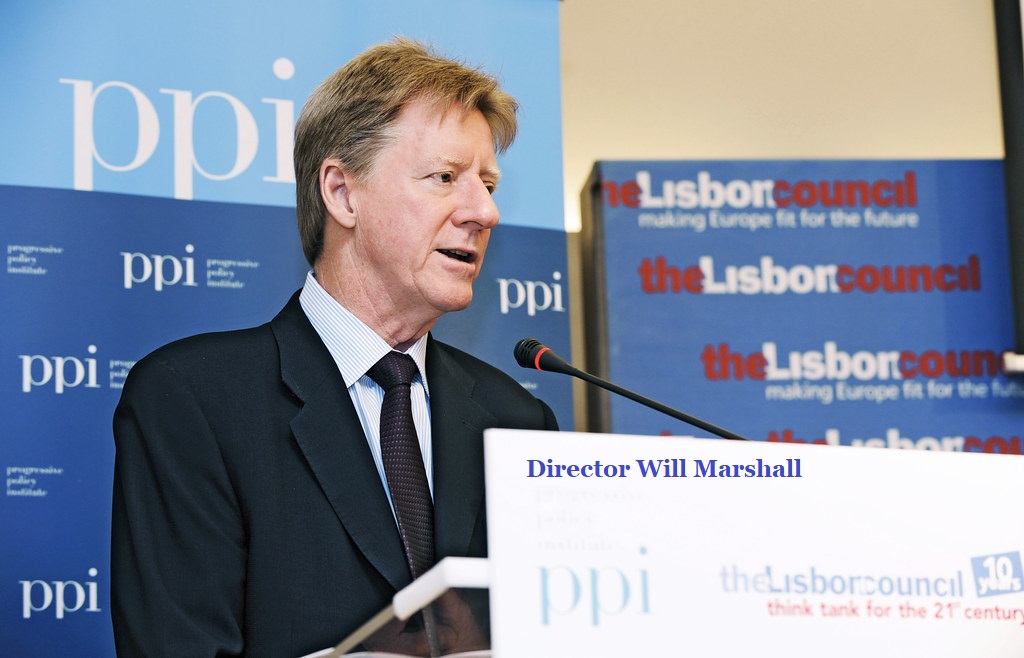
PPI pushes conservative ideology while dressing it up like progressive philosophy. The biography of its founder, Will Marshal, states, “Founded in 1989, PPI started as the intellectual birthplace of the New Democrat and ‘Third Way’ movements, earning a reputation as President Bill Clinton’s ‘idea mill.”’

Lily Geismer’s book, Left Behind, claims that the Democrats failed attempt to solve inequality demonstrates how Bill Clinton “ultimately did more to sell free-market thinking than even Friedman and his acolytes” (Left Behind Page 13). She went on to note that Journalist Charles Peters called Clinton and his core supporters, neoliberals. Geismer noted:

“Peters meant it not as a pejorative but as a positive. … Neoliberals, he observed, ‘still believe in liberty and justice and a fair chance for all, in mercy for the afflicted and help for the down and out,’ but ‘no longer automatically favor unions and big government’” (Left Behind Page 18). [Emphasis added]

Historian Arthur Schlesinger labeled the DLC “a quasi-Reaganite formation” and accused them of “worshiping at the shrine of the free market” (Left Behind Page 46). DLC stands for Democratic Leadership Council which is also referred to as “New Democrats.”

David Osborne was an early fellow at PPI. He developed his view of entrepreneurial government into a 1992 book written with Ted Gaebler, called Reinventing Government: How the Entrepreneurial Spirit is Transforming the Public Sector.” In their book the authors “made the case for what they called ‘entrepreneurial schools,’ which would compete among each other for customers” (A Wolf at the School House Door Page 84).  Under Osborne’s influence, “the DLC became one of the first political organizations to explore charter schools as a means of improving public education” (Left Behind Page 118). Osbourn became a senior advisor for Vice President Al Gore and founded PPI’s Reinventing America’s Public Schools. He is still its Director Emeritus.

Reinventing America’s Public Schools is aggressively for school privatization through charter schools. They are funded by the Walton Family Foundation (TIN: 13-3441466), the Broad Foundation (TIN: 95-4686318), and the Arnold Foundation (TIN: 26-3241764). These are the billionaires paying the freight and they want their deliverables.

Propaganda Masquerading as Research

There are two main claims being asserted in the report. One is that achievement gaps are shrinking in areas with significant school choice. The second claim is that charter schools do not negatively impact public schools. The 74 quotes Brandon Brown, CEO of the Mind Trust in Indianapolis, saying, “[A] lot of the evidence shows that the growth of high-quality charter schools does not come at the expense of the school district.” Both of these claims are farcical.

The PPI report claims:

“Stanford University’s Center for Research on Education Outcomes (CREDO) has undertaken many local studies and, in 2023, released its third major national report in a series spread out over the past 30 years. In that massive study, CREDO researchers assessed the performance of students at 6,200 charter schools in 29 states between 2014 and 2019, confirming that charter-school students, on average, outperformed their peers in demographically-matched traditional public schools” (Report Page 6).

If we believed the CREDO results, the differences of 0.011 standard deviations in math and 0.028 standard deviations in reading are so small as to be meaningless. In addition, the CREDO methodology is highly suspect. Professor Andrew Maul of UC Santa-Barbara stated, “The study’s ‘virtual twin’ technique is insufficiently documented, and it remains unclear and puzzling why the researchers use this approach rather than the more accepted approach of propensity score matching.”

Economics writer, Andrea Gabor, noted the “study excludes public schools that do NOT send students to charters, thus introducing a bias against the best urban public schools, especially small public schools that may send few, if any, students to charters.” Schools sending less than 5 students to charters are excluded from the study. In addition, the CREDO study makes no adjustment for charter schools creaming students which means charters teach fewer special education and language learner students than do public schools.

Macke Raymond is the current director of CREDO. In 2015, her Hoover Institute Fellow’s profile said, “In partnership with the Walton Family Foundation and Pearson Learning Systems, Raymond is leading a national study of the effectiveness of public charter schools.” The 2023 report was their third in this series of studies. Her partners have too much skin in the game to be viewed as unbiased.

The PPI report looks at 10 cities “with more than one-third of students enrolled in bricks-and-mortar charter or charter-like schools.” PPI claims, “In every one of these cities, students have significantly closed the gap in outcomes between low-income students and all students statewide between 2010-11 and 2022-23” (Report Page 10). (Emphasis added)

In the beginning of the standardized testing craze, outcome gaps between racial groups were a big concern. Then Sean Reardon and his team at Stanford discovered that these gaps in testing results were more likely poverty driven. There is almost no information about where PPI got the data to support their claims. Most of the 10 cities studied are in states that have changed test types and venders since 2011. This makes the state tests somewhat difficult to use for comparing gap changes if the data required could be attained. However four of the cities PPI studied are in the NAEP (National Assessment of Education Progress) Trial Urban District Assessment (TUDA) group; Cleveland, District of Columbia, Detroit and Philadelphia.

Using the NAEP data explorer to look at 8th grade math, the results for students receiving free or reduced lunch was found. Free and reduced lunch is generally believed to be a good indicator of poverty and 8th grade math is a subject that all students take. There was almost no change over the 12 years cited.
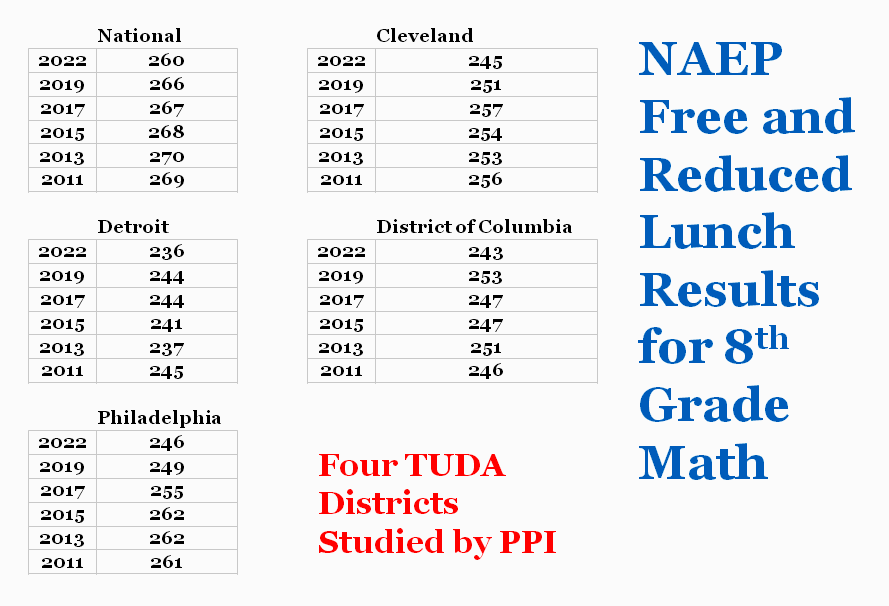
Only the national results saw a 3% improvement and the four studied cities saw testing declines of more that 1%. The PPI report states, “In all of these 10 cities, the data show that in the last decade (school years 2010-2011 through 2022-2023), low-income urban students closed the gap with statewide test score averages by 25-40% (Report Page 10). This is a surprising and difficult claim to accept. In fact, it looks like an outright lie.

Conclusion

It has been clear that The 74 was a billionaire propaganda rag ever since its original funding was provided by the Dick and Betsy DeVos Family Foundation, the Walton Family Foundation, the Doris and Donald Fisher Fund and Bloomberg Philanthropies.

PPI appears to be an organization stuck in its 1990s neoliberal ideology with their misguided belief that markets are always the superior path to improvement.

Both organizations seem to be missing out on ethics. Here they have joined in a lie to sell school choice.

Time to Leave International PISA Testing

20 Feb

By Thomas Ultican 2/20/2024

February began with Progressive Policy Institute and The 74 teaming up for a Webinar on PISA math test results, declaring “Historically Underperforming PISA Scores are a Call to Action”. 

Dr. Yong Zhao, Foundation Distinguished Professor of Education at University of Kansas and among his many accolades, an appointed Professor of Educational Leadership at University of Melbourne, has a different view, stating:

“Since 2000, our scores on PISA have barely changed. While there’s much chatter about learning from other systems, it has not happened. There is no reason that the U.S. should continue its participation in PISA.”

Zhao sees standardized testing as undermining student creativity. PISA tests stress cognitive skills while noncognitive skills are more related to creativity and entrepreneurship. His book, Who’s Afraid of the Big Bad Dragon, describes how in 605 AD the Chinese government developed a testing system known as “keju” to select people for prestigious government positions. That system is now blamed for stifling creativity and scientific development. When westerners showed up in their ships, guided by compasses and using gunpowder, both invented in china, the Chinese could not defend themselves. Zhao writes, “In fact, the keju system has been held responsible for the decline of the Chinese empire.” (Big Bad Dragon page 35)

PISA 2022 Testing Results

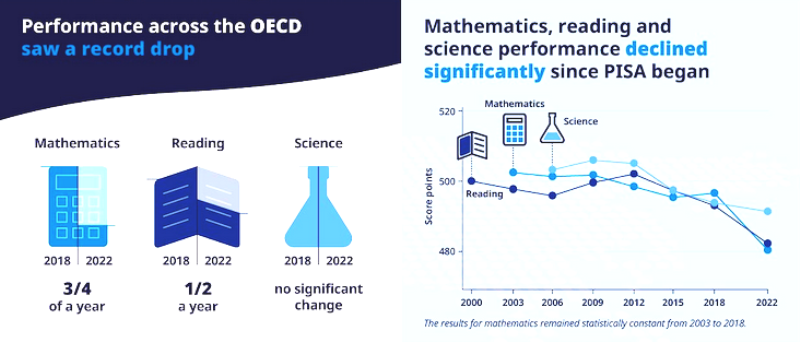
A quick peek at PISA’s data presentation reveals average scores in everything have gone the wrong direction since bankers from the Organization of Economic Co-operation and Development (OECD) got involved. Furthermore, their baseless use of translating test scores into time is fraudulent.

Why would anyone pay attention to their views on education?

Progressive Policy Institute

Going into the 1984 Democratic convention, several politicians, not happy with the party’s direction, met in a San Francisco hotel room but did not take action. After Walter Mondale’s thumping by Ronald Reagan, the Democratic Leadership Council (DLC) was created based on a plan developed by Al From who believed that being independent from the Democratic Party would allow them to be more “entrepreneurial”. Current PPI Director, Will Marshall, was hired to be policy director (Left Behind Pages 43-45).

To drive their policy strategy, From and Marshall decided to establish a think tank. Seeing the way Heritage Foundation, American Enterprise Institute and Cato Institute had driven the conservative revolution in the 1970s and 1980s, they created a new idea-generating center called Progressive Policy Institute (PPI) (Left Behind Pages 112-113).

Early on, PPI came out with articles opposing minimum wages which many people saw as anti-union. Later, a PPI fellow, David Osborne, famously campaigned for an entrepreneurial government to meld public and private to maximize productivity and effectiveness. Lily Geismer said, “Osborne developed these ideas into a book cowritten with Ted Gaebler, called Reinventing Government: How the Entrepreneurial Spirit Is Transforming the Public Sector; which was released in 1992” (Left Behind Page 117).

Geismer continued:

“Under Osborne’s guidance, the DLC became one of the first political organizations to explore charter schools as a means of improving public education. Charters, along with the other programs, became a critical part of the new approach that DLC promised it would provide as the nation was starting a new decade.” (Left Behind Page 118)

It is no surprise to see PPI joining with The 74 to trash public education. Their “third way” agenda has a lot in common with the GOP driven school choice and anti-labor agenda.

For this Webinar, the PPI expert panel included Dr. Peggy G. Carr, Commissioner of the National Center for Education Statistics (NCES) in the U.S. Department of Education, Andreas Schleicher, Director of the Directorate of Education and Skills at the OECD and Jonathan A. Supovitz, Professor in charge of Organizations, Leadership, and Systems Division at University of Pennsylvania, Graduate School of Education. The moderator was PPI’s Tressa Pankovits, Co-Director of Reinventing America’s Schools.

Peggy Carr served in NCES for more than 20 years before Biden appointed her Commissioner. She is undoubtedly a gifted mathematician but knows little about America’s classrooms. Carr recently made headlines when the charter school she founded, Children’s Village Academy in North Carolina, was charged with paying exorbitant interest rates on a 15-year old loan she gave the school.

Andreas Schleicher is a fine mathematician but, just like Peggy Carr, he knows nothing about good education. His personal PISA involvement blinds him to how little value standardized testing is for evaluating student learning.

I really don’t want to say anything mean about moderator Tressa Pankovits because she is a fellow Aztec, unfortunately her resume reveals no training or experience as an educator. Still she is PPI’s “Co-Director of Reinventing America’s Schools, which researches innovations needed to create a 21st century model for public education that is geared to the knowledge economy.” It is hard to understand how her background qualifies for the position. Before she got this job she worked 10 years for Paul Vallas who hurt public schools in Chicago, Philadelphia, New Orleans and Bridgeport. He also has no training or experience as an educator.

The only educator in this group is Jonathan A. Supovitz. His values look shaky, based on the company he keeps.

PISA and the OECD

OECD was formed in 1961 as a follow-on to the Marshall plan, run by bankers and economists. Market Business states:

“All OECD member states claim to be market economies that are committed to democracy. The organization says it provides a platform where they:

  • Share and compare policy experiences.
  • Identify good practices.
  • Coordinate members’ international and domestic policies.
  • Seek answers to common problems.”

In 2014, German writers, Sija Graupe and Jochen Krautz, wrote “From Yardstick to Hegemony”, using OECD documents:

“The OECD Conference documentation of 1961 declares unequivocally: ‘It goes without saying that the educational system must be an aggregate of the economy, it is just as necessary to prepare people for the economy as real assets and machines. The educational system is now equal to highways, steel works and chemical fertilizers’”.

“What this unrealistic worldview setting in turn impedes is any critique or will to change because rather than being understood by the public as a theoretical construct it is, according to the neoliberal economist August Hayek, accepted by most as an immediately evident truth. Whether they are true or false, economic theories and all assessments based on these (such as PISA) determine reality. … As long as people believe having more PISA points is better than less in order to be successful economically they will, of course, do everything they can to acquire more. Education is then forced to uncritically yield to the pressure of comparative assessment, even if it is based on pure assertion.”

The meaningfulness of PISA testing results are pure assertion based on bad science.

Noel Wilson’s famous 1997 peer-reviewed thesis, Educational Standards and the Problem of Error fundamentally states the error involved in educational testing is so great that validity is compromised. In other words, standardized tests are not refined enough to make more than generalizations and are bunk for measuring learning or teaching.

Yong Zhao shared research showing an inverse relationship between test scores and economic development:

“In fact, a correlational analysis done in 2007 showed a negative correlation between international test scores and economic development (Baker, 2007). That is, countries with higher scores in the first international study did worse than countries with lower scores.” 

Because America does not filter students from the academic system before high school, tested populations do not compare well internationally. However, since 2010, in the yearly International Math Olympiad, the USA team has come in first four times and never finished lower than fourth … out of over 100 entrants.

So why are we still bothering with meaningless PISA exams???