Tag Archives: Charter schools

School Choice Barbecued Cajun Style

5 Sep

By Thomas Ultican 9/5/2016

Mercedes Schneider’s newest book continues her legacy of scholarship and philosophical prescience.  In School Choice; The End of Public Education? she documents and explains many facets of the issue. Three glaring problems with “school choice” as an education policy caught my eye: (1) Friedman’s choice ideology ends the concept of mandatory education for all, (2) “choice” has abandoned its original purpose and become a profiteering racket, and (3) “choice” is historically a method used to promote segregation.

School Choice Foundations

Austrian Economist Friedrich Hayek who believed in classical liberalism especially the concept that it is in the common interest that all individuals must be able to secure their own economic self-interest, without government direction. In September 1944, the University of Chicago Press published Hayek’s book The Road to Serfdom. It was squarely against government programs like social security and Roosevelt’s new deal.

In 1950, Hayek left the London School of Economics for the University of Chicago. It was there that Milton Friedman and a host of young scholars met their sole mate Hayek. They saw government social programs as seeds for tyranny and public education was no exception. Friedman became known as the father of school choice when he wrote, “The Role of Government in Education” advocating school vouchers for universal private education in 1955.

I knew all of this but Schneider unearthed an amazing quote from the paper I did not know. Friedman was not only opposed to schools run by democratically elected boards; he also believed mandates for compulsory education were an obstacle to freedom:

“Perhaps a somewhat greater degree of freedom to choose schools could be made available also in a governmentally administered system, but it is hard to see how it could be carried very far in view of the obligation to provide every child with a place.” (School Choice Page 32)

Schneider commented, “Here we have the idea that for the market to be at its best, it needs to be free from any obligation to educate all children.” And she continued in some depth clearly illuminating this anti-humanistic and fatally flawed theory that is the foundation of “school choice” theory.

A Legacy of Segregation

Mercedes Schneider is a product of segregated schools in St. Bernard Parish, Louisiana. She says the Orleans Parish schools she attended have a history that “does not inspire pride.” Not only were the schools segregated, but more tragically, the parish refused to construct new schools for the growing back student population. Not just separate schools for whites and blacks but not of equal quality by design.

After “Brown versus the Board of Education of Topeka” required the end of the farcical separate but equal policies, southern politicians turned to school choice and vouchers as a way to avoid integration. Milton Friedman’s timely paper was well received in the segregated south.

To this point Schneider states:

“Thus, what is clear about tuition grants, scholarships, or grants-in-aid, and the history of American public education is that these were tools used to preserve segregation. There it is: The usage of choice for separating school children into those who are ‘desirable’ and those who are not. Though it seems that most Southern states were ready participants in resisting the federal requirement to integrate their public education systems, Senator Byrd’s sentiment of ‘massive resistance’ was even formally declared in a U.S. legislative document commonly known as the ‘Southern Manifesto.’” (School Choice Page 22)

Today, it is not much different with the possible exception of more emphasis on class separation than in the past. Recently a blogger known as “educationrealist” posted this discerning observation:

“I offer this up as opinion/assertion, without a lot of evidence to back me: most parents know intuitively that bad teachers aren’t a huge problem. What they care about, from top to bottom of the income scale, is environment. Suburban white parents don’t want poor black and Hispanic kids around. Poor black and Hispanic parents don’t want bad kids around. (Yes, this means suburban parents see poor kids as mostly bad kids.) Asian parents don’t want white kids around to corrupt their little tigers, much less black or Hispanic. (White parents don’t really want too many Asians around, either, but that’s the opposite of the “bad kids” problem.)

“Parents don’t care much about teacher quality. They care a lot about peer group quality.”

Around 2003, a friend tried to convince my wife and I to send our daughter to High Tech High. This mother did not want her daughter to be exposed to all those bad influences at Mira Mesa High School. Mira Mesa High School is a quality school that graduates amazingly gifted students every year and sets them on to a course of academic and social success. But the new charter school that Bill Gates and Irwin Jacobs had put so much money into surely would not have all those feared “bad kids.”

“Begs to be Gamed”

“By 2015, according to the Education Commission of the States website, 42 states, the District of Columbia, and Puerto Rico all had charter school laws. Of these, 33 states had charter authorizing bodies, yet only 15 states and Washington, D.C., had standards for charter authorizers and the requirement that charter authorizers annually produce formal reports regarding the charter schools they oversee. Furthermore, only 11 states and the District of Columbia specify performance criteria to determine whether a charter should be continued or revoked.” (School Choice Page 59)

Charter schools have become the vogue privatization vehicle of the 21st century. Schneider presents a detailed background of charter school formation starting with Ray Budde’s 1974 conference paper that proposed a new structure for school management that he called “charter schools” and AFT President Albert Shanker’s 1988 fascination with Budde’s idea. Shanker extended Budde’s ideas with his own “school with-in a school” concept in which teachers would be authorized to experiment.

Shanker quickly became disenchanted by the direction the charter school movement took. It became clear to him that the new charter school laws made corruption and profiteering inevitable. In various articles, he highlighted the cases demonstrating how dangerous and poorly regulated charter schools were. He wrote of the Noah Webster schools gaming the system in Michigan for $4 million and of Washington D.C. giving a charter to a man charged with assault with a deadly weapon whose head of school security was a convicted felon. Schneider shares this quote from Shanker:

“A pluralistic society cannot sustain a scheme in which the citizenry pays for a school but has no influence over how the school is run. … Public money is shared money, and it is to be used for the furtherance of shared values, in the interest of e pluribus unum. Charter schools and their like are definitely antithetical to this promise.” (School Choice Page 57)

I was fascinated by the quotes from Addison Wiggins Forbes magazine article about why hedge fund operators are so pro-charter school industry. One quote reads:

“About the only thing charters do well is limit the influence of teachers’ unions. And fatten their investors’ portfolios.

“In part, it’s the tax code that makes charter schools so lucrative: … firms that invest in charters and other projects located in ‘underserved’ areas can collect a generous tax credit – up to 39% – to offset their costs.” (School Choice Page 101)

One of the most lucrative aspects of the charter industry seems to be facilities. Open a charter school and start a real estate company that specializes in leasing school facilities. Then you can charge yourself twice the going rates and the taxpayer picks up the bill. Schneider asks, “Why does the federal government not see through the potential real estate exploitation…?” Probably corruptions and cowardice have a lot to do with it.

Charter schools have never honestly out performed elected board directed public schools. In some cases, charter schools have gotten relatively good testing results, but on closer inspection these good testing results are not the result of good pedagogy. There are three common practices that help charters look good on testing; (1) instead of a balanced curriculum they focus on preparation for testing, (2) through various techniques, they only accept easier to educate students and (3) they do not back fill when students leave the school.

Instead of recognizing the amazing public education system we have in the United States our Congressional leaders are promoting charter schools both monetarily and with praise. Mercedes Quotes the Sense of Congress from their version of the new federal education law that is little more than a charter industry add. Paragraph 2 stated:

 “It is the sense of the Congress that charter schools are a critical part of our education system in this Nation and the Congress believes we must support opening more quality charter schools to help students succeed in their future.” (School Choice Page 151)

 Schneider concludes the charter school portion of the book with;

“Adequate monitoring of charter schools is not happening, by and large, and those individual using taxpayer money to serve their own interests by operating charter schools only contribute to damaging American public education” (School Choice Page 155)

 I have endeavored to give a taste of this wonderful effort by Mercedes Schneider and encourage everyone to not only read it but share it with others. If we educators can educate the public about how our legacy passed down from previous generations is being robbed, the public will stop these villains immediately. Remember, they are greedy cowards who will quail before public sanction.

A Nation at Risk

29 Aug

By Thomas Ultican 8/29/2016

The Introductory Segment of A Nation at Risk

“All, regardless of race or class or economic status, are entitled to a fair chance and to the tools for developing their individual powers of mind and spirit to the utmost. This promise means that all children by virtue of their own efforts, competently guided, can hope to become happy creative people who can manage their own lives freely and not be coerced into an unwarranted servitude.”

Our Nation is at risk. Our once unchallenged preeminence in commerce, industry, science, and technological innovation is being overtaken by profiteers from throughout the world lusting after our public education expenditures. This report is concerned with the unwise education policies that are being proffered by the enemies of prosperity, cultural advancement and the democratic spirit of America’s citizens. We report to the American people that while we can take justifiable pride in what our schools and colleges have historically accomplished and contributed to the United States and the well-being of its people, the educational foundations of our society are presently being eroded by a rising tide of greed fueled by antidemocratic hubris that threatens our very future as a Nation and a people. What was unimaginable a generation ago has begun to occur—the world’s greatest school system is being destroyed by a worm in the lion’s bowels.”

“If an unfriendly foreign power had attempted to impose on America the sundering of democratic school governance and the purloining of taxpayer dollars that exists today, we might well have viewed it as an act of war. As it stands, we have allowed this to happen to ourselves. We have allowed wealthy amateurs to drown out the voice of experienced educators and let them impose their disruptive uninformed ideology on America’s children. Moreover, we have dismantled essential support systems which helped make America’s education system the bedrock of democracy and enlightened citizenry throughout the world. We have, in effect, been committing an act of unthinking, unilateral self-destruction.”

“Our society and its governing institutions seem to have lost sight of the basic purposes of schooling, and of the high expectations and disciplined efforts needed to attain them. This report, the result of 200 years of experience, seeks to end the misguided reform of our educational system and save this fundamental foundation of America; our public education system. We seek to renew the Nation’s commitment to schools and colleges of high quality governed democratically throughout the length and breadth of our land.”

“That we have compromised this commitment is, upon reflection, hardly surprising, given the unprecedented amounts of money being spent by profiteers for control at the cost our children’s future. Schools are routinely called on to provide solutions to personal, social, and political problems that the home and other institutions either will not or cannot resolve. We must understand that these demands on our schools are being met in heroic ways. Unfortunately, many political elites call our best ever prepared schools and educators failures; even forcing them to write letters to parents confirming that failure.”

“President Reagan noted the central importance of education in American life when he said: “Certainly there are few areas of American life as important to our society, to our people, and to our families as our schools and colleges.” This report, therefore, is as much an open letter to the American people as it is a report to the Secretary of Education. We are confident that the American people, properly informed, will do what is right for their children and for the generations to come.

“The Risk”

“History is not kind to those who idly ignore evil. When America’s democratic ideals are under attack by titans of industry and wealth managers both at home and abroad, the time has come to stand and be counted. The world is indeed one global village. We live among determined, wealthy, and arrogant individuals and corporations with no concern other than profits. They have become the enemies of common people, their communities and democratically governed education. We must compete with them to save free, non-usurious universal education. America’s democratic processes may once have been reasonably secure with honest dialog and sincere ideals. It is no longer.”

“The genius of America’s diverse decentralized education with few high stakes exams has shown through in the amazing production of its creative citizens. When standardized education and high stakes testing was embraced in Asia and the Indian sub-continent, America offered free universal education to all with multiple opportunities to re-enter a path to higher education. Our goal is creative students who can innovate and lead happy lives. Towards that end our system is clearly a humanistic approach, leading the way internationally.”

American Scholars Were Dominating the World

One measuring stick demonstrating the success of our system might be Nobel Prize winners since 1949: America had 313 laureates; India 7; and China 8. Of the 8 Chinese, the Dalai Lama and Liu Xiaobo who won peace prizes both are considered criminals – Xiaobo is still in a Chinese prison; four are scientists who earned their degrees in the United States or Great Britain; and the two literature recipients were educated in China at international schools. It brings to mind Professor Yong Zhao’s statement at the 2015 NPE conference, “If you want results like the Chinese, follow their example.” The US has never won at standardized testing but leads the world in creative thinkers.

Our concern, however, goes well beyond matters of educational theory and social justice. It also includes the intellectual, moral, and spiritual strengths of our people which knit together the very fabric of our society. The people of the United States need to know that greedy people are trying to create a new era that will effectively disenfranchise them, not simply from having their voice heard in the education of their children, but also from the chance to participate fully in our national life. A high level of shared education is essential to a free, democratic society and to the fostering of a common culture, especially in a country that prides itself on pluralism and individual freedom.

For our country to function, citizens must be able to reach some common understandings on complex issues, often on short notice and on the basis of conflicting or incomplete evidence. Education helps form these common understandings, a point Thomas Jefferson made long ago in his justly famous dictum:

“I know no safe depository of the ultimate powers of the society but the people themselves; and if we think them not enlightened enough to exercise their control with a wholesome discretion, the remedy is not to take it from them but to inform their discretion.”

Part of what is at risk is the promise first made on this continent: All, regardless of race or class or economic status, are entitled to a fair chance and to the tools for developing their individual powers of mind and spirit to the utmost. This promise means that all children by virtue of their own efforts, competently guided, can hope to attain the mature and informed judgment needed to chart their own path, and through no manipulation by the state or industrial powers manifest their own interests fruitfully which will naturally enhance society itself.

Indicators of the Risk

Three key players in the assault on California’s public schools are Walmart heiress, Carrie Walton Penner, Netflix CEO, Reed Hastings and nativist republican politician, Steve Poizner. In 2001, they started EdVoice an organization that claims California schools are broken and must be reformed. In 2003 Poizner founded the CCSA, which funds school privatization. Walton Penner and Hastings remain as board members of both EdVoice and CCSA.

Valerie Strauss reports, “Hastings’ slap at elected boards, while offensive, wasn’t unique. Gates said the same thing when he extolled “mayoral control” of urban schools. “Instead of having a committee of people, you have that one person,” Gates said, “where we’ve seen the willingness to take on some of the older practices and try new things.” The problem, as Strauss noted, is that many of these “pet projects” have yet to deliver on their hype as a pathway out of poverty for poor kids. The darker reality is that these schools are in fact doubling as product development centers for the fabulously rich and their well-connected associates.”

From noted historian and education authority, Diane Ravitch,

“For the past three decades, critics of public education in the United States have assailed it and used its flaws to promote publicly funded privatization. Corporate and political interests have attacked the very concept of public education, claiming that the private sector is invariably superior to the public sector.”

From Professor Julian Vasquez Heilig,

“The hundreds of millions of dollars spent to promote privately managed schools is coming from the non-democratic foundations of billionaires such as Bill and Melinda Gates Foundation, Broad Foundation and the Walton Family Foundation. Smaller organizations including the Black Alliance for Education Options and the Libre initiative and the Democrats for Education Reform have accepted tens of millions of dollars over the years from billionaires and their foundations to press for market-based school choice.”

Jonathan Palto, Connecticut’s leading education writer,

“The colossal and disastrous effort to privatize public education in the United States is alive and well thanks to a plethora of billionaires who, although they’d never send their own children to a public school, have decided that individually and collectively, they know what is best for the nation’s students, parents, teachers and public schools.”

Peter Greene, education writer and teacher,

“At this point, from its rejection by assessment and education professionals, to its defeat in court, VAM [Value Added Measures – based on standardized testing] has shed any possible pretense of being a legitimate means of evaluating teachers and stands revealed for what it always was– a way to destabilize the profession and get rid of public school teachers. It remains one of the big threats to public education.”

Carol Burris, Director of NPE and former New York Principal of the Year, “Charters, regardless of their original intent, have become a threat to democratically governed, neighborhood public schools, and questions about their practices, opacity and lack of accountability are increasing as their numbers grow.”

Dale Russakoff reported in the New Yorker, that Corey Booker, Chris Christy and Mark Zuckerberg decided to take over the Newark Public Schools,

“Early in the summer of 2010, Booker presented Christie with a proposal, stamped ‘Confidential Draft,’ titled ‘Newark Public Schools—A Reform Plan.’ It called for imposing reform from the top down; a more open political process could be taken captive by unions and machine politicians. ‘Real change has casualties and those who prospered under the pre-existing order will fight loudly and viciously,’ the proposal said. Seeking consensus would undercut real reform. One of the goals was to ‘make Newark the charter school capital of the nation.”’

For Secretary of Education, Obama passed over former teacher and education expert Linda Darling-Hammond in favor of Arne Duncan, his basketball buddy, who’d aligned himself with the corporate reform movement as CEO of Chicago Public Schools. As Secretary, Duncan “continued and carried the torch for pushing educational policies that don’t have basis in research, such as value-added measurements, using high-stakes testing to evaluate teachers, or continuing to promote charters schools as a silver bullet to solve inequality,” said Wayne Au, who teaches in the education program at the University of Washington.

Emily Talmage, an educator in Maine, warns about the threat of Competency Base Education (CBE),

“according to the U.S. Department of Education, students will ‘no longer [be] tethered to school buildings or schedules.’ Instead, the system will require students to earn ‘digital badges’  that they will display in individual competency-profiles accessible to potential employers and investors.”

Senator Sherrod Brown of Ohio recently wrote to Secretary of Education, John King about the waste, fraud and abuse in Ohio that has grown with the charter school movement:

“Ohio’s current lack of oversight wastes taxpayer’s money and undermines the ostensible goal of charters: providing more high-quality educational opportunities for children. There exists a pattern of waste, fraud, and abuse that is far too common and requires extra scrutiny.”

This is a scandal occurring nationwide.

Conclusion

Each generation of Americans has outstripped its parents in education, in literacy, and in economic attainment. The educational attainment of the last few decades far surpass that of their parents, however for the first time their opportunities are diminished.

What lies behind this emerging national belief that our schools are failing? It is the amateurish or maybe cynical belief that standardized testing was a valid measure of educational quality which supported greed exacerbated by lust.

On a broader scale, we sense that this push for billionaire supported education reform has significant political implications, for it pits the interests of common community members against corporate interest and the super wealthy. These reforms have already destroyed many schools and harmed many communities by eliminating community schools and promoting segregation. These outcomes are readily apparent in places like Detroit, Los Angeles and Oakland.

As Jefferson said, “I know no safe depository of the ultimate powers of the society but the people themselves, …” The power of any society ultimately resides with the people. If we and our neighbors demand our democratic rights, then our wonderful community schools will continue their legacy of victory for the people.

Ciedie Aech’s Wonderful Book

20 Aug

By Thomas Ultican 8/20/2016

There are few public school systems in America that have been more harmed by what Diane Ravich aptly dubbed “corporate education reform” than those in Denver, Colorado. Ciedie Aech tells the story of a professional educator working in the horrific and unstable environment that developed with the extra-legal federal take-over of public schools. In reality, this is a heart wrenching story, but Aech’s sarcastic humor turns it into a delight. Any teacher in America’s public k-12 system who reads “Why is you always got to be trippin” will immediately recognize many scenes Ciedie delightfully paints while telling this dreadful story.

About the Title

 “One day when noise from unsupervised students caught my attention, I stepped into the hallway to find a group of boys throwing friendly punches outside a neighboring classroom.

 “‘Gentlemen!’ I stated reactively, clearing my throat. Happy to ignore extraneous interference, the boys continued their game. ‘Gentlemen!’ I said again, this time a little more loudly. Straightening, the boys stopped to look my way. ‘Okay, let’s go,’ I directed. ‘Aren’t you supposed to be in class?’ ‘Aw, Miss,’ two or three grumbled as the small group broke up and began to move away. Pulling at chronically sagging pants while smoothing intricately braided hair, a tall, thin young man hung back.

 “As a student who had attended one of my afternoon classes for more than six months, he knew me well. Watching his friends now amble unhurriedly down the hall, he turned to look at me in plaintive wonder. ‘Aw, Miss,’ he protested. ‘Why is you always got to be trippin’?’

 ‘“Why is I always got to be trippin’? …

 “If you don’t take pains to hold them together? If you don’t step in, over and over (and then over again) to pull them circuitously inward towards success – sometimes with no other help than the full power of your will? They struggle, they flounder; they deflate and fall apart. Desperately they count upon the people in their lives who make the effort to ‘trip.’”

 Background for the Story

If you are a fan of privatizing public schools and corporate education reform, Denver is your cup of tea. The Thomas B. Fordham Institute (one of those “think-tanks” that like the New York Times reports is more like a tax free lobbying firm than an honest evaluator of education policy) rated Denver Public Schools (DPS) the third best school choice system in the United States behind only New Orleans and Washington DC.

In the summer of 2005, Michael Bennet, who had spent the previous 2 years with his fellow Wesleyan alum, John Hickenlooper as chief of the mayor’s staff was appointed Superintendent of DPS. He previously earned a law degree at Yale and was editor of the Yale Law Journal. Prior to working for the mayor and future governor of Colorado, Bennet spent six years as the managing director of the Anschutz Investment Company. However, he had no training or experience as an educator or in education administration.

Two years before Bennet departed to become Colorado’s junior United States Senator, he hired another lawyer with no education background (other than tutoring English in Hong Kong) to be chief operating officer of DPS, Tom Boasberg. Before coming to Denver, Boasberg did a stint at the FCC, then went into the corporate world. When Bennet departed Boasberg who is now a member of Jeb Bush’s Chief for Change was elevated to Superintendent of DPS. Boasberg did obtain an administration credential from the unaccredited Broad Academy in 2009.

Then there is State Senator Michael Johnston another instant education expert from TFA. He is credited with writing the law that requires Colorado teachers to be evaluated by the discredited value added method based on standardized testing. He seems to be yet another elitist from Yale out to destroy public schools (Bennet, Booker, Malloy, King, etc.). The following from Mercedes Schneider paints a clear picture of the modern education privatizing tool:

“In his NCTQ bio, Johnston presents himself as, ‘the founder and former principal of MESA (Mapleton Expeditionary School of the Arts), a 7-12 Gates funded small high school in north Denver.’  It is increasingly common practice for former TFAers to become instant leaders and entrepreneurs, opening and leading schools without a solid educational foundation but with funding (in the case of Johnston’s school, Gates money). Johnston is a TFAer from Yale, and TFA really likes Yale. His Yale bachelors degree is in a generic major (philosophy); so, like many former TFAers ‘on the climb,’ Johnston made a quick stop to the Broad-financed Harvard Graduate School of Education for one of those educational policy masters degrees TFAers are increasingly fond of brandishing.  And make no mistake: Harvard educational policy is all about data driven assessment of supposed “teacher effectiveness.”  The Harvard Center for Educational Policy Research is funded by a cadre of now-all-too-familiar reformer foundations, including Broad, Gates, Joyce, and Rodel.”

 Just a few miles up highway 36 from Denver is Broomfield, Colorado home of the Walton family established and supervised, Charter School Growth Fund.  Carrie Walton Penner, sits on the board of the foundation and Carrie’s husband, Greg Penner, is a director of this non-profit venture capital fund that invests in charter schools. Annie Walton Proietti, niece of Carrie, works for a KIPP school in Denver. KIPP is a system to which the Walton family has donated millions of dollars.

How Ciedie Viewed the Beginning of the Harm

 “Proffered up by an unmistakably concerned and oft-professed-liberal activist, this emphatic assertion was accorded an immediate defense through an even yet more logical rationale: ‘I wouldn’t send my children there.’

“Progressive declarations like this one, coming as they did from privileged-class and generally non-minority but avowed open-minded citizens, oh, they just made so much sense – to other privileged-class and generally non-minority but compassionately troubled advocates. Holding test scores high, progressive thinkers waved what they argued to be incontrovertible truth. What had to be done? What was undoubtedly required? Was the immediate “non-negotiable” reformation of our nation’s lowest-income, lowest-scoring schools.”

 Ciedie points out:

 “When, in the name of a ‘benevolent’ intervention, you assertively malign, label, invade and destabilize those schools where, due to the wide array of issues attached to poverty and cultural disconnect, only around 40 percent of students graduate and move on to find success at a college – ultimately what you are doing in the name of your unprecedented ‘compassion?’ Is making sure that even this small but steady percent of minority students cannot progress and successfully integrate into society.”

 Soon after the reform invasion, she noticed:

 “With great determination, good educators closed their eyes. Industriously, good teachers taught themselves in an imitation of financially motivated “fixer” administrators; with great tenacity, good teachers refused a direct look at the deregulated chaos now dancing with impunity around an ever realigning array of testing and penalty practices. Hearing, and subsequently spouting, only a cautious reflection of the shallow district, state and federal dogma, good teachers offered up only a passively guarded support for the belligerent doctrine of accountability – a progressively more retaliatory doctrine which, year after year, continued to hold to the incontrovertible fact that: All of those unacceptable test scores?

“Were forevermore, always and only, the product of bad teachers.”

 About all the money for reform, Ciedie perceived:

 “So. When big money gets thrown around under the socially responsible guise of helping less powerful and politically disenfranchised citizens – benevolently offering that helpful leg up, so to speak; well, it’s a funny but historical trend that quite often this particular kind of money?

“Somehow, sort of, gets redirected.”

In one vignette Ciedie is chatting with a fellow educator. It really hit home with me, because I too teach in a “failing school” with 70% free and reduced lunch and 20% language learners. It was like my personal experience:

“One year, a few days into my Thanksgiving Break, I met up with a friend – a teaching peer who, for the past twenty years, had been employed inside a high-scoring, long-term-stably-administrated secondary school located in the suburbs of a neighboring district. When our conversation predictably turned to issues of education, it immediately became clear that, in the modern age of a low-income school accountability, what we, as public school educators, had each experienced? Diverged dramatically.

“It felt, in fact, a little like discussing educational practices as they existed here on Earth… and somewhere way out in the far reaches of the universe. On Jupiter, maybe. At one point, we paused to count up the non-teaching/nonstudent-contact days we had each had so far that fall.

“She counted two.

“I counted seventeen.”

 I loved the following observation because I have been living it for fifteen years:

“Well, now: here’s a little secret. I suppose this could be confidential. I apologize if I’m letting the cat out of the bag.

“But: More inner-city, low-income-school teachers actually, with a full intention, chose to walk into those complicated buildings; chose to work, day after day, inside those low-income, culturally-complex schools; chose to spend year upon year standing right there in front of those so many assertively labeled “difficult” children because they wanted to – than you might think.

“Oh, man. Crazy, huh?”

 Ciedie asked the obvious question:

“Why was it, the question kept rising up over the years. Well, why was it that those schools most quickly and aggressively labeled as “drop-out factories” – schools slated for closure or an endless chain of reforms, schools forced through the fatal destabilization of restructure and redesign, schools branded publicly as being underused failures, schools negatively marked with the highly publicized letter grade of an F – well, why was it that such a large percent of these schools (shoot, pretty much all of them) had traditionally served as a home to non-dominant-culture, non-privileged-class, minority students?”

 Bell the Cat

A wonderful allegory, that illustrates the folly of corporate education reform:

“Opening our scene, we move in upon a small group of administratively enterprising mice; a group of mice who have had it up to here with the never-ending litany of mouse citizen complaints about a Big Bad Cat: an omnipresent feline willing to wreak ongoing havoc upon poor, defenseless mice. Mouse-world constituents have made it more than clear: They will no longer tolerate such an unremitting harassment. Hence, the intentional meeting of mousey governmental minds.

‘“If only we knew when the cat was coming,’ sighs one contemplative legislator.

“‘A bell,’ offers another: ‘What if a bell was placed around the neck of the cat?’

‘“Yes, yes, a bell!’ A multitude of voices now loudly and animatedly agrees. Ah, the cheers; oh the excitement; and then, my, oh my, the adamantly mandated and heavily earmarked rodent legislation. A bell it shall be. An imperatively necessary warning bell to be placed preemptively around the neck of the cat. What a small, helpless rodent’s dream come true!

 “Oh – but then.

“Even with so many well-meaning and supportively exuberant legislators behind this exceptional plan; despite the brashly exacting orders which have been written into massively inflexible laws – well, gosh, as it turns out? Once these proudly enthusiastic little mice have calmed down; once each mouse has taken the time to get a direct look at reality – well, each legislator realizes that not one politician has thought of, nor painstakingly offered up, a true-life proposal for getting that excitingly legislated bell onto the neck of the cat.”

 Then Ciedie goes on to make many statements like this:

“However, in modern days; in magically modern days dedicated to the pursuit and procurement of suddenly available and minimally regulated bell-the-cat funding disbursals? Complicatedly diverse school boards comprised of multiple, non-political, equity-minded citizens – citizens who found it necessary to not only listen to, but act upon, the concerns voiced by frustrated educators, students, parents and old-school administrators:

“Well, school boards like these? Really got in the way.”

 Which leads to another observation:

“In truly compassionate days bent to the no-waiting miracles of a test-based accountability, it was not simply the mayor, now, but the mayor’s self-proclaimed Superhero Superintendent (two imperial monarchs willing to work side-by-side as an incontrovertible royalty) who both said so. Laboring hand-in-hand; uttering statements as a team – mutually these two powerful leaders could make it unambiguously clear: Both, they now claimed? Were unquestionably on board; both were ready to do whatever was necessary; both were willing, even, to spend an unparalleled amount of that governmental and/or philanthropic funding in their effort to prove just how bad the so many low-income schools placed under their royal jurisdiction: Really were.”

“In days of a statistical liability, it has become increasingly possible to find “public” school districts where the children of not only the superintendent but every member of the school board attend private schools.”

 Ciedie enlightens us to what good teacher are;

“Good teachers; well, good teachers, and oh surely this was obvious – even glaringly self-apparent in the fast pace of magical days devoted to a truer national compassion: Good teachers?

“Were young. Oh, very, very young.”

 About the TFA influx:

“Despite their designated unreliability; despite, even, their surely ungrateful lack of loyalty for stoically sticking around and “taking” the abuses created by an ever-shifting, funding-lucrative reform – huge numbers of these oft-labeled undependable Teach-For-A-Minute girls (and oh, yes, a lesser number of surely just as undependable Teach-For-A-Minute boys) were now being ever more massively produced.”

 A Very Sad Ending for Ciedie and Denver

“I was very assertively and unceremoniously sent home.

“Having no useful case against me save my age, my too often and too liberally expressed opinions, and, most annoyingly, my unhelpful ability to see directly through our district’s more than-a-decade-long loyalty to the implementation of community confusing smoke screens – taking advantage of a union-allowed option for a preemptive and, in days of a faster-and-faster-no-due-process-necessary modern-day evaluation, no concrete evidence required perp-walking/keys-confiscated/no-school-contact-allowed administrative leave – the district commandeered an abruptly unanticipated and overwhelmingly painful mid-year separation from my students, offering neither them nor any of my teaching peers an explanation as, strategically, they installed a brand-new never-taught-before replacement.”

A recent report by The Progressive Policy Institute (another of those tax-free lobbying firms masquerading as a “think-tank”) extols these reforms and brushes over the fact that their own data shows that the racial gaps in Denver’s schools have widened over the last decade.

In a rebuttal, Terrenda White of the University of Colorado, Boulder stated that the report utilized unreliable methods to establish cause and effect relationships. White also pointed out “widening gaps in achievement should have (but did not) temper the report’s call for aggressively expanding school choice as the best strategy for equalizing opportunity.”

Memo on Education to My Congressman, Scott Peters

24 Jul

By Thomas Ultican 7/24/2016

In 2000, you became my city councilman. Then in 2012, you became my Congressman in the 52nd District. I have always respected your work and integrity. However, when it comes to education, I see the Democratic Party as part of the problem and not the solution. Your latest response to me further reinforced my belief that politicians are being so propagandized by big money interests that they do not know what is real concerning education policy.

America’s Public Education System Trails No-One

Your last message to me contained several statements that I consider misguided. This paragraph is verbatim to one I received from you in July, 2015 and it is not defensible. Your office wrote:

“In an increasingly global economy, it is critical that we make educational investments that put our students in a position to compete with the rest of the world. For years, the United States has trailed China, India, and others not just in investment in education, but in student achievement. When making changes to education policy, Congress should be sure that it is closing that gap.”

It is well known that the United States spends far more on education than China and India combined, but more importantly the United States has never trailed China or India in education. On international testing some cities and countries around the world have achieved spectacular scores. However, these scores are averages and because our education system is much more universal we test all our students; they don’t. Plus, we have a huge number of students living in poverty.

But, on an even playing field, the team from the United States just won the world’s oldest international math and science competition for the second year in a row. In The International Mathematical Olympiad team USA came in first ahead of Korea, China, Taiwan, Russia, Singapore and the rest of the field from 109 countries.

Last year in response to my comments about HR 5 the pre-cursor to the new federal education law, ESSA, you made the same claim as above. At that time, I informed you of America’s continued unparalleled achievement in Nobel Prize winners:

 “Student achievement measures depend upon what you want. If the goal is creative students who can innovate and lead happy lives, then our system is clearly out producing India and China. One measuring stick might be Nobel Prize winners since 1949: America had 313 laureates; India 7; and China 8. Of the 8 Chinese, the Dalai Lama and Liu Xiaobo who won peace prizes both are considered criminals – Xiaobo is still in a Chinese prison; four are scientists who earned their degrees in the United States or Great Britain; and only the two literature recipients were educated in China. To recap, since 1949 two international and widely recognized citations for Chinese educated students compared to 313 such citations from our world’s best American education system.”

To wrap up the point I am making here, it is a slander of the world’s greatest education system to say that it is lagging any other country. It is just not true. When establishing policy in any field one must deal with reality not illusion.

STEAM and STEM are Frauds

Your message continued:

“That’s one of the reasons I support making key investments in Science, Technology, Engineering, Arts and Design, and Math (STEAM) education programs. STEAM programs prepare our students to be innovators, put them in position to add to San Diego’s rich legacy of scientific discovery and entrepreneurship, and close the achievement gap between ourselves and are largest global competitors.”

STEAM is derived from the fraudulent idea that the US is falling behind in STEM education. When I was working in Silicon Valley in the 1990’s, newspaper reports were full of baloney about the STEM shortage in America undermining our economic viability in the world. Congresswoman, Zoe Lofgren was championing the need for H1-B visas so American corporations could compete. The result is that there are less opportunities for America’s STEM educated students and here in your district all of the large apartment complexes are filled with Indian people working at QUALCOMM.

There was no shortage, but the STEM field wages were driven down. Here is a quote from a 2013 article in the Columbia Journalism Review and this is not an outlier; there are a host of articles with this same message.

“According to Miller, Neill told them this is not the argument “she normally encounters on this issue.” The conventional wisdom is that tech companies and universities can’t find enough homegrown scientists to hire, so they need to import them from China and India. Neill suggested to Miller and Shah that “we would have more impact if we represented a large, organized group.

“Miller and Shah are, in fact, part of a large group. Figures from the National Institutes of Health, the National Academies, the National Science Foundation, and other sources indicate that hundreds of thousands of STEM workers in the US are unemployed or underemployed. But they are not organized, and their story is being largely ignored in the debate over immigration reform.”

The point is that we do not need ill formed education policies paired with bad immigration policy based on false premises. Instead of STEM or the more politically acceptable STEAM education policies driven from capital cities, we need K-12 schools to provide solid liberal arts programs that will be the foundation for future student growth. Diane Ravitch, the former Assistant Secretary of Education from Bush 41’s administration, put it well in today’s (7/24/2016) New York Times:

“If we really cared about improving the education of all students, we would give teachers the autonomy to tailor instruction to meet the needs of the children in front of them and to write their own tests. We would insist that students in every school had an equal opportunity to learn in well-maintained schools, in classes of reasonable size taught by expert teachers. Anyone who wants to know how students in one state compare with students in other states can get that information from the N.A.E.P., the existing federal test.”

 ESSA May Be Worse Than NCLB

One more paragraph from your message to me says:

“Earlier in 2015, the House passed a version of the education bill – a much-needed update to No Child Left Behind – that did not achieve these goals so I did not support it. Since then, I have advocated to make it better. Through negotiations between the House and Senate, Congress came to an agreement on an update, called the Every Student Succeeds Act, which was a significant improvement. I was joined by over 350 Representatives in supporting the updated bill and the President signed it into law in early December.”

While there is little doubt that ESSA is better than the original house version it is still bad law. Daisaku Ikeda in a book called Unforgettable Friends, writes, “Having been driven from the lectern by the government in the past, Dr. Delich [Francisco J. Delich, Former Rector of the National University of Córdoba, Argentina] is very deeply and personally aware of the evil of allowing government to control education. He wants to build a society in which political leaders respect educators. Education, he believes, is the very foundation of the nation.” ESSA ergates power over schools away from parents and teachers and to the federal government.

This allows the uninformed and the corrupt too much opportunity to harm students nationwide. For example, large sums of money are earmarked for promoting the development of charter schools. Charter schools have not improved education in the least, but they have opened the door for fraud and profiteering at the expense of students.

Democracy is an important principle and no money should be spent on schools by the federal government if that money is not controlled by an elected body. Parents and teachers should control education using democratic processes to govern schools in their local community; not federal or state bureaucrats wielding authoritarian power.

ESSA also mandates standardized testing of all students in grades 3 – 8 and 11. This is a massive waste of money and harmful. For the first time ever student testing results on the nations report card, NAEP, stayed flat of fell during the last 10 years. Massive testing with punitive consequences has harmed not improved schools.

ESSA also provides money for competency based education (CBE) also known as personalize learning. The basic idea behind CBE is to have children sit at computers earning badges for demonstrating a learning competency. It is the worst kind of fill up the student with knowledge pedagogy imaginable but it does have huge profit potential. Emily Talmage a teacher and education writer from Maine has been sounding the alarm about this terrible idea. She writes:

“Although we were assured that the reauthorization of the Elementary and Secondary Education Act was intended to restore control to states and local districts, the truth is that much of the document was carefully crafted to enable a proliferation of “personalized learning.”

“KnowledgeWorks highlights the many ways that ESSA “opens the door” for personalized learning, including its Innovative Assessment Zones, resources for ‘21st Century Community Learning Centers,’ and grant money for technology available in virtually every section of the document.”

ESSA has made students and communities more vulnerable to being fleeced by corporate carpetbaggers and it increases the role of the federal government in local education policy.

America’s public school system is the foundation that made our great democratic experiment a resounding success. Allowing our schools to be stolen by profiteers actually creates a “Nation at Risk.” The federalized destruction of the public education system has become real. Please be alert to self-serving corporate actors and fight for the survival of the public education system in America.

San Diego Foundation Biased Toward Privatizing Schools

13 Jul

By Thomas Ultican 7/13/2016

San Diego Foundation was established in 1975 and has grown to almost $700 million in assets. It’s self-described purpose: “As one of the nation’s leading community foundations, The San Diego Foundation strives to improve San Diegans’ quality of life by creating equity and ensuring opportunities to be WELL (Work, Enjoy, Live & Learn).” In 2014, they gave over $10 million to educational endeavors. The following table illustrates the spending bias against public education.

 Category of Giving Amount Granted
University and College Grants and Scholarships $6,106,052
Civic education – Libraries, Camps, etc. $1,333,266
Charter School and Competency Based Education (CBE) $1,339,802
Private K-12 Schools $1,129,225
Public K-12 Schools (Not including charters) $373,628

Competency Based Education (CBE)

Peter Greene an education expert from Pennsylvania discussed CBE in terms of education reform ideas that should die. He wrote:

“Two years ago, CBE was barely on my radar, and honestly, having lived through the early-nineties disastrous fiasco that was Outcome Based Education, I’m still kind of amazed that we’re back here. But we are. What has changed since 1991? Computers, the internet, the cloud, the sheer raw data collecting and crunching power that a company like Pearson now has at its command. In a CBE world, neither teachers nor schools are necessary– just students at their computer terminal being put through their software-controlled paces, each keystroke and answer filed away (and put to all manner of uses) in their new lifelong data record. Public education and citizen privacy would all be washed away. CBE fans are ju-jitsuing themselves some support for the approach (Quick! Run away from the evil test and take refuge in this CBE sanctuary over here!) and ESSA has opened the door wide for new “personalized” and non-BSTest-based measures of student achievement. I still think there are some serious hurdles in CBE’s path, but if it clears those obstacles, we’ll be looking at a huge threat to public education in this country (and the absolute end of teaching as a career).”

The SD Foundation granted the Girard Foundation of La Jolla $550,415 which they promptly spent on CBE development. They gave Gooru $300,000 and $105,850 went to Make It Matter LLC. Gooru is creating technology that enables CBE and Make it Matter specializes in marketing computer based “1:1” education. Personalized one to one education means a child is stuck in front of a computer with no real human exchange involved. It is terrible education policy with a huge profit potential.

SD Foundation also gave Kid Spark Education of Solana Beach $550,000 dollars to work on CBE development.

Foundations Join Forces and Support Privatizing Schools

Besides sending over $200,000 to seven charter schools in San Diego County, SD Foundation gave $30,000 to Teach for America (TFA). TFA is a program that give college graduates 5 weeks of summer training and then state education leaders allow them to teach classes mostly in charter schools. They are inexpensive unqualified teachers.

SD Foundation spending on Universities is surprising. Almost 40% of that spending is on schools outside of San Diego County totaling $2,409,711. Grants and scholarships given in the county totaled $3,696,341. One would expect an organization that “strives to improve San Diegans’ quality of life by creating equity and ensuring opportunities” would spend a greater share of their education dollars in San Diego.

The largest single grant bestowed by the SD Foundation was $2,6 5 0,7 0 9 to the Jewish Community Foundation of San Diego. The JC Foundation had net assets at the end of 2014 of $171,593,990.

The Jewish Community Foundation spending on education follows a similar pattern as the San Diego Foundation. They spent $466,830 for groups working to privatize public education most of which went to TFA ($406,330). They also spent lavishly on private schools including $146,000 to La Jolla Country Day, a decidedly upscale K-12 private school.

By far the largest grant by the Jewish Community Foundation was the $25,817,228 bequeathed to University of California San Diego. A major patron of both the Jewish Community Foundation and UCSD is the Qualcomm founder and billionaire, Irwin Jacobs.

Three more grants from the Jewish Community Foundation were interesting. They gave Cornell University $5,511,000. They also gave the Goldman Sachs Philanthropy Fund $6,362,171.  The Goldman Sachs fund asset total at the end of 2013 was $1,500,395,380. And the JC Foundation gave the SD Foundation $1,515,800. Why give money back? It is like the Charter School Growth Fund giving their benefactors from Walmart $15,000,000 in 2013. Why?

Do They Understand What They Are Supporting?

There is no denying that both of these funds contribute to a host of worthy efforts. However, are these large concentrations of wealth undermining democratic governance? Are the people making grants to advance the privatization of public schools and promotion of CBE even aware of the ramifications of their grants?

The reality is that these two funds are large but not in comparison with many other funds around California and the US. Yet, they did put a combined almost $2,000,000 towards privatizing public schools in 2014 and only about $425,000 toward support for public schools which went mostly to wealthy neighborhoods.

Our neighbors up in Los Angeles have multiple huge funds. The table below lists the seven largest.

Fund Name Asset Total
Getty Trust, J. Paul $11,982,862,131
California Endowment, The $3,668,459,217
Hilton Foundation, Conrad N. $2,576,376,157
Broad Foundation, Eli & Edythe, The $1,941,410,735
Annenberg Foundation $1,663,095,893
California Community Foundation $1,457,110,000
Simon Foundation, Norton, The $1,349,804,152

The motives for today’s education reform ideology are complicated by greed and lack of understanding. Some people truly believe that America’s public schools are failing and need disruptive reform. They are wrong. For the past, 30-years public schools have been steadily improving. In a recent Atlantic Magazine article Jack Schneider wrote:

 “Finally, consider the outcomes produced by the educational system. Critics are right that achievement scores aren’t overwhelmingly impressive and that troubling gaps persist across racial, ethnic, and income groups. Yet scores are up over the past 40 years, and the greatest gains over that period have been made by black and Hispanic students. They’re right that the U.S. finishes well behind exam-oriented countries like Taiwan and Korea on international tests. But scores are roughly on par with countries like Norway, which was named by the United Nations the best place in the world to live; and students from low-poverty states like Massachusetts outscore most of their global peers. Critics are right that 40 percent of college students still don’t graduate. But almost half of all American high-school students now head off to college each year—an all-time high. And whatever the doom-and-gloom about schools failing to address workforce needs, it’s worth remembering that the U.S has the strongest economy in the world—by an enormous margin.”

 Save Public Schools and Taxpayers

It is time to support public education and stop tax dollar scammers. The main weapons in the drive to privatize schools and create new corporate profit centers are charter schools, standardized testing and CBE.

The charter industry has become fraud riddled. Being able to innovate by removing accountability has led to uncertified teachers, unsafe schools and unprofessional schools. California’s earthquake safety laws do not apply to charter schools. Many charter schools are basically publicly supported private schools. Charter schools have no accountability to taxpayers and no curricular accountability. It is time to end this dangerous, destructive and expensive experiment by immediately moving all charter schools under the management of publicly elected boards and state education laws. Anything less is to support this continued wanton and growing fraud.

Standardized testing is worthless. It does not measure student, school or teacher competence. Colleges are all well aware that the SAT is not a good indicator of student success; high school grades are better. The only valid outcomes from standardized testing are it correlates well to family wealth and it makes for good propaganda when taking over schools in poor communities. Other than that it is expensive and harmful.

CBE is the latest scheme to sell technology to schools, mine student data and sell testing services for outcome verification. It is a terrible idea if you want children to be well educated, creative and lifelong learners.

It is clear that all recent education agendas coming from corporate entities have been about what is good for the adults at those corporations. Reform has become almost exclusively about fleecing taxpayers at the expense of their children.

California’s Charter School Led CBE Invasion

29 Jun

By Thomas Ultican 6/29/2016

This January (2016), Fortune Magazine announced that Netflix CEO, Reed Hastings, has launched a new $100-million-dollar fund to support education initiatives and other groups. The notice goes on to state:

“Hastings is the fund’s sole trustee while Neerav Kingsland, the former CEO of charter school supporter New Schools for New Orleans, is serving as CEO. The fund’s website explains its philanthropic mission: “Currently, too many children do not have access to amazing schools. Our aim is to partner with communities to significantly increase the number of students who have access to rich and holistic educational experiences.”

The “rich and holistic educational experience” is to be delivered by charter schools employing competency based education (CBE).

Competency Based Education

The United States Department of Education promotes and describes CBE:

 “Transitioning away from seat time, in favor of a structure that creates flexibility, allows students to progress as they demonstrate mastery of academic content, regardless of time, place, or pace of learning. Competency-based strategies provide flexibility in the way that credit can be earned or awarded, and provide students with personalized learning opportunities. These strategies include online and blended learning, dual enrollment and early college high schools, project-based and community-based learning, and credit recovery, among others.”

 Instead of a structured course with a teacher, students will log into a computer and earn badges for demonstrating competencies in an online environment. “Personalized learning opportunities” is a euphemism for a computer based course delivered in isolation.

It is a terrible idea! The last thing a 21st Century student needs is to be shoved in front of another inert digital device. Students need to interact with “highly qualified” certificated teachers, adults who they can trust. Students need to; measure, calculate, weight, work in small groups, discuss ideas, write, and get professional feedback. Students need structure, stability and direction. None of this is provided online.

Technology in education is more of an expensive mirage than a useful tool and competency based education (CBE) is fool’s gold.

In 2003, I took the state of California’s 52-hour life insurance course. That meant 52 hours of seat time with an insurance industry veteran who made the subject come alive. Today that insurance course is online with an online exam. No real industry context is imparted and cheating on the exam is rampant.

This is the kind of education Hastings and his ilk are vigorously promoting. CBE means lower quality education delivered at great profit to corporate providers and testing companies.

CBE learning is embraced by President Obama, Bill Gates, Eli Broad, Reed Hastings, Education Secretary John King, The Walton family, the new federal education law, Pearson Corporation and many business executives. Few experienced education professionals not profiting from one of these entities support it.

Computers are good at drilling information and conducting fact checks. However, educators have known for more than a century that this kind of teaching is destructive. To create understanding, all of the modes of learning must be actively engaged. Drill and skill destroys the desire to learn and undermines development of creativity.

Big Money Being Poured into CBE

 In 2004, the Don and Doris Fisher Foundation along with the Schools Future Research Foundation each provided $100,000 to start the Charter Schools Growth Fund in Broomfield, Colorado. The Fisher Foundation is based on profits from GAP Inc. and the School Future Research Foundation was a Walton Family Foundation supported fund that seems to have disappeared. The original elected board of directors for the Charter School Growth Fund was comprised of John Walton, Don Fisher, and John Lock.

In 2010, the President-CEO of the Charter School Growth Fund, Kevin Hall, decided to purchase the struggling Dreambox Inc. of Bellevue, Washington for $15,000,000. By then the fund was so large and he could do it. He subsequently invested another $10,138,500 into Dreambox. [data from 2014 form 990]

A recent National Public Radio report on the Rocketship schools reported:

 “Rocketship students often use adaptive math software from a company called Dreambox Learning. The company was struggling when Reed Hastings, the Netflix founder turned education philanthropist and investor, observed it in action at a Rocketship school several years ago. His investment allowed Dreambox to become one of the leading providers of math software in North America, currently used by about 2 million students.”

 Kevin Hall left his $465,000 a year position at the Charter School Growth Fund to join Hastings on the board of Dreambox Inc. This company is now positioned to be the dominant supplier of software products into the CBE market. Pearson corporation has positioning itself to be the company that tests students and issues completion badges. If the big standardized test goes away, Pearson will do just fine supporting CBE.

In March, Emily Talmadge wrote a very interesting piece about CBE from a more national prospective. She reported:

“Since at least 2009, the Nellie Mae Education Foundation has poured millions of dollars into the latest ed reform craze that has made headlines recently due to investments of billionaires like Mark Zuckerberg of Facebook and Reed Hastings of Netflix.  When stripped of the misleading rhetoric that often surrounds it, “personalized learning” is the digital, data-driven system of schooling designed to trigger giant corporate profits along with tightly controlled, work-forced aligned learning outcomes.”

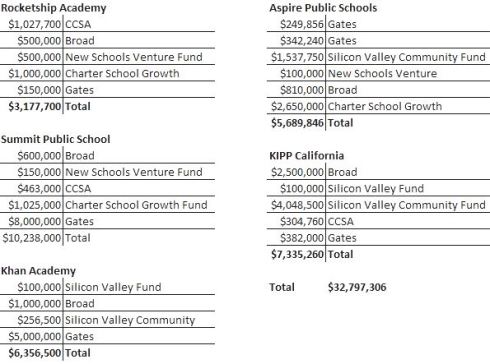
The foundations working to privatize public schools are almost all organized under IRS tax code 501(c)(3), which means they cannot engage in direct or even indirect support of political candidates and they must file an IRS form 990 every year. These forms detail who they gave money to and how much they pay top fund administrators. For following these and other rules, they become a tax free entity. The latest complete set of form 990’s is from tax year 2014 which details spending in 2013. The chart below is based on an analysis of selected 2014 form 990’s

Fund Totals

Fund Spending on Organizations Implementing CBE

 The 2013 spending of the following list of seven funds was analyzed: California Charter Schools Association (CCSA), The Edythe and Eli Broad Foundation (Broad), New Schools Venture Fund, Charter School Growth Fund, The Bill and Melinda Gates Foundation (Gates), The Silicon Valley Fund, The Silicon Valley Community Foundation. Other than the data for the Gates fund, the information all comes from 2014 form 990’s. The Gates data came from his foundation web site.

The spending on these five schools was extraordinary in that the amounts given are far greater than the amounts these organizations typically give to other charter schools. Most grants to charter schools from these funds are significantly less than $50,000 unless it is for startup purposes. So what made these five schools worthy of $33,000,000 in 2013? They are all testing CBE principles on their students.

A look at some of the key board members of these funds reveals a small community of wealthy true believers.

 KIPP Foundation: Doris Fisher, John Fisher, Reed Hastings, Carrie Walton Penner

Silicon Valley Fund: John Fisher, Ted Mitchell

New Schools Venture Fund: Lauren Powell Jobs, Ted Mitchell

Edythe and Eli Broad Foundation: Eli Broad, Gregory Mcginity

Charter School Growth Fund: Kevin Hall, John Fisher, Carrie Walton Penner

California Charter Schools Assoc.: Reed Hastings, Carrie Walton Penner, Gregory Mcginity

 The Silicon Valley Community Foundation is a little different than the other six organizations. It is not significantly about privatizing schools. There are many large community funds in California like this one and they support things ranging from community art to homeless shelters. However, funds like the San Diego Foundation and the Los Angeles Community Foundation have huge assets and they support charter schools at a much higher rate than they support public schools. A little light shined on these community foundations might make it less likely that they continue spending patterns that many of their board members probably do not understand.

All of this spending to undermine the present public education system is predicated on an article of faith held by wealthy (amateur education policy experts) reformers – “public schools are failing.”

In a June Atlantic Magazine article, Jack Schneider put it this way:

 “Thus, despite the fact that there is often little evidence in support of utopian schemes like “personalized online learning,” which would use software to create a custom curriculum for each student, or “value-added measures” of teachers, which would determine educator effectiveness by running student test scores through an algorithm, many people are willing to suspend disbelief. Why? Because they have been convinced that the alternative—a status quo in precipitous decline—is worse. But what if the schools aren’t in a downward spiral? What if, instead, things are slowly but steadily improving? In that light, disruption—a buzzword if ever there was one—doesn’t sound like such a great idea.”

 The evidence says America’s public schools are indeed continuously improving. But, misguided “do-gooders” are threatening to destroy the system and charter schools are the vehicle implementing their schemes. It is time for an OPT OUT of charter schools movement and a halt to CBE.

Privatizing California’s Public Schools

19 Jun

By Thomas Ultican 6/19/2016

The California Charter Schools Association (CCSA) and the Republican machine destroying public education in California or at least trying to privatize it; are promoting their jaded cause.

Three key players in the assault on California’s public schools are Walmart heiress, Carrie Walton Penner, Netflix CEO, Reed Hastings and nativist republican politician, Steve Poizner. In 2001, they started EdVoice a lobbying organization that claims California schools are broken and must be reformed. In 2003 Poizner founded the CCSA. Walton Penner and Hastings remain as board members of both EdVoice and CCSA.

About These Key Players

In a 2008 Sacramento Bee Article announcing Poizner’s run for governor, it said, “Poizner, 51, sold a high-tech business in 2000 for $1 billion and has spent more than $24 million of his own money to launch his political career. A socially moderate, pro-choice Republican, Poizner has gone to great lengths to woo the conservative base of the Republican Party, touting himself as a fiscal conservative.” In 2001, Poizner took a senior fellows position in the Bush white house. He was elected California’s insurance commissioner serving from 2007 to 2011.

Reed Hastings is famous for being the founding CEO of Netflix. Joanne Jacobs wrote a puff piece about Hastings for EducationNext, a conservative pro-school-privatization  publication. She opened the article:

 “Netflix CEO Reed Hastings has given millions of dollars to start charter schools. He’s put millions more into developing education software to personalize learning. But he doesn’t just give money. He makes things change. And he is not a fan of school boards.

 “The high-tech billionaire—he hit the “b” this year, according to Forbes—led and financed a 1998 campaign that forced the California legislature to liberalize its restrictive charter law. He served on the California Board of Education for four years. Hastings provided start-up funding for the Aspire Public Schools charter network and helped start and fund EdVoice, a lobbying group, and the NewSchools Venture Fund, which supports education entrepreneurs.”

 Many super-wealthy education reformers are not fans of democracy. There is a natural and dark human tendency to desire control over others. With their massive wealth, billionaire’s are capable of subverting democracy and enforcing their frequently uninformed opinions.

For decades, John Walton and the Walton Family Foundation promoted vouchers as the ideal fix for what Walton saw as needing fixed. In a Washington Post article Jeff Bryant wrote:

 “Fully inculcated with Friedman’s philosophies, and motivated by the myth of school failure spread by the Reagan administration, the Waltons were ready for their education revolution to begin.

 “John Walton launched the foundation’s battle for school choice by throwing both money and influence into a succession of voucher referendums throughout the 1990s and beyond — only to see the cause defeated at the ballot box time after time, as numerous studies have chronicled. The public, it would seem, was nowhere near as keen on the idea of vouchers as the Waltons and their ilk.”

 After a series of defeats, the foundation transitioned the privatization agenda to advancing charter schools. Bryant continued:

 “According to a pro-union website, another member of the Walton family, Carrie Walton Penner, sits on the board of the foundation connected to the prominent KIPP charter school chain—on which the Walton Family Foundation has lavished many millions in donations—and is also a member of the California Charter Schools Association. Carrie’s husband, Greg Penner, is a director of the Charter Growth Fund, a ‘non-profit venture capital fund’ investing in charter schools. And Annie Walton Proietti, the daughter of Sam Walton’s youngest son Jim, works for a KIPP school in Denver.”

 Carrie Walton Penner serves on the boards of several organizations, including the KIPP Foundation, the Charter School Growth Fund, the California Charter Schools Association, EdVoice, Innovate Public Schools and the Stanford University Graduate School of Education.

Reed Hastings is on the board of the California Charter Schools Association; the KIPP Foundation; DreamBox Learning, an education technology company; and the Pahara Institute, which provides fellowships to education leaders. On the business side, he served on Microsoft’s board until 2012 and is now on Facebook’s board.

This is a tight knit group of wealthy elites flexing their financial power to control education policy which means privatizing public schools.

The Hired Guns

Jeb Wallace is the CEO of CCSA. He is unusual in the pro-privatize set in that he did work in an elementary school in Los Angeles. He helped create a school within the school that led to a charter conversion. Wallace left LA to join Allen Bersin in San Diego to supervise charter schools in the San Diego Unified School District.

Bersin is cited by the Democrats for Education Reform as “a hero of education reform.” The citation says, “Appointed in 1998 as Superintendent of Public Education of the San Diego Unified School District, Bersin led the eighth largest urban school district in the country. In 2005, Governor Schwarzenegger appointed him as California’s Education Secretary. Bersin is a lawyer with no training in education. In her book, The Death and Life of the Great American School System, Diane Ravitch called Bersin’s tenure in San Diego a test run for corporate style education reform.

Wallace went from San Diego Unified to be COO of High Tech High, the new startup charter school sponsored by the Jacobs family, founders and major stock holders of Qualcomm Inc. The Bill and Melinda Gates Foundation provided a $9.4 million startup grant and has contributed another almost $4 million in support funding since 2000.

In 2009, Wallace moved on to be President and CEO of CCSA. The Association form 990 covering tax year 2013 listed his remuneration as $336,000.

Bill Lucia, who is the CEO of EdVoice, was a senior official at the Department of Education in the George W. Bush administration. Lucia has served as Executive Director of the State Board of Education and in a number of key staff positions within the California State Legislature, including Chief Consultant of the Assembly Education Committee, senior staff on the Budget and Appropriations Committees, and Chief of Staff and education consultant to the Chairman of the Senate Republican Caucus.

Lucia has worked in various senior education policy roles, including as COO and Director of Policy at EdVoice from March 2008 through March 2010. Prior to joining EdVoice, Lucia served as Senior Vice President for Advocacy and Policy, leading the advocacy and legal defense team at the California Charter Schools Association(CCSA). Before joining CCSA, Lucia worked as Senior Assessment Policy Liaison for Educational Testing Service.

The most recent EdVoice form 990 lists compensation to Lucia as more the $250,000.

Compassionate Love for Children Motivates the CCSA Board

This calls to mind the observation Ciedie Aech made in her wonderful book Why Is You Always Got To Be Trippin’:

 “So. When big money gets thrown around under the socially responsible guise of helping less powerful and politically disenfranchised citizens – benevolently offering that helpful leg up, so to speak; well, it’s a funny but historical trend that quite often this particular kind of money? Somehow, sort of, gets redirected.”

 Diane Tavenner the CCSA board Chairman is the Founder and CEO of Summit Public Schools, a non-profit charter management organization focused on Silicon Valley. Her reported charter school earnings for 2013 – $192,000.

Ana Ponce the CCSA board Secretary is Chief Executive Officer of Camino Nuevo Charter Academy (CNCA). CNCA is a neighborhood network of 5 elementary and secondary schools serving over 2000 students within the greater MacArthur Park neighborhood near Downtown Los Angeles. Her reported charter school earnings for 2013 – $205,000.

Christopher Nelson the CCSA Treasure is the Managing Director of the Doris & Donald Fisher Fund (Gap Inc. profits used to privatize public schools). His reported foundation earnings for 2013 – $475,000.

Cameron Curry a CCSA board member is the founder of the Classical Academy schools in north San Diego County. His organization has five sites serving 3,000 students. His reported charter school earnings for 2013 – $223,000.

Margaret Fortune a CCSA board member is the President and CEO of Fortune School of Education. There are five Fortune Schools in San Bernardino and Sacramento serving 1250 students. Her reported charter school earnings for 2013 – $226,000.

Gregory McGinity a CCSA board member is the Executive Director of Policy for The Broad Foundation. His reported foundation earnings for 2013 – $303,000.

The 2014 form 990 report to the IRS reveals that 12 employees of CCSA were paid more than $150,000 each in 2013.

Swaying Elections

 In the lead up to the San Diego County school board election on California’s June 7 primary ballot, the Voice of San Diego reported, “Partly to ensure charter schools get a fair review when they petition to open a school, CCSA is backing four challengers in the election: Powell, Jerry Rindone, Paulette Donnellon and former state Sen. Mark Wyland.” There are similar reports from around California of big money political activity supporting candidates thought to be more charter school friendly.

In 2013, the CCSA reported taking in $22,000,000. The Association declares itself to be a 501(c)(3) non-profit, which means CCSA must adhere to the associated regulations.

One of the regulations prohibits 501(c)(3)’s from engaging in electoral politics. IRS code states:

 “Under the Internal Revenue Code, all section 501(c)(3) organizations are absolutely prohibited from directly or indirectly participating in, or intervening in, any political campaign on behalf of (or in opposition to) any candidate for elective public office. Contributions to political campaign funds or public statements of position (verbal or written) made on behalf of the organization in favor of or in opposition to any candidate for public office clearly violate the prohibition against political campaign activity.  Violating this prohibition may result in denial or revocation of tax-exempt status and the imposition of certain excise taxes.” (emphasis added)

 It is hard to see how a fair reading of this code makes it possible for organizations like CCSA not to lose their 501(c)(3) status. Why are people like Carrie Walton Penner, Reed Hastings and Jeb Wallace allowed to flout this law with impunity?

When researching for this report, I noticed that the California Foundation which has over $3 billion in assets and donates to charter schools shares the same address as the CCSA. (Correction; they only share the same zip code.)

I also noticed that many of the key people involved in privatizing California’s public schools were significantly involved in California and national republican party politics. Having groups like the Democrats for Education Reform and the Obama administration joining these Republicans in the effort to privatize public schools is difficult to comprehend.

Public schools are important to both American democracy and a vibrant just culture. They are worth fighting to save from arrogance, ignorance and greed.

Governor “Charter School”

8 Jun

I recently commented on a Diane Ravitch post writing, “I love Governor ‘Moon-beam’; I detest Governor ‘Charter-School;’” referring to Governor of California, Jerry Brown.

Ed Source recently reported:

“Brown started two charter schools in Oakland when he was mayor of the city, and has fought, through vetoes, attempts to encroach on their independence or dilute protections in the state’s charter school enabling law. This year, he vetoed AB 787, which would have banned for-profit charters, which operate primarily online charter schools. Brown said proponents failed to make a case for the bill, and the bill’s ambiguous wording could have been interpreted to restrict the ability of nonprofit charter schools to continue using for-profit vendors.”

Two consistent features of modern education governance are that politicians and business men who have power enforce their own particular biases even though lacking both educational experience and knowledge. The second feature is education policy is NOT based on research. As Anthony Cody describes, “Sadly, Lubienski, Debray, and Scott discovered that ‘research played virtually no part in decision making for policymakers, despite their frequent rhetorical embrace of the value of research.’”

Governor Brown (in the face of mounting evidence) is more concerned about the future of the charter industry than he is about fraud and the diminution of public schools. He obviously believes that public schools are failing and that privatized schools are the path to better education. Neo-liberal philosophy increasingly embraced by the Democratic party postulates that “private business will always outperform government institutions.”

Is it Cyber-Charter or Cyber-Fraud?

The private businesses being protected by Brown, cyber-schools, are increasingly seen as extremely poor quality and more fraud than education alternative. In February Steven Rosenfeld reported, “For the second time in three months, the Walton Family Foundation—which has spent more than $1 billion to create a quarter of the nation’s 6,700 public charter schools—has announced that all online public school instruction, via cyber charter schools, is a colossal disaster for most K-12 students.”

Steven Singer an education commentator and activist from Pennsylvania stated it succinctly, “If you’re a parent, you’d literally be better off having your child skip school altogether than sending her to a cyber charter. LITERALLY! But if you’re an investor, online charters are like a free money machine. Just press the button and print however much cash you want!”

The nation’s largest cyber-charter chain is Michael Milken’s K-12 Inc. (remember his junk bond fraud conviction) The state legislation, AB 787, that Brown vetoed was inspired by the suspicious activities of California Virtual Academy and its contracted management organization K-12 Inc.

Since California Virtual Academy is a non-profit it is supposed to operate independently from its contracted management company, K-12 Inc. In a series of articles focused of the failure of California’s on-line charter schools, Jesse Califati at the San Jose Mercury News described:

“According to the nonprofit’s application for tax-exempt status, California Virtual Academy at San Mateo has a board of directors whose members should be willing to cut ties with the company if they feel the school is getting a raw deal. Indeed, the application specifies that all agreements between K12 and the school are the result of ‘arm’s-length’ negotiations.

“But a review of minutes from the 2014-15 school year’s board meetings and records of the board’s relationship to administrators hand-picked by K12 suggest the board has little or no independence from the company. A K12 employee led the board meetings, and all 35 resolutions she encouraged the board to endorse won unanimous approval.

“The board’s open public meetings are held during the workday in a conference room or around an administrator’s desk in the Daly City-based Jefferson Elementary School District, which authorized the academy’s charter. And board members rarely attend the meetings in person. They usually just call in from home.

“All told, the board spent an average of 13 minutes in each meeting.”

 In another piece Califati recounted:

 “Michael Kirst, president of the State Board of Education, worked for K12 as a consultant before Gov. Jerry Brown appointed him to the post in 2011. In March 2015, the board voted against shuttering a school run by the company that California Department of Education staff said should close because it was in financial disarray, marking the only time such a recommendation has been ignored.”

Privatized Systems Are Unstable and Increase Costs

The well-known education commentator Peter Greene states:

“Charters close because charter schools are businesses, and businesses close when it is not financially viable for them to stay open.

“The free market will never work for a national education system. Never. Never ever.

“A business operating in a free market will only stay in business as long as it is economically viable to do so. And it will never be economically viable to provide a service to every single customer in the country.”

 Center for Media and Democracy “has calculated, nearly 2,500 charter schools have shuttered between 2001 and 2013, affecting 288,000 American children enrolled in primary and secondary schools, and the failure rate for charter schools is much higher than for traditional public schools.”

In addition to the unstable nature of free market charter schools, it is not possible to run a public education system and a privatized education system for the same amount of money as just a public system. In order to maintain the same level of support to classrooms and satisfy the quest for public school choice, it will require taxes to be increased to finance the dual system.

MGT Consulting conducted a research study of the charter school costs to Los Angeles Unified School Districts (LAUSD). In addition to the over $500 million dollars in lost revenue from students leaving the system, LAUSD incurred almost $100 million dollars in un-recouped administrative costs to oversee the charter schools. The school district has more than 40 people assigned to state mandated charter school oversight responsibilities.

A researcher at Columbia University Teachers College, Jason B. Cook looked into local community cost effects spurred by charter school competition. Among the discoveries he documents:

“A key finding of this study is that charter competition also decreases the TPSD [Traditional Public School District] revenues raised through property taxes by depressing appraised district-level residential property values.  I also find that charter competition causes districts to spend less on instructional and other current expenditures and spend more on new construction capital outlays. This reallocation is more than a simple proportional change. A one percentage point increase in charter competition increases the overall amount that TPSDs spend on capital outlays by 7.3 percent.”

 “Successful Charters” Have Glaring Flaws

The KIPP charter chain has approximately 100 schools and is widely considered to be a charter school success story. Center for Media and Democracy looked at their tax records from 2013 and saw these highlights:

“KIPP received more than $18 million in grants from American tax dollars and more than $43 million from other sources, primarily other foundations;

“KIPP spent nearly $14 million on compensation, including more than $1.2 million on nine executives who received six-figure salaries, and nearly $2 million more on retirement and other benefits;

“KIPP also spent over $416,000 on advertising and a whopping $4.8 million on travel; it paid more than $1.2 to the Walt Disney World Swan and Resort;

“It also paid $1.2 million to Mathematica for its data analysis; that’s the firm that was used to try to rebut concerns about KIPP’s performance and attrition rates.”

Mary Ann Zehr wrote about a Western Michigan study of KIPP for Education Week:

“KIPP charter middle schools enroll a significantly higher proportion of African-American students than the local school districts they draw from, but 40 percent of the black males they enroll leave between grades 6 and 8, says a new nationwide study by researchers at Western Michigan University.

 “’The dropout rate for African-American males is really shocking,’ said Gary J. Miron, a professor of evaluation, measurement, and research at the university, in Kalamazoo, and the lead researcher for the study. “Kipp is doing a great job of educating students who persist, but not all who come.”

In a related story the headline on Mike Klonsky’s latest post says, “Chicago neighborhood schools, not charters, [are] the driving force behind rising grad rates.” Based on findings by the University of Chicago’s Consortium on Chicago School Research, Mike continues, “Well, it’s that time of year when the media spotlight is on all the privately-run charter schools that supposedly enroll 100% of their students in a college program. Of course they fail to mention they mean 100% of the 25% or fewer that make it from freshman year to the graduation ceremony.”

If the charter school generated dropout students are not misplaced by the dual system like the thousands of unaccounted for students in New Orleans, it is the public schools which must take them in.

It’s Not About Children; It’s About the Benjamin’s

Charter schools were originally considered an experiment. After a quarter of a century of doing considerable harm to local communities, and showing no unambiguously documented education successes (not even matching public school performance on testing), common sense dictates that we end this experiment. Unfortunately, charter schools have become an industry and feckless organizations like the California Charter School Association (CCSA) are spending millions of dollars to privatize public schools.

During the run-up to the recent California primary (June 7), it was an unpleasant surprise to learn that CCSA was spending $300,000 where I live on the four San Diego County Board of Education seats that were on the ballot. Diane Ravitch shared how much money the national charter industry was spending in California; posting on her widely followed blog, “There you have it: with all the issues facing the state, one-third of the $28 million spent by outside groups on state races is coming from charter advocates.” Charter schools have become an industrial complex. It is not about improved schools or choice; it’s only about the money.

Caprice Young was the first president of the California Charter Schools Association. Today she is leading the Magnolia Public Schools, a California Charter School chain that is known to be part of the controversial Turkish Imam, Fethullah Güllen’s charter school empire. The Los Angeles based education activist Robert D. Skeels posted:

“Magnolia, its parent Pacifica Institute, and their cult leader Fethullah Gülen are all high profile Armenian Genocide deniers. To make matters worse, their entire public relations campaign is paid for with money that is supposed to be used in classrooms. Magnolia enlisted the help of the California Charter Schools Association (CCSA) for this Gülen misinformation campaign, and CCSA’s “CEO” Jed Wallace is quoted in the press release in which misrepresentations about both Magnolia’s connections to the Gülen Network, and their audit results appear.

“The CCSA is currently attacking an Armenian candidate running for California Assembly, spending obscene amounts of money. That the CCSA, Jed Wallace, and Caprice Young are simultaneously attacking Armenian candidates for office, while working hand-in-hand with organizations that actively deny the Armenian Genocide is highly disconcerting.”

Last night (June 7) I heard Donald Trump call America’s schools “failed.” That must be the same lie that Governor “Charter-School” believes. America’s public schools are amazing. Even after two decades of denigration and slander by elites, our public schools are still the foremost education system in the world. Don’t allow greed and foolishness to destroy this bedrock of American democracy.


Charter Schools Strip Public System

27 May

By Thomas Ultican 5/27/2016

United Teachers of Los Angeles (UTLA) contracted with MGT of America Consulting, LLC for a report on costs to Los Angeles Unified School District (LAUSD) caused by charter schools. MGT reported, “these data indicate that LAUSD has a nearly $600 million impact from independent charter schools. By far, the most significant financial impact to LAUSD is in the area of declining enrollment lost to charter schools” which they estimated as a “total net revenue loss in 2014-15 $508,280,866.” Within a few days the California Charter Schools Association (CCSA) began attacking the report in an open letter to the LAUSD Board of Education.

CCSA said of the report: “This report is riddled with inaccuracies;” “It draws sweeping and often irresponsible conclusions based on limited information and obsolete data;” “It paints a distorted picture of charter schools’ role in L.A. Unified’s financial portfolio;” “Charters are essential to the district’s success.”

A fair reading of the report reveals that MGT’s representative was conservative, clear, careful and reasoned. MGT is a private research firm that has expertise in analyzing school and other governmental systems. They accepted a contract with the UTLA to research a set of specific questions and they do not appear to have a dog in this fight. Conversely, the $15 million budget that California Charter Schools Association (CCSA) has to promote charter schools gives them an undeniable agenda.

CCSA Disputes and Reality

There are 24 findings stated in the MGT report. Each of the findings is explained in some detail and the source of the data is given. The CCSA disputes four of these findings in their open letter. The refutations bring to mind arguments about how many angles can dance on the head of a pin.

CCSA disputed the special education findings. MGT found, “the district has both a higher proportion of special education students than the charter schools (13.4% vs. 8.1%, as of December 2013) and of that proportion, has double the percentage of higher cost ‘Moderate to Severe’ special education students than its charters (30% vs 15%), as reported in the data compiled for the Independent Financial Review Panel report published November 10, 2015.”

CCSA says, “The report uses a number of outdated and erroneous statistics that paint a misleading picture of both the proportion of students with disabilities in charters schools and the fiscal impact on the District.” They claim a “recent analysis” shows the LAUSD over identifies special education students. They also point to data from the Office of the Independent Monitor that shows that LA charter school only served 3% less special education students in 2013-2014 not the 5% difference shown in the report. Why there is a discrepancy between the data provided by the Independent Monitor and LAUSD is not clear. The following chart based on data provided by LAUSD and the state of California indicates for some reason the percentage of charter school students in LAUSD is increasing.

SPED Percent LA

It may be that the CCSA is more worried about possible changes to California law than they are about this report. They stated, “The UTLA/MGT ‘Finding 5’ regarding Proposition 39 oversight fees is false. If a school district, such as the Los Angeles Unified School District, charges a pro rata share, the facilities are not substantially rent free and the school district cannot charge the 3% oversight fee.” On this subject the MGT report explains, “LAUSD has fifty-six (56) charter schools currently co-located in LAUSD facilities and has elected to use the “pro rata share” approach for facilities charges. By doing so, the district may have determined it may not also charge the 3% oversight fee. However, the majority of the costs included in the pro rata calculation are direct costs that charters should already be paying that are associated with occupancy of the facilities (e.g. utilities, custodial, trash, grounds, etc.).” It does not look like a false claim at all but just a suggestion for the district to save a few dollars from going into the pockets of CCSA clients.

Poor Law Harming Local Schools

The MGT study illustrates how charter school law in California is fashioned to favor privately operated charter schools over public schools. If a local community passed a bond measure in the 1980’s to build a new public school, it is the law in California that the members of that local community – who still might be paying for that public school – will have no choice but to allow a private operator move into the facility. In addition, the charter school law requires the local school district to incur many direct and indirect costs to support charter schools.

In California, since its statehood, a super-majority (67%) was required to pass a school bond measure. In 2000, after losing an effort that March to mitigate the super-majority rules and the infamous proposition 13 limitations, supporters brought forward proposition 39 that would reduce school-bond super-majorities to 55% and did not seriously threaten proposition 13 protections enacted in 1978. It passed 53% to 47% in November.

In the official ballot summary for proposition 39 in the November 7, 2000 election the support message was signed by Lavonne Mcbroom, President California State PTA; Jacqueline N. Antee, AARP State President; and Allan Zaremerg, President California Chamber of Commerce. The statement against the proposition was signed by Jon Coupal, Chairman Save Our Homes Committee, Vote No on Proposition 39, a Project of the Howard Jarvis Taxpayers Association; Dean Andal, Chairman Board of Equalization, State of California; and Felicia Elkinson, Past President Council of Sacramento Senior Organizations.

This proposition was a battle royal with every media source and elected official bloviating endlessly about the righteousness of their side. However, like in the official ballot measure statements, there was no discussion of the charter school co-location funding requirement in article six of the proposition.

When proposition 39 is coupled with the undemocratic charter authorizing system in California, citizens lose all democratic control of their local schools. With the three levels of government having the power to authorize charter schools it is almost impossible to turn down an charter request no matter how bad the schools previous history is or how inundated a community might be with certain types of schools. As former Assistant Secretary of Education, Diane Ravitch writes:

 “District officials in California have confided in me that it is virtually impossible to stop a charter proposal, no matter how bad it is or how little it is needed. If the district turns down the proposal, the charter advocates appeal to the Los Angeles County School Board, where they are often approved. In the off-chance that both the district and the county turn down their proposal, the advocates appeal to the state, where they are almost certain to win approval.”

CCSA Influencing Elections

Here in San Diego, it appears the CCSA is trying to pack the San Diego County Board of Education with charter school proponents. Four of the five seats on the Board are up for election on June 7. The Voice of San Diego reported, “Nine candidates will vie for the openings, including four incumbents: Gregg Robinson, Mark Anderson, Guadalupe Gonzalez and Rick Shea. All except Shea are community college educators.” And they continue, “CCSA is backing four challengers in the election: [Mark] Powell, Jerry Rindone, Paulette Donnellon and former state Sen. Mark Wyland.”

Evidently the fact that “The County Board denied six of the seven charters it has reviewed since 2011 is a cause for corporate spending. In all of those cases, County Board members went along with the recommendations of staff members who reviewed the document.” The County Board only reviews cases that have already been turned down by local school districts.

Stop Authorizing Charter at Least until Law Fixed

Public education run by democratic processes is a major good. The past two decades of school reform have produced nothing but negative results and profits. The more enthusiastically the corporate and billionaire driven reforms have been embraced the worse the results (see Denver, New Orleans and Washington DC). It is time to stop all new charter school authorizations in California. It is time to reject the Common Core State Standards and the Next Generation Science Standards. It is time to embrace professional educators working democratically within local communities to restore public education in America. It is time to protect our great inherited legacy – public education – which is definitely not a privatized market driven education.

A Recommendation for Beyond Measure

1 May

By Thomas Ultican 5/1/2016

Vicki Abeles, the director of the documentary film “Race to Nowhere”, writes about the damage modern education reform is doing to our children and our culture. Her book, Beyond Measure, subtitled “Rescuing an Overscheduled, Over Tested, Underestimated Generation” jumps into the readers face starting with the amazing poem in the forward and continues gaining powerful momentum through chapter five. Abeles is trained in law and not education and that fact leads to my one criticism; her suggested solution, starting in chapter six, reflects the tendency of those without deep educational experience to discover silver bullets that will fix everything.

Abeles writes, “Without even realizing it, our driving goal has become all about preparing for the college application, not preparing for the college experience or life beyond. Performing, not learning. Amassing credentials, not growing. Not even really living.” (page 7)

She writes of observing her own daughters’ growing stress and of her staying up until midnight or later to do homework. But the event that got her attention was the suicide of 13-year-old Devon Marvin. Devon was viewed as one of the success stories in the community. When her mother Jane investigated Devon’s emails and text messages, the only cause for the suicide appeared to be a math test. “’She was torn up about this math.’ Jane told me. ‘Here’s a child who had always been so successful on so many fronts – and a stupid math grade.’” (page 9)

Abeles explains how eighteen-year-old Emily recounted slipping into deep depression her junior year and contemplating suicide. Here is Emily’s powerful quote that Abeles shares:

 “Junior year is supposedly the most important in high school and my effort just wasn’t going to cut it, not if I wanted to go to a decent college, and without a degree from a top university I was not going to be successful…. I had failed. All those years of late nights studying for AP classes followed by 5 AM water polo or swim practices, what would they come to? Nothing, just like me. In a world where we must excel in not one but many areas, I had not done so in any. I would rather be dead than face the years to come, sure to be filled with constant reminders of my failure. In my mind, there was only one way out.” (page 10)

 After sharing powerful anecdotal evidence, Adele opens chapter one, “Sicker, Not Smarter”, with a quote from Saint Louis University School of Medicine professor and pediatrician Stuart Slavin:

 “My personal feeling is that we are conducting an enormous and unprecedented social experiment on an entire generation of American children, and the evidence of a negative impact on adolescent mental health is overwhelming. This is particularly disturbing given the fact that having mental health problems in the teen years predisposes to mental health problems in adulthood. It is even more profoundly disturbing when one considers that there is absolutely no evidence that this educational approach actually leads to better educational outcomes.” (page 15)

 Abeles developed personal contact with multiple mental health and brain development experts in the writing of this book. She writes:

 “We think of the years from zero to three as the critical period for brain development, but Temple University neuroscientist Laurence Steinberg underscores that adolescence is another one. ‘[T]he brain’s malleability makes adolescence a period of tremendous opportunity – and great risk,’ writes Steinberg. ‘If we expose our young people to positive, supportive environments, they flourish. But if the environments are toxic, they will suffer in powerful and enduring ways.’” (page 31)

 The book takes on many of the bad ideas in education “reform”. She spends chapter three debunking the idea that rigorous daily homework assignments and longer hours are desirable. Among the many pieces of evidence she cites that homework is out of control, harming family life and not valuable is the comparison with Finland. “One of the consistent superstars on this test [PISA], Finland, logs the least homework time – an average of less than 3-hours per week for 15-year-olds (and Finish students spend fewer days and hours each day in school than their American counterparts).” (page 76)

Chapter four is titled “Testing: Learning Beyond the Bubble.” Abeles writes: “The outcome is not, as the tests intended, a good education for all. In fact, it is nearly the opposite. Standardized tests have driven American education into a vise grip of regimentation.” (page 99)

And she makes the cogent point:

 “Policy makers made matters even worse when they attached powerful consequences to standardized test scores – teachers’ job evaluations, schools’ funding, and students’ high school diplomas and college admissions – thereby plunging the entire American education system into a stultifying culture of fear.” (page 100)

 Abeles not only debunks the value of standardized testing but provides evidence of the mental health harm high stakes testing is engendering. She cites the work of Brent Fulton, Richard Scheffler, and Stephen Hinshaw at UC Berkeley who looked into 2015 ADHD rates. They found evidence that rates shot up dramatically with the introduction of high stakes testing. (page 106)

Abeles turned to solutions in chapter 6 and here I have a small criticism. In her research for this book and other projects she became enamored with High Tech High in San Diego. The High Tech High (HTH) program and curriculum evolved from the work of Larry Rosenstock and colleagues in the New Urban High School Project, an initiative of the U.S. Department of Education’s Office of Vocational and Adult Education.

Gary Irwin son of Qualcomm founder Jacob Irwin and Bill Gates were the main financiers of the startup of HTH. Gary Irwin is still involved with HTH as the Chair of its board of directors.

HTH uses a constructivist approach to education called problem based learning. At HTH students work with teaching teams that guide 50 students. My friend, Professor Larry Lawrence, toured HTH this March and related observing some of the same attributes Abeles notes. Students were relaxed, happy and seemingly engaged in their projects. However, Professor Lawrence soon noted that the high school only had one math class for all students. This concerned him. A student guide confessed that she did not feel challenged in her math class.

Also, public schools do not have the financial wherewithal to have only 50 students assigned to a team of teachers. This is California where we equitably provide financing for students to attend schools that have teachers serving 180 students each day in classes often exceeding 40 students.

In 2001, I was enrolled in a master’s of education program at UCSD. At the time, I was enamored with Dewey’s constructivist ideas and the problem based approach to teaching. Unfortunately, California state standards and NCLB rules made it impossible for public schools to implement or continue with these ideas.

Today, as I study problem based learning, I perceive that it is not a magic elixir for improving education. It is simply a promising idea that can be implemented along with other teaching strategies.

Not everyone is happy with the preparation of students from HTH because of their somewhat narrow approach to learning. I do not want to denigrate HTH, but some educators have complained that students from HTH are not well prepared for the college classroom. Whatever the reality is, the HTH approach is not the sole “silver bullet.”

The bottom line is that Vicki Abeles’ book is an important work that brings to light many aspects of the terrible damage being done by the test, punish and privatize era of education reform.