Tag Archives: Carey Wright

Questioning the Mississippi Miracle Again

21 Mar

By Thomas Ultican 3/21/2025

The national assessment of education progress (NAEP) is a biennial effort of the Department of Education. At the end of February, Chad Aldeman of The 74 – a billionaire created propaganda rag – asks, “How did Mississippi go from 49th in the country a decade ago to near the top today?” The simple answer is they didn’t. Still Aldeman’s article carries the title, “There Really Was a ‘Mississippi Miracle’ in Reading. States Should Learn From It.”

Australian, Noel Wilson, published his dissertation Educational Standards and the Problem of Error in 1997. This work, which has never been refuted, says that error in standardized testing is too large to reliably compare student outcomes. Psychologist Donald Campbell observed, “The more any quantitative social indicator is used for social decision-making, the more subject it will be to corruption pressures and the more apt it will be to distort and corrupt the social processes it is intended to monitor.” This is known as Campbell’s Law. Together, these two seminal works tell us that standardized testing to monitor and evaluate education is both unreliable and bad policy.

I have finally found something positive coming out of our felonious president’s administration. ABC News reports that he has ended the agency that compiles the “Nation’s Report Card” also known as NAEP. He eliminated the National Center for Education Statistics (NCES) which had existed for more than 150 years. Now, we won’t know how many students or schools our nation has or other important data about them, but we will no longer be wasting money on standardized testing.

This may be the last time we get a chance to look at billionaire sponsored deceptions based on NAEP testing.

Not a Miracle

Aldeman states:

“… [W]hen the Urban Institute adjusted NAEP scores based on each state’s demographics, Mississippi’s fourth-grade reading scores came out on top.”

“Some people have even tried to cast doubt on Mississippi’s NAEP gains by arguing they’re merely a function of testing older kids. But this has been debunked: Mississippi does hold back more kids than other states, but it always has, and the average age of Mississippi’s NAEP test-takers has barely budged over time.”

The Urban Institute and every other report that shows reading scores surging in Mississippi are based on 4th grade NAEP scores. It is remarkable how well Mississippi fourth graders have performed on NAEP reading tests since 2013. In 2024, they moved all the way up to 10th in comparison to the 49 other states, the District of Columbia, Department of Defense schools and Puerto Rico.

The first link in the second paragraph quoted above is a post by Diane Ravitch. She did not say anything about student ages but did state, “The surest path to success in fourth-grade reading on NAEP is to hold back third-graders who did not pass the third-grade reading test.” She also linked to a post from the right-wing Fordham Institute which posits, “A partial explanation for its NAEP improvement is that it holds students back.”

The second link in the paragraph is from a Fordham Institute article refuting Michael Hiltzik of the Los Angeles Times. Fordham asserts, “His claims about Mississippi’s NAEP scores and retention policy are based on a debunked theory and are demonstrably wrong in ways that he should have known.” This latest link is to a Magnolia Times article by Carey Wright, who as secretary of education in Mississippi instituted its reading program including third grade retention. Ms. Wright has too much skin in the game to be a powerful source that “demonstrably” sets the LA opinion writer straight.

If Mississippi’s reading program is really working not just 4th graders but 8th graders should also be showing gains. They do not. NCES publishes comparison lists of state results.
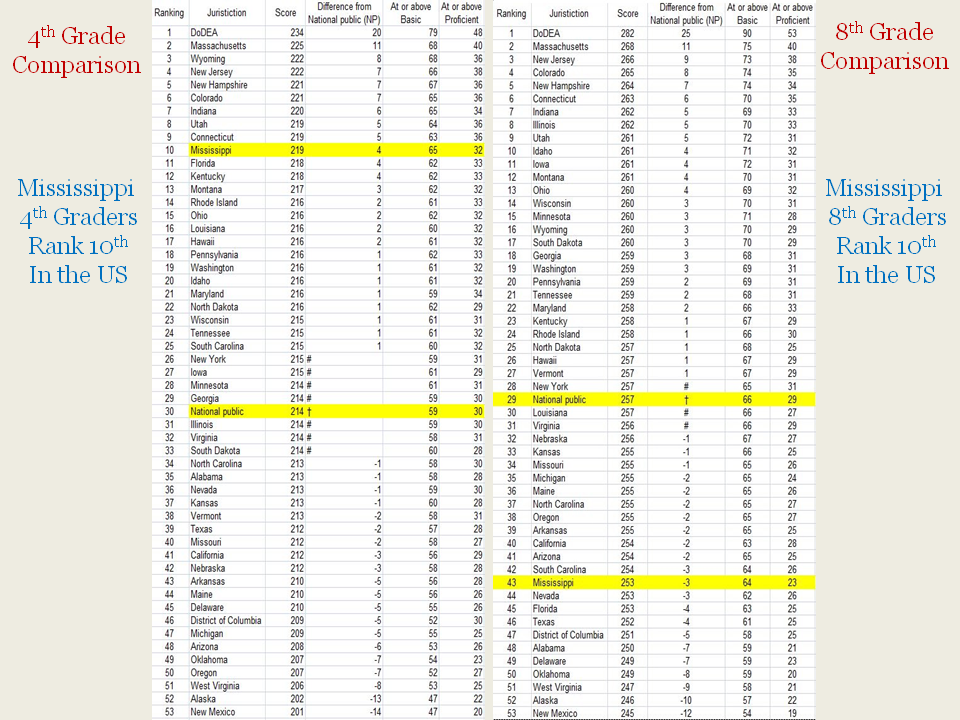
Using the 2024 data, we see that indeed Mississippi’s 4th graders were number ten in the country but why are their 8th graders still number 43? The Mississippi reading program has been in effect since 2013 which means the 8th graders have been subjected to it their entire school life.

Another way to look at this is by plotting Mississippi reading scores against national averages.
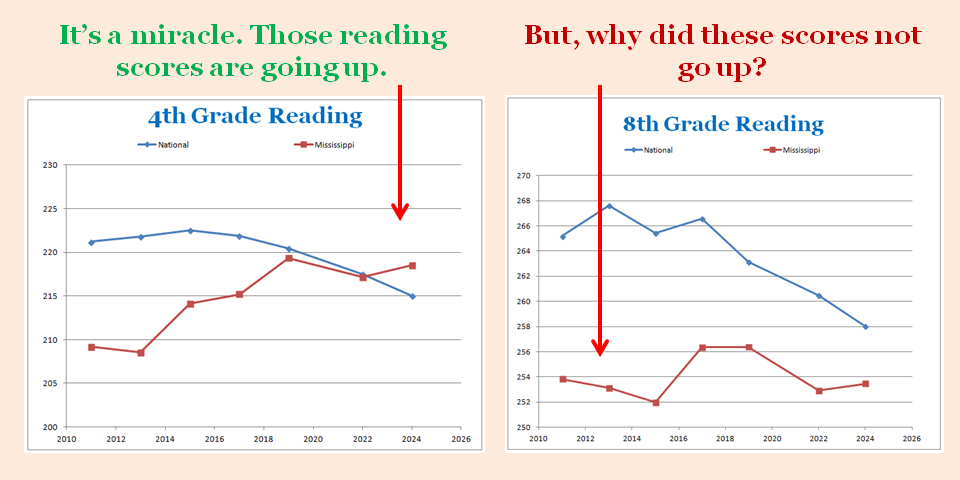
This data shows us there is something fishy about the Mississippi’s 4th grade reading scores. They are hardly miracles but seem more like subterfuges.

It does not conclusively prove anything but science of reading, which is employed by Mississippi, started to be widely implemented in 2013 at the same time national reading scores started getting worse.

Carey Wright and the Right-wing

Carey Wright began her education career in 1972 as a teacher in Maryland.

In 2010, Michelle Rhee hired her to be chief academic officer for Washington DC public schools. Wright was an administrator in the DC schools during the height of their cheating scandals. Besides working with some of the most callus and harmful education leaders in American history, she is a member of Jeb Bush’s Chiefs for Change and a graduate of the late Eli Broad’s superintendent training academy. Both organizations are or were widely seen as enemies of public education.

In a 2023 Magnolia Times article, Wright claimed:

“Students who are retained in third grade because of reading deficiencies are provided with intensive interventions and support throughout the school year so they will be successful in later grades. 

“A recent report from Boston University’s Wheelock Educational Policy Center found this strategy is working. The report reviewed English Language Arts scores and later academic outcomes from the first cohort of third graders promoted and retained under Mississippi’s Literacy-Based Promotion Act of 2013.”

Upon opening the link Wright provided, we discover that the cited report was commissioned by the Foundation for Excellence in Education, which is Jeb Bush’s non-profit. He is chairman of the board and his girl Friday, Patricia Levesque, is the CEO. Their organization is known for working to privatize public schools and promoting Edtech.

Evidently ExcelinEd’s researchers discovered that the 6th grade results do not look as bad as the 8th grade results. The reports first key finding states, “For students who were in the third grade in 2014-15, being retained under Mississippi’s policy led to substantially higher ELA scores in the sixth grade.” This appears to be an example of looking for data to sell your ideology.

After spending four years in the classroom, Wright transitioned to various administrative roles. When leading special education services in Montgomery County during the early 2000s, she was serving in the middle of a corporate education reform triumvirate. John Deasy was promoting charter schools and teacher “pay for performance” in Prince George County. Baltimore had Andres Alonzo firing teachers and closing schools. Just a few miles away, Michelle Rhee was promising to “fix” Washington DC’s schools by firing teachers and principals.

Unfortunately, Carey Wright was drawn into this kind of billionaire school reform. She was probably a talented administrator, but many of her decisions were tainted by her friends in education.

The data does suggest that there has been some education progress in Mississippi. That improvement is most likely due to the dedication of poorly compensated public school educators.


Mississippi Malarkey

11 Jun

By Thomas Ultican 6/11/2023

Nickolas Kristof’s opinion piece in the New York Times might not have been blatant lying but it was close. His depiction of the amazing education renaissance in Mississippi as a model for the nation is laughable. Lauding their third grade reading retention policies as enlightened, he claims their secret sauce for success is implementing the science of reading (SoR). This is based on a willful misreading of data while tightly embracing Jeb Bush’s futile education reform ideology.

Kristof gushes over Mississippi,

“So it’s extraordinary to travel across this state today and find something dazzling: It is lifting education outcomes and soaring in the national rankings. With an all-out effort over the past decade to get all children to read by the end of third grade and by extensive reliance on research and metrics, Mississippi has shown that it is possible to raise standards even in a state ranked dead last in the country in child poverty and hunger and second highest in teen births.” (Emphasis added)

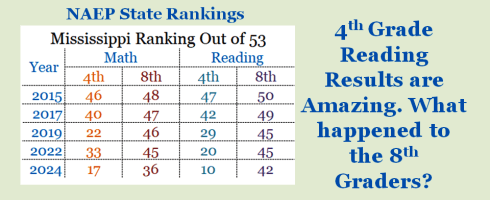
The soaring national rankings claim is a crock. National Assessment of Education Progress (NAEP) is the most trusted testing standards by which entities are compared. NAEP provides a ranking of 53 jurisdictions, consisting of 50 states plus the District of Columbia, Puerto Rico and the Department of Defense Education Agency.  A table was constructed using the NAEP rankings.

From 2015 to 2022, testing outcomes for Mississippi fourth graders did “soar” past more than 20 states in both math and reading. But results from eighth grade expose those lofty outcomes as a mirage. In 2013, Mississippi followed Florida’s lead and introduced retaining all third graders who did not meet end of year reading exam targets. That is the probable reason for the improved fourth grade testing scores and why those illusory gains were erased by eighth grade.

Misusing data allows Kristof to end the paragraph indicating poverty is not an excuse for education failure. It reminds me of a statement written by education professor Kathryn Strom,

“The “no excuses” rhetoric (i.e, “poverty is not an excuse for failure”) is one that is dearly beloved by the corporate education reformers  because it allows them to perpetuate (what many recognize to be) the American myth of meritocracy and continue the privatization movement under the guise of “improving schools” while avoiding addressing deeply entrenched inequities that exist in our society and are perpetuated by school structures.” (Emphasis added)

To add heft to his argument that poverty is no excuse, Kristof quotes Harvard economist David Deming from the Harvard Kennedy School and Harvard Graduate School of Education, saying “Mississippi is a huge success story and very exciting.” He adds, “You cannot use poverty as an excuse.”

It is important to note that Harvard is famous for supporting privatization of public education and promoting failed scholarship. Deming is currently doing research with Raj Chetty and John Friedman. Along with Jonah Rockoff, Chetty and Friedman published the now thoroughly debunked value added measures (VAM) paper. Their faulty research caused many teachers to lose jobs before it was exposed as a fraud. Kristof is using an economist (not an educator) from a group best known for scholastic failure as his expert.

Kristof also indicates that spending is not important. He writes, “Mississippi has achieved its gains despite ranking 46th in spending per pupil in grades K-12.” If we look up at the 8th grade rankings, it seems they are getting what they paid for.

The Mississippi Miracle Uses the Jeb Bush Method

In 2000, former Netscape CEO Jim Barksdale came home to Mississippi and made reading education his cause. He and his wife put up 100-million dollars to establish the Barksdale Reading Institute. Barksdale also used his political influence to promote state spending on education. There have been some real gains in Mississippi and Barksdale’s effort likely aided that improvement. For Kristof, this was the beginning of a renaissance.

In 2013, Mississippi’s legislature adopted packages of education focused bills which included third grade mandatory reading retention. That same year, they hired a new state superintendent of education, Carey Wright, from the Washington, D.C., public school system. Kristof lavishes her with praise declaring, “Wright ran the school system brilliantly until her retirement last year, meticulously ensuring that all schools actually carried out new policies and improved outcomes.”

Of course the article was an opinion piece but even opinions should be tethered to some objective reality. When asserting a public servant is “brilliant” or was “meticulously ensuring” some supporting evidence should be provided.

Wright began her education career in 1972 as a teacher in Maryland. After just four years in the classroom, she transitioned to various administrative roles. When leading special education services in Montgomery County during the early 2000s, she was serving in the middle of a corporate education reform triumvirate. John Deasy was promoting charter schools and teacher “pay for performance” in Prince George County. Baltimore had Andres Alonzo firing teachers and closing schools. Just a few miles away, Michelle Rhee was promising to “fix” Washington DC’s schools by firing teachers and principals.

In 2010, Rhee hired Carey Wright to be chief academic officer for Washington DC public schools. Wright was an administrator in the DC schools during the height of the cheating scandals. Besides working with some of the most callus and harmful education leaders in American history, she is a member of Jeb Bush’s Chiefs for Change and a graduate of the late Eli Broad’s superintendent training academy. It is highly likely that being steeped in corporate education reform mythology is why Kristof views her as “brilliant.”

The darling of corporate education reformers is an army of unqualified teachers recruited by Teach For America (TFA). It is not unusual for a college graduate to take a five-week summer training course, teach in a charter school or public school for two years and then become an education expert for some either public or private agency. This is an absurdly irresponsible system but effective for wealthy individuals looking to privatize or end public education.

Kristoff notes, “Two Teach for America veterans, Rachel Canter and Sanford Johnson, in 2008 founded an organization called Mississippi First that has been a tireless advocate of raising standards.” Evidently a two-year stint as a temp teacher makes one a veteran. These two apparently are proceeding swimmingly along the corporate reform path.

Sanford Johnson’s biography includes teaching four years at Coahoma County High School (2003-2005) and two years at KIPP charter school (2005-2007), co-founding Mississippi First and becoming its Deputy Director (2008-2019) and today is Executive Director of Teach Plus. Teach Plus is the TFA formed group working to privatize teacher training. He also has another biography posted at the corporate education reform organization Pahara Institute. Johnson has made many corporate connections.

After two years (2004-2006) as a TFA temp teacher in Greenville, Mississippi, Rachel Canter went to Harvard University for a master’s in public policy. In 2008, back in Mississippi, she and Sanford Johnson founded Mississippi First with Rachel as director.

New PIE Network Partners’ Logos

Canter is still the director of Mississippi First and according to her PIE network BIO she was instrumental in the passage of the 2013 third grade retention bill. That year, the PIE network named Mississippi First “Game Changer of the Year.” She is now a board member of PIE along with Nina Reese President National Alliance for Public Charter Schools and Robin Lake Director Center for Reinventing Public Education.

Pontificating While Clueless

Kristof states, “With such a focus on learning to read, one of the surprises has been that Mississippi fourth graders have also improved significantly in math.” His entire article is based on the misunderstanding of data possibly through ignorance but more likely through ideological belief.

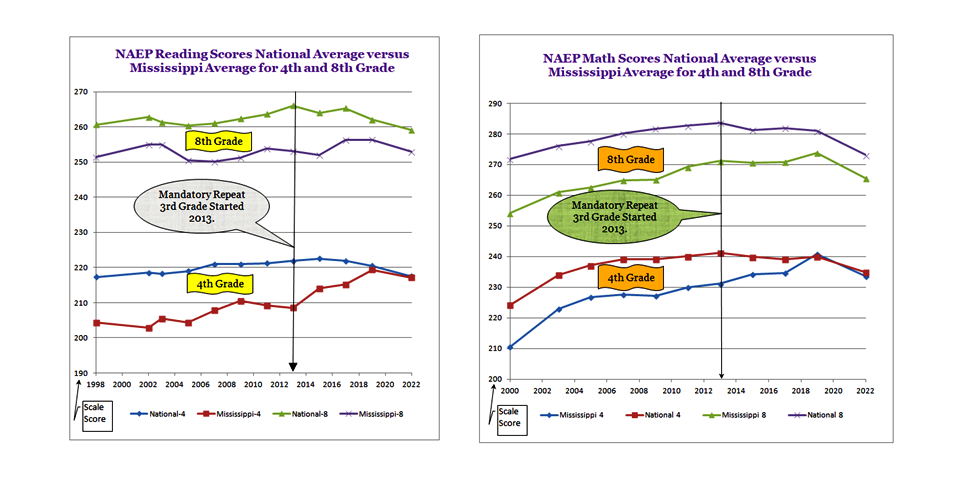
These graphs show that the fourth grade “miracle” disappears by eighth grade. They also illustrate the point Ferman University’s literary expert Paul Thomas makes: “But the greatest issue with tests data is that inexpert and ideologically motivated journalists and politicians persistently conform the data to their desired stories—sometimes crisis, sometimes miracle.”

Third grade retention improvement has not only been shown to disappear; it is harmful to the students retained. Kristof informs us that “A Boston University study this year found that those held back did not have any negative outcomes such as increased absences or placement in special education programs.” This study was commissioned by Jeb Bush’s ExcelinEd and only looked at students through sixth grade. It does not address disengagement or dropouts. Is Kristof being deliberately deceptive?

Kristof also makes a big deal out of Mississippi’s high school graduation rate climbing to 87 percent, surpassing the national average. This does look like real progress but graduation rates have become highly suspect. America’s high school graduation rates peaked at about 77% in 1970 and drifted down for almost four decades to 69% in 2007.  Since then, on-line credit recovery arrived and students are completing entire semester courses in as little as one day. This is a new corporate profit center where corruption is ignored.

Conclusions

Education historian and former Assistant Secretary of Education Diane Ravitch wrote,


“What’s worrisome about this article is that Kristof asserts that poverty doesn’t matter (it does); funding doesn’t matter (it does); class size doesn’t matter (it does). In his account, states that want to improve test scores can do it without raising teachers’ salaries, without upgrading buildings, without spending a nickel to improve the conditions of the schools or the well-being of children. Children who are hungry, lack medical care, and are homeless or ill-housed are not likely to learn as well as those who have advantages.

“Does this explain why so many rightwingers love “the science of reading”? Publishers are rolling out new programs. Education can be reformed in the cheap. Can’t expect taxpayers to foot the bill, can you?”

In this opinion piece, Nicholas Kristof touched on and promoted almost every billionaire inspired agenda item aimed at decreasing money going to public education. He acted as a representative of elites, advancing policies undermining education quality for common people.

This was not about improvement. It was about lowering taxes.