Tag Archives: Bill Gate

Breakfast with Professor Lawrence

25 Mar

By Thomas Ultican 3/25/2016

Tuesday was another spectacular day in southern California and I was cruising up old Highway 101 to meet Larry Lawrence for a late breakfast. We met at the Ki café just south of Swami’s and the Kook. Swami’s is a famous surfing spot in Encinitas, California and the Kook is an often redecorated statue near the San Elijo State Beach. The Ki specializes in smoothies, juices and healthy meals prepared from organic products including the coffee I had with breakfast. Larry is a regular there. He directed me to a seat at his favorite table with an awe inspiring view of the Pacific Ocean. A scintillating three hour conversation about saving public schools ensued.

Professor Lawrence has reservations about standardized education. He illustrated them with a personal experience.

In 1962, he attended a class during the summer put on by the University of Illinois Committee on the School of Mathematics. In December 1951, the Colleges of Education, Engineering and Liberal Arts and Sciences established the University of Illinois Committee on School Mathematics (UICSM) to investigate a new pedagogy for high school mathematics. When he returned to Morningside High School in Inglewood, California, Larry convinced a colleague from the middle school to go take the course with him the following summer.

Two years later, Larry was teaching geometry and one of his classes was composed of the students out of his middle school friend’s honors algebra class. Larry soon discovered that this teacher had gotten so bogged down with teaching new ideas like set theory and algebra properties that he had not completed most of the fundamentals of algebra. His students were lost. Therefore, Larry changed the class he was teaching from geometry and made it algebra I. The administration supported his decision with almost no reservations. In today’s standardized environment, Larry is quite certain no professional educator would be allowed to make that kind of call.

The weekend of February 28th Professor Lawrence was at the United Opt Out conference in Philadelphia. He sees opt out as one of the most effective means of fighting today’s mean spirited greed driven education reform. He says the destruction to Philadelphia’s public school system by test driven reform and privatization is pervasive and profound. He called it truly sad.

On March 3, he was in Los Angeles at a meeting of TEAch (Transparency, Equity and Accountability in CHarter schools). He estimates an attendance of 80 people including Joan Kramer (retired teacher, activist, author of the Turtle Learning blog), Jackie Goldberg (former California State Assemblywoman, founding member of the progressive caucus and former student of Professor Lawrence at Morningside High), Steve Zimmer (President of the Los Angeles Unified School District), Scott Schmerelson (LAUSD board member) and the Red Queen of LA (The well known blogger). The moderator was Susan Phillips. These activists gathered to form strategies for saving public schools from the destruction caused by the billionaire financed charter school movement.

On March 8th, Larry was in Anaheim where Superintendent of Schools, Michael Matsuda was hosting a viewing of “Killing Ed.” He says, “This is an excellent documentary about the Gulen Charter Empire that needs to be shown to everyone.” On this occasion he also got to speak with Tina Andres (Southern California BAT leader).

On March 9th, he represented the Occidental Alumni in Education and toured the original High Tech High in San Diego.   After a brief meeting with the schools CEO and philosophical guide, Larry G. Rosenstock, Larry and one other Occidental alumnus were lead through the High Tech schools by two student “ambassadors” for almost two and a half hours.

High Tech schools were started with the support of Qualcomm founder, Irwin Jacobs and Bill Gates in 2000. Larry saw a very casual environment with small classes. Curriculum at High Tech is all presented using problem based learning, also known as the constructivist approach which derives from the thinking of John Dewey. High Tech has a robust professional development program for teachers which supports the constructivist ideal. It also confers a  masters in education, through the profession development program.

During the tour, Larry noticed that everyone was taking the same math class. When he asked the “ambassadors” about it, one of them said “yeah, that’s frustrating. I am good at math and I am not being challenged.” Overall, he rated the school as first rate but did see a few warts.

I have had a few students come into my classes from High Tech High who really hated it and a teacher friend of mine at Southwestern Community College says the students from High Tech struggle with a non-problem based learning environment.

Professor Lawrence shared some personal experience and knowledge that leads him to believe that High Tech system will eventually fail because it has no robust structure in place like public schools.

UCLA started a lab school in 1882. In 1925, Corinne A. Seeds was hired to lead the school. She like Larry Rosenstock was a Dewian and was a dynamic forceful personality. Seeds became a key figure in developing and promoting progressive education during the 1930s, ’40s and ’50s. When Seeds was in charge, the school flourished. Seeds retired in 1957 and for three years the school floundered.

Then fortune shined on the school again with the arrival of another dynamic personality in 1960, John Goodlad. In his New York Times obituary it said, “Professor Goodlad proposed a radically new model of schools, in which elementary school students would not be divided into specific grades and their work would not be graded.” Larry worked with Goodlad at what was then called the Seeds school and he still promotes this idea. I see a lot of merit in it as well.

In 1987, Goodlad left UCLA and the Seeds school. After that the school, suffered tremendous financial duress without its charismatic leader. In the 1990’s, Seeds tried to solve its problems by becoming a charter school and today it is a private school that calls itself a lab school.

Professor Lawrence thinks that when the charismatic founding leader of High Tech is gone it will face a bleak future as well. Not being part of the democratically supported and supervised system will eventually catch up with High Tech and undermine the good work being done there.

On March 19th, Larry got an email from Karen Wolfe (education activist and parent) inviting him to Sunday morning breakfast in LA with Diane Ravitch. At 6 AM Sunday morning he was headed north on Highway 5 for breakfast with Karen, Diane, Tina Andres, Ellen Lubic and Josh Leibner. His commitment to public education and energy to fight for it has inspired me.

We left lunch challenging each other to think of some way to bring together the disparate activists in San Diego who support public education. We are hoping that we might be able to join with other southern California activist at the National Public Education conference this April in Raleigh, North Carolina and advance our struggle for the salvation of public education in our part of the country.

DuFour; Just Another “Reformy” Consultant

28 Feb

DuFour’s new book, In Praise of American Educators and How They Can Become Even Better, is dismal. He has taken his once promising idea, (the PLC) and turned it into a vehicle for implementing Common Cores State Standards and teacher control. He is just another education consultant in search of “thirty pieces of silver.”

To be fair, the opening two chapters do address the relentless attack on educators and chapter 2 is called “The Phony Crisis.” Unfortunately those two chapters of faint praise for teachers and documentation of the false propaganda endured by public schools segue straight to “reformyville.”

In 2005 or 2006, I was teaching Algebra II when a young colleague suggested that we Algebra II teachers form a professional learning community (PLC). She had just read DuFour’s book and three tenets of his idea were appealing. PLC’s were to be (1) voluntary, (2) self-selected and (3) governed by consensus. Our Algebra II PLC agreed to meet every Wednesday for lunch. In high schools lunch is only 30 minutes but we did create value.

In fact, we were very productive. We created innovative lessons like solve around the room and solve around the table. We developed many assessments; we refined curricular pacing and shared our student challenges. Unfortunately, this was the sole time that I experienced a PLC in which I did not feel my time was mostly wasted.

Early in the book, Dufour cites Diane Ravitch’s book, The Death and Life of the Great American School System, twice and he also quotes Mercedes Schneider’s A Chronicle of Echoes once. But after the first two chapters he cites nothing but reformist literature, Bill Gates sponsored think tanks and corporate reform entities.

He claims that the United States lags major economic powers; Canada, Germany, Switzerland and Australia in career and technical education. He makes the argument that schools should be developing skilled workers for American corporations by citing the Gates supported Center on Education and the Workforce (CEW); “The second part of the CEW strategy calls on the federal government to establish a Learning and Earnings Exchange that links high school and post-secondary transcript information with employer wage records.” (Page 78)

He praises Delaware’s top down approach for responding to a call by the international banking group Organization for Economic Cooperation and Development (OECD) to provide educators with more collaboration time. He writes, “In its Race to the Top application, it stipulated that all core subject teachers would be provided with at least ninety minutes each week to work as members of collaborative teams.” I am all for teachers having time to collaborate, but this does violate the principles of being voluntary and self selected which means it will be another onerous demand on teacher time with limited reward.

DuFour uses McKinsey and Company as the source that validates his PLC strategy:

 “The McKinsey & Company investigation of the world’s highest-performing educational systems has the following three conclusions.

… 3) The best process for providing this professional development is the professional learning community process …” (Page 81)

 Diane Ravitch calls McKinsey and Company “the global powerhouse behind ‘reform.’” She continues

“Where did David Coleman, architect of the Common Core standards, get his start: McKinsey. Which firm pushes the narrative of a ‘crisis in education’: McKinsey. Which firm believes that Big Data will solve all problems: McKinsey.”

 DuFour attacks unions and repeats the false talking point coming from the Vergara anti-tenure lawsuit in California. Of course he cites the anti-teacher Gates and Walton funded group National Council on Teacher Quality’s call to end “last in first out” policies.

For DuFour, like all “reformsters”, the metric to judge schools by is the big standardized test. He says schools need to establish a set of smart goals for improvement. One of his suggested goals is “We will increase the school’s mean score on the ACT exam from 21.9 to 26.0.”

Speaking of the Big Standardized Test (BS Test) one of my favorite education writers, Peter Greene wrote:

“The BS Tests suck, and they suck in large, toxic, destructive ways. But if you’re a Common Core advocate, you need to see that the so-called Common Core tests are not aligned with the Core, that, in fact, no standardized test will ever be aligned with the Core.”

 Now we have arrived at the wonderful new purpose of the PLC. PLC’s no longer belong to teachers they are a vehicles for instituting Common Core State Standards (CCSS). So DuFour tells us, “High-yield districts put processes in place to ensure that teams are focused on the right work.” (Page 134) That “right work” is the implementation of the greatest advancement in American education ever, CCSS.

He cites the National Governors Association Center for best practices and the Council of Chief State School Officers call for these awesome standards to be benchmarked against the highest-performing nations in the world. He reports:

 “By September 2009, fifty-one states and territories had initially agreed to endorse the CCSS. Soon, however, the initiative became caught up in a political debate about the overreach of the federal government into a states’ rights issue (even though it had been launched by the states).” (Page 141)

 It does not seem to bother DuFour in the least that in 2009 the CCSS had not been written and no one outside of Bill Gates’ small circle new who was writing the CCSS. This might have been a good time to cite Mercedes Schneider’s book Common Core Dilemma. I called her book “the bomb” because it thoroughly debunked the kind CCSS propaganda that DuFour continues to propagate.

DuFour’s book is an attempt to sell his PLC consulting business to billionaire education deformers. It has no value for current educators because it abandons those principles that were valuable when he first proposed PLC’s.

Open Message to California Senators – Save us from the New ESEA

6 Dec

Dear Senators, Boxer and Feinstein

As senior members of the US Senate, please use your influence to stop the disingenuous rewrite of the Elementary and Secondary Education Act (ESEA).

There is an effort to ram this bill through congress sight unseen. It only became available to the public and our representatives including you on November 30th. As educators from around the country see the details of this bill, they are deeply concerned for the future of public education in America. Is it the intent of the US congress to privatize public schools like Chile or Sweden did?

I left a job doing research in magnetic recording in 1999 to become a teacher. As a person immersed in the Silicon Valley culture, I was a big believer in technology. After more than a decade in the classroom, I am convinced education technology has been mostly a waste of money. It has not improved either engagement or understanding.

Yet, this federal law spends large amounts of money promoting dubious technology initiatives such as “personalized learning” and “blended learning.” If these are truly good ideas they will be adopted without federal coercion. My personal experience with these ideas says they encourage bad pedagogy. Multiple choices testing to assess drill and skill teaching is the basic strength of these methodologies and that is not good teaching.

This is little more than money being earmarked for the benefit of particular corporations. Most technology spending creates a net harm to our students who are forced into larger classes so districts can pay for the required hardware and software.

The social improvement bonds that appear on page 797 under the name “Pay for Success Initiative” look like a way for Wall Street bankers to get a cut of those education tax dollars. It is a legal opening for investment bankers to pocket taxpayer money. Is this kind of policy the new normal under the citizens’ united ruling?

Today, the biggest threat to quality public schools is the charter school movement. It is a huge problem in California. Charter school theory postulates that charters with less restrictive state regulations are going to experiment with pedagogy and then transfer their successful innovations to the “failing” public school system. This theory was based on a fallacy. Public schools were never failing especially here in California and we have not seen one successful innovative idea come from the charter sector. In fact, those seven-thousand “no excuses” charter schools in the United States are practicing methods harkening back to the 19th century; very regressive education brought by untrained inexperienced people.

Worst of all is the record of charter schools is one of fraud, instability and segregation. It would make sense for the federal government to closely scrutinize this out of control segment of education that is being used by hedge fund investors as an investment vehicle. Instead, this law spends significant money promoting charter schools and coercing states for the benefit of the charter industry. Section 4302 calls for:

 “(1) supporting the startup of new charter schools, the replication of high-quality charter schools, and the expansion of high-quality charter schools;”

This facet of the law will harm public schools and expose more students to the unsupervised education market. It is not about improving schools for children; it is about pocketing those education tax dollars.

In his massive study of the rise and fall of numerous civilizations, the great historian Arnold Toynbee observed in his A Study of History, “The bread of universal education is no sooner cast upon the waters than a shoal of sharks arises from the depths and devours the children’s bread under the educator’s very eyes.” We must protect our precious public education system from the sharks; unfortunately, this law is a shark feeder.

In the December 5th Washington Post, Kenneth Zeichner, a professor of teacher education at the University of Washington at Seattle noted that “Provisions in the legislation for the establishment of teacher preparation academies are written to primarily support non-traditional, non-university programs such as those funded by venture philanthropists.” He believes this law will do significant harm to teacher education in America.

One facet of the No Child Left Behind Law (NCLB) that I liked was the requirement for a “highly qualified” teacher in every classroom. As the prominent author and educator, Mercedes Schneider posted to her blog on December 5th:

 “What is interesting is that ESSA foregoes the NCLB language prohibiting emergency or provisional certification. In fact, ESSA does allow for provisional certification and the waiving of licensing criteria for states and schools receiving Title I funding (see page 143). Furthermore, it seems that provisional or emergency certification could be subsumed in ‘certification obtained through alternative routes.’”

 On December 10th, the writer and educator from South Carolina, Professor Paul Tomas, wrote on his blog a conclusion I have reached:

 “At best, ESSA is a very slight shuffling of the test-mania element of the accountability era; however, this reverting to state-based accountability will guarantee another round of new standards and new tests—all of which will drain state and federal funding for processes that have never and will never achieve what they claim to achieve (Mathis, 2012).

 “ESSA will be another boondoggle for education-related corporations, but once again, that profit will be on the backs of children and underserved communities.”

This law does mandate that every child in grades 3 to 8 and 11 is tested every year. The NCLB era has taught me unambiguously that standards based testing harms teaching and learning for many profound reasons. Feedback from this corporate testing is not timely and there is no learning component related to what is going on in the classroom associated with the big test. And worst of all this kind of testing seriously harms the love of learning and thinking. Massive testing is not just expensive, it is harming children.

I know there are many people like the leaders of the AFT, NEA and PTA supporting this law. They believe it is a lesser evil, however, I think they listened to their big donors before they read the legislation. When a group is getting millions of dollars from Bill Gates, it is easy to rationalize supporting his position. Please look closely at this legislation and stand up for parents, children and public schools in America.

Fix it or kill it.

New ESEA is a Stinker – Kill It

2 Dec

Our corrupted political system is poised to advance the theft of public education from local communities and surrender it to corporate greed. The reauthorization of the Elementary and Secondary Education Act of 1965 (ESEA) was agreed to in conference committee around November 17, but withheld from public or congressional scrutiny until November 30th. This thousand page plus law is scheduled for a vote (with no time for comment or study); this week in the house and next week in the senate.

Here are some of the discoveries I have made.

On pages 450 and 469, the federal government commits to giving large grants to promote “blended learning” and “personalized learning.” These are euphemisms that mean replace teachers with computer delivered lessons. There is a complete lack of evidence supporting this education approach, but if you own a large technology company it is a way to capture taxpayer provided education dollars.

So what if it harm public schools?

The doors are also opened for Wall Street actors like Goldman-Sachs and JP Morgan Chase to get their hands on school funds through social impact bounds. These are bonds that do not pay a fixed rate of return. They are paid by the local governments to the bond holder when a particular social need has been successfully solved by the investment. On page 797, this financial scam is called the “Pay for Success Initiative.”

As Mercedes Schneider observed, “Of course, the problem here is that the funder of the pay-for-success initiative could somehow exploit children or influence such exploitation in an effort to shape the desired, ‘successful’ outcome. Only successful outcomes result in profits.”

Testing of every child in grades 3 – 8 and 11 every year is mandated. Every state is required to test 95% of its students and language learners are subject to multiple statewide interim assessments. States are allowed the “opt out” option for parents, but it is not clear what happens if more than 5% opt out of yearly testing. That appears to be illegal. Only 1% of the special needs population is allowed an alternative assessment.

No other country in the world forces their children into this much testing. It truly is folly. Every year since the acceleration of the federal takeover of schools in 2001, student growth has slowed and the learning gaps have increased. These policies are not good for students, they are not good for communities, but they are profitable for testing corporations.

They are also the means by which control over education can be wielded by federal overlords.

I am reminded of something presented by Francis W. Parker of Chicago at the 1891 National Education Association gathering. He wrote:

 “The common school furnishes the essential principles in the development and perpetuation of a democracy, and its growth and progress has been purely democratic; it has been and is, ‘of the people, for the people, and by the people.’ The common school had its birth in the New England school district; and the New England school district with the town is the root from which sprung all the democratic forms of government which have developed in our country. In a word, the spirit and nourishment of the common-school system has always depended, and depends to-day, entirely upon the will of the majority. State and national officials are given little more than advisory influences.

 “… That which has its birth-in-the-desires-and-intelligences-of-the people, and is applied by the will of the people, becomes an organic, permanent factor in the progress of civilization of that people.”

Today’s legislators have forgotten the hard won lessons of our ancestors. Instead of protecting the common school concept and the rights of local communities who built and paid for our public education system, they are busy selling it for thirty pieces of silver or worse foolishly giving away what they have no right to govern.

The section titled “21st Century Schools” could also be called the “Public School Privatization” section. It states:

 ‘‘SEC. 4302.”

“(a) IN GENERAL.—The Secretary may carry out a charter school program that supports charter schools that serve early childhood, elementary school, or secondary school students by—

‘‘(1) supporting the startup of new charter schools, the replication of high-quality charter schools, and the expansion of high-quality charter schools;

“(2) assisting charter schools in accessing credit to acquire and renovate facilities for school use; and

‘‘(3) carrying out national activities to support—“

 Charter schools are not public schools. Citizens have no voting control over their governance and have no right to see what wages are paid or how money is being spent. Public schools are prohibited from pulling students out of schools, dressing them in colorful tee-shirts and making them participate in political demonstrations. That is becoming more and more frequent at charter schools.

The money to support charter schools comes from public school budgets; taxpayers.

Charter schools are plagued with fraud and instability. They have been a powerful agent exacerbating segregation. Across the nation public schools have consistently outperformed charter schools and I do not know of any pedagogical innovations originating in a charter school. In fact, the “no excuses” charter schools are quite regressive.

But billionaires like Bill Gates, Eli Broad and the Walton family love charter schools, so we the taxpayers of this country are going to support the diminution of our local public schools and doom children to attending corporate for profit schools.

Even the “non-profit” charter schools are really for profit schools. Just look at the salaries founders and top administrators are giving themselves.

In the bill, congress promotes the expansion of temporary teachers with no training like those provided by Teach for America. Today, these idealistic young people are cynically utilized to undermine professional teachers and their unions. Many of the “no excuses” charters schools are predominantly staffed with these untrained – inexperienced youths.

None of this is good for students but there is a lot of money to be made in the burgeoning charter industry.

This bill will be in force at least until 2020 if it is passed. It is clearly both anti-public school and anti-teacher, still, labor leaders Garcia of the NEA and Weingarten of the AFT support it and so does the PTA.

However, unlike them, I am not getting money from Bill Gates and I don’t support Hillary Clinton. So, I say kill this stinker of a bill and start over. I know NCLB is terrible, but replacing it with nearly as bad does not make sense to me.

NGSS is Science Education Plague

12 Nov

By T. Ultican 11/12/2015

Three bad ideas have taken root in California; common core, charter schools and NGSS (Next Generation Science Standards and Framework). There is growing awareness of the draw backs associated with common core’s top down control of schools and the often fraudulent and unstable charter school movement. On the other hand, most people have not heard of the NGSS. Monday, I was required to attend a “professional development” day focused on NGSS.

I teach math and physics at Mar Vista High School in Imperial Beach, California. It is a magical place. The school sits about 6 blocks from the beach. Once, I actually walked down that beach and made an unconventional crossing into our neighbor suburb, Las Playas de Tijuana. Mexico is that close. Naturally, a lot of Spanish is spoken by our amazingly peaceful and kind students.

My district has set up cohorts made up of teachers from four high schools, tasking selected teachers in the various subject areas with leading professional development activities. Since I teach in two core areas, math and science, I am required to go for both NGSS and CCSS indoctrination (buying into these regimes is required for teacher leaders and administrators if they want to keep their jobs). Unfortunately, the creation of both NGSS and CCSS was led by testing company executives and CEO’s like Louis Gerstner from IBM and not experts in pedagogy.

These business executives have recklessly foisted their misguided education policies on America; not even pilot testing the transmogrification they propose. Political pressure driven by a few billionaires causes these changes to be abruptly instituted. Instead of a reasoned and thoughtful roll out of radical curricular changes, schools are forced to transition to them immediately, creating extreme discontinuities in the learning sequence.

For our NGSS training, we started with a November article in Science Scope magazine by Joe Krajcik called “Three-Dimensional Instruction – Using a New Type of Teaching in the Science Classroom.” He tells us that “Classrooms incorporating three-dimensional learning will have students build models, design investigations, share ideas, develop explanations, and argue using evidence, all of which allow students to develop important 21st century skills such as problem solving, critical thinking, communication, collaboration, and self management.” Honestly, the only thing that appears new here is developing 21st century skills instead of 20th century skills.

These are all known principles of cognitive development that have been around for more than a century. They reflect the work of Dewey, Vygotsky and Piaget. It is the constructivist approach. I endorse that kind of pedagogy, however, the poorly written NGSS standards (close to undecipherable) are being forced onto students without matching cognitive readiness, violating Vygotsky’s “zone of proximal development” theory.

For example, approximately 30 core ideas are to be investigated by students and assessed in kindergarten through 2nd grade. Six science standards are to be introduced in kindergarten including earth’s systems, motion and stability, forces and interactions, and engineering design. At the same time, CCSS require that these babies learn to read, write and do math. Not even the Chinese expect babies to forgo childhood to be scholars destined to advance the economic engine. It is a huge mismatch in cognitive development that portends permanent damage.

The disturbing part of my training was the sight of three bright young teachers caught up in this “corporate education reform” sausage grinder. The week before our cohort met they were pulled out of classes for a day to work with district curricular leaders on planning the event. They gathered materials, planned a lab activity and tried very hard to take us through a demonstration lesson that illuminated the three dimensions of learning. We all had a nice day off from teaching and tried not to be negative Nancy’s, but none of the real issues with NGSS were discussed.

At the high school level, NGSS standards require integrated science just like common core requires integrated math. My school tried integrated math in the 1990’s and abandoned it as a bad idea. Now, I am teaching integrated math III. However, science is different than math. Most math teachers have enough background in algebra, geometry and statistics to teach any level of integrated math. It is the rare science teacher who has expertise in all science domains: earth science, biology, chemistry and physics.

NGSS writers posited that chemistry and physics principles like Newton’s laws, the gas laws, and atomic structure would be so thoroughly apprehended by 8th grade, that it would not be necessary to teach them in high school. In high school, student are to create reports and videos that explain the energy transformations behind global warming and how Darwin’s laws of evolution correctly explain the development of life. There are almost no high school chemistry or physics standards in NGSS.

I personally believe that the existence of global warming caused by human activity (burning fossil fuels) is settled science. I also think Darwin was a gifted scientific observer whose theory of evolution is well founded. On the other hand, why overweight the standards with these two controversial topics? I am not saying ignore them, but they are central to these new science standards and they do not need to be.

NGSS was never pilot tested and was rushed into existence before people had a chance to vet it. Therefore, NGSS is full of errors and horribly misaligned.

NGSS is another of those dreams held by a rich powerful man that has been ramrodded into existence. Luis Gerstner the former CEO of both IBM and RJR Nabisco started campaigning for these standards in 1995. In 1996, he talked the National Governors Association into making him chairman of a new non-profit named Achieve Incorporated. Achieve was charged with making his standards dream a reality. He remained the chairman of Achieve until the standards were completed in 2013 and copyrighted by Achieve Inc.

Unlike Bill Gates, Gerstner did not drop out of school. And not only did he complete school himself, he hired many people who had been to school. These are his only qualifications for leading education policy in America. Like Gates’s common core, Gerstner’s NGSS is terrible education policy that came about because America’s democratic process and the principal of local control of education were sundered by billionaires.

(Condensed) D.C. Schools: A Portrait of “Corporate Education Reform” Failure

23 Oct

This summer the National Academy of Sciences produced a lengthy report for the city of Washington D.C. documenting the effects of their 2007 Public Education Reform Amendment Act (PERAA).[1] The report is a powerful set of data and observations that damn “Corporate Education Reform.”

What is “Corporate Education Reform”?

In 1996, Louis Gerstner, CEO of IBM, hosted the National Governor’s Association conference at the IBM conference facility in Palisades, New York. This conference with the exception of one Asian man was an all white, all male conference made up of 49 CEO’s and 40 governors. There were no educators involved.

At the conference, the Governors established their own non-profit and non-governmental corporation called Achieve Inc. Gerstner was named Achieve’s chairman. Achieve Inc. subsequently supervised the writing of both the Common Core State Standards and the Next Generation Science Standards. While Bill Gates’ Council of Chief State School Officers owns the copyright for Common Core, Gerstner’s Achieve Inc. owns the copyright for the Next Generation Science Standards.

Former Assistant Secretary of Education, Diane Ravitch, is the first person I noticed calling this education reform movement led by super-wealthy business men with no education experience or training “corporate education reform.”

Eliminate Local Control and Privatize

In 1968 D.C. finally got democratic control over their schools only to experience complete loss of parental control with the passage of Public Education Reform Amendment Act in 2007. Mayor, Fenty became czar of education.

In 1995 and 1996 New Gingrich and Bill Clinton teamed up to start the privatization of education process in D.C. by weakening the elected school board and establishing charter schools.

“… by 2014, the percentage [of charter schools] was 44 percent. PCSB [Public Charter School Board] reports that there are approximately 100 individual charter schools, governed by 61 chartering organizations, which function as school districts, …” Pg 31

With almost 50% of the D.C. students in charter schools governance in certain aspect of education is not possible. As the report says:

“There are no standardized formats or definitions in charter schools’ budgets or audits … In addition, the charter management organizations’ accounts are not open to the public ….” (Page 72)

Charter schools are making matters worse; public money is spent with no oversight.

“The U.S. Department of Education has recently reported that that D.C. is among the worst school systems in the nation in providing appropriate educational opportunities for students with disabilities, and it has the worst record of any state in the country for meeting federal special education goals.” (Page 131)

The report notes the D.C. schools have a “crisis in absenteeism” and:

“D.C.’s public schools have had among the worst on-time graduation rates in the country.” (Page 154)

The report also says that charter school gains in test performance over time do not match public schools.

“The EDCORE analyses by sector also showed that, although both DCPS [D.C. Public Schools] and charter students showed improvement, the magnitude of the gains were higher for DCPS students in every year.” (Page 177)

Mayoral Control and VAM Evaluation

In 2007, the city of Washington D.C. completed its embrace of “corporate education reform” when Mayor Fenty assumed total control of all public schools and named Michelle Rhee, a Teach for America alumni with limited experience, chancellor. She made standardized testing and value added measures (VAM) the dominant factor in evaluating schools and teachers.

Education reporter, John Merrow, summed up Rhee’s tenure of just over three years running D.C.’s schools:

“To date, nearly 600 teachers have been fired, most because of poor performance ratings.

“After just two years of Rhee’s reforms, 33% of all teachers on the payroll departed; after 4 years, 52% left.”

“Some of the bloom came off the rose in March 2011 when USA Today reported on a rash of ‘wrong-to-right’ erasures on standardized tests and the Chancellor’s reluctance to investigate.”

Outcomes for the D.C. schools are some of the worst in the nation. Their scores on NAEP [National Assessment of Education Progress] testing still lag the nation. The problem has never been schools or even “corporate education reform.” The problem is rampant poverty.

The problem is rampant and unaddressed poverty.

D.C. Schools: A Portrait of “Corporate Education Reform” Failure

21 Oct

By T. Ultican 10/21/2015

This summer the National Academy of Sciences produced a lengthy report for the city of Washington D.C. documenting the effects of their 2007 Public Education Reform Amendment Act (PERAA).[1] It describes a system that has adopted the “corporate education reform” approach to improving public education. The report is a powerful set of data and observations that damn this genre of reform.

What is “Corporate Education Reform”?

In 1995, Louis Gerstner, CEO of IBM, attended the National Governor’s Association meeting and made an impassioned speech about the crisis in education and the critical and immediate need for national standards in education. As Mercedes Schneider explained in her book Common Core Dilemma, this was not a well timed call to arms. Liz Chaney had just finished destroying Bill Clinton’s national history standards, which made the subject of national education standards radioactive.

Gerstner wasn’t deterred. He hosted the 1996 National Governor’s Association conference at the IBM conference facility in Palisades, New York. This conference with the exception of 1 Asian man was an all white, all male conference made up of 49 CEO’s and 40 governors.[2] There were no educators involved.

The main outcome of this conference was the Governors established their own non-profit and non-governmental corporation called Achieve Inc. Achieve was tasked with promoting and writing national education standards. Gerstner was named Achieve’s chairman. Achieve Inc. subsequently supervised the writing of both the Common Core State Standards and the Next Generation Science Standards. While Bill Gates’ Council of Chief State School Officers owns the copyright for Common Core, Louis Gerstner’s Achieve Inc. owns the copyright for the Next Generation Science Standards. In Dilemma, Mercedes Schneider summed it up, “No need to meaningfully involve teachers in changes that Achieve, Inc. had already decided needed to be instituted.”[3]

Former Assistant Secretary of Education, Diane Ravitch, is the first person I noticed calling this education reform movement led by super-wealthy business men with no education experience or training “corporate education reform.” It seems an appropriate appellation and as the D.C. schools report shows it is also misguided and damaging.

Key tenants of “corporate education” reform are: (1) Eliminate direct democracy (no elected school boards) (2) Evaluate teachers based on value added measures derived from standardized testing (3) privatize public education by promoting the charter school movement (4) make teaching a non-professional endeavor (5) use testing data to label public schools in poor and minority neighborhoods failures (6) use draconian turn-around models which require firing all the administration and at least 50% of a school’s staff (7) replace “failed” public schools with charter schools (8) destroy teachers unions and blame teachers and their unions for “failing” schools (9) promote standards based education and testing (10) apply merit pay schemes. This list could easily be extended.

Eliminate Local Control and Privatize

In 1995 and 1996, Bill Clinton in concert with Newt Gingrich and the Republican controlled house established charter schools in Washington D. C. and undermined the power of the elected school board. Of course the excuse was “failing” schools but that was not true. The schools might have needed some improved professional leadership, but it was the communities that were failing not the schools.

It is like the educator and commentator from Pennsylvania, Steven Singer, writes:

“Poverty is skyrocketing. It’s been on the rise for at least three decades, but since the economy collapsed in 2008, the ranks of the poor have swollen like an untreated wound left to fester and rot. …Claiming that education alone can resolve this problem is like saying all a starving person really needs is a fork and spoon. But that won’t help if he has nothing to eat!”

It is true poverty damaged students are not performing well on standards based tests, however, the Science Academy report shows that white students in the more affluent neighborhoods of D.C. are scoring above the national average. Schools in failing neighborhoods are being blamed for the fact that 73 percent of the students in D.C. live in unsafe impoverished neighborhoods.
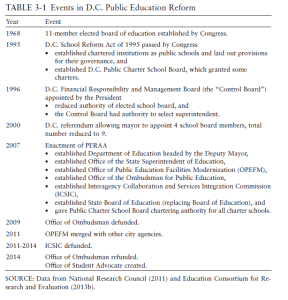
Democracy time line

This chart from the report shows the attack on democratic processes in D.C. from finally getting democratic control over their schools in 1968 to complete loss of parental control with the passage of Public Education Reform Amendment Act. D.C. joined the other “corporate reform” cities such as Chicago, Los Angeles and New York in establishing the mayor as czar of education significantly diminishing the effect parents and teachers have on education policy.

By 1995, D.C. schools were charging down the path of “corporate education reform” when Bill Clinton signed the D.C. school reform act introducing charter schools and establishing the charter school board. The growth of charter school privatization movement is startling with charter schools enrolling nearly 50% of D.C. students in 2015. From the report:

“… by 2014, the percentage was 44 percent. PCSB [Public Charter School Board] reports that there are approximately 100 individual charter schools, governed by 61 chartering organizations, which function as school districts, or local education agencies (LEAs). D.C. has one of the largest percentages of a city’s students enrolled in charters nationwide, and D.C. is viewed as a leader by proponents of charter schools.” Pg 31

With almost 50% of the D.C. students in charter schools governance in certain aspect of education is not possible. Originally, charter schools were supposed to be laboratories that were freed from the more stringent rules for public schools so they could try new ideas. However, when 50% of the students are in charter schools, parents, educators and administrators have no way of monitoring education practices or spending. D.C. functionally has 62 school districts. One for all the public schools and one for each of the 61 charter school management organizations that operate in private. As the report says:

“There are no standardized formats or definitions in charter schools’ budgets or audits, though the PCSB [Public Charter School Board] is making progress in this area. The adequacy study also commented on the difficulty of ascertaining charter facility costs. In addition, the charter management organizations’ accounts are not open to the public, and there have been cases of mismanagement.” (Page 72)

“Because each charter school is an independent local education agency, the charter sector did not (and does not) have any overarching strategy to improve teacher quality (or any other factor in education).” (Page 79)

This lack of accountability is costing the public schools money and at the same time there is no way to know how the charter schools are spending money especially when it comes to special education and second language learners. The structure of education in D.C. is failing special education students. From the report:

“In another DCPS [D.C. Public Schools] official’s view, the problem is that a charter school will receive all the required supplementary special education funds for a student while DCPS is still expected to provide supplements that a student requires, such as dedicated aides or home or hospital services. This official also noted that DCPS has no authority to address problems in charter schools: it can only report noncompliance to PCSB [Public Charter Schools Board] and to OSSE [Office of the State Superintendant of Education].” (Page 129)

“The U.S. Department of Education has recently reported that that D.C. is among the worst school systems in the nation in providing appropriate educational opportunities for students with disabilities, and it has the worst record of any state in the country for meeting federal special education goals.” (Page 131)

“Another city official we interviewed commented that “there is no monitoring arm for how LEAs [Local Education Agencies] serve the ELL [English Language Learners] population.” For example, this person noted, the city provides $4,200 in funds in addition to the $11,000 allocated under the uniform per student funding formula (an additional $6,000 is provided for each special education student), but there is no structure for monitoring what LEAs [Local Education Agency] do with these funds or determining whether they are addressing students’ basic needs. At the same time, charter schools have no consistent source of technical assistance or other resources, such as professional development, to help ensure that they are providing what English-language learners need. As a city official noted, “there is no way for people to know if they are doing it right.”’ (Page 133)

One of the largest problems created by the lack of cohesiveness between the charter schools and the public schools system is that students are being lost. These lost students become what Dr. Mark Naison has labeled “the Disposables.” Dr. Naison writes:

“They are the more than 90 million Americans of working age who are not in the labor force and do not have regular jobs.

“They are the millions of teenagers who dropped out or were pushed out of school in cities like Detroit and Memphis and New Orleans and Los Angeles and Chicago and have disappeared from view because the divisions between charter schools and public schools have made it impossible to develop a coherent strategy to make sure no child is lost.”

The report notes the D.C. schools have a “crisis in absenteeism” and a terrible graduation rate.

“D.C.’s public schools have had among the worst on-time graduation rates in the country. For the class of 2014, the overall rate was 61 percent, compared with the national average of 81 percent (Chandler, 2014d). For DCPS schools, the graduation rate was 58 percent—up 2 percentage points from the previous year; for the charter schools, it was 69 percent—down almost 7 points.” (Page 154)

“Nationally, for 2012-2013, the overall rate increased from 78 to 81 percent; for blacks it increased from 66 to 68 percent, and for Hispanic students it increased from 71 to 76 percent.” (Page 189)

The report also contained this nugget suggesting that charter school gains in test performance over time do not match public schools.

“The EDCORE analyses by sector also showed that, although both DCPS [D.C. Public Schools] and charter students showed improvement, the magnitude of the gains were higher for DCPS students in every year.” (Page 177)

Mayoral Control and VAM Evaluation

A central tenant of “corporate education reform” is to limit democratic processes by ending elected local school boards. Democracy is always more difficult to administer than authoritarian control from a centralized power like a mayor. Of course this means that parents and teachers will not have much of a voice (if any) in how their local school; is run, what it teaches or what its policies are. In 2007, the city of Washington D.C. completed its embrace of “corporate education reform” when the Mayor Renty assumed total control of all public schools. The report observes:

“The specific strategies that Fenty and the chancellor he appointed, Michelle Rhee, chose were prominent on the national reform agenda: an emphasis on improving human capital using recruitment, evaluation, and compensation of educators; data-driven decision making; more uniform standards across schools; and greater school-level accountability through the use of student testing and other indicators.” (Page 40)

Fenty chose a person with five weeks of Teach for America training and three years’ experience teaching first grade to be chancellor. It was an odd choice, but she was connected to the lawyer, Joel Klein, who Michael Bloomberg had selected to run New York’s schools. Mayoral control seems to always value political considerations over professional competence when selecting public school leaders. For example, in Chicago, Daly chose Duncan and in Los Angeles, Villaraigosa chose Deasy; neither man had significant professional credentials or experience in education.

The agenda chosen was straight out of the “corporate education reform” playbook. They blamed teachers and principals for poor testing and graduation results, they instituted teacher evaluations base in large part on growth models known as value added measures and they introduced merit pay for teachers and principals. Survival in the Rhee-Fenty schools would depend foremost on high stakes testing.

Education reporter, John Merrow, summed up Rhee’s tenure of just over three years running D.C.’s schools:

“Ms. Rhee made her school principals sign written guarantees of test score increases. It was “Produce or Else” for teachers too. In her new system, up to 50% of a teacher’s rating was based on test scores, allowing her to fire teachers who didn’t measure up, regardless of tenure. To date, nearly 600 teachers have been fired, most because of poor performance ratings. She also cut freely elsewhere–closing more than two-dozen schools and firing 15% of her central office staff and 90 principals.”

“For teachers, DCPS has become a revolving door. Half of all newly hired teachers (both rookies and experienced teachers) leave within two years; by contrast, the national average is understood to be between three and five years. Veterans haven’t stuck around either. After just two years of Rhee’s reforms, 33% of all teachers on the payroll departed; after 4 years, 52% left.”

For more than 100 years, political leaders have every few years proposed merit pay as a way to motivate good performance. This idea does not have a great track record in most industries, because it undermines unity of purpose. In education, it has been a total failure laced with fraud, but this does not stop “corporate education reformers” from insisting on merit pay. Rhee’s merit pay scheme, which pays bonuses of up to $25,000, led to a cheating scandal. Merrow’s report continued:

“Some of the bloom came off the rose in March 2011 when USA Today reported on a rash of ‘wrong-to-right’ erasures on standardized tests and the Chancellor’s reluctance to investigate. With subsequent tightened test security, Rhee’s dramatic test scores gains have all but disappeared. Consider Aiton Elementary: The year before Ms. Rhee arrived, 18% of Aiton students scored proficient in math and 31% in reading. Scores soared to nearly 60% on her watch, but by 2012 both reading and math scores had plunged more than 40 percentile points.”

After two decades of adopting the “corporate education reform” agenda, the D.C. schools are damaged. Curriculum has been narrowed by hyper-focus on high stakes testing, which only accurately identifies economic conditions in the neighborhood. With just 25% of students attending their local community school and many community schools closed these once pillars of community support have been toppled. Parents have no effective place to bring grievances and experienced professional educators have been pushed out in favor of new hires, many of whom are unqualified Teach for America replacements on temporary contracts.

All this disruption and still the outcomes from the D.C. schools are some of the worst in the nation. They still have an attendance crisis and a graduation crisis. Their scores on NAEP [National Assessment of Education Progress] testing is still at the bottom of the nation. The problem is not the schools or even the misguided “corporate education reform.” The problem is rampant and unaddressed poverty in the neighborhoods of our nation’s capital. The problem has never been our public schools; it has always been poverty.

  • “National Research Council. (2015). An Evaluation of the Public Schools of the District of Columbia: Reform in a Changing Landscape. Committee for the Five-Year (2009-2013) Summative Evaluation of the District of Columbia’s Public Schools. Board on Testing and Assessment, Division of Behavioral and Social Sciences and Education. Washington, D.C.: The National Academies Press.”
  • Schneider, Mercedes. Common Core Dilemma “Who Owns Our Schools?” Teacher’s College Press, New York and London, ©2015 by Teacher’s College, Columbia University.
  • Ibid.

Lily’s Betrayal Letter

5 Oct

Yesterday was the worst of days and best of days. In the morning as usual I checked email and social media and there was Steven Singer’s post, “Teachers Told They’re Endorsing Hillary Clinton by NEA Leadership. Membership Opinions Unnecessary.” When I finished his post I saw my friend Paula Meyers had posted the Seattle area justice fighter, Susan Dufresne’s graphic #NEADoesntSpeak4Me; that caught my emotion exactly. With this in mind, I went to the Kearny Mesa Buddhist Center for World Peace Prayer. In the afternoon, things seemed improved; the San Diego Chargers won an exciting game over the Cleveland Browns.

NEADoesntSpeak4Me

Then I got an email message from Lily Eskelsen-Garcia, president of the NEA. Lily has been a great disappointment to me. It is not her fault. It’s mine. I believed she was a breath of fresh air who rose to the leadership of the NEA by merit and was willing to speak truth to power. Fooled again! Then this April in Chicago she stood on stage and lied to us. She pledged to no longer take money from Bill Gates but her fingers were crossed. Now, she employed power politics to get Hilary Clinton the NEA endorsement; personal power and influence have trumped democracy, public education and the teaching profession. I will attempt to analyze her message.

“My fellow educators,
I wanted to be the first to let you know that your elected representatives to the NEA PAC Council and the NEA Board of Directors took action to recommend Hillary Clinton in the Democratic primary for President of the United States. I am so proud of the thoughtful, thorough and incredibly rich discussion that your elected leaders held. It was truly what democracy looks like.”

Balderdash! I live in California, my elected representatives didn’t even vote. We have the largest delegation in the United States.
I heard that you argued against those who said there is no reason to give our endorsement this early, saying we would lose political clout if we don’t. It is also said that you felt that Bernie Sanders would never be able to mount a credible winning general election effort.

“I am also extremely proud of this decision because I know that Hillary is a strong leader who will do what’s best for the future of all of America’s students and public schools.”

Anthony Cody is correct, clear and succinct on this point: “The current field of candidates in the Democratic party is limited to Hillary Clinton and Bernie Sanders. Clinton has a close association with the Gates Foundation, which has been a major donor to the Clinton Foundation. Clinton has made it clear that she is a solid supporter of the Common Core and believes that such a testing system ‘helps you organize your whole education system.’ So if we want a change from the nation’s current trajectory in education, we need to look elsewhere.”

It is beyond my most optimistic reach to see Hilary Clinton as being more than marginally different than Barack Obama when it comes to education policy. There is a reason that Marc Tucker wrote the infamous ‘Hilary Letter’ to her. He saw a like-minded individual that would support the tenets for education reform that Diane Ravitch later labeled “corporate education reform.” This is education reform that views students as economic assets to be cultivated for the benefit of the state.

“After an extensive review of the candidates and an in-depth discussion, your leaders saw what I know – Hillary Clinton will be a champion for students and educator in the White House. She has a 30 year history of standing up for students and strong public schools and has actively engaged in conversations with educators in this campaign. Secretary Clinton told your leaders today that she won’t make a single decision about developing education policy without educators being in the room.”

This is complete prevarication. She has a close supportive relationship with both Bill Gates and Eli Broad. She was billed as co-President by her husband when he signed legislation taking power from Washington DC’s school board and authorizing charter schools. It was from that administration that we got “Goals 2000” and its call for national standards and testing. She voted for “No Child Left Behind” (NCLB). That is not a 30-year history of standing up for students and strong public schools. And her friends from her days as a member of the Board of Directors at Walmart have to be counted among the nations biggest enemies of public schools.

“As a U.S. Senator, Hillary Clinton was a champion for our cause, earning an “A” grade from the NEA for her support on the issues most important to our students, but even before serving in the Senate, Clinton was a champion of the students we educate. While every first lady has an admirable cause, Hillary chose to stand up to the for-profit healthcare industry to advocate for children’s healthcare. Her campaign ultimately led to the largest expansion of public health care in decades, when millions of American children received health coverage under the Children’s Health Insurance Program (CHIP).”

Clinton voted for the punitive anti-teacher NCLB in 2001. This March, Edweek reported: “And earlier this year, the American Federation of Teachers, which endorsed Clinton in her 2008 race, and the Center for American Progress, a think tank closely aligned with the Obama administration that also includes some former Clinton aides among its top ranks, came out with a proposal to test students every year, but only use the results for school accountability in certain grade spans.” So, did she get that NEA “A” grade for supporting testing or was it her work on health care?

“Even before running for president, Hillary championed early education and affordable college, and she sponsored efforts to ensure equal pay for equal work and to make it easier for workers to join a union.”

This sounds like pretty much what all Democrats say they stand for and it is hard to see how this makes her so much better than other Democrats vying for the nomination. Why didn’t the NEA keep its powder dry and see who was willing to save public education form greed driven reform? Get some real and substantial commitments? It appears that this endorsement is more about currying favor for national union leaders with the Clinton’s than it is about fighting for teachers and public education.

“And in 2016, the stakes for strong public schools will be too high to sit on the sidelines! Right now, there are presidential hopefuls who have made a career of attacking educators and public education to the detriment of students. They have allies like the Koch brothers, who have committed to spend $1 billion to defeat a pro-public education candidate like Hillary Clinton and taking control of the White House.

“With so much at stake, you cannot sit on the sidelines – America’s students need you today! And that is why I am asking you to join our campaign stand up for our students and make sure that we give all students the opportunity to a quality education.”

Yes, it is true that a lot of money is being spent to destroy public education in America. Unfortunately, a lot of that money is from people like the hedge fund fake democrats at the Democrats for Education Reform who support Hilary. There is nothing here that says she is clearly the champion for public education that we must support. She looks a lot more like a corporate education reformer who will continue the disastrous Obama agenda.

“Together, we can help elect Hillary Clinton as our next president and ensure that every child has the opportunity to succeed.
Gracias,
– Lily
Lily Eskelsen Garcia
National Education Association President”

Lily, you need to rethink your course. You are a smart beautiful spokesperson for the NEA. You are dumping that great opportunity to make a real difference and playing value degrading power politics that has eliminated the democratic process in our union to get this endorsement. Two other major unions – the Service Employees International Union and the American Federation of State, County and Municipal Employees – have indicated that they will take more time to consult their members about an endorsement in the primary.

Common Core Dilemma is the Bomb

23 Jun

Mercedes Schneider’s new book is “evidence based” and damning. She concludes with “CCSS [Common Core State Standards] cannot work.” And “It is destined for the education reform trash heap, just like the punitive, test-driven No Child Left Behind (NCLB) from which it emerged.”

In Common Core Dilemma, Schneider shows herself to be a masterful researcher and clear thinker. She takes on the daunting task of making this Machiavellian episode concise, engaging and understandable. She triumphs.

If you never heard of the common core or “corporate education reform”, this book will be a difficult but necessary read and there is no choice but to educate yourself. If on the other hand you have been immersed in this issue since 2009, Common Core Dilemma will confirm your worst suspicions and demonstrate that you might have been naïve but certainly not cynical.

The opening chapters document the roots of CCSS sewed within Bill Clinton’s goals 2000 and the creation of the non-profit Achieve Inc. by the National Governors’ Association (NGA). Achieve became the corporate vehicle for producing the “state led” CCSS and goals 2000 accelerated the quest for national education standards.

Louis Gerstner, IBM CEO, is identified as the “godfather” of Achieve. As the keynote speaker for the NGA conference in 1995 Gerstner stated three urgent education goals for 1996: (1) high national academic standards with accountability, (2) the standards must happen NOW, and (3) don’t be sidetracked by academicians. Louis was well positioned to shape education policy; not only had he been to school, he had hired people who had been to school. In 1996, the governors of NGA held their Education Summit at Gerstner’s IBM conference facility in Palisades, New York.

As I read this documented history, I started wondering if Bill Gates’ personal competition with IBM and Gerstner had something to do with his decision to become an education “reformer”?

Ironically, the National Governors Association created their own non-governmental non-profit or was it really Gerstner who started Achieve? In any case the organization that wrote the CCSS was the creation of 40 governors and 49 corporate executives at the 1996 IBM meeting. No practicing educators were involved. No wonder Diane Ravitch calls this “corporate education reform.”

Mercedes sums up the attitude, “No need to meaningfully involve teachers in changes that Achieve, Inc. had already decided needed to be instituted.” After all we were warned by Gerstner, “Don’t be sidetracked by academicians.”

The precursor to CCSS, American Diploma Project (ADP), is explained. In her description, Schneider details the three principal organizations involved, Ed Trust (Kati Haycock), Fordham Foundation/Institute (Checker Finn) and Achieve Inc. These three non-profits garnered huge corporate largess while developing and promoting ADP. Schneider notes that during the ADP standards development when Achieve defined American education as failing; Achieve was repudiating its own claims of success two years earlier.

The story of how Achieve’s 2008 paper “Out of Many, One” became the central document for selling CCSS illustrates clearly that CCSS certainly was not a state led effort. It was the effort of incorporated non-profits financed by other corporations and corporate executives.

An intriguing set of relationships appear in the story of David Coleman and his Student Achievement Partners (SAP). Coleman is known as the lead writer of CCSS. It was he and the President of Council of Chief State School Officers (CCSSO), Gene Wilhoit, who went to Seattle and convinced Bill Gates to finance the development of CCSS.

The “reformer” relationships are surprisingly intertwined. David Coleman had a previous lucrative business deal with Chicago Public Schools through his startup company Grow Network. CEO Arne Duncan gave him a $2.2 million non-compete contract to analyze testing data in 2002 and renewed it in 2003 for $2.1 million. Coleman and his partner Jason Zimba sold Grow Network to McGraw-Hill and started Student Achievement Partners (SAP) in 2007.

The lead writers of CCSS were David Coleman, Jason Zimba and Susan Pimentel all from SAP. The rest of the original 24 writers were from Achieve, College Board and ACT. Today, Coleman is President of College Board and the man who helped him sell CCSS to Gates, Gene Wilhoit, has left CCSSO and taken the lead at SAP.

The only person amongst the original group of 24 people who wrote the CCSS that had any classroom teaching experience at all appears to be Zimba. He taught physics at Bennington College for a short duration. And strangely enough the president of Bennington College while he worked there was David Coleman’s mother, Elizabeth Coleman.

Bill Gates the billionaire who dropped out of Harvard only to become the richest man in the world by means that are not entirely above scrutiny, paid for both the writing of CCSS and for insuring they get good publicity. The insane amounts of money Gates doled out to organizations that supported his education ideas such as “without measurement, there is no pressure for improvement” is thoroughly documented and explained.

Gate basically became the de facto national school superintendent or secretary of education only more powerful. It is estimated that the spending on CCSS by the Bill and Melinda Gates Foundation may run into the billions of dollars. It is a complete distortion of the democratic process and has led to bad and wasteful policies. Policies like mandating a nationwide change to a new pedagogy that has never been tested and demanding that all schools across America abandon their current curriculum and develop a new one immediately with no transition time.

An enlightening chapter explains the amazing CCSS Memorandum of Understanding (MOU) which was signed by 46 governors and theirs state school chiefs before the CCSS were ever written, thus locking them in to the “voluntary” standards. It explains how it came about, the implications and the need for the lock-in.

The final few chapters deal with the enormous amounts of money mega-corporations like Pearson are planning to make from CCSS. It appears the real reason all the states had to have a standardized education is to pave the way for mega-corporations to dominate the education testing and publishing industry. It allowed them to take their products to “scale” where smaller local companies could never compete. As Mercedes points out “the goal of CCSS is not excellence. It is standardization.”

Common Core Dilemma is definitely a book that anyone trying to defend public education from privatization and profiteering should have in their library. For the uninitiated to the corporate takeover of public schools it will be more than an eye opener. Finally, it’s an informational text so David Colman would surly approve of it for your high school students to read.

“Is TFA a CULT?”

12 May

By T. Ultican 5/12/2015

This question arose from the audience at a recent NPE (Network for Public Education) colloquium on the TFA (Teach for America) – my answer, “no, TFA is not a cult.” However, the question is not without merit. Cynical actors are taking advantage of sincere young people for personal power and profit. In the same way that military organizations take undisciplined and timid youths, isolate them, stress them and indoctrinate them with a certain ethic.

TFA indoctrinates its new corps members with a behaviorist and market based education ideology. It is not the Peoples Temple in Guyana but it is in the words of Chad Sommer “an incubator for transforming social justice minded youths into advocates for Koch-brothers style education policies.”

NPE held its 2015 convention two blocks up the street from Lake Michigan in the historic Drake Hotel. Sunday morning, I went from breakfast with hundreds of BATs, teachers, and parents, who believe public education is important enough to fight for, to a session focused on the TFA. On my way, I passed by a large open room with thirty or so well appointed tables just off the lobby. Since the construction of the Drake in 1920, high tea has been served there every day.

I recalled the story a teacher from Minnesota told me. In 1947, a public school teacher from a poverty stricken rural community not far from Minneapolis had driven her five eighth-graders to Chicago and treated them to high tea at the Drake. My new friend from Minnesota said that her eighty-year-old mother still counts that among the greatest memories of her life.

The expert panel at the TFA session:

Moderator: Julian Vasquez Heilig, Director of the Doctorate in Educational Leadership Program at Sacramento State University and a founding board member of the NPE.

Professor, Terica Butler earned her Doctoral degree from the Department of Instruction and Curriculum Leadership at University of Memphis in May 2014. Her research emphasis was on alternative paths to teacher credentialing which included researching the training of TFA corps members.

Annie Tan, is currently a special education teacher in Chicago public schools with a master degree in special education. She was a member of TFA corps class of 2011 placed in a Chicago charter school.

Chad Sommer, with a degree in marketing, became a member of the TFA corps class of 2011 placed in Chicago public elementary school.

 Jameson Brewer, Ph.D. student in Educational Policy, Organization and Leadership at the University of Illinois at Champaign-Urbana was a member of TFA corps class of 2010 placed at Carver High School in Atlanta, Georgia.

Katie Osgood is a special education teacher in Chicago currently working at a psychiatric hospital. She also taught special education in the Chicago Public Schools. She holds a Masters in Elementary and Special Education from DePaul University.

It may be possible to criticize the quality of some of this panel’s judgments, but one point is clear, their research and advocacy will not pave the way to personal profit or power in the same way that being pro-TFA could.

A path to political power and prestige is available to corps members and researchers who support these three positions: (1) Education outcomes are the responsibility of teachers and there are no excuses for teachers who fail to raise test scores. (2) Authoritarian leadership is required in both the classroom and in the administration of schools. (3) Market based principles are the path to scholastic improvement and standardized testing is the only reliable measurement of that improvement. Each of the panel members pushed back against these market-based “reform” positions that are profoundly embedded within TFA.

Professor Heilig opened the proceedings with a few brief personal remarks. He told us of his own experience at forums to discuss TFA and facing rooms packed by TFA corps members and supporters. He also mentioned that TFA with the backing of large private funding from organizations like the Gates, Broad and Walton foundations pays staffers on Ed-committees in Washington DC for both the Democrats and the Republicans.

TFA is an organization that is both willing and able to play power politics to get its agenda enacted.

Professor Butler observed that the summer five week training course did not equip the corps members for a full time teaching schedule in the fall. Summer-school students are only in class for four hours a day and there were normally four corps members assigned to each class. That meant that the TFA corps member student taught by sharing a class and only taught for 1 hour a day. Then in the fall they were hit with six hours a day in a classroom by themselves.

Jameson Brewer and Annie Tan were unusual corps members. They studied education in school and joined TFA to get a job when they could not find a full time teaching position. Somehow even during the height of the depression, TFA was able to place its corps members in classrooms across America.

Jameson who went through a university credentialing program prior to TFA told us that he became an example of how well TFA teachers perform in the classroom. He also shared the following table of data with us comparing TFA preparation with preparation by a typical teacher education program.

Student teaching Methods Observations
TFA 16-18 hour 125 hours 2
Typical TEP 630 hours 496 80

Chad Sommer was more typical of the TFA experience. He has written that I was “naively seduced by TFA’s do-gooder marketing pitch. I charged ahead on a mission to close the academic ‘achievement gap’ that TFA blames on incompetent (read unionized) teachers.” With a marketing degree in hand and five weeks of training which included a heavy dose of Doug Lemov’s Teach Like a Champion (part of the TFA recipe for teaching), Chad became a new elementary school teacher at a public school in Chicago.

All three former TFA corps members agree that they were taking jobs that would otherwise have gone to a trained educator and Jameson Brewer says he directly replaced an experienced certificated teacher much to the chagrin of the principal that was forced to hire him.

The TFA Message to Corps Members

The fundamental messages these corps members received during training were that public schools in America are failing and the cause is bad teaching. Social conditions are just an excuse. Great teachers can overcome “achievement gaps” and not raising test scores means that the teacher is a failure. These failing teacher are said to have succumbed to “the soft bigotry of low expectations.” The sole arbiter of success in a classroom is test scores. This was all part of the TFA academic impact model.

Teach for America and the ‘education entrepreneurs’ who developed the “no excuses” charter school movement (mostly TFA alums) believe that America’s schools are failing and that they have a mission to save our country’s future. People like Doug Lemov, Stacey Boyd and John King, with no substantial background in education (which they see as a strength), started schools.

They Derided education theories taught by university professors. It was clear to them that the first item to fix in schools was discipline so they put children in uniforms, made many rules about everything the children did and enforced those rules harshly. It reminds professional educators of 19th century pedagogy.

Based on behaviorist theory, the “no excuses” model is completely authoritarian and autocratic. While a really skilled practitioners might raise test scores employing these harsh tactics, there are terrible side effects. Students learn to hate learning and creativity is sundered. To use professor Zhao’s metaphor – Rudolph the red-nosed reindeer will be killed.

Annie’s Story

I met Annie Tan at breakfast on Saturday morning. As I was headed into lunch after the morning sessions I encountered Annie again. Being a friendly engaging person, she invited me to go with her to find a table. We walked to the front of the giant room accommodating at least 35 tables for 12 and sat down with Jose Vilson, the well-known blogger from New York, Peter Greene AKA Curmudgucation, Jennifer Berkshire AKA EduShyster, and Adell Cothorne, the principle who blew the whistle on Michelle Rhee. Also at the table was Peter Greene’s wife. It was an amazing hour and I discovered that Peter, his wife and Jose are trombone player like myself. Later, I learned that Peter and his wife met through their participation in a community orchestra.

Annie Tan graduated from Columbia University with an emphasis in special education. When she could not get a job, she joined the TFA and was sent to Chicago. Annie was assigned as a special education teacher at a charter school in Chicago. She was the only special education teacher on staff for grades K-4.

The only support she received was during her monthly TFA advisory visits. The school was led by a TFA alum and most of the staff was current or former TFA corps members. Few staff member had more than three years’ experience. In February, Annie’s TFA supervisor (not the principal) informed her she was failing as a teacher by not moving her students fast enough towards success on standardized testing and may be fired.

At the end of the year, she was fired. Four years later, she has a master’s degree in special education and is succeeding as a teacher in the Chicago Public School system.

I know from my personal experience that being labeled a failure is psychically devastating. Primary tenets of corporate inspired “reform” include disruption, labeling a certain percentage of people failures and firing them as a warning to those left behind.

During my first year of teaching, I worked under the Alan Bersin administration in San Diego. Diane Ravitch tells the story of Bersin and the corporate “reform” piloting done by San Diego Unified School District in her book, The Death and Life of the Great American School System. I was fired for not moving my students toward achieving standards even though my classes scored extremely well on the district end of course exams.

I had a credential in math, a credential in physics and high test scores but that was all trumped by the requirement to let go a certain number of first year teachers. I was a fifty year-old and that is probably the reason I was targeted. Even though I felt certain the firing had very little to do with my actual performance in the classroom, I was bothered by self-doubt about my abilities as an educator for the next decade.

I am guessing the Annie still believes in some corner of her mind that she failed at her first teaching job and that thought still undermines her confidence. Authoritarianism is a horrible creed and especially horrible when applied to an education environment.

TFA is a Cult

A great warrior for public education, Katie Osgood, made these three assertions: “TFA is a cult; its corps members are exhausted, isolated and only have TFA to attach to.” “TFA is destroying communities of color: they drive out teachers of color.” And “Tenure is a children’s right.” While I quibbled with her use of the term cult, I recognize she is the psychiatric professional and I certainly agree that they do use the techniques she describes to change youthful idealistic minds toward a market based ideology.

Her last two claims are unvarnished truth. Katy has been identified by TFA as the number one opponent of TFA on social media. She is relentless and impassioned. I am glad she is on my side. In her “An Open Letter to Teach for America Recruits” Katie writes:

“Many of you no doubt believe you are joining a progressive education justice movement; that is the message TFA sells so well. But TFA is not progressive. The data-driven pedagogy, the fast-track preparation, the union-busting, the forced exploitation of your labor, the deep-pocketed affiliation with corporate education reform are all very conservative, very anti-progressive ideas.”

And

“Ask yourself: Since when did billionaires, financial giants, or hedge fund managers on Wall Street begin to care about the education of poor black and brown children in America? If you follow the money, you will see the potential for mass profit through privatization, new construction, union-busting, and educational service industries. Why would a group dedicated to educational justice partner with these forces?”

On further reflection, I think TFA just might be a cult.