
By Thomas Ultican 3/9/2026
Artificial Intelligence (AI) is a billionaire driven con job. In the early 20th century, eugenicists claimed they could improve the human condition by measuring general intelligence and eliminating the bad genetics associated with dense people. Their unsavory ideology posited a racial hierarchy based on faulty intelligence testing. Still today, researchers have never found a reliable way to measure intelligence. The concept of artificial general intelligence (AGI) rests in part on a belief that intelligence can be measured. It is science fiction that is unlikely to ever exist but there is money to be made. Unsurprisingly, tech billionaires are invading America’s schools to advance their latest scam while teachers are busy “AI-proofing” classrooms.
Google announced an AI training for “all six million K-12 teachers and higher education faculty.” They have signed a three-year agreement with ISTE+ASCD to carry out the training using Google’s Gemini and NotebookLM tools.
Benjamin Riley, who founded the think tank Cognitive Resonance, believes the Google partnership is part of an ongoing process making ISTE+ASCD a “shill” for Big Tech. He predicted that much of the training will end up “wasting teachers’ time, Google’s money and ISTE+ASCD’s relevance.”
The Association for Supervision and Curriculum Development (ASCD) began as a part of the National Education Association (NEA) in 1943. In 1972, they separated from the NEA. ISTE was founded in 1979. In the 1980s, ISTE worked on developing education technology standards. In 2015, the national education technology standards were renamed the “ISTE Standards.” In 2023, ISTE and ASCD merged forming ISTE+ASCD. It is the relevance of this organization that Riley claims will be destroyed by their signing the Google training contract.
This past July, the American Federation of Teachers (AFT) announced $23 million in funding from Open AI, Anthropic and Microsoft for a National Academy of AI Instruction to train up to 400,000 educators. The new entity will train teachers “on how to use AI tools for tasks like generating lesson plans.” University of Mississippi researcher, Mark Watkins, described this announcement as “a gigantic public experiment that no one has asked for.”
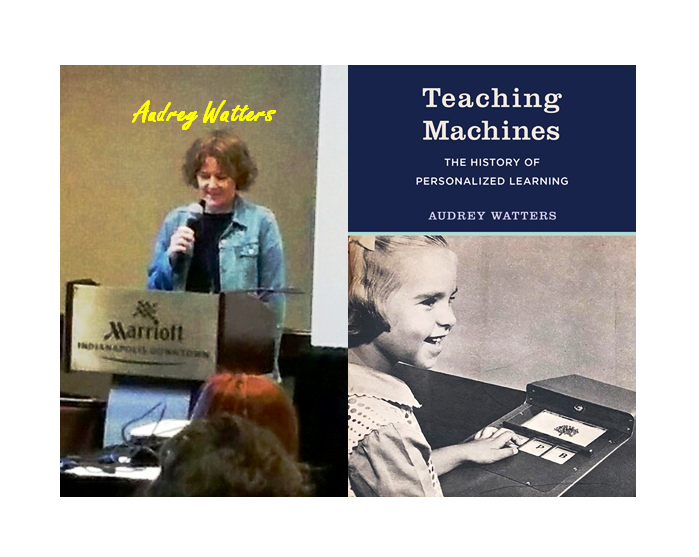
Technology and education critique Audrey Watters says, “unions should be one of the ways in which workers resist, rather than acquiesce to … the tech industry’s vision of the future.” By joining forces with big tech, AFT is implicitly endorsing its products. Watters continued, “Teaching teachers how to use a suite of Microsoft tools is not so much an ‘academy’ as a storefront.”
Or as Ben Riley wryly put it, “Google and ISTE+ASCD announce new partnership to destroy US education.”
Middle School Students Not Learning Science
In every corner of the United States, people want their children to have a world class education. As a result, throughout the country spending on education is huge. The lords of Silicon Valley are desperate to make AI profitable and see education technology as possible source of big profits. They don’t give a damn about educating children but really want to sell AI no matter how useless or even harmful it may be for education.
Bums Rush for AI
Ted Gioia writes a popular blog about culture. In a post last July, he noted:
“AI is now bundled into all of my Microsoft software.
“Even worse, Microsoft recently raised the price of its subscriptions by $3 per month to cover the additional AI benefits. I get to use my AI companion 60 times per month as part of the deal.”
“Most people won’t pay for AI voluntarily—just 8% according to a recent survey. So they need to bundle it with some other essential product.”
This is a big dilemma for the tech masters. A huge amount of Wall Street money is being poured into AI but profits are not there and maybe never will be. The investors want to see a return.
AI technology is very expensive and environmentally destructive. It is estimated that data centers will consume 1,580 terawatt-hours a year by 2034. One terawatt hour is the equivalent energy of a billion kilowatt hours. The associated data centers are also water hogs. At ChatGPT, for every 5 to 50 responses, two cups of water are consumed. With daily customer usage in the millions, that is a lot of water. (The AI Con – Page 159)
A known high school Spanish teacher and author from Indiana, Matt Miller, says what teachers get from AI company training is over-the-top talk about “how much the world is going to change and how we’re revolutionizing education.” The trainers never address the fact that most students use generative AI for “cognitive offloading.”
I was in the classroom when internet use first exploded on the scene. Within a couple years, I was getting beautifully written physics-problem solutions from most of my students. I soon discovered that there were worked out examples of almost all physics problems available on-line. That particular group of students did not learn the material and did poorly on AP testing. I am quite certain that AI in school will be even more detrimental to learning.
AI, when demonstrated by technology salesmen, is akin to magic. There is a reason a magician never reveals how their tricks work. In the same vein, no AI sentience exists and is not likely to ever exist but claims of AI sentience exist. These fictitious claims endorse thinking about the nature of intelligence that is based in eugenics and race science. (The AI Con – Pages 22-23)
Watters claims, “schools must do everything in their power to protect their faculty, staff, and students from the eugenicists and the fascists and the ‘anti-Woke’ mobs.”
Justin Reich wrote in the Conversation, “At MIT, I study the history and future of education technology, and I have never encountered an example of a school system – a country, state or municipality – that rapidly adopted a new digital technology and saw durable benefits for their students.”
Watters added:
“So why exactly are we rushing into this whole ‘AI literacy’ thing? I mean, other than the obvious grift, of course.”
Closing Remarks
AI stands for artificial intelligence which is a fraud. There is no intelligence; artificial or otherwise. A huge amount of data—most of it stolen—is run through computer-based algorithms. Much like a plastic extruding machine creates products, these algorithms are word, number and image extruding machines. In their book “The AI Con,” professors Emily Bender and Alex Hana labeled LLMs like ChatGPT “synthetic text extruding machines”. (The AI Con – Page 31) That is a much more accurate and descriptive name than AI.
Some community college districts in California have spent millions on AI-chatbots to help students navigate admissions, financial aid and campus services. Unfortunately, the chatbots do not provide clear and accurate answers.
This points to the same reason; I never trust AI for an internet search because AI makes mistakes. The spending on AI is gargantuan and it is still not reliable. Some of these issues may be overcome but it will never be good at education.
Do we really want to encourage children to use facilities that generates AI child sexual abuse material? Last year, a Stanford Cyber Policy Report stated:
“In this report we aim to understand how educators, platform staff, law enforcement officers, U.S. legislators, and victims are thinking about and responding to AI-generated child sexual abuse material (CSAM).
“Our main findings are that while the prevalence of student-on-student nudify app use in schools is unclear, schools are generally not addressing the risks of nudify apps with students, and some schools that have had a nudify incident have made missteps in their response.”
AI is dangerous, not accurate and I believe it will harm education. There is just no reason for America’s schools to rush into this technology. And when schools do adopt AI, let that adoption be guided by educators and not by technology salesmen.


 tultican
Recent Comments