Tag Archives: Ashana Bigard

Beyond Resilience Katrina at 20

14 Oct

By Thomas Ultican 10/14/2025

The book William Franz Public School is a well documented work that shines a light on the deep racism in New Orleans and especially in its public schools. The title is the school where 6-years-old Ruby Bridges accompanied by federal officers desegregated New Orleans’ schools to the chagrin of the 1,000 plus protesters out front. “The message rang clear; Louisiana’s strong commitment to the education of its White, wealthier children paralleled an equally strong commitment to keep its Black, poor residents uneducated and isolated, and thus economically and politically powerless.” (WFPS 11) That ugly racism still permeates New Orleans which made me question what are their Black residents thinking and feeling. Ashana Bigard’s book, “Beyond Resilience Katrina 20, brilliantly provides some answers.

Bigard and her family have been in New Orleans forever; she is at least fifth generation. Her large family is a big part of the soul of New Orleans. Ashana takes her readers into the Black community that has refused to be beaten down and defeated by wealthy White supremacists.

After Katrina, the people in power stole the public community schools, fired the mostly Black teaching force and brought in predominantly white kids from Teach for America (TFA) to teach. Ashana shares that story beginning with running from the storm and then fighting against injustice for the last 20-years.
Katrina Arrived

Hurricane Katrina arrived about a week before payday for much of the New Orleans community. Like many others, Ashana and her family had experienced hurricanes before. They really could not afford to travel so they chose to wait it out at home. The storm came through and made a direct hit on the city, it was loud and intense but the next morning things seemed OK.

It was a tough night, but they had successfully ridden out the storm and it was beautiful outside. Ashana decided to walk to the old New Orleans community of Carrollton to check on a friend. Downed trees were everywhere. On the way an old man informed her that if she did not “have a boat in your pocket” she better get out of there because the levees had failed and the water was coming. (Bigard Page 11)

Some people in the community believed the levees had been purposefully blown up. Ashana and her family quickly got it together to load up and head out for Houston where they stayed until New Orleans opened again.
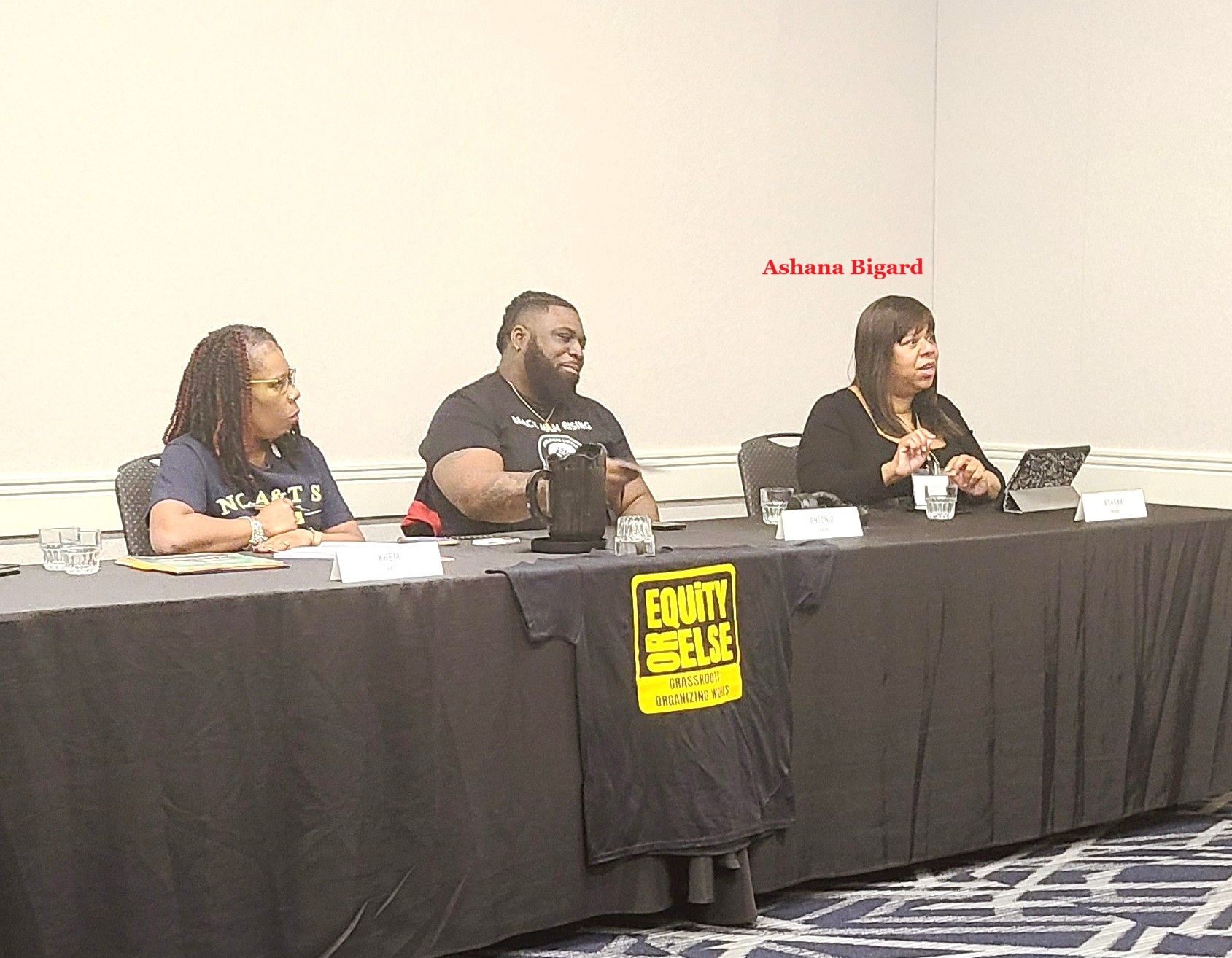
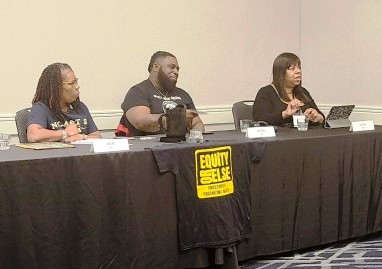
NPE 2025 Photo by Ultican

Back in New Orleans “the fraud was staggering” and media racism was appalling. Ashana noted:

“It seemed like every opportunity afforded to them, the media disparaged us calling us refugees and calling us looters. … White people getting food from stores to help each other … were described as ‘finding food.’ Black people doing the exact same thing were ‘looters’ and criminals who should be shot on sight, despite the fact that they had been left to die with no water, no food for days on end.” (Bigard Pages 32 and 33)

Rebuilding New Orleans

The work force in New Orleans is dominated by the Black community. However, when the rebuild started, local unions were frozen out. Wealthy carpetbaggers were running the show. Ashana sarcastically asks, “how could everybody get their money off the top if they were actually paying people real wages?”

There were no longer community schools that welcomed children or a city that was welcoming to its people. They soon began referring to their children’s schools as “test prep factories” and the kids called them “preparatory prison practice.” The youths of New Orleans named the new Knowledge is Power Program (KIPP) schools “kids in prison practice.” (Bigard Page 34)

Ashana worked at various non-profits as a student, parent and community counselor and advocate. She worked for families and friends of Louisiana’s incarcerated children where family members wanted to understand how their children first came into contact with the legal system.

Where were the arrests happening? Where were the summons coming from?” (Bigard Page 44)

The discovery didn’t take long. Ashana states, “The police inside the schools were arresting children for almost anything.” (Bigard Page 45) Best practices in adolescent development call for supportive environments, recognition of the biological realities of the teen years, and second chances not criminalization and punishment. This new school-to-prison pipeline was a complete abandonment of reason.

What developed in New Orleans was a harsh unforgiving no-excuses approach. This led to high expulsion rates and a 61% graduation rate.

Ben Kleban of College Prep charters told Ashana he would run his schools the way he wanted and if you don’t like it do what I did and start your own school. However, many PHDs, principals and academics from New Orleans applied to start schools almost none of them received a charter. (Bigard Page 54)

Ashana tells the story of counseling a teenage boy, a good student whose grades began falling for no apparent reason. Also he was becoming more and more despondent. After a week of discussion, he finally opened up about being sexually assaulted by a female TFA teacher. Apparently, the teacher succumbed to the adultification of young Black people. The student was blaming himself and tried to protect the teacher saying, “She came from Teach for America: they don’t give them much training.” (Bigard Page 98)

Ashana and her team were brought in to conduct a workshop on trauma: signs of trauma, solutions for trauma and how to deal with trauma in your classroom. Ten minutes into the workshop all 26 of the young White women were in tears. Ashana states:

“They were crying saying they were overwhelmed, suffering from secondary trauma, felt like they were crazy, and they all felt they were doing more harm than good. They had no support and when they went to Teach for America for support, they told them to try harder, and if they weren’t connecting, it was their fault because everyone else was doing a great job.”

The training developed into multiple unscheduled workshops that day as teachers went out and encouraged their colleagues to attend. Ashana says:

“I left the workshop understanding you never know all sides of the story and that there was a second wave of victims, and that was young, hopeful, starry-eyed white young people who thought this would be a great city to live in and a great opportunity and they could come and help out because of the teacher shortage which was caused by the firing of all our teachers and subsequently telling them that they had to take multiple tests to qualify to come back to teach while simultaneously telling young white children they only needed two weeks of training to do so.” (Bigard Pages 119-121)

The Legacy of Racism Lives On

To enroll children into the almost all charter system in New Orleans, parents must use OneApp. It runs the school choice algorithm but strangely only white children get into the best schools, not even if you’re a Black family in the upper middle class do you get a seat. It is common to see white people move to the city and magically get their children into schools with 100 children on the waiting list. Ashana notes, “They didn’t even know the school existed prior to moving to the city, but racism and classism still existed heavily within the new system.” (Bigard Page 268)

Ashana tells black people in New Orleans that poverty is not a moral failing. She says, “We start understanding that we are not broke we are stolen from.” (Bigard Page 318)

I have presented a few highlights in this delightful and insightful book. For me, Ashana’s book offers a rare view into the life of Black people fighting White supremacy and a story of love and family.

Bravo Ashana Bigard!
Privatized Education Disaster in New Orleans

3 Sep

By Thomas Ultican 9/3/2025

August 29th was the twentieth anniversary of hurricane Katrina wiping out New Orleans. On this occasion, the billionaire-funded baloney machine is outdoing itself. Ravi Gupta wrote a post for ‘The 74’ called, The Inconvenient Success of New Orleans Schools.” The Washington Post assigned a guy from the United Kingdom, Ian Birrell, to write, Never seen before’: How Katrina set off an education revolution. I gave up my subscription to the Washington Post some time ago but my friend Gary Rubinstein wrote a post about Birrell’s article. He noted, “Supposedly based on recent research, it basically trotted out all the old bogus claims that I hadn’t heard anyone claim in at least ten years.”

The truth is that the all charter school district is a giant failure that even corruption rampant New Orleans is struggling to hide.

Before Katrina, Louisiana was passing laws aimed at taking over the New Orleans public school system and there was some merit to their endeavor. Six interim superintendents appeared between 1998 and 2005. An FBI investigation led to 11 indictments in 2004 and by end of the school year in May 2005 the district was effectively bankrupt. Unfortunately, the state created the Recovery School District (RSD) and turned to privatization to solve the problem.

By the end of the 2004-2005 school year, the state had taken over five New Orleans schools. RSD turned all five into charter schools operated by four groups: University of New Orleans; Middle School Advocates, Inc.; Knowledge Is Power Program; and Institute for Academic Excellence. All set to begin in the 2005-06 school year; however Katrina made landfall soon followed by “disaster capitalists” swooping like swarming buzzards.

Before Katrina, Orleans Parish School Board (OPSB), which ran the public schools in New Orleans, operated 123 schools; in the spring following the storm, it was running just four. With OPSB out of the road and RSD in charge, “pheaulanthropists” like the Walton family, Bill Gates and Eli Broad were ready to help.

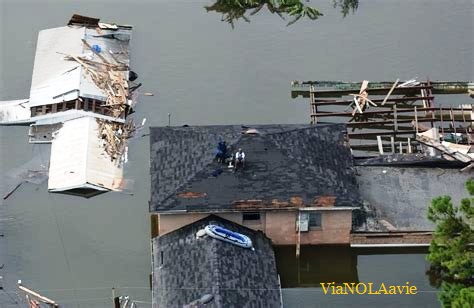
2005 Devastation by Hurricane Katrina

In 2009, Louisiana’s Board of Elementary and Secondary Education (BESE) made it more difficult for schools to remain academically acceptable, effectively ending most of the remaining public schools in New Orleans. BESE raised the minimum school performance scores for academic unacceptability to 65 for the 2010-11 school year and 75 for the 2011-12 school year. By 2018, there were no public schools left.

Evaluating the Results

In her 2018 book, After the Education Wars, Andrea Gabor wrote, “To borrow another ancient military metaphor, the New Schools Venture Fund and its New Schools for New Orleans offshoot, is the Trojan horse that funnels outside money, expertise, and influence to New Orleans.” (Page 229) The majority of the school privatizing billionaires invested by funneling funds through New Schools Venture Fund and New Schools for New Orleans (NSNO). Most of the investing was in schools adhering to the KIPP no-excuses model.

Around 2014, Neerav Kingsland was leading NSNO. He would go on to work for Reed Hastings and then become the leader of the Hastings and John Arnold created City Fund designed to promote privatization and end voter directed public schools.

In his article for ‘The 74’, Ravi Gupta claims, “There’s no one better at parsing the data than Doug Harris, who chairs Tulane’s economics department and directs the Education Research Alliance for New Orleans.” It is almost impossible to check Harris’s work because he has proprietary control of much of the education data from New Orleans. Furthermore, confidence in his work is undermined by his team sharing office space on the seventh floor of 1555 Poydras Street with NSNO.

In June, Harris released The New Orleans Post-Katrina School Reforms: 20 Years of Lessons”. It is organized around twelve conclusions. Of course conclusion-1 claims improved student outcomes in testing scores, graduation rates and college going. (Page 8) Improved graduation rates and increased college going is a national trend for which it is hard to credit the all charter school system. The claim of improved testing results cannot be shown. Since the entire system was shut down and then reconstituted as a significantly smaller privatized organization, there is nothing to compare to that was not changed.

Gary Rubenstein explained:

“Reformers needed a new experiment where the schools would keep the same students they already had, but the staff at those schools would be replaced with nonunion charter school educators, and charter chains or start-up charter boards would run the schools. Race to the Top provided Tennessee the funding and incentive to test the reformers’ hypotheses.” (Doomed page 19)

This experiment demonstrated that it was not the public schools causing poor performance and privatizing them provided no improvement.

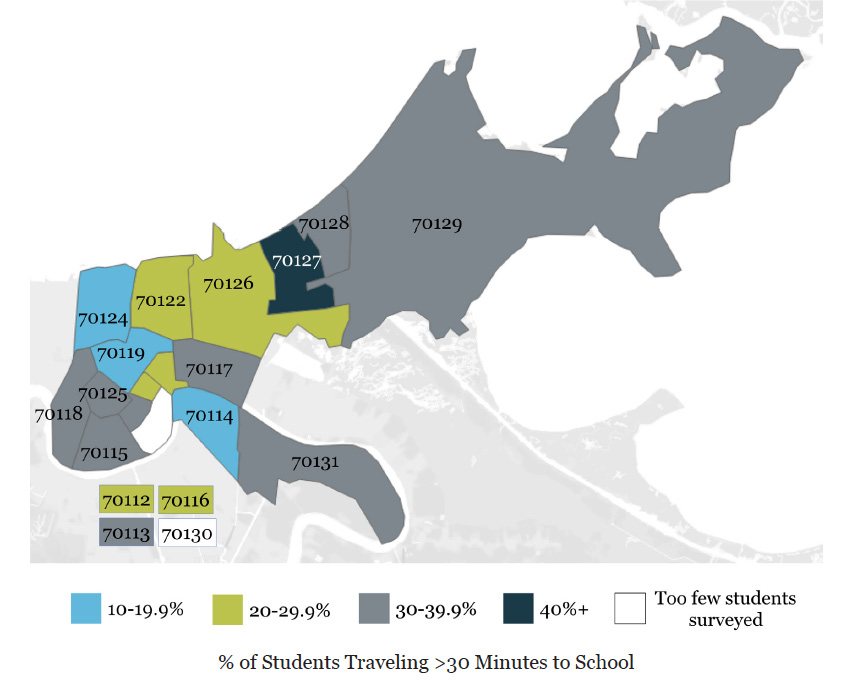
There are a few items in Harris’s report that do not support the privatized system. One of those is Conclusion-5: where he shares, “Transportation costs doubled, and students are traveling farther to get to school.”  (Page 20) From his map, it appears that more than 30% of the students are spending in excess of one-hour a day on busses which must be miserable and drives up costs.

In the report’s acknowledgement section, there is another reason to be skeptical of Doug Harris’s results. It says, “Second, we thank our funders, including Tulane and the Murphy Institute, but also the Laura and John Arnold Foundation, Spencer Foundation, William T. Grant Foundation, and Booth Bricker Foundation.”

Like almost all large foundations the Spencer Foundation (EIN: 36-6078558) with $667,415,167 in assets makes a few troubling grants but in general is supporting research and scholarship. The same could be said for the William T. Grant Foundation (EIN: 13-1624021) with $403,141,185 in assets.

However, The Booth-Bicker Fund (EIN: 72-0818077) with assets of $68,702,721 is spending heavily to promote privatized education and almost no organization in America has spent more to privatize public education than the Laura and John Arnold Foundation (EIN: 26-3241764) with its whopping $4,309,915,225 in assets. Of course, these large amounts of money are influencing Harris and his team.

What Do the Locals Say?

In April, at the NPE conference in Columbus, Ohio, Ashana Bigard and Antonio Travis presented on the all charter school system in New Orleans.  Antonio’s description of being a student in New Orleans sounded like classic child abuse. Mrs. Bigard informed us that New Orleans schools are being sued regularly because of their practices with children. However, there is almost no reporting about the suits because the settlements always include a non-disclosure agreement (NDA). She told the story of asking a KIPP administrator how many NDA’s they had created. He said none but when she responded that she was in court just the week before and saw a KIPP NDA created, he backed off and promised to get back to her. She is not holding her breath.

Ashana Bigard is on the Right

Last year, when a charter school failed, the superintendent replaced it with the first New Orleans public school since 2017. The superintendent was fired, but that is what Mrs. Bigard said parents want. She said they desire that every time a charter school fails it is replaced by a more stable public school. Charter schools have become a revolving door with a couple schools going out of business every year.

In her 2018 book, “After the Education Wars,” Andrea Gabor reported that a third of New Orleans charter schools had been shuttered.

Senator Joseph Bouie Jr. equated the NOLA school system to the “Tuskegee syphilis experiment.” Professor Bouie, former administrator of Southern University at New Orleans, had good reason for this analogy. At Tuskegee University, black men with syphilis were given no treatment even after penicillin was shown to be effective. Dozens of men died and their wives, children and untold number of others were infected. NOLA black residents had their community schools taken away and replaced by privatized schools, often miles away. This “experiment” stole their rights and bestowed the public schools to private actors.

In 2021, Secretary of Education Miguel Cardona visited the Orleans Public School District. He heard first-hand the growing disillusionment with the all charter system. Four of the six parents told him they wanted to go back to neighborhood schools. Parents complained about Teach for America placing unqualified teachers in schools and the One App process for not offering school choice where they lived.

Raynard Sanders who has over forty years of experience in teaching, education administration and community development, said the charter experiment has “been a total disaster in every area.” He asserted NOLA had “the worst test scores since 2006, the lowest ACT scores, and the lowest NAEP (National Assessment of Educational Progress) scores.”

In a letter to the editor, former OPSD superintendent, Barbara Ferguson, stated:

“The state took over 107 of New Orleans’ 120 public schools and turned them into charter schools. Last year, 56 of New Orleans’ 68 public schools had scores below the state average. Thus, after nearly 20 years, over 80% of New Orleans schools remain below the state average. This charter school experiment has been a failure.”