By Thomas Ultican 9/3/2025
August 29th was the twentieth anniversary of hurricane Katrina wiping out New Orleans. On this occasion, the billionaire-funded baloney machine is outdoing itself. Ravi Gupta wrote a post for ‘The 74’ called, “The Inconvenient Success of New Orleans Schools.” The Washington Post assigned a guy from the United Kingdom, Ian Birrell, to write, “Never seen before’: How Katrina set off an education revolution.” I gave up my subscription to the Washington Post some time ago but my friend Gary Rubinstein wrote a post about Birrell’s article. He noted, “Supposedly based on recent research, it basically trotted out all the old bogus claims that I hadn’t heard anyone claim in at least ten years.”
The truth is that the all charter school district is a giant failure that even corruption rampant New Orleans is struggling to hide.
Before Katrina, Louisiana was passing laws aimed at taking over the New Orleans public school system and there was some merit to their endeavor. Six interim superintendents appeared between 1998 and 2005. An FBI investigation led to 11 indictments in 2004 and by end of the school year in May 2005 the district was effectively bankrupt. Unfortunately, the state created the Recovery School District (RSD) and turned to privatization to solve the problem.
By the end of the 2004-2005 school year, the state had taken over five New Orleans schools. RSD turned all five into charter schools operated by four groups: University of New Orleans; Middle School Advocates, Inc.; Knowledge Is Power Program; and Institute for Academic Excellence. All set to begin in the 2005-06 school year; however Katrina made landfall soon followed by “disaster capitalists” swooping like swarming buzzards.
Before Katrina, Orleans Parish School Board (OPSB), which ran the public schools in New Orleans, operated 123 schools; in the spring following the storm, it was running just four. With OPSB out of the road and RSD in charge, “pheaulanthropists” like the Walton family, Bill Gates and Eli Broad were ready to help.

2005 Devastation by Hurricane Katrina
In 2009, Louisiana’s Board of Elementary and Secondary Education (BESE) made it more difficult for schools to remain academically acceptable, effectively ending most of the remaining public schools in New Orleans. BESE raised the minimum school performance scores for academic unacceptability to 65 for the 2010-11 school year and 75 for the 2011-12 school year. By 2018, there were no public schools left.
Evaluating the Results
In her 2018 book, After the Education Wars, Andrea Gabor wrote, “To borrow another ancient military metaphor, the New Schools Venture Fund and its New Schools for New Orleans offshoot, is the Trojan horse that funnels outside money, expertise, and influence to New Orleans.” (Page 229) The majority of the school privatizing billionaires invested by funneling funds through New Schools Venture Fund and New Schools for New Orleans (NSNO). Most of the investing was in schools adhering to the KIPP no-excuses model.
Around 2014, Neerav Kingsland was leading NSNO. He would go on to work for Reed Hastings and then become the leader of the Hastings and John Arnold created City Fund designed to promote privatization and end voter directed public schools.
In his article for ‘The 74’, Ravi Gupta claims, “There’s no one better at parsing the data than Doug Harris, who chairs Tulane’s economics department and directs the Education Research Alliance for New Orleans.” It is almost impossible to check Harris’s work because he has proprietary control of much of the education data from New Orleans. Furthermore, confidence in his work is undermined by his team sharing office space on the seventh floor of 1555 Poydras Street with NSNO.
In June, Harris released “The New Orleans Post-Katrina School Reforms: 20 Years of Lessons”. It is organized around twelve conclusions. Of course conclusion-1 claims improved student outcomes in testing scores, graduation rates and college going. (Page 8) Improved graduation rates and increased college going is a national trend for which it is hard to credit the all charter school system. The claim of improved testing results cannot be shown. Since the entire system was shut down and then reconstituted as a significantly smaller privatized organization, there is nothing to compare to that was not changed.
Gary Rubenstein explained:
“Reformers needed a new experiment where the schools would keep the same students they already had, but the staff at those schools would be replaced with nonunion charter school educators, and charter chains or start-up charter boards would run the schools. Race to the Top provided Tennessee the funding and incentive to test the reformers’ hypotheses.” (Doomed page 19)
This experiment demonstrated that it was not the public schools causing poor performance and privatizing them provided no improvement.
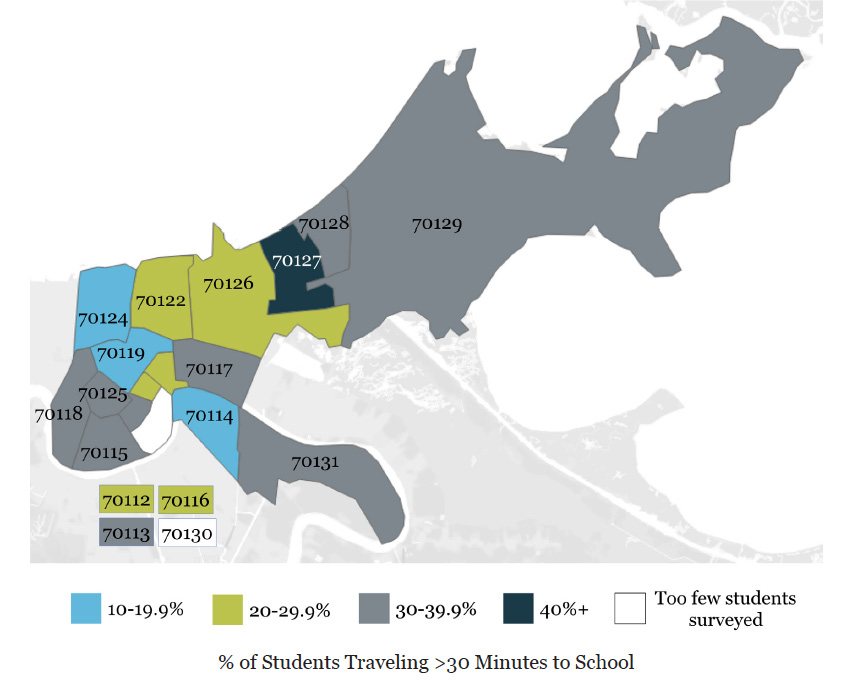
There are a few items in Harris’s report that do not support the privatized system. One of those is Conclusion-5: where he shares, “Transportation costs doubled, and students are traveling farther to get to school.” (Page 20) From his map, it appears that more than 30% of the students are spending in excess of one-hour a day on busses which must be miserable and drives up costs.
In the report’s acknowledgement section, there is another reason to be skeptical of Doug Harris’s results. It says, “Second, we thank our funders, including Tulane and the Murphy Institute, but also the Laura and John Arnold Foundation, Spencer Foundation, William T. Grant Foundation, and Booth Bricker Foundation.”
Like almost all large foundations the Spencer Foundation (EIN: 36-6078558) with $667,415,167 in assets makes a few troubling grants but in general is supporting research and scholarship. The same could be said for the William T. Grant Foundation (EIN: 13-1624021) with $403,141,185 in assets.
However, The Booth-Bicker Fund (EIN: 72-0818077) with assets of $68,702,721 is spending heavily to promote privatized education and almost no organization in America has spent more to privatize public education than the Laura and John Arnold Foundation (EIN: 26-3241764) with its whopping $4,309,915,225 in assets. Of course, these large amounts of money are influencing Harris and his team.
What Do the Locals Say?
In April, at the NPE conference in Columbus, Ohio, Ashana Bigard and Antonio Travis presented on the all charter school system in New Orleans. Antonio’s description of being a student in New Orleans sounded like classic child abuse. Mrs. Bigard informed us that New Orleans schools are being sued regularly because of their practices with children. However, there is almost no reporting about the suits because the settlements always include a non-disclosure agreement (NDA). She told the story of asking a KIPP administrator how many NDA’s they had created. He said none but when she responded that she was in court just the week before and saw a KIPP NDA created, he backed off and promised to get back to her. She is not holding her breath.
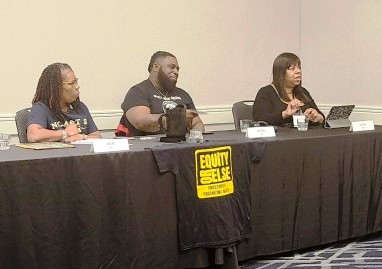
Ashana Bigard is on the Right
Last year, when a charter school failed, the superintendent replaced it with the first New Orleans public school since 2017. The superintendent was fired, but that is what Mrs. Bigard said parents want. She said they desire that every time a charter school fails it is replaced by a more stable public school. Charter schools have become a revolving door with a couple schools going out of business every year.
In her 2018 book, “After the Education Wars,” Andrea Gabor reported that a third of New Orleans charter schools had been shuttered.
Senator Joseph Bouie Jr. equated the NOLA school system to the “Tuskegee syphilis experiment.” Professor Bouie, former administrator of Southern University at New Orleans, had good reason for this analogy. At Tuskegee University, black men with syphilis were given no treatment even after penicillin was shown to be effective. Dozens of men died and their wives, children and untold number of others were infected. NOLA black residents had their community schools taken away and replaced by privatized schools, often miles away. This “experiment” stole their rights and bestowed the public schools to private actors.
In 2021, Secretary of Education Miguel Cardona visited the Orleans Public School District. He heard first-hand the growing disillusionment with the all charter system. Four of the six parents told him they wanted to go back to neighborhood schools. Parents complained about Teach for America placing unqualified teachers in schools and the One App process for not offering school choice where they lived.
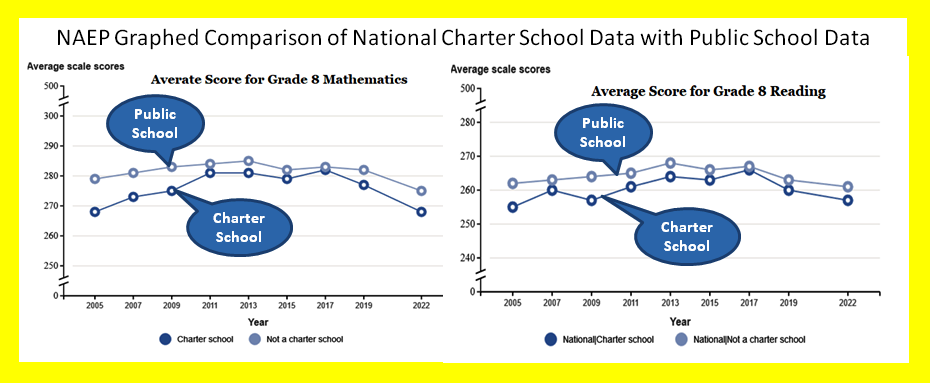
Raynard Sanders who has over forty years of experience in teaching, education administration and community development, said the charter experiment has “been a total disaster in every area.” He asserted NOLA had “the worst test scores since 2006, the lowest ACT scores, and the lowest NAEP (National Assessment of Educational Progress) scores.”
In a letter to the editor, former OPSD superintendent, Barbara Ferguson, stated:
“The state took over 107 of New Orleans’ 120 public schools and turned them into charter schools. Last year, 56 of New Orleans’ 68 public schools had scores below the state average. Thus, after nearly 20 years, over 80% of New Orleans schools remain below the state average. This charter school experiment has been a failure.”


 tultican
Recent Comments