Tag Archives: A Nation at Risk

Hoover Institution 2023 “A Nation at Risk” Address

1 Jan

By Thomas Ultican 1/1/2024

Amazingly, Hoover Institution marked 40+ years of “A Nation at Risk” (ANAR) by glorifying it. They published a 300+ page book, in November, claiming it was the stick that stirred the education reform pot. While their namesake’s mishandling of the 1929 Wall Street crash could be credited with inspiring Social Security, labor rights and many other New Deal reforms, ANAR brought nothing but pain to public schools. Fourteen writers, known for attacking public education and living on the right, created the material presented.

In 1983, Gerald Holton, then a physics professor at Harvard University, and a member of the National Commission on Excellence in Education, drafted some of the most alarmist language in ANAR, including: “If an unfriendly foreign power had attempted to impose on America the mediocre educational performance that exists today, we might well have viewed it as an act of war.”

Last year, I met James Harvey, who was responsible for getting ANAR ready to print. He viewed Holton’s line “to be utter bombast.” In a final editing session at the University of Utah, he and Commission Chairman, David Gardner, agreed to excise the line from the report. Harvey took ANAR back to Washington DC, gave the revision to the printer … and went on vacation.

Later, he learned commission member and Nobel Prize winning Chemist, Glenn Seaborg, had refused to sign off on the report until Holton’s line was restored.

When writing an ANAR thirty-fifth anniversary report for National Public Radio, Anya Kamenetz discovered the commission never set out to undertake an objective inquiry into the state of the nation’s schools. She wrote, They started out already alarmed by what they believed was a decline in education, and looked for facts to fit that narrative.”

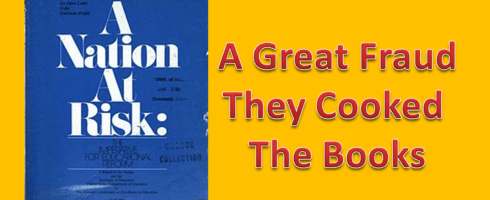
A decade before, Florida education professor, James Guthrie, noted, “They cooked the books to get what they wanted.”

Salvatore Balbones wrote Education ‘reforms’ big lie for Salon, observing:

“The commission included 12 administrators, 1 businessperson, 1 chemist, 1 physicist, 1 politician, 1 conservative activist, and 1 teacher. No students or recent graduates. No everyday parents. No representatives of parents’ organizations. No social workers, school psychologists, or guidance counselors. No representatives of teacher’s unions (God forbid). Just one practicing teacher and not a single academic expert on education.”

In ANAR, the most convincing evidence given that America’s public schools were failing was a bullet point on page 11:

“The College Board’s Scholastic Aptitude Tests (SAT) demonstrate a virtually unbroken decline from 1963 to 1980. Average verbal scores fell over 50 points and average mathematics scores dropped nearly 40 points.”

This is the single most powerful piece of evidence providing proof that Americas’ schools were failing. It was also based on a lie or at best, ignorance.

In 1990, engineers at Sandia National Laboratory in New Mexico looked at the same data and found an error. Their findings appeared to have been suppressed. Gerald Bracey reported in Huffington Post, “Jim Raths of the University of Delaware and then an editor at the Journal of Educational Research made it the entirety of the May/June 1993 issue of that small journal.” That seems to be the only place it was ever published but some reporters and scholars saw the report in the early 1990s.

From their writings, we know the Sandia engineers disaggregated the data by race and sex. They found that every group advanced during the 1963 to 1980 period and continued to do so until 1988 when the data was gathered. The other simultaneous occurrence was the larger numbers of people testing every year. Increases were driven by poor, minority and female students, causing the test averages to drop.

ANAR was a fraudulent paper and America’s schools were actually healthy and doing well.

Selling a Fraud +40

Authors of Hoover Institution’s A Nation at Risk +40

NameSectionFieldAbout
Stephen L. BowenIntroductionPoliticianPaul LePage’s policy adviser and Director of Maine Heritage Policy Center.
Deborah StipekChapter 1EducationFormer Director of UCLA Seeds School. Stanford Graduate School of Ed.
Maria D. FitzpatrickChapter 2EconomicsDepartment of Policy and Management at Cornell University.
Michael HansenChapter 3EconomicsSenior Fellow on Education Policy Brookings Institution; labor economist
Thomas S. DeeChapter 4EconomicsStanford professor; member of the American Enterprise Institute
Robert PondiscioChapter 5EducationSenior Fellow at American Enterprise Institute; former teacher
Eric BettingerChapter 6EconomicsProfessor Stanford Graduate School of Education; education economists
Tom Vander ArkChapter 7FinanceExecutive Director of Education Gates Foundation; EdTech champion
Eric A. HanushekChapter 8EconomicsFather of evaluating teachers using value added measures; Co-founder of CREDO
Michael T. HartneyChapter 9Political ScienceSenior Fellow at the Manhattan Institute; Hoover Fellow
John D. SingletonChapter 10EconomicsProfessor of economics University of Rochester; Studies school boards.
Michael J. PetrilliChapter 11Political SciencePresident at Thomas B. Fordham Institute; editor Education Next
Cami AndersonChapter 12AdministratorIn 2011, appointed Superintendent of Newark Public Schools
Margaret “Macke” RaymondConclusionPolitical ScienceDirector of CREDO; married to Eric Hanushek who was her professor in Rochester.

A common theme in most of the essays presented is “ANAR did not cover this really important topic” and instructs readers about its importance. ANAR’s 38 recommendations are along the lines of fixing unacceptable teachers but not eliminating elected school boards. It seems blowing up the education system never occurred to the commission and that is criticized as a weakness by some of the authors.

ANAR did kick off an era of school reform that continued gaining momentum into the twenty-first century. In chapter 5, Robert Pondiscio claims, “Decades of education reform have left policymakers, educators, and students alike fatigued and unimpressed.” (Page 109) These reforms were often so misguided, destructive and self-serving that the word “reform” became an odorous term.

At its core, ANAR was an attack on the teaching profession. Chapters three and four address this. Michael Hansen observed ANAR did “encourage bringing qualified people from other occupations into teaching to support hard-to-staff fields, and these policies gained momentum.” (Page 66) Hansen cites Teach for America as a particularly outstanding example of an alternative certificate program. Evidently, college graduates with no training, mostly hired by charter schools to teach scripted lessons, are venerated by Senior Fellows from the Brookings Institution.

In the wake of ANAR, President Reagan backed merit pay for teachers. It is a reform with a long track record of failure, pre-dating ANAR and Reagan. When the present state controller of Houston’s schools, Mike Miles, was in Dallas, he introduced a merit pay program based on value-added measures. It unsurprisingly resulted in a drain of experience from the district. Senior teachers quit and left. It was one more example of merit pay not producing the hoped for result.

In chapter 9, Michael Hartney does not hold back on his anti-public school feelings. Christopher Rufo’s Manhattan Institute colleague says American K-12 education “is burdened by a century-old, one-size-fits-all governance model that prioritizes adult rather than student interests.” (Page-181) The “one-size-fits-all governance model” is also known as democracy. It is the system where local communities control their schools through elected representatives. The malarkey about prioritizing adults over students is meaningless rhetoric. No one other than parents cares more about students than public school teachers and officials.

Hartney calls for privatizing schools as the solution to his claimed burden. He states, “[F]or chronically low-performing systems, policymakers can disrupt the ‘district as monopoly’ education provider by pursuing a portfolio management model (PMM) strategy that takes districts out of the business of running schools and instead has them provide performance-based oversight in a diverse ecosystem of regulated, but still autonomous, schools of choice.” (Page-181) This piece of “argle-bargle” means turn your community’s schools over to private operators. Someone may get rich but the well-run, responsive public schools will be gone.

Michael Petrilli writes in chapter 11 that “student achievement plateaued and even started to decline in the 2010s.” (Page 226) He postulates that the softening of the No Child Left Behind accountability might be responsible. More likely, the hyper-focus on testing and standards were responsible for a general slowing in education progress since 2000.

Conclusion

It appears that Stanford’s Hoover Institution right-wingers are more interested in ending public education than reforming it.

A Nation at Risk started out as a fraud. Schools were not failing but ANAR produced phony data to show they were. Sure there were big problems within the public education system. Dale Russakoff’s The Prize documented extreme corruption within Newark, New Jersey’s public schools. Violence levels were unacceptably high in some school districts. However, ANAR ignored those problems. Instead, they speculated about how poor American scholarship opened the door for the Japanese taking over auto production, Koreans dominating steel and Germans ruling machine tools.

BUT they were wrong!

Those “terrible” American students were busy inventing the computer industry … internet, I-pad and smart phone, followed by a great surge in biotech. Maybe Glenn Seaborg won a Nobel Prize but he was completely blind about America’s schools or what good education looked like. He was a chemist, not a pedagogue. Conspicuously, there were no pedagogues on the National Commission on Excellence in Education.

Today, ANAR is still a weapon for undermining public schools. It is embraced by people on the far right to do away with public education while also attacking anything else belonging to the commons.
Charter School Experiment FAILURE Documented Again

17 Aug

By Thomas Ultican 8/17/2020

Marketing and lack of oversight have obscured the failure of the charter school industry. The latest research reported by Carol Burris and her team at the Network for Public Education (NPE) documents the atrocious going out of business rate among charter schools.

The United States Education Department (USED) has invested more than $4 billion promoting the industry but has not effectively tracked the associated fraud, waste and failures. After 25-years of charter schooling, Broken Promises is the first comprehensive study of their closure rates.

Charter School Myths and Promises

Former American Federation of Teachers (AFT) union President, Albert Shanker, is often cited as the father of charter schools. His Wikipedia entry says, “In 1988, Shanker was the first to propose charter schools in the U.S.” He was not, nor was he central to charter school development.

Five years before Shanker’s famous 1988 speech in which he mentioned charter schools, the Reagan administration had published the infamous A Nation at Risk. In his speech, Shanker was clearly responding to that report as well as President Reagan’s call for choice in education and his own belief that American education was not serving the majority of students well.

At the time, Shanker was reading Ray Budde’s book from which he appropriated the terminology “charter.” In his 1988 speech, Shanker proposed,

“The school district and the teacher union would develop a procedure that would encourage any group of six or more teachers to submit a proposal to create a new school.”

“That group of teachers could set up a school within that school which ultimately, if the procedure works and it’s accepted, would be a totally autonomous school within that district.”

“I would approve such a proposal if it included a plan for faculty decision making, for participative management; team teaching; a way for a teaching team to govern itself; and a provision that shows how such a subunit would be organized so the teachers would no longer be isolated in the classroom throughout their professional lives, but would have the time to be available to share ideas and talk to and with each other.”

The actual development of charter schools was far different. Education Writer Rachel Cohen described what arose,

“At its outset, the real power in the charter coalition was what might be termed the ‘technocratic centrists’: business leaders, moderate Republicans, and DLC members looking for Third Way solutions that couldn’t be labeled big-government liberalism. While charters have drawn praise from other quarters—for instance, some educators and progressive activists see them as tools for racial and economic justice—these groups have never formed the heart of charters’ power base.”

In 1991, Bill Clinton – then Arkansas Governor and Chairman of the Democratic Leadership Council (DLC) – embraced the technocratic version of charter schools as a “Third Way” solution. Shanker would later complain, “It is almost impossible for us to get President Clinton to stop endorsing [charters] in all his speeches.”

By the time charter schools were birthed in Minnesota, Albert Shanker had agreed with several of the main points presented in “A Nation at Risk.” In accord with the DLC, Shanker stated,

“The reforms that resulted from A Nation At Risk and the other reports constituted a much-needed corrective to the softness of schools in the late ’60s and throughout the ’70s. Yes, we needed schools that had standards, and we still do.”

However, the public school failure belief was based on little more than illusion.

While writing an NPR article on the 35th anniversary of “A Nation at Risk,” Anya Kamenetz discovered that the report “never set out to undertake an objective inquiry.” Two of the authors admitted to her that they were “alarmed by what they believed was a decline in education, and looked for facts to fit that narrative.” The dubious evidence presented in their report would have never withstood a rigorous peer review process.

Some powerful evidence points in the opposite direction and indicates that the results from US public schools in the 60s and 70s were actually a great success story.

One measuring stick demonstrating that success is Nobel Prize winners. Since 1949, America has had 383 laureates; the second place country, Great Britain, had 132. In the same period, India had 12 laureates and China 8.

Stanford’s Center for Education Policy Analysis report on education achievement gaps states, “The gaps narrowed sharply in the 1970s and the first half of the 1980s, but then progress stalled.”

The digital revolution and the booming biotech industry were both created by students mostly from the supposedly “soft public schools” of the 60s and 70s.

In his 1999 book, The Schools Our Children Deserve, Education writer Alfie Kohn described the philosophy of current education reform saying it “consists of saying in effect, that ‘what we’re doing is OK, we just need to do it harder, longer, stronger, louder, meaner and we’ll have a better country.”’

Corporate groups, Third Way Democrats and the AFT all called for manufacturing style standards to be applied to public education. Unfortunately, standards based education has proven to be toxic; leading to jejune classes and the sundering of creativity. Children are learning to hate learning.

In his book Winners Take All, Anand Giridharadas calls modern social reform based on the belief that business leaders and market forces are the sure way to a better society “MarketWorld.” Charter schools are a “MarketWorld” education reform that has brought disruption, harm to public schools and accelerating segregation. They have produced superior marketing not superior education.

Broken Promises

Broken Promises opens by quoting the words of student mother Elouise Matthews to the Orleans Parish School Board:

“I am a parent of Mary D. Coghill [Charter School]. For the last three years I have had to place my kids at different schools each year because the schools keep closing. My child was attending MCPA, that school closed. He then went to Medard Nelson, that school closed. Now, he is at Coghill and y’all are trying to close that school. I am tired of moving my child every year because y’all are closing schools.”

In the modern era of school choice, the one choice New Orleans parent do not have is sending their children to a stable public school. New Orleans is a 100% privatized school district. It is the epitome of “MarketWorld” education reform.

“Broken Promises” looked at cohorts of newly opened charter schools between 1998 and 2017. Ryan Pfleger, Ph.D. led the analysis of charter schools closures utilizing the Department of Education’s Common Core of Data (CCD).

Before 1998, the massive government data base did not uniquely identify charter schools and the last complete data set available for all schools in America was 2017.

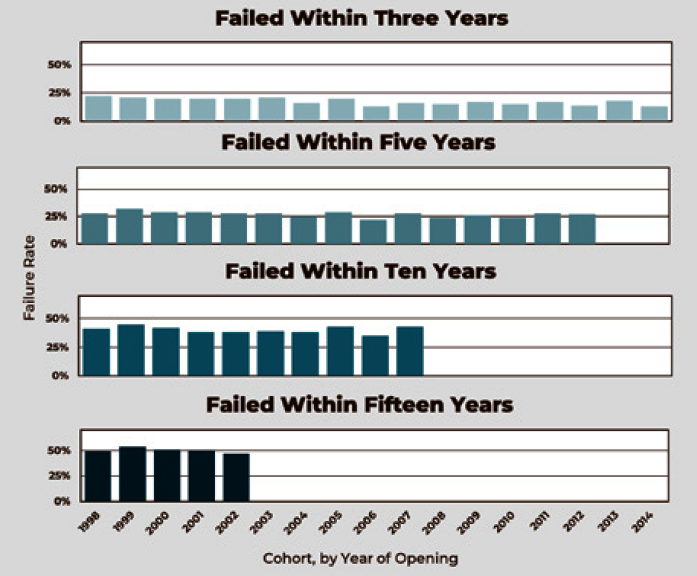
Startup charter school cohorts were identified by year and the cohort closure rates were tracked at 3, 5, 10 and 15 years after opening. The overall failure rates discovered were 18% by year-3, 25% by year-5, 40% by year-10 and 50% by year-15.

The NPE team discovered that half of all charter schools in America close their doors within fifteen years.

All Cohort Failure Graphic

Graphic from Broken Promises Showing Charter School Failure Rates

Many charter schools close within their first year of operations. “Broken Promises” shares the story of several of these quick failures. The following story was based on a TV newscast in North Carolina:

On a Thursday morning in September of 2014, parents dropped their children off at the Concrete Roses STEM Academy charter school in Charlotte, North Carolina. Families were handed a notice that the school would close the very next day. The school had claimed (and was funded for) an enrollment of 300 students although actual enrollment was only 126.

 Concrete Roses STEM Academy was open for only one month.

Because Concrete Rose STEM Academy closed before officially reporting attendance to the federal government in October, they do not count as a failed school. In the CCD database, they never showed students thus did not meet the criteria for having opened.

Burris and team document close to a million students being displaced by school closures. These displaced students then put tremendous pressure on public schools which are required to take them in.

“Broke Promises” also cites National Education Association research showing that “52 percent of students displaced by charter closings receive free or reduced-price lunch.”

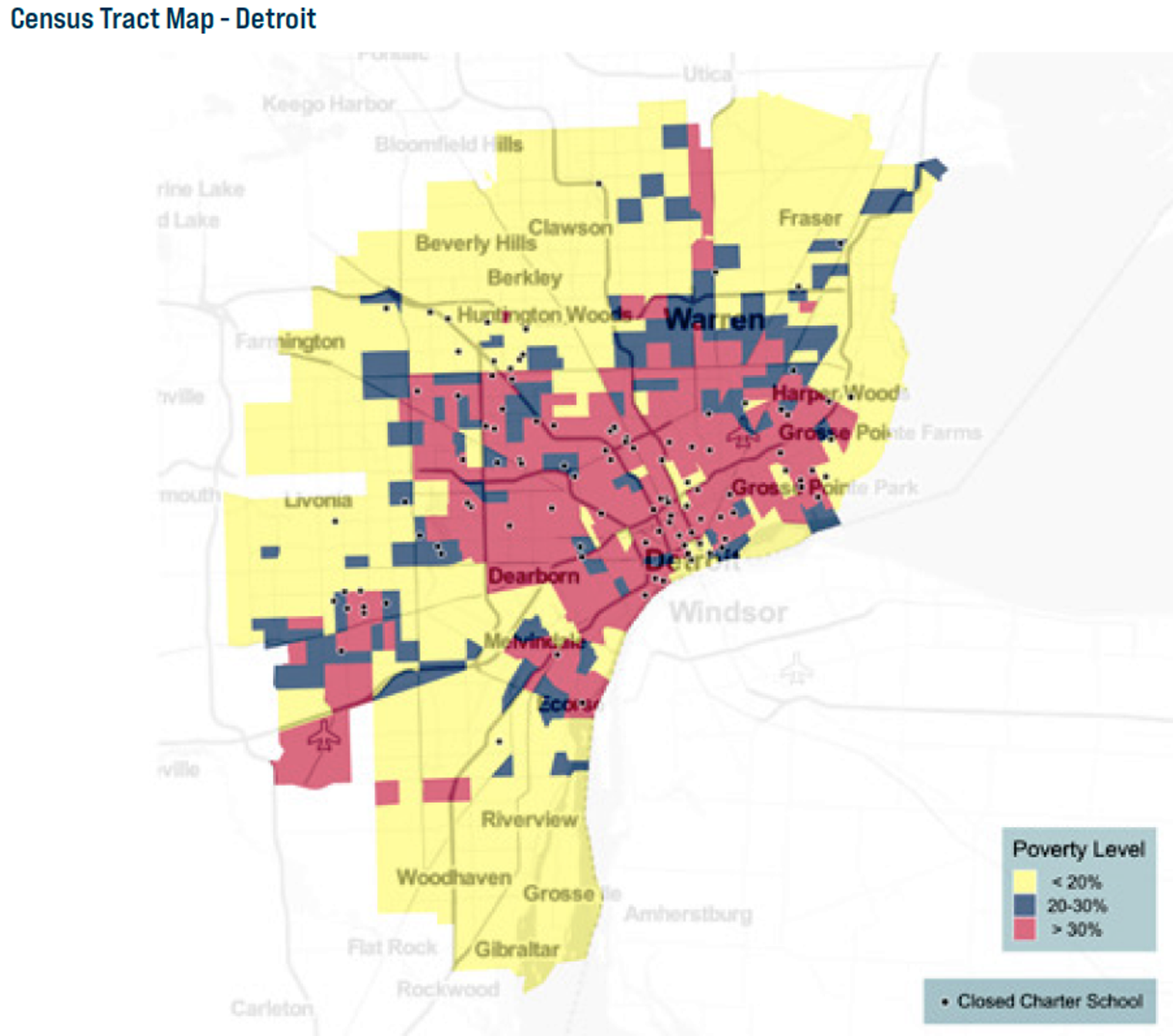
Census tract maps collated with charter school closures were utilized to understand where the closures were happening. In Detroit for example, they noted that between 1998 and 2015 245-charter schools opened of which 106 had closed (43%) by 2017.

The report states, “Fifty-nine percent of the failures were located in tracts with 30 percent or above rates of poverty, although there were a far greater number of tracts with lower levels of poverty.”

Census Tract Map Showing High Poverty Neighborhoods with Highest Charter Churn.

Mounting Evidence Shows Charter Schools Are Bad Policy

As charter schools started becoming a more significant part of local school districts, fiscal impacts mounted. In 2014, researchers Robert Bifulco from Syracuse University and Randall Reback from Bernard College published a study of the fiscal impacts in the public schools of Buffalo and Albany, NY. They estimated that the net costs in Buffalo were between $633 and $744 per pupil and in Albany between $976 and $1,070 per pupil. Thus, public school students were suffering reduced fiscal support in order to finance charter schools.

In 2016, Professor Bruce Baker of Rutgers University produced Exploring the consequences of charter school expansion in U.S. cities for the Economic Policy Institute. In the summary of this report he stated,

“Other reports have shown how high test scores and popularity of charter schools could be the byproducts of using data from cherry-picked charter schools that serve cherry-picked or culled populations. This report adds further insights for the debate on how expanding charter schools as a policy alternative achieves the broader goal. Specifically, it shows that charter expansion may increase inequity, introduce inefficiencies and redundancies, compromise financial stability, and introduce other objectionable distortions to the system that impede delivery of an equitable distribution of excellent or at least adequate education to all children.”

In 2017, NPE Executive Director Carol Burris produced “Charters and Consequences.” In it she stated,

“… nearly every day brings a story, often reported only in local newspapers, about charter mismanagement, failure, nepotism or outright theft and fraud.”

“This report … is the result of a year-long exploration of the effects of charter schools and the issues that surround them.”

To accompany the report, NPE started an ongoing web page, #AnotherDayAnotherCharterScandal, which catalogues and makes available the horrific charter industry record of fraud and malfeasance.

In 2018, Professors Helen F. Ladd of Duke University and John D. Singleton of Syracuse University published The Fiscal Externalities of Charter Schools: Evidence from North Carolina. Like the study of Buffalo and Albany they found powerful evidence that it was costing schools in Durham, NC $3600 per student lost to charters. The paper also stated, “We find smaller, though sizable, Net Fiscal Impacts in the non-urban districts and considerable heterogeneity across them.”

That same year professor Gordon Lafer of the University of Oregon published Breaking Point: The Cost of Charter Schools for Public School Districts.” Lafer stated,

“In 2016-17, charter schools led to a net fiscal shortfall of $57.3 million for the Oakland Unified School District, $65.9 million for the San Diego Unified School District, and $19.3 million for Santa Clara County’s East Side Union High School District. The California Charter School Act currently doesn’t allow school boards to consider how a proposed charter school may impact a district’s educational programs or fiscal health when weighing new charter applications.”

Last year, NPE published two investigations of the federal Charter Schools Program (CSP). In Asleep at the Wheel, they stated, “We estimate that program funding has grown to well over $4 billion. That could bring the total of the potential waste to around $1billion.” At a congressional hearing, Education Secretary Betsy DeVos speaking about the report testified, “The report that you referenced has been totally debunked as propaganda.”

In response, NPE redoubled efforts and in December published Still Asleep at the Wheel where they documented that their conservative claims in the first report under-reported the extent of wasted money and negligence associated with the CSP.

Time to join with the NAACP in their 2018 call for a charter school moratorium. With the industries record of creaming, advancing segregation and self-dealing, charter profiteering can not be accepted. Charters have not delivered significant education improvements just disruption, community harm and fraud. School chartering is a FAILED experiment.