NPE2025 Columbus Impressions

8 Apr

By Thomas Ultican 4/8/2025

Last weekend, it was a rainy sad environment greeting the 2025 Network for Public Education (NPE) conference but inside the Columbus Hyatt it was blue-skies. When I left Ohio Monday morning, the local environment matched the hope and determination generated for three days.

The first conference event was a Friday evening session with Diane Ravitch and Professor Josh Cowen discussing vouchers. They made three things abundantly clear. As Cowen noted, “By every standard of the policy debate, vouchers have failed.” They always get defeated by voters at the poles and have become welfare for the wealthy. Funding for vouchers is wrecking state budgets.

As people were exiting the room, I got Diane and Pastor Charles Foster to pose for a picture. This created a wonderful example of tolerance and communication needed today. Ravitch is a Jew from New York City, Charles is a devout Baptist from Texas and I am a Nichiren Buddhist from California; yet we are all three genuine friends.

Charles and Diane

Day 2, Saturday

It was a marathon of sharing. At 8 AM, participants gathered in a large room for breakfast and speeches. Ravitch shared that “The Department of Education was not created to raise test scores but to raise equity.” She noted that America is a diverse country and that we must live with diversity and not deny it.

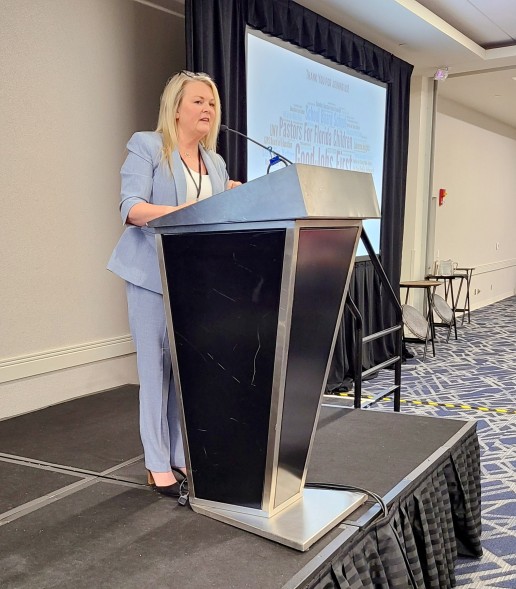
Jesse Piper, an NPE board member from rural Missouri, passionately ended the breakfast meeting claiming that when you start defunding schools, the community goes next. Jesse used the demise of her on small town as an example. Piper also stated, “Christian nationalism is teaching women to be submissive to their husbands and husbands to be submissive to their bosses.” She concluded by asserting to this large room full of public school educators, “You’re not indoctrinating students, that is what religious and private schools do.”

Jesse Piper

From there we broke into sessions in several rooms. Unfortunately, wonderful sessions were occurring at the same time making it hard to pick which one to attend. I presented on Science of Reading (SoR) in the first breakout presentations of the day. Nancy Bailey and Elena Aydarova PhD joined in the sharing. We had a large audience and people kindly told us they liked the presentations. (I am willing to share the Power Point file I used.)

Nancy Bailey

After lunch and a wonderful speech by John H. Jackson president of the Schott Foundation, I went to learn about Lifewise. I had no idea how fast that organization is growing. It was founded in 2018 in Ohio. There are now organizations in 26 states including California. Lifewise promotes RTRI (Release Time for Religious Instruction). Schools that participate must release children during the school day for a bus trip to the Lifewise facility where they learn a benighted form of Christianity based on the ancient Nicene Creed.

There are two types of states that authorize Lifewise, may-states and shall-states. Ohio just became a shall-state that mandates schools to participate if it is offered.

Lifewise wants kids younger than 14 because they are more successfully indoctrinated. When the kids come back to class, they show their presents and tell stories of ice cream parties. Kids that are at Lifewise often miss out on important learning. An Ohio science teacher showed pictures of his kids getting ready for the total eclipse that the Lifewise students missed.

That evening, we enjoyed a speech by the 2022 national teacher of the year, Kurt Russell. Russell says he no longer thinks of public education as important. Rather because it is the foundation of our democracy, it is vital, it is essential and “it is bigger than that; it is life.” Usually I am not impressed by someone being named teacher year whether it is of the school, district, county, state or the country. In this instance, he seemed totally deserving of the accolade.

Kurt Russell

Day 3, Sunday

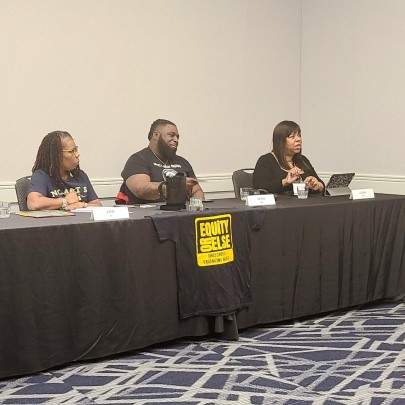
I was really moved by the New Orleans presentation. We heard from a former charter school student and a brilliant mom. They made it clear that control is the byword in the district’s charter schools. The young man, a former charter school student, described a hair-raising ordeal which sounded like child abuse designed to keep the black community in its place.

Last year, when a charter school failed the superintendent replaced it with the first New Orleans public school since 2017. She was fired, but that is what the mom speaking to us claimed parents want. She said they desire that every time a charter school fails it is replaced by a more stable public school. Charter schools have become a revolving door with a large percentage of schools going out of business every year. Unfortunately, those in power want to maintain their portfolio model school district that does not include public schools.

She also said that charters in New Orleans are being sued regularly for some of their practices with children. However, there is almost no reporting about the suits because the settlements always include a non-disclosure agreement (NDA). She told the story of asking a KIPP administrator how many NDA’s they had created. He said none but when she retorted that she was in court just the week before and saw a KIPP NDA created, he backed off and promised to get back to her. She is not holding her breath.

The New Orleans Panel

The brunch time speaker was state representative from Texas, Gina Hinojosa, who has been in an all out battle with Texas Governor Greg Abbott to stop his universal voucher scheme. She says private equity is the plan that is causing billionaires Dunn, Wilks, Yass, Musk and others to finance vouchers in Texas. Hinajosa stresses that the most sinister aspect of the voucher plan is profiting through finance. She reports that a Texas Catholic Credit Union has already been established.

Gina Hinohosa

The last event on Sunday afternoon was special. American Federation of Teachers President, Randi Weingarten, presented us with a fiery speech when she introduced the final keynote speaker of the conference, Governor Tim Waltz of Minnesota.

Waltz was definitely not a disappointment. He made many vintage Waltz type statements:

“I know in this room I’m preaching to the choir. The choir needs to sing louder.”

“Some people say ‘I’m just not into politics.’ Well too damn bad, politics is into you.”

“We should not call them oligarchs, we should call them what they are greedy bastards.”

He was proud of the fact of being cited as the least wealthy person ever to run for Vice-President of the United States.

Waltz asserted that the middle class was built by public education and labor unions. As for what we are going through now, he speculates that it will get worse; so be ready for it.

Governor Waltz surprised us by staying in the room and taking picture with hundreds of us.

Tom and Tim

My impression was that this was the best NPE event to date. The breakout sessions that I attended were amazing and I did not hear of any disappointments. The keynote speakers were excellent and finishing with Governor Waltz was the cherry on top.

AI in School is the Latest Edtech Scam

30 Mar

By Thomas Ultican 3/30/2025

For more than thirty years, technology companies have looked to score big in the education sector. Instead of providing useful tools, they have schemed to take control of public education. At the onset of the twenty-first century, technologists claimed putting kids at computers was a game changer that would fix everything. They followed that up by promoting tablets with algorithmic lessons replacing teachers and claiming they provide better education. Today’s hoax is that artificial intelligence (AI) will make all these failed efforts work. What it actually does is undermine authentic learning. 

The release of ChatGPT in November 2022 is responsible for the Edtech sales-forces switching their sales pitches from personalized learning to AI. However, AI has always been at the root of personalized learning. It just did not have the advantage of large language models (LLM) that emulate writing in English. However, AI expert Yann LeCun notes:

“LLMs are really good at retrieval. They’re not good at solving new problems, [or] finding new solutions to new problems.”

Artificial Intelligence is a misnomer. There is no intelligence; just algorithms. The term, “Artificial Intelligence”, was first coined by Professor John McCarthy at a Dartmouth College conference in 1956. That same year AI became an academic discipline.

Machine-learning has been part of AI since its 1950s beginning. Algorithms are created to allow a machine to automatically improve its performance on a given task. For almost two decades, Netflix has used machine-learning to create personalized recommendations, based on a customer’s previous viewing history. Deep-learning is an advancement in machine-learning. It layers algorithms into computer units ridiculously referred to as neurons. Google Translate uses it for translation from one language to another.

With the advent of LLMs, the energy use associated with AI has risen dramatically. Professor Jonathan Koomey, who founded the End-Use Forecasting group at Lawrence Berkley National Laboratory, worked on a report funded by the US Department of Energy. He estimated that data centers currently use 176 TWh of our country’s electricity which is about 4.4% of it. Koomey forecasts that this consumption might double or even triple by 2028 to between 7% and 12% of our electricity usage.

Selling to Schools

For serious educators, AI is a set of computer algorithms, making cheating easy. It is another tool for creating an easier to control and more profitable education system. Billionaire Laurene Powell Jobs is a leader in the AI-revolution in education. Her Amplify digital lessons liberally apply AI and her XQ Institute is working to integrate AI into classrooms. Edward Montalvo, XQ institute’s senior education writer has claimed:

‘“The future of AI in education is not just about adopting new technologies; it’s about reshaping our approach to teaching and learning in a way that is as dynamic and diverse as the students we serve,’ XQ Institute Senior Advisor Laurence Holt said. … Through AI, we can also transcend the limitations of the Carnegie Unit — a century-old system in which a high school diploma is based on how much time students spend in specific subject classes.

“Changing that rigid system is our mission at XQ.”

The advocates of computer learning in K-12 classrooms need to get rid on the Carnegie Unit to maximize profits. The “unit” is a minimum requirement creating a nationwide agreed-upon structure. It does not control pedagogy or assessments but insures a minimum amount of time on task.

Education writer, Derek Newton’s article for Forbes, opposed ending the Carnegie unit for a host of reasons but the major one is cheating:

“Cheating, academic misconduct as the insiders know it, is so pervasive and so easy that it makes a complete mockery of any effort to build an entire education system around testing.” (See here)

“But because of the credit hour system, which is designed to measure classroom instruction time, it’s still relatively hard to cheat your way to a full college degree.”

The system XQ is trumpeting has students doing online lessons and then testing to receive a credit. It eliminates class levels and also undermines student socialization.

In a recent interview Kristen DiCerbo, Khan Academy’s chief leaning officer, mentioned that when ChatGPT was seeking more funding, they needed the Academy’s help. Bill Gates wanted improved performance as a condition for his support. Khan Academy helped train the new startup to pass the AP Biology exam which was a Gates requirement. This probably means that Khan gave ChatGPT access to his data base so they could feed the information into their LLM.

Earlier this year, an American Psychological Association (APA) magazine article claimed, “Much of the conversation so far about AI in education centers around how to prevent cheating—and ensure learning is actually happening—now that so many students are turning to ChatGPT for help.” The big downsides to AI includes students not thanking through problems and rampant cheating. In the AP physics classroom, I started seeing students turning in perfectly done assignments while being unable to solve the problems on an exam.

The APA article noted that for several years AI was powering learning management tools, such as Google Classroom, Canvas, and Turnitin. I experimented with Canvas for a few years and found two downsides and no upside. The front end of Canvas was terrible and they claimed ownership of all my work posted to Canvas. APA sees it as a positive that “educators are increasingly relying on AI products such as Curipod, Gradescope, and Twee to automate certain tasks and lighten their workload.”

Curipod is an AI edtech product from Norway focused on test prep.

Gradescope is an AI grading tool from Turnitin LLC.

Twee is an English language arts AI application that aids with lesson development and assessment.

These products are selling the fact that they use AI. However, they appear to be a waste of time that may marginally help a first or second year teacher.

Benjamin Riley is a uniquely free thinker. He spent five years as policy director at NewSchool Venture Fund and founded Deans for Impact. His new effort is Cognitive Resonance which recently published Education Hazards of Generative AI.” With his background, I was surprised to learn he does not parrot the party line. In an article this month Riley states:

“Using AI chatbots to tutor children is a terrible idea—yet here’s NewSchool Venture Fund and the Gates Foundation choosing to light their money on fire. There are education hazards of AI anywhere and everywhere you might choose to look—yet organization after organization within the Philanthro-Edu Industrial Complex continue to ignore or diminish this very present reality in favor of AI’s alleged “transformative potential” in the future. The notion that AI “democratizes” expertise is laughable as a technological proposition and offensive as a political aspiration, given the current neo-fascist activities of the American tech oligarchs—yet here’s John Bailey and friends still fighting to personalize learning using AI as rocket fuel.”

John Bailey is American Enterprise Institute’s AI guy. He has worked under Virginia Governor Glenn Youngkin, done some White House stints, was vice president of policy at Jeb Bush’s Foundation for Excellence in Education and is a member of the Aspen Global Leadership Network. In other words, he and his friends disdain public education and are true believers in big-tech.

Every time big-tech claims its new technology will be a game changer for public education they have either lied or are deluded by their own rhetoric. According to technology writer, Audrey Watters, generative AI is built on plagiarism. Besides being unethical, AI is also unhealthy. A new joint study by Open AI and MIT found that the more students ask questions of ChatGPT the more likely they are to become emotionally dependent on it.

The way AI is presently being marketed to schools obscures the reality it is another big-tech product that is both unhealthy and retards learning.

Questioning the Mississippi Miracle Again

21 Mar

By Thomas Ultican 3/21/2025

The national assessment of education progress (NAEP) is a biennial effort of the Department of Education. At the end of February, Chad Aldeman of The 74 – a billionaire created propaganda rag – asks, “How did Mississippi go from 49th in the country a decade ago to near the top today?” The simple answer is they didn’t. Still Aldeman’s article carries the title, “There Really Was a ‘Mississippi Miracle’ in Reading. States Should Learn From It.”

Australian, Noel Wilson, published his dissertation Educational Standards and the Problem of Error in 1997. This work, which has never been refuted, says that error in standardized testing is too large to reliably compare student outcomes. Psychologist Donald Campbell observed, “The more any quantitative social indicator is used for social decision-making, the more subject it will be to corruption pressures and the more apt it will be to distort and corrupt the social processes it is intended to monitor.” This is known as Campbell’s Law. Together, these two seminal works tell us that standardized testing to monitor and evaluate education is both unreliable and bad policy.

I have finally found something positive coming out of our felonious president’s administration. ABC News reports that he has ended the agency that compiles the “Nation’s Report Card” also known as NAEP. He eliminated the National Center for Education Statistics (NCES) which had existed for more than 150 years. Now, we won’t know how many students or schools our nation has or other important data about them, but we will no longer be wasting money on standardized testing.

This may be the last time we get a chance to look at billionaire sponsored deceptions based on NAEP testing.

Not a Miracle

Aldeman states:

“… [W]hen the Urban Institute adjusted NAEP scores based on each state’s demographics, Mississippi’s fourth-grade reading scores came out on top.”

“Some people have even tried to cast doubt on Mississippi’s NAEP gains by arguing they’re merely a function of testing older kids. But this has been debunked: Mississippi does hold back more kids than other states, but it always has, and the average age of Mississippi’s NAEP test-takers has barely budged over time.”

The Urban Institute and every other report that shows reading scores surging in Mississippi are based on 4th grade NAEP scores. It is remarkable how well Mississippi fourth graders have performed on NAEP reading tests since 2013. In 2024, they moved all the way up to 10th in comparison to the 49 other states, the District of Columbia, Department of Defense schools and Puerto Rico.

The first link in the second paragraph quoted above is a post by Diane Ravitch. She did not say anything about student ages but did state, “The surest path to success in fourth-grade reading on NAEP is to hold back third-graders who did not pass the third-grade reading test.” She also linked to a post from the right-wing Fordham Institute which posits, “A partial explanation for its NAEP improvement is that it holds students back.”

The second link in the paragraph is from a Fordham Institute article refuting Michael Hiltzik of the Los Angeles Times. Fordham asserts, “His claims about Mississippi’s NAEP scores and retention policy are based on a debunked theory and are demonstrably wrong in ways that he should have known.” This latest link is to a Magnolia Times article by Carey Wright, who as secretary of education in Mississippi instituted its reading program including third grade retention. Ms. Wright has too much skin in the game to be a powerful source that “demonstrably” sets the LA opinion writer straight.

If Mississippi’s reading program is really working not just 4th graders but 8th graders should also be showing gains. They do not. NCES publishes comparison lists of state results.

Using the 2024 data, we see that indeed Mississippi’s 4th graders were number ten in the country but why are their 8th graders still number 43? The Mississippi reading program has been in effect since 2013 which means the 8th graders have been subjected to it their entire school life.

Another way to look at this is by plotting Mississippi reading scores against national averages.

This data shows us there is something fishy about the Mississippi’s 4th grade reading scores. They are hardly miracles but seem more like subterfuges.

It does not conclusively prove anything but science of reading, which is employed by Mississippi, started to be widely implemented in 2013 at the same time national reading scores started getting worse.

Carey Wright and the Right-wing

Carey Wright began her education career in 1972 as a teacher in Maryland.

In 2010, Michelle Rhee hired her to be chief academic officer for Washington DC public schools. Wright was an administrator in the DC schools during the height of their cheating scandals. Besides working with some of the most callus and harmful education leaders in American history, she is a member of Jeb Bush’s Chiefs for Change and a graduate of the late Eli Broad’s superintendent training academy. Both organizations are or were widely seen as enemies of public education.

In a 2023 Magnolia Times article, Wright claimed:

“Students who are retained in third grade because of reading deficiencies are provided with intensive interventions and support throughout the school year so they will be successful in later grades. 

“A recent report from Boston University’s Wheelock Educational Policy Center found this strategy is working. The report reviewed English Language Arts scores and later academic outcomes from the first cohort of third graders promoted and retained under Mississippi’s Literacy-Based Promotion Act of 2013.”

Upon opening the link Wright provided, we discover that the cited report was commissioned by the Foundation for Excellence in Education, which is Jeb Bush’s non-profit. He is chairman of the board and his girl Friday, Patricia Levesque, is the CEO. Their organization is known for working to privatize public schools and promoting Edtech.

Evidently ExcelinEd’s researchers discovered that the 6th grade results do not look as bad as the 8th grade results. The reports first key finding states, “For students who were in the third grade in 2014-15, being retained under Mississippi’s policy led to substantially higher ELA scores in the sixth grade.” This appears to be an example of looking for data to sell your ideology.

After spending four years in the classroom, Wright transitioned to various administrative roles. When leading special education services in Montgomery County during the early 2000s, she was serving in the middle of a corporate education reform triumvirate. John Deasy was promoting charter schools and teacher “pay for performance” in Prince George County. Baltimore had Andres Alonzo firing teachers and closing schools. Just a few miles away, Michelle Rhee was promising to “fix” Washington DC’s schools by firing teachers and principals.

Unfortunately, Carey Wright was drawn into this kind of billionaire school reform. She was probably a talented administrator, but many of her decisions were tainted by her friends in education.

The data does suggest that there has been some education progress in Mississippi. That improvement is most likely due to the dedication of poorly compensated public school educators.

Movement to Destroy American Democracy

12 Mar

By Thomas Ultican 3/12/2025

Author Katherine Stewart is a friend of mine. OK, we are not bosom buddies and have only met face to face once briefly. However, in 2017, I wrote about her book The Good News Club and we began communicating by email. In 2019, when she published The Power Worshippers, I again reviewed her book and our email communications were enhanced. Now, she has completed the trilogy with Money Lies and God, her just released book, which continues a deep dive into Christian nationalism and the extreme right’s anti-democratic agenda.

On Money Lies and God’s cover, Congressman Jamie Raskin insightfully labels the book, “An indispensable citizen’s guide to the antidemocratic MAGA right.”

Whenever I read a book, the first thing I do is read everything on the cover and all introductory material. I was amazed by the well known people commenting on this book. Besides Jamie Raskin, I was particularly stuck by comments from Nancy MacLean and Steve Schmidt. Not that their selected comments were so mind blowing but because they are such heroes of mine.

Maclean, the famous historian and author of “Democracy in Chains”, states, “A bracing must-read story of how the varied streams have merged into a mighty river moving toward massive destruction—and it explains how together, we can divert it.”

Schmidt, John McCain’s campaign manager, political strategist and cofounder of the Lincoln Project, wrote, “Pieces through the fog and noise to reveal the dangerous forces gathering, planning, and plotting against liberty.”

The comments made me think this book could be special. I was not disappointed.

Building toward a Trilogy

Living in Santa Barbra, California in the early 2000s, Stewart was stunned to learn that her daughter’s elementary school had a protestant after school program for students called “The Good News Club.” For the past almost two decades this discovery has driven her to research how religious organizations are now allowed to proselytize babies in public facilities. The more she dug, the scarier reality became.

A significant figure in the tearing down of the separation of church and state was lawyer Jay Sekulow. Born into a Jewish family he converted to evangelical Christianity in the 1980s. In 1990, Pat Robertson brought Sekulow together with a few other lawyers to form the American Center for Law and Justice (ACLJ) (notice how close the acronym is to ACLU). In 1994, the Alliance Defense Fund (ADF) added its name to the growing roster of well financed Christian legal organizations and is backed by groups that are a veritable who’s who of the Christian Right.

In 2001, this legal juggernaut succeeded again in their efforts to undermine the separation of church and state with its victory in Good News Club v. Milford Central School. Stewart commented:

“An alien visitor to planet First Amendment could be forgiven for summarizing the entire story thus: Clarence Thomas and Antonin Scalia, together with a few fellow travelers on the Supreme Court and their friends in the ADF and ACLJ, got together and ordered that the United States should establish a nationwide network of evangelical churches housed in taxpayer-financed school facilities.”  

The destruction of the first amendment was well underway.

In “The Power Worshippers”, Stewart dove deeply into the world of Christian nationalism. Among the many insightful items she shared were the actions of Paul Weyrich. He coined the term “moral majority.” He also co-founded the Heritage Foundation, The Free Congress Foundation and the American Legislative Exchange Council.

Weyrich made 12 trips to Russia and Eastern Europe before his death in 2008 and became a strong supporter of closer relations with Russia. Stewart reports, “He was writing and speaking frequently in defense of Russia and facilitating visits between U.S. conservatives and Russian political leaders.” (Power Page 270)

In 2013, Bryan Fischer of the American Family Association called Putin a “lion of Christianity.” In 2014, Franklin Graham defended Putin for his efforts “to protect his nations’ children from the damaging effects of any gay and lesbian agenda.” He also lamented that Americans have “abdicated our moral leadership.” In 2015, Graham met privately with Putin for 45-minutes. In 2016, Mike Pence said Putin was “a stronger leader in his country than Barack Obama has been in this country.” (Power Page 272)

Donald J. Trumpski’s embrace of Putin and other despotic world leaders is an outcome spurred by Christian nationalism.

Completing the Trilogy

In the introduction to “Money Lies and God”, Stewart states, “There is no world in which America will become the ‘Christian nation’ that it never actually was; there is only a world in which a theocratic oligarchy imposes a corrupt and despotic order in the name of sectarian values.”  (Money Page 7)

In these pages, Stewart expands beyond just the evangelical community to include the Conservative Catholic community that has joined forces with the evangelicals. The reader is introduced to Opus Dei, the ultraconservative and secretive Catholic group founded in fascist Spain. “Opus Dei does not disclose its membership, but Leonard Leo has a listed entry on the website of the Catholic Information Center in Washington, D.C., which is operated by Opus Dei …” (Money Page 43)

 Stewart reports on the big 2023 Mom’s for Liberty event in Philadelphia. That same year, she attended the Network for Public Education event in Washington D.C. which is where I had my face to face encounter with my “friend.” She writes extensively about both events.

The book does a lot of documenting of the tremendous amount of money right wingers are pouring into their agenda. She cites the spending by the DeVos-Prince family, Texan Tim Dunn, Jeff Yass, Richard Uihlein, the Corkerys, Mike Rydin, Rebekah Mercer, Charles Koch and more. You meet the Ziklag group, a secretive organizations for high net-worth Christian nationalists. A ProPublica article asserts, “Ziklag appears to be the first coordinated effort to get wealthy donors to fund an overtly Christian nationalist agenda …”

I was surprised that our American psychosis is being spread rapidly around the world. Stewart attended the 2023 National Conservatism Conference (NatCon) in London where she saw representatives of the ADF and the Heritage foundation.

Stewart summarizes the NatCon pitch:

“The sum of all our problems—and the greatest threat that the United States and its sister republics around the world have ever faced—is the rise of the ‘woke’ elite. Cosmopolitan, overeducated, gender-fluid, parasitic, anti-Christian idolaters who worship at the shrine of diversity, equity, and inclusion, the leaders of this progressive cabal are bent on elevating undeserving people of color while crushing hardworking ‘real’ Americans (or real Britons, or whoever is in the audience).” (Money Page 100)

In the “The Rise of the Spirit Warriors” chapter, Stewart notes,

“In October 2023, the spirit warriors notched another stunning victory when one of their own … became Speaker of the U.S. House of Representatives. Congressman Mike Johnson of Louisiana indicated on his first day as Speaker that God himself had a hand in his ascension to a position second in line to the presidency.” (Money Page 163)

Late in the book, Stewart contends, “The axis around which a sector of the global antidemocratic reaction now turns is an extraordinary alliance between a dominant wing of the Republican Party in the U.S. and the Russian dictator Vladimir Putin.” (Money Page 214)

I hope you read “Money Lies and God”.  It is an extraordinarily well written and researched endeavor.  

“Educational Pluralism” Another Name for Privatization

5 Mar

By Thomas Ultican 3/5/2025

Johns Hopkins University and The 74 teamed up one more time to satisfy their billionaire donors and promote privatizing public education. Ashley Berner, Director of the Johns Hopkins Institute for Education Policy, is featured in a The 74 interview entitled “‘We’re the Outliers’: Ashley Rogers Berner on Public Funding for Private Schools. She notes that many other countries openly pay for religious schools and calls for America to follow their lead.

In this interview, Berner tells many half-truths dripping with deception. She states:

“There’s dogmatism on both the left and the right. On the left, it’s tied into the unions and their claim to sole authority — that only the district schools, which they run, are legitimate. And on the right, you have the argument that parent autonomy is the desired end goal, that it’s sufficient to determine school quality and the government has no legitimate role.”

I do not agree that on the right “parent autonomy is the desired end goal.” Their goal is ending public education. And Berner’s claim that unions have “sole authority” over education policy or the district schools she says they run is farcical. Teachers unions certainly have an influence but so does the business community and the voting public of which they are members.

She is implying that it is mainly teachers unions that are opposed to privatizing public education. This dismisses the rest of us who believe that public schools are the bedrock that created the world’s greatest, freest and most powerful nation. It is this school system that people like Ashley Berner, Johns Hopkins University and the billionaires funding The 74 are out to end.

Berner’s Argument

In 2017, Berner published her book Pluralism and American Public Education: No One Way to School.” In it she describes how many European and Asian countries pay for various types of schools. They fund private schools, religious schools and district schools. Because they fund all types of schools, there are no warring sides. She is spreading this argument widely in conservative circles.

Her essay at the Manhattan Institute starts:

“For more than a century, public education in the U.S. has been defined as schools that are funded, regulated, and exclusively delivered by government. The past 25 years have brought some diversified forms of delivery through charter schools and various private-school scholarship mechanisms. Nevertheless, most discussions and debates over school reforms take place within the existing paradigm: only district schools are considered truly public, and all alternative models (whether charters, tax credits, or vouchers), must justify themselves on the basis of superior test scores.”

This 2019 article continues in the same misleading vain. Charter schools are the privatized alternative schools that were originally an experiment. The charters that were given to these schools by states had some performance demands attached. The reality is that these demands were never onerous and in most cases not equivalent to the demands put on district schools. Voucher schools have no demands attached and for two decades the results posted by voucher schools have been horrible.

At the Manhattan Institute, researchers know that even oblique shots at government schools plays real well and Berner does not miss the opportunity. In the interview she stated, “Meanwhile, many critics of the ubiquitous district public school also seek independence from state control and accountability, even if it comes with funding attached.”

In her book, she applies the noun pluralism to education. While for more than a century Americans have been paying for public schools, that is not good enough for Berner. She is calling for school choice paid for by taxpayers. Quite unlike former President Grant’s position:

 “Leave the matter of religion to the family altar, the church, and the private school, supported entirely by private contributions. Keep the church and state forever separate.” (Good News Pages 73-74)

At the Fordham Institute, they published Berner’s article “3 ways to increase choice and decrease polarization in U.S. schools.” In it she asserted:

“Third, build the infrastructure to support both choice and quality. A great example is Indianapolis’s The Mind Trust, a nonprofit that, since 2006, has recruited teachers into the state, launched four dozen charter schools and partnered with the city’s public school district to design schools that by design meet their communities’ specific needs.

In 2018, I wrote a piece about The Mind Trust. My conclusion stated:

“Lubienski and Lubienski conducted a large scale research of education data and came to the surprising conclusion that public schools outperform privatized schools. They also saw that most of the “studies” that claimed otherwise were paid for by advocates and not peer reviewed. The claims of success by The Mind Trust seem to fit this description like print to wood block.”

It should be noted; the Mind Trust bringing in hundreds of Teach for America teaching candidates with 5 weeks of training and a two year commitment harmed Indianapolis’s teaching corp.

Berner Ignores Why America has a Separation between Church and State

There is a document in the library of Congress called Religion and the Founding of the American Republic.” The first line of the document states, “Many of the British North American colonies that eventually formed the United States of America were settled in the seventeenth century by men and women, who, in the face of European persecution, refused to compromise passionately held religious convictions and fled Europe.”

Eighteenth century Americans knew of the suffering brought by the Anglican and Catholic churches. They saw theocracies as the road to terror and wanted strict boundaries separating the secular government and religious life.

In The 74’s interview, Burner speaks about finding an elementary school for her children when she was studying at Oxford:

“The Anglican Church was the top local provider of elementary education, but there was a state-funded Jewish school down the street. There was a Montessori school, all kinds of secular schools.”

This does not seem like enough of a justification for the United States to abandon its constitution and tear up the world’s foremost K-12 education system. But strangely enough, that is exactly what the extreme right has been angling to achieve. This is not conservatism. This is radical anti-Americanism.

Teach Truth

23 Feb

By Thomas Ultican 2/23/2021

In “Teach Truth: The Struggle for Antiracist Education,” Author Jesse Hagopian takes his readers inside the struggle and shares Black culture. At the 2018 Indianapolis Network for Public Education conference, Journey for Justice Chairman, Jitu Brown, introduced Jesse as “a freedom fighter who happens to be a teacher.” What I did not understand then is that he also happens to be man who can write.  This book is exceptional.

Jesse defines two concepts that he uses throughout the book: uncritical race theory and truthcrime law.

He states, “Uncritical race theory denies that racism exists at all, or maintains that racism primarily victimizes white people, or rejects any systemic or institutional analysis in favor of an inter personal explanation that understands racism as only sporadic and merely the product of individual bias.” (Page 7)

He explains:

“A truthcrime is any act of honest pedagogy in a jurisdiction where truthful teaching has been outlawed. Truthcrime is enforced disremembering. A truthcrime law, then, is one that makes lying to children obligatory and effectively renders honest educators as truthcriminals.” (Page 16)

Interesting Take on CRT

A goofball white guy from Seattle, Washington became famous by attacking critical race theory (CRT) in a completely dishonest way. Unfortunately, right-wing billionaire money trumpeted his assertions. At a time when the vast majority of America’s teachers had never heard of CRT, he claimed that public schools were indoctrinating students with CRT. For a short period of time, CRT became the racist rights number one anti-public schools slogan and a Republican campaign tool.

CRT emerged amongst scholars and lawyers in the late 1970s and early 80s as a way to understand the forces upon Black citizens after Brown v. Board of Education in 1955, The Civil Right act of 1964 and the Voting Rights act of 1965. It was pretty much the purview of graduate school seminars. (Page 6)

At a June, 2022 “Road to Majority Policy Conference” in Nashville, Tennessee, Texas Senator Ted Cruz declared, “Let me tell you right now, critical race theory is bigoted, it is a lie, and it is every bit as racist as the Klansmen in white sheets.” Hagopian observed, “The irony here is profound; while Cruz compares those who teach CRT to the KKK, his own attack on antiracist education aligns with one of the Klan’s primary objectives: thwarting Black education and antiracist pedagogy—which they have done ferociously throughout US history.” (Page 40)

Hagopian discusses why feckless Democrats did not effectively respond to the GOP’s CRT attacks. He gives the example of Democrat Terry McAuliffe’s race for the Virginia Governorship against Glenn Youngkin. When Youngkin made a full throated attack on CRT calling it “toxic” and “flagrant racism, plain and simple” that is a “poisonous left-wing doctrine,” McAuliffe replied, “I don’t think parents should be telling schools what they should teach.” This response might have cost him the race. (Page 150)

Why was McAuliffe’s answer so weak in this contest between two multimillionaire white men? Hagopian think he knows. He says, “Because many liberal politicians don’t actually support CRT, they are placed in a difficult spot during elections when Republicans attack it.” Although opposing bigotry, they do not want to support a movement that could upset their corporate sponsors. (Page 150)

Diane Ravitch wondered why so many people were silent in the face of a coordinated effort to teach inaccurate history? She wrote:

“Where was Bill Gates? Although right-wing nuts attacked Bill Gates for spreading CRT, Gates said nothing to defend schools and teachers against the attacks on them. He is not known for shyness. He uses his platform to declare his views on every manner of subject. Why the silence about teaching the nation’s history with adherence to the truth? Why no support for courageous teachers who stand up for honesty in the curriculum?” (Page 153)

Hagopian concludes, “Their lack of gusto for racial, economic, and social justice stems instead from the fact that, as with the GOP, they are predominantly funded by white billionaires who see no advantage to teaching students about systematic racism or capitalist exploitation.” (Page 156)

President Trump invokes maximum hyperbole with his unenlightened view of CRT:

“Getting critical race theory out of our schools in not just a matter of values, it’s also a matter of national survival. We have no choice, the fate of any nation ultimately depends upon the willingness of its citizens to lay down—and they must do this—lay down their very lives to defend their country” (Page 79)

Billionaire Dollars Push the Lie

Jesse began his career as a teacher at Hendley Elementary School in South Washington DC. The school’s neighborhood had a dearth of grocery stores and jobs. Hendley had a completely segregated 100% African American student population. It was 2001 and that September, the World Trade Center attack was coincident with him becoming an educator.  (Page 223)

He tells the story of his first year teaching noting seeing a police officer jack-up a fifth grade boy against a wall; the boys feet were dangling. The student was accused of throw paper in class. Jesse also describes a whole in the middle of the classroom chalkboard that his students called a bullet hole.

A poster session on US history revealed another hole in the classroom. The posters were all hung on a Friday and that weekend it rained. Upon arriving at school on Monday morning, Jesse found the floor flooded and the posters soaked. After the second classroom flooding, he wised-up and put a large trash bin below the hole in the roof. His work orders to fix the roof were never filled.

Hagopian observes, “I received a graduate degree in education theory that year by witnessing the cynicism of our nation’s ability to mobilize armies to bomb people on the other side of the world while refusing to find the money to fix the hole in the ceiling of my classroom or properly care for these children in the shadow of the White House.” (Page 224)

The attack on teaching truth in America’s classrooms is being financed by right-wing billionaires. People like Julie Fancelli, an heir of the Publix grocery fortune, former secretary of public education, Betsy DeVos, oil magnate, Charles Koch, the secretive electronics billionaire, Barre Seid, and so many more.

Jesse notes that:

“Maintaining an economic system such as ours, where eighty-one billionaires have more wealth than the bottom half of all people on Earth, doesn’t just happen by accident. It takes careful investment in institutions that shape ideas, and those investments see the biggest returns in the mass media and the system of schooling.” (Page 157)

A Surprise to Me

I was aware that homosexuality was illegal in America until the 1970s and that the legal turning point came in 1969 at the Stonewall Inn. This gay bar in Greenwich Village was the site of a gay uprising when police raided the bar. Today’s annual pride festivals originate from and celebrate the Stonewall riot.

What I did not know until reading Teach Truth is that the rebellion was led by Marsha P. Johnson and a host of Black and Brown queer people. (Page 97-98)

I highly recommend reading this book. It is full of surprises like this one.

Strange Science of Reading Law Suit

20 Feb

By Thomas Ultican 2/20/2025

December 4, 2024, two law firms from New York and Chicago respectively filed a class action law suit against reading curriculum developers not steeped in science of reading (SoR).  One of the attorneys behind this Massachusetts suit, Benjamin Elga, said he listened to the Sold a Story podcast and immediately saw “an injustice that cried out for redress.” Their main claim is that “the National Reading Panel commissioned by Congress in 1997 confirmed, all credible education and literacy research shows that daily phonics instruction is necessary for literacy success” and that these curriculum developers were deliberately deceiving schools and parents when they did not focus on systematic phonics instruction.

The suit was brought against: Lucy Calkins and her Units of Study, Irene Fountas and Gay Su Pinnell and their Reading Resources, The Reading and Writing Project at Mossflower, Teachers College Columbia University, Greenwood Publishing Group, Heinemann Publishing and HMH Education Co.

First of Its Kind Law Suit

Never before have curriculum providers been targets of this type of suit.

In paragraph-22 of the filing, the plaintiffs claim, “For decades, scientists and educators have understood that the first step in teaching literacy is robust, daily, and extensive instruction in phonics.” Unfortunately, this statement is not true.

The ideology supporting phonics comes from the National Reading Panel (NRP) that was supervised by the National Institute of Child Health and Development (NICHD). NRP was founded in 1997 and presented its findings in 2000. The report was supposed to end the reading wars but it came under immediate attack including in the minority report by Joanne Yatvin, who wrote: “At its first meeting in the spring of 1998, the Panel quickly decided to examine research in three areas: alphabetics, comprehension, and fluency, thereby excluding any inquiry into the fields of language and literature.”

Yatvin was the superintendent of a school district in Oregon, held a PhD in education and was the only panel member with classroom experience teaching reading.

Yatvin published Babes in the Woods: The Wanderings of the National Reading Panelfor Kappan (January 1, 2002) in which she directly addressed the phonics piece:

“The situation worsened when the phonics report was not finished by the January 31 deadline. NICHD officials, who wanted it badly, gave that subcommittee more time without informing the other subcommittees of this special dispensation. The phonics report in its completed form was not seen, even by the whole subcommittee, of which I was a member, until February 25, four days before the full report was to go to press. By that time, not even all the small technical errors could be corrected, much less the logical contradictions and imprecise language. Although a few changes were made before time ran out, most of the report was submitted ‘as is.’ Thus the phonics report became part of the full report of the NRP uncorrected, undeliberated, and unapproved. For me, that was the last straw, and I informed my fellow panel members that I wanted my minority report to be included.”

The blow-back to the original report was strong. Elaine Garan is an award-winning researcher, author of Resisting Reading Mandatesand educator with 24 years of experience as a reading teacher.  In March 2001, she wrote, “Beyond the Smoke and Mirrors: A Critique of the National Reading Panel Report on Phonics” published by Kappan. When two NRP panel members, Linnea Ehri and Steven Stahl, attacked her in their Kappan article, she responded:

“I used the data and words of the National Reading Panel (NRP) to establish that its report was fatally flawed in terms of the fundamental research protocols, including validity, reliability and generalizability.  I established that, rather than living up to the highly publicized claims of ‘scientific’ accuracy, the report was riddled with errors.”

Garan was right. There are no “strong correlative and causal relationships between systematic phonics instruction and reading success.”

Despite the suits claim that “all credible education and literacy research shows that daily phonics instruction is necessary for literacy success”, there are in truth many highly credentialed scholars who disagree.  Posted on Ferman University Professor Paul Thomas’s blog are many articles with links to hundreds of scholars opposing SoR. In a recent post, he noted,

“The hand wringing over the 2024 NAEP reading results, however, seems to focus on learning loss and post-Covid consequences—not that reading achievement on NAEP was flat during the balanced literacy era and now has dropped steadily during the SOR era:”

Peter Johnston and Deborah Scanlon of the University at Albany debunked the Science of Reading (SoR) in this report.

Maren Aukerman is currently a Werklund Research Professor at the University of Calgary who focuses on literacy education and formerly served on the faculties at Stanford University and the University of Pennsylvania. She warns of journalists using logical fallacies to promote science of reading (SoR). For example, not reporting research showing students taught to read without systematic phonics “read more fluently.”

In 2023, a major study of teaching reading in the United Kingdom was released. The UK embraced a phonic first reading paradigm similar SoR in 2012. The researchers conclude an over-emphasis on phonics instruction caused reading test scores to go down. This matches what we have seen with this year’s National Assessment of Education Progress (NAEP) testing.

2024 NAEP Reading Results

Both nationally and internationally, many education researchers are openly opposed to SoR. Its support comes almost exclusively from billionaire sponsored researchers and publications.

Lawyers versus Educators

Two scholars, Robert J. Tierney, Dean Emeritus of the Faculty of Education at University of British Columbia, and Paul David Pearson, Evelyn Lois Corey Emeritus Professor of Instructional Science in the Berkeley School of Education at the University of California Berkeley, published the free to download “Fact-Checking the Science of Reading.”  

Lawyer Benjamin Elga said he listened to the Sold a Story podcast and it motivated his law suit. The education professionals wrote:

“Undoubtedly, for both of us, the precipitating event was Emily Hanford’s (2022) release of the six-part podcast, Sold a Story, broadcast by American Public Media beginning in late 2022. Hanford’s series motivated us to accelerate our response for many reasons—two of which were most pressing to us:

  1. A consistent misinterpretation of the relevant research findings; and
  2. A mean-spirited tone in her rhetoric, which bordered on personal attacks directed against the folks Hanford considered to be key players in what she called the Balanced Literacy approach to teaching early reading.” (Pages xiii and xiv)

Paragraph 39 of the law suit states, “Cueing methods have been roundly criticized for teaching children to guess rather than read.”

This above is a diagram of what they mean by cueing. Orthography uses phonics type approaches to sound out unknown words. Does it look right? With the second cue, syntactic, a student tries to understand what is written. Does it sound right? What would make it conform to grammar rules? Semantics is the last of the three cues. Does it make sense?

Cueing methods like all widely used reading curriculums embrace phonics as a tool but not as part of a daily structure.

Tierney and Pearson observed,

“It seems overly limiting to discredit the use of cueing systems based on what some might consider a restrictive assumption—that reading is entirely the accurate naming of words, rather than an act of meaning making that involves hypothesizing. To dismiss the use of context as an over-reliance on ‘guessing’ or ‘predicting’ ignores important evidence.” (Page 65)

Who Are These People?

With five lawyers listed on the class action law-suit, Kaplan & Grady is a firm in Chicago specializing in commercial and civil rights cases. Justice Catalyst Law (JCL) is a non-profit law firm from New York with two lawyers listed on the case. Both firms are fairly new, Kaplan & Grady was founded in 2022 and JCL was formed in 2018 per their tax filings (TIN 83-0932015).

Not much is known about the private company but in 2022, the non-profit took in $2,185,000 in contributions and Partner Benjamin Elga has connections to big Silicon Valley money. He is a Senior Fellow at American Economic Liberties Project to which The Irish Times reports that eBay founder Pierre Omidyar is a large contributor.

New court filings are due in March and the lawyers are demanding a jury trial.

Billionaire Purchased Research Hawks Virtual Tutoring

12 Feb

By Thomas Ultican 2/12/2025

Billionaires have enlisted the aid of Universities in their push to sell kids-at-screens education. The latest effort, dutifully reported in The 74, claims that Johns Hopkins University has shown “Done Right, Virtual Tutoring Nearly Rivals In-Person Version.” They say two new studies performed there show “how high-quality virtual tutoring can help struggling students.” In Massachusetts, they are testing virtual tutoring programs on 6-year old students, which is morally repugnant.  

The 74 reports,

“In a quasi-experimental study published in December, Neitzel and her colleagues found that first-graders in Massachusetts who used Ignite Reading, a one-to-one virtual tutoring program, made substantial progress in reading, with the percentage of students reading on grade level rising from just 16% in the fall to about 50% by spring.”

Neitzel is Assistant Professor Amanda Neitzel, Deputy Director of Evidence Research at Johns Hopkins University. Ignite Reading is a for profit company specializing in science of reading (SoR) approaches to virtual tutoring. The bill for this program, which was run in 13 Massachusetts elementary schools, was paid by One8 Foundation (TIN: 04-6836735), a three-quarter-billion dollar Jewish centric foundation that regularly gives to privatizing organizations like Teach For America, KIPP and Success Academy.

The quasi-experimental study was published in December, 2024. Quasi-experimental research is research that resembles experimental research but is not true experimental research. While quasi-experimental designs don’t offer the same level of control as true experimental designs, they are still useful for studying situations where randomization is difficult or impossible. However, they can be misleading.

Page 4 of the study described Ignite Reading, as a one-to-one virtual tutoring program, fostering early literacy development. The paper states, “As part of the program, students attend daily 15-minute virtual tutoring sessions with specially paired Ignite Reading tutors who leverage a sequenced, research-based instructional plan designed to develop students’ early-literacy skills, related basic alphabetic knowledge, phonemic awareness, phonics, decoding, and fluency.” The SoR curriculum was assessed using DIBELS’s basic early literacy skills test.

The DIBELS use throws some shade on Neitzel’s research. Many educators and scholars loudly detest DIBELS. Berkley’s P. David Pearson wrote, “I have decided to join that group of scholars and teachers and parents who are convinced that DIBELS is the worst thing to happen to the teaching of reading since the development of flash cards.” DIBELS focuses on phonics and sounds and not words and meaning. Many of DIBELS assessment phrases are purposefully gibberish.

While I question the assessment methodology, I would think first graders who were forced to participate with an on-line tutor 15 minutes every day of the school year would improve somewhat. Even a bad methodology will produce some results though it might poison a baby’s mind about reading.

Billionaire Funded Air Reading

The second Johns Hopkins research article cited is about San Mateo, California’s Air Reading which was founded in 2021. Crunchbase reports that Air Reading’s last two rounds (2023 and 2024) of funding were financed by Accelerate which highlights how billionaires are bending research to their liking.

They self-claim, “Accelerate actively builds the country’s knowledge of tools and practices that significantly advance student learning.” The reality seems quite different. Accelerate appears more like a pass-through portal for billionaire dollars. The 2022 tax form 990 (TIN: 88-3207484) shows CEO Kevin Huffman’s Tennessee company has just over $14-million in assets yet they seem to be Air Reading’s main funding source. Accelerate’s funds were recently augmented with $10-million from John Arnold.

Accelerate’s Posted Funders

Arrow Impact is a $60-million dollar non-profit established by wealthy Stanford financial professor, Mark Wolfson (TIN 83-1423625). In 2023, Wolfson added another $7.5 million to Arrow Impact and he seems to be the poor guy here. Former Tennessee Governor and billionaire Bill Haslam with his wife Crissy operate a $100-million tax free foundation (TIN 62-1867423). Griffin Catalyst belongs to billionaire Ken Griffin founder of Citadel Financial. John Overdeck is the billionaire founder of Two Sigma Investments. His Overdeck Family Foundation has over $850-million in assets (TIN 26-4377643). Arnold Ventures (TIN 26-3241764), Gates Foundation (TIN 86-1065772) and the Walton Family Foundation (TIN 58-1766770) complete the list of billionaires putting investments through Accelerate.

The Johns Hopkins report informs:

“Air Reading is grounded in the Science of Reading. Comprehensive, one-on-one diagnostics identify students’ learning needs and inform group placement and bi-weekly assessments to track student progress.”

“During the 2023-24 school year, six elementary schools in a district in Texas took part in a randomized controlled trial to evaluate the impact of Air Reading on reading outcomes for first through sixth grade students.” (Page 4)

The fundamental outcome is they once again showed that students getting extra tutoring outperform students who do not. The study was monitored using the corporate supported NWEA MAP testing scheme. Neitzel et al explain that based on these outcomes, “the control group who scored at the 50th percentile would increase their score to the 55th percentile if they participate in the tutoring.” (Page 10) The report admits it was, “comparing the reading achievement of students receiving the Air Reading intervention to those receiving the standard classroom instruction.” (Page 11) In other words, the study compared those receiving 40-minutes of tutoring four days a week with those who were not.

This result is so unsurprising that it is difficult to fathom why they bothered other than billionaires want to sell putting “those people’s children” at screens.

SoR is key to putting kids a screens. That is why billionaires are pushing it down America’s throats.

Insights

Before billionaire education reform, education research was much more honest. Typically, an education researcher would study some aspect of teaching or learning, gather data, write up the study and submit it to some journal for publication. The study would go through a peer-review process in which several experts in the field would review the paper and then at a large gathering the researcher would defend the paper. If the defense went well, the respected journal would publish the paper.

Billionaires have to some extent eliminated the peer review process when their organizations like TNTP publish a paper that is promoted by billionaire funded media like The 74. Once the paper is published other billionaire funded organizations cite the sham papers in their reports or like the University of Arkansas’s School Demonstration Project financed by the Walton family, just cite their own previous bogus work.

The 74, claimed that Johns Hopkins has shown “Done Right, Virtual Tutoring Nearly Rivals In-Person Version.” If a school can convince students to log on to tutoring and pay for the online tutors, this might be true. However, the demonstrations that virtual tutoring can “nearly” rival the in person versions were extremely well resourced and had the ability to force children to log in. Even if the downside health problems associated with kids at screens are ignored and “nearly” rival is a good enough goal for your schools and their parents, it is unlikely they will get an equivalently well resourced program.

Billionaires like Laurene Powell Jobs and Bill Gates want to put kids at screens in the worst way. Unfortunately, it is a method that seriously degrades education. Their kids will never be subjected to this kind of diminished education and no other American student should be either.

New NAEP Scores No Reason to Panic

4 Feb

By Thomas Ultican 2/4/2025

Billed as the Nations Report Card, the National Assessment of Education Progress (NAEP) just released data from the 2024 testing window. The first NAEP assessments occurred in 1969 and in 1996 school testing in all states became mandatory every two years. Almost since the beginning, the testing results have been treated as a crisis moment. This year, both math and reading data came in lower than pre-pandemic levels. To the reform group, Education Trust, this is a time for action but it seems more likely that less action might be in order. The last two decades of education reform have been a harmful disaster. So prudence in our response is a better course.

The problem with all this data is summed up nicely by Peter Greene:

“As long time readers know …, I’m not one to get excited about scores on the Big Standardized Test, despite the claims that it will tell us How Schools Are Doing. There are lots of reasons to suspect that America’s Gold Standard of Testing is not all the gold standardy. And there is one serious lesson to be learned, which is that having all this cold hard data doesn’t actually change a damned thing— everyone just “interprets” it to support whatever it is they wanted to do anyway.

Plots of the average testing results covering math and reading for the past 32-years do not inspire much insight even if you believe in standardized testing.

The plots above were created from NAEP Data. Since 1992, both sets, which are plotted on a 500 point scale, wiggled up and down within a 10 point range.

In 2020, COVID-19 happened and this year’s 4th graders joined in-school classes a year or more late. The 8th graders missed at least their 5th grade in-school classes and some of them missed significantly more. During that year or more out of school, a tendency for truancy developed. So it is not surprising that their testing scores are not stellar, but they are still within the 10-point historical range.

Reading Scores Down

Peggy Carr, Commissioner of the National Center for Education Statistics (NCES) said, “Student achievement has not returned to pre-pandemic levels, reading scores continue to decline, and our lowest performing students are reading at historically low levels.”

For the past decade, there has been a major dispute over how to teach reading in the United States. Dozens of states have overhauled their reading instruction to adopt so called science of reading (SoR) methods. These changes came about largely due to a well financed corporate driven campaign that has drowned out literary experts.

NAEP created charts based on reading data disaggregated by scoring percentiles are shown below.

In both the 4th grade and 8th grade charts reading scores started declining about 2015 and have fallen every testing window since. At about the same time, balanced literacy, which was the nation’s most popular method for teaching reading, started being replaced by SoR. The correlation between SoR and the dip in reading scores is obvious but may be misleading. Chalkbeat reports,And while federal education officials are usually reticent to explain what caused a particular increase or decrease in scores, Carr cautioned that the near-universal dips in reading should not be taken as evidence that reading reforms have not worked.”

I have believed for some time that SoR is less about good teaching and more about profits, so it is tempting to discount Dr. Carr’s warning. Standardized testing has serious limitations and it would be hypocritical to discount it only when I did not like the results and then hale the outcomes that I liked.

However, the NAEP data since 2017 certainly provides NO support for SoR.

Math Staying Steady

The 2024 math results for fourth-grade improve by 3% over 2022 but were still 2% lower than the pre-pandemic 2019 testing. Eighth-graders treaded water in 2024 with scores that were not significantly different from 2022 and were 8% lower than 2019.

NAEP allows researchers to break down scores by region. I created this bar graph of fourth grade math for the last five testing windows. The South, Midwest and Northeast had almost identical scores while the west lagged by 4-6 percent. Would we all like to see better scores? of course. On the other hand, there is nothing here that looks dire. In 2022, there was a small drop in scores and in 2024 about half of the drop was overcome.

Absenteeism is probably holding back score recovery in both math and reading. It is generally considered that when a student misses more than 10% of the school year they are chronically absent. National Public Radio (NPR) has reported, the rates of chronic absenteeism doubled during the pandemic. NAEP also asked students, during this last testing cycle, how many days they had missed in the previous month. NPR notes that, “Across the board, lower-performing students were more likely to report missing five or more days of school in the previous month, compared with higher-performing students.”

Some Final Observations

 In 2007, NCES performed a study on what happened to the 1992 NAEP participants. They were interested in how the four attainment level, Below Basic, Basic, Proficient and Advanced, matched student outcomes.

The key results are shown in the table above. It looks like the levels have misleading names. Half of the students in the Basic group achieved a bachelor’s degree or higher. This means that they were college ready and academically proficient. The NAEP labels are aligned too high; therefore misleading.

In 2019, Diane Ravitch commented on that year’s NAEP data: “After a generation of disruptive reforms—No Child Left Behind and Race to the Top, VAM and Common Core—after a decade or more of disinvestment in education, after years of bashing and demoralizing teachers, the National Assessment of Educational Progress (NAEP) for 2019 shows the results:

‘“Over the past decade, there has been no progress in either mathematics or reading performance, and the lowest-performing students are doing worse,”’ said Peggy Carr, the associate commissioner of the National Center for Education Statistics, which administers the NAEP. ‘“In fact, over the long term in reading, the lowest-performing students—those readers who struggle the most—have made no progress from the first NAEP administration almost 30 years ago.”’

SoR became the billionaire reform de jure in 2019. No Child Left Behind, Race to the Top, VAM and Common Core had come to be seen as either failures or frauds. Profiteers hoped the new SoR strategy would lead to privatizing and controlling all aspects of education and they made great efforts to promote it. Will the 2024 NAEP results be the beginning of the end for their greedy dreams?

Whatever the case, Ravitch’s 2019 NAEP analysis still holds true. The 2024 NAEP results are nothing to celebrate but certainly are not a crisis. After all, they are based on standardized testing that is not capable of measuring learning or teaching. Family wealth is about the only thing to which NAEP data correlates.

FCMAT Attacks Weed Elementary

28 Jan

By Thomas Ultican 1/28/2025

In 1992, California inaugurated the Fiscal Crisis Management Assist Team (FCMAT) in the aftermath of the Richmond School District bankruptcy. It was set up as a quasi-autonomous non-governmental organization headquartered in Bakersfield. Unfortunately, from the beginning, FCMAT functioned as a tool of the politically connected and never provided actual assistance to districts dealing with financial matters. FCMAT, which is pronounced fick-mat, recently started attacking the Weed Union Elementary School District, a single-school district, based on little more than feelings and rumors.

Weed Elementary School is in Weed, California on the foothills of Mount Shasta, one of the twelve 14,000+ feet high mountains in California. Weed is 230 miles north of Sacramento along interstate-5 in Siskiyou County. Abner Weed came to the county in 1889 and became a business and political success. Weed founded the Weed lumber company and at one time his sawmills were the largest producers in the world. The town he built and its schools bear his name.

Weed California Entrance

Today, this small town of 2,900 people is not wealthy. The Weed Elementary school accountability report card shows 78% of its students are socioeconomically disadvantaged. This is the target of FCMAT’s warrantless attack.

Attack Background

Over the Thanksgiving break in 2019, there was some sort of flood at Weed Elementary School. The district took measures to clean up the district office, a conference room, two special day classrooms and the library. They believed that this was all that was required.

Soon after, the superintendent resigned and the district hired Jon Ray for the job in April, 2020. When Ray entered the school, he smelled an odder reminiscent of the mold infestation at a school where he previously worked. Ray hired a vendor to investigate and they found significant mold hidden in the walls.

Weed Elementary School

It seems that there was some bad blood between the Siskiyou County Office of Education and Jon Ray at Weed Union Elementary School District. In an interview, Ray voiced the opinion that most of those bad feelings were generated by his decision to open school for in person classes in August, 2020.

When the county superintendent received anonymous allegations of possible fraud, misappropriation of funds or other illegal fiscal practices at the Weed Union Elementary School District, he decided to call in FCMAT at a cost of $250,000. This is probably a decision he now regrets.

As Superintendent Ray was informed, FCMAT was not here to help. They were there to find issues and concluded in their report, “Based on the findings in this report, there is sufficient evidence to demonstrate that fraud, misappropriation of funds and/or assets, or other illegal fiscal practices may have occurred specific to bid splitting and other areas reviewed.”  (Report Page 28)

However, Mr. Ray’s response to FCMAT’s report is more convincing than the report. Most of the criticism of Weed Elementary was cited as feelings. For example, FCMAT stated:

“The district’s decision to use construction management multiprime (CMMP) as its construction method seemed questionable to both FCMAT and the county superintendent. … To the county superintendent and FCMAT, it seemed the district was reacting to issues as they arose rather than following a comprehensive plan”. (Report Page 6)

Superintendent Jon Ray responded:

“These comments are exemplary of the type of impressions and feelings that permeate the entire Report. Since FCMAT is claiming that its evidence supports grave accusations like fraud and misappropriation, it is shocking to find so many instances where the basis for these charges is solely the way it ‘seemed’ to FCMAT.” (Response Page 3)

Once you go thru the FCMAT report and all of its feelings you come to one substantive charge, bid splitting. The California Department of Education web site definition of bid splitting states:

“Bid splitting is intentionally dividing purchasing to avoid getting price quotes or going out to bid using a more formal procurement method. Per Public Contract Code 20116, It shall be unlawful to split or separate into smaller work orders or projects any work, project, service, or purchase for the purpose of evading the provisions of this article requiring contracting after competitive bidding.

Mr. Ray and the district responded, “FCMAT has not provided any evidence, fact, or document indicating that the District ever split any bid to avoid a bid limit; they did not because none exists.”

Several of the FCMAT report findings seem to undermine the fraud and bid splitting allegations. Starting on page 6 in the report they site (1) the District determined that managing smaller contracts without paying a general contractor’s mark-up provided a cost savings; and (2) the district determined that it could purchase equipment, materials and supplies for projects to both reduce a contractor’s mark-up and to ensure supplies would be available during a country-wide supply chain crisis.

In 2021 and 2022, due to COVID, prices for raw materials were exploding and contractors were reticent to make commitments. Jon Ray and the board at Weed Elementary saw no choice but to act as contractor and purchase the needed materials. This was not something they wanted to do but while operating their K-8 school, concluded it was something they had to do.

Michael Fine Behind the Scenes was the Problem

Michael Fine is the chief executive officer of FCMAT. He and his team have found a Bakersfield, California money tree. Transparent California reveals that in 2023, Fine was paid $383,879.87 and there were 11 other FCMAT employees who received more than $279,000 for the year and five more workers made more than $158,000. It is a lot cheaper to live in Bakersfield than Los Angeles, San Diego, San Francisco or Sacramento. To keep their money tree alive, they just need to keep the rich and powerful happy. That is not the people in Weed, California.

The Data Center Reported that in 1992 that FCMAT had a budget of $562,000 which ballooned to $35.6 million by 2002. They also criticized its use of no-bid contracts and lack of accountability. Los Angeles State Assembly Woman Jackie Goldberg called for an audit of FCMAT in 2003. The state auditor reported that FCMAT was providing value to districts but did criticize the over use of no-bid contracts. That appears to be the only audit ever done of FCMAT.

FCMAT actually does bad financial investigating. For example, in 2022, a FCMAT study claimed that Stockton Unified School District (SUSD) was headed for serious financial difficulties when the one time spending from the federal government is gone in fiscal year 2024-25. They said the district is spending one time funding on $26.3 million in salaries, benefits and services that appear essential.

It turned out that a FCMAT consultant who previously worked for the Stockton schools, Susan Montoya, apparently created phantom positions that were the source of the $30 million dollar shortage. It was SUSD that discovered that the $30 million budget deficit was a rouge not FCMAT.

Time to Audit and End FCMAT

There are terrible FCMAT experiences all over the Golden state. What is never found is a good experience or a story of how FCMAT helped a school district. School leaders just talk about how they survived FCMAT, how costly it was and in the happy cases how they finally got FCMAT off their back.

The money going thru FCMAT needs to be examined. The salaries are outrageous and the services worse than stink.

California schools could use some expert help not a police force making money from struggling schools by finding something on them so the state can takeover.

Time to end FCMAT and start over.