Archive | education RSS feed for this section

Relay Graduate School Forced onto DC Black Community

30 Mar

By Thomas Ultican 3/30/2022

School leaders and teachers in Washington DC’s wards 7 and 8 are being compelled into training given by Relay Graduate School of Education (RSGE). West of the Anacostia River in the wealthier whiter communities public school leaders are not being forced. When ward 7 and 8 administrators spoke out against the policy, they were fired. Two of them Dr. Carolyn Jackson-King and Marlon Ray, formerly of Boone Elementary School are suing DC Public Schools (DCPS) for violating the Whistleblower Protection Act and the DC Human Rights Act.

Jackson-King and Ray are emblematic of the talented black educators with deep experience that are being driven out of the Washington DC public school system. They are respected leaders in their schools and the community. When it was learned Jackson-King was let go, the community protested loudly and created a web site publishing her accomplishments.

In 2014, Jackson-King arrived at the Lawrence E. Boone Elementary school when it was still named Orr Elementary. The school had been plagued by violence and gone through two principals the previous year. Teacher Diane Johnson recalled carrying a bleeding student who had been punched to the nurse’s office. She remembered students fighting being a daily occurrence before Jackson-King took over.

In 2018, Orr Elementary went through a $46 million dollar renovation. The community and school board agreed that the name should be changed before the building reopened. Orr was originally named in honor of Benjamin Grayson Orr, a D.C. mayor in the 19th century and slave owner. The new name honors Lawrence Boone a Black educator who was Orr Elementary’s principal from 1973 to 1996. 

Jackson-King successfully navigated the campus violence and new construction. By 2019, Boon Elementary was demonstrating solid education progress as monitored by the district’s star ratings. Boone Elementary which is in a poor minority neighborhood went from a 1-star out of 5 rating when Jackson-King arrived to a 3-star rating her last year there.

City Council member Trayon White petitioned Superintendent Lewis Ferebee to rescind the removal of Jackson-King as principal stating,

“I have received many letters, emails and texts from parents and former students regarding this action. I join them in getting answers. I have personally witnessed Dr. Jackson-King’s leadership. Over the past six years, she has transformed Boone into a 3-star school by incorporating new partners and programs. She is not just a pillar at Boone, she is a pillar in the community with much respect from those who know her. … In the words of many, ‘Dr. Jackson-King has led our School Family Community from total chaos to success.’”

Marlon Ray was Boone’s director of strategy and logistics. He worked there for 13-years including the last six under Principal Jackson-King. Despite his long history in the district, Ray was apparently targeted after filing a whistleblower complaint over Relay Graduate School. Ray questioned RGSE’s relationship with DCPS, the Executive Office of the Mayor and the Office of the State Superintendent of Education. He implicated Mary Ann Stinson, the DCPS Cluster II instructional superintendent who wrote Jackson-King’s district Impact review that paved the way for her termination.

In the lawsuit, Ray alleges that DCPS leadership responded by requiring him to work in person five days a week in the early months of the pandemic while most of his colleagues, including Jackson-King’s replacement Kimberly Douglas, worked remotely. This continued well into the spring of 2021.

In October of 2020, Ray joined with about 30 Washington Teacher’s Union members, parents and students to rally against opening schools before it was safe. Ray reported that he received a tongue lashing from a DCPS administrator for being there and then 2-hours later receive a telephoned death threat. He reports the caller saying, “This is Marcus from DCPS; you’re done, you’re through, you’re finished, you’re dead.”

Ray’s position was eliminated in June, 2021.

Dr. Jackson-King and Ray were not the only ones who experienced retaliation and were ultimately terminated due to opposing Relay. Johann Lee, formerly of Kimball Elementary School and Richard Trogisch, formerly of School Without Walls criticized Relay and DCPS’s COVID mitigation strategy, respectively. They are also both out. Ray says there are others who have not come forward.

Embracing a School Privatization Agenda

George Bernard Shaw noted that, “… the first rule of morals and manners in a Democratic country: namely, that you must not treat your political opponent as a moral delinquent” (Selected Non-Dramatic Writings of Bernard Shaw page 408). Keeping this in mind, I will try not to impugn Mayor Bowser’s integrity. I believe she is sincere in her belief that public schools are failing and that privatization is the cure. It is an illusion that started gaining adherents during the Reagan administration and the next five presidents have continued advancing it.

In Washington DC, the mayor has almost dictatorial power over public education. Therefore, when she becomes convinced of an illusion that falsely claims public schools are failing, there are few safeguards available to stop policy led destruction.

In the chart above, notice that all of the key employees she chose to lead DC K-12 education have a strong connection to organizations practicing what Cornell Professor Noliwe Rooks labels “segrenomics.” In her book Cutting School (Page 2), she describes it as the businesses of taking advantage of separate, segregated, and unequal forms of education to make a profit selling school. Bowser’s first Deputy Mayor for Education, Jennifer Niles, was a charter school founder. Her second Deputy Mayor, Paul Kihn, attended the infamous privatization centric Broad Academy. She inherited Kaya Henderson as DCPS Chancellor and kept her for five years. Kaya Henderson, a Teach For America alum, was the notorious Michelle Rhee’s heir apparent. The other two Chancellors that Bowser chose, Antwan Wilson and Lewis Ferebee, also attended the Broad Academy and both are members of Jeb Bush’s Chiefs for Change.

The DCPS web page is quite unusual in that it is close to being a Muriel Bowser campaign organ. A 2018 message concerning the end of Education Week ironically stated,

“Today, Mayor Bowser also announced that the Office of the State Superintendent of Education (OSSE) awarded $1.5 million in grants to five nonprofit organizations to recruit and train more than 250 high-quality new charter school teachers. The Scholarships for Opportunities and Results (SOAR) Act Teacher Pipeline Grant awardees are: Relay Graduate School of Education, the Urban Teacher Center, AppleTree Institute, KIPP DC, and the National Center for Montessori in the Public Sector.”

There are four main governing Components in the Washington DC school system: (1) The State Board of Education (SBE); (2) The Office of the State Superintendent of Education; (3) The Public Charter School Board and (4) The District of Columbia Public Schools. The SBE is an elected board with little power to effect policy. The other three entities are all controlled by Mayor Bowser.

The State Superintendent of Education who awarded $7.5 million in public education dollars to five private companies was Hanseul Kang. Before Bowser appointed her to the position, Kang was a member of the Broad Residency class of 2012-2014. At that time, she was serving as Chief of Staff for the Tennessee Department of Education while her fellow Broadie, Chris Barbic, was setting up the doomed to fail Tennessee Achievement School District. In 2021, Bowser had to replace Kang because she became the inaugural Executive Director of the new Broad Center at Yale. Bowser chose Christina Grant yet another Broad trained education privatization enthusiast to replace Kang.

(For a background information on the Broad Academy see Broad’s Academy and Residencies Fuel the Destroy Public Education Agenda.)

Bowser and her team are in many ways impressive, high achieving and admirable people. However, their deluded view of public education and its value is dangerous; dangerous for K-12 education, dangerous for democracy.

“Teach like it’s 1885

The root of the push back against Relay training by ward 7 and 8 educators is found in the authoritarian approach being propagated. NPR listed feedback from dismayed teachers bothered by schemes such as:

  • “Students must pick up their pens within three seconds of starting a writing assignment.
  • “Students must walk silently, in a straight line, hands behind their backs, when they are outside the classroom.
  • “Teachers must stand still, speak in a ‘formal register’ and square their shoulders toward students when they give directions.”

Dr. Jackson-King noted, “Kids have to sit a certain way, they have to look a certain way. They cannot be who they are. Those are all the ways they teach you in prison — you have to walk in a straight line, hands behind your back, eyes forward.”

RSGE does not focus on education philosophy or guidance from the world’s foremost educators. Rather its fundamental text is Teach Like a Champion which is a guidebook for no-excuses charter schools.

Three no-excuses charter school leaders established RGSE. In the post “Teach Like it’s 1885”, published by Jenifer Berkshire, Layla Treuhaft-Ali wrote, “Placed in their proper racial context, the Teach Like A Champion techniques can read like a modern-day version of the *Hampton Idea,* where children of color are taught not to challenge authority under the supervision of a wealthy, white elite.”

The Hampton Idea comment is a reference to W.E.B. Du Bois’s 1906 speech at Hampton University in which he called on the Black students to seek academic skills not just technical education.  

In her book Scripting the Moves, Professor Joanne Golann wrote:

‘“Ultimately no-excuses charters schools are a failed solution to a much larger social problem,’ education scholar Maury Nation has argued. ‘How does a society address systemic marginalization and related economic inequalities? How do schools mitigate the effects of a system of White supremacy within which schools themselves are embedded?’ Without attending to these problems, we will not solve the problems of educational inequality. ‘As with so many school reforms,’ Nation argues, ‘no-excuses discipline is an attempt to address the complexities of these problems, with a cheap, simplistic, mass-producible, ‘market-based’ solution.’” (Page 174)

Legitimate education professionals routinely heap scorn on RSGE. Relay practices the pedagogy of poverty and as Martin Haberman says,

“In reality, the pedagogy of poverty is not a professional methodology at all. It is not supported by research, by theory, or by the best practice of superior urban teachers. It is actually certain ritualistic acts that, much like the ceremonies performed by religious functionaries, have come to be conducted for their intrinsic value rather than to foster learning.”

Mercedes Schneider looked at Relay in March (2018) and began her piece, “Relay Graduate School of Education (RGSE) is a corporate reform entity whose ‘deans’ need not possess the qualifications that deans of legitimate graduate schools possess (i.e., Ph.D.s; established professional careers in education, including publication in blind-review journals).”

Ken Zeichner is one of America’s leading academics studying teacher education. In a paper on alternative teacher preparation programs focused on Match Teacher Residency and RGSE, he asserted,

“These two programs prepare teachers to use highly controlling pedagogical and classroom management techniques that are primarily used in schools serving students of color whose communities are severely impacted by poverty. Meanwhile, students in more economically advantaged areas have greater access to professionally trained teachers, less punitive and controlling management practices and broader and richer curricula and teaching practices. The teaching and management practices learned by the teachers in these two independent programs are based on a restricted definition of teaching and learning and would not be acceptable in more economically advantaged communities.”

This is the training program that these courageous educators were fired for opposing.

Petaluma Charter School Lessons

23 Mar

By Thomas Ultican 3/23/2022

A Petaluma Argus-Courier headline read, “Petaluma could soon welcome charter school.” Local prodigy, Gianna Biaggi, had come home to establish the Magnolia Global Academy for Leaders (MGAL). Biaggi had spent the previous year as a New School Creation Fellow at the High Tech High Graduate School of Education. She was exited to use her new training to establish a High Tech High inspired school where she grew up.

Petaluma is a unique community with a lot of appeal. In the 1990’s, I was invited to a celebration of the 1968 Monterey Pop Festival’s 30th anniversary hosted by a Buddhist family in Petaluma. Picked up my date in San Francisco, headed across the Golden Gate Bridge and in less than a 40-mile drive up highway 101 we were there. It would be one of the more memorable evenings of my life.

I met a musician named David Freiberg at the party and asked him what bands he had been in that I might know. David responded, “I was in Jefferson Airplane and Quiz Silver Messenger Service.” I was impressed and his Wikipedia page is even more impressive. He was there with Linda Imperial who currently had the world’s number one solo jazz vocal album. Somehow, I ended up in the kitchen with David and Linda where I asked them to sing the spiritual “Amazing Grace.” They gifted me an amazing a cappella performance.

Petaluma is a community of mostly white liberals. The racial breakdown is 70% White, 1.3% Black, 21% Hispanic, 4.4% Asian and 3.3% other. It is in Sonoma County which has a Democratic Party voter registration of 57.7%, a no preference voter registration of 19.2% and a Republican Party voter registration of 17.5%.

 Gianna Biaggi attended Sonoma High School in nearby Sonoma, California. In her 2013 graduation speech, she spoke of being a part of the Youth Ambassador’s program and how that led to a wonderful three weeks in Paraguay. She also proudly noted, “Through the support of my favorite teacher, Ms. Manchester, I created the Wolf Club, named after Jack’s [Jack London] illustrious nickname, ‘Wolf.’”  She also stated, “With the help of Wolf Club members, Ms. Manchester, and the director of Jack London State Park, I was successfully able to create Jack’s Ambassadors, a program for middle school students that is based off of my experience with the Youth Ambassadors.”

After graduating from high school, Gianna continued down the path of seeking to be of public service and creating for the community. Following earning a 2017 bachelor’s degree in international studies from Kenyon College in Ohio, she won a Samuel Huntington Public Service Award and became an Interexchange Christianson Grantee. That took her to Nairobi, Kenya where she created a community library in the Kibera slums and established Sunflower Fellows, a 4-year literacy and leadership program for low-achieving girls attending informal schools.

Gianna’s story about her time in Africa is really impressive. However, Petaluma is not Nairobi. The US education system is sophisticated and staffed by a huge number of highly educated and experienced professionals. Siphoning money from public schools to create a parallel school system negatively affects public school students. It creates irrecoverable stranded costs that drain per-capita resources.

High Tech High Graduate School of Education

High Tech High (HTH) graduate school of education is in a different category than Relay Graduate School or the training provided by TNTP. Relay and TNTP were created to undermine the role of public universities in training educators and to promote school choice. Both organizations have shallow academic and profession depth. Conversely, HTH graduate school was created to teach HTH teachers the school’s brand of progressive education and it undeniably has academic and professional depth starting with founders Larry Rosenstock and Rob Riordan.  

For several years Professor Riordan while a faculty member of the Harvard Graduate School of Education led the practicum seminar for Harvard’s student teachers. He has a wealth of education credits to his name. Professor Rosenstock also taught at the Harvard Graduate School of Education, and the University of California, Berkeley School of Education. He holds a Juris Doctor from Boston University, and an honorary doctorate from Cambridge College.  It was fascinating to learn that while Rosenstock was at Brandeis University he developed a close relationship with Abe Maslow the originator of Maslow’s Hierarchy of Needs. They regularly carpooled to school.

In 1998, Larry Rosenstock and Rob Riordan were on a team at Harvard that won a large grant from the Clinton administration to design a new American high school. They traveled around the country looking for existing models when a teacher in San Diego got them exited. So they moved there to study his approach and soon after were offered a job to create High Tech High.

At the time, neoliberal thinking was permeating the Clinton administration and America’s business community. The analysis in Reagan’s “A Nation at Risk” was widely accepted as basic fact. Business leaders were convinced public education was failing and market based solutions were the required answer. In San Diego, a 40-person committee of business elites led by Gary Jacobs decided they wanted to create their own independent public school. They contacted Rosenstock for his advice and he explained charter schools.

Gary Jacobs is the former director of education programs at Qualcomm but more importantly, he is the son of Qualcomm founder and billionaire Irwin Jacobs. These wealthy San Diegans knew nothing about education, but perceived no problem with experimenting on other people’s children. They appeared convinced that if they hired the right consultant, they could create something new and wonderful that would lead the way to education reform.

The education model they embraced was similar the progressive education ideas first suggested by John Dewey at the beginning of the 20th century. Problem based education was their focus. It was reminiscent of the experimental school developed by Corinne Seeds at UCLA.

Tufts University Education Professor, Kathleen Weiler, wrote Democracy and Schooling in California: The Legacy of Helen Heffernan and Corinne Seeds. She shared,

“Helen Heffernan and Corinne Seeds were nationally recognized as leaders of the progressive education movement and were key figures in what was probably the most concerted attempt to put the ideals of progressive education into practice in a state-wide system of public education in the United States.”

Heffernan was the California Commissioner of Rural and Elementary Education between 1926 and 1965, and Seeds was the Director of the University Elementary school at UCLA between 1925 and 1957.

Professor Larry Lawrence worked at the Seeds school under Jonathan Goodlad. He observed that when the charismatic Goodlad left in 1987, the school floundered. When Heffernan retired, the progressive education movement in California slowed and reversed. After meeting with HTH founding principal and CEO, Larry Rosenstock, and touring one of the schools, Professor Lawrence concluded that when Rosenstock leaves, the HTH system will falter.

Professor Lawrence also questioned the quality of the school’s math education. A science professor from Southwestern Junior College regularly complained during committee meetings I attended about how unprepared for college academics the incoming HTH students were.

As appealing as progressive education is, there is some reason it has never blossomed.

Magnolia Global Academy for Leaders (MGAL)

In November 2020, the Sonoma Index-Tribune ran the headline, “Local grad to launch new all-girls high school in Sonoma County.” The article began,

“Gianna Biaggi is a Sonoma Valley native and a graduate of Sonoma Valley High School. She is currently a New School Creation Fellow at High Tech High, an education charter school incubator in San Diego.”

Evidently nothing developed with the girl’s school but a few miles away in Petaluma she found a lot of support for her new school idea. It helped that the new Superintendent of Petaluma City Schools, Matthew Harris, is a pro-choice former Teach For America corps member.

Gianna is a well liked local girl. She was able to quickly gather 50-people willing to have their names added to a supporters list on the new MGAL web-page.

Included on the supporters list were Iliana Madrigal-Hooper, Commission on the Status of Human Rights; Dr. Matthew Long, Santa Rosa Junior College, Petaluma Campus; Dr. Lena MacQuade, Sonoma State University, Women’s and Gender Studies and Rob Riordan, President Emeritus, High Tech High Graduate School of Education. It seems that the main motivation for several people on the list was doing a favor for Gianna.

On August 24, 2021, Gianna formerly submitted her 800 page charter petition to the Petaluma City Schools board. That is when the delusion was pierced. The district staff came back with a powerful rejection recommendation that included:

“The charter school presents an unsound educational program for the pupils to be enrolled in the charter school.”

“The petitioners are demonstrably unlikely to successfully implement the program set forth in the petition.”

“The charter school is demonstrably unlikely to serve the interests of the entire community in which the school is proposing to locate.”

“The Petition submitted is for the establishment of a district-operated ‘dependent’ charter school. … First, as a dependent, District-operated charter school, MGAL could not legally operate in most private facilities. School facilities for public school districts are highly regulated as to location, condition and safety, and the kind of space available in the local community does not meet applicable legal standards as dictated by the Field Act.”

The board voted unanimously 5-0 to turn down the charter petition.

A Few Observations

One of the major flaws in charter school legislation is that people with minimal background in teaching and administering schools are allowed to petition for charters. This has resulted in horrible schools like KIPP, Uncommon Schools and Yes Prep with their test prep and “no excuses” agenda.

In Petaluma’s case, Gianna Biaggi seems like a well intentioned bright young women but she does not have the experience to start and run a school. However, a dependent charter is an intriguing idea. It is a charter that is created by a school district to operate within and be governed within the District’s family of school options. It must follow all state facility laws. Shouldn’t all taxpayer funded schools be required to provide the same level of safety as a public school?

Deborah Meier has long been an advocate of progressive education and smaller democratically operated schools. In 1974, she founded Central Park East and latter the Mission Hill School in Boston. These very successful programs have made her more open to charter schools because of the possibility for developing smaller progressive schools. It seems like the dependent charter school model could be a path for this kind of development. That explains her willingness to serve on the advisory board for HTH Graduate School of Education. However, she also believes schools must practice and model democracy. She has written, “We can learn a lot from charters about autonomy, but not much about democracy.” (Public Education Page 164)

An illusion underlies the “public education is failing” meme. It has been propagated relentlessly by corporations and billionaires ever since the Reagan administration published A Nation at Risk.” That publication was based on misunderstood statistics and sold a belief that schools were failing. A study at Sandia lab seven years later showed that not only were schools not failing but that they had been delivering steadily improving test results if you compared apples to apples. The whole premise of “A Nation at Risk” was based on misguided bad scholarship.

Birthed in the bowels of the 1950’s segregationist south, school choice has never been about improving education. It is about white supremacy, profiting off taxpayers, cutting taxes, selling market based solutions and financing religion. School choice ideology has a long dark history of dealing significant harm to public education.

MAGA Re-Districting Incites School Litigation

10 Mar

By Thomas Ultican 3/10/2022

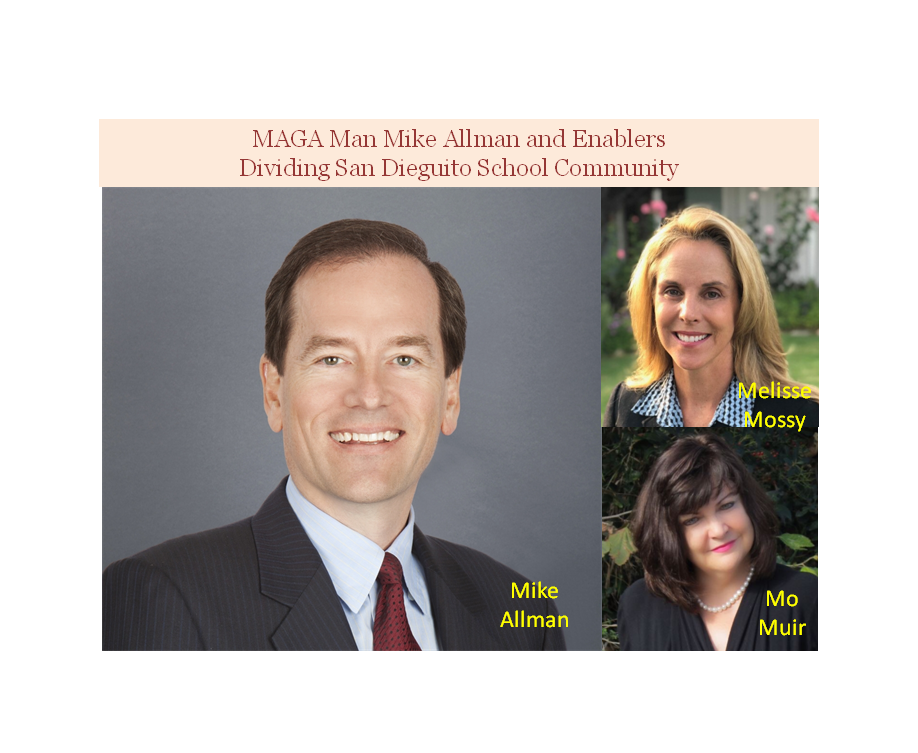
Attorney Cory Briggs has filed a suit against San Dieguito Union High School District (SDUHSD) over their new Trustee Area map. California law requires school districts to rebalance the board member areas after each decennial federal census. Led by Trustee Mike Allman three of the five district trustees apparently decided to use this requirement for political advantage. In the process, the suit claims they not only broke the spirit of the law but actually acted illegally.

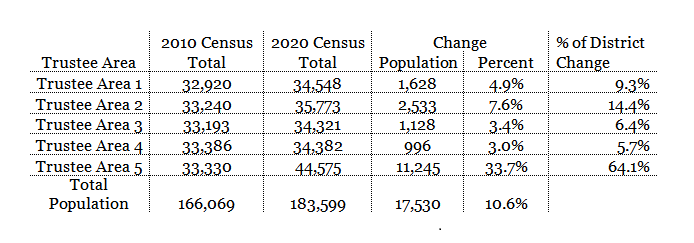
Table 1: SDUHSD Population Change

All of the trustee areas experienced population growth with area-5 showing significant growth, so it was surprising to see the trustee from that area, Julie Bronstein, being mapped out of the district. Attorney Briggs stated in the suit,

“Over the last couple years, SDUHSD’s governing board has become fractured by a 3-to-2 vote on multiple topics and the board members in the majority have become openly hostile toward the board members in the minority. The majority recently misused the statutorily required procedure for adjusting the boundaries of SDUHSD’s five trustee areas in order to give the majority’s members an electoral advantage in upcoming elections, and to put the minority’s two members at a disadvantage, by altogether rearranging the boundaries instead.”

If this is true, they also ignored the warning based on the California Voting Rights Act (CVRA) from San Diego County Superintendent of Schools Paul Gothold. He wrote,

“However, under Cal. Education Code section 5019.5, each school district has an independent obligation to approve maps that are consistent with the intent and purpose of the CVRA. This section envisions that there will be adjustments to trustee areas by a district and not the wholesale re-writing of boundaries.”

MAGA Man

Michael Allman is a self-described “libertarian-leaning Republican.” He arrived in San Diego to work for Sempra Energy; he is a former executive of Southern California Gas Co. and until 2016 was an executive at a software company called Bit Stew Systems. Allman received a BS in Chemical Engineering from Michigan State University and an MBA from the University of Chicago home of infamous libertarian economist Milton Friedman.

In 2020, he ran for an SDUHSD school board seat. It was Allman’s second foray into electoral politics. He ran in the 2018 district 52 congressional primary. He was matched against incumbent Democrat Scott Peters and five fellow Republican challengers. Allman reported $415,109.45 total campaign spending in that race of which $300,000 came via his personal loan.

He garnered a disappointing 3.9% of the vote.

Four days before the 2020 school board election Allman posted,

“Teachers unions’ goals are in direct conflict with those of school boards.

“I will be your independent voice on the board and will work for students, parents and taxpayers. I am not beholden or supported by the teachers union.”

In his school board race, he personally contributed $29,000 of the $33,333.55 in campaign contributions and loaned his campaign another $30,000. He out-spent his opponent five to one. Allman won the seat with 7,507 votes to 7,181 votes.

He went to his first board meeting as a Trustee on December 15, 2020 with his MAGA agenda locked and loaded.

Trustee Mossy introduced an Allman inspired proposal to change the time of the regularly scheduled Thursday at 5 PM board meetings to an alternating schedule of 9 AM and 5 PM (amended to 3 PM and 5 PM). This change to years of precedence obviously made it more difficult for working people especially teachers to attend school board meetings.

Allman wrote a proposal calling for the board to adopt Rosenberg’s Rules of Order in place of Roberts Rules of Order. According to Jurassic Parliament, the Rosenberg Rules are less Democratic giving more power to the chair and the majority. They are simpler with their rules stretching only to 10 pages compared to the 787 pages explaining the Roberts Rules, but that also gives the chair more power to make ruling interpretations. After a discussion the item was labeled a “future agenda item.”

He proposed changing the board’s legal council to Cory, Hargreaves & Savitch LLP. Most public school district would not touch such a “school choice” promoting law firm. The firm’s web site states,

“If you view charter or private schools as opportunities to improve public education, we are aligned with you. We want to help you make a positive difference.”

This proposal was sent to a legal committee for further review.

Allman’s big agenda item of the day was for all SDUHSD schools to open on January 4, 2021 for face to face instruction. Part of the resolution he authored stated, “The Governing Board designates Trustee Allman as the Board’s spokesperson for matters addressed by or arising from this Resolution.”

The board made it clear that all board members would be spokespersons and not just Allman. They also decided to start with one day a week in person before going to five days a week on January 27. After those changes the MAGA coalition of Allman, Muir and Mossy provide the three required votes.

The San Dieguito teacher’s union immediately took legal action that stopped the at once in person school openings.

From that first meeting until today, Allman has been a force dividing people and instigating scorched earth politics.

New Area Maps Reflect Radical Power Politics

The trustee positions in SDUHSD have a duration of four years with odd numbered areas-1, -3 and -5 holding elections in non-presidential off years. Areas-2 and -4 are voted on during presidential election years.

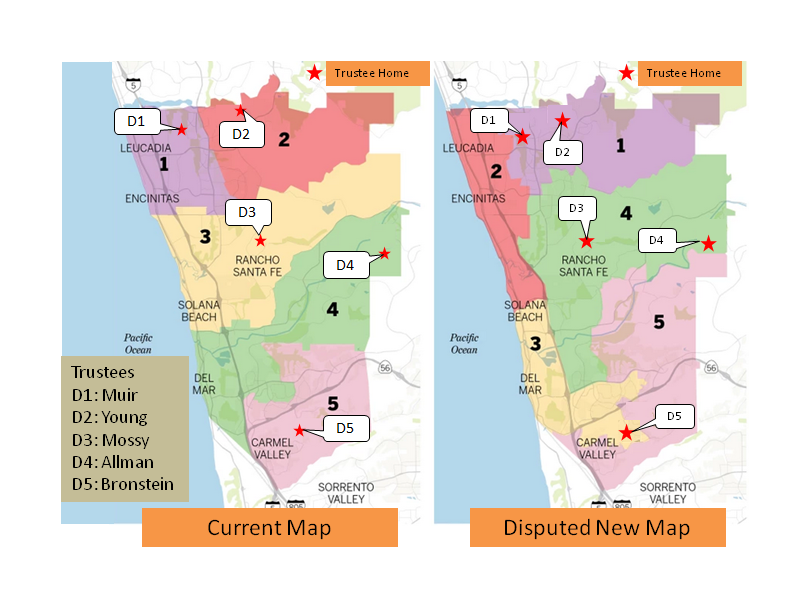
The adopted new map known as Scenario 8 radically redrew area-1 and swaps the area number with area-2. This leads to about 30,000 people in the former area-1 not voting this year and about 30,000 people in the former area-2 voting again this year. So some citizens will not vote for 6 years and others will vote after 2 years.

Trustee Muir whose term is up this year is moved into the new Area-1 and Trustee Young who normally voted with the minority is also now in the same new area-1. For Young whose term ends in 2024, she has a difficult decision to make. Does she serve out her final two years and then not be able to run for re-election in 2024 or does she run again this year for basically the same seat she won in 2020?

Melisse Mossy whose term ends this year has seen her area-3 significantly reshaped to the point she no longer lives in it. Mike Allman’s area-4 is still similar to the current map. He is the only trustee not negatively affected by the new map.

The boundaries of area-5 have also been significantly redrawn; moving area-5 Trustee Julie Bronstein who is up for re-election to the extremely redrawn area-3. At a board meeting last month, Bronstein retorted, “It would make sense, Trustee Allman, if you were being sincere about wanting it to be coastal, but the way it’s been drawn, it literally has a line just right around my house.”

The new areas-1 and -5 have no current board members living in them. The adopted map splits the cities of Solana Beach and Encinitas into three areas and it splits the city of Cardiff into 2 areas.

In the suit filing, Attorney Corey Briggs stated,

“SDUHSD’s demographers initially prepared at least three maps – known as Scenario 1, Scenario 2, and Scenario 3 – that lawfully adjusted the five trustee areas’ boundaries. Furthermore, one of the three map finalists considered by SDUHSD’s governing board on February 17, 2022 – Scenario 1C – also lawfully adjusted the five boundaries.”

Map scenarios 1, 2 and 3 were presented to the board by a lawyer from F3 Law which arranged for demographers to create them. According to Trustee Katrina Young,

“It has been stated that the Teacher’s Union is behind Map 1C. However, in two separate emails to the Board, a community member has identified herself as the ‘constituent who drew and submitted Community Maps C and D, which were presented to the public as Scenarios 1C and 6 respectively.’”

The mystery is where did the adopted scenario-8 map originate? The San Diego Union reports that all of the board members with the exception of Mike Allman who did not respond claimed not to know.

On his Facebook page, Allman claims that scenario-8 is legal and defiantly states, “The decision on which map to choose is up to our Board, and no one else.”

Observation

Democracy, the rule of law and fair play have long been upheld as American virtues. However, the former president brought into open a cancer inflicted modern conservatism causing many of its leaders to eschew these virtues. Their MAGA philosophy venerates political power above all and makes them more akin to radicals than conservatives. Conservatism has value to offer our society but when it turns against fair play, the rule of law and even democracy itself, it veers toward fascism.

In his 1894 essay “How to become a Genius,” (Selected Non-Dramatic Writings of Bernard Shaw Page 346) George Bernard Shaw wrote,

“The America of to-day is built on the repudiation of royalty. The America of to-morrow will be built on the repudiation of virtue.”

Let’s hope that was not prescient.

Choosing to End Public Education

25 Feb

By Thomas Ultican 2/25/2022

In 2017, the new President of the United States was explicit in his intention to end public education. He appointed a dominionist as secretary of education and regularly invoked the libertarian inspired pejorative “government schools” when referring to public schools. He loudly supported a movement to end public education which started in earnest five decades before he took office.

Its foundation was the economic theories of Milton Friedman and opposition to integration in the old south. Neoliberals, libertarians and their billionaire financiers have unsparingly attacked public education. Their fundamental weapon for ending the public school system is “choice.”

The newly published book Public Education: Defending a Cornerstone of American Democracy is a compilation of 29-essays edited by David C. Berliner and Carl Hermanns. All of the essays are written by accomplished award winning educators and historians. Gloria Ladson-Billings, known for her work on Culturally Relevant Pedagogy wrote,

“Some years ago, when the school choice movement began to gain attention, I argued that we were looking at the beginnings of the plan to destroy public education. There are those who declared I was being ‘alarmist.’ But I made this pronouncement after looking at the ways other aspects of public services have faced severe erosion.” (Education 226)

She also speculated that a contributing factor for the loss of consensus to support public schooling is the long-term campaign by powerful interest groups to portray public education as failing.

In another essay, Education Historian and former US Assistant Secretary of Education Diane Ravitch reported that in 1984 the Republican Party for the first time called for prayer in school and “choice.” She stated,

“Despite the sordid history of school choice and its origins in the segregationist movement, the term became a rallying cry for critics of public education. Right-wing think tanks, libertarian billionaires, and groups like the American Legislative Exchange Council – an organization that brought together far-right extremists, big corporate money, and other who wanted to reduce government regulation and unleash free enterprise – unleashed an unmodulated campaign of vilification against public schools.” (Education 27)

Duke University Professor of History and Public Policy Nancy MacLean, this past September published a new research paper at the Institute of New Economic Thinking – How Milton Friedman Exploited White Supremacy to Privatize Education.” She is the author of the must read book Democracy in Chains: The Deep History of the Radical Right’s Stealth Plan for America.” In her new paper MacLean states,

“This paper traces the origins of today’s campaigns for school vouchers and other modes of public funding for private education to efforts by Milton Friedman beginning in 1955. It reveals that the endgame of the “school choice” enterprise for libertarians was not then—and is not now–to enhance education for all children; it was a strategy, ultimately, to offload the full cost of schooling onto parents as part of a larger quest to privatize public services and resources.”

A New Trojan Horse

The Gateway Drug: Charter Schools

An article by the Education Law Center’s Wendy Lecker states,

“As noted in a 1996 Detroit Metro Times article, while the DeVos’ ultimate aim was to abolish public education and steer public funds to parochial schools, they knew not to be blatant about that goal. Thus, they chose a vehicle that blurred the lines between public and private schools- a “gateway drug” to privatizing public education: charter schools.”

After John Walton read the 1983 Reagan administration publication ‘“A Nation at Risk’ with its ominous warnings about the failings of public education,” he convinced his family to direct their philanthropy toward reforming public education. Throughout the 1990s he campaigned endlessly for new voucher legislation and saw his efforts repeatedly rebuffed. Shortly before his death in 2005, John joined Don Fisher and Buzz Woolley in establishing the Charter School Growth fund. Around the same time the Walton Family Foundation began financing charter school startups in communities across America.

Jeff Bryant interviewed Jeffry Henig of Teachers College about the Walton’s move to supporting charter schools. Bryant asserted,

“Henig believes many conservatives view charter schools as a way to ‘soften the ground’ for potentially more private options, though he isn’t entirely sure ‘the Waltons view charters as a Trojan Horse for eventually providing vouchers universally.’”

Former Secretary of Education Betsy DeVos has carried on a relentless attack on public education that continues today. One of the images she sells is viewing students as having a backpack full of taxpayer money which each school age child’s parents spends on education services. In her essay “Public Education at a Crossroads: Will Horace Mann’s Common School Survive the Era of Choice?” educator, administrator and public school advocate Carol Burris warns,

 “Given the anti-tax, anti-government proclivities of those who espouse this type of funding scheme, it is likely that fewer and fewer tax dollars would be place in the backpack over time. Parents once again would assume the sole responsibility for educating their children, buying what services they could afford, with the poor relying on charity.” (Education 239)

A Pillar of Democracy: Public Education

In the essay “Values and Education Policy” Edward Fiske and Helen Ladd tell us, “Good education policy making is rooted in coherent and enlightened educational values.” (Education 33) They begin by discussing the values expressed by Horace Mann who successfully implemented his vision of “common schools.” Today’s public school system is very much a result of that vision and his leadership. Some of the issues Mann addressed are the same issues driving “choice” today. Fisk and Ladd share,

“The idea of taxing all citizens, including those of the privileged classes who already enjoyed access to private education, in order to finance the education of poor and working-class children was viewed as both wasteful and as an infringement of property rights. Mann argued that free schooling served the collective interests of all citizens, rich and poor alike. ‘Jails and state prisons are the complement of schools,’ he wrote. ‘So many less as you have the latter, so many more you must have of the former.’”

“He famously declared, ‘Education, then, beyond all other devices of human origin, is the great equalizer of the conditions of men – the balance-wheel of the social machinery.’” (Education 34-36)

The authors conclude,

“Proponents of citizenship education are struggling to find a place in school curricula. Powerful private foundations and individuals, including the recent U.S. Secretary of Education, are raising millions of dollars to undermine the concept of universal education by privatizing public education and, by means of vouchers and charter schools, to break the link between publicly supported schools and democratically elected officials. Racial resegregation of schools is now pervasive, and courts are retreating from the notion that public funds should not be used to further sectarian religious instruction.” (Education 45)

For a long time, Richard and Betsy DeVos have been working to obliterate the separation of church and state, and privatize public education. In a 2001 interview conducted at the Gathering, Richard  lamented how awful it was that public schools had replaced churches as the center of communities. He did not identify whose church would be accepted as the new community center, but it seems certain to be some flavor of Christianity.

Public Education Shares Informed Discourse

Thirty-two of America’s most accomplished education thinkers and practitioners share their insights. All of them have more than two-decades of experience practicing, researching and debating education policy. None of them are billionaires trying to offload their tax burden or implement self-centered libertarian ideology.

In these pages, there is general respect for Horace Mann’s education advocacy and the public school system but also recognition of associated problems. The common schools were not just the “great equalizer” but also the great homogenizer. They indoctrinated students with a protestant Anglo-Saxon ethic. There is nuanced discussion here about the great foundation for democracy (public schools) needing to inspire not indoctrinate. And some of the authors reject the “great equalizer” belief as a myth.

Professor Ken Zeichner discusses the extreme segregation of public schooling in the United States, speculating they are “possibly more segregated today than it was in the 1960s.” (Education 178) He says in non-dominant communities, families and community members are excluded from real participation in school affairs. He recommends community centered engagement versus school centered engagement. Unfortunately he reports, “Both federal legislation and school practices have encouraged school-centric as opposed to community-centric family and community engagement, creating mutual distrust between families and schools.” (Education 179)

University of Georgia’s Peter Smagorinsky shares, “According to [Betsy] DeVos, those who direct the prevailing K-12 system are ‘trapped in an outdated education model,’ beholden to the ‘wrong and manipulative’ theories of Horace Mann and John Dewey.’” For people not on the extreme right this sounds like nonsense. However, Smagorinsky cautions that people’s positions “are largely emotional and the argumentative reasoning is used as a post hoc means of justifying an established position, … it’s unlikely the Culture Wars will end any time soon, because no one can win them with logic or facts.”

I will end my taste of what is in this wonderful compilation with a quote from one of the editors, David Berliner. He ran through a litany of the scandals arising from both the charter and voucher school movements fueled by unregulated taxpayer dollars. Then personally gratifying to me he wrote, “But Tom Ultican, a thoughtful and passionate defender of public schooling, has a reminder to Americans about the origins of the charter and voucher movement in our nation,”

“Birthed in the bowels of the 1950s segregationist south, school choice has never been about improving education. It is about white supremacy, profiting off taxpayers, cutting taxes, selling market-based solutions and financing religion. School choice ideology has a long dark history of dealing significant harm to public education.

“Milton Friedman first recommended school vouchers in a 1955 essay. In 2006, he was asked by a conservative group of legislators what he envisioned back then. PRWatch [published by the Center for Media and Democracy] reports that he said, ‘It had nothing whatsoever to do with helping ‘indigent’ children; no, he explained to thunderous applause, vouchers were all about ‘abolishing the public school system.’” (Education 280-281)

Enabling the Privatizers – The End Game is Finally Here

8 Feb

Guest post by an Oakland parent and teacher, Jane Nylund 2/8/2022

Lest we all forget, from six years ago, here was the plan: 50% of our kids into charter schools. https://capitalandmain.com/oaklands-charter-school-tipping-point-0531

And now, it looks like that plan is coming to fruition. You are following the privatization playbook to the letter.

When the well-paid accountants arrive and show a slide comparing Oakland Unified School District (OUSD) to other districts of similar enrollments/socio-economic status (SES), and make the simplistic assumption that OUSD has too many schools compared to the others and that we have to be just the same, here’s what you are really saying.

Lesson 1) High poverty children don’t deserve smaller schools and class sizes, anywhere in the state of California, unless it’s a charter.

Lesson 2) It isn’t acceptable for a high-needs district to appear to have it “better” than the others with smaller schools. Smaller schools are meant for wealthy people.

Lesson 3) Because we don’t have the political will to invest in the other comparison districts, we need to continue to dis-invest in Oakland instead, thus creating “equity” at the bottom. Nothing new, we’ve been doing that for years. See Lesson #1

Lesson 4) It’s okay to let Bill Gates experiment with small schools for our kids, until he becomes bored and pulls funding.

Here is the equivalent of that purported “savings” that really isn’t: 

1) Recent HQ pay for two years. OUSD used to have 14 positions at $200K+; in 2020 they had 47.

2) Lease at 1000 Broadway.

3) Cost of a new school site kitchen.

So, by closing all these schools, OUSD can now have the cost equivalent of a kitchen. Maybe.

Turn this entire idea on its head. The continued austerity measures for high-poverty districts like Oakland are a clear message to these families that they don’t deserve a mix of schools, like, say, San Francisco. 

Have you ever looked at the school mix in San Francisco, our neighbor across the bay? You should. I recently noted that they have a mix of 122 schools, give or take. They have 14% charter enrollment, and several comprehensive high schools. They also support a mix of much smaller schools from 100-500 kids each, of all types. They don’t use an “ideal” size. That doesn’t exist, and research bears that out, no matter how many presentations and how many consultants you pay to come up with an “ideal” number. So, if you are arguing that Oakland has too many schools, then you need to head over to SF and advise their board to also close schools. Oh, that’s right, they have wealthy families there. Don’t want to rock the boat. See Lesson #2

The accountants never look at San Francisco as a comparison district because of socio-economics, but SF still comes in at 57% free and reduced price lunch. Clearly, San Francisco does something we don’t, even as elite San Franciscans are trying to shut down their elected school board. The obvious answer is that San Francisco is not a top-heavy, privatized, portfolio district.

No one in OUSD, Financial Crises and Management Assist Team (FCMAT), or local and state government has ever answered the obvious question: find me a comparison district in California, the same as ours, that has all the community services/pay/benefits/supports/enrichment as a result of having 40-50 schools.  This nonsensical premise is what you are trying to sell us. What is a model district that you can reference that has successfully achieved and implemented this accounting miracle? Stockton, Sacramento, Long Beach?  Where?

Answer: none of the above.  You can’t find any high-needs district that has all of this because it supports a magical number of 40-50 schools. So you are asking us to just go along to get along with Stockton, Sacramento, and Long Beach, and many others. All that “savings” simply evaporates, along with enrollment, and the status quo remains. It is truly mind-blowing that you are promising community schools to magically appear, when there is no other district model in the state that supports this idea that you can close dozens of schools, and expect tax dollars to rain down upon school sites. The consultants will be falling all over themselves to be first in line for the money grab. It would be laughable if it wasn’t such a tragedy.

Go back to my point #1 in case you forgot about the entire argument about why this exercise isn’t about children. It isn’t about savings. It isn’t about more money for school sites.  It isn’t about teacher pay. It’s about not having the guts to stand up to bullies like FCMAT and their state overlords. It’s about taking the easy way out because of a “belief” system. It’s neat and tidy, and pencils out nicely. But once you put down those pencils, the disaster you have created for our communities will be irreparable and will change the fabric of the Oakland community forever. But John Fisher doesn’t care. The chaos will make it that much easier for the luxury A’s stadium to go in. But you already knew that. 

Pirates Profiteers and Privatizers

21 Dec

By Thomas Ultican 12/21/2021

Ronald Reagan claimed the nine most terrifying words in the English language are “I’m from the government, and I’m here to help.” The new book, The Privatization of Everything, documents the widespread theft of the commons facilitated by Reagan’s anti-government philosophy. His remark echoed a claim from the “laissez-faire cheerleader” Friedrich Hayek that government has us all on the “road to serfdom” (Privatization 120). Sherrilyn Ifill, the former Director-Council of the NAACP Legal Defense Fund observed,

“What we’re seeing in our country today: the rhetoric, the hate, the ignorance, the coarseness, the vulgarity, the cruelty, the greed, the fear is the result of decades of poor citizenship development. It is a reflection of the fully privatized notion of citizenship, a feral conflict for the scraps left by oligarchs (Privatization 13).”

Libertarian politicians like former speaker of the house Paul Ryan and Senators Ron Johnson and Rand Paul claim Hayek and writer-philosopher Ayn Rand as their guiding lights. In a 2012 article, Politico reported, “…, to bring new staffers up to speed, Ryan gives them copies of Hayek’s classic “Road to Serfdom” and Rand’s “Atlas Shrugged” — books he says inspires his political philosophy.” Politico also stated,

“But Hayek and Rand were violently opposed to each other’s ideas. It is virtually impossible to hold them in the same brain. When the termagant Rand met Hayek, she screamed across the room, ‘Compromiser!’ and reviled him as an ‘abysmal fool,’ an “ass” and a ‘totally, complete, vicious bastard.’”  (Termagant: a violent, turbulent, or brawling woman.)

Ayn Rand’s problem with Hayek was that he was not really the “laissez-faire cheerleader” he was purported to be. He certainly opposed many of the ideas emanating from Franklin Roosevelt’s New Deal believing they would lead to worse problems than the ones being addressed. Fundamentally his thinking was shaped by a fear of communism. However, unlike today’s libertarians, he was not opposed to all government programs or interventions and that is what stirred Ayn Rand’s fury.

Robert Nielsen’s 2012 review of Hayek’s The Road to Serfdom observes,

“He also calls for social insurance in case of sickness and accident, as well as government assistance after a natural disaster. ‘But there is no incompatibility in principle between the state providing greater security in this way and preservation of individual freedom.’ I think most advocates of Hayek have not read this passage and don’t realise he is not an extremist arguing against all forms of government. Let me repeat this, Hayek is arguing there is a good case for the government to get involved in healthcare, either in the form of universal healthcare or government insurance.”

John Maynard Keynes is thought of as the liberal economist whose theories guided President Roosevelt as he grappled with the great depression. Hayek’s and Keynes’s economic theories were in some ways polar opposites. However, Hayek came to London to work at the School of Economics where he and Keynes who was 16-years his senior became friends. They exchanged several letters concerning Hayek’s works in which Keynes found some agreement.

Chet Yarbrough’s audio book review of The Road to Serfdom states,

“Contrary to a wide perception that John Maynard Keynes (a liberal economist in today’s parlance) denigrated ‘The Road to Serfdom’; Keynes, in fact, praised it.”

“Though Keynes praised ‘The Road to Serfdom’, he did not think Hayek’s economic’ liberalism practical; i.e. Keynes infers that Hayek could not practically draw a line between a safety net for the poor, uninsured-sick, and unemployed (which Hayek endorsed) while denying government intervention in a competitive, laissez-faire economy.”

It is disingenuous to cite the theories of Friedrich Hayek as the justification for privatizing government functions and the commons.

The Privatization of Everything

The Privatization of Everything co-author Donald Cohen is the founder and executive director of In The Public Interest. Co-author Allen Mikaelian is the bestselling author of Metal of Honor and a doctoral fellow in history at American University. Besides the authors’ individual work, the team at In The Public Interest contributed significantly to the book with research and documentation.

Of their intention in writing the book, the authors state,

“Our approach is both idealistic and practical. We want readers to see the lofty values and big ideas behind the creation of public goods, and we want readers to feel empowered to question those values and introduce new ones. We want to help change the conversation, so we can stop talking about ‘government monopolies’ and return to talking about public control over public goods (Privatization 19).

They detail several cases showing the downside of the government being forced to give control over to private business. In this era of human-activity-induced climate change, what has been happening at the National Weather Service (NWS) is instructive.

In the 1960s, President John F. Kennedy believed that the US and the Soviet Union could find a field of cooperation in supporting the World Meteorological Organization. As a result, 193 countries and territories all agreed to provide “essential data” on a “free and unrestricted basis.” “Each day, global observations add up to twenty terabytes of data, which is processed by a supercomputer running 77 trillion calculations per second (Privatization 267).”

The book notes, “In the 1990s, at about the same time that forecasting got consistently good, private interests and free-market absolutists started insisting that the NWS and related agencies were ‘competing’ with private enterprise.” Barry Myers, head of AccuWeather was loudly accusing the government of running a “monopoly.” He went to the extreme of calling for the government to get out of the weather predicting business which made no sense since AccuWeather is completely dependent on NWS predictions. (Privatization 268)

After a killer tornado in 2011, NWS employees proposed a smart-phone app to better inform the public. The author’s report, “… this ultimately took a backseat to Myers’s insistence that his AccuWeather apps shouldn’t face ‘unfair’ competition (Privatization 270).” To this day, NWS has no smartphone app.

Weather forecasts are pretty good for up to a week but after that as time passes they become more and more useless. The models for predicting the weather are highly dependent on the preceding day and the farther you get from accurate data for that day the more error invades the predictions. NWS restricts its predictions to a one-week time-frame but AccuWeather and the Weather Channel in order to attract customers provide meaningless 2-week up to 90-days predictions. (Privatization 272)

Extreme weather events are life threatening. The authors state,

“The NWS’s mission includes saving lives. The business model of corporations like AccuWeather includes saving lives of paying customers only (Privatization 273).”

There are many episodes like NWS detailed. In the section on private prisons, we read about such atrocities as the Idaho correctional facility known as the “Gladiator School” (Privatization 140). When detailing the privatization of water we are informed of Nestles CEO, Peter Brabeck stating how extreme it was to believe that “as a human being you should have a right to water (Privatization 54).”

Privatizing Public Education Stabs Democracy in the Heart

The First Public School in America

Boston Latin School was founded April 23, 1635. America’s first public school only accepted boys for their curriculum centered on humanities including the study of Latin and Greek. Its more famous revolutionary-era students were Samuel Adams, John Hancock and Benjamin Franklin. These revolutionary thinkers who gave America democracy were educated in a public school and would latter agree that free public schools were necessary to a functioning democracy.

When Betsy DeVos was calling for vouchers and charter schools, she was implicitly demanding public dollars support religious schools that would not accept transgender students or homosexual teachers. She wanted schools free to teach a doctrine of science denial and religious bigotry. “Freedom of choice in this case meant the freedom to discriminate, with the blessing of public funds (Privatization 210).”

One of the several disturbing stories about the menace of privatizing schools comes from Reynolds Lake Oconee, Georgia. Wealthy real estate developer Mercer Reynolds III made a charter school the center of his community development. The charter school application called for 80% of the children to come from Reynolds properties. The other 12% would go to students in nearby wealthy white communities and the remaining 8% would go to countywide residents. (Privatization 211-212)

With a mix of taxpayer and private funding, Reynolds built an impressive school. It had a piano lab with 25 pianos, a pond and offered 17 AP classes. The school is 73% white. The nearby public school that is 68% black and would never dream of a piano lab has seen the Reynolds school continually siphon off more of their students. They have been forced into laying-off staff and tightening budgets. (Privatization 212)

Cohen and Mikaelian concluded,

“This was a clear-cut case of rich whites diverting money from struggling black families in order to further push them to the margins. And they used the ideas of school choice and free market to justify it.

As the book makes clear, every time a public good is privatized the public loses some of their democratic rights over that lost good. This is a powerful book that everyone should read. In the last chapter the authors call out to us,

“We can’t let private interests sell us public goods as consumers, because the free market can’t avoid creating exclusions. School choice quickly devolves into segregation. Public parks and highways are divided into general versus premium services. In the midst of a notional health crisis, ventilators go to the highest bidder.”

Current Attack on Democracy and Public Education

30 Nov

By Thomas Ultican 11/30/2021

Nancy MacLean’s amazing book Democracy in Chains documents Charles Koch’s anti-democratic and anti-public education agenda plus his relationship with Nobel Prize winning economist James Buchanan (Democracy in Chains page 184). She quotes Buchanan speaking about their shared libertarian agenda, “The project must aim toward the practical removal of the sacrosanct assigned to majority rule.” MacLean writes of Buchanan, “The collective enemy he was constructing included nearly everyone in education except academic economists” (Democracy in Chains page 119). She also noted that the handsomely Koch-financed politician Dick Armey called for the end of public education which he labeled “the most socialized industry in the world” (page 196). Today’s pandemic attack on public education is simply a continuation of a more than a half-century long crusade to end it. Koch money is still feeding the cause.

Christopher Leonard’s Kochland is the story of Charles Koch beginning with his earning two MIT masters of engineering degrees. For those who don’t know about him and his late younger brother David, this book is a magnificent tutorial.

In 1966, after five years working for his father, Charles became the CEO of a company then known as Rock Island Oil & Refining Company. After his father Fred died in 1967, Charles took a disparate set of assets – a cattle ranch, a minority share in an oil refinery and a gas gathering business – and stitched them together into the company the family renamed Koch Industries as a tribute to their father. Today it is the second largest privately held corporation in the world.

Unfortunately, it was the works of Austrian economists and philosophers Ludwig Von Mises and Friedrich Hayek that attracted Koch. He has been described as a libertarian and a conservative but “classical liberal” is a more apt description. Leonard observed, “Hayek, in particular, put forward a radical concept of capitalism and the role that markets should play in society, and his thinking had an enduring effect on Charles Koch” (Kochland page 42).

Charles and his late brother David have spent lavishly promoting their libertarian beliefs. Inspired by the anti-New Deal Austrian Economist Friedrich Hayek; the brothers agreed that public education along with most other public institutions must be abolished.

Charles Koch has been the leader of the effort to undermine democratic rule and state management, but he is hardly alone. Joining his libertarian crusade are Wal-Mart’s Walton Family Foundation, Wisconsin’s Lynde and Harry Bradley Foundation, Illinois’s Richard Uihlein, the dark money donor directed fund, Donors Trust and many others.

Jane Mayer’s book Dark Money described Donors Trust and its sister organization Donors Capital Fund as “a screen for the right wing, behind which fingerprints disappeared from the cash.”

The Pandemic Attack

In the spring of 2020, a campaign to ignore school safety issues associated with the novel corona virus was initiated. The former president and his secretary of education began calling for schools to be opened immediately for full time face to face instruction. There was a nationwide response from the Republican Party that included establishing Astroturf parent organizations demonstrating throughout the nation for schools to be reopened. There was little concern for the health of school staff or about the likelihood that children would take COVID home to vulnerable family members.

This spring, the attack on public schools took a dark and violent turn. School board members were being screamed at and threatened because they were requiring students to ware masks. The accusations grew in scope to include the supposed teaching of critical race theory (CRT) and supplying children with inappropriate books like “Ruby Bridges Goes to School: My True Story”.

Oddly, most teachers did not have a clue about what CRT was because it is seldom addressed outside of Law School graduate seminars.

Last month State Representative Christine Palm and former Assistant US Attorney, Frank Hanley Santoro wrote in the CT Insider,

“Clearly, something is afoot. Why is this happening suddenly and simultaneously in so many different places around the state (and indeed the country)? Why is the pattern so similar? … Why pick on CRT, which schools don’t even teach …? This doesn’t sound like something that just happened to occur to parents at a local bake sale.”

“The explanation may lie with Steve Bannon. According to Bannon, ‘This is the Tea Party to the 10th power,’ and ‘The path to save the nation is very simple. It’s going to go through the school boards.”’

The National Education Policy Center at the University of Colorado weighed in on why the attack on CRT and where it’s coming from:

“Well-established and powerful far Right organizations are driving the current effort to prevent schools from providing historically accurate information about slavery and racist policies and practices, or from examining systemic racism and its manifold impacts. These organizations include the American Legislative Exchange Council (ALEC), Goldwater Institute, Heritage Foundation, Koch family foundations, and Manhattan Institute, as well as billionaire-funded advocacy organizations such as Parents Defending Education and the Legal Insurrection Foundation.”

“The anti-CRT narrative is … used to accomplish three goals: to thwart efforts to provide an accurate and complete picture of American history; to prevent analysis and discussion of the role that race and racism have played in our history; and to blunt the momentum of efforts to increase democratic participation by members of marginalized groups.”

Doug Porter of the Wordsanddeeds blog writes, “While the racial resentment that the school board battles illustrate is as American and ever-present as apple pie, the road to retaking power through educational culture wars is part of a current, well-funded national strategy by some of the usual Dark Money suspects.”

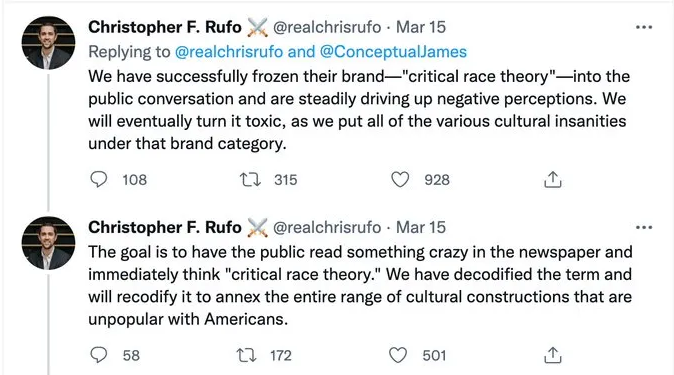
Christopher Rufo’s Tweets about the Framing of CRT

According to his biography at the Manhattan Institute, the 35-years-old Christopher Rufo “is a senior fellow and director of the initiative on critical race theory at the Manhattan Institute.” As he clearly indicates in the tweets shown above his team at the Institute has rebranded CRT to “annex the entire range of cultural constructions that are unpopular with Americans.” He knows it is a false construct but does not care because it has become amazingly successful. Honesty is not a treasured virtue in libertarian circles. Winning is all that matters.

Source Watch reports,

“The Manhattan Institute (MI) is a right-wing 501(c)(3) non-profit think tank founded in 1978 by William J. Casey, who later became President Ronald Reagan‘s CIA director. It is an associate member of the State Policy Network.”

Funding for the the Manhattan Institute and the State Policy Network include generous grants from Koch Family Foundations, Lynde and Harry Bradley Foundation, Scaife Foundation, Walton Family Foundation and many other funders of libertarian causes. For example, 2017 tax records show that Donors Trust (EIN 52-2166327) sent $6,500,000 to the State Policy Network and in 2020 the Bradley Foundation reported gifting $850,000 to the Manhattan institute.

The last available Tax form for the Manhattan Institute (EIN: 13-2912529) covers parts of 2018 and 19. It shows a regular yearly intake of more than $15 million in grants which seems to mainly pay large salaries. Senior Fellow, Christopher Rufo is not listed on the form but all of the senior fellows from tax year 2018-19 raked in more than a quarter million in salary and benefits.

Creating Astroturf Organizations

To create an effective political ground game, billionaire financed artificial organizations are continuously created. One outcome of this was noted by Blogger Jan Ressenger when she observed that the CRT controversy has links to “Well funded groups working to galvanize parents [including] Parents Defending Education,  Moms for LibertyNo Left Turn in Education,  FreedomWorks, and  Parents’ Rights in Education.”

Addressing these billionaire financed groups, Professor Maurice Cunningham wrote a very insightful post, Koch Connections and Sham Grassroots of Parents Defending Education”. About the newest organization, Moms for Liberty and its two leaders, he wrote,

“Moms for Liberty’s creation story is similar to others in the anti-public education universe: ‘moms on a mission to stoke the fires of liberty.’ In a year and a half Moms for Liberty’s Form 990 tax returns are likely to show these two patriotic moms hauling down in excess of $150,000 each.”

Cunningham says it will be a year and a half before we have documentation about the pay for the founders of Moms for Liberty because non-profits do not file their first tax forms until 2-years after legal formation. The effective date on the Moms for Liberty articles of incorporation is 01/01/2021. The three founding officers signing the document are Tina Descovich, Tiffany Justice and Bridget Ziegler. Up until 2020, Descovich and Justice were both school board members in Indian River County, Florida (Vero Beach). Ziegler is the wife of Christian Ziegler, vice chairman of the Florida Republican Party and a former Congressional Fellow at the Heritage foundation.

In 2020, it appears Tiffany Justice voluntarily gave up her school board seat on the Indian River County school board. Tina Descovich was defeated in her reelection bid for the Brevard school district board. Jennifer Jenkins, a former school employee, campaigned against Descovich’s opposition to teacher raises and mask mandates. She won by 10% points in the heavily Republican district.

The Washington Post reported, “In 10 months, Moms for Liberty has grown to 135 chapters in 35 states, with 56,000 members and supporters, according to the organization’s founders.” In praising Moms for Liberty, Christian Ziegler (the husband of co-founder Bridget Ziegler), told the Post, “I have been trying for a dozen years to get 20- and 30-year-old females involved with the Republican Party, and it was a heavy lift to get that demographic, but now Moms for Liberty has done it for me.”

Obviously, Moms for Liberty is not a spontaneous movement of conservative mothers incensed by the teaching of CRT and the implementation of mask mandates. It is another well financed Astroturf organization designed to undermine public education and promote a libertarian agenda.

Pumping the Message

To generate “research”, a large network of think tanks working under the umbrella organization State Policy Network (SPN) was developed. This network is made up of 64 affiliated members and 98 associated members. In 2019, The Center for Media and Democracy reported that the 64 affiliated members took in more than $120 million in donations from almost exclusively far right conservatives. The Manhattan Institute that created the bogus CRT outrage is an associated member of SPN.

Once the “research” is completed, it is fed to ALEC, where model legislation is distributed to the large number of Republican state legislators who attend their secretive meetings. The legislators then take these models home and introduce them as if they wrote the bill. Jim Miller reports, “Recently, ALEC has been very active in working to suppress voting rights, undermine labor unions, privatize public education, fight action on climate change, fuel rightwing anger over “critical race theory,” promote anti-abortion, and anti-trans bills.”

To widely disseminate their message to local residents, a vast assemblage of local news sites has been established. According to a Columbia Journalism Review study, “There are five companies that make up the core of the network: Metric Media LLC, Newsinator (that, according to Iowa state records, has the alternative  name Franklin Archer), Local Government Information Services (LGIS), Pipeline Media, and Locality Labs.”

In Virginia, there were 28 active Metric Media sites algorithmically generating stories during the recent governor’s race. The local news sites in the network have little advertising and no subscription fees. The Columbia Journalism Review linked funding for the network sites to “the dark-money ATM of the conservative movement” and “a Catholic political advocacy group that launched a $9.7 million campaign in swing states against the Democratic presidential candidate Joe Biden.”

Under the unifying organization Metric Media, the group produces more the 5,000,000 automated articles every month through its 1300 local news sites. Popular Information reports,

“A Popular Information analysis found that between January and November 2021, the 28 ‘local news’ sites in Virginia published 4,657 articles about Critical Race Theory in schools.”

“Nationwide, tens of thousands of articles about Critical Race Theory have been published across the Metric Media network. That number is growing every day.”

Opinion

Nancy MacLean observed that Buchanan and Koch had concluded, “There was no glossing over it anymore; democracy was inimical to economic liberty.” (Democracy in Chains page 152)

The anti-democratic impulse of the oligarch must be contained. There is an underlying wisdom to democratic decision making. It is a wisdom that bends toward equity and humanism. Public education is the soil from which that wisdom can flower. For the past five decades, an autocratic businessman has been pushing our country in the direction of widespread suffering and discrimination.  

Neither capitalism nor socialism is a perfect guide for society. Education, medicine, prisons and policing are not well suited to a strict capitalist approach. A strict socialist approach does not function well in manufacturing, farming and entertainment. Ideologues demanding one of these two economic methods to the exclusion of the other are a problem. The guide to balancing these competing ideologies is humanism. In other words ponder, “The policy best serving the majority of the people while maintaining a keen eye to insure that the minority is not abused.”

The best way to move society forward toward a more perfect union is to make democracy ever more inclusive. And the best way to improve democracy is to protect and fund public education.

Shady Dyslexia Agenda Accelerating

28 Oct

By Thomas Ultican 10/28/2021

An intricately connected network of organizations is controlling dyslexia discourse in the US and taking over dyslexia screening and remediation. Thirty-nine states now have adopted dyslexia laws. Most of these laws contain the International Dyslexia association’s (IDA) remediation recommendation of being “multisensory, systematic, and structured.” Researchers Jo Worthy et al state, “This approach is not well supported by research, but it is officially sanctioned through legislation in many states and has had a profound effect on policy and practice.”

IDA, the Academic Language Therapy Association (ALTA), and the International Multisensory Language Education Council (IMSLEC) are three big players. IMSLEC started as an IDA committee, and ALTA certifies dyslexia specialists in the multisensory language approach, which is consistent with IDA’s Knowledge and Practice standards for educators. IDA began certifying teachers in 2016, in addition to accrediting dyslexia teacher training programs. The websites of these organizations link to each other and to Decoding Dyslexia, a network of parent organizations with chapters in every state. The mission statements and lobbying materials used by all Decoding Dyslexia sites employ language from IMSLEC and IDA.

Using Parents and Students

Rachael Gabriel is Associate Professor of Literacy Education at the University of Connecticut. When large numbers of people showed up at legislative hearings in Connecticut, she became interested in their unusual engagement and strangely similar comments. Gabriel used critical discursive psychology, positioning theory, and narrative policy analysis to analyze the dyslexia law advocacy. She says, “I argue that this narrative can be understood as a conversion narrative, which drives a privatization agenda in which public schools become mandated consumers for a growing dyslexia industry, and in which the nature of instruction for students with reading difficulties is narrowly prescribed.”

Gabriel shares several extracts from the oral and written testimonies given at the legislative session on special education. The first extract is from a student who introduced himself as a 10-year-old who was “here to speak in support of Bill RHB 5562, An Act Concerning Special Education to get dyslexia recognized in the State of Connecticut.”

“I have dyslexia. Reading and math are really hard for me. I’ve had too many teachers that don’t understand how to teach me. Finally, this year I went to Lindamood Bell training and reading is getting easier.”

This is a typical message indicating public school teachers do not know how to teach students with dyslexia but finally he was saved. Interestingly the private company Lindamood Bell’s training credited with making it possible for him to read is not one of several private companies that qualify as IDA certified reading specialists. In fact they report that many of their clients have previously been failed by a certified company. The certified companies all use some version of the 1930’s Orton-Gillingham method whose phonics centered practice IDA calls “structured literacy.”

An important psychological motivator for parents of children struggling with learning to read is the repeated claim that dyslexia is a brain centered condition often associated with giftedness. Statements similar to the following extract from a written comment are common.

“This is a disability worth our investment of time It is the disability of Speilberg [sic], Einstein, and Steve Jobs . . . Honor us and embrace us. We are continually the great minds of every generation. We are the ‘game changers.’”

The idea that dyslexia is associated with other kinds of giftedness is a wives tale. Johnston and Scanlon from the University at Albany wrote in their 2020 research paper,

“Public narratives about dyslexia commonly claim that people classified as dyslexic have an array of special positive attributes such as intelligence or creativity – more so than those not so classified. There is virtually no scientific evidence for these claims.”

Although the parent organization Decoding Dyslexia (DD) does not have a centralized leadership, each of the state organizations shares information from DD and IDA. They uniformly call for:

  1. “A universal definition and understanding of “dyslexia” in the state education code.
  2. Mandatory teacher training on dyslexia, its warning signs and appropriate intervention strategies.
  3. Mandatory early screening tests for dyslexia.
  4. Mandatory dyslexia remediation programs, which can be accessed by both general and special education populations.
  5. Access to appropriate “assistive technologies” in the public school setting for students with dyslexia.”

Parents with babies who struggle with reading are vulnerable to manipulation. The widely distributed message that dyslexia is a sign of high intelligence must be appealing. These parents are informed that their public school teachers do not know how to teach dyslexics. They are assured that private companies certified by IDA can accurately screen for dyslexia and provide the kind of “structured literacy” that saves children from academic disaster. The result is that whenever laws instituting the Decoding Dyslexia agenda are proposed large numbers of parents show up in support.

What is Dyslexia? What are the Myths?

The idea of dyslexia has been around for more than 100-years, but there is still no widely agreed upon definition. That means there is no consensus method for screening for dyslexia. Johnston and Scanlon reported in 2020,

“The bottom line is that there are many definitions of, and theories about, dyslexia and simply no agreed-upon definition that allows schools, clinicians, researchers, or anyone else, to decide who is dyslexic in any valid or reliable way.

From an instructional standpoint, there is no practical distinction between those classified as dyslexic and others at the low end of the normal distribution of word reading ability in the early elementary grades.”

Variations of this statement are quite widely available. A 2020 article in Reading Research Quarterly by J. G. Elliot states,

“I argue in this article that despite a proliferation of scientific findings, our understanding of dyslexia is marked by serious weaknesses of conceptualization, definition, and operationalization that not only are unscientific but also lead to impoverished practice in schools, social inequity in understanding and provision for many struggling readers, and reduced life chances for millions of students worldwide.”

IDA and DD promote mandatory early screening for dyslexia but the commercially available tools they promote are not up to the task. A 2017 article by Vanderheyden et al noted,

“In education, it is not uncommon for error rates to range from 50%–60%, meaning if a school assesses 100 children for whom 20 are “true positives” (i.e., truly have dyslexia), then most of the 20 (approximately 16–18) will be identified, but 50 to 60 students will be identified as false positive errors in the process.”

IDA bases its recommendations for reading remediation on the “science of reading” (SOR). In 2000, the National Reading Panel report claimed that its recommended phonics based word decoding methods were based on science. This kicked off a phenomenon often referred to as the “Reading Wars.” In 2004, David Pearson from UC Berkley’s Graduate School of education commented about the raging war,

“For example, several scholars, in documenting the practices of highly effective, highly regarded teachers, found that these exemplary teachers employed a wide array of practices, some of which appear decidedly whole language in character (e.g., process writing, literature groups, and contextualized skills practice) and some of which appear remarkably skills oriented (explicit phonics lessons, sight word practice, and comprehension strategy instruction). Exemplary teachers appear to find an easier path to balance than either scholars or policy pundits.”

In other words, SOR is definitely not settled science. Which means the IDA’s “structured literacy” is not a consensus driven approach.

In 2016, the International Literacy Association asserted,

“Both  informal  and  professional  discussions  about  dyslexia   often   reflect   emotional,   conceptual,   and   economic   commitments,   and   they   are   often   not   well   informed by research. Our beliefs and practices should be  grounded  by  what  emerges  from  the  available  evidence  (Elliott  &  Grigorenko,  2014;  Vellutino,  1979;  Washburn,  Joshi,  & Binks-Cantrell, 2011)

As  yet,  there  is  no  certifiably  best  method  for  teaching  children  who  experience  reading  difficulty  (Mathes  et  al.,  2005).  For  instance,  research  does  not  support  the  common  belief  that   Orton-Gillingham–based   approaches   are   necessary   for   students classified as dyslexic.”

IDA and the research papers cited here claim that as much as 20% of kindergarten and first grade students have reading issues. However, if their school has a professional intervention approach – that could be any of the interventions discussed here – by the time students reach high school less that 2% still have reading issues. Is it possible that the high number of students with reading difficulties in America is because reading is taught at a developmentally inappropriate age? On international testing Finish students test extremely well in reading and they don’t formally teach reading there until age 7.

Conclusion

The IDA organization has many professionals in reading education and the point here is not that they are wrong about screening and intervention pedagogy. The point is that the agenda they are promoting is far from settled science. They should continue to promote their beliefs but they need to stop using a legal strategy backed by power politics to force schools into becoming mandated consumers.

America’s public schools are staffed with an enormous number of well trained and experienced reading instructors. Denigrating them is not justified and is bad for reading education.

The International Dyslexia Association and Decoding Dyslexia are no longer advocates for students and parents. They have become predators using legal strategies and political power to feed an expanding dyslexia industry.

Corporations Invade Delaware Public Schools

18 Oct

By Thomas Ultican 10/18/2021

A multifaceted corporate plan for control of Delaware public education is in progress. Billionaires are financing numerous edtech projects that isolate children at screens. To validate literacy curriculum the state has turned to the International Dyslexia Association and their nonsense “science of reading” standards. A key driver for the corporate takeover is the so called High Quality Instructional Materials (HQIM) certified as such by EdReports.

Whenever the words “high quality” are used to promote something in education, it is a good bet that swamp land is being sold.

A private email from a Delaware teacher stated the situation succinctly,

“Over the past several years, it has seemed like Delaware was going in the right direction after the nightmare of Gov. Jack Markell and the RTTT grant. There was suddenly more of a focus on the whole child, starting in October of 2018 when Gov. John Carney announced that our state would adopt trauma-informed practices. … Teachers were beginning to breathe a sigh of relief that maybe our state would begin to implement more reasonable education practices than the rigid, scripted, market-based programs we have seen. Then all of a sudden this summer, this stuff about HQIM started popping up from DDOE. Schools were written up in The 74. Videos were made with the Knowledge Matters group …. Professional development was announced with TNTP.”

Delaware has one of the oldest public education systems in America. The History of Public Education in Delaware dates back to the 1792 state constitution which called for the establishment of public education as soon as possible (History page 19). In 1796, a permanent fund for public education was established (History page 19). In the following graphic a plaque identifies the historic Clayton Stone School built in 1805 on land donated by John Dickinson the “Penman of the American Revolution.” This is the legacy being threatened by corporate raiders.

Corner Stones of the Corporatization Plan

There was concern that Delaware’s children were falling behind due to the COVID pandemic. Monica Gant, Ph.D. from the Delaware Department of Education (DDOE) presented their strategy to accelerate learning in March. (Accelerating learning is highly questionable learning strategy.) Grant pitched, 

“DDOE is excited to use ESSER II funds to provide all Delaware public schools with five resources to support learning acceleration for students in literacy and mathematics for summer 2021:

Literacy Professional Learning and core HQIM Summer Booster content for raising 1-6 graders

Student access to online text repository (all students)

Access to Zearn Math Summer Intensive Series for all rising 1-8 graders

Zearn Professional Learning

High-dosage tutoring seats for multiple grades”

Under the heading “Literacy Professional Learning,” Professor Grant noted, “Participants will have a chance to apply their learning of the Science of Reading either through their district HQIM or utilize free OER (Open Education Resources) HQIM for this work.” And she announced that teachers will have the following professional materials available.

  • “Free OER – Core Knowledge Language Arts (CKLA) and Expeditionary Learning (EL)
  • Summer Booster provided by SchoolKit and TNTP
  • Districts already using American Reading Company (ARC) – Summer Booster provided by American Reading Company
  • Districts already using Bookworms – Bookworms Booster provided by UD (PDCE)”

Let’s unpack this a little. First, what is this ESSER II fund the DDOE is so excited about? ESSER II – Passed on Dec. 27, 2020 as part of the Coronavirus Response and Relief Supplemental Appropriations Act. Delaware received $182,885,104.

HQIM stands for high quality instructional materials. Amplify is the edtech company controlled by billionaire Laurene Powell Jobs. On the Amplify website they explain the HQIM qualifier,

“States and districts across the country are focusing on materials that have been rigorously reviewed and deemed high-quality by EdReports.org, the leading third-party curriculum reviewer (or, in Louisiana, by a Tier 1 designation). EdReports defines high-quality instructional materials as materials that are closely aligned to rigorous standards and easy to use.”

Unfortunately, EdReports is a creation of edtech money plus libertarian focused foundations and other neoliberal supporters of privatizing public education. EdReports shares its major sources of finance:

“EdReports is funded by Broadcom Corporation, the Bill & Melinda Gates Foundation, Carnegie Corporation of New York, Charles and Lynn Schusterman Family Philanthropies, the Helmsley Charitable Trust, the William and Flora Hewlett Foundation, the Overdeck Family Foundation, the Samueli Foundation, the Charles and Helen Schwab Foundation, the Stuart Foundation, the Walton Family Foundation, and the Oak Foundation.”

EdReports is not an unbiased or even a knowledgeable arbiter of best curriculum or pedagogy practices. It is part of a scheme to advance corporate control over education content.

Free OER is more of the same. It provides free digital resources which are delivered on a tablet or computer screen. OER reports that their top supporters are the Leona M. and Harry B. Helmsley Charitable Trust, Bill & Melinda Gates Foundation, William and Flora Hewlett Foundation, Draper Richards Kaplan Foundation, Charles and Lynn Schusterman Family Philanthropies and The Robin Hood Foundation. These are not legitimate philanthropies. Rather they are organizations with a political agenda who intend to profit from or privatize or end public education.

Both CKLA which is an Amplify product and Expeditionary Learning (EL) mentioned in the plan provide scripted lessons to a screen. Nancy Bailey wrote a scathing critique of CKLA that seems to fit EL as well. In it she quotes an Oklahoma teacher giving CKLA the only positive spin she could,

“I wouldn’t want my children taught this way. I don’t know the rationale behind adopting it. The curriculum doesn’t light up the eyes of kids. It removes the autonomy from the teacher. I guess if people have come through an alternate route and don’t have a teaching degree, you can teach it without much experience.”

The DDOE has adopted a rigidly scripted market-based program called “Bookworms” for K-5 literacy. It was developed locally by University of Delaware professor Sharon Walpole. However, this is another digital product that undermines teacher professionalism and is also part of OER’s national offerings.

The newer product being foisted on Delaware schools is Zearn. It is another digital learning platform similar to i-Ready and Amplify. Bill Gates (Foundation Tax Id: 56-2618866) and the New Schools Venture Fund (Foundation Tax Id: 94-3281780) are spending heavily to make this company founded in 2014 a success. Between 2016 and 2019 Gates gifted them more than $7,000,000.

Of the 16 leaders listed on Zearn’s first year (2014) web-site, five of them came from Mit Romney’s Bain & Company including Shalinee Sharma who still leads Zearn. Two of them were from Wireless Generation which eventually became Amplify which endured some spectacular failures.  

It is difficult to find independent research that evaluates Zearn. Though it is designed to maximize test scores, the only academic study found (from Johns Hopkins University) showed that Zearn treatment students did not outperform other public school students on standardized testing. However, since those tests are basically useless, that result does not mean much.

Zearn claims to be engaging for students and that students like the product. However, on an independent review site, students are brutal in their condemnation of Zearn with comments like, “I am in fifth grade and the thing has me doing stuff, my baby brother could do!” Worst of all, it is not healthy to put children at screens for long periods of time.

Propaganda Versus Reason

The Delaware teacher quoted above mentioned articles produced by Knowledge Matters about local schools appearing in The 74. Funders for The 74 include the Walton Family, Bill & Melinda Gates, the Emerson Collective (Laurene Powell Jobs), the Joyce Foundation, and Michael Bloomberg. So it was an easy lift for Knowledge Matters to place their articles touting corporate created literacy materials. This is all part of a billionaire funded anti-public education publishing cabal.

Knowledge Matters is hardly a fair unbiased commentator. Their steering committee includes Chester E. Finn, Thomas B. Fordham Institute; Kaya Henderson former Chancellor of the District of Columbia Public Schools; Joel Klein former Chancellor of the New York City Department of Education and David Steiner former New York State Commissioner of Education. All of these people have done damage to public education.

To guide the Delaware public schools’ literacy program, the DDOE has turned to The International Dyslexia Association (IDA) – who advocates the “science of reading” – to validate Delaware’s programs. The National Education Policy Center warned against, “Misrepresenting the ‘science of reading’ as settled science that purportedly prescribes systematic intensive phonics for all students.” And they stated that policy makers, “Should support the professionalism of K-12 teachers and teacher educators, and should acknowledge the teacher as the reading expert in the care of unique populations of students.” IDA is more about selling testing and promoting corporate created scripted literacy lessons than it is about helping students learn.

No teacher should be condemned to professional development from TNTP. This spinoff from Teach for America (TFA) is unqualified because of weak education scholarship and limited experience. Almost every Delaware school district has a more experienced and professional team than TNTP can provide. Without the huge funding they received from billionaires, TNTP would have never survived into the 21st century. TNTP is famous for writing papers that are not peer reviewed and often contravene evidence. Their papers do support the agenda of the billionaires funding them.

For more than 200 years, Delaware has been developing a world class education system. The districts and schools in the state are staffed by genuinely well trained and experienced staff. Instead of turning to TFA teachers who have little experience and less training for leadership in pedagogy, turn to your existing education professionals. Turn away from hubris and greed. Instead of buying scripted lessons that kill creativity in both teachers and students, let your high quality professional educators do their job.

Machine Teaching Requires Behaviorist Approach

8 Oct

By Thomas Ultican 10/8/2021

The controversial Harvard psychology professor B. F. Skinner (the B. F. stands for Burrhus Frederic) taught pigeons to play ping pong, created a box for tending babies more efficiently called an air crib and became the national mouthpiece for behaviorism. His predecessor in behaviorist theory was Columbia University Psychology Professor Edward Thorndike. In 1898, Thorndike published the law of effect which posited that responses which produce a satisfying effect are more likely to occur again and responses that produce a discomforting effect become less likely to repeat. Skinner developed an enhancement of this learning theory that he called operant conditioning.

Operant conditioning, sometimes referred to as instrumental conditioning, is a method of learning that occurs through rewards and punishments. Skinner believed he could create a machine that would reward students as soon as they got a correct answer and send them for more instruction if they missed an answer. By using “programmed instruction” which broke learning into small chunks, Skinner claimed students would be able to interface with his machines and at a “personalized” rate learn more deeply and efficiently.

The story of these machines and their promises of enhanced learning is chronicled by the amazing Audrey Watters. She has added significantly to the history of mechanized teaching, the philosophical basis supporting it and how it relates to the modern computerized version. Her new book, Teaching Machines: The History of Personalized Learning published by MIT press is wonderfully sourced. In it, Watters states,

“What today’s technology-oriented education reformers claim is a new idea – ‘personalize learning’ – that was unattainable if not unimaginable until recent advances in computing and data analysis has actually been the goal of technology-oriented education reformers for almost a century. Education psychologists like Sidney Pressey, the person often credited with inventing the first ‘teaching machine,’ talked about using mechanical devices in the 1920s in ways almost identical to those who push for personalized learning today. All so that, as Pressey put it, a teacher could focus on her ‘real function’ in the classroom: ‘inspirational and thought-stimulating activities,’ including giving each student individualized attention.” (Teaching Machines page 9)

Audrey Watters has been writing about technology in education for most of the 21st century. She published The Curse of the Monsters of Education Technology in 2016 and based on the research for that book, she made these remarks to a class at MIT.

“I don’t believe we live in a world in which technology is changing faster than it’s ever changed before. I don’t believe we live in a world where people adopt new technologies more rapidly than they’ve done so in the past. … But I do believe we live in an age where technology companies are some of the most powerful corporations in the world, where they are a major influence – and not necessarily in a positive way – on democracy and democratic institutions. (School is one of those institutions. Ideally.) These companies, along with the PR that supports them, sell us products for the future and just as importantly weave stories about the future.”

Will Teaching Machines Replace Teachers?

In 1954, Skinner was provided space at Harvard where he assembled a team of “bright young behaviorists” including Susan Meyer (Markle). They “started work on designing their new teaching machines as well as ‘programs,’ the material that would accompany them.” (Teaching Machines page 135) This led to “programmed instruction.” Watters explained,

“Programmed instruction was individualized instruction. Meyer Markle likened it to the work of a tutor, ‘a master of intellectual teasing’ who adjusts the lesson to her student’s needs but also challenges the student to keep moving forward. … ‘Each student was now to have his own private tutor, encased in a small box.’” (Teaching Machines pages 138 and 139)

According to Watters, Meyer Markle was the most significant contributor to the development of programmed instruction but in the 1950s women like her were professionally undermined and men were normally credited instead. Watters identifies Norman Crowder as the most likely to be credited with innovations in programmed instruction instead of Meyer Markle.

In 1958, Doubleday started publishing Crowder’s series of self-instruction manuals – “TutorTexts.” An ad in Popular Science said TutorText was “a complete programmed teaching machine in book form.” (Teaching Machines pages 139 and 140)

In 1959, Crowder claimed, “Automatic tutoring by intrinsic programming is an individually used, instructorless model of teaching which represents an automation of the classical process of individual tutor.” Watters notes, “While Skinner and Pressey were quick to insist that their teaching machines would not replace teachers, Crowder clearly felt less obligated to do so.” (Teaching Machines page 142)

Many people were giddy about the possibility of replacing teachers with these marvelous new machines. The machines were believed to be creating new markets while improving education. Caution was thrown to the wind. Pressey wrote,

“I was shocked at what followed: the most extraordinary commercialization of a new idea in American education history -…. Then millions of research dollars went into, first, the confident elaboration of these ideas and only slowly into any questioning of them.” (Teaching Machines page 148)

The same greed blinded path has been followed by the promoters of digital education. They continue to over-promise while hyping untested behaviorist based learning at a screen. It is more mindless implementation without questioning.

“Banking model of education”

In Teaching Machines, Watters illuminates the history of promoters like Skinner completely forgetting scholarly caution and diving headlong into achieving lucrative manufacturing deals with corporations like IBM, Rheem and Harcourt Brace. At the same time, door to door encyclopedia salesmen began selling books by Crowder and others that implemented programmed instruction. The parallels with today become obvious.

There is a big difference from the teaching machine era (1928-1980) and today. Then, large technology corporations were not nearly as powerful which meant voices of education professionals started to be heard and the mania subsided.

The Brazilian educator Paulo Freire famous for being jailed by the 1964 Brazilian coup leaders called machine learning the “banking model of education, in which the scope of action allowed to the students extends only as far as receiving, filing and storing the deposits.”  He contrasted that with “problem posing education,” which is a dialogue between teachers and students in which knowledge is jointly constructed. (Teaching Machines page 226)  

Even the father of teaching machines, Sydney Pressey soured on behaviorism. Drawing on the work of Swiss psychologist Jean Piaget, “Pressey challenged behaviorism for failing to adequately account for the developmental stages children pass through – and pass through without ‘so crude and rote process as the accretion of bit learning stuck on by reinforcements.”  He felt the teaching machine movement faced a crisis because of behaviorism. (Teaching Machines page 234)

Noam Chomsky reviewed Skinner’s book Beyond Freedom and Dignity for the New York Review of Books in 1971. In his article “The Case Against B. F. Skinner” he wrote, “Skinner’s science of human behavior, being quite vacuous, is as congenial to the libertarian as to the fascist.” (Teaching Machines pages 239 and 240)

This is just a short taste of the content of Teaching Machines. It is a special book by a special writer.