Archive | education RSS feed for this section

SOUTHLAKE INTOLERANCE fueled by Christian Nationalism

14 Jul

By Thomas Ultican 7/14/2024

Mike Hixenbaugh’s They Came for the Schools tells the story of a suburb of Dallas, purposefully divided by Christian nationalists. He shared a magazine story claiming, “Southlake had become the “It” suburb of the Dallas-Fort Worth metroplex, …” The glossy September 2007 D magazine used the headline: “WHY YOU SHOULD Hate Southlake.”

Hixenbaugh wrote:

‘“They’re good at everything in Southlake,’ the magazine declared, noting that, in addition to football, Carroll had won state championships in cross-country, swimming, baseball, soccer, theater, accounting, and robotics. ‘If you’ve never been, there’s something a little Pleasantville about it. The streets are cleaner than your streets, the downtown more vibrant, the students more courteous, their parents more prosperous. Everyone is beautiful in Southlake. Everyone smiles in Southlake. Everyone is a Dragon in Southlake.” (Page 25)

The pride of Southlake is Carroll Independent School District, home to Carroll Dragons, which produces some of the highest SAT averages in Texas. Even better, Carroll is a perennial state football championship contender. People in Southlake wear green tee shirts with “Dragon Pride” stenciled on them and the S emblem on street signs are shaped like curvy little dragons.

Underneath all of this wonderful stuff, latent racism was smoldering in schools. The year after Donald Trump was elected president, some Carroll students posted a video of themselves doing a call and response. One girl calls “nig” and other students respond with “ger.” After two repetitions, she says, “Ay, we up on that Black shit, ay?” This event triggered a wide recognition in Southlake of a problem that needed addressing, especially after several Asian, Black, Hispanic and gay students related tales of bullying at the schools. (Page 35)

Hixenbaugh describes how many civic-minded parents (Republicans, Democrats, Whites, Blacks, Asians and Hispanics) came together to address the problem. The school board directed that a committee of parents, teachers, students and community members be established to create proposals for a more inclusive district. Most of the committee members were volunteers. Some like Russell Maryland, former Dallas Cowboy and three times Super Bowl champion, were recruited to be on the new District Diversity Council (DDC). (Page 45)

In early 2020, the DDC was about finished with their Cultural Competence Action Plan (CCAP), needing one more meeting in April to go over details with the full committee before presenting it to the school board in May. This plan began imploding when COVID-19 became apparent in early March and a week later Texas Governor Abbott ordered an emergency closure of all Texas schools. (Page 58)

On May 25, video of George Floyd being murdered by white Minneapolis police officers appeared. That came two months after nurse Breonna Taylor was killed in Louisville during a botched drug raid. Three months prior to that, Ahmaud Arbery was shot to death by three white men while jogging. These events and the brutality of Floyd’s death sparked a nationwide protest.

By August 3, when the CCAP initiative was finally presented to the school board, confusion reigned. A protest group organized by former and current Carroll High Schools students, known as Southlake Anti-Racism Coalition (SARC), sent the mayor a list of demands, including defunding the police. Residents began to conflate CCAP with the SARC letter. That night, more than 100 people signed up to speak mostly supporting CCAP. However, three board members asked for more time to evaluate the plan. (Pages 68 and 69)

Sharks Smelling Blood

Southlake Family PAC, originally formed in 2011 to oppose retail liquor sales in Southlake, reemerged from a long dormancy, just ahead of the August 3 school board meeting. This PAC was now headed by two connected conservatives. Tim O’Hare, former chair of the Tarrant County Republican Party, as mayor of Farmington Branch, made national headlines for passing a law banning undocumented immigrants from renting homes or apartments in the town and was now a Southlake resident. He joined forces with Leigh Wambsganss, a previous leader of the Northeast Tarrant County Tea Party. She had drawn notoriety for a Facebook comment, saying of Black Lives Matter activists, “sadly, they need to die.” (Pages 76 and 77)

The PAC’s priorities were spelled out in a short manifesto online:

“Southlake Families is unapologetically rooted in Judeo-Christian values. We welcome all that share our concerns and conservative values…. Conservative principles have made Southlake an extraordinary city in which to live and raise a family and we believe Southlake Carroll’s tradition of excellence must be protected. We reject recent campaign smears calling our tradition of excellence ‘racist.’ … We must rise up and work hard to protect our traditional way of life, which is currently under attack by extremists. … We believe in faith, freedom and family.” (Page 77)

They declared that CCAP forced kids to complete “social justice training” for graduation. A volunteer diversity council developed under the plan was labeled “diversity police,” creating “an environment where you are guilty until proven innocent of ‘microaggressions.’” They claimed it would “require students and teachers to take a ‘cultural competence test’ that can be used for shaming and discipline.” (Page 77)

Maryland and others who worked on CCAP were certain those claims bore little resemblance to the plan they produced. However as political scientist Brandon Rottinghaus stated:

“Whether it’s true or not is irrelevant. If people believe that its true, then it’s politically potent.” (Page 78)

The Southlake saga became a Christian right victory story and an example for the nation. Mike Hixenbaugh, a reporter for NBC, continued by chronicling the story of Patriot Mobile in Southlake which aligns with the Seven Mountains dominionism. He documents west Texas billionaires, Farris Wilks and Tim Dunn, putting huge dollars into promoting Christian Nationalism and attacking gay people.

For his effort, Hixenbaugh was labeled “Fiction-baugh” but the story he told is chilling.

Rafael and Ted Cruz

At CPAC, just in case anyone was wondering, tough guy Ted Cruz declared, “My pronouns are ‘Kiss my ass!” This line got a standing ovation. Crazy Ted looks balanced, compared with his father, Rafael who in 2021, led weekly Bible studies at Patriot Mobile’s corporate office in Grapevine, live-streamed for customers.

Hixenbaugh noted:                                                                                                    

“In one Patriot sermon, Cruz, an immigrant from Cuba and the father of the firebrand senator Ted Cruz, dismissed the concept of separation of church and state as a myth, arguing that America’s founders meant that ideal as a ‘one-way wall’ preventing the government from interfering with the church, not preventing the church from having dominion over the government-a widely disputed claim popularized by David Barton.” (Page 177) (See Katherine Stewart’s The Power Worshippers Page 127) 

Reporting on an early 2022 Patriot Mobile Bible study by Rafael Cruz, Hixenbaugh writes:

‘“I am so thankful also for what happened in Southlake,’ Cruz said, ‘where Christians got involved and transformed a school board from having seven evil, liberal people promoting all this garbage … some committed Christian people said, ‘Enough is enough.” Left unsaid was the fact that most of the supposedly evil liberals on Carroll’s school board were in fact churchgoing Republicans and that one of them was the spouse of one of Patriot Mobile’s founders.” (Page 178)

Rafael Cruz is one of the leading proponents of the Seven Mountains mandate. It is a pretty good bet that his son, Ted Cruz, agrees with him.

Hixenbaugh, aka Fiction-baugh, has written a terrific book detailing how Christian Nationalists promoted intolerance, racism and homophobia to divide a community and advance their Seven Mountains agenda. He describes how they used the Southlake experience to spread a hateful doctrine among neighboring communities.

Intolerance, racism and homophobia are not ideals based on the teachings of Jesus of Nazareth. They are not Christian… just evil.

That Way Madness Lies

4 Jul

By Thomas Ultican July 4, 2024

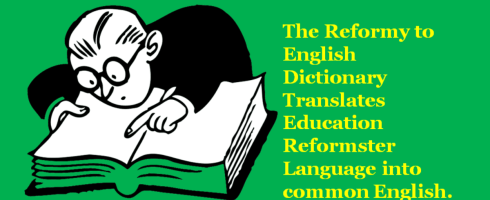
Valerie Strauss introduced America to Karen McKeegan Fraid and her That Way Madness Lies blog in 2013. In the pre-corporate billionaire-owned Washington Post, Strauss wrote the pro-public education Answer Sheet blog. Fraid created the “Reformy to English” dictionary as an aid for understanding the world of billionaire funded school-reform with her motivation being:

“I have done fairly extensive reading into their ideas as well as about their actions, and something struck me last week while I was rereading the Broad Foundation’s School Closure Guide (yes, It really exists): it is like an English-speaker reading Voltaire in the original French.”

The “Reformy to English” dictionary is still presented in three volumes:

  1. http://karenfraid.tumblr.com/post/52189780597/reformy-to-english-dictionary-volume-one
  2. https://karenfraid.tumblr.com/post/52356987097/reformy-to-english-dictionary-volume-two
  3. https://karenfraid.tumblr.com/post/53900029533/reformy-to-english-volume-three

The question is after more than a decade, how are Fraid’s translations doing? For example, her quote about the Broad Foundation lost some of its relevance when Eli Broad died in 2021, two years after he paid $100 million to establish the Broad Center at Yale University.

“Reformy to English” Translations Review

Market-Based Reform (noun): A school of thought that relies on the financial and social studies illiteracy of the general population in order to convince the public that codifying the market power of campaign donors and tying the invisible hand’s ability to expose shitty and overpriced products and services for what they are (and thus allowing the free market to eliminate those companies and products from the economy through a lack of demand) will somehow avoid the inevitable market failure in the form of corruption, decreased productivity and out of control wealth gaps and a resulting economic collapse.  Market-Based Reform is a euphemism for “Corporate Subsidy Disbursement,” “Economic Power Grab” and “Fear-Based Economic Policy.”

This translation seems spot-on today but not quite as central like in 2013. The charter school movement was the big dog in market-based reform; however, the effort to privatize schools with vouchers recently has taken on a central role in the effort to destroy public education.

In an 2016 article for AlterNet, Jeff Bryant shared about his conversation with Jeffry Henig of Teachers College:

“Henig believes many conservatives view charter schools as a way to ‘soften the ground’ for potentially more private options, though he isn’t entirely sure ‘the Waltons view charters as a Trojan Horse for eventually providing vouchers universally.’”

21st Century Skills (plural noun): These are what students gain when an educator is replaced with an iPad.  How else will kids ever get enough screen time if we don’t provide it in schools?

This definition is still 100% accurate.

 “School Choice (noun): This is when politicians choose to close a public school and instead choose to pay their campaign donors to operate a charter school.  School choice also refers to subsidizing upper-income families and religious institutions with tax dollars, often redirected from “failing schools.”  School choice also refers to the choice made by charter and private schools to discriminate against students with disabilities, students in extreme poverty and high-risk students by choosing policies guaranteed to skim only the students that they choose.  School choice is also used as a tool to stem the tide of white flight, without having to convince white folks to spend time with those unlike themselves.

Fraid’s school choice definition holds up pretty well, with a caveat. In 2013, charter school discrimination was slowed down by state accountability regulations. With the ascendance of vouchers, laws were written to make discrimination based on race, religion, sexual orientation, scholastic strength, etc. acceptable. In fact, voucher school accountability is generally against the law; seen as government interference.

Outcome-Based Learning (noun): (Synonyms include Proficiency-Based Learning, Standards-Based Reform, Performance-Based Education, and any combination of any of the previous words that include at least one hyphen and no awareness of irony.)  An education philosophy in which the outcome or performance on assessments is the goal in and of itself.  Any learning that does not assist the student immediately in test performance is a waste of time and resources, since Reformers know that they never use anything that they learned in school in their jobs today.”

Outcome-based learning is a renamed attempt to promote the 1970’s “mastery learning” theory, a major flop. Today, competency-based education (CBE) is a digital screen approach for replacing the often derided outcome-based learning. These schemes all posit that drilling and mastering small skills is the best way to teach. It has not worked yet.

CBE is required to get rid of teachers and further develop kids learning at screens.

Fraid’s 2013 definition can be updated with competency-based learning but would still be the same drill-and-skill bad pedagogy.

High-Stakes Test (noun): An assessment in which the margin of error is often greater than the desired gains; nevertheless, such assessments have the power to close schools, fire teachers, cause children to repeat a grade, defund districts or schools, cause states and municipalities to lose funding, fire administrators, shame communities, stifle economic growth, increase dropout rates, disenfranchise parents and children, increase race-based segregation, increase crime rates, raise taxes, burden local governments, increase poverty, pit neighbors against each other, determine which students can attend well-funded schools or institutes of higher learning.”

Since 2013, parents and educators have come out so strongly against these tests that their destructive power was reduced. The fact that these norm-referenced exams are incapable of identifying learning or good teaching has not caused them to go away. Big testing corporations like Pearson, College Board and ACT make too much money from parents, schools and states to let it go. Testing is still being used as metrics for comparing schools, judging college acceptance and evaluating teachers.

No Child Left Behind (NCLB) (noun): Landmark piece of bipartisan legislation which basically codified the Lake Wobegon mantra that all children need to be above average, while also starting the push to make percentiles reign supreme.  That would now serve as a phenomenal example in a lesson on irony, except the forced over-reliance on standardized tests in said legislation has resulted in 10 years of skipping extended lessons on literary devices and understanding of statistics in favor of test-prep reading and math exercises that suck all of the joy out of life as we know it.  That fact is also ironic, but the kids will never know that now.”

The reference to Garrison Keillor’s Lake Wobegon is dated but the claim that NCLB was mathematically-challenged is true. In 2001, many scholars and educators were looking to improve student learning and teaching. NCLB put an end to these scholarly efforts and replaced them with test-based accountability. The fundamental problem is standards-based testing only reveals the financial condition of people in a schools’ zip-code. Based on misunderstood data and erroneous testing regimes, many great schools were labeled failures and shuttered.

It was a tragedy that still plagues America.

In 2013, I wrote The Unwarranted Demise of Mar Vista Middles School.I had worked there for one year and knew it to be a solid school with an excellent staff. Unfortunately, the student demographics shifted to the point that 76% were from low social-economic families, 75% were Hispanic students and 44% were language learners. There was just no way MVMS could meet the ill-designed testing targets demanded by NCLB.

Karen McKeegan Fraid deserves high praise for her often funny and irreverent but mostly prescient definitions. Eleven years ago, she made fun of the scoundrels who worked to end free taxpayer supported public education, some just being drawn to the scam for the $$$.

But, billionaire financiers are in it to destroy America’s public school system.

Inspire Charter School Legacy

28 Jun

By Thomas Ultican 6/28/2024

Inspire Charter Schools looked like the next district attorney target when Sean McManus and his A3 charter empire were officially charged with “Theft of Public Funds.” The San Diego Union’s Kristen Taketa reported October 9, 2019 that Inspire was subject to a new state audit. She focused on it with several articles over the next year. The only reason Inspire did not lead to sensational stories of greed, unethical practices and fraud was no DA pursued them.

Former Los Angeles Unified teacher, Herbert “Nick” Nichols, created Inspire schools through his corporation, Provenance, originally called Inspire Charter Schools. Adhering to the use-small-school-districts strategy, his first school was authorized by the Acton-Agua Dulce Unified school district (Los Angeles County) July 1, 2014. It grew from 151 students in the 2014-15 school year to 4,321 students in  2018-19 and then closed up shop on June 30, 2019.

Why?

Taketa reported:

“Nichols’ annual salary is $380,000, Inspire’s spokesman Chris Bertelli said. In 2016, Nichols was paid $514,197.”

A deeper look at tax records revealed Nichols compensation was in 2015 ($120,305), 2016 ($514,197), 2017 (missing), 2018 ($614,391) and 2019 ($442,136). During that missing year, Inspire Charter Schools charter management organization (CMO), called Inspire District Office (EIN: 46-4743375), became Provenance (EIN: 82-1672890) and compensations were apparently not reported to the IRS.

Things imploded rapidly. In early October, 2019, seven county education superintendents called for the Fiscal Crisis Management and Assistance Team (FCMAT) to audit all Inspire schools. That followed the California Charter Schools Association rescinding Inspires membership. Nick Nichols took a leave of absence in September and resigned as CEO in October, 2019.

Nichols helped create all of the Inspire schools, effectively controlled by his corporation, Provenance. As CEO, he became sole statutory member of Inspire schools, with the only vote for selecting school boards and changing operations. He selected charter school board members, who then voted to hire Provenance to guide their schools. Only Nichols could sign checks for the various charter schools. It was a nasty and illegal arrangement.

In 2019, Taketa reported:

“The Union-Tribune emailed questions to Inspire about it being the sole statutory member on July 16. Within five days, the Inspire school boards changed their bylaws to remove Inspire Charter Schools as the sole statutory member, according to their board agendas.”

Before these questions, Inspire seemed to be full speed ahead. State records show them opening five home-school or primarily virtual charters on July 1, 2019. All are still in business.

Remnants are Profiting

On November 20, 2023, FCMAT finally submitted their report. Auditors were not able to conclude whether fraud occurred, largely because Inspire’s records were in such poor condition. The report stated:

“On October 11, 2019, Nichols and the CMO signed a separation and release agreement removing Nichols from his duties over the Inspire network. The agreement includes the following:

“Nichols has been on unpaid administrative leave since September 20, 2019.

“Must repay outstanding payroll advances totaling $1,055,834; however, $195,910.89 has been repaid, leaving an outstanding balance of $859,923.11.”

“This was the beginning of the Inspire network’s eventual end, with each Inspire Charter School rebranding itself and becoming its own independent charter school under its own nonprofit public benefit corporation as presently established as of this report.”

On September 20, 2020, Granite Mountain Charter School sued Provenance (aka Inspire Charter Schools, aka Inspire District Office) for breach of contract, breach of fiduciary duty and constructive fraud, unfair business practices and more. They claimed Provenance, which controlled their bank account, had moved more than $70,000,000 in and out of it. Granite Mountain believes Provenance purloined between $5 million and $10 million.

Provenance also registered Granite Mountain’s domain name and claimed ownership of their logo. They offered to sell them back for $200,000. The suit, filed in a Los Angeles County Court, seeks the return of the domain and at least $5 million.

In May, 2022, Granite Mountain filed a suit against Yosemite Valley Charter School and Director Laurie Goodman in Fresno County. A Fresno judge ruled since the money involved was related to the LA trial, that case had first jurisdiction. The main point here is one charter school suing another charter school was caused by Provenance commingling money.

Granite Mountain’s charter petition was approved by Lucerne Valley School District January 10, 2019. Nichols was the only person that could use their checking account. In August, Granite Mountain school board voted to remove Nichols from the account and replace him with its treasurer and Provenance Chief Financial Officer, Chris Williams, as check signer.

The law suit claims this did not happen.

All about the Money

Since each school is a non-profit public benefit corporation, they must file IRS 990 tax forms. Granite Mountain Charter School (EIN 83-3660999), Monarch River Academy (EIN 83-4510641) and Yosemite Valley Charter School (EIN 84-2358972) were reviewed.

Two items stood out: they are profitable and salaries are amazing.

These people live in relatively low cost areas of the state. The salaries would be big in San Diego or Los Angeles but are giant in Fresno and surrounding areas where the cost of living is much less.

Though these charters are all mostly virtual schools, by California Law they must hire credentialed teachers. What became clear when interviewing teachers is that quality of education was not the first priority. Keeping parents happy was paramount. Keeping average daily attendance money arriving is the main goal.

Teachers at these organizations have no unions and receive almost no support when parents complain. I heard stories of educators being pushed out when one Christian mom did not like their openness to gay students. Another episode involved a teacher getting complaints for pushing too hard to cover state standards and was fired. The school did not care about meeting state standards. They were only concerned with keeping parents happy.

When asked about changes that have come since the demise of Inspire, one teacher said, “Now we have multiple Inspires with each school being a location where families and friends are being hired into high paying jobs that they are not qualified to hold.” Another described the utter incompetence of an administrator holding professional development training on material the admin did not understand.

Inspire charter schools has transitioned from being a fraudulent entity setup to scam money from the state of California into a hook-up club of admin-heavy schools. In both cases, the education product has been horrible with terrible academic results.

This is more evidence for shutting down cyber charter schools. County education agencies provide cyber services and maintain education integrity. The incentives for this type of school are all wrong for quality education provided by private business.

Education Trail Blazers

15 Jun

By Thomas Ultican 6/15/2024

At the dawn of the 19th century, a need to educate the masses was becoming more apparent. Political leaders, Thomas Jefferson and John Adams, called for taxpayer-supported public education. However, real or important education was for boys only. There was some movement to educate girls but it was mostly directed toward domestic utility and female etiquette; not the more rigorous boys’ curriculum.

Jean Jacques Rousseau’s famous book, Emile, captured the attitude:

“The good constitution of children initially depends on that of their mothers. The first education of men depends on the care of women. Men’s morals, their passions, their tastes, their pleasures, their very happiness also depend on women. Thus the whole education of women ought to relate to men. To please men, to be useful to them, to make herself loved and honored by them, to raise them when young, to care for them when grown, to counsel them, to console them, to make their lives agreeable and sweet – these are the duties of women at all times, and they ought to be taught from childhood. So long as one does not return to this principle, one will deviate from the goal, and all the precepts taught to women will be of no use for their happiness or for ours.” (Page 365)

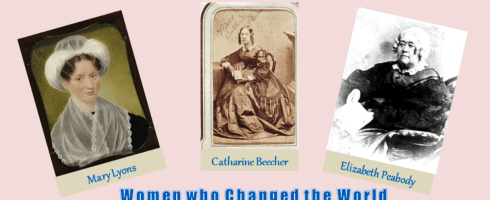
In this environment bereft of encouragement, several amazing women stood up and changed the world. They struggled to educate themselves and opened a path for their younger sisters.

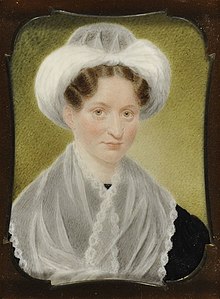
Mary Lyon

Mary was the sixth of eight children, born February 28, 1797, on a 100-acre farm near Buckland, Massachusetts to Aaron and Jemina (Shepard) Lyon. She was only five when her Revolutionary war veteran father died. After Mary turned 13 years old, her mother remarried and moved out of the home. Mary, now considered an adult, remained on the farm working for her brother, Aaron, making $1 a week maintaining the household.

At that time, many people believed educating girls was a waste. In most New England towns, the school year was typically ten months long, divided into winter and summer terms. In some places, girls were only allowed to attend summer sessions when boys were needed for farm work. Mary was fortunate that the school in Buckland allowed girls to attend year-round. She left at the age of thirteen but already had more education than most girls.

In 1814, when Mary was just seventeen, she was offered her first teaching job at a summer school in the nearby town of Shelburne Falls. Her teaching experience became the catalyst for Mary to advance her own education, no small task for a nineteenth century woman with little money. Besides this, the emphasis on “lady-like” curriculum at women’s schools was not attractive to her. She wanted a more rigorous program that included the study of Latin and the sciences.

In 1834, Laban Wheaton, a local politician, and his daughter-in-law, Eliza, called upon Mary for assistance in establishing the Wheaton Female Seminary in Norton, Massachusetts. For the Seminary, Mary created the first American curriculum with the goal to be equal in quality to men’s colleges.

It was renamed Wheaton College and just celebrated its 189th commencement.

1835 witnessed Mary developing Mount Holyoke Female Seminary. She wanted to create a rigorous college that made it possible for women who were not wealthy to attend. The yearly tuition was set at $60 and to control costs, required students to perform domestic tasks; Emily Dickinson, who attended the Seminary in 1847, was tasked with cleaning knives.

Mount Holyoke Female Seminary opened in 1837 with 80 girls, with an unheard of curriculum. She required seven courses in the sciences and mathematics for graduation and introduced women to performing laboratory experiments. Field trips were organized where students collected rocks, plants, specimens for lab work and inspected geological formations.

After 12 years leading Mount Holyoke, Mary tragically died. She contracted erysipelas, possibly from a student, and passed March 5, 1849. However the foundation of her school was sound and in 2024 Mount Holyoke held its 187th commencement.

Mary’s very deep religious beliefs, born a Baptist converting to Congregationalism, drove her hard work. Her grave on Holyoke campus bears Mary Lyons’ famous declaration: “There is nothing in the universe that I fear, but that I shall not know all my duty, or shall fail to do it.”

Catharine Beecher

Catharine, the eldest of nine children, was born to Lyman Beecher and his wife Roxana on September 6, 1800. In the home of this famous Presbyterian minister and evangelist, ideas about literature, religion, and reform were constantly under discussion. When nine years old, the family moved to Litchfield, Connecticut, where she attended Litchfield Female Academy. This was the only formal education she ever received.

By the time Catharine was 22 years old, she was engaged to Yale University professor Alexander Fisher. After he died in a shipwreck, Beecher never married and dedicated the rest of her life to education.

In 1823, Catharine founded the Hartford Female Seminary offering a full range of subjects instead of just fine arts and languages. She was an early pioneer of physical education for girls, defying the prevailing notions of women’s fragility and introduced calisthenics to improve women’s health. Unlike other women’s schools, Catherine’s seminary taught women to use their own judgment and become socially useful.

Her younger sister, Harriet, attended the school and also taught at it.

In 1831, the Beecher family moved west when Lyman became president of Lane Theological Seminary, a progressive Cincinnati institution on the Ohio frontier. There, Catharine opened the Western Female Institute, one of several educational institutions where she prepared women teachers in the American West. Harriet also worked at the institute.

In 1836, Harriet met and married Calvin Ellis Stowe, a clergyman and seminary professor, who encouraged her literary activity and was himself an eminent biblical scholar. Like her sister Catharine, Harriet strongly opposed slavery and eventually wrote Uncle Tom’s Cabin.

Catherine was also a writer and philosopher. Her essay on “Slavery and Abolitionism with Reference to the Duty of American Females” was published in 1837. It provided a peek into her conservative outlook, often isolating her from the major developments in the history of American reform. She held that all Christian women were abolitionists by definition but urged gradual rather than immediate emancipation. Meekness and tact were necessary in any criticism of slaveholders.

These same conservative views caused her to oppose voting by women.

After Catharine’s financially-troubled Cincinnati school closed, she worked on McGuffey Readers and spent the next decade touring the American West, setting up several female teaching academies. In 1841, she published A Treatise on Domestic Economy, followed by The Duty of American Women to Their Country (1845) and The Domestic Receipt Book (1846). She remained a genteel critic of slavery and foe of the franchise for women, believing that women’s true role as redeemers rested in domestic duties as mothers and wives.

Catharine Beecher died May 12, 1878 in Elmira, New York.

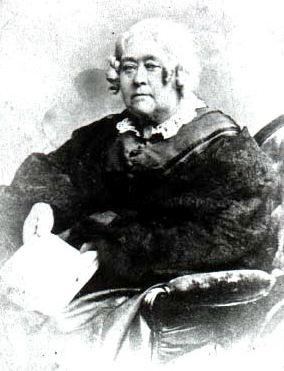
Elizabeth Palmer Peabody

This absolutely amazing woman, Elisabeth Palmer Peabody, was born in Billerica, Massachusetts on May 16, 1804. Her father, Nathaniel Peabody, was a dentist and her mother, Elizabeth Palmer, had a philosophy of life rooted in Unitarianism. Mrs. Peabody home-schooled her children and started her own small school where at age 16, Elizabeth began teaching. Her father taught her Latin and she went on to be a gifted linguist, familiar with more than ten languages.

There were five Peabody siblings, her brothers Nathaniel and George plus sisters, Sophia Amelia and Mary Tyler. Sophia married novelist Nathaniel Hawthorne while Mary married famed-education reformer, Horace Mann.

One of Elizabeth’s early mentors was Dr. William Ellery Channing, the “father of Unitarianism.” She claimed to be raised in the “bosom of Unitarianism.” She also was a member of the Transcendentalist community.

From 1834-1835 she worked with Bronson Alcott at his famous experimental Temple School in Boston. The school was forced to close when Alcott was accused of teaching sex education. Other Transcendentalist-inspired ideals used at the school were also strongly criticized. However their Socratic method of instruction is still popular today.

Elizabeth became America’s first female publisher and her book store, simply known as “13 West Street,” was a center for philosophical discussion. Both Ralph Waldo Emerson and Dr. Oliver Wendell Holmes Jr. gave lectures there and her publishing venture produced not only Channing’s Emancipation in 1840 but several of Nathaniel Hawthorne’s books. In 1849, she was first to publish Henry David Thoreau’s Civil Disobedience.

She opened the first publicly supported kindergarten in 1860 and wanted this Boston school “to awaken the feelings of harmony, beauty and conscience” in students. Doubts about the school’s effectiveness caused her to travel to Germany and observe the model practiced by disciples of kindergarten founder, Friedrich Froebel. Upon returning, she traveled across the country giving lectures and holding training classes. From 1873 to 1875 she published the Kindergarten Messenger.

In addition to her teaching, Elizabeth wrote grammar and history texts, touring America to promote the study of history. In 1865, she wrote the Chronological History of the United States.

Elizabeth championed the rights of Native Americans and edited Sarah Winnemucca’s autobiography, Life Among the Paiutes.

Elizabeth Peabody died on January 3, 1894, in Jamaica Plain and was buried at Concord’s Sleepy Hollow Cemetery. Abolitionist minister Theodore Parker praised her as “a woman of most astonishing powers … many-sidedness and largeness of soul … rare qualities of head and heart … A good analyst of character, a free spirit, kind, generous, noble.”

Three Remarkable Women!!!

Sex Discrimination Education Law

2 Jun

By Thomas Ultican 6/2/2024

Joe Biden promised, when running for president, to undo the damage to Title IX implemented during the Trump and DeVos era. The 1972 amendment to the US education law enacted rules against sexual discrimination at all schools receiving federal dollars. This was a fix to the 1964 civil rights law which lacked protection in schools based on a students’ sex. During the three year process of developing new guidelines, the Education Department received over 300,000 comments. The rules were announced in April and will go into effect in August.

Under Trump’s rules, there was no protection for LGBTQ+ students. That will change.

Biden’s changes will replace a narrow definition of sex-based harassment with a wider range of conduct. They reverse a requirement that schools only investigate alleged incidents on their campus. Also ended are demands for in-person live hearings in courtroom-like settings where the person accused of sexual misconduct, or their lawyer, can question the accuser.

Betsy DeVos called Biden’s new rules a “radical rewrite” of the law. She claimed it was an “endeavor born entirely of progressive politics, not sound policy.” Kel O’Hara, a senior attorney at Equal Rights Advocates, had a much different take:

“The new regulations put an end to unfair and traumatic grievance procedures that favor harassers. No longer will student survivors be subjected to processes that prioritize the interests of their perpetrators over their own well being and safety.”

Genesis of Title IX 

Bernice Sandler, known as “The Godmother of Title IX”, earned a master’s degree in Clinical and School Psychology and in 1952 married Jerrold Sandler. The couple had two children. Bernice returned to school at the University of Maryland where she earned a Doctor of Education in Counseling and Personnel Services.

Sandler began teaching at Maryland part-time but her application for a full-time position was continually denied. When inquiring why, Bernice was told she “comes on too strong for a woman” and that she was “just a housewife who went back to school.”

This led Bernice to joining the Women’s Equity Action League (WEAL). While researching the strategies of African American civil rights activists, she discovered that in 1968, President Lyndon B. Johnson further amended the civil rights restrictions on companies receiving federal dollars from discriminating on the basis of race, color, religion and national origin, by adding gender.

Bernice realized that most universities had federal contracts and were illegally not hiring women. Between 1969 and 1971, she and WEAL filed sex discrimination charges against 250 schools, including the University of Wisconsin, Columbia University and the entire state university and college systems of California, New Jersey and Florida.

In 1970, she filed a class-action lawsuit against all universities in America.

In the same year, Edith Green was an education policy expert and Democratic Congresswoman from Oregon. The sudden flurry of enforcement requests piqued her interest and caused Green to begin hearings on sex discrimination at federally funded universities.

Persuaded by testimonies put forth during the hearings, Representative Patsy Mink of Hawaii joined Green in drafting legislation prohibiting sex discrimination in education.

In the Senate, Indiana Democrat, Birch Bayh, led the legislation. Bayh’s wife, the former Marvella Hern, was an outstanding student from Oklahoma. Marvella was drawn to the work of Thomas Jefferson, founder of the University of Virginia. She wanted to go to that college but her application was returned with a note saying, “Women need not apply.”

Bayh was a co-recipient of the NCAA Gerald R. Ford Award at the 2006 convention. In an interview he shared with NCAA News about Title IX:

“We spent 26½ years together with Marvella teaching me about what it was really like being a woman in a man’s world. Without her, I know I wouldn’t understand the importance of this legislation.”

When the legislation was formed, Senator Bayh wrote the 37 words that became Title IX:

“No person in the United States shall, on the basis of sex, be excluded from participation in, be denied the benefits of, or be subjected to discrimination under any education program or activity receiving Federal financial assistance.”

On Title IX’s 50th anniversary in 2022, The Harvard Gazette interviewed Jeannie Suk Gersen, Professor of Law, and Susan Ware PhD historian.

Gersen noted the motivation for the law, “Women faced blatant educational inequality, such as exclusion from certain colleges and universities or from certain programs and spaces within those schools, higher admissions standards than men, more frequent tenure denials than men, and myriad other imposed disadvantages relative to men.”

Ware shared her opinion on why the law made such dramatic and rapid change:

“Once you point out that the men’s crew team has its own boathouse and the women have to change in their van and they don’t have showers, anybody can see that’s not fair, and it’s not equal. So just making a list of things that need to be addressed and having Title IX to back you up was a very effective way to get change.

Those changes came quickly. By the early 1980s, women were receiving about 40% of the resources compared to men for collegiate sports programs. Title IX is often presented as a zero-sum game; “if women win, men lose.”

Ware shared one of her favorite quotes, “There’s men, there’s women, and there’s football.”

A Bipartisan Effort

June 23 1972, President Richard Nixon signed Title IX into law. One of the biggest supporters of the legislation was Alaskan Republican Senator, Ted Stevens. He believed young women should have equal opportunity to their male counterparts for participating in school athletics. His support gained him a reputation as “protector of Title IX.”

On March 1 1972, the Senate version of Title IX overwhelmingly passed (88-6). Ten days later, the House version passed (275-125). After the bill went through conference committee, the Senate agreed (63-15) and the House voted (218-180) to pass it into law.

This bill not only upended intercollegiate sports but also touched many other corners of the campus. It forced shifts in hiring, promotion, admissions, reckoning on sexual harassment and assault.

There has also been a dramatic change in college graduation rates. Pew research showed that in 1970, 8% of women and 14% of men graduated. In 2021, those college graduation numbers became 39% for women and 37% for men.  

Title IX opened a path of justice and equality in America.

Biden’s new rules have made the law more robust and fair.

A Conversation on the Science of Reading

27 May

By Thomas Ultican 5/27/2024

Two eminent professors of instruction and literacy teamed up to write Fact-Checking the Science of Reading.” P David Pearson of UC Berkeley and Robert J. Tierney of University of British Columbia are Emeritus Professors with high reputation in their respective countries.

In the introduction, they inform us that Emily Hanford’s 2022 “Sold a Story” podcasts motivated them to write. In particular, they noted:

  1. “A consistent misinterpretation of the relevant research findings; and
  2. “A mean-spirited tone in her rhetoric, which bordered on personal attacks directed against the folks Hanford considered to be key players in what she called the Balanced Literacy approach to teaching early reading.” (Page XIV)

Their book presents 10 claims related to science of reading (SoR), each followed up with a three-step evaluation: “a) Unpacking the evidence presented for its validity; b) Offering our reading of the evidence; and c) Concluding with a revised version of the claim that we can support.”

An Example

The 5th claim cited states, “The Three-Cueing System (Orthography, Semantics and Syntax) has been soundly discredited.”

Orthography uses phonics type approaches to sound out unknown words. Does it look right? With the second cue, syntactic, a student tries to understand what is written. Does it sound right? What would make it conform to grammar rules? Semantics is the last of the three cues. Does it make sense?

The authors presented three pages of evidence about claim 5. For example they shared:

“Consequently poor readers fail to develop the decoding skills necessary for facile word identification, and their accuracy and fluency appear to flounder. Good readers, on the other hand, are able to successfully enlist phonemic awareness and the letter-sound correspondences to decode, and then understand, words. These differences between good and poor are taken as evidence that accurate and automatic word recognition is key to developing fluent reading for meaning. This view lends credence to the argument that phonics is the more expeditious approach to beginning reading expertise—and that approaches enlisting multiple cueing systems are flawed, misguided and perhaps even harmful to young readers (Hanford, 2018; 2019; Moats, 2000) (Page 57)

They, with years of experience studying reading education, noted:

“Criticisms of the three-cueing system are based on a combination of anecdotal evidence and opinion (Seidenberg, 2017; Moats, 2000), including extrapolations from static comparisons of the strategies of good and poor readers. They do not examine specific interventions involving the three-cueing system, such as the Interactive Strategies Approach (Vellutino & Scanlon, 2002; Scanlon et al., 2024), or the work of Marie Clay (1993: 1998) on Reading Recovery.” (Page 57)

The two quotes above came from the “unpacking the evidence presented for its validity” section of evaluation. Their next section, “offering our reading of the evidence”, stated:

“The only way we can make sense of the arguments marshaled against the three-cueing system is to infer that the opponents object to its use in pedagogy rather than in reading theory. Many of the most vocal critics of the three-cueing system either espouse or support models of the expert reading process that posit an important role for all three of these information sources.” (Page 58)

This part became fairly dense with descriptions and graphics for three reading models, David Rumelhart’s Interactive Model of Reading, PB Gough’s One Second of Reading Model and Rumelhart’s & McClelland’s Parallel Distributed Processing Model. Interestingly, these employed all three of the Three-Cueing domains: Semantics, Syntactic and Orthography. Today, the models are widely praised by many of those objecting to the Three-Cueing system.

They concluded “reading of the evidence” by stating, “Significant support for a more inclusive orientation has also emerged from several studies comparing multiple cueing approaches with singular emphasis on phonics,” citing examinations of the Interactive Strategies Approach (ISA) by Vellutino and Scanlon 2002, Scanlon and Anderson 2020 and Scanlon et al. 2024. It is a plan that intends to help readers develop word-solving strategies and uses orthographic, phonological, syntactic, semantic and lexical cues. (Page 63)

Pearson and Tierney asserted:

“Drawing from 25 years of research regarding the use of this approach with beginning and struggling readers as well as middle grade students, they found that the ISA, more so than other approaches, offers readers a form of self-teaching. This advantage supports readers’ successful, ongoing enlistment of phonics for word learning in the context of their engagement with ‘natural’ texts (i.e., texts that are not contrived to ensure a preset repetition of selected words or word families, or not specifically designed for research purposes).” (Page 64)

The final part of their analysis created a revised version of the claim they can support. The authors don’t disparage the claim. Rather they state:

“To rely on extrapolations from comparisons of good and poor readers while ignoring research on the efficacy of multiple cueing pedagogical approaches seems short-sighted. Prudently, in her discussions of cueing systems, Adams (1998) did not deny their possible role, but instead suggested the need for more research on their use with beginning readers. We believe that the work of Scanlon and her colleagues (2024) has answered Adams’ call by demonstrating that a ‘full tool box’ of word solving strategies, as reflected in their ISA interventions, enhances word solving, word reading, orthographic mapping, and understanding connected text.”

Pearson and Tierney do not agree that Three-Cueing has been soundly discredited; they provide evidence that cueing systems are successful teaching strategies. For example, when developing student comprehension, focusing primarily on phonics instruction does not measure up to cueing systems.

Settled Science is an Oxymoron

Science is a natural commitment to modesty “is always provisional; ever-ready to be tweaked, revised, or replaced by the next theoretical insight or empirical findings.” As Reinking, Hruby and Risko (2023) stated “settled science is an oxymoron.” In the case of SoR, not only is it not settled science, many literacy researchers believe it is a substandard approach. (Page 20)

SoR advocates say when teaching reading, the “settled science” of phonics “first and fast”, should be applied. They are working to make it against the law to disagree, claiming other forms of instruction cause child harm. SoR reading theory may have some holes but their political power is unquestioned and global. Laws mandating SoR have been enacted in 40 US states, UK, Canada, Australia, New Zealand and other English-speaking countries. These rules limit teacher autonomy and attempt to make reading a scripted subject. (Page XII)

The Orwellian labeled science of reading (SoR) is not based on sound science. It more accurately should be called “How to Use Anecdotes to Sell Reading Products.” In 1997, congress passed legislation, calling for a reading study. From Jump Street, establishment of the National Reading Panel (NRP) was a doomed effort. The panel was given limited time for the study (18 months) which was a massive undertaking, conducted by twenty-one unpaid volunteers. NRP fundamentally did a meta-analysis in five reading domains, ignoring 10 other important reading domains. In other words, they did not review everything and there was no new research. They simply searched for reading studies and averaged the results to give us “the science of reading.”

SoR’s real motivation is to sell products, not helping children struggling to read. Scholars like Pearson and Tierney are ignored and swept away by a podcaster with no credentials.

For the sake of the future, we must stop legally mandating SoR as a solution to a fraudulent “reading crisis” and put our trust in education professionals.

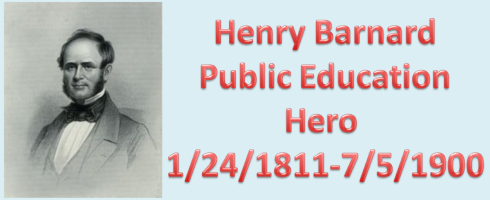
Henry Barnard and the Department of Education

21 May

By Thomas Ultican 5/21/2024

In 1867, Henry Barnard was appointed the first Commissioner of the new US Department of Education. Today that position is called Secretary of Education. The Department came into being with President Johnson’s signature on March 2nd and was followed by Barnard’s being sworn in as Commissioner on March 11th. Powerful forces opposed to a federal takeover of schools abolished the department on July 20, 1868. It officially became the Bureau of Education, attached to the Department of Interior, where it remained until 1979.  Barnard continued as Commissioner of the Bureau until March 15, 1870. (BARNARD Pages 106-108)

Henry Barnard’s contribution to establishing the common school system and the ideals of pedagogy in America and Europe were remarkable. Boone, an early 2oth century writer, stated that “in magnitude and detail, in permanency of result and general cooperation, Barnard’s work in Rhode Island was scarcely second to that of Horace Mann in Massachusetts.” (Barnard Page 61)

Barnard’s Early Life

On January 24, 1811, Henry was born at home in Hartford, Connecticut and was named after his is father, a well-to-do Puritan farmer. His mother, the former Elizabeth Andrus, unfortunately died when Henry was just four. Still he wrote, “It was my blessed inheritance to be born in a family in which chore-doing and mutual help was the rule and habit and happiness.” There were siblings, at least one brother and one sister.  (Barnard Page 7)

Hartford Connecticut Home Where Henry Barnard was Born and Died

In the late 1600s, Connecticut’s Governor Hopkins founded the Hartford Grammar School that Henry attended. He detested that school but would later change his mind, realizing it was “a school of equal rights, where merit, and not social position, was the acknowledged basis of distinction and therefore the fittest seminary to give the schooling essential to the American citizen.” At 13 years old, he transferred to Monson Academy in Hampton County, Massachusetts. (Barnard Page 8)

Fifteen year old Henry entered Yale in 1826 and graduated with a bachelors of arts in 1830. He would return to Yale in 1833 to study law and was admitted to the Bar in 1835.

Barnard was sent home from Yale for his part in the 1828 “bread and butter rebellion”, over poor food in the mandatory dining hall. During this short stay at home, his sister became ill. It was then that Henry first learned of the Pestalozzi from her attending physician, Dr. Eli Todd. The doctor was acquainted with American Pestalozzian, William McClure, and both shared a high opinion of the Swiss educator. (Barnard Page 11)

Upon his graduation, Yale President, Jeremiah Day, advised Henry to teach school for a year. He took a teaching position in Tioga County, Pennsylvania. This would be his only classroom teaching experience but it gave him a deeper perspective of pedagogy than other school reformers of his day. (Barnard Page 14)

After leaving Tioga County and before returning home to Hartford, he made a tour of Auburn, Ithaca, Niagara, and Rochester. It was the first of many important trips he would take.

Political and Professional Life

Barnard became an ardent Whig. The Whig party appeared around 1830 in opposition to the Democratic President, Andrew Jackson. Henry’s strong anti-Jackson feelings were expressed in speeches and by his attendance at the 1831 Whig convention as a delegate. (Barnard Page 14) Illinois Congressman, Abraham Lincoln, was also a Whig.

In 1837, without running for office, he was elected as one of two Hartford delegates to the Connecticut general assembly. Horace Mann of Massachusetts described him as having “fine powers of oratory, wielding a ready and able pen, animated by a generous and indomitable spirit, willing to spend and be spent in the cause of benevolence and humanity.” (Barnard Page 24)

Barnard introduced a bill “to provide for the better supervision of the common schools.” This law created a state committee to supervise schools and Barnard was appointed the new Secretary of the Connecticut Education Committee. (Barnard Page 26)

Washington DC Normal School

He was convinced the quality of educator in America’s common schools must be improved, writing, “No one sends a shoe to be mended, or a horse to be shod, or a plow to be repaired, except to an experienced workman, and yet parents will employ teachers who are to educate their children for two worlds,” without their careful training. (Barnard Page 44)

Henry’s two main focuses became the development of normal schools for teacher training and graded schools for children. He outlined the graded schools: 1) primary schools, with the “teachers all females and the children below 8 years of age”, 2) secondary schools, comprising children from 8 to 12 years of age and 3) high schools for boys and girls. To achieve these goals he attended hundreds of meetings with community members where he gave eloquent and inspiring speeches. (Barnard Page 29)

Barnard also spoke to these issues in other states. He had made such a convincing two-hour speech supporting graded schools in Barre, Massachusetts, that Horace Mann offered, “If you will deliver that in 10 places, I’ll give you $1,000.” (Barnard Page 48)

In 1842, Barnard and the common-school education system suffered a setback. A new Democratic administration swept the Whigs out of power in Connecticut and neither he nor the system was popular with the Democrats. (Barnard Page 49)

Horace Mann reported:

“Four years ago a new System was established in Connecticut which was most efficiently and beneficently administered under the auspices of one of the ablest best of men: but it is with unspeakable regret that I am compelled to add that within the last month all his measures for improvement have been suffered to fall.” (Barnard Page 48)

Rhode Island quickly took advantage of Connecticut’s firing Barnard. In 1843, Rhode Island Governor, James Fenner, invited him to “test the practicability of his own plans of educational reform.” Over the next four years he organized a “revolution in the public opinion and the educational system of the State; a revolution which is without a parallel …” (Barnard Page 54)

Following Barnard’s death on July 5, 1900, the Hartford Courant shared:

  • Yale 1826-1830
  • Admitted to the Connecticut Bar 1835
  • Nominated without his knowledge to serve in the Connecticut legislature and was elected 1837
  • Ushered through with unanimous support laws to provide better supervision by establishing the Board of Commissioners of Common Schools. After originally declining to lead the commission he took the post 1838 
  • Visited Europe 7 times to study education. Corresponded with Marshall, Clay and Webster. He met with Wordsworth, Lockhart, De Quincey, Carlyle and others.
  • Secretary of Connecticut State Board of Education 1838-42
  • Superintendent of schools in Rhode Island 1843-49
  • Superintendent Connecticut State Normal School and secretary of the board of education 1850-54
  • President of the state university of Wisconsin 1857-63
  • President of St. John’s College, Annapolis 1865-66
  • US commissioner of education 1867-70

The Courant’s memorial stated,

“The work of Dr. Barnard, which is monumental, and with which his name will be associated in all coming time, is his work in educational literature, as a writer, editor and publisher. He has done more than any man before or since to give to the English speaking world the best thoughts of the world on education. His collected writings include 52 volumes, averaging 500 pages, comprising 800 individual treatises. The article on school architecture alone had a circulation of more than 10,000 copies.”

There was one disagreement between Mann and Barnard. In spring of 1943, Mann and his new bride, Mary Peabody, took a European honeymoon. He was captivated by the schools he saw in Prussia (Democracy’s Schools Page 104). On the contrary, Barnard found that Prussian students were, “subjected to the depressing and repressing influences of a despotic government and of a state of society in which everything is fixed both by law and the iron rule of custom.” (Barnard Page 48)

The author of Henry Barnard’s Interior Department biography, Barnard C. Steiner, wrote this tribute:

“The greatest contribution  yet made by the United States to the uplifting-genius of the world’s progress was the establishment of the free public school supported by general taxation and directed by the State, and Horace Mann and Henry Barnard were ‘the men to whom America owes the organization of the public-school system.’” (Barnard Page 32)

A Call for Segregation, Exclusion and Caste

8 May

By Thomas Ultican 5/8/2024

Republicans, following the lead of Manhattan Institute’s Christopher Rufo, are out to end Diversity, Equity and Inclusion (DEI) programs. The world’s richest man, Elon Musk, wrote on X, “DEI is just another word for racism.” Rufo’s and Musk’s central complaint is DEI unfairly harms white people. Billionaire hedge-fund manager, Bill Ackman, wrote, “DEI is racist because reverse racism is racism, even if it is against white people.”  It is easy to conclude, these men are calling for policies leading back to 1876 and segregation, exclusion and caste (SEC).

Bill Ackman is not a GOP shill. He is a neoliberal who has donated hundreds of thousands of dollars to Al Gore, Barack Obama and Pete Buttigieg. When Musk responded to a post on X, blaming Jews for flooding countries in the West with “hordes of minorities,” calling it “actual truth,” Ackman leaped to his defense with Elon Musk is not an antisemite.” This is as hard to believe as Republicans are warriors against anti-Semitism. After all, the Republican Party is the main vector for the anti-Semitic “replacement theory.” A theory claiming Jews are involved in a plot to inundate the U.S. with undocumented immigrants who will “replace” the ebbing white majority and keep the GOP out of power.

Writing in the Wall Street Journal about his role in bringing down Harvard’s first ever black female President, Claudine Gay, Rufo ignored claims of plagiarism and anti-Semitism brought against her and focused on efforts ending DEI in higher education. Gay’s chief critic was Bill Ackman. In a long statement, he claimed DEI was the “root cause” of anti-Semitism at Harvard.

Ending DEI at College

Medical Schools Do Not Want Students Who Look and Think Alike

The Chronicle of Higher Education reports at least 82 bills opposing DEI in higher education have been filed in 20 states since 2023. Twelve of them became law in Idaho, Indiana, Florida, Texas and other states lead by GOP politicians. Kevin Stitt, the Governor of Oklahoma, signed an executive order in December, ending spending on DEI, claiming:

“Encouraging our workforce, economy, and education systems to flourish means shifting focus away from exclusivity and discrimination, and toward opportunity and merit. We’re taking politics out of education and focusing on preparing students for the workforce.”

The OU student newspaper reported, “Offices that are focused on African American, Hispanic, or LGBTQ+ students likely violate the Executive Order.”

Florida has a long dark history of racism, ranging from fighting in the civil war for rights to own black people to the 1923 Ocoee massacre that powerful Floridians are trying to hide. Totally in keeping with this racist past, Tallahassee Democrat reported the DeSantis administration pushed to gut diversity, equity and inclusion programs in higher education. In May 2023, the Governor signed a bill banning state public colleges and universities from spending money on DEI. He asserted:

“This bill says the whole experiment with DEI is coming to an end in the state of Florida. We are eliminating the DEI programs.”

In June 2023, Texas Governor Greg Abbott signed a bill, dismantling DEI programs in higher education. It was introduced into the state senate by State Senator Brandon Creighton. Afterwards, Creighton claimed, “With this bold, forward-thinking legislation to eliminate DEI programs, Texas is leading the nation, and ensuring our campuses return to focusing on the strength of diversity and promoting a merit-based approach where individuals are judged on their qualifications, skills, and contributions.”

Dallas Morning News reported:

“The bill was challenged by Democrats every step of the way, from the Senate higher education subcommittee to the House floor. But starting in January 2024, Texas campuses must eliminate DEI offices, mandatory DEI statements and training.”

Abbott also signed a related law, reducing tenure protection for college professors. As a result, higher education institutions in Texas are finding it more difficult to attract top professors.

Stephanie Saul of the New York Times notes that some schools are finding workarounds to mitigate damage. Whereas both University of Florida and University of Texas ended their DEI programs and terminated administrators and staff, Florida State University and University of Tennessee took steps to save employees and continue some valuable services that would otherwise be lost.

Florida State University did it mostly by changing title names and reclassifying positions of employees, already working in DEI to give them new roles; an approach that did not require laying anyone off. This left in place some of the previous DEI department’s work. The school reshuffled jobs and turned the Equity, Diversity and Inclusion Office into the Office of Equal Opportunity Compliance and Engagement.

At University of Tennessee, the DEI program is now called Division of Access and Engagement. The newly named department is still working to diversify the campus and beat back injustice. Unfortunately Tennessee lawmakers have become wise to the workaround. A bill introduced in January specifically stated that no such offices should be operating “regardless of name or designation.” White GOP lawmakers are steadfastly opposed to diversity, equity and inclusion. They see it as a “WOKE” plot foisted on them by liberals.

Corporations and DEI

Corporations Value Diversity

Surprisingly America’s corporations are quite bullish on DEI. Taylor Tedford of the Washington Post shared, “In his annual letter to shareholders this year, JPMorgan Chase CEO Jamie Dimon emphasized that DEI ‘initiatives make us a more inclusive company and lead to more innovation, smarter decisions and better financial results for us and for the economy overall.’” Many large companies tout DEI as leading to business success. A 2023 study of 1200 firms by McKinsey & Company found organizations with the highest racial, ethnic and gender representation are 39% more likely to outperform. A Moody’s study found companies with greater diversity on their boards and in executive leadership have higher ratings.

However conservative opponents of DEI are attacking corporations in court. Last September, a federal judge in Washington State threw out the lawsuit alleging Starbucks violated its duty to shareholders by endeavoring to diversify its workforce. The suit was based on the company’s goals of hiring more people of color, attracting diverse suppliers and tying executive pay to achieving diversity goals.

Growing legal, social and political attacks cause some organizations to delete DEI from public view. They are not necessarily abandoning it but rewriting policies that once emphasized race and gender to prioritize inclusion for all.

Opinion

Manhattan Institute’s, Christopher Rufo, worked at Discovery Institute, dedicated to replacing Darwinian biology with “intelligent design”. There, he developed a talent for tapping into white insecurities with racially dishonest tropes, like abuse of critical race theory (CRT). As the CRT furor began to wane, Rufo turned to another racially-sensitive topic, reframing DEI as being against white people.

Sadly the GOP, which used to have ideals and ethics, joined this campaign. The fact is non-white males and women are not competing on a level playing field when it comes to hiring, admittance to training programs or gaining promotions. DEI programs work to rectify this. Now, Republicans are turning this on its head, claiming it is the “WOKE” agenda of liberals working against white people. This racially-tinged attack on women and minorities demonstrates how bankrupt the GOP ideology has become.

Doubtlessly there are some legitimate grievances with DEI but that does not mean it should be destroyed. Some aspects of the movement may need reformation but America needs this tool. Instead of lamenting people who are different, we need to awaken to the fact that these differences should be celebrated as the key to our greatness.

Conservative lawmakers have set themselves up by opposing diversity, fighting against equal opportunity and ignoring inclusion.

Their fight against DEI is not a good look … it appears racist, caring only about whites.

Hyped AI New Personalized Learning

25 Apr

By Thomas Ultican 4/25/2024

In education today, Artificial Intelligence (AI) and personalized learning are the same thing. AI has been around for 70 years and is the technology that drove personalized learning. The release of ChatGPT in November 2022 caused buzz and may be responsible for Edtech sales-forces switching to AI from personalized learning. The personalized learning scam was exposed and AI became the shiny new object.

ChatGPT is a new language model developed by OpenAI. The basis is a giant data base to retrieve query answers and its breakthrough uses human style essays to deliver the responses. This makes cheating easier, giving teachers new issues to confront. To this point, blogger and educator Mercedes Schneider says “AI and I are not friends”, noting:

“As a teacher for many decades, I find increasingly more of my time consumed with devising means to ensure students complete my assignments without the easy-cheat, sustain-my-own-ignorance that AI enables in today’s students– and, it seems, an increasing number of (especially remote) professionals who may be using the corner-chopping ability AI offers to even hold multiple full-time positions.”

Schneider tested ChatGPT typing in “Could you provide some background info on Mercedes Schneider? She resides in Louisiana.” The answer revealed a weakness… much of the information was correct, some wrong, with other information, old and irrelevant. She did not attend University of Southern Louisiana nor received her PhD from LSU. Mercedes took her red pencil to this chatbot answer, “According to her website, she holds a Bachelor of Arts in secondary education ‘(TRUE)’, a Master of Education in gifted education ‘(FALSE)’, and a PhD in curriculum and instruction ‘(FALSE)’, all from the University of Southern Mississippi ‘(FALSE).’”

These errors may be unusual but the chatbot is unreliable.

What is AI?

“Artificial Intelligence” was first coined by Professor John McCarthy for a conference on the subject at Dartmouth College in 1956. It was also founded as an academic discipline in 1956.

Mathematician, computer scientist, and cryptanalyst, Alan Turing, described a test for verifying computer intelligence in a 1956 paper. He proposed a three-player game in which the human “interrogator” is asked to communicate via text with another human and a machine. If the interrogator cannot reliably identify the human, then the machine is judged “intelligent.”

Coursera states, “AI is an umbrella term that encompasses a wide variety of technologies, including machine learning, deep learning, and natural language processing (NLP).” However, none pass the Turing test for machines manifesting intelligence.

Machine-learning has been part of AI since its 1950s beginning. Algorithms are created to allow a machine to improve its performance on a given task automatically. Netflix uses it to create personalized recommendations, based on previous viewing history.

Deep-learning is advancement in machine-learning, layering algorithms into computer units referred to as neurons. Google Translate uses it for translation from one language to another.

Neural Network Cartoon

Natural language processing (NLP) is used in many products and services. Most commonly, NLP is used for voice-activated digital assistants on smartphones, email spam-scanning programs, and translation apps, deciphering foreign languages. ChatGPT uses large language models, an advancement to NLPs enabling a dialog format, to generate text in response to questions or comments posed.

Nick Bostrom, Director of the Future of Humanity Institute at the UK’s Oxford University, said, “A lot of cutting edge AI has filtered into general applications, often without being called AI because once something becomes useful enough and common enough it’s not labeled AI anymore.”

No machine has passed the Turing test. To this point there is no intelligence associated with AI, just algorithms. Another problem with powerful AI systems is they use a lot of electricity: by 2027, one researcher suggests that collectively, they could consume each year as much as a small country.

Should We Be Afraid?

In May 2023, Geoffrey Hinton, who won the Turing award in 2018 for “deep learning”, a foundation to much of AI in use today, spectacularly quit Google. He said companies, like Google, had stopped being proper stewards for AI in face of competition to advance the technology.

That same month a Scientific American article stated:

“A 2023 survey of AI experts found that 36 percent fear that AI development may result in a “nuclear-level catastrophe.” Almost 28,000 people have signed on to an open letter written by the Future of Life Institute, including Steve Wozniak, Elon Musk, the CEOs of several AI companies and many other prominent technologists, asking for a six-month pause or a moratorium on new advanced AI development.”

However other scientists in the field disagree.

The Guardian reported:

“Jürgen Schmidhuber, who has had a long-running dispute with Hinton and others in his industry over appropriate credit for AI research, says much of these fears are misplaced. He says the best counter to bad actors using AI will be developing good tools with AI.”

“And I would be much more worried about the old dangers of nuclear bombs than about the new little dangers of AI that we see now.”

Stanford professor, Andrew Ng, was a part of the Google brain project. He is not worried and in a recent interview stated:

“I can’t prove that AI won’t kill us all, which is akin to proving a negative, any more than I can prove that radio waves being emitted from Earth won’t allow aliens to find us and wipe us out. But I am not overly concerned about our radio waves leading to our extinction, and in a similar way I don’t see how AI could lead to human extinction.”

Meta’s chief AI scientist, Luan LeCun, scoffs at his peers dystopian attitudes, saying, “Some people are seeking attention, other people are naive about what’s really going on today.”

Hopefully dangers from AI are mitigated by the safety concerns addressed and development is not harmed by a flat-earth mentality.

Selling to Schools

Fast Company is a modern business news organization, tracking edtech sales and issues. Their April 16, 2024 article opened with,

“Between the pandemic and the rise of generative AI, the education sector has been in a permanent state of flux over the past few years. For a time, online learning platforms were ascendant, meeting the moment when workplaces and schools alike went remote (and later, hybrid). With the public debut of ChatGPT in 2022, edtech companies—such as edX, which was one of the first online learning giants to launch a ChatGPT plugin—jumped at the opportunity to integrate generative AI into their platforms, while teachers and administrators tried to understand what it could mean in the classroom.”

Generative AI is a tool that generates text, images, videos and other products.

I understand how K-12 students might want to become familiar with new AI tools but expecting them to be a boon to learning seems farfetched. Teachers need to find ways to stop students from misusing it. Clever as they are most students will not make good choices when realizing a chatbot can do homework.

Fast Company pointed out, schools are being inundated with new AI edtech products. George Veletsianos, Professor of learning technologies, University of Minnesota, recently gave purchasing guidance to school leaders in Conversation. Of his five points, point two seems especially relevant:

“Compelling evidence of the effect of GenAI products on educational outcomes does not yet exist. This leads some researchers to encourage education policymakers to put off buying products until such evidence arises. Others suggest relying on whether the product’s design is grounded in foundational research.”

“Unfortunately, a central source for product information and evaluation does not exist, which means that the onus of assessing products falls on the consumer. My recommendation is to consider a pre-GenAI recommendation: Ask vendors to provide independent and third-party studies of their products, but use multiple means for assessing the effectiveness of a product. This includes reports from peers and primary evidence.”

“Do not settle for reports that describe the potential benefits of GenAI – what you’re really after is what actually happens when the specific app or tool is used by teachers and students on the ground. Be on the lookout for unsubstantiated claims.”

Experience informs me that there will be many educational benefits from the overhyped AI but money hunger will be lurking. I am guessing AI currently will be of little use for teaching literature, mathematics or most sciences but will be a focus for computer science students.

Do not rush to implement AI tools in the K-12 environment.

Schools are more likely to be fleeced than left behind when the salesman calls. It may be the same person, who was selling “personalized learning” three or four years ago

…  but it is still BAD pedagogy.

Defend the People’s Schools

19 Apr

By Thomas Ultican 4/19/2024

I am sure you’ll be shocked to your core but there are some really bad people out there trying to end publicly-financed free education.

Since the beginning to the 21st millennium, misguided wealthy people have been attacking public education. The reasons range from religion to hubris. Betsy DeVos thinks secular education is an insult to her Christian God. Bill Gates believes he knows more than anyone else and Charles Koch is opposed to all government-sponsored social action. That would all be fine if they were not billionaires, using immense wealth to impose their way.  

Truth-in-Funding (TiF) offers tools for opposing their propaganda with a webpage providing links to 25 organizations, working to protect public schools. Organizations such as National Education Policy Center, Network for Public Education and Education Law Center share links to their research along with toolkits for delivering the message.

The Truth-in-Funding Group

TiF’s homepage states:

“School voucher programs use public funds to pay for private education costs. These programs are spreading despite overwhelming evidence that they are harmful public policy.”

And their about page says:

“This website offers a wide range of tools from groups that oppose vouchers and other efforts to divert public funding in education. We work to protect the vital institution of public education and ensure all students have access to welcoming, well-resourced public schools.”

Highlighted Materials

Network for Public Education (NPE) was founded in 2013 by a middle-school teacher from Oakland, California, Anthony Cody and former Education Department official and education historian, Diane Ravitch. Soon after the founding, past New York principal of the year, Carol Burris, came on board as director. NPE has focused on uniting friends of public schools, researching the reality behind school choice and creating tools to protect public education.

Ravitch Introducing Keynote Speaker Gloria Ladson-Billings

At NPE Washington DC October 2023

One of NPE’s many “Toolkits”, which are concise two-page documents, is Do charter schools and school vouchers “hurt” public schools? The answer is:

“Yes.

“Charter schools, vouchers, and other “choice” options redirect public money to privately operated education enterprises, some of which operate for profit. That harms your public schools by siphoning off students, resources, and funding and reducing the ability of public schools to serve the full range of student needs and interests.”

This conclusion was justified with four paragraphs of explanation and eight examples from across America.

Policy Matters Ohio is a non-profit policy research institute. Funded by mostly small foundations and individual donations they claim to “create a more vibrant, equitable, sustainable and inclusive Ohio through research, strategic communications, coalition building and policy advocacy.”

Their 2023 Ohio voucher study concluded:

  • “Ohio is currently ranked 46th for per-pupil equitable distribution of funding. State funding that is allocated towards vouchers should be directed to public schools so that students can get the resources they need to thrive.
  • “Ohio public schools need funding, especially our largest urban school districts with high concentrations of Black, Brown, and Economically disadvantaged students (CCS example)
  • “Ohio is ranked 40th in starting teacher salaries, and falls below the national average. Funding allocated towards vouchers takes away from money that should be invested in our educators. Can help us to recruit and retain more teachers in the state
  • “Private schools can choose to kick back a child, but as of right now they would be able to keep the money that was awarded, this needs to be changed so that private schools are not benefiting from public dollars for a child they are not educating .
  • “With universal vouchers comes universal bussing costs for public-school districts who bear the cost of transporting all district voucher students to private schools. Property taxes will continue to rise as the public is forced to pay a billion dollars for private school tuition, which will strain lower income districts.”

With the advent of billionaire-financed attacks on public education, non-peer reviewed policy reports and education outcome studies have become prevalent. In response, a group of scholars created the National Education Policy Center (NEPC), housed at the University of Colorado to test the claims being made.

In 2023, there was a legislatively mandated report by the Georgia Department of Audits and Accounts estimating costs and benefits of the state’s new Qualified Education Expense tax credit (QEEC). It is a tax credit school voucher scheme that provides families with “scholarships”. These programs can be controversial because they send taxpayer funding to private schools which serve primarily religious schools that regularly exclude students based on faith, sexual orientation or disability. The Georgia report concluded the state would save money with these vouchers.

David S. Knight, University of Washington, studied the report for NEPC and concluded:

“Taken together, little evidence or data supports the report’s main findings and conclusions. If more accurate parameters are used to generate cost estimates, particularly for the switcher rate and for the cost savings of declining enrollment, a different picture emerges. While the report concludes that the tax-credit scholarship program will have a positive fiscal impact, a far more likely scenario, and one that has already played out in other states, is that the tax credit will cost Georgia taxpayers millions of dollars, potentially requiring future cuts to public services, while providing a cash bonus to many wealthy families.”

A visitor to the TiF library page discovers 13 hyper-linked categories including “Graphics” where I found this:

A Big Concern

 At the bottom of TiF’s main page, below the 25 hyper-linked partners, is a link to Partnership for the Future of Learning (PFL) with an invitation to visit their website.

Learning Policy Institute is listed as a member of the PFL network, founded in 2015 with Stanford professor Linda Darling-Hammond in charge and offices in Palo Alto and Washington DC. San Francisco-based Sandler Foundation was the lead funder with Atlantic Philanthropies, S.D. Bechtel, Jr. Foundation, Ford Foundation, William and Flora Hewlett Foundation. Stuart Foundation also provided initial support.

The Ford, Bechtel and Hewlett foundations have often supported initiatives that undermine public schools. The Hewlett foundation joined Zuckerberg and Kellogg in funding PFL. Hewlett’s 2022 form 990-PF (EIN: 94-1655673) reports grants of $600,000 to NWEA, $533,336 to Education Trust and $1,935,000 to the Aspen Institute.

Learning Policy Institute’s 2022 tax report lists Darling-Hammond’s salary at over $500,000 (EIN: 47-2772048). She has a history of being both supportive of public education and a problem. My friend, Steven Singer, titled his 2018 post about Darling-Hammond, Linda Darling-Hammond vs. Linda-Darling Hammond – How a Once Great Educator Got Lost Among the Corporate Stooges.” While often brilliant, she does not seem to value the importance of school governance.

Another PFL partner, WK Kellogg Foundation, is one of America’s largest grant-making organizations. A quick perusal of their 990-PF tax forms (EIN: 38-1359264) showed many grants to clearly worthwhile causes. Unfortunately they also give money to organizations like Teach For America, who pawns off fake temp-teachers on America’s students. Their 2021 form gives the most recent spending data available from Kellogg, with the following partial table of giving:

PFL cites Teach Plus as a network partner. It is a private company trying to monetize teacher-training, established in 2007 by Celine Coggins, a professor at Harvard Innovation Labs. Her Harvard resume says, “Under Celine’s leadership, Teach Plus grew to over 30,000 participating teachers and a $10M annual operating budget by offering groundbreaking programs in leadership development and advocacy.” The actual groundbreaking was the effort to replace teacher-leadership and -training by established public universities like UCLA, University of Texas and University of Illinois, with a for-profit company.

PFL may be a true friend of public education but some of the organizations they listed are not. Until they clean their house of organizations that harm public education, TiF should reconsider giving them a link on their otherwise pristine webpage.

I do not want to overemphasize TiF’s one questionable link but am sensitive about the issue. Every national education news source now receives funding from Bill Gates. In addition, other billionaire enemies of public schools also contribute to school news outlets like The 74, education week etc. There are few places for the public to get true un-slanted education news.  

So far Truth-in-Funding appears to be a valuable resource for fighting misinformation and saving universal free public education.