Archive | Corporate Education Reform RSS feed for this section

Malcolm Baldrige Award Promotes School Privatization

25 Nov

The November 18 San Diego Union reported: “The Charter School of San Diego is among four recipients awarded the 2015 Malcolm Baldrige National Quality Award, a top presidential honor for performance in the public and private sectors.”

Malcolm Baldrige National Quality Award: “An award established by the U.S. Congress in 1987 to raise awareness of quality management and recognize U.S. companies that have implemented successful quality management systems. Awards can be given annually in six categories: manufacturing, service, small business, education, healthcare and nonprofit. The award is named after the late Secretary of Commerce Malcolm Baldrige, a proponent of quality management. The U.S. Commerce Department’s National Institute of Standards and Technology manages the award, and ASQ administers it.”

I had never heard of San Diego’s first charter school which was founded in 1994. In the past many hoaxes have been perpetrated concerning education, so I decided to do a little digging. I asked, “What made this charter school worthy of a literally one-in-a-million presidential honor?” I found the award was not based on merit! For example, the school is into year four of needs program improvement (meaning failing) under the No Child Left Behind act.

The award announcement came from Commerce Secretary, Penny Priztker. She is quoted as saying:

“The winners were chosen for their ‘outstanding commitment to sustainable excellence through innovation, improvement and visionary leadership.’ The Charter School of San Diego won in the education category for its ability to help students who despite enrolling ‘academically behind and at risk of never receiving a high school diploma, 94-98 percent of those enrolled have graduated from the Charter School of San Diego or successfully transitioned back to a traditional public school.’”

This implies the charter school saves children who can’t make it in public school and even heals their issues to the extent they can go back to public school! That is just fabrication.

It is true that over 70% of Charter School of San Diego students are labeled socioeconomically disadvantaged but that is not unusual. The public school where I work, Mar Vista Senior High School, matches that and has more than twice as many English learners as the charter school. My school and the charter school make a good comparison.

In the March, 2015, all California charter and public schools administered the California High School Exit exam. The March administration was given to sophomores and is the main component of the federally mandated Adequate Yearly Progress evaluation. My school and the charter school had the following results:

Mar Vista Senior High School (420 tested) Passing Rates

Math: All Students : 84% Socioeconomic: 81% English Learners: 65%
English All Students: 85% Socioeconomic: 82% English Learners: 60%

Charter School of San Diego (320 tested) Passing Rates

Math: All Students : 79% Socioeconomic: 76% English Learners: 62%
English All Students: 84% Socioeconomic: 82% English Learners: 63%

When I looked at this data, it seemed to me that my high school, which has also been labeled a failing school for the past five years just like the charter school, looked pretty good. We had more than double the English Language Learners, the same percentage of socioeconomically disadvantaged students and our sophomores outperformed theirs. In addition, our dropout rates are lower.

To understand what is happening here, I looked at the principals involved starting with Penny Pritzker. According to Forbes, “The Hyatt heiress has carefully positioned herself at the intersection of wealth and politics, becoming Commerce Secretary in 2013 after working as a key Obama fundraiser. (She also donated $250,000–just to his second inauguration celebration.)” She is worth about $2.4 billion.

It seems that Billionaires are more interested in profits and advancing private business than world class education for the children of ordinary people. That $700 billion a year spent on education in the United States is too enticing. It turns a billionaire green with desire.

Tom Vander Ark, the well known shill for “corporate education reform” really likes Charter School of San Diego. He wrote in 2014:

“I met Mary Searcy Bixby in the fall of 1999 in a converted retail space in an outdoor shopping mall in San Diego (the same day I visited Larry Rosenstock in a vacant warehouse that become [sic] High Tech High). When I was a public school superintendent, my team had created an alternative school in a mall so I immediately liked the idea. As founder of The Charter School of San Diego, Mary had created (what I’m pretty sure was) the first flex school network as an “independent study” charter school launching in 1994. Five years later, Mary had 19 locations including converted retail and commercial real estate locations serving over 2,000 students. Students attended in two shifts, studied online and print instructional materials, and progressed at their own pace.”

“Altus Institute is the parent corporation to a network of charter schools that includes The Charter School of San Diego (est. 1994), Audeo Charter School (est. 2001), Mirus Secondary School (est. 2007), and Laurel Preparatory Academy (est. 2013). Altus Schools strive to help students achieve by creating alternative educational options that put students’ needs first and to deeply reduce dropout rates.”

Vander Ark is a former officer of the Democrats for Education Reform and an enthusiastic proponent of education technology including cyber-schools. The Democrats for Education Reform are the group that brought us Arne Duncan. Financed by several hedge fund operators, they are huge proponents of privatizing public education with charter schools.

Mary Searcy Bixby, the founder and CEO of Charter School of San Diego, is from San Diego where she attended Marian Catholic High School and obtained both a BA in English and an MA in curriculum and instruction from the local Catholic university, University of San Diego.

Recently, Tom Davis a long time educator and school leader joined Bixby as Educational Reform Project Director. Davis is retired from more than 40 years in public schools and does have deep experience and training.

A few items of interest were revealed by the Altus Institutes form 990 filings. The most current available form 990 covered 2012 and predates Davis’s arrival. Bixby’s total compensation that year was $297,000. She is getting into Eva Moscowitz type earnings and her per-student rate is much higher than Eva’s. In 2010, someone or some entity gave Bixby’s schools $4,500,000 in new buildings and property; which established a strong base for expansion.

This joint statement from Bixby and Davis is on their website:

“We appreciate Ted Kolderie (Senior Associate, Education Evolving), Eric Premack (Executive Director, Charter Schools Development Center), Jed Wallace (President and CEO, California Charter Schools Association), and Pat Hyndman (Chairperson, Vistage) for sharing their expertise and thoughtful insight. Thank you for your courtesy, professionalism, and genuine interest and warmth.

“Thanks to Gail Audrict (Orleans Parish School Board), Alexina Medley (Warren Easton Charter School), and Maggie Runyan-Shefa (New Schools for New Orleans) for sharing the New Orleans experience with Davis and Bixby. Educational Reform in New Orleans is inspring [sic] the education leaders across the United States. The extraordinary model New Orleans provides us leads others to a new way of thinking.”

The Malcolm Baldrige award that Charter School of San Diego displays on its web site is part of a coordinated attack on public schools. There is nothing special about that charter school and public schools in San Diego provide better education.

Charter schools harm public education by diverting tax dollars to private pockets and opening the path of corruption, instability and segregation.

Disturbingly this attack is being led by the Democratic Party. For decades the Democrats prided themselves on supporting and protecting public education. Now, they attack teachers and work to privatize public schools. Who will join the righteous fight to save America’s great public education system from a corrupted political system and corporate greed?

(Condensed) D.C. Schools: A Portrait of “Corporate Education Reform” Failure

23 Oct

This summer the National Academy of Sciences produced a lengthy report for the city of Washington D.C. documenting the effects of their 2007 Public Education Reform Amendment Act (PERAA).[1] The report is a powerful set of data and observations that damn “Corporate Education Reform.”

What is “Corporate Education Reform”?

In 1996, Louis Gerstner, CEO of IBM, hosted the National Governor’s Association conference at the IBM conference facility in Palisades, New York. This conference with the exception of one Asian man was an all white, all male conference made up of 49 CEO’s and 40 governors. There were no educators involved.

At the conference, the Governors established their own non-profit and non-governmental corporation called Achieve Inc. Gerstner was named Achieve’s chairman. Achieve Inc. subsequently supervised the writing of both the Common Core State Standards and the Next Generation Science Standards. While Bill Gates’ Council of Chief State School Officers owns the copyright for Common Core, Gerstner’s Achieve Inc. owns the copyright for the Next Generation Science Standards.

Former Assistant Secretary of Education, Diane Ravitch, is the first person I noticed calling this education reform movement led by super-wealthy business men with no education experience or training “corporate education reform.”

Eliminate Local Control and Privatize

In 1968 D.C. finally got democratic control over their schools only to experience complete loss of parental control with the passage of Public Education Reform Amendment Act in 2007. Mayor, Fenty became czar of education.

In 1995 and 1996 New Gingrich and Bill Clinton teamed up to start the privatization of education process in D.C. by weakening the elected school board and establishing charter schools.

“… by 2014, the percentage [of charter schools] was 44 percent. PCSB [Public Charter School Board] reports that there are approximately 100 individual charter schools, governed by 61 chartering organizations, which function as school districts, …” Pg 31

With almost 50% of the D.C. students in charter schools governance in certain aspect of education is not possible. As the report says:

“There are no standardized formats or definitions in charter schools’ budgets or audits … In addition, the charter management organizations’ accounts are not open to the public ….” (Page 72)

Charter schools are making matters worse; public money is spent with no oversight.

“The U.S. Department of Education has recently reported that that D.C. is among the worst school systems in the nation in providing appropriate educational opportunities for students with disabilities, and it has the worst record of any state in the country for meeting federal special education goals.” (Page 131)

The report notes the D.C. schools have a “crisis in absenteeism” and:

“D.C.’s public schools have had among the worst on-time graduation rates in the country.” (Page 154)

The report also says that charter school gains in test performance over time do not match public schools.

“The EDCORE analyses by sector also showed that, although both DCPS [D.C. Public Schools] and charter students showed improvement, the magnitude of the gains were higher for DCPS students in every year.” (Page 177)

Mayoral Control and VAM Evaluation

In 2007, the city of Washington D.C. completed its embrace of “corporate education reform” when Mayor Fenty assumed total control of all public schools and named Michelle Rhee, a Teach for America alumni with limited experience, chancellor. She made standardized testing and value added measures (VAM) the dominant factor in evaluating schools and teachers.

Education reporter, John Merrow, summed up Rhee’s tenure of just over three years running D.C.’s schools:

“To date, nearly 600 teachers have been fired, most because of poor performance ratings.

“After just two years of Rhee’s reforms, 33% of all teachers on the payroll departed; after 4 years, 52% left.”

“Some of the bloom came off the rose in March 2011 when USA Today reported on a rash of ‘wrong-to-right’ erasures on standardized tests and the Chancellor’s reluctance to investigate.”

Outcomes for the D.C. schools are some of the worst in the nation. Their scores on NAEP [National Assessment of Education Progress] testing still lag the nation. The problem has never been schools or even “corporate education reform.” The problem is rampant poverty.

The problem is rampant and unaddressed poverty.

D.C. Schools: A Portrait of “Corporate Education Reform” Failure

21 Oct

By T. Ultican 10/21/2015

This summer the National Academy of Sciences produced a lengthy report for the city of Washington D.C. documenting the effects of their 2007 Public Education Reform Amendment Act (PERAA).[1] It describes a system that has adopted the “corporate education reform” approach to improving public education. The report is a powerful set of data and observations that damn this genre of reform.

What is “Corporate Education Reform”?

In 1995, Louis Gerstner, CEO of IBM, attended the National Governor’s Association meeting and made an impassioned speech about the crisis in education and the critical and immediate need for national standards in education. As Mercedes Schneider explained in her book Common Core Dilemma, this was not a well timed call to arms. Liz Chaney had just finished destroying Bill Clinton’s national history standards, which made the subject of national education standards radioactive.

Gerstner wasn’t deterred. He hosted the 1996 National Governor’s Association conference at the IBM conference facility in Palisades, New York. This conference with the exception of 1 Asian man was an all white, all male conference made up of 49 CEO’s and 40 governors.[2] There were no educators involved.

The main outcome of this conference was the Governors established their own non-profit and non-governmental corporation called Achieve Inc. Achieve was tasked with promoting and writing national education standards. Gerstner was named Achieve’s chairman. Achieve Inc. subsequently supervised the writing of both the Common Core State Standards and the Next Generation Science Standards. While Bill Gates’ Council of Chief State School Officers owns the copyright for Common Core, Louis Gerstner’s Achieve Inc. owns the copyright for the Next Generation Science Standards. In Dilemma, Mercedes Schneider summed it up, “No need to meaningfully involve teachers in changes that Achieve, Inc. had already decided needed to be instituted.”[3]

Former Assistant Secretary of Education, Diane Ravitch, is the first person I noticed calling this education reform movement led by super-wealthy business men with no education experience or training “corporate education reform.” It seems an appropriate appellation and as the D.C. schools report shows it is also misguided and damaging.

Key tenants of “corporate education” reform are: (1) Eliminate direct democracy (no elected school boards) (2) Evaluate teachers based on value added measures derived from standardized testing (3) privatize public education by promoting the charter school movement (4) make teaching a non-professional endeavor (5) use testing data to label public schools in poor and minority neighborhoods failures (6) use draconian turn-around models which require firing all the administration and at least 50% of a school’s staff (7) replace “failed” public schools with charter schools (8) destroy teachers unions and blame teachers and their unions for “failing” schools (9) promote standards based education and testing (10) apply merit pay schemes. This list could easily be extended.

Eliminate Local Control and Privatize

In 1995 and 1996, Bill Clinton in concert with Newt Gingrich and the Republican controlled house established charter schools in Washington D. C. and undermined the power of the elected school board. Of course the excuse was “failing” schools but that was not true. The schools might have needed some improved professional leadership, but it was the communities that were failing not the schools.

It is like the educator and commentator from Pennsylvania, Steven Singer, writes:

“Poverty is skyrocketing. It’s been on the rise for at least three decades, but since the economy collapsed in 2008, the ranks of the poor have swollen like an untreated wound left to fester and rot. …Claiming that education alone can resolve this problem is like saying all a starving person really needs is a fork and spoon. But that won’t help if he has nothing to eat!”

It is true poverty damaged students are not performing well on standards based tests, however, the Science Academy report shows that white students in the more affluent neighborhoods of D.C. are scoring above the national average. Schools in failing neighborhoods are being blamed for the fact that 73 percent of the students in D.C. live in unsafe impoverished neighborhoods.

Democracy time line

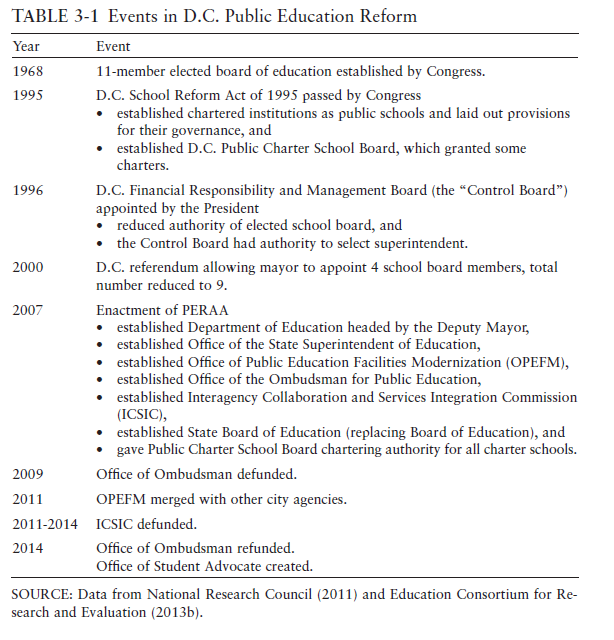
This chart from the report shows the attack on democratic processes in D.C. from finally getting democratic control over their schools in 1968 to complete loss of parental control with the passage of Public Education Reform Amendment Act. D.C. joined the other “corporate reform” cities such as Chicago, Los Angeles and New York in establishing the mayor as czar of education significantly diminishing the effect parents and teachers have on education policy.

By 1995, D.C. schools were charging down the path of “corporate education reform” when Bill Clinton signed the D.C. school reform act introducing charter schools and establishing the charter school board. The growth of charter school privatization movement is startling with charter schools enrolling nearly 50% of D.C. students in 2015. From the report:

“… by 2014, the percentage was 44 percent. PCSB [Public Charter School Board] reports that there are approximately 100 individual charter schools, governed by 61 chartering organizations, which function as school districts, or local education agencies (LEAs). D.C. has one of the largest percentages of a city’s students enrolled in charters nationwide, and D.C. is viewed as a leader by proponents of charter schools.” Pg 31

With almost 50% of the D.C. students in charter schools governance in certain aspect of education is not possible. Originally, charter schools were supposed to be laboratories that were freed from the more stringent rules for public schools so they could try new ideas. However, when 50% of the students are in charter schools, parents, educators and administrators have no way of monitoring education practices or spending. D.C. functionally has 62 school districts. One for all the public schools and one for each of the 61 charter school management organizations that operate in private. As the report says:

“There are no standardized formats or definitions in charter schools’ budgets or audits, though the PCSB [Public Charter School Board] is making progress in this area. The adequacy study also commented on the difficulty of ascertaining charter facility costs. In addition, the charter management organizations’ accounts are not open to the public, and there have been cases of mismanagement.” (Page 72)

“Because each charter school is an independent local education agency, the charter sector did not (and does not) have any overarching strategy to improve teacher quality (or any other factor in education).” (Page 79)

This lack of accountability is costing the public schools money and at the same time there is no way to know how the charter schools are spending money especially when it comes to special education and second language learners. The structure of education in D.C. is failing special education students. From the report:

“In another DCPS [D.C. Public Schools] official’s view, the problem is that a charter school will receive all the required supplementary special education funds for a student while DCPS is still expected to provide supplements that a student requires, such as dedicated aides or home or hospital services. This official also noted that DCPS has no authority to address problems in charter schools: it can only report noncompliance to PCSB [Public Charter Schools Board] and to OSSE [Office of the State Superintendant of Education].” (Page 129)

“The U.S. Department of Education has recently reported that that D.C. is among the worst school systems in the nation in providing appropriate educational opportunities for students with disabilities, and it has the worst record of any state in the country for meeting federal special education goals.” (Page 131)

“Another city official we interviewed commented that “there is no monitoring arm for how LEAs [Local Education Agencies] serve the ELL [English Language Learners] population.” For example, this person noted, the city provides $4,200 in funds in addition to the $11,000 allocated under the uniform per student funding formula (an additional $6,000 is provided for each special education student), but there is no structure for monitoring what LEAs [Local Education Agency] do with these funds or determining whether they are addressing students’ basic needs. At the same time, charter schools have no consistent source of technical assistance or other resources, such as professional development, to help ensure that they are providing what English-language learners need. As a city official noted, “there is no way for people to know if they are doing it right.”’ (Page 133)

One of the largest problems created by the lack of cohesiveness between the charter schools and the public schools system is that students are being lost. These lost students become what Dr. Mark Naison has labeled “the Disposables.” Dr. Naison writes:

“They are the more than 90 million Americans of working age who are not in the labor force and do not have regular jobs.

“They are the millions of teenagers who dropped out or were pushed out of school in cities like Detroit and Memphis and New Orleans and Los Angeles and Chicago and have disappeared from view because the divisions between charter schools and public schools have made it impossible to develop a coherent strategy to make sure no child is lost.”

The report notes the D.C. schools have a “crisis in absenteeism” and a terrible graduation rate.

“D.C.’s public schools have had among the worst on-time graduation rates in the country. For the class of 2014, the overall rate was 61 percent, compared with the national average of 81 percent (Chandler, 2014d). For DCPS schools, the graduation rate was 58 percent—up 2 percentage points from the previous year; for the charter schools, it was 69 percent—down almost 7 points.” (Page 154)

“Nationally, for 2012-2013, the overall rate increased from 78 to 81 percent; for blacks it increased from 66 to 68 percent, and for Hispanic students it increased from 71 to 76 percent.” (Page 189)

The report also contained this nugget suggesting that charter school gains in test performance over time do not match public schools.

“The EDCORE analyses by sector also showed that, although both DCPS [D.C. Public Schools] and charter students showed improvement, the magnitude of the gains were higher for DCPS students in every year.” (Page 177)

Mayoral Control and VAM Evaluation

A central tenant of “corporate education reform” is to limit democratic processes by ending elected local school boards. Democracy is always more difficult to administer than authoritarian control from a centralized power like a mayor. Of course this means that parents and teachers will not have much of a voice (if any) in how their local school; is run, what it teaches or what its policies are. In 2007, the city of Washington D.C. completed its embrace of “corporate education reform” when the Mayor Renty assumed total control of all public schools. The report observes:

“The specific strategies that Fenty and the chancellor he appointed, Michelle Rhee, chose were prominent on the national reform agenda: an emphasis on improving human capital using recruitment, evaluation, and compensation of educators; data-driven decision making; more uniform standards across schools; and greater school-level accountability through the use of student testing and other indicators.” (Page 40)

Fenty chose a person with five weeks of Teach for America training and three years’ experience teaching first grade to be chancellor. It was an odd choice, but she was connected to the lawyer, Joel Klein, who Michael Bloomberg had selected to run New York’s schools. Mayoral control seems to always value political considerations over professional competence when selecting public school leaders. For example, in Chicago, Daly chose Duncan and in Los Angeles, Villaraigosa chose Deasy; neither man had significant professional credentials or experience in education.

The agenda chosen was straight out of the “corporate education reform” playbook. They blamed teachers and principals for poor testing and graduation results, they instituted teacher evaluations base in large part on growth models known as value added measures and they introduced merit pay for teachers and principals. Survival in the Rhee-Fenty schools would depend foremost on high stakes testing.

Education reporter, John Merrow, summed up Rhee’s tenure of just over three years running D.C.’s schools:

“Ms. Rhee made her school principals sign written guarantees of test score increases. It was “Produce or Else” for teachers too. In her new system, up to 50% of a teacher’s rating was based on test scores, allowing her to fire teachers who didn’t measure up, regardless of tenure. To date, nearly 600 teachers have been fired, most because of poor performance ratings. She also cut freely elsewhere–closing more than two-dozen schools and firing 15% of her central office staff and 90 principals.”

“For teachers, DCPS has become a revolving door. Half of all newly hired teachers (both rookies and experienced teachers) leave within two years; by contrast, the national average is understood to be between three and five years. Veterans haven’t stuck around either. After just two years of Rhee’s reforms, 33% of all teachers on the payroll departed; after 4 years, 52% left.”

For more than 100 years, political leaders have every few years proposed merit pay as a way to motivate good performance. This idea does not have a great track record in most industries, because it undermines unity of purpose. In education, it has been a total failure laced with fraud, but this does not stop “corporate education reformers” from insisting on merit pay. Rhee’s merit pay scheme, which pays bonuses of up to $25,000, led to a cheating scandal. Merrow’s report continued:

“Some of the bloom came off the rose in March 2011 when USA Today reported on a rash of ‘wrong-to-right’ erasures on standardized tests and the Chancellor’s reluctance to investigate. With subsequent tightened test security, Rhee’s dramatic test scores gains have all but disappeared. Consider Aiton Elementary: The year before Ms. Rhee arrived, 18% of Aiton students scored proficient in math and 31% in reading. Scores soared to nearly 60% on her watch, but by 2012 both reading and math scores had plunged more than 40 percentile points.”

After two decades of adopting the “corporate education reform” agenda, the D.C. schools are damaged. Curriculum has been narrowed by hyper-focus on high stakes testing, which only accurately identifies economic conditions in the neighborhood. With just 25% of students attending their local community school and many community schools closed these once pillars of community support have been toppled. Parents have no effective place to bring grievances and experienced professional educators have been pushed out in favor of new hires, many of whom are unqualified Teach for America replacements on temporary contracts.

All this disruption and still the outcomes from the D.C. schools are some of the worst in the nation. They still have an attendance crisis and a graduation crisis. Their scores on NAEP [National Assessment of Education Progress] testing is still at the bottom of the nation. The problem is not the schools or even the misguided “corporate education reform.” The problem is rampant and unaddressed poverty in the neighborhoods of our nation’s capital. The problem has never been our public schools; it has always been poverty.

  • “National Research Council. (2015). An Evaluation of the Public Schools of the District of Columbia: Reform in a Changing Landscape. Committee for the Five-Year (2009-2013) Summative Evaluation of the District of Columbia’s Public Schools. Board on Testing and Assessment, Division of Behavioral and Social Sciences and Education. Washington, D.C.: The National Academies Press.”
  • Schneider, Mercedes. Common Core Dilemma “Who Owns Our Schools?” Teacher’s College Press, New York and London, ©2015 by Teacher’s College, Columbia University.
  • Ibid.

Lily’s Betrayal Letter

5 Oct

Yesterday was the worst of days and best of days. In the morning as usual I checked email and social media and there was Steven Singer’s post, “Teachers Told They’re Endorsing Hillary Clinton by NEA Leadership. Membership Opinions Unnecessary.” When I finished his post I saw my friend Paula Meyers had posted the Seattle area justice fighter, Susan Dufresne’s graphic #NEADoesntSpeak4Me; that caught my emotion exactly. With this in mind, I went to the Kearny Mesa Buddhist Center for World Peace Prayer. In the afternoon, things seemed improved; the San Diego Chargers won an exciting game over the Cleveland Browns.

NEADoesntSpeak4Me

Then I got an email message from Lily Eskelsen-Garcia, president of the NEA. Lily has been a great disappointment to me. It is not her fault. It’s mine. I believed she was a breath of fresh air who rose to the leadership of the NEA by merit and was willing to speak truth to power. Fooled again! Then this April in Chicago she stood on stage and lied to us. She pledged to no longer take money from Bill Gates but her fingers were crossed. Now, she employed power politics to get Hilary Clinton the NEA endorsement; personal power and influence have trumped democracy, public education and the teaching profession. I will attempt to analyze her message.

“My fellow educators,
I wanted to be the first to let you know that your elected representatives to the NEA PAC Council and the NEA Board of Directors took action to recommend Hillary Clinton in the Democratic primary for President of the United States. I am so proud of the thoughtful, thorough and incredibly rich discussion that your elected leaders held. It was truly what democracy looks like.”

Balderdash! I live in California, my elected representatives didn’t even vote. We have the largest delegation in the United States.
I heard that you argued against those who said there is no reason to give our endorsement this early, saying we would lose political clout if we don’t. It is also said that you felt that Bernie Sanders would never be able to mount a credible winning general election effort.

“I am also extremely proud of this decision because I know that Hillary is a strong leader who will do what’s best for the future of all of America’s students and public schools.”

Anthony Cody is correct, clear and succinct on this point: “The current field of candidates in the Democratic party is limited to Hillary Clinton and Bernie Sanders. Clinton has a close association with the Gates Foundation, which has been a major donor to the Clinton Foundation. Clinton has made it clear that she is a solid supporter of the Common Core and believes that such a testing system ‘helps you organize your whole education system.’ So if we want a change from the nation’s current trajectory in education, we need to look elsewhere.”

It is beyond my most optimistic reach to see Hilary Clinton as being more than marginally different than Barack Obama when it comes to education policy. There is a reason that Marc Tucker wrote the infamous ‘Hilary Letter’ to her. He saw a like-minded individual that would support the tenets for education reform that Diane Ravitch later labeled “corporate education reform.” This is education reform that views students as economic assets to be cultivated for the benefit of the state.

“After an extensive review of the candidates and an in-depth discussion, your leaders saw what I know – Hillary Clinton will be a champion for students and educator in the White House. She has a 30 year history of standing up for students and strong public schools and has actively engaged in conversations with educators in this campaign. Secretary Clinton told your leaders today that she won’t make a single decision about developing education policy without educators being in the room.”

This is complete prevarication. She has a close supportive relationship with both Bill Gates and Eli Broad. She was billed as co-President by her husband when he signed legislation taking power from Washington DC’s school board and authorizing charter schools. It was from that administration that we got “Goals 2000” and its call for national standards and testing. She voted for “No Child Left Behind” (NCLB). That is not a 30-year history of standing up for students and strong public schools. And her friends from her days as a member of the Board of Directors at Walmart have to be counted among the nations biggest enemies of public schools.

“As a U.S. Senator, Hillary Clinton was a champion for our cause, earning an “A” grade from the NEA for her support on the issues most important to our students, but even before serving in the Senate, Clinton was a champion of the students we educate. While every first lady has an admirable cause, Hillary chose to stand up to the for-profit healthcare industry to advocate for children’s healthcare. Her campaign ultimately led to the largest expansion of public health care in decades, when millions of American children received health coverage under the Children’s Health Insurance Program (CHIP).”

Clinton voted for the punitive anti-teacher NCLB in 2001. This March, Edweek reported: “And earlier this year, the American Federation of Teachers, which endorsed Clinton in her 2008 race, and the Center for American Progress, a think tank closely aligned with the Obama administration that also includes some former Clinton aides among its top ranks, came out with a proposal to test students every year, but only use the results for school accountability in certain grade spans.” So, did she get that NEA “A” grade for supporting testing or was it her work on health care?

“Even before running for president, Hillary championed early education and affordable college, and she sponsored efforts to ensure equal pay for equal work and to make it easier for workers to join a union.”

This sounds like pretty much what all Democrats say they stand for and it is hard to see how this makes her so much better than other Democrats vying for the nomination. Why didn’t the NEA keep its powder dry and see who was willing to save public education form greed driven reform? Get some real and substantial commitments? It appears that this endorsement is more about currying favor for national union leaders with the Clinton’s than it is about fighting for teachers and public education.

“And in 2016, the stakes for strong public schools will be too high to sit on the sidelines! Right now, there are presidential hopefuls who have made a career of attacking educators and public education to the detriment of students. They have allies like the Koch brothers, who have committed to spend $1 billion to defeat a pro-public education candidate like Hillary Clinton and taking control of the White House.

“With so much at stake, you cannot sit on the sidelines – America’s students need you today! And that is why I am asking you to join our campaign stand up for our students and make sure that we give all students the opportunity to a quality education.”

Yes, it is true that a lot of money is being spent to destroy public education in America. Unfortunately, a lot of that money is from people like the hedge fund fake democrats at the Democrats for Education Reform who support Hilary. There is nothing here that says she is clearly the champion for public education that we must support. She looks a lot more like a corporate education reformer who will continue the disastrous Obama agenda.

“Together, we can help elect Hillary Clinton as our next president and ensure that every child has the opportunity to succeed.
Gracias,
– Lily
Lily Eskelsen Garcia
National Education Association President”

Lily, you need to rethink your course. You are a smart beautiful spokesperson for the NEA. You are dumping that great opportunity to make a real difference and playing value degrading power politics that has eliminated the democratic process in our union to get this endorsement. Two other major unions – the Service Employees International Union and the American Federation of State, County and Municipal Employees – have indicated that they will take more time to consult their members about an endorsement in the primary.

Lunch with Larry

6 Sep

I recently wrote an open message to my congressman, Scott Peters, urging him to reject the proposed rewrite of the Elementary and Secondary Education Act. In it I said, “When fads like “new math”, “phonics only” or “whole word” came along, they infected many jurisdictions but not a majority of the country. As their weaknesses manifested, these fads were abandoned before serious damage occurred.” Federally centered power would end that protection from bad policy. After reading this post, Professor Larry Lawrence invited me to lunch to discuss “new math.”

I met Larry briefly in Chicago at the April NPE conference. I knew he lived in Carlsbad, California less than 30 miles north of my San Diego home. I was intrigued by his proposal to get together and discuss the “Zen of teaching math.” So I agreed to meet him at a spot between our homes.

Larry has been called a “consummate teacher of math” and has a significant pedigree. After graduating from Morningside High School in Inglewood, California, Larry did his undergraduate work at Occidental College where he was a classmate of star quarterback, Jack Kemp. Barack Obama also attended Occidental. When finished there, Larry went on to Columbia University’s Teacher’s College pursuing a Masters degree.

It was at Columbia that Larry was introduced to a more profound grasp of the principles of mathematics and how students can successfully develop mathematical thinking. In 1958, almost 30 years before California’s 1985 adoption of “teaching for understanding” also referred to as “new math”, Larry was learning from the movement’s fathers. (1)

Referring to the 1985 adoption of “teaching for understanding” Elizabeth Green tells us in her book Building A+ Better Teacher, “… the California teachers were struggling to understand students’ ideas, figure out what the students needed to know, and then use that information to respond.” (2) Larry and I agreed that this was the essential weakness with “teaching for understand” – the elementary school teachers did not have the training to do it.

On day one of his first math class at Columbia (Advance Algebra), the teacher gave an instruction for an assignment that stumped Larry. He went throughout the dorm asking everyone he could find to explain to him what “one to one correspondence” meant. No one knew! In 1958, few people apprehended the fundamental principles of mathematics.

Larry also brought along a prompt from his professor. I have shared the setup here:

Arithmetic by mail: Stan Brown had a pen pal, Al Moore, who lived in Alaska. Stan and Al corresponded quite frequently. Stan liked to receive letters from Al because he wrote about interesting things like hunting and fishing and prospecting for gold. Al enjoyed hearing about the things Stan did, especially about school, for Al had had very little opportunity to attend school. One day, Al wrote to ask if Stan would mind teaching him some arithmetic. Stan agreed but decided he needed to know how much Al already knew. So, in his next letter to Al he included a simple test, and asked Al to write in the answers and to return the test to him. Al sent the test back immediately; he said it was very easy and asked Stan to send some harder questions next time.

Take 2 away from 21.                                                  1

What is half of 3?                                                        ͻ

Add 5 to 7.                                                                  57

Does 2 x 4 ½ equal 9?                                                No

Which is larger, .000065 or .25?                                .000065

How many times does 3 go into 8?                             Twice

How many times does 9 go into 99?                           Twice

Which is larger, 3 or 23?                                              23

What is a number smaller than 4?                               4 (written smaller)

What is a number larger than 4?                                 4 (written larger)

Some of Al’s reasoning follows.

Anyone can see that 3 goes into 8 twice, and pretty neatly too, without any 2 left over. You put 3 into 8 the regular way and then you turn another 3 around and put it in on the other side of the 8.

In question 4, you don’t even need a ruler to tell that 2 x 4 ½ is different from 9.

In question 8, 23 is larger than 3 because 23 already has a 3 in it and a 2 added on in front.

Larry was an early adopter of “new math” when in 1959 he returned to Morningside High School to teach mathematics. Since taking that decision, he has dedicated his life to improving education in California. In the early 1960’s, Larry may have been the first California teacher to teach calculus in high school.

His career includes a stint at UCLA working in the lab school then known as Seeds. In 1975, he received his doctorate from UCLA and went on to work as director of curriculum for the Turlock School District. He also served as the principal of an elementary school in Upland California. In 1982, he returned to UCLA to again work in the lab school training elementary school teachers how to teach mathematics.

Larry’s story is also the story of education reform gone wrong. There are many Larry Lawrence’s out there who have dedicated their lives to understanding teaching and learning. They are a treasure. They have both theoretical knowledge and practical experience, but as Elizabeth Green reports (and then praises) people like Doug Lemov and Stacy Boyd purposefully shunned people like Larry when they formulated their “no excuses” charter school movement and embraced pedagogy spiced with “disruption.”

Larry told me that in 1993 he got involved with developing a charter school. The lab school at UCLA was having a difficult time surviving and they decided to become a charter. In retrospect, Larry says that was a mistake because on the whole, charters are damaging the public education system. Whether they are good or bad, “charters harm public education.”

It was a wonderful lunch at a second floor corner table overlooking the Pacific Ocean. The drive from La Jolla along old highway 101 to the Ki restaurant in Cardiff by the Sea is among the most breathtakingly beautiful drives in America. The restaurant Larry chose had a wide variety of; wraps, smoothies, tofu dishes and teas. The staff knew Larry by name. I had the cheeseburger.

  1. Green, Elizabeth. Building A+ Better Teacher, W.W. Norton & Company New York and London, ©2014 by Elizabeth Green – page 102
  2. Ibid. page 105

Trekkie Standards for Science – The Standards

3 Jul

The Next Generation Science Standards (NGSS) are awful. Do not adopt these standards. Corporate “Mad Men” gave them a name conjuring up the heroic images of Gene Rodenberry’s science fiction television series “Star Trek the Next Generation,” but they are really solely about pecuniary interests and power. If your state did adopt them reverse that disastrous course immediately. These misguided science standards are the pinnacle of “corporate education reform” whose theories of pedagogy are informed by profit incentive and theories of disruption.

The worst part about these standards is that they are not the real standards. The real standards are going to be written by testing corporations when they create the summative assessments for “accountability.” The NGSS are the universe of standards from which the subset of tested real standards will be taken. Once school leaders and teachers know the tested standards that will determine their future and the survival of their schools, they will focus on them like a cat after a bird.

Paul Bruno a middle school science teacher critiqued the NGSS for EdSource in April 2013 when the final draft was released. He wrote, “The most immediately striking weakness of these new science standards is that they are difficult to read. Indeed, the standards are so difficult to decipher that at various times the drafters have released a 2 ½ minute instructional video and a 5-page set of written directions to aid in interpreting them.”

This point keeps being reinforced. On June 25, 2015 NGSS released another “evidence statement” which notes “The evidence statements are intended to identify clear, measurable components that, if met, fully satisfy each performance expectation (PE) described within the NGSS.”

In Bruno’s 2013 article he makes other cogent points about the weaknesses in the NGSS; writing:

“In reality, a student’s ability to engage successfully in a ‘science practice’ is likely to depend first and foremost on his related scientific knowledge. So while the NGSS suggest that a third grader should be able to ‘use evidence to support an explanation,’ his skill with that ‘scientific practice’ will depend mostly on his knowledge of the phenomenon he is trying to explain. A family background in gardening may allow him to proficiently marshal evidence to support an explanation about plant growth, but he may nevertheless be unable to generate well-supported explanations about electronic circuits.”

The NGSS is a new theory of science education. It divides all of science into 13 core ideas which are all addressed in grade spans; kindergarten – 2nd grade, 3rd grade – 5th grade, 6th grade – 8th grade and high school. The same core ideas are repeated at each grade span.

To Bruno’s point, each disciplinary core idea (DCI) is associated with “scientific practices” and “crosscutting concepts.” Skills are emphasized over knowledge with the inherent view that the skills will easily transfer between core ideas. This is probably wrong and of course it has never been piloted because in the Procrustean world of “corporate education reform” speed is of the essence and if a few eggs are broken so be it.

In January, 2015, Peter Bishop, physics and math teacher extraordinaire, studied the NGSS over winter break. He came to our AP physics teachers meeting with some observations and concerns. Like any Annapolis man who served as an officer in the US Navy, Peter looked unflinchingly at what we are facing and identified some issues that we should address.
He spotted this in NGSS Appendix D:

“…Successful application of science and engineering practices (e.g., constructing explanations engaging in argument from evidence) and understanding of how crosscutting concepts (e.g., patterns ,structure and function) play out across a range of disciplinary core ideas (e.g., structure and properties of matter, earth materials and systems) will demand increased cognitive expectations of all students. Making such connections has typically been expected only of “advanced,” “gifted,” or “honors” students The NGSS are intended to provide a foundation for all students, including those who can and should surpass the NGSS performance expectations. At the same time, the NGSS make it clear that these increased expectations apply to those students who have traditionally struggled to demonstrate mastery even in the previous generation of less cognitively demanding standards…”

Peter’s response to this:

“How will this affect our instruction? In the statewide 2013 CST report, 40% of Algebra students were Far Below or Below Basic. Only 16% of the Physics students fell in these categories. The numbers are similar for Chemistry (21%) and Bio (18%). If we can take performance in Algebra as a reasonable metric to predict performance in science courses which require mastery of basic Algebra skills we can expect a dramatic increase in low scoring students.”

The design of NGSS is to start the standards with kindergarten students and the next year’s standards build on to the previous year’s development. By 6th grade students are supposed to: model the hydrologic cycle, report on global warming and other issues, understand the kinetic theory of temperature, work with theories of entropy, understand kinetic energy, and more. Even if the apparent belief that the rate of human development can be altered by these awesome standards is true, high school students for nearly a decade will not have the prerequisites to succeed. Today’s students are set up to fail just like the common core has set up math and English students to fail.

There are other voices across America speaking harshly about this new theory of science education. Heather Mac-Donald writing for the National Review said:

“Those standards, developed by educrats and science administrators, and likely to be adopted initially by up to two dozen states, put the study of global warming and other ways that humans are destroying life as we know it at the very core of science education.

“The New York Times reports that the standards’ authors anticipate the possible elimination of traditional classes such as biology and chemistry from high school in favor of a more ‘holistic’ approach. This contempt for traditional disciplines has already polluted college education, but it could do far more damage in high school.”

In the spirit of Lynn Chaney, Heather seems to detect a liberal college professor type conspiracy in the standards. I always find this stuff entertaining but I do see her point about citizens losing any influence over what is taught in local schools.

Doctor Stephen Uzzo from New York is concerned with the statements in NGSS. He says:

“They make sweeping and overreaching statements like: ‘scientific knowledge assumes an order and consistency in natural systems (3-PS2-b)’ When we know that emergent systems abound in nature (we have an exhibit on this upstairs), and making believe nature is consistent and orderly ignores much of 20th century science, never mind 21st. Anyone who watches the weather report knows this is just incorrect.”

Doctor Jenifer Helms from Arkansas really does not like the NGSS:

“These new standards leave a great deal to be desired, and by that, I mean that they are abysmal. I have read the entire 103-page document; and then I compared the NGSS K-12 standards with the current Arkansas Frameworks standards that can be found here. What I discovered was not just disappointing, it was disturbing.”

Trying to write education standards is probably a little like picking color choices for repainting a condominium project. No matter what, there are going to be complaints. However, In this case, it seems that the desire for dictatorial control over education is a much bigger driver than the perceived need for national science standards.

The major attempt to establish national standards in 1894 has had a profound effect on education in America and it would be hard to argue that was not positive. In the 20th century, the American public education system produced more Nobel Prize winners than any other system in the world. The United States which was viewed as a second tier power when the century began rose to dominate the world militarily, monetarily and culturally. So, maybe there is a lesson here.

In the development of standards in 1894, the call for standards was almost exclusively from professional educators and all 110 people involved in writing the standards were professional educators. There was little political and almost no financial support for the adoption of these standards and there was no high stakes testing for accountability. These standards were more or less embraced across the country based on their merit. They were education suggestions from respected educators and were embraced by each locale according their own needs.

In the introductory remarks for the Report of the Commissioner of Education, Department of the Interior, Washington, October 1, 1910, Commissioner Elmer Ellsworth Brown beautifully states the genius of the American education organization.

“Our educational organization answering as it does to our federal plan of government presents peculiar advantages as regards the making of a varied flexible yet inherently unified system of instruction. It is an organization not readily understood by foreigners. It offers many obstacles to the carrying out of any plans for rapid and uniform improvement. Yet the self governing character of its several members is of itself an incalculable advantage. Whatever unity is attained must be an inner unity an agreement through conviction.”

By contrast the NGSS were totally the product of power politics and political influence. These standards should more correctly be called the IBM standards. In 1995 the CEO of IBM, Louis Gerstner, spoke to the National Governors Association (NGA) on the urgent need for standards in education now. Lynn Chaney had torpedoed Bill Clinton’s nascent standards drive the year before, so it was unrealistic to expect immediate movement toward national standards. (1)

The following year Gerstner hosted the NGA at the IBM conference facility in Palisades, New York. At this 1996 conference, a new non-profit organization was started by the governors and CEO’s in attendance called Achieve, Inc. (2) According to Achieve’s 990 tax forms, Louis Gerstner was either chairman of the board of Achieve or emeritus chairman from its inception until the NGSS standards were finished in 2013. Achieve has copyright ownership of NGSS.

The NGSS website says the developmental work on these standards would not have been possible without the support of: The Carnegie Foundation of New York, The GE Foundation, The Noyce Foundation, The Cisco Foundation and DuPont. According to the science framework, Carnegie Foundation gave Achieve Inc. a contract to manage the development of the NGSS, but who actually wrote these standards?

I call NGSS the pinnacle of “Corporate Education Reform.” They learned from the CCSS fiasco. The web site lists 26 states and 40 individuals as writing the standards. Instead of being written in secret by testing company employees, the 36 education professionals and four corporate scientists who are credited with writing the standards are featured. But who really put this airplane built by committee together. Could it be Sue Pimantel a CCSS lead writer? The 2011 and 2012 Forms 990 for Achieve Inc. show Pimantel received $333,791 for consulting services, but they do not advertise her involvement on the NGSS site.

Like the CCSS the NGSS is an untested new theory of education being foisted on communities throughout America by un-American means. These were not great ideas that attained “an agreement through conviction.” There is nothing about this heavy handed corporate intrusion into the life of American communities that promises greater good. It is harmful, disruptive and expensive. I know my school district would have never adopted this of its own volition.

1) Schneider, Mercedes K. Common Core Dilemma, Teacher College Press New York and London, 2015
2) Ibid.

Common Core Dilemma is the Bomb

23 Jun

Mercedes Schneider’s new book is “evidence based” and damning. She concludes with “CCSS [Common Core State Standards] cannot work.” And “It is destined for the education reform trash heap, just like the punitive, test-driven No Child Left Behind (NCLB) from which it emerged.”

In Common Core Dilemma, Schneider shows herself to be a masterful researcher and clear thinker. She takes on the daunting task of making this Machiavellian episode concise, engaging and understandable. She triumphs.

If you never heard of the common core or “corporate education reform”, this book will be a difficult but necessary read and there is no choice but to educate yourself. If on the other hand you have been immersed in this issue since 2009, Common Core Dilemma will confirm your worst suspicions and demonstrate that you might have been naïve but certainly not cynical.

The opening chapters document the roots of CCSS sewed within Bill Clinton’s goals 2000 and the creation of the non-profit Achieve Inc. by the National Governors’ Association (NGA). Achieve became the corporate vehicle for producing the “state led” CCSS and goals 2000 accelerated the quest for national education standards.

Louis Gerstner, IBM CEO, is identified as the “godfather” of Achieve. As the keynote speaker for the NGA conference in 1995 Gerstner stated three urgent education goals for 1996: (1) high national academic standards with accountability, (2) the standards must happen NOW, and (3) don’t be sidetracked by academicians. Louis was well positioned to shape education policy; not only had he been to school, he had hired people who had been to school. In 1996, the governors of NGA held their Education Summit at Gerstner’s IBM conference facility in Palisades, New York.

As I read this documented history, I started wondering if Bill Gates’ personal competition with IBM and Gerstner had something to do with his decision to become an education “reformer”?

Ironically, the National Governors Association created their own non-governmental non-profit or was it really Gerstner who started Achieve? In any case the organization that wrote the CCSS was the creation of 40 governors and 49 corporate executives at the 1996 IBM meeting. No practicing educators were involved. No wonder Diane Ravitch calls this “corporate education reform.”

Mercedes sums up the attitude, “No need to meaningfully involve teachers in changes that Achieve, Inc. had already decided needed to be instituted.” After all we were warned by Gerstner, “Don’t be sidetracked by academicians.”

The precursor to CCSS, American Diploma Project (ADP), is explained. In her description, Schneider details the three principal organizations involved, Ed Trust (Kati Haycock), Fordham Foundation/Institute (Checker Finn) and Achieve Inc. These three non-profits garnered huge corporate largess while developing and promoting ADP. Schneider notes that during the ADP standards development when Achieve defined American education as failing; Achieve was repudiating its own claims of success two years earlier.

The story of how Achieve’s 2008 paper “Out of Many, One” became the central document for selling CCSS illustrates clearly that CCSS certainly was not a state led effort. It was the effort of incorporated non-profits financed by other corporations and corporate executives.

An intriguing set of relationships appear in the story of David Coleman and his Student Achievement Partners (SAP). Coleman is known as the lead writer of CCSS. It was he and the President of Council of Chief State School Officers (CCSSO), Gene Wilhoit, who went to Seattle and convinced Bill Gates to finance the development of CCSS.

The “reformer” relationships are surprisingly intertwined. David Coleman had a previous lucrative business deal with Chicago Public Schools through his startup company Grow Network. CEO Arne Duncan gave him a $2.2 million non-compete contract to analyze testing data in 2002 and renewed it in 2003 for $2.1 million. Coleman and his partner Jason Zimba sold Grow Network to McGraw-Hill and started Student Achievement Partners (SAP) in 2007.

The lead writers of CCSS were David Coleman, Jason Zimba and Susan Pimentel all from SAP. The rest of the original 24 writers were from Achieve, College Board and ACT. Today, Coleman is President of College Board and the man who helped him sell CCSS to Gates, Gene Wilhoit, has left CCSSO and taken the lead at SAP.

The only person amongst the original group of 24 people who wrote the CCSS that had any classroom teaching experience at all appears to be Zimba. He taught physics at Bennington College for a short duration. And strangely enough the president of Bennington College while he worked there was David Coleman’s mother, Elizabeth Coleman.

Bill Gates the billionaire who dropped out of Harvard only to become the richest man in the world by means that are not entirely above scrutiny, paid for both the writing of CCSS and for insuring they get good publicity. The insane amounts of money Gates doled out to organizations that supported his education ideas such as “without measurement, there is no pressure for improvement” is thoroughly documented and explained.

Gate basically became the de facto national school superintendent or secretary of education only more powerful. It is estimated that the spending on CCSS by the Bill and Melinda Gates Foundation may run into the billions of dollars. It is a complete distortion of the democratic process and has led to bad and wasteful policies. Policies like mandating a nationwide change to a new pedagogy that has never been tested and demanding that all schools across America abandon their current curriculum and develop a new one immediately with no transition time.

An enlightening chapter explains the amazing CCSS Memorandum of Understanding (MOU) which was signed by 46 governors and theirs state school chiefs before the CCSS were ever written, thus locking them in to the “voluntary” standards. It explains how it came about, the implications and the need for the lock-in.

The final few chapters deal with the enormous amounts of money mega-corporations like Pearson are planning to make from CCSS. It appears the real reason all the states had to have a standardized education is to pave the way for mega-corporations to dominate the education testing and publishing industry. It allowed them to take their products to “scale” where smaller local companies could never compete. As Mercedes points out “the goal of CCSS is not excellence. It is standardization.”

Common Core Dilemma is definitely a book that anyone trying to defend public education from privatization and profiteering should have in their library. For the uninitiated to the corporate takeover of public schools it will be more than an eye opener. Finally, it’s an informational text so David Colman would surly approve of it for your high school students to read.

“Is TFA a CULT?”

12 May

By T. Ultican 5/12/2015

This question arose from the audience at a recent NPE (Network for Public Education) colloquium on the TFA (Teach for America) – my answer, “no, TFA is not a cult.” However, the question is not without merit. Cynical actors are taking advantage of sincere young people for personal power and profit. In the same way that military organizations take undisciplined and timid youths, isolate them, stress them and indoctrinate them with a certain ethic.

TFA indoctrinates its new corps members with a behaviorist and market based education ideology. It is not the Peoples Temple in Guyana but it is in the words of Chad Sommer “an incubator for transforming social justice minded youths into advocates for Koch-brothers style education policies.”

NPE held its 2015 convention two blocks up the street from Lake Michigan in the historic Drake Hotel. Sunday morning, I went from breakfast with hundreds of BATs, teachers, and parents, who believe public education is important enough to fight for, to a session focused on the TFA. On my way, I passed by a large open room with thirty or so well appointed tables just off the lobby. Since the construction of the Drake in 1920, high tea has been served there every day.

I recalled the story a teacher from Minnesota told me. In 1947, a public school teacher from a poverty stricken rural community not far from Minneapolis had driven her five eighth-graders to Chicago and treated them to high tea at the Drake. My new friend from Minnesota said that her eighty-year-old mother still counts that among the greatest memories of her life.

The expert panel at the TFA session:

Moderator: Julian Vasquez Heilig, Director of the Doctorate in Educational Leadership Program at Sacramento State University and a founding board member of the NPE.

Professor, Terica Butler earned her Doctoral degree from the Department of Instruction and Curriculum Leadership at University of Memphis in May 2014. Her research emphasis was on alternative paths to teacher credentialing which included researching the training of TFA corps members.

Annie Tan, is currently a special education teacher in Chicago public schools with a master degree in special education. She was a member of TFA corps class of 2011 placed in a Chicago charter school.

Chad Sommer, with a degree in marketing, became a member of the TFA corps class of 2011 placed in Chicago public elementary school.

 Jameson Brewer, Ph.D. student in Educational Policy, Organization and Leadership at the University of Illinois at Champaign-Urbana was a member of TFA corps class of 2010 placed at Carver High School in Atlanta, Georgia.

Katie Osgood is a special education teacher in Chicago currently working at a psychiatric hospital. She also taught special education in the Chicago Public Schools. She holds a Masters in Elementary and Special Education from DePaul University.

It may be possible to criticize the quality of some of this panel’s judgments, but one point is clear, their research and advocacy will not pave the way to personal profit or power in the same way that being pro-TFA could.

A path to political power and prestige is available to corps members and researchers who support these three positions: (1) Education outcomes are the responsibility of teachers and there are no excuses for teachers who fail to raise test scores. (2) Authoritarian leadership is required in both the classroom and in the administration of schools. (3) Market based principles are the path to scholastic improvement and standardized testing is the only reliable measurement of that improvement. Each of the panel members pushed back against these market-based “reform” positions that are profoundly embedded within TFA.

Professor Heilig opened the proceedings with a few brief personal remarks. He told us of his own experience at forums to discuss TFA and facing rooms packed by TFA corps members and supporters. He also mentioned that TFA with the backing of large private funding from organizations like the Gates, Broad and Walton foundations pays staffers on Ed-committees in Washington DC for both the Democrats and the Republicans.

TFA is an organization that is both willing and able to play power politics to get its agenda enacted.

Professor Butler observed that the summer five week training course did not equip the corps members for a full time teaching schedule in the fall. Summer-school students are only in class for four hours a day and there were normally four corps members assigned to each class. That meant that the TFA corps member student taught by sharing a class and only taught for 1 hour a day. Then in the fall they were hit with six hours a day in a classroom by themselves.

Jameson Brewer and Annie Tan were unusual corps members. They studied education in school and joined TFA to get a job when they could not find a full time teaching position. Somehow even during the height of the depression, TFA was able to place its corps members in classrooms across America.

Jameson who went through a university credentialing program prior to TFA told us that he became an example of how well TFA teachers perform in the classroom. He also shared the following table of data with us comparing TFA preparation with preparation by a typical teacher education program.

Student teaching Methods Observations
TFA 16-18 hour 125 hours 2
Typical TEP 630 hours 496 80

Chad Sommer was more typical of the TFA experience. He has written that I was “naively seduced by TFA’s do-gooder marketing pitch. I charged ahead on a mission to close the academic ‘achievement gap’ that TFA blames on incompetent (read unionized) teachers.” With a marketing degree in hand and five weeks of training which included a heavy dose of Doug Lemov’s Teach Like a Champion (part of the TFA recipe for teaching), Chad became a new elementary school teacher at a public school in Chicago.

All three former TFA corps members agree that they were taking jobs that would otherwise have gone to a trained educator and Jameson Brewer says he directly replaced an experienced certificated teacher much to the chagrin of the principal that was forced to hire him.

The TFA Message to Corps Members

The fundamental messages these corps members received during training were that public schools in America are failing and the cause is bad teaching. Social conditions are just an excuse. Great teachers can overcome “achievement gaps” and not raising test scores means that the teacher is a failure. These failing teacher are said to have succumbed to “the soft bigotry of low expectations.” The sole arbiter of success in a classroom is test scores. This was all part of the TFA academic impact model.

Teach for America and the ‘education entrepreneurs’ who developed the “no excuses” charter school movement (mostly TFA alums) believe that America’s schools are failing and that they have a mission to save our country’s future. People like Doug Lemov, Stacey Boyd and John King, with no substantial background in education (which they see as a strength), started schools.

They Derided education theories taught by university professors. It was clear to them that the first item to fix in schools was discipline so they put children in uniforms, made many rules about everything the children did and enforced those rules harshly. It reminds professional educators of 19th century pedagogy.

Based on behaviorist theory, the “no excuses” model is completely authoritarian and autocratic. While a really skilled practitioners might raise test scores employing these harsh tactics, there are terrible side effects. Students learn to hate learning and creativity is sundered. To use professor Zhao’s metaphor – Rudolph the red-nosed reindeer will be killed.

Annie’s Story

I met Annie Tan at breakfast on Saturday morning. As I was headed into lunch after the morning sessions I encountered Annie again. Being a friendly engaging person, she invited me to go with her to find a table. We walked to the front of the giant room accommodating at least 35 tables for 12 and sat down with Jose Vilson, the well-known blogger from New York, Peter Greene AKA Curmudgucation, Jennifer Berkshire AKA EduShyster, and Adell Cothorne, the principle who blew the whistle on Michelle Rhee. Also at the table was Peter Greene’s wife. It was an amazing hour and I discovered that Peter, his wife and Jose are trombone player like myself. Later, I learned that Peter and his wife met through their participation in a community orchestra.

Annie Tan graduated from Columbia University with an emphasis in special education. When she could not get a job, she joined the TFA and was sent to Chicago. Annie was assigned as a special education teacher at a charter school in Chicago. She was the only special education teacher on staff for grades K-4.

The only support she received was during her monthly TFA advisory visits. The school was led by a TFA alum and most of the staff was current or former TFA corps members. Few staff member had more than three years’ experience. In February, Annie’s TFA supervisor (not the principal) informed her she was failing as a teacher by not moving her students fast enough towards success on standardized testing and may be fired.

At the end of the year, she was fired. Four years later, she has a master’s degree in special education and is succeeding as a teacher in the Chicago Public School system.

I know from my personal experience that being labeled a failure is psychically devastating. Primary tenets of corporate inspired “reform” include disruption, labeling a certain percentage of people failures and firing them as a warning to those left behind.

During my first year of teaching, I worked under the Alan Bersin administration in San Diego. Diane Ravitch tells the story of Bersin and the corporate “reform” piloting done by San Diego Unified School District in her book, The Death and Life of the Great American School System. I was fired for not moving my students toward achieving standards even though my classes scored extremely well on the district end of course exams.

I had a credential in math, a credential in physics and high test scores but that was all trumped by the requirement to let go a certain number of first year teachers. I was a fifty year-old and that is probably the reason I was targeted. Even though I felt certain the firing had very little to do with my actual performance in the classroom, I was bothered by self-doubt about my abilities as an educator for the next decade.

I am guessing the Annie still believes in some corner of her mind that she failed at her first teaching job and that thought still undermines her confidence. Authoritarianism is a horrible creed and especially horrible when applied to an education environment.

TFA is a Cult

A great warrior for public education, Katie Osgood, made these three assertions: “TFA is a cult; its corps members are exhausted, isolated and only have TFA to attach to.” “TFA is destroying communities of color: they drive out teachers of color.” And “Tenure is a children’s right.” While I quibbled with her use of the term cult, I recognize she is the psychiatric professional and I certainly agree that they do use the techniques she describes to change youthful idealistic minds toward a market based ideology.

Her last two claims are unvarnished truth. Katy has been identified by TFA as the number one opponent of TFA on social media. She is relentless and impassioned. I am glad she is on my side. In her “An Open Letter to Teach for America Recruits” Katie writes:

“Many of you no doubt believe you are joining a progressive education justice movement; that is the message TFA sells so well. But TFA is not progressive. The data-driven pedagogy, the fast-track preparation, the union-busting, the forced exploitation of your labor, the deep-pocketed affiliation with corporate education reform are all very conservative, very anti-progressive ideas.”

And

“Ask yourself: Since when did billionaires, financial giants, or hedge fund managers on Wall Street begin to care about the education of poor black and brown children in America? If you follow the money, you will see the potential for mass profit through privatization, new construction, union-busting, and educational service industries. Why would a group dedicated to educational justice partner with these forces?”

On further reflection, I think TFA just might be a cult.

Comment on Awful NPRM for Teacher Training

20 Jan

It is hard to express how profoundly inimical I find the set of proposed federal regulations for teacher education schools. These rules are not based on good science and are not motivated by experience or called for by leading professional educators. The costs are devastating for local school districts, state education budgets and universities. Students will be subjected to even more expensive testing that accelerates the well-known tendency for standardized testing to pervert curriculum. And the instruments being used for objectively evaluating teacher colleges are neither designed for that purpose nor capable of doing it. While these regulations will transfer policy control from states to the federal government, they will not only do little to improve teaching but to the contrary will harm schools, the teaching profession, and pedagogy.

Here in California, Linda Darling-Hammond, Chairman of the California Commission on Teacher Credentialing (CCTC) is among those who oppose using test scores as a measure of teacher training effectiveness, as is state Superintendent of public instruction, Tom Torlakson. Besides opposing using tests to evaluate education schools, the CCTC said that it would have to develop some 57 new tests to generate student-achievement data that could be used for all of its licensing areas. It put the total cost of the regulations in California at close to $485 million for just one year. [1]

Darling-Hammond was President Obama’s education spokesperson during his first presidential campaign and Tom Torlakson has been leading one of the world’s largest school systems for 15 years. These are dedicated talented and widely respected professional educators. The new rules would override their judgment and implement policies against the best thinking of California’s education leaders. That is beyond the scope of reasonable federal authority and in light of these facts; implementation of these rules would be crass authoritarianism.

The most alarming section of the regulations describes the indicators that states must gather and report:

“§ 612.5What indicators must a State use to report on teacher preparation program performance for purposes of the State report card?
While a State would be able to use additional indicators and establish its own “cut-scores,” it would be required to use the following indicators of teacher preparation program performance: (i) Student learning outcomes (ii) employment outcomes, (iii) survey outcome data, and (iv) an assurance that the program is accredited by a specialized accreditation entity recognized by the Secretary for accreditation of professional teacher education programs, or an assurance by the State that the teacher preparation program provides teacher candidates with content and pedagogical knowledge and quality clinical preparation who have met rigorous teacher candidate entry and exit qualifications.” [2]

Certainly, teacher education programs should be accredited by recognized regional accrediting organizations and this has been a long standing practice throughout our nation. A survey of employers that hire newly minted teachers seems reasonable and the reporting requirements not overly expensive or burdensome. Although mandates like this have been routinely implemented since the 1950’s causing a bloating of school administrative staffs nationwide. Efforts to reduce reporting requirements would be a more helpful focus for these new rules. It would allow schools to put more money in classrooms. Although I understand the need to insure that tax dollars are spent appropriately, I also know that bureaucratization is fraught with mission creep and expenses that often exceed the value of the benefit that was expected.

Employment outcomes’ reporting is a job creation clause for bureaucrats that does little to ensure teacher program quality. It is the job of highly trained school district leaders to ensure that they are hiring quality candidates for the classroom. It would be quite unusual to find a school system leader who was not diligent in this aspect of his job. Unprofessional teacher training schools that provide poorly qualified teachers will not be able to place their teachers. These local school leaders are more effective at policing quality teacher outcomes than a federal bureaucrat at the Department of Education could ever hope to be. This requirement will only further burden local school districts and teacher colleges with expensive reporting rules that will do little to improve teacher education.

Student learning outcomes is by far the most intolerable, debilitating, and wrongheaded requirement in these proposed rules. It is intolerable because student outcomes are to be based on a pseudo-science which is widely disputed by professional statisticians and educators. Wherever these value added models (VAM) have been implemented, the outcomes have been unstable. The preponderance of evidence is that VAM is not capable of accurately identifying the causes of educational outcomes. VAM assumes those outcomes can be measured by objective means; that is a highly dubious assumption.

Furthermore, the learning outcomes section is debilitating because it will force more testing and do even more damage to pedagogy and state budgets. It is wrongheaded because it will cause curriculums to narrow, undermine creativity and exacerbate the environment that creates cheating and fraud.

The required indicators and definitions of terms in section of 612.5 clearly state that VAM or some method that is even less developed be used to evaluate teacher education colleges:

“The first required indicator of academic content knowledge and teaching skills would be student learning outcomes (see proposed § 612.5(a)(1)). “Student learning outcomes” would be defined as data on the aggregate learning outcomes of students taught by new teachers (as that term would be defined in § 612.2(d)) trained by each teacher preparation program in the State. The State would choose to calculate the data on student learning outcomes using measures of student growth (as that term would be defined in § 612.2(d)), teacher evaluation measures (as that term would be defined in § 612.2(d)), or both.

“Definitions of “student growth” and “teacher evaluation measure” would also be added to proposed § 612.2. “Student growth” would be defined as the change in student achievement in tested grades and subjects and the change in student achievement in non-tested grades and subjects for an individual student between two or more points in time. This could be a simple comparison of achievement between two points in time or a more complex “value-added model” [3] that some States already use to assess teacher preparation program performance based on levels of student growth associated with new teachers from those programs.” [3]

It is a requirement that locks in the current debilitating testing environment and accelerates the control of schools away from parents and communities toward state and federal government agencies.

As Professor Yong Zhao has written, “Under the spell of authoritarianism, Americans have willingly surrendered their beloved local governments to state and federal control. Locally elected school boards have turned into bureaucratic branches of state and federal government, for in effect, they only collect local taxes. They then use that tax money to implement the wishes of state and federal governments in curriculum, pedagogy, and assessment.” [4] It is time to put the brakes of the federal hegemony over public schools and recognize the wisdom of allowing diverse approaches across this great country to manifest. Do not kill creativity like other countries that use high stakes testing and authoritarian rule have done.

Sharon Robinson, President of the American Association of Colleges for Teacher Education writes, “The price tag for states to implement these regulations would be steep —higher, we believe, than the fiscal estimates provided in the proposed rules. … Furthermore, the proposed regulations mirror misguided rating systems and incentives that have created the unproductive, test-driven accountability environment of today’s K-12 schools — even as the administration has sought to address that very issue with increased flexibility for states in recent months.” [5]

Molly Corbett Broad, President of American Council on Education states, “Considering the size and scope of the regulations proposed, the limited extent to which systems capable of meeting the new requirements currently exist, and the existing data on the substantial costs to develop these systems, the estimate provided in the NPRM {Notice of Proposed Rule Making} grossly underestimates the actual burden these regulations would impose. [6]

Keving K. Kumashiro of the University of San Francisco reviewed these proposed regulations for the National Education Policy Center. He concluded:

“Improving teacher quality and teacher preparation should be a process that engages key constituents and communities and draws on both scholarly and practical expertise. The proposed regulations have not emerged from an inclusive, democratic decision-making process, or from the substantive involvement of qualified experts, or from sound research…. Additionally, the regulations reflect an historic over reach of the federal government through regulation, in at least three ways: the proposed regulations extend the reach of the federal government into what is currently the domain of states (program approval) and institutions(academic affairs); the proposed regulations extend to all states what is currently required only of states who received Race to the Top funding or ESEA waivers; and the proposed regulations make significant policy changes without substantive and inclusive deliberation with either the profession or Congress.” [7]

Kelly Field the senior education writer for the Chronicle of Higher Education reported, ‘”There are no state tests that I’m aware of that have been shown to be valid and reliable as a measure of teacher performance,” said Donald E. Heller, dean of the College of Education at Michigan State University. “They’re all constructed to measure student performance.” Extrapolating those tests to measure the programs that educated the teachers is even more of a stretch, he added.”’ [8]

The American Association of Colleges for Teacher Education (AACTE) disputes the claim that the implementation of this rule would cost between $42 million and $47 million. “In general, we find the analysis to vastly underestimate the development and implementation costs that states and institutions of higher education would incur if the regulations were to be adopted. The Department repeatedly, but erroneously, assumes that many states have much of the capacity in place to implement the proposed regulations.” [9] As noted earlier, California leaders believe the first year would cost half a billion dollars.

This NPRM is bad for teaching, bad for education schools and especially bad for poor communities. The testing associated with this proposal will exacerbate the negative experience good teaching suffered under George Bush’s “no child left behind”, a misguided policy widely considered a destructive abomination. Education schools will be saddled with new burdens that do nothing to improve their school. Still, it is poor communities that will suffer most of all. Education schools, in their own self interest, will not want their graduates to work in poor and minority communities. Across the United States many great state institutions focus on developing teacher corps capable of addressing the problems associated with poverty. With these rules in place it would be against their survival to continue that mission.

1)Teacher-Prep Regs Too Costly, Higher Ed. Groups Say By Stephen Sawchuk January 5, 2015 6:43 for Education Week http://blogs.edweek.org/edweek/teacherbeat/2015/01/teacher-prep_regs_too_costly_h.html?r=1701586631

2) https://www.federalregister.gov/articles/2014/12/03/2014-28218/teacher-preparation-issues

3) Ibid.

4) Zhao, Yong Who’s Afraid of the Big Bad Dragon? Jossey-Bass, San Francisco, © John Wiley and Sons, Inc. 2014.

5) http://hechingerreport.org/content/burdensome-restrictive-flawed-why-proposed-federal-regulations-for-teacher-preparation-programs-are-a-cause-for-concern_18389/

6) https://secure.aacte.org/apps/rl/res_get.php?fid=1591&ref=res

7) REVIEW OF PROPOSED2015 FEDERAL TEACHER PREPARATION REGULATIONS: by Kevin K. Kumashiro, University of San FranciscoforNational Education Policy Center http://nepc.colorado.edu/files/ttr10-tchrprepregs_0.pdf

8) New Rules Would Judge Teacher-Prep Programs on Job Placements and Student Learning By Kelly Field http://chronicle.com/article/New-Rules-Would-Judge/150263/?cid=at&utm_source=at&utm_medium=en

9) The American Association of Colleges for Teacher Education (AACTE) https://secure.aacte.org/apps/rl/res_get.php?fid=1590&ref=res

Illusion Motivates Education Reform

29 Dec

By Thomas Ultican 12/29/2014

My earliest memory of public education criticism was overhearing my mother and her teacher colleagues talking about a book memorably named, “Why Johnny Can’t Read.” It was a sensation that implicitly stated that public education in America was a dismal failure and that the nation was on a path to its own cultural and fiscal demise. Recently Jim Arnold & Peter Smagorinsky wrote this amazing paragraph about the history of declaring the failure of America’s public education system:

“Admiral Rickover published “American Education, a National Failure” in 1963, and in 1959 LIFE magazine published “Crisis in Education” that noted the Russians beat us into space with Sputnik because “the standards of education are shockingly low.” In 1955 Why Johnny Can’t Read became a best seller, and in 1942 the NY Times noted only 6% of college freshmen could name the 13 original colonies and 75% did not know who was President during the Civil War. The US Navy in 1940 tested new pilots on their mastery of 4th grade math and found that 60% of the HS graduates failed. In 1889 the top 3% of US high school students went to college, and 84% of all American colleges reported remedial courses in core subjects were required for incoming freshmen.”

The paragraph above recalls more than a century of national failure to properly educate our citizenry yet in that same century America became the world’s leader economically, scientifically, militarily and culturally. Does this mean that education quality does not matter or is it more likely that the perception of American education failing – is and was an illusion?

By the middle of the 20th century, cities and villages throughout the USA had developed an impressive educational infrastructure. With the intent of giving every child in America the opportunity for 12 years of free education, this country was the world’s only country not using high stakes testing to deny the academic path to more than a third of its students. The physical infrastructure of our public schools was of high quality and schools were staffed with well trained experienced educators.

Furthermore, a trained administrative structure was in place and the path to continuous improvement had been established. No one should deny that public education can be improved, but what is also undeniable is that America’s current system has a history of producing successful citizens. To call public education in America a failure is to make better the enemy of good. It promotes a destructive illusion.

I feel a surrealistic connection to what might be the most important driver ever for this destructive illusion. Terrel ‘Ted’ Bell, Ronald Reagan’s Secretary of Education, instigated a commission that gave us the infamous, “Nation at Risk.” Beyond just claiming that public education in America was failing and needed drastic reform; the claimants said that reform needed the leadership of people who were not professional educators.

First of all, the idea that you should ignore the advice of practicing professionals concerning any field of human endeavor is foolhardy, but foolhardiness permeates modern education reform. It is through Bell I feel a chimerical connection to imprudent reform.

Bell was from Lava Hot Springs, Idaho. I too grew up in rural Idaho. He attended Albion State Normal School in southern Idaho. That was my mother’s alma mater as well as that of more than half of my public school teachers. Like most of the Albion graduates, Bell taught while continuing his own education. He eventually earned a doctorate of education from the University of Utah. This man with roots close to my own became a key instrument in advancing the attack on America’s public schools, which he loved.

Bell’s “Nation at Risk” was a political document written by business men and famous scientists. It claimed without substantiation or peer review that the very fate of the nation was at risk because of our failing schools. The authors said “the educational foundations of our society are presently being eroded by a rising tide of mediocrity that threatens our very future as a Nation and a people” and claimed, “If an unfriendly foreign power had attempted to impose on America the mediocre educational performance that exists today, we might well have viewed it as an act of war.”

The paper was a very successful polemic and not an honest scholarly effort. Its prejudicial analysis of education was based on unsupported beliefs and ignored data that countered those beliefs. “Nation at Risk” significantly advanced the destructive illusion that public education was failing and the rescue must be led by corporate chieftains.

Terrel Bell was a idealist and an realist. He supported the department of education and Medicare. He had a profound religious faith in Mormonism. As a classroom chemistry teacher for many years, he devoted his life to public education. Bell was an unlikely choice to head Ronald Regan’s Department of Education. Bell, however, was picked because of his high standing as a leader of education policy in the Nixon and Ford administrations which purchased him favorable standing among the education community.

Bell was supposed to oversee the demise of the department of education and support the states’ rights views (definitely not national standards) of the new President, but he had his own agenda. Bell said, “There are three things to emphasize in teaching: The first is motivation, the second is motivation, and the third is (you guessed it) motivation.” It is strange that an experienced educator with this kind of understanding about the crucial nature of motivation for learning would be a champion of national education standards. But he was.

By the 1980’s, many education theorist and observers knew that wherever standards had been tried they tended to circumscribe curriculum and engender jejune pedagogy which stunted the intrinsic motivation to learn. In many ways, Bell is typical of a modern education reformer. He was idealistic, moral, selfless and believed fiercely in the destructive illusion that American public education was failing.

Teach for America and the ‘education entrepreneurs’ who developed the “no excuses” charter school movement also spring from that same kind of idealistic passion based on the heartfelt belief that America’s schools are failing and that they have a mission to save our country’s future.

People like Doug Lemov, Stacey Boyd and John King deeply believed that public schools were failing. With no substantial background in education (which they saw as a strength), they started ‘no-excuse’ charter schools. Deriding education theories taught by university professors, it was clear to them that the first item to fix in schools was discipline so they put children in uniforms, made many rules about everything the children did and enforced those rules harshly. In some ways, it was reminiscent of 19th century teaching.

‘Education entrepreneurs’, because they have no respect for education professionals, are doomed to reinventing the wheel. The truth is that even with the tremendous financial and political support their movement secured; the results have been mixed at best and as far as improving education practices they are abysmal failures.

The truly difficult outcome from these disciples of economist like Eric Hanushek instead of educators like John Dewey is that they are still true believers in the need to ‘disrupt’ public education because it is failing. Everything they have done and believed in about education is based on the failure illusion that they hang onto tenaciously.

The godfather of the ‘education entrepreneurs’ seems to be the MIT trained economist, Eric Hanushek. His major claim to fame is proposing value added measures (VAM) to evaluate schools and teachers. Economists often function today as modern era soothsayers. To me Hanushek is little more than a mountebank.

His VAM has been widely criticized as being statistically absurd, but that hasn’t stopped “elite” schools like MIT and Stanford from singing his hosannas. Hanushek reminds me of a description of economists in the book “An Incomplete Education“:

“Economists are fond of saying, with Thomas Carlyle, that economics is ‘the dismal science.’ As with much of what economists say, this statement is half true. It is dismal.”

Hanushek’s bad science has done a lot to advance the perfidious illusion that American schools are failing.

I too was a victim of the American schools are failing myth. I decided to become an educator in 1999. I left a successful career as a research scientist working in the recording industry to become an educator. With strong beliefs about the importance of public education, I saw myself as a talented guy who could make major contributions to righting the distressed ship of public education.

My mindset wasn’t that different than that of the ‘education entrepreneurs.’ I was not in the classroom for many months when I started to realize I might be the most inept teacher at my school. Teaching is more difficult than being a research scientist and experience in teaching is also more important. It became clear to me that I had been bamboozled. The teaching profession and the condition of public schools in San Diego County in 2002 had never been in better shape.

It is interesting the way this deception has manifested in the neighborhoods of America. In middle class and upper middle class neighborhoods, people believe the illusion but are thankful that their own neighborhood public schools are such wonderful exceptions.

Here in San Diego, parents at Torrey Pines Elementary School or Challenger Middle School or Poway High School love their schools and would fight for them. At the same time they believe that public schools in poor neighborhoods are failing. The result is that people in poor neighborhoods who don’t have the political capital to fight for their schools no longer can send their children to quality public schools.

They must send them to charter schools or drive them to another neighborhood. Poor communities are having their wonderful public institutions like the venerable Compton High School taken from them.

I will conclude with words that the great historian Arnold Toynbee wrote in his masterpiece study of five millennia of human development concerning publicly supported education. He observed that “The bread of universal education is no sooner cast upon the waters than a shoal of sharks arises from the depths and devours the children’s bread under the educator’s very eyes.” I hope this was a warning not a prophecy!