By Thomas Ultican 7/23/2024
Gina Raimondo, Rhode Island’s unpopular governor, appointed the clearly unqualified Angélica Infante-Green as Commissioner of Education, in 2019. That was the year before Joe Biden selected Raimondo as Secretary of the Treasury. Infante-Green’s qualifications amounted to recommendations from New York’s Joel Klein and Jeb Bush. She was a former Teach For America (TFA) teacher in New York city who had never led a district nor been a school principal. Her first action on the job was to take over the Providence school district, the state’s largest.
Like all corporate sponsored “reformers,” Infante-Green took to propaganda rag, The 74, and updated on when, if ever, Providence will exit state control. However, Rhode Island exiting state control matters less than in most states with elected school boards because Mayors run schools. Providence Mayor Jorge Elorza officially petitioned the state to take over his schools, one of the poorer school districts in America. Politicos decided that schools were “failing” because of poor test scores.
Besides poverty, Providence’s schools are almost 70% latinx with 40% language learners. Famous educators like Pestalozzi, Herbert and Dewey would not have gotten test scores acceptable to the local business community. It was a case of testing to privatize, without care for public education and little comprehension of teaching or learning.
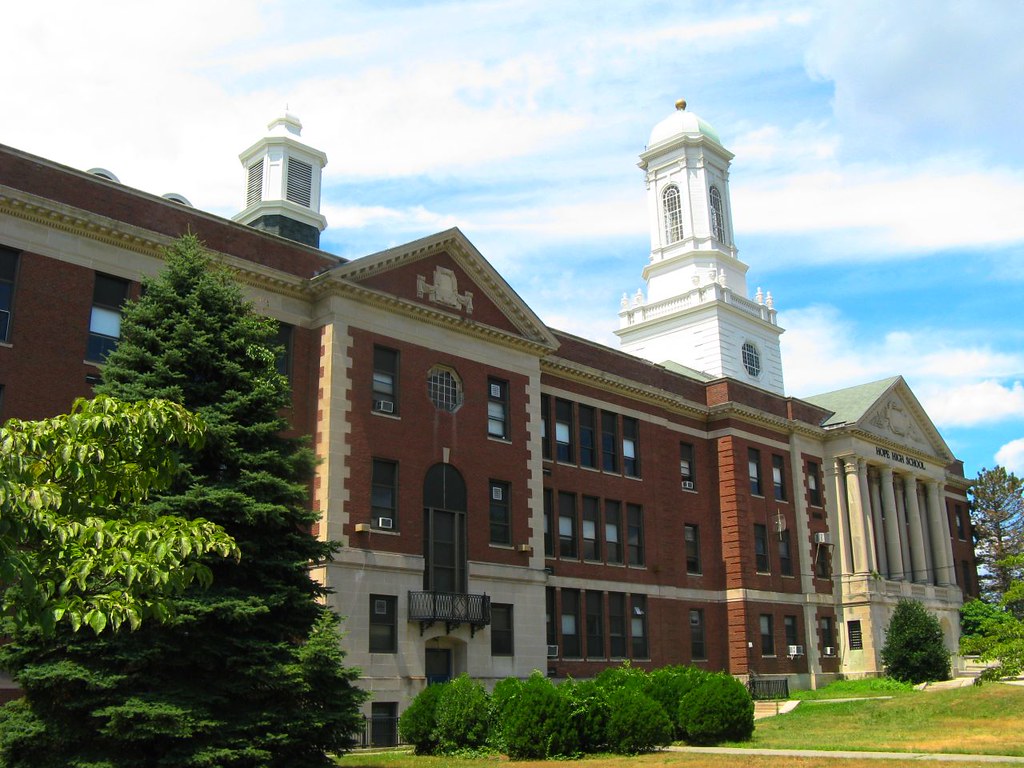
Hope High School in Providence
Infante-Green did not actually give much information about her plans for turning over management of the Providence school district to the city. She only shared:
“We said that in 2024, we’d look at how much progress has been made. But when that was decided in 2019, nobody anticipated a pandemic.”
Does she envision semi-permanent state control?
Feeding Corporate Friends
Part of the requirements in Rhode Island for a school to exit state receivership is an independent review. Of course, Infante-Green did not ask Brown University, Providence College or University of Rhode Island to conduct the review. She contracted with Massachusetts-based consulting firm, SchoolWorks, to lead an independent review.
SchoolWorks has a long history of supporting charter schools and privatization of public education. A tab on their web page advertises the only two categories of training they offer: For Charter School Authorizers and For Charter School Founders.
About For Charter School Founders, SchoolWorks says:
“Behind every successful charter school is a passionate group of individuals who dedicated their time and talent to envisioning a new school, garnering community support, and crafting a thoughtful and comprehensive charter school application. These are challenging, time-consuming tasks; and we celebrate pioneers like you for your commitment to innovating education.”
A link on the LittleSis data base provides some historical background for SchoolWorks. The CEO in 2016, Scott Blasdale, was a founding board member of the Massachusetts Charter School Association. He also was executive director and founding teacher of Academy of the Pacific Rim Charter Public School.
In the period that Richard Daley and Rham Emanuel were mayors of Chicago, SchoolWorks held consulting contracts for local public schools. They also consulted for KIPP schools, the Ewing Marion Kauffman Foundation and National Heritage Academies. The billion dollar Kauffman Foundation’s (EIN: 43-6064859) spending aligns with funding by Arnold, Dell, Gates and Walton, including generous gifts to TFA, Thomas B. Fordham Foundation, TNTP and Digital Promise.
Testing to Privatize
Johns Hopkins University was integral to the attack on public schools in Providence, Rhode Island. In May 2019, at the invitation of Infante-Green, Johns Hopkins Institute for Education Policy led a review of the Providence Public School District. The Partnership for Rhode Island, a group of local business leaders, funded the review.
The Johns Hopkins study was commissioned in May and presented in June. Based on the report, Providence Mayor Elorza officially petitioned the state to takeover Providence Public School District on July 19, 2019.
This request was based on testing data and Johns Hopkins not so unbiased report. In 2020, the Institute for Education policy at Johns Hopkins joined Jeb Bush’s Chiefs for Change to write a paper, calling for more standardized testing. This collaboration clearly indicated a penchant for school privatization and a tilt against public schools.
Adopting the Science of Reading
Infante-Green defended her school takeover methods stating:
“We have something called the Right to Read Act [which requires teachers to be trained in the science of reading]. By 2025, our K-8 teachers will all be trained, but we’re at about 75 percent.”
Science of Reading (SoR) is much more about profits and control than good teaching. SoR is not based on sound science and, more accurately, should be called “How to Use Anecdotes to Sell Reading Products.”
Professor Maren Aukerman, currently Werklund Research Professor at the University of Calgary, focuses on literacy education and democratic citizenship. She previously served on the faculty at Stanford University and University of Pennsylvania. Her recently published paper in the Literary Research Association on work by Goldstein, Hanford and others promoting SoR noted:
“The problem is not with recognizing that teaching phonics can play a facilitative role in having children learn to read; that insight is, indeed, important, if not particularly new. The problem is that this narrative distorts the picture to the point that readers are easily left with a highly inaccurate understanding of the so-called ‘science of reading.”’
Professor Paul Thomas of Furman University, with a deep background in teaching and education research, criticized of American Public Media’s Emily Hanford writing:
“As I have pointed out numerous times, there is a singular message to Hanford’s work; she has never covered research that contradicts that singular message.
“For example, not a peep about the major study out of England that found the country’s systematic phonics-first policy to be flawed, suggesting a balanced approach instead.
“And not a peep about schools having success with one of Hanford’s favorite reading programs to demonize.”
Nancy Bailey is an expert in special education and early reading instruction. In a recent posting, she declared:
“A troubling feature of the Science of Reading (SoR) is the connection between those who believe in the power of phonemes (and more) and those who want to privatize public schools. The old NCLB crowd has been rejuvenated and seems onboard with digital instruction replacing public schools and teachers.“
Infante-Green’s claim that SoR is something wonderful and positive for public schools in Rhode Island is malarkey. It is a giveaway to corporations that harms students and undermines educators.
An Intriguingly Strange Claim
Infante-Green is quoted by The 74 stating:
“What’s interesting about Providence is that about 19,000 children apply to charter schools and there are only 22,000 students in the district. So they want charter schools.”
This assertion makes no sense. While it is not surprising that charter school enrollment in Rhode Island increased, the most recent (2021) available enrollment data showed 10,547 charter students. Claiming 19,000 student applications for privatized schools in Providence alone strains credibility.
Rhode Island’s Commissioner of Education promotes privatization.
It is true that since the pandemic, student enrollments have dropped and chronic absenteeism has grown throughout the nation. In Providence, both of these have soared. Even Central Falls, the most impoverished school district in Rhode Island, had a significantly lower absentee rates and better attendance than Providence. Commissioner of Education, Angelica Infante-Green, took over Providence schools five years ago, making no effective action while dropout rates climbed, students disappeared and many scholars coming to class sporadically.
Clearly, these schools would be in a better state if her takeover never happened.
It is time to quit playing privatization games with the public school system and return them to professionals in the district.
State takeovers have a nationwide record of failure and Providence is adhering to that history.


 tultican
As a retired teacher from the RI School for the Deaf, located in Providence but actually a state school, I can attest that the devaluation of authentic teaching began in RI prior to Angélica Infante-Green. I retired in 2011, and teaching in the few years prior was suffocated by the Rhode Island Department of Education’s infatuation with Race to the Top, the Common Core State Standards, mass-administered standardized testing, and teacher accountability under Commissioner of Education Deborah Gist, darling of Chiefs for Change and graduate of the Broad Superintendents Academy. The situation did not improve when she was replaced with Ken Wagner, recently of New York. Mr. Wagner was chosen by then governor, Gina Raimondo (now Secretary of Commerce). I wrote an opinion piece in the Providence Journal, enumerating the reasons that he was not a good choice for RI’s public schools, but obviously my opinion was not heeded. Here is the wayback article. https://www.providencejournal.com/story/opinion/2015/07/13/new-education-chief-raises-concerns/33884657007/ Here is a piece I wrote in 2016 describing Ken Wagner’s enthusiasm for expanding the Achievement First charter school in Providence. https://resseger.wordpress.com/2016/12/07/ri-commissioner-of-education-ken-wagner-achievement-first-promoter/ Commissioner Wagner made an incredible statement in praise of the use of automated scoring for essay responses on the state assessment at a 2016 meeting of the RI Council on Elementary and Secondary Education. He declared that scoring by algorithm is more efficient and just as good as if not better than scoring by teachers. At that meeting he also insisted that the annual state testing be done online, because online learning has an underlying instructional purpose. He stated: “We can’t think about student engagement unless we have a serious strategy around digital learning.” (emphasis added) I can’t think of a more misguided understanding of student engagement, can you? There is more about his warped views on teaching/learning, and the dehumanization of schooling in RI, in my 2016 post here: https://resseger.wordpress.com/2016/05/27/story-telling-species/
LikeLike
Hi Sheila. Thank you for this informative response. Do you have any idea why Ken Wagner left in 2019? That is still a mystery to me.
LikeLiked by 1 person
Hi Thomas, Honestly I don’t remember, but I was glad to see him go. I once attended a RIDE presentation he made, and he was a truly strange person, with an irrational reaction to members of the audience (including me) who were clearly not enamored of him. As I do recall, he was trained as a school psychologist. As far as I could tell, he had practically no insight into human development or the needs of learners. I think someone wrote about him, “He looks remarkably human for an android.”
LikeLiked by 1 person