By Thomas Ultican 8/29/2023
Advanced Placement (AP) in high school is an assault on good pedagogy. Teacher and author, Annie Abrams, reports, “The College Board is closing in on ownership of a national curriculum that holds not only high schools, but also universities to the company’s academic standards and its philosophy of education.” (Page 6) Pricey private high schools and colleges are abandoning AP but public schools are short changed.
John Dewey studied life and how it functions. In the first half of the twentieth century, America’s preeminent philosopher advanced pragmatism. Stanford University’s philosophy department states, “Use of Dewey’s ideas continues apace in aesthetics and art criticism, education, environmental policy, information theory, journalism, medicine, political theory, psychiatry, public administration, sociology, and of course in the philosophical areas to which Dewey contributed.”
In his book, Democracy and Education, Dewey wondered:
“Why is it, in spite of the fact that teaching by pouring in, learning by passive absorption, are universally condemned, that they are still so intrenched in practice? That education is not an affair of ‘telling’ and being told, but an active and constructive process, is a principle almost as generally violated in practice as conceded in theory.” (Page 46)
Alfred North Whitehead, a famous educator, philosopher and scientist, active in the late nineteenth and early twentieth century, wrote the three-volume Principia Mathematica (1910–1913), with his former student, Bertrand Russell. This was the 23rd of the 100 best non-fiction books in the century. Whitehead founded process philosophy and in his amazing essay, “The Aims of Education,” shared:
“In training a child to activity of thought, above all things we must beware of what I will call ‘inert ideas’—that is to say, ideas that are merely received into the mind without being utilized, or tested, or thrown into fresh combinations.” (Page 1)
“And I may say in passing that no educational system is possible unless every question directly asked a pupil at any examination is either framed or modified by the actual teacher of that pupil in the subject.” (Page 5)
“But the first requisite for educational reform is the school as a unit, with its approved curriculum based on its own needs, and evolved by its own staff. If we fail to secure that, we simply fall from one formalism into another, from one dung-hill of inert ideas into another.” (Page 13)
The greatest philosophers and education theorists of the twentieth century warned, in no uncertain words, against the College Board style of cram and exam. Instead of pragmatism and process philosophy, behaviorism is implemented with standards and standardized tests, accompanied by a trophy or punishment.
Short Changed: How Advanced Placement Cheats Students
Standardization in public schools began in 1892 with the Committee of Ten. There was consternation among elite schools over student quality. Charles William Elliot, President of Harvard University and a former chemist, led the group of men—all men—establishing the first standards. This was the terrible idea which opened the road for College Board and AP programs.
Annie Abrams’s Short Changed documented the road to AP and identified James Bryant Conant, Harvard University President <another chemist>, as leading the way. He believed in standards and standardized testing. Abrams stated, “Conant’s advocacy for reform based on intellectual merit and technocracy set the stage for the Advanced Placement program” (Page 23) and shared:
“ETS would produce test with scientific precision and the other organizations would guide the programs of testing. The College Board, the American Council on Education, and the Carnegie Foundation would come together under the aegis of the Educational Testing Service. The new agency’s trustees elected Conant chairman of the board.” (Page 41 and 42)
“Conant’s position of power represented a victory by believers in the notion of quantifiable IQ … Conant was obsessed with testing and admitting students on the basis of ‘aptitude’ instead of ‘achievement’ …” (Page 42)
“For Conant, an objective metric like the SAT would ensure rational, impartial selection of the next generation of leaders based on intellectual merit, which tests would be able to identify.” (Page 43)
Beginning in 1951 a major force, the Ford Foundation, supported four different approaches to the same goal of enriching education for the superior student. In 1953, it issued a paper on the four strategies, including the Blackmer report and the Kenyon plan. (Page 72)
The Kenyon plan, led by Gordon Keith Chalmers, produced “School and College Study of Admission with Advanced Standing.” Abrams noted it as the “most immediate blueprint for the AP program.” The Blackmer Committee developed “General Education in School and College,” recommending schools and colleges reconsider their roles in making education more efficient and meaningful.
These two plans became the Advanced Placement program. (Page 13)
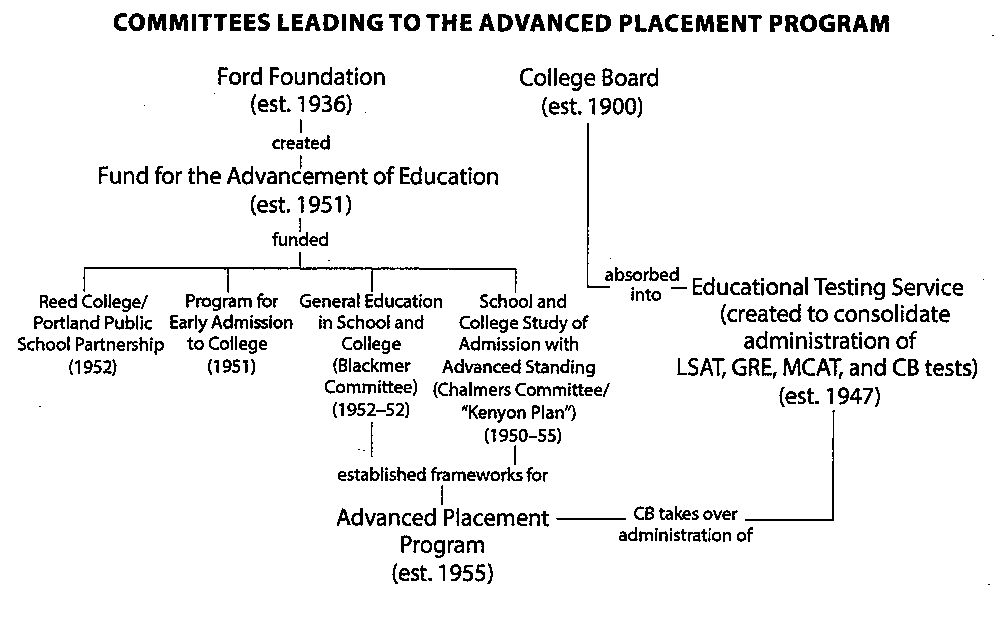
(Page 14)
The founders of AP did not want a national curriculum. However, beginning in 1955, with the first AP exams, the College Board started moving toward that eventuality.
Inside Higher Education reported in 2020:
“Ten years ago, AP teachers were given a course description with a brief curriculum outline and sample exams to study. They were given a fair amount of autonomy that replicated the academic freedom of a college professor. That is no longer the case.”
Bad Pedagogy from the Uninformed
In 2012, former college professor and AP teacher, John Tierney, wrote “AP Classes are a Scam” for Atlantic magazine, stating:
“To me, the most serious count against Advanced Placement courses is that the AP curriculum leads to rigid stultification — a kind of mindless genuflection to a prescribed plan of study that squelches creativity and free inquiry. The courses cover too much material and do so too quickly and superficially. … The AP classroom is where intellectual curiosity goes to die.”
Peter Gray PhD, writing for Psychology Today, learned that a group of high school teachers could not use his teaching methods. The classes were so scripted that to prepare the students for end of course exams, they could not make time for anything else.
Gray also noted, “The College Board has been a failure as an aid to education, but a resounding success as a business.” It continuously strives to bring in money, expand its customer base and add new fees. The president makes over a million dollars per year and upper executives, $300,000 to $500,000.
Nicholas Tampio, Professor of Political Science Fordham University, noted “AP courses should only count for high school credits and no more,” and shared “The AP has ‘quietly emerged as a below-the-radar national curriculum for able high school pupils and top-notch teachers.”’
Unfortunately, big money drives AP.
“Rising Above the Gathering Storm” is another polemic.
In 2005, Lamar Alexander announced one of the day’s star witnesses for the education committee:
“Peter O’Donnell is here, who is a member of the National Academy’s Committee that produced ‘The Gathering Storm,’ and his work in Dallas is one reason for the inclusion in ‘The Gathering Storm’ report of the advanced placement recommendations.”
Another modern edu-philanthropists with no education experience nor training, O’Donnell testified:
“The Advanced Placement Incentive Program succeeds because of three fundamental concepts: the high standards of Advanced Placement, which is built on a strong curriculum, rigorous national exams, and measurable results; emphasis on excellent teacher training; and financial incentives for teachers and students. Incentives are key to the success of our program. They provide extra pay for extra work and are paid by private donors.”
His program became the National Math and Science Initiative (NMSI). It calls for teacher merit pay, a hundred-year-old idea with a hundred-year failure record. Students get cash when they pass the AP exam!
“While there may be similar-ish programs in districts across the country, the big dog in the AP bribery biz is the National Math and Science Initiative. NMSI is an organization that was launched ‘to address one of this nation’s greatest economic and intellectual threats – the declining number of students who are prepared to take rigorous college courses in math and science and are equipped for careers in those fields.’ You may recognize that as a classic reformster talking point– low test scores are a threat to our national security– and in fact, the big launching funders of NMSI include Exxon, the Michael and Susan Dell foundation, and the Gates Foundation.”
Elite private schools have been dropping AP courses. In 2018, Sidwell Friends, Georgetown Day, National Cathedral and St. Albans in the District of Columbia, as well as Landon and Holton-Arms School in Bethesda, Maryland and Potomac in McLean, Virginia all ended their relations with AP. That was just in the Washington DC area after querying 150 colleges and discovering students won’t face entrance penalties.
A Personal Experience
In 2004, I moved from middle school to high school to teach a combined regular and AP physics class. My eight AP students were taking six AP classes each. Flabbergasting!
There used to be an aphorism, saying, American high school students were the laziest in the world. They played sports, partied, did very little academic work, graduated and three months later, showed up in college as the top students in the world.
Low-pressured high schools were what students of the 1950s through the 1970s needed. They were not mature enough for college. Today, suicide rates are skyrocketing and intellectual curiosity has cratered.
· AP classes are Not needed in high school!


 tultican
I’ve never understood the push for early college. Having taught some thing like 5,000 students, there were perhaps 5 or 6 with the exceptional maturity and intellectual curiosity to justify such a need. Why is everyone in such a damn hurry?
A spin off of NMSI landed in my school between my own oldest child’s college matriculation and that of her younger siblings. The elite colleges which had looked favorably on the older one’s AP’s had mostly discarded them four short years later. I was told: that credential has been devalued. The marketing scam had overreached.
Why do less selective colleges still look favorably at AP’s? It’s an easy metric, like SAT’s or ACT’s, to apply. Those institutions at the top of the food chain have lots of staff in the admissions offices and have the resources to probe deeply into curating the exclusive kind of incoming class they seek.
LikeLiked by 1 person
From a teacher and special ed mom – AP classes were so frustrating to me! My son reportedly made points in class that were “above the other kids’ heads” and was “a pleasure to have in class.” However, he could not pass the AP classes due to the large amounts of homework. He had never had this issue in regular classes. It’s ridiculous that the students who understand the concepts the most fail due to reading fewer novels and writing fewer essays than the other kids. To top it off, the school was perpetuating the lie that he needed these classes to go to college! I had to have an in-person meeting with the administration to have them add a note in his file that he was not to be pushed to take AP classes and intended to complete regular graduation requirements. Madness!
LikeLiked by 1 person
No.
Standardized tests, such as the SAT and the AP exams will leave bright students at the mercy of teachers, who are often ignorant, abusive, or worse.
All it takes is one teacher to wreck a promising student’s GPA.
While I am generally civil, I can be stubborn and I often resist or ignore busywork.
I would not have attended a decent college without standardized testing.
LikeLike