Archive | February, 2022

Choosing to End Public Education

25 Feb

By Thomas Ultican 2/25/2022

In 2017, the new President of the United States was explicit in his intention to end public education. He appointed a dominionist as secretary of education and regularly invoked the libertarian inspired pejorative “government schools” when referring to public schools. He loudly supported a movement to end public education which started in earnest five decades before he took office.

Its foundation was the economic theories of Milton Friedman and opposition to integration in the old south. Neoliberals, libertarians and their billionaire financiers have unsparingly attacked public education. Their fundamental weapon for ending the public school system is “choice.”

The newly published book Public Education: Defending a Cornerstone of American Democracy is a compilation of 29-essays edited by David C. Berliner and Carl Hermanns. All of the essays are written by accomplished award winning educators and historians. Gloria Ladson-Billings, known for her work on Culturally Relevant Pedagogy wrote,

“Some years ago, when the school choice movement began to gain attention, I argued that we were looking at the beginnings of the plan to destroy public education. There are those who declared I was being ‘alarmist.’ But I made this pronouncement after looking at the ways other aspects of public services have faced severe erosion.” (Education 226)

She also speculated that a contributing factor for the loss of consensus to support public schooling is the long-term campaign by powerful interest groups to portray public education as failing.

In another essay, Education Historian and former US Assistant Secretary of Education Diane Ravitch reported that in 1984 the Republican Party for the first time called for prayer in school and “choice.” She stated,

“Despite the sordid history of school choice and its origins in the segregationist movement, the term became a rallying cry for critics of public education. Right-wing think tanks, libertarian billionaires, and groups like the American Legislative Exchange Council – an organization that brought together far-right extremists, big corporate money, and other who wanted to reduce government regulation and unleash free enterprise – unleashed an unmodulated campaign of vilification against public schools.” (Education 27)

Duke University Professor of History and Public Policy Nancy MacLean, this past September published a new research paper at the Institute of New Economic Thinking – How Milton Friedman Exploited White Supremacy to Privatize Education.” She is the author of the must read book Democracy in Chains: The Deep History of the Radical Right’s Stealth Plan for America.” In her new paper MacLean states,

“This paper traces the origins of today’s campaigns for school vouchers and other modes of public funding for private education to efforts by Milton Friedman beginning in 1955. It reveals that the endgame of the “school choice” enterprise for libertarians was not then—and is not now–to enhance education for all children; it was a strategy, ultimately, to offload the full cost of schooling onto parents as part of a larger quest to privatize public services and resources.”

A New Trojan Horse

The Gateway Drug: Charter Schools

An article by the Education Law Center’s Wendy Lecker states,

“As noted in a 1996 Detroit Metro Times article, while the DeVos’ ultimate aim was to abolish public education and steer public funds to parochial schools, they knew not to be blatant about that goal. Thus, they chose a vehicle that blurred the lines between public and private schools- a “gateway drug” to privatizing public education: charter schools.”

After John Walton read the 1983 Reagan administration publication ‘“A Nation at Risk’ with its ominous warnings about the failings of public education,” he convinced his family to direct their philanthropy toward reforming public education. Throughout the 1990s he campaigned endlessly for new voucher legislation and saw his efforts repeatedly rebuffed. Shortly before his death in 2005, John joined Don Fisher and Buzz Woolley in establishing the Charter School Growth fund. Around the same time the Walton Family Foundation began financing charter school startups in communities across America.

Jeff Bryant interviewed Jeffry Henig of Teachers College about the Walton’s move to supporting charter schools. Bryant asserted,

“Henig believes many conservatives view charter schools as a way to ‘soften the ground’ for potentially more private options, though he isn’t entirely sure ‘the Waltons view charters as a Trojan Horse for eventually providing vouchers universally.’”

Former Secretary of Education Betsy DeVos has carried on a relentless attack on public education that continues today. One of the images she sells is viewing students as having a backpack full of taxpayer money which each school age child’s parents spends on education services. In her essay “Public Education at a Crossroads: Will Horace Mann’s Common School Survive the Era of Choice?” educator, administrator and public school advocate Carol Burris warns,

 “Given the anti-tax, anti-government proclivities of those who espouse this type of funding scheme, it is likely that fewer and fewer tax dollars would be place in the backpack over time. Parents once again would assume the sole responsibility for educating their children, buying what services they could afford, with the poor relying on charity.” (Education 239)

A Pillar of Democracy: Public Education

In the essay “Values and Education Policy” Edward Fiske and Helen Ladd tell us, “Good education policy making is rooted in coherent and enlightened educational values.” (Education 33) They begin by discussing the values expressed by Horace Mann who successfully implemented his vision of “common schools.” Today’s public school system is very much a result of that vision and his leadership. Some of the issues Mann addressed are the same issues driving “choice” today. Fisk and Ladd share,

“The idea of taxing all citizens, including those of the privileged classes who already enjoyed access to private education, in order to finance the education of poor and working-class children was viewed as both wasteful and as an infringement of property rights. Mann argued that free schooling served the collective interests of all citizens, rich and poor alike. ‘Jails and state prisons are the complement of schools,’ he wrote. ‘So many less as you have the latter, so many more you must have of the former.’”

“He famously declared, ‘Education, then, beyond all other devices of human origin, is the great equalizer of the conditions of men – the balance-wheel of the social machinery.’” (Education 34-36)

The authors conclude,

“Proponents of citizenship education are struggling to find a place in school curricula. Powerful private foundations and individuals, including the recent U.S. Secretary of Education, are raising millions of dollars to undermine the concept of universal education by privatizing public education and, by means of vouchers and charter schools, to break the link between publicly supported schools and democratically elected officials. Racial resegregation of schools is now pervasive, and courts are retreating from the notion that public funds should not be used to further sectarian religious instruction.” (Education 45)

For a long time, Richard and Betsy DeVos have been working to obliterate the separation of church and state, and privatize public education. In a 2001 interview conducted at the Gathering, Richard  lamented how awful it was that public schools had replaced churches as the center of communities. He did not identify whose church would be accepted as the new community center, but it seems certain to be some flavor of Christianity.

Public Education Shares Informed Discourse

Thirty-two of America’s most accomplished education thinkers and practitioners share their insights. All of them have more than two-decades of experience practicing, researching and debating education policy. None of them are billionaires trying to offload their tax burden or implement self-centered libertarian ideology.

In these pages, there is general respect for Horace Mann’s education advocacy and the public school system but also recognition of associated problems. The common schools were not just the “great equalizer” but also the great homogenizer. They indoctrinated students with a protestant Anglo-Saxon ethic. There is nuanced discussion here about the great foundation for democracy (public schools) needing to inspire not indoctrinate. And some of the authors reject the “great equalizer” belief as a myth.

Professor Ken Zeichner discusses the extreme segregation of public schooling in the United States, speculating they are “possibly more segregated today than it was in the 1960s.” (Education 178) He says in non-dominant communities, families and community members are excluded from real participation in school affairs. He recommends community centered engagement versus school centered engagement. Unfortunately he reports, “Both federal legislation and school practices have encouraged school-centric as opposed to community-centric family and community engagement, creating mutual distrust between families and schools.” (Education 179)

University of Georgia’s Peter Smagorinsky shares, “According to [Betsy] DeVos, those who direct the prevailing K-12 system are ‘trapped in an outdated education model,’ beholden to the ‘wrong and manipulative’ theories of Horace Mann and John Dewey.’” For people not on the extreme right this sounds like nonsense. However, Smagorinsky cautions that people’s positions “are largely emotional and the argumentative reasoning is used as a post hoc means of justifying an established position, … it’s unlikely the Culture Wars will end any time soon, because no one can win them with logic or facts.”

I will end my taste of what is in this wonderful compilation with a quote from one of the editors, David Berliner. He ran through a litany of the scandals arising from both the charter and voucher school movements fueled by unregulated taxpayer dollars. Then personally gratifying to me he wrote, “But Tom Ultican, a thoughtful and passionate defender of public schooling, has a reminder to Americans about the origins of the charter and voucher movement in our nation,”

“Birthed in the bowels of the 1950s segregationist south, school choice has never been about improving education. It is about white supremacy, profiting off taxpayers, cutting taxes, selling market-based solutions and financing religion. School choice ideology has a long dark history of dealing significant harm to public education.

“Milton Friedman first recommended school vouchers in a 1955 essay. In 2006, he was asked by a conservative group of legislators what he envisioned back then. PRWatch [published by the Center for Media and Democracy] reports that he said, ‘It had nothing whatsoever to do with helping ‘indigent’ children; no, he explained to thunderous applause, vouchers were all about ‘abolishing the public school system.’” (Education 280-281)

Privatizing Educator Training to End Public Education

17 Feb

By Thomas Ultican 2/17/2022

The agenda for privatizing public education embraces indoctrinating educators. Billionaire sponsors determined that overturning teacher and administrative training by public universities was essential. These “philanthropists” early on embraced Teach For America (TFA) and TNTP which expose teachers to a market centered way of thinking. In 2001, a new non-profit developed by graduate students at Harvard University focused on administrator training. The New Leaders for New Schools (NLNS) program taught a pro-privatization and business focused ideology to prospective school leaders.

Mercedes Schneider wrote in her book Chronicle of Echoes, “Wendy Kopp declared that she had a force of young, predominantly-Ivy League idealists for sale; Big Money arrived on the scene to make the purchase.” Wendy Kopp is the founder of TFA and the young idealists for sale were “temp teachers” who have no intention of staying in the classroom.

Why would they make this purchase? Microsoft’s Bill Gates nor The Gap’s Doris Fisher nor Sun America’s Eli Broad nor Walmart’s Alice Walton would have ever considered using untrained temps in key positions within their businesses. However, they have spent many hundreds of millions of dollars to push unqualified temp teachers into America’s classrooms.

In addition, an emerging plutocracy has routinely financed charter schools started by inexperienced TFA teachers and as the article TNTP is a Part of the Destroy Public Education Infrastructure observed, “Before the billionaire driven push to privatize public education, a “non-profit” company like TNTP would have gotten no consideration for training teachers because they were unqualified.”

The same story of financing unqualified or barely experienced people repeated itself in 2001 when a Harvard Graduate School inspired non-profit was launched. The NLNS team was woefully lacking in credentials or experience for training principals but they immediately attracted billionaire funding.

It becomes obvious that improving public schools is not the agenda. Rather, an injudicious belief that market based solutions were how to fix “failing” schools drove the benighted spending. The reality is that schools were not failing; some communities were. To sell their misguided policies and neoliberal ideology, five decades of “failing” schools hogwash has been produced by American tycoons along with five decades of “market-world” solutions. If the real agenda is ending universal free public education then maybe the spending is not benighted; just evil.

New Leaders for New Schools a Billionaire Financed Program

NLNS’s first usable presence on the Wayback Machine is a 2001 page. The history page says,

“In the spring of 2000, a team of five graduate students at Harvard Business School and the Harvard Graduate School of Education completed a business plan to launch New Leaders for New Schools. … The NLNS business plan was entered into the annual Harvard Business School business plan contest and NLNS became the first non-profit team ever to be selected as a semi-finalist in Harvard’s competition. … Soon after, New Leaders for New Schools received start-up funding from a number of venture philanthropists and venture capitalists.”

The 2001 web page also lists the founding team with short biographies.

CEO and Co-Founder: Jon Schnur was a policy advisor on K-12 education in the Clinton Administration. Jon was Associate Director for Educational Policy at the White House, Vice President Gore’s Senior Policy Advisor on education, and Special Assistant to the Secretary of Education. Jon led the Education Department’s team responsible for supporting the development of high-quality charter schools and addressing significant public policy issues related to the creation of these schools. He completed a Masters in Education at the Harvard Graduate School of Education.

President and Chief Curriculum Officer and Co-Founder: Monique M. Burns is currently completing her doctorate at the Harvard Graduate School of Education. She moved into education reform after business school, and opened four middle schools in Washington, DC through her work with the McKenzie Group. She was a Special Assistant to the Superintendent of the Philadelphia Public School District. While working on her doctorate, Monique has spent a year as a leadership coach and consultant for fourteen charter schools in Massachusetts. Monique’s dissertation is a study of the management and instructional leadership skills necessary for being a successful entrepreneurial leader of a start-up charter school.

Chief Operating Officer and Co-Founder: Benjamin G. Fenton is a graduate of Harvard Business School. He was a management consultant for McKinsey and Company. After leaving McKinsey, he worked for Fisher Scientific where he developed a marketing and sales strategy for their online procurement subsidiary, ProcureNet.

Director of Recruiting and Admissions and Co-Founder: Allison Gaines taught second grade in a New York City school. She has also worked as a journalist at Time Warner and as a producer for Brooklyn Academy of Music’s Education and Humanities Department, where she produced educational workshops with the Royal Shakespeare Company. Her experiences as a teacher drove her to focus on school reform through improved leadership. While working on a Masters Degree in Education at Harvard, specifically focused on School Leadership and Development, she co-wrote a handbook introducing the public to school reform initiatives and worked on parental involvement at the Boston Plan for Excellence.

While these people seem like someone a shrewd business man might want to hire. They did not have the experience and education background to compete with universities for training school leaders. The typical university program would have multiple doctorates in education and business with decades of experience. NLNS had two doctoral candidates focused on creating successful charter schools and a “reform” template. None of the founders had deep experience in schools.

Education policies from the Clinton administration provide some clues as to why they were financed. Marc Tucker, a leader in the standards-driven education reform movement, saw like-minded education reformers in the arriving Clinton administration who believed like him that the public school system was outdated and failing. His infamous November 11, 1992 “Hillary Letter” laid out several reform ideas that would completely change how education is done. He began:

“First, a vision of the kind of national — not federal — human resources development system the nation could have. … What is essential is that we create a seamless web of opportunities, to develop one’s skills that literally extends from cradle to grave and is the same system for everyone — young and old, poor and rich, worker and full-time student. It needs to be a system driven by client needs (not agency regulations or the needs of the organization providing the services), guided by clear standards that define the stages of the system for the people who progress through it, and regulated on the basis of outcomes that providers produce for their clients, not inputs into the system.”

The Clinton’s supported education standards, charter schools and TFA. Jon Schnur’s involvement in founding NLNS was proof that the new organization believed in the “failing” public schools mythology and neoliberal ideology. His co-founders were all either involved in the new business oriented education “reform” movement or came from a business centric organization like McKinsey and Company.

Almost as soon as NLNS legally established itself as a non-profit, the billionaire Eli Broad gifted them $1,056,000 (EIN: 95-4686318) and the New Schools Venture Fund kicked in another $253,000 (EIN: 94-3281780). By 2004, NLNS was claiming support from 10 foundations and corporations.

LittleSis Data Base Map: New Leaders for Privatizing Schools

The LittleSis Map above shows the large amounts gifted to NLNS by the biggest spenders on privatizing public education. If you go to the map and click on the entity names a large data base of spending and associations opens up. Today, NLNS lists over 90 corporate and foundation supporters. Those who have been following the people and corporations working to end public education will recognize many of the names listed.

NLNS’s Odd Naming History

Today, New Leaders for New Schools is more simply named New Leaders.

In 1995, The New Leaders (TNL) was formed to support talented Black community leaders and politicians. Its uniform source locator or url was “http://Newleaders.org.”  In 2000, NLNS established an internet presence at url “http://www.nlns.org.”   

In 2006, TNL announced that their legacy web page was being shutdown and would be re-launched. In 2007, the Newleaders.org page reappeared and in their about statement said, “New Leaders for New Schools is a national non-profit organization that selects and trains passionate and results-focused individuals, from within education, as well as former educators, to become urban public school principals.” There was no other explanation of the change in mission. The page also said, “For more information on our organization, please navigate to http://www.nlns.org.”  

In 2011, the url “http://www.nlns.org” disappeared and New Leaders for New Schools changed name to New Leader with the url “http://Newleaders.org.”     

Oakland, California and New Leaders

A 2005 press release from New Leaders announced their new partnership with Oakland Unified School District (OUSD) and updated their commitment with the Aspire charter school chain. Some of the following passages from the announcement make sense today.

“New Leaders also announced a major grant from the Bill & Melinda Gates Foundation which will support this work along with $200,000 from local funders, and $75,000 from the CA Charter Schools Association.”

“Representatives from New Leaders for New Schools were joined by Dr. Randolph Ward, OUSD State Administrator …”

“With the expansion of the New Leaders’ program in Oakland, up to 50 New Leaders principals will be recruited over the next 3 years, including up to 35 for OUSD and up to 15 for Bay Area charter schools.”

‘“We are excited to partner with New Leaders for New Schools to train outstanding educators to start urban charter high schools in the Bay Area,’ said Caprice Young, CEO of the California Charter Schools Association.”

This occurred less than two years after the state of California took control of OUSD. The state picked Randolph Ward to be the new Superintendent and gave him total control. He had just completed training at Eli Broad’s new superintendent’s training program and it is more than likely that the billionaire had a lot to do with Ward’s selection.

The Aspire charter school chain is run by the first charter management organization in America. It was established by Reed Hastings and Don Shalvey.

In new news, the OUSD’s school board just undid their October decision not to close schools. The reversal was a response to Alameda County Superintendent of Education L. Karen Monroe’s demand that they continued to close schools. She also ordered them to follow the dictates of the Fiscal Crisis Management Assist Team that has been involved with OUSD by order of the state since the 2003 takeover. Monroe’s order also carried an implied threat of another district takeover.

What made Monroe insist on closing public schools? Her county biography gives us a clue when it says, “L.K. holds a degree in Public Administration from the University of Southern California, a teaching credential from Holy Names University, and her administrative credential from the national New Leaders educational leadership program.” (Emphasis Added)

Enabling the Privatizers – The End Game is Finally Here

8 Feb

Guest post by an Oakland parent and teacher, Jane Nylund 2/8/2022

Lest we all forget, from six years ago, here was the plan: 50% of our kids into charter schools. https://capitalandmain.com/oaklands-charter-school-tipping-point-0531

And now, it looks like that plan is coming to fruition. You are following the privatization playbook to the letter.

When the well-paid accountants arrive and show a slide comparing Oakland Unified School District (OUSD) to other districts of similar enrollments/socio-economic status (SES), and make the simplistic assumption that OUSD has too many schools compared to the others and that we have to be just the same, here’s what you are really saying.

Lesson 1) High poverty children don’t deserve smaller schools and class sizes, anywhere in the state of California, unless it’s a charter.

Lesson 2) It isn’t acceptable for a high-needs district to appear to have it “better” than the others with smaller schools. Smaller schools are meant for wealthy people.

Lesson 3) Because we don’t have the political will to invest in the other comparison districts, we need to continue to dis-invest in Oakland instead, thus creating “equity” at the bottom. Nothing new, we’ve been doing that for years. See Lesson #1

Lesson 4) It’s okay to let Bill Gates experiment with small schools for our kids, until he becomes bored and pulls funding.

Here is the equivalent of that purported “savings” that really isn’t: 

1) Recent HQ pay for two years. OUSD used to have 14 positions at $200K+; in 2020 they had 47.

2) Lease at 1000 Broadway.

3) Cost of a new school site kitchen.

So, by closing all these schools, OUSD can now have the cost equivalent of a kitchen. Maybe.

Turn this entire idea on its head. The continued austerity measures for high-poverty districts like Oakland are a clear message to these families that they don’t deserve a mix of schools, like, say, San Francisco. 

Have you ever looked at the school mix in San Francisco, our neighbor across the bay? You should. I recently noted that they have a mix of 122 schools, give or take. They have 14% charter enrollment, and several comprehensive high schools. They also support a mix of much smaller schools from 100-500 kids each, of all types. They don’t use an “ideal” size. That doesn’t exist, and research bears that out, no matter how many presentations and how many consultants you pay to come up with an “ideal” number. So, if you are arguing that Oakland has too many schools, then you need to head over to SF and advise their board to also close schools. Oh, that’s right, they have wealthy families there. Don’t want to rock the boat. See Lesson #2

The accountants never look at San Francisco as a comparison district because of socio-economics, but SF still comes in at 57% free and reduced price lunch. Clearly, San Francisco does something we don’t, even as elite San Franciscans are trying to shut down their elected school board. The obvious answer is that San Francisco is not a top-heavy, privatized, portfolio district.

No one in OUSD, Financial Crises and Management Assist Team (FCMAT), or local and state government has ever answered the obvious question: find me a comparison district in California, the same as ours, that has all the community services/pay/benefits/supports/enrichment as a result of having 40-50 schools.  This nonsensical premise is what you are trying to sell us. What is a model district that you can reference that has successfully achieved and implemented this accounting miracle? Stockton, Sacramento, Long Beach?  Where?

Answer: none of the above.  You can’t find any high-needs district that has all of this because it supports a magical number of 40-50 schools. So you are asking us to just go along to get along with Stockton, Sacramento, and Long Beach, and many others. All that “savings” simply evaporates, along with enrollment, and the status quo remains. It is truly mind-blowing that you are promising community schools to magically appear, when there is no other district model in the state that supports this idea that you can close dozens of schools, and expect tax dollars to rain down upon school sites. The consultants will be falling all over themselves to be first in line for the money grab. It would be laughable if it wasn’t such a tragedy.

Go back to my point #1 in case you forgot about the entire argument about why this exercise isn’t about children. It isn’t about savings. It isn’t about more money for school sites.  It isn’t about teacher pay. It’s about not having the guts to stand up to bullies like FCMAT and their state overlords. It’s about taking the easy way out because of a “belief” system. It’s neat and tidy, and pencils out nicely. But once you put down those pencils, the disaster you have created for our communities will be irreparable and will change the fabric of the Oakland community forever. But John Fisher doesn’t care. The chaos will make it that much easier for the luxury A’s stadium to go in. But you already knew that. 

Schools Closings Creating Community Uproar in Oakland

1 Feb

By Thomas Ultican 2/1/2022

Alameda County has designated Oakland Unified School District (OUSD) with a “lack of going concern” label. Translation: They are going broke and must follow orders to save their district. However, many Oakland citizens are not ready to genuflect; leaving school board members in a trap. Twenty years of billionaires financing attacks on Oakland’s public school system has created a toxic political environment.

In October 2021, the OUSD board voted to end its policy of permanently closing schools every year. On November 8th – less than 2 weeks later – Alameda County Office of Education (ACOE) Superintendent L. Karen Monroe sent a memo approving the OUSD 2021-22 budget but included a “lack of going concerndesignation. The memo also demanded school closures resume and $90 million dollars in budget cuts be made by January 31. Monroe also assigned the Fiscal Crisis and Management Assistance Team (FCMAT) to direct fiscal management, noting “the school district shall follow the recommendations of the team.”

The county claimed seven financial issues: (1) decline in enrollment not budgeted; (2) unrecorded health care liabilities; (3) structural deficits; (4) multiyear projection not reliable; (5) one time funding use not sustainable; (6) past board did not make necessary budget adjustments; and (7) forgoing $10 million in AB 1480 funding.

OUSD refuted all of these charges noting: (1) the district’s COVID enrollment declines were less than most districts; (2) health care liabilities were a onetime charge and not significant; (3) the structural deficits cited are quite small and the board agrees all one time funded positions will need to be ended; (4) acknowledges the need to address the positions funded by one-time sources; (5) November 3, 2021 the board explicitly voted that all positions funded with one-time funds will not carry over to the following fiscal year; (6) this is a new board confronted with a clear, manageable challenge it agrees to resolve and (7) the choice to forgo $10 million instead of closing schools was accounted for in the district’s budget.

The District leadership believes not one of these claims by the county can legitimately be considered a basis for the “lack of going concern” designation.  OUSD district-5 Director Mike Hutchinson asserts, “Karen Monroe for five years has had oversight over every budget, and she approved the budgets.” Hutchinson also claims that the district has been working closely with the county and is in better fiscal shape than it has been in years. He asks, “What is new, besides the district’s decision not to close more schools?”

Twenty years ago, the state took over OUSD claiming a financial crisis which has led directly to OUSD becoming the most privatized public school system in California. Then like now, the Bakersfield non-profit FCMAT was brought in to supervise. The state went on to appoint a series of administrators to run the district. The new administrators welcomed charter schools and closed public schools. Concern that this could happen again might explain why three board members have changed their positions on closing schools and are placating Karen Monroe.

Schools proposed to be closed or merged between 2022 and 2024: Prescott, Brookfield, Carl Munck, Parker (K-5), Parker (6-8), Grass Valley, Horace Mann, Korematsu, RISE, Manzanita Community, Westlake, La Escuelita grades 6-8, Ralph J. Bunche, Dewey Academy, Community Day School, Manzanita Community School, Hillcrest grades 6-8.

The Billionaire Created Conundrum

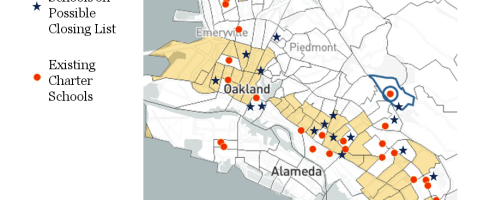
The map of charter schools in Oakland and proposed school closings shows that both are all in the minority dominated flats (the low lying area between the bay and the hills). With all of these closings, residents in the flats may no longer have a traditional public school serving their community.    

Much of this can be laid at the door step of the six billionaire “education reformers” living across the bay – Reed Hastings (Netflix), Arthur Rock (Intel), Carrie Walton Penner (Walmart), Laurene Powell Jobs (Apple), Mark Zuckerberg (Facebook) and Doris Fisher (The Gap).

Reed Hastings established America’s first charter management organization (CMO) in Oakland. There are now six Aspire charter schools serving Oakland families.

Arthur Rock, Doris Fisher and Carrie Walton Penner have been investing in Teach For America (TFA) and charter school growth in Oakland. Mark Zuckerberg and Laurene Powell Jobs have been pushing education technology as well as TFA and charter schools.

Along with these billionaires, New Yorker Michael Bloomberg and Tulsa billionaire Stacey Schusterman have joined in the spending to sway Oakland’s school board elections.

Oakland’s own T. Gary Rogers established a foundation before he died that continues to be central to the local school privatization agenda. It significantly supports and directs privatization efforts by GO public education and Education78. The City Fund created by Reed Hastings and John (Enron) Arnold recently gave GO and Education78 a total of $5 million (EIN 82-4938743).

This brief outline of the money being spent to privatize schools in Oakland would be woefully incomplete if Eli Broad was not mentioned. Although his direct spending to advance privatization in Oakland has been relatively modest, the four Superintendents and many administrative staff members that he trained and got placed in Oakland are central to OUSD being the most privatized district in California. A key training manual developed at the Broad Center was the School Closure Guide.”

“Black Hole Mike” Hutchinson observed,

“A lot of these policies were first tried out in Oakland. If you go back and look at the Eli Broad handbook on school closures, a lot of the source information that they used for that report is from Oakland.”

The billionaire spending has resulted in 39 charter schools operating in Oakland today. Nine were authorized by the county, one by the state of California and 29 by OUSD. Using data from the California Department of Education, it can be shown that 31% of the publicly supported k-12 students in Oakland attend privatized charter schools.

It is disturbing that 22 of the 39 schools have a student body made up by more than 90% Hispanic and Black students. Overall 67% of Oakland’s charter school children are Hispanic or Black but only 50% of the residents of Oakland are Hispanic or Black. The privatization agenda has driven school segregation in Oakland to new heights.

The other divisive agenda is gentrification. Ken Epstein is a longtime observer of OUSD and a bay area pundit. He observed,

“Many school advocates view these school closures as a land grab of public property by privatizers. Others see this is a way to force Black and Latino families out of Oakland, making education inaccessible for them by closing the schools in the neighborhoods where they live.”

If a well financed developer could gain control of the flats, the profit possibilities are immense. These concerns are further fed when OUSD board President Gary Yee tells a Skyline High School parent that the school should be closed because the property is too valuable to be used for public education.

Is Closing Schools in the Flats the Only Possible Solution?

In an email to board members, Jane Nylund an OUSD alum, a teacher and high school student parent with a long family history in Oakland stated,

“For 2018, I counted 14 positions at $200K+, including benefits. In 2020, OUSD had 47 admin positions at $200K+ including benefits (Transparent California). And in 2019, many of them got 10% raises, all inclusive, around $20-30K each. While it’s true that other large districts have a lot of admin, OUSD has one of highest paid administrations compared to the rest of the state, at 526% of the state average. It still has its consultants at 325% of the state average. Collectively, those salaries went from around $3M to $10.7M in two years.”

Based on the claims in the OUSD administrations school closing presentation, the salary increases Jane highlights total to a million dollars greater than the projected cost savings from the closures and those are disputed.

VanCedric Williams is a school board Director representing OUSD district-3. In a private email former OUSD teacher Steven Miller reported on a community meeting attended by Williams,

“VanCedrick Williams repeatedly pointed out that OUSD has not looked at any other possible solution than closing more schools. He also notes that there is no real plan, just a stampede to close more schools.”

The OUSD board believed they could afford to keep all their schools open in October. Then L. Karen Monroe from the Alameda County Office of Education threatened them. She is in a position to cause havoc in Oakland. That seems to have intimidated some board members who are now ready to ignore equity for residents of the flats. The case for mass school closings is not well founded. Rather, the evidence suggests market based ideology and gentrification are trumping justice.