Archive | October, 2021

Shady Dyslexia Agenda Accelerating

28 Oct

By Thomas Ultican 10/28/2021

An intricately connected network of organizations is controlling dyslexia discourse in the US and taking over dyslexia screening and remediation. Thirty-nine states now have adopted dyslexia laws. Most of these laws contain the International Dyslexia association’s (IDA) remediation recommendation of being “multisensory, systematic, and structured.” Researchers Jo Worthy et al state, “This approach is not well supported by research, but it is officially sanctioned through legislation in many states and has had a profound effect on policy and practice.”

IDA, the Academic Language Therapy Association (ALTA), and the International Multisensory Language Education Council (IMSLEC) are three big players. IMSLEC started as an IDA committee, and ALTA certifies dyslexia specialists in the multisensory language approach, which is consistent with IDA’s Knowledge and Practice standards for educators. IDA began certifying teachers in 2016, in addition to accrediting dyslexia teacher training programs. The websites of these organizations link to each other and to Decoding Dyslexia, a network of parent organizations with chapters in every state. The mission statements and lobbying materials used by all Decoding Dyslexia sites employ language from IMSLEC and IDA.

Using Parents and Students

Rachael Gabriel is Associate Professor of Literacy Education at the University of Connecticut. When large numbers of people showed up at legislative hearings in Connecticut, she became interested in their unusual engagement and strangely similar comments. Gabriel used critical discursive psychology, positioning theory, and narrative policy analysis to analyze the dyslexia law advocacy. She says, “I argue that this narrative can be understood as a conversion narrative, which drives a privatization agenda in which public schools become mandated consumers for a growing dyslexia industry, and in which the nature of instruction for students with reading difficulties is narrowly prescribed.”

Gabriel shares several extracts from the oral and written testimonies given at the legislative session on special education. The first extract is from a student who introduced himself as a 10-year-old who was “here to speak in support of Bill RHB 5562, An Act Concerning Special Education to get dyslexia recognized in the State of Connecticut.”

“I have dyslexia. Reading and math are really hard for me. I’ve had too many teachers that don’t understand how to teach me. Finally, this year I went to Lindamood Bell training and reading is getting easier.”

This is a typical message indicating public school teachers do not know how to teach students with dyslexia but finally he was saved. Interestingly the private company Lindamood Bell’s training credited with making it possible for him to read is not one of several private companies that qualify as IDA certified reading specialists. In fact they report that many of their clients have previously been failed by a certified company. The certified companies all use some version of the 1930’s Orton-Gillingham method whose phonics centered practice IDA calls “structured literacy.”

An important psychological motivator for parents of children struggling with learning to read is the repeated claim that dyslexia is a brain centered condition often associated with giftedness. Statements similar to the following extract from a written comment are common.

“This is a disability worth our investment of time It is the disability of Speilberg [sic], Einstein, and Steve Jobs . . . Honor us and embrace us. We are continually the great minds of every generation. We are the ‘game changers.’”

The idea that dyslexia is associated with other kinds of giftedness is a wives tale. Johnston and Scanlon from the University at Albany wrote in their 2020 research paper,

“Public narratives about dyslexia commonly claim that people classified as dyslexic have an array of special positive attributes such as intelligence or creativity – more so than those not so classified. There is virtually no scientific evidence for these claims.”

Although the parent organization Decoding Dyslexia (DD) does not have a centralized leadership, each of the state organizations shares information from DD and IDA. They uniformly call for:

  1. “A universal definition and understanding of “dyslexia” in the state education code.
  2. Mandatory teacher training on dyslexia, its warning signs and appropriate intervention strategies.
  3. Mandatory early screening tests for dyslexia.
  4. Mandatory dyslexia remediation programs, which can be accessed by both general and special education populations.
  5. Access to appropriate “assistive technologies” in the public school setting for students with dyslexia.”

Parents with babies who struggle with reading are vulnerable to manipulation. The widely distributed message that dyslexia is a sign of high intelligence must be appealing. These parents are informed that their public school teachers do not know how to teach dyslexics. They are assured that private companies certified by IDA can accurately screen for dyslexia and provide the kind of “structured literacy” that saves children from academic disaster. The result is that whenever laws instituting the Decoding Dyslexia agenda are proposed large numbers of parents show up in support.

What is Dyslexia? What are the Myths?

The idea of dyslexia has been around for more than 100-years, but there is still no widely agreed upon definition. That means there is no consensus method for screening for dyslexia. Johnston and Scanlon reported in 2020,

“The bottom line is that there are many definitions of, and theories about, dyslexia and simply no agreed-upon definition that allows schools, clinicians, researchers, or anyone else, to decide who is dyslexic in any valid or reliable way.

From an instructional standpoint, there is no practical distinction between those classified as dyslexic and others at the low end of the normal distribution of word reading ability in the early elementary grades.”

Variations of this statement are quite widely available. A 2020 article in Reading Research Quarterly by J. G. Elliot states,

“I argue in this article that despite a proliferation of scientific findings, our understanding of dyslexia is marked by serious weaknesses of conceptualization, definition, and operationalization that not only are unscientific but also lead to impoverished practice in schools, social inequity in understanding and provision for many struggling readers, and reduced life chances for millions of students worldwide.”

IDA and DD promote mandatory early screening for dyslexia but the commercially available tools they promote are not up to the task. A 2017 article by Vanderheyden et al noted,

“In education, it is not uncommon for error rates to range from 50%–60%, meaning if a school assesses 100 children for whom 20 are “true positives” (i.e., truly have dyslexia), then most of the 20 (approximately 16–18) will be identified, but 50 to 60 students will be identified as false positive errors in the process.”

IDA bases its recommendations for reading remediation on the “science of reading” (SOR). In 2000, the National Reading Panel report claimed that its recommended phonics based word decoding methods were based on science. This kicked off a phenomenon often referred to as the “Reading Wars.” In 2004, David Pearson from UC Berkley’s Graduate School of education commented about the raging war,

“For example, several scholars, in documenting the practices of highly effective, highly regarded teachers, found that these exemplary teachers employed a wide array of practices, some of which appear decidedly whole language in character (e.g., process writing, literature groups, and contextualized skills practice) and some of which appear remarkably skills oriented (explicit phonics lessons, sight word practice, and comprehension strategy instruction). Exemplary teachers appear to find an easier path to balance than either scholars or policy pundits.”

In other words, SOR is definitely not settled science. Which means the IDA’s “structured literacy” is not a consensus driven approach.

In 2016, the International Literacy Association asserted,

“Both  informal  and  professional  discussions  about  dyslexia   often   reflect   emotional,   conceptual,   and   economic   commitments,   and   they   are   often   not   well   informed by research. Our beliefs and practices should be  grounded  by  what  emerges  from  the  available  evidence  (Elliott  &  Grigorenko,  2014;  Vellutino,  1979;  Washburn,  Joshi,  & Binks-Cantrell, 2011)

As  yet,  there  is  no  certifiably  best  method  for  teaching  children  who  experience  reading  difficulty  (Mathes  et  al.,  2005).  For  instance,  research  does  not  support  the  common  belief  that   Orton-Gillingham–based   approaches   are   necessary   for   students classified as dyslexic.”

IDA and the research papers cited here claim that as much as 20% of kindergarten and first grade students have reading issues. However, if their school has a professional intervention approach – that could be any of the interventions discussed here – by the time students reach high school less that 2% still have reading issues. Is it possible that the high number of students with reading difficulties in America is because reading is taught at a developmentally inappropriate age? On international testing Finish students test extremely well in reading and they don’t formally teach reading there until age 7.

Conclusion

The IDA organization has many professionals in reading education and the point here is not that they are wrong about screening and intervention pedagogy. The point is that the agenda they are promoting is far from settled science. They should continue to promote their beliefs but they need to stop using a legal strategy backed by power politics to force schools into becoming mandated consumers.

America’s public schools are staffed with an enormous number of well trained and experienced reading instructors. Denigrating them is not justified and is bad for reading education.

The International Dyslexia Association and Decoding Dyslexia are no longer advocates for students and parents. They have become predators using legal strategies and political power to feed an expanding dyslexia industry.


Corporations Invade Delaware Public Schools

18 Oct

By Thomas Ultican 10/18/2021

A multifaceted corporate plan for control of Delaware public education is in progress. Billionaires are financing numerous edtech projects that isolate children at screens. To validate literacy curriculum the state has turned to the International Dyslexia Association and their nonsense “science of reading” standards. A key driver for the corporate takeover is the so called High Quality Instructional Materials (HQIM) certified as such by EdReports.

Whenever the words “high quality” are used to promote something in education, it is a good bet that swamp land is being sold.

A private email from a Delaware teacher stated the situation succinctly,

“Over the past several years, it has seemed like Delaware was going in the right direction after the nightmare of Gov. Jack Markell and the RTTT grant. There was suddenly more of a focus on the whole child, starting in October of 2018 when Gov. John Carney announced that our state would adopt trauma-informed practices. … Teachers were beginning to breathe a sigh of relief that maybe our state would begin to implement more reasonable education practices than the rigid, scripted, market-based programs we have seen. Then all of a sudden this summer, this stuff about HQIM started popping up from DDOE. Schools were written up in The 74. Videos were made with the Knowledge Matters group …. Professional development was announced with TNTP.”

Delaware has one of the oldest public education systems in America. The History of Public Education in Delaware dates back to the 1792 state constitution which called for the establishment of public education as soon as possible (History page 19). In 1796, a permanent fund for public education was established (History page 19). In the following graphic a plaque identifies the historic Clayton Stone School built in 1805 on land donated by John Dickinson the “Penman of the American Revolution.” This is the legacy being threatened by corporate raiders.

Corner Stones of the Corporatization Plan

There was concern that Delaware’s children were falling behind due to the COVID pandemic. Monica Gant, Ph.D. from the Delaware Department of Education (DDOE) presented their strategy to accelerate learning in March. (Accelerating learning is highly questionable learning strategy.) Grant pitched, 

“DDOE is excited to use ESSER II funds to provide all Delaware public schools with five resources to support learning acceleration for students in literacy and mathematics for summer 2021:

Literacy Professional Learning and core HQIM Summer Booster content for raising 1-6 graders

Student access to online text repository (all students)

Access to Zearn Math Summer Intensive Series for all rising 1-8 graders

Zearn Professional Learning

High-dosage tutoring seats for multiple grades”

Under the heading “Literacy Professional Learning,” Professor Grant noted, “Participants will have a chance to apply their learning of the Science of Reading either through their district HQIM or utilize free OER (Open Education Resources) HQIM for this work.” And she announced that teachers will have the following professional materials available.

  • “Free OER – Core Knowledge Language Arts (CKLA) and Expeditionary Learning (EL)
  • Summer Booster provided by SchoolKit and TNTP
  • Districts already using American Reading Company (ARC) – Summer Booster provided by American Reading Company
  • Districts already using Bookworms – Bookworms Booster provided by UD (PDCE)”

Let’s unpack this a little. First, what is this ESSER II fund the DDOE is so excited about? ESSER II – Passed on Dec. 27, 2020 as part of the Coronavirus Response and Relief Supplemental Appropriations Act. Delaware received $182,885,104.

HQIM stands for high quality instructional materials. Amplify is the edtech company controlled by billionaire Laurene Powell Jobs. On the Amplify website they explain the HQIM qualifier,

“States and districts across the country are focusing on materials that have been rigorously reviewed and deemed high-quality by EdReports.org, the leading third-party curriculum reviewer (or, in Louisiana, by a Tier 1 designation). EdReports defines high-quality instructional materials as materials that are closely aligned to rigorous standards and easy to use.”

Unfortunately, EdReports is a creation of edtech money plus libertarian focused foundations and other neoliberal supporters of privatizing public education. EdReports shares its major sources of finance:

“EdReports is funded by Broadcom Corporation, the Bill & Melinda Gates Foundation, Carnegie Corporation of New York, Charles and Lynn Schusterman Family Philanthropies, the Helmsley Charitable Trust, the William and Flora Hewlett Foundation, the Overdeck Family Foundation, the Samueli Foundation, the Charles and Helen Schwab Foundation, the Stuart Foundation, the Walton Family Foundation, and the Oak Foundation.”

EdReports is not an unbiased or even a knowledgeable arbiter of best curriculum or pedagogy practices. It is part of a scheme to advance corporate control over education content.

Free OER is more of the same. It provides free digital resources which are delivered on a tablet or computer screen. OER reports that their top supporters are the Leona M. and Harry B. Helmsley Charitable Trust, Bill & Melinda Gates Foundation, William and Flora Hewlett Foundation, Draper Richards Kaplan Foundation, Charles and Lynn Schusterman Family Philanthropies and The Robin Hood Foundation. These are not legitimate philanthropies. Rather they are organizations with a political agenda who intend to profit from or privatize or end public education.

Both CKLA which is an Amplify product and Expeditionary Learning (EL) mentioned in the plan provide scripted lessons to a screen. Nancy Bailey wrote a scathing critique of CKLA that seems to fit EL as well. In it she quotes an Oklahoma teacher giving CKLA the only positive spin she could,

“I wouldn’t want my children taught this way. I don’t know the rationale behind adopting it. The curriculum doesn’t light up the eyes of kids. It removes the autonomy from the teacher. I guess if people have come through an alternate route and don’t have a teaching degree, you can teach it without much experience.”

The DDOE has adopted a rigidly scripted market-based program called “Bookworms” for K-5 literacy. It was developed locally by University of Delaware professor Sharon Walpole. However, this is another digital product that undermines teacher professionalism and is also part of OER’s national offerings.

The newer product being foisted on Delaware schools is Zearn. It is another digital learning platform similar to i-Ready and Amplify. Bill Gates (Foundation Tax Id: 56-2618866) and the New Schools Venture Fund (Foundation Tax Id: 94-3281780) are spending heavily to make this company founded in 2014 a success. Between 2016 and 2019 Gates gifted them more than $7,000,000.

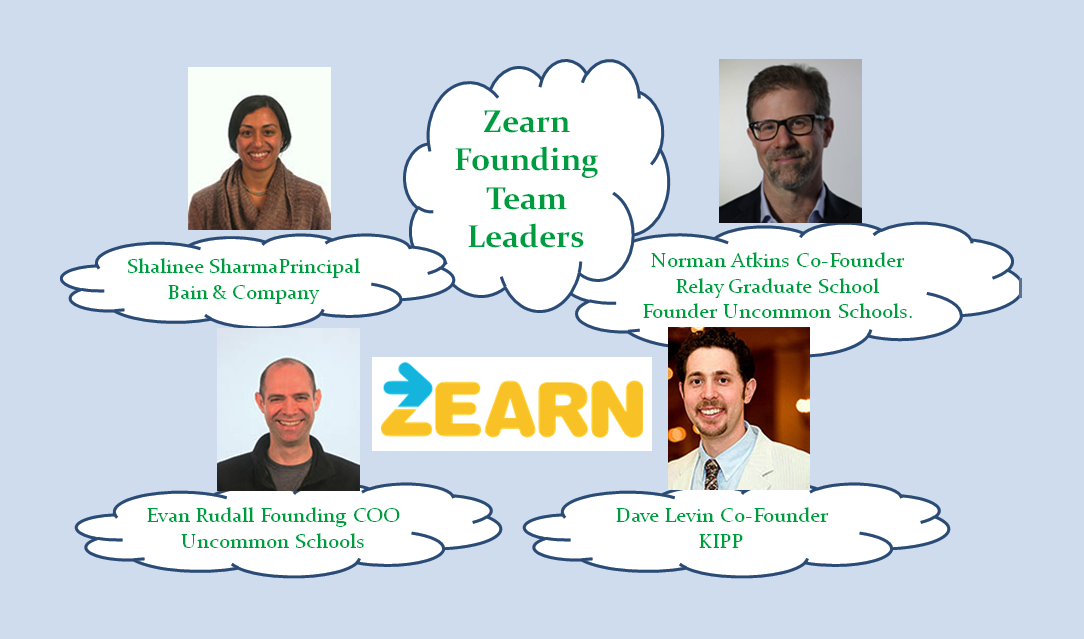
Of the 16 leaders listed on Zearn’s first year (2014) web-site, five of them came from Mit Romney’s Bain & Company including Shalinee Sharma who still leads Zearn. Two of them were from Wireless Generation which eventually became Amplify which endured some spectacular failures.  

It is difficult to find independent research that evaluates Zearn. Though it is designed to maximize test scores, the only academic study found (from Johns Hopkins University) showed that Zearn treatment students did not outperform other public school students on standardized testing. However, since those tests are basically useless, that result does not mean much.

Zearn claims to be engaging for students and that students like the product. However, on an independent review site, students are brutal in their condemnation of Zearn with comments like, “I am in fifth grade and the thing has me doing stuff, my baby brother could do!” Worst of all, it is not healthy to put children at screens for long periods of time.

Propaganda Versus Reason

The Delaware teacher quoted above mentioned articles produced by Knowledge Matters about local schools appearing in The 74. Funders for The 74 include the Walton Family, Bill & Melinda Gates, the Emerson Collective (Laurene Powell Jobs), the Joyce Foundation, and Michael Bloomberg. So it was an easy lift for Knowledge Matters to place their articles touting corporate created literacy materials. This is all part of a billionaire funded anti-public education publishing cabal.

Knowledge Matters is hardly a fair unbiased commentator. Their steering committee includes Chester E. Finn, Thomas B. Fordham Institute; Kaya Henderson former Chancellor of the District of Columbia Public Schools; Joel Klein former Chancellor of the New York City Department of Education and David Steiner former New York State Commissioner of Education. All of these people have done damage to public education.

To guide the Delaware public schools’ literacy program, the DDOE has turned to The International Dyslexia Association (IDA) – who advocates the “science of reading” – to validate Delaware’s programs. The National Education Policy Center warned against, “Misrepresenting the ‘science of reading’ as settled science that purportedly prescribes systematic intensive phonics for all students.” And they stated that policy makers, “Should support the professionalism of K-12 teachers and teacher educators, and should acknowledge the teacher as the reading expert in the care of unique populations of students.” IDA is more about selling testing and promoting corporate created scripted literacy lessons than it is about helping students learn.

No teacher should be condemned to professional development from TNTP. This spinoff from Teach for America (TFA) is unqualified because of weak education scholarship and limited experience. Almost every Delaware school district has a more experienced and professional team than TNTP can provide. Without the huge funding they received from billionaires, TNTP would have never survived into the 21st century. TNTP is famous for writing papers that are not peer reviewed and often contravene evidence. Their papers do support the agenda of the billionaires funding them.

For more than 200 years, Delaware has been developing a world class education system. The districts and schools in the state are staffed by genuinely well trained and experienced staff. Instead of turning to TFA teachers who have little experience and less training for leadership in pedagogy, turn to your existing education professionals. Turn away from hubris and greed. Instead of buying scripted lessons that kill creativity in both teachers and students, let your high quality professional educators do their job.

Machine Teaching Requires Behaviorist Approach

8 Oct

By Thomas Ultican 10/8/2021

The controversial Harvard psychology professor B. F. Skinner (the B. F. stands for Burrhus Frederic) taught pigeons to play ping pong, created a box for tending babies more efficiently called an air crib and became the national mouthpiece for behaviorism. His predecessor in behaviorist theory was Columbia University Psychology Professor Edward Thorndike. In 1898, Thorndike published the law of effect which posited that responses which produce a satisfying effect are more likely to occur again and responses that produce a discomforting effect become less likely to repeat. Skinner developed an enhancement of this learning theory that he called operant conditioning.

Operant conditioning, sometimes referred to as instrumental conditioning, is a method of learning that occurs through rewards and punishments. Skinner believed he could create a machine that would reward students as soon as they got a correct answer and send them for more instruction if they missed an answer. By using “programmed instruction” which broke learning into small chunks, Skinner claimed students would be able to interface with his machines and at a “personalized” rate learn more deeply and efficiently.

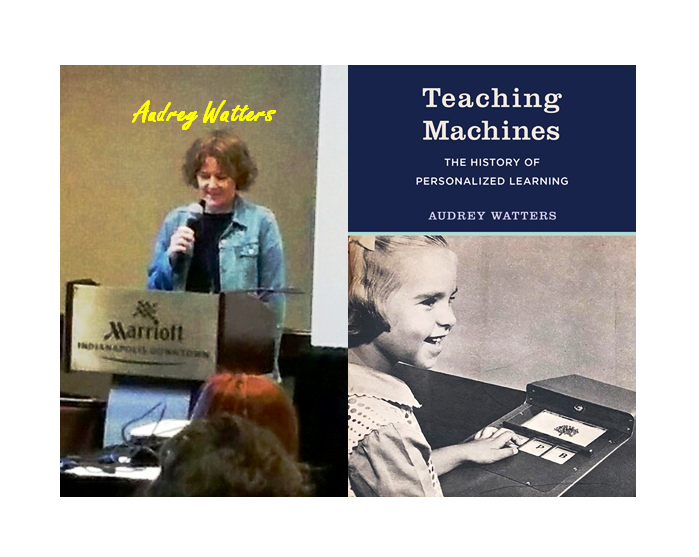
The story of these machines and their promises of enhanced learning is chronicled by the amazing Audrey Watters. She has added significantly to the history of mechanized teaching, the philosophical basis supporting it and how it relates to the modern computerized version. Her new book, Teaching Machines: The History of Personalized Learning published by MIT press is wonderfully sourced. In it, Watters states,

“What today’s technology-oriented education reformers claim is a new idea – ‘personalize learning’ – that was unattainable if not unimaginable until recent advances in computing and data analysis has actually been the goal of technology-oriented education reformers for almost a century. Education psychologists like Sidney Pressey, the person often credited with inventing the first ‘teaching machine,’ talked about using mechanical devices in the 1920s in ways almost identical to those who push for personalized learning today. All so that, as Pressey put it, a teacher could focus on her ‘real function’ in the classroom: ‘inspirational and thought-stimulating activities,’ including giving each student individualized attention.” (Teaching Machines page 9)

Audrey Watters has been writing about technology in education for most of the 21st century. She published The Curse of the Monsters of Education Technology in 2016 and based on the research for that book, she made these remarks to a class at MIT.

“I don’t believe we live in a world in which technology is changing faster than it’s ever changed before. I don’t believe we live in a world where people adopt new technologies more rapidly than they’ve done so in the past. … But I do believe we live in an age where technology companies are some of the most powerful corporations in the world, where they are a major influence – and not necessarily in a positive way – on democracy and democratic institutions. (School is one of those institutions. Ideally.) These companies, along with the PR that supports them, sell us products for the future and just as importantly weave stories about the future.”

Will Teaching Machines Replace Teachers?

In 1954, Skinner was provided space at Harvard where he assembled a team of “bright young behaviorists” including Susan Meyer (Markle). They “started work on designing their new teaching machines as well as ‘programs,’ the material that would accompany them.” (Teaching Machines page 135) This led to “programmed instruction.” Watters explained,

“Programmed instruction was individualized instruction. Meyer Markle likened it to the work of a tutor, ‘a master of intellectual teasing’ who adjusts the lesson to her student’s needs but also challenges the student to keep moving forward. … ‘Each student was now to have his own private tutor, encased in a small box.’” (Teaching Machines pages 138 and 139)

According to Watters, Meyer Markle was the most significant contributor to the development of programmed instruction but in the 1950s women like her were professionally undermined and men were normally credited instead. Watters identifies Norman Crowder as the most likely to be credited with innovations in programmed instruction instead of Meyer Markle.

In 1958, Doubleday started publishing Crowder’s series of self-instruction manuals – “TutorTexts.” An ad in Popular Science said TutorText was “a complete programmed teaching machine in book form.” (Teaching Machines pages 139 and 140)

In 1959, Crowder claimed, “Automatic tutoring by intrinsic programming is an individually used, instructorless model of teaching which represents an automation of the classical process of individual tutor.” Watters notes, “While Skinner and Pressey were quick to insist that their teaching machines would not replace teachers, Crowder clearly felt less obligated to do so.” (Teaching Machines page 142)

Many people were giddy about the possibility of replacing teachers with these marvelous new machines. The machines were believed to be creating new markets while improving education. Caution was thrown to the wind. Pressey wrote,

“I was shocked at what followed: the most extraordinary commercialization of a new idea in American education history -…. Then millions of research dollars went into, first, the confident elaboration of these ideas and only slowly into any questioning of them.” (Teaching Machines page 148)

The same greed blinded path has been followed by the promoters of digital education. They continue to over-promise while hyping untested behaviorist based learning at a screen. It is more mindless implementation without questioning.

“Banking model of education”

In Teaching Machines, Watters illuminates the history of promoters like Skinner completely forgetting scholarly caution and diving headlong into achieving lucrative manufacturing deals with corporations like IBM, Rheem and Harcourt Brace. At the same time, door to door encyclopedia salesmen began selling books by Crowder and others that implemented programmed instruction. The parallels with today become obvious.

There is a big difference from the teaching machine era (1928-1980) and today. Then, large technology corporations were not nearly as powerful which meant voices of education professionals started to be heard and the mania subsided.

The Brazilian educator Paulo Freire famous for being jailed by the 1964 Brazilian coup leaders called machine learning the “banking model of education, in which the scope of action allowed to the students extends only as far as receiving, filing and storing the deposits.”  He contrasted that with “problem posing education,” which is a dialogue between teachers and students in which knowledge is jointly constructed. (Teaching Machines page 226)  

Even the father of teaching machines, Sydney Pressey soured on behaviorism. Drawing on the work of Swiss psychologist Jean Piaget, “Pressey challenged behaviorism for failing to adequately account for the developmental stages children pass through – and pass through without ‘so crude and rote process as the accretion of bit learning stuck on by reinforcements.”  He felt the teaching machine movement faced a crisis because of behaviorism. (Teaching Machines page 234)

Noam Chomsky reviewed Skinner’s book Beyond Freedom and Dignity for the New York Review of Books in 1971. In his article “The Case Against B. F. Skinner” he wrote, “Skinner’s science of human behavior, being quite vacuous, is as congenial to the libertarian as to the fascist.” (Teaching Machines pages 239 and 240)

This is just a short taste of the content of Teaching Machines. It is a special book by a special writer.