By Thomas Ultican 9/24/2021
Educating children is expensive. Wealthy people like Charles Koch do not mind paying to educate their own children but they detest the idea of being taxed to pay for educating other people’s children. In the dystopian market driven system libertarians such as Koch espouse, people should only receive what they pay for. They believe almost all government programs should be ended including Medicare, Medicaid, Social Security, the FAA, the EPA, the Department of Energy, the FDA, The Consumer Product Safety Commission and more. Libertarians contend that mail, schools and roads should be privatized plus personal and corporate taxes should be abolished (Kochland Pages 113 and 114).
Toward achieving their ends, Koch, Gates, the Walton family and scores of wealthy elites have been building an infrastructure to take over and privatize the public school system. By twisting the laws concerning tax free philanthropic organizations, wealthy moguls are funneling huge sums of money into creating privatized schools; thus eliminating local control by elected school boards. All the while, they illegitimately write off most of their spending to promote public school privatization as charitable giving.
In addition to spending to privatize schools, a key strategy employed to advance their market based agenda is the creation of alternate teacher professional development and certification. It is another new privatized system under their control and not influenced by university based programs or education scholars.
The third leg of their attack on public education is political spending to take over elected school boards and influence legislatures.

The New Schools Venture Fund (NSVF) and Teach for America (TFA) support all three of the ending public schools privatization pillars.
The article “Organized to Disrupt” gives many details about the founding, purpose and lavish financing for NSVF. A former CEO of NSVF, Ted Mitchell, was also simultaneously President of the California State Board of Education. He left NSVF to become Under Secretary of the United States Department of Education. NSVF is generating more than $100,000,000 yearly income which it uses to invest in edtech start ups, charter schools and political organizing.
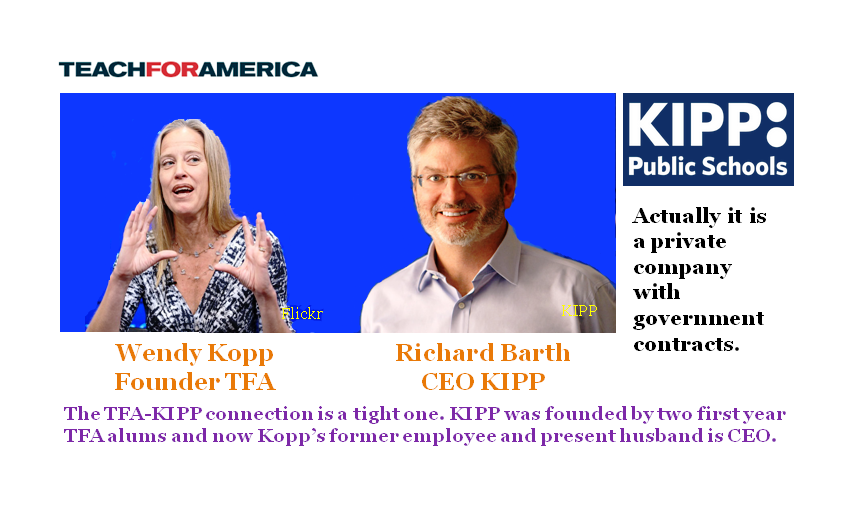
The TFA story is well known. The post “TFA is Bad for America” gives some details about how through huge financing, TFA is providing its billionaire funders with a privatization army of youthful college graduates looking for a career. These temp teachers – 80% of whom are gone in three years – have no business in a classroom. Real teachers go through a rigorous college teaching curriculum and a year of student-teaching under the supervision of a master teacher. TFA teachers get no teaching curriculum and five weeks of teacher training in the summer.
These unqualified TFA teachers have become the backbone of the teaching core for no-excuses charter schools. They embrace market based reform as a mechanism for reforming schools (Scripting Page 173) and within two to three years after they leave the classroom, their TFA connections put them in good position to became district, state or federal education leaders. TFA also offers political help for corps members to run for school board positions through its associated Leadership for Education Equity (LEE) non-profit. The LEE board of trustees consists of Emma Bloomberg (Michael Bloomberg’s daughter); Steuart Walton (billionaire); Arthur Rock (billionaire) and Elisa Villanueva Beard (TFA-CEO).
Training Educators
Teacher fellowships are used to influence teacher training and develop neoliberal attitudes. The late Eli Broad created the Broad Fellowships which trained school leaders how to close schools, in the benefit of enabling privatized schools and about the superiority of a market based approach. Before he died, Broad transferred the program and monetary support for it to Yale University.
In Oakland, California, the billionaire funded school privatization group GO Public Schools offers teacher fellowships of $3500 for their two year program. In Indianapolis, the $15 billion Lilly Endowment runs a 100 teacher yearly $12,000 fellowship program.
Two early problems slowing school privatization efforts were that teachers were both opposed to it and were respected by their communities. The fellowships described above are just three examples out of the many funded by extremely wealthy people to shape young teacher attitudes. It is not an accident that few of these fellowship programs are run by education professionals or scholars.
In 1997, the founder of TFA, Wendy Kopp, started The New Teachers Project (TNTP) to provide professional development services. She chose Michelle Rhee to be its founding director. This organization designed to train teachers was founded by a person that has never taught and was led by an untrained teacher that had two years experience as a TFA temp teacher. Even though a reasonable school administrator would never contract with an obviously incompetent group such as TNTP, it has flourished due to a continuous influx of billionaire dollars and powerful political connections.
Besides helping to shape teacher attitudes, founding director Rhee was one of the loudest voices in America claiming teachers were incompetent and low IQ.
Today, TNTP has a new initiative called PLUS to train principals. PLUS has clients in Camden, Kansas City, New York, Philadelphia and San Francisco. Billionaire spending is the reason school districts turn their back on established administrative programs at local universities for this unqualified group. In Kansas City, three billion-dollar foundations, Kaufman, Hall and Walton, are funding the PLUS program.
Relay Graduate School of Education is a private stand alone graduate school created and led by people with meager academic credentials. It was founded by officials from the no-excuses charter school industry and lavishly financed by billionaires. This completely bogus graduate school was certified after New York’s billionaire Chancellor of Education, Merryl H. Tisch, tapped David Steiner to be Commissioner of Education. Steiner, who is closely aligned with Jeb Bush’s Chiefs for Change, officially certified Relay. He was also a founding board member and still serves on the Relay board.
Control School Boards
School boards are being controlled in several ways. One obvious way, was covered in the article “School Board Elections 2020: The Good, The Bad and The Ugly.” It tells the story of a small group of super wealthy individuals spending to put their preferred candidates on school boards in Los Angeles, Oakland and Indianapolis. In California, this group also contributed to almost every senate and assembly race.
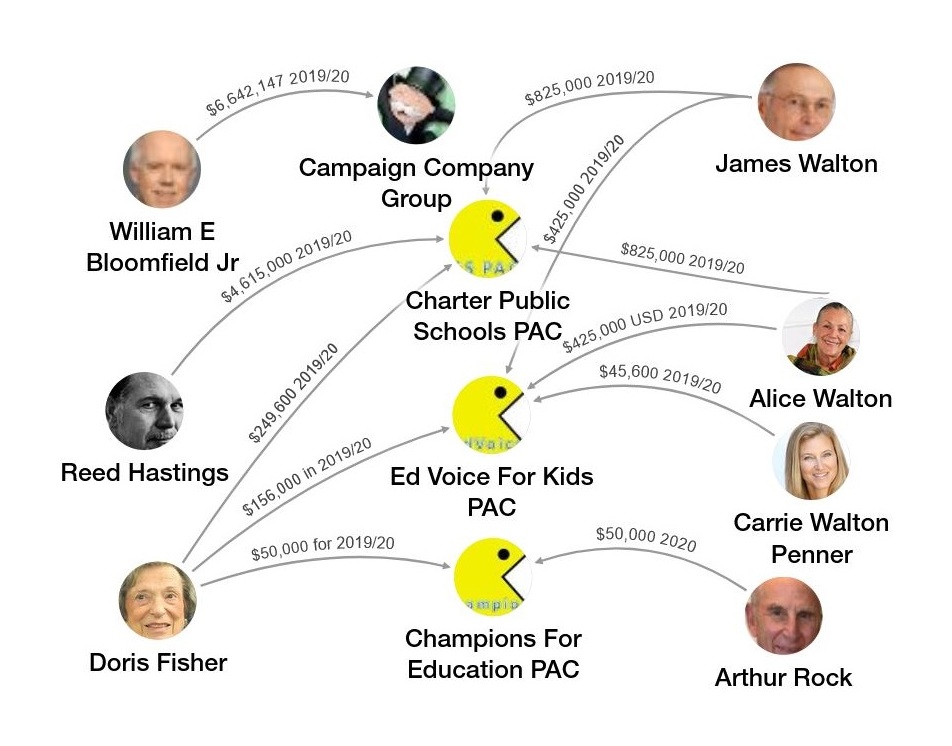
Billionaire Spending in the 2020 LA School Board Election
More than money is required to politically control local school boards. The Mind Trust in Indianapolis became an example of developing a local political group working on education issues along with spending by local plutocrats. This method has led to the public school system there being the second most privatized system in America; second only to New Orleans.
In 2018, billionaires Jon Arnold and Reed Hastings claimed to be investing $100 million each to establish a new anti-public school non-profit they called The City Fund. Since then several billionaires including Bill Gates and Michael Dell have started contributing to the fund. To advance their privatization agenda, The City Fund is spending significant amounts developing local political organizations. The following are examples.
Saint Louis – The Opportunity Trust: In 2018, a former TFA corps member and TFA employee for 14 years, Eric Scroggins, founded The Opportunity Trust. That same year The City Fund gifted it $5.5 million.
San Antonio – City Education Partners: Listed as being for community engagement efforts including the development and launch of San Antonio School Finder and correlated operations support. $4.98 million
Oakland – Educate78: Cited as a continuation of support previously provided by The Hastings Fund for work to improve public education including the expansion of high quality schools and support for the development of diverse teacher pipelines. $4.25 million
Memphis – Memphis Education Fund: Noted as support for operational budget and community engagement effort. $5 million
Newark – New Jersey Children’s Foundation: Stated as support for the launch of the new organization and ongoing operating budget support. $5.325 million
Baton Rouge – New Schools for Baton Rouge: Cited as support for expansion and launch of high quality nonprofit schools in Baton Rouge. $13,487,500
New Orleans – New Schools for New Orleans: Listed as support for the expansion of high quality schools and training for school leaders. $7,750,000
Oakland – Oakland Reach: Cited as operating budget support for ongoing parent and community engagement. $500,000
Atlanta – RedefinEd: Noted as operations support and support for work to empower communities, build teacher and leadership development pipelines, and expand high quality schools. $2,750,000
Denver – RootED (formerly Blue Schools): Listed as operating budget support and support for expansion of high quality schools. $21,000,000
Oakland and Stockton – Silicon Schools Fund: Cited as support for expansion of innovative public school models. $1,566,666
Indianapolis – The Mind Trust: Noted as operating support and support for expansion of high quality schools. $18,000,000
Privatizing Schools
Several billionaires have been spending large amounts of money for three decades to advance the growth of charter schools in America. Today, fortunately, they are seeing some resistance to the non-stop expansion. As Network for Public Education Director Carol Burris noted,
“Everything changed when DeVos was in charge. Progressives and moderates started to see that charter schools were really a ‘gateway drug’ for the libertarian right, a means to further the destruction of public education.”
However, with the Supreme Court destroying the separation between church and state, private schools have been growing rapidly in states with voucher programs. Almost all of these private schools are religious schools.
The economist Milton Friedman is one of the godfathers of the current movement to end public education. Duke University’s noted historian and the author of Democracy in Chains, Nancy MacLean, shared the following quotes from Friedman. They leave no doubt about the true purpose of the choice movement in the mind of one of its creators. The first comes from 2004 and the second is from a 2006 speech at a meeting of the American Legislative Exchange Council (ALEC).
“In my ideal world, government would not be responsible for providing education any more than it is for providing food and clothing.”
“The ideal way would be to abolish the public school system and eliminate all the taxes that pay for it.”

 tultican
Recent Comments