Archive | July, 2021

Embarrassing Paper from the University of Arkansas

27 Jul

By Thomas Ultican 7/27/2021

Masquerading as a serious education research paper, Making it Count: The Productivity of Public Charter Schools in Seven U.S. Citiesis little more than a flawed propaganda screed. The authors from the University of Arkansas College of Education and Health Professions claim the superiority of “public charter” schools over traditional public schools (TPS) by employing thoroughly discredited methods. They repeat the same data manipulation malfeasance that has been debunked multiple times over the past decade.

The paper was produced by the School Choice Demonstration Project which resides within the Department of Education Reform. That department was established by the University Arkansas’s College of Education and Health Professions in 2005. Arizona State Professor Eugene Glass commented that the department is, “one of the strangest I have ever seen.” Glass reports that the Department of Education Reform was made possible by a $10 million dollar gift from the Walton Family Foundation plus another $10 million from the University of Arkansas’s matching gift program.

Subsequent to the big 2005 grant, Walton Family Foundation tax records (EIN: 13-3441466) reveal more than $30 million in grants to the University of Arkansas Foundation and school administration.

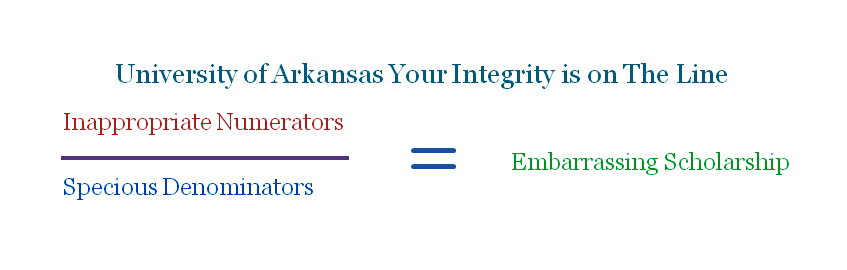
Inappropriate Numerators and Specious Denominators

The people at the School Choice Demonstration Project insist on using “public charter school” and “traditional public schools” to differentiate between charter schools and public schools. Charter schools are private companies that have a government license to provide schooling. Public schools are controlled by elected public representatives and must accept all students. Charter schools are not required to meet all public school rules of operation. Referring to charter schools as “public charter schools” and public schools as “traditional public schools” reveals a strong bias.

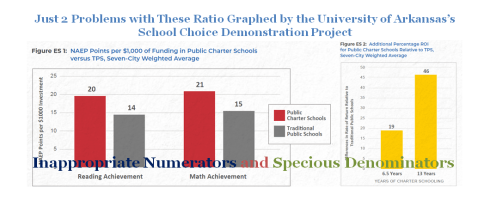
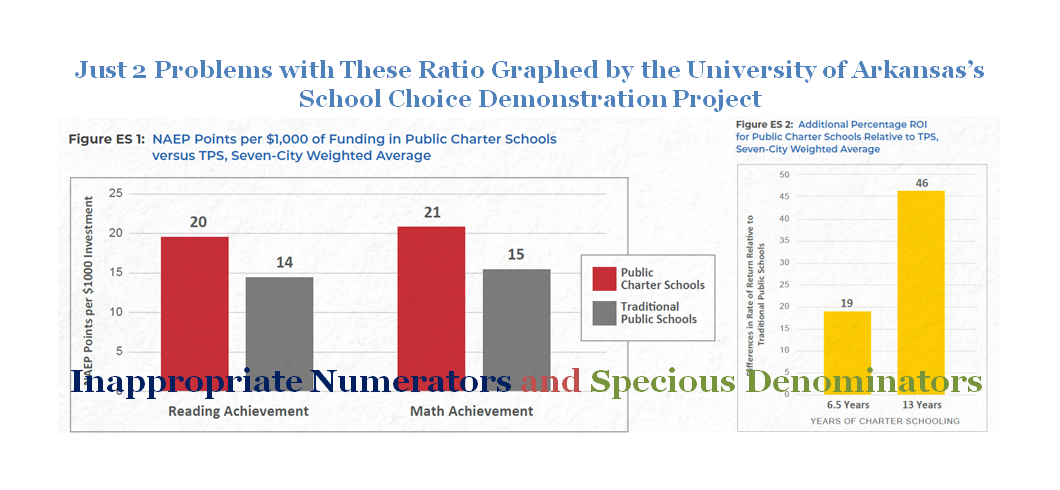
The authors attempt to compare testing results per $1,000 dollar funding between charter and public schools. They use manipulated National Assessment of Education Performance (NAEP) data. Another Walton Family creation, the Center for Research on Education Outcomes (CREDO) at Stanford University, used a “virtual twin” scheme to create the comparison data employed.

Business writer Andrea Gabor states that CREDO studies which compare charter schools with public schools start with two key assumptions “A) That standardized-test scores are an adequate measure of school quality and B) that creaming in charter schools does not exist.” Many studies dating back to the eugenics movement debunk standardized-testing for mistaking correlation versus causation and for not being able to compensate for the problem of error. A glance at state enrollment records confirms that charter schools practice creaming.

The CREDO method does not compare charter school test performance to actual public schools; rather it creates mathematical simulations. They use arithmetic magic to create the “virtual twin” schema that stands in for a public school students. This method introduces several biases that advantage charter schools.

The “Making it Count” paper gets its “inappropriate numerators” from CREDO. It is also where they get the theory for their wild claim that “public charter schools in our sample would produce $487,177 more in lifetime earnings than the TPS.”

The denominators in the paper’s calculations are based on school spending per student. The data used comes from a 2020 paper also produced by mostly the same authors; Charter School Funding:  Inequity Surges in the Cities. In this update of a previous report on the 2013-14 school year, they state, “Our most recent report updated that analysis by drawing upon data from the 15 metropolitan areas for the 2015-16 school year.” In other words, no methodology changes just an update.

One of America’s leading authorities on education finance, Rutgers University’s Bruce Baker, reviewed the 2013-14 report for the National Education Policy Center. In the introduction, Professor Baker wrote,

“A district’s expenditure can be a charter’s revenue, since charter funding is in most states and districts received by pass-through from district funding, and districts often retain responsibility for direct provision of services to charter  school students—a reality that the report entirely ignores when applying its resource-comparison framework. In addition, the report suffers from alarmingly vague documentation regarding data sources and methodologies, and it constructs entirely inappropriate comparisons of student population characteristics. Simply put, the findings and conclusions of the study are not valid or useful.” (Emphasis added)

Professor Baker noted that the report’s authors knew about their errors because “these issues have been extensively explored for decades and are fundamental and long-accepted components of virtually every state’s finance system.” He also pointed out that he and other critics have previously highlighted these flaws in papers produced by the same authors. This was the genesis of the “specious denominators.”

Baker addressed using the paper’s data for return on Investment claims,

“In only a handful of states are the majority of charter schools ostensibly fully fiscally independent of local public districts. This core problem invalidates all findings and conclusions of the study, and if left unaddressed would invalidate any subsequent ‘return on investment’ comparisons.

The Authors

Corey A. DeAngelis is the national director of research at the American Federation for Children (DeVos), the executive director at the Educational Freedom Institute (Friedman), an adjunct scholar at Cato Institute (Koch), and a senior fellow at Reason Foundation. He was named on the Forbes 30 Under 30 list for his work on education policy and received the Buckley Award from America’s Future in 2020.

Patrick J. Wolf is principal investigator of the School Choice Demonstration Project where he has led or is leading major studies of school choice initiatives including longitudinal evaluations of school voucher programs in Washington, DC; Milwaukee, WI; and the state of Louisiana.

Cassidy Syftestad is a Doctoral Academy Fellow, Department of Education Reform at the University of Arkansas. Her previous experience includes working at the Koch Institute, the Heritage Foundation, the Heartland Institute and Hillsdale College.

Larry D. Maloney is president of Aspire Consulting.

Jay F. May is founder of and senior consultant for EduAnalytics.

OUSD, the Digital Divide and Edtech – Be careful what you wish for

24 Jul

By  Steven Miller, July 22, 2021 (Guest Post by former Oakland Educator)

In 2018, Thomas Ultican wrote about the dangers of Edtech:

“Public education in America contends with four dissimilar but not separate attacks. The school choice movement is motivated by people who want government supported religious schools, others who want segregated schools and still others who want to profit from school management and the related real estate deals. The fourth big threat is from the technology industry which uses their wealth and lobbying power to not only force their products into the classroom, but to mandate “best practices” for teaching. These four streams of attack are synergistic.”

Edtech is now far more predominant everywhere today, after 2 COVID school years, which has resulted in the massive imposition of distance-learning.

Back in 2018, Education Week Research Center reported that a strong majority of the country’s principals  – 85% of those interviewed –  felt that too much screen time was not good for students – 77% felt students worked alone too often and 67% felt the tech industry had too much influence over public education.  And now Edtech is being established as the savior of our children.

That was then; this is now.

We all know, teachers, students, parents, communities – all the primary stake-holders – we all know that the new school year presents us with some of the greatest challenges we have ever faced in public education. Re-opening is a crisis and an emergency. So what is Edtech bringing to OUSD? Is it helping?

The education reporter for The Oaklandside, Ashley McBride, wrote on July 20, 2021:

“More than a year ago, the city of Oakland together with Oakland Unified School District and a group of nonprofit partners launched the Oakland Undivided campaign with an ambitious goal: to close the digital divide by raising enough money to purchase laptops and internet hotspots for every student in Oakland who needed them during the pandemic. At the time, public school students were required to learn from home virtually, but roughly 25,000 of them in Oakland lacked a computer, reliable internet, or both….”

“Today, as students prepare to head back to their classrooms full-time in the fall, nearly 97% of students in Oakland Unified School District have a computer and working internet at home, including 98% of students who are low-income, according to district data.”

Sounds like a good thing, a really good thing. The problem with Edtech, however, is not the digital technology. Technology is a tool that can be used well or turned against us. Technology can actually be employed to make schools better, not cheaper. The issue is how it is configured. As always, we must follow the money trail to really discover who benefits.

While OUSD is currently planning on fully re-opening, distance learning is an option. It will certainly be more pervasive in the classroom. Edtech makes its money off harvesting student data. Who will own the data this coming year, 2021-22?  Who can use the data? Do students or their parents control their own data?

The School Board must play a leading role in guaranteeing public policy here.

Chrome books store every single key stroke (and possibly every eye movement) on the cloud, which they own. Google Chromebooks also have a pre-installed program called “Gaggle”, which, we are told, scans student homework to look for depression, suicide ideation and likely various threats to shoot up the school. Google Classroom material is configured to surveille the students. Data and ever more data is the mother’s milk of Edtech. 

One problem is the people who control the data harvested from Edtech algorithms have increasing influence in creating the curriculum. This new private power in public schools is routinely used to undercut the role of experienced teachers and call the shots.

Whether corporations or big-shot administrators, the people who control this power love to spout about “healing the digital divide”. This is the corporate happy-speak that the OUSD school board, as well as their “private partners” and NGOs, traditionally have used to dress up policies that are demonstrated to work against student learning. But “healing the digital divide” with chrome books turns our children’s information into fodder for corporate profits.

Another favorite is “personalized learning”, supposedly something that Edtech will make available to every student and bring public education into the 21st Century. This myth is based on the same type of algorithms that Netflix and Amazon use to “personalize” their services to your interests. The biggest backers of personalized learning are Bill Gates, Google and the Chan- Zuckerberg Initiative.  As noted by blogger Peter Greene:

“Personalized learning, whether we’re talking about a tailored-for-you learning program on your computer screen or a choose the school you’d like to go to with your voucher, is not about actual personalization. It’s about another path for marketing, a way of personalizing the marketing of the product, the edu-commodity that someone is already trying to make money from.

“We’re being sold (and in many cases are arguing against) an AI that spits out just the digitized worksheet that Student 12-5452 needs to continue studies, but that’s not where we’re headed. Look, for instance, at the new, improved PSAT
that returns both a score and some recommendations. ‘Looks like you need to log in to Khan Academy’s lesson series for calculus.’ Or ‘You would really benefit from the AP Calculus course– talk to your guidance counselor today.”’

On March 21, 2021, OUSD signed an agreement to replace diagnostic testing from the Smarter Balanced Assessment Consortium with the notorious I-Ready. One of the funders of i-Ready is the Kenneth Rainnin Foundation, which also funds local Oakland privatizers like GO Public Schools, the Oakland Public Education Fund, the New Schools Venture Fund, Aspire charter schools, Educate 78 Oakland Public Schools, the East Bay Community Foundation, and Education for Change.

I-Ready is based in the techniques of behavioral modification that was fundamental to the highly discredited system of Competency Based Education that holds that children should learn alone and in isolation, taking constant tests to prove their “mastery”.

This reactionary and unproductive philosophy is also disguised as “performance-based education”, “standards-based education”, “outcome-based education”, and “programmed instruction” among others. I-Ready is Competency Based Education on a screen.

Funny thing, i-Ready regularly identifies Black, Indigenous, and students of color as failing. If the goal is to prove that Oakland children are “failing”, then i-Ready is the tool to use. But maybe it is not best to welcome students back and then give them standardized tests to measure how far behind they have fallen.

 Keeanga-Yamahtta Taylor wrote:

“The dystopian imagery of a ‘lost generation’ of Black youth is redolent of earlier moral panics: the discoveries of ‘crack babies’ in the nineteen-eighties and ‘super predators’ in the nineties were also rooted in anecdote-driven, pseudo-scientific evidence. Today’s evidence for the spiral of Black children is the tactically vague measurement of ‘learning loss.’ But no one needs to invent a new metric to discover that, during the worst crisis in modern American history, students might be falling behind.”

Ashley McBride describes another facet of Edtech coming to Oakland:

“The Oakland Reach, a parent advocacy group involved with the Oakland Undivided campaign, has been working with Sydewayz Cafe, an information technology business in Oakland, to provide tech support for the organization’s virtual family hub during the pandemic. In the fall, The Oakland Reach plans to launch a fellowship to give students and their families more intensive training in technology and digital platforms, said executive director Lakisha Young. They’ve also been helping families get a federal discount on broadband service.”

Here we have another private power with powerful influence in OUSD. Oakland Reach and the OUSD, in partnership, received a $900,000 grant from the notorious privatizers, the Center on Reinventing Public Education (CRPE) and The New Teacher Project, which supposedly trains teachers, but which pushes privatization. These organizations are part of a complex of billionaire-financed privatization networks like Teach For America, too many to name.

CRPE advocates that school boards should look at schools like a stock portfolio, get rid of the poor performers and invest in the successful stocks. When New Orleans privatized every single school as charters, CRPE came up with “the Blueprint Process”. OUSD used the Blueprint Process to justify closing 23 schools in 2018.

The OUSD School Board, in its grace and wisdom, still intends to close schools as the 2021-2022 school year begins. How many? The Board will announce its plan for school closures on August 16, one week after school begins. “Nothing says ‘Welcome back to school for a restorative restart’ than to tell schools filled with Black and brown students that we’re going to close your school or change your school because you’re not doing well,” said parent Kim Davis during a public comment portion of the meeting.

CRPE has developed a national network called “Education Cities” with the purpose of disrupting public schools. This corporate mob operates in 32 different cities across the country including Oakland, Cincinnati and Atlanta.

From Atlanta to Cincinnati to Oakland, a loosely connected network of nonprofit groups is working to reshape the way their school districts function. Their national scope has gone mostly unexamined, even as their influence is arguably far more likely to affect schools in the average American city than a Betsy DeVos-inspired voucher program.

CRPE also advocates to abolish the political control of public schools by elected school boards. They would be replaced by “Community Education Councils (CECs)”, which would exert “light local governance”. In addition, CRPE advocates for vouchers, what they call “backpack funding”:

A local CEC would have three essential functions: (1) assembling and disbursing funds for each student’s personal education fund; (2) monitoring the quality, innovativeness, and responsiveness to economic change of the learning options available to students; and (3) protecting students by ensuring valid information for choices among diverse learning experiences, monitoring equity of student placements, and identifying fraudulent or ineffective schools or learning providers.

Their essay on funding also discusses students’ personalized education funds, including so-called “back pack funding” that follows students through different learning experiences, and how they can be assembled and managed. The remainder of this essay focuses on the promotive and protective functions of light local governance.

The complex of “OUSD partners” that have banded together to enforce a corporate dictatorship for privatized and semi-privatized education is out in the open. It runs the gamut from chrome books to Oakland Reach to Oakland Undivided to the Center for Reinventing Public Education to the Gates Foundation to Michael Bloomberg, who has bought and paid for several school board members, and beyond.

Certainly, better and more equitable education technology is essential and a public priority. But the way this will be implemented threatens children in Oakland and across the country.

Key question that unravel the whole mess are:

“What are these corporate education reformers going to do with all the data your child will produce next year? Who owns it?”

Every click, every search, the amount of time a child spends on a project or on multiplication, whatever, becomes the property of the corporations that own the apps and the algorithms. They can store it, sell it, search it and configure it with AI, and even… create a profile of your kid that the corporation owns. In May, Dr Velislava Hillman a visiting Fellow at the London School of Economics shared,

“Naviance, owned by Hobson, is a multi-layered data-collecting platform, which until February 2021 formed part of the Daily Mail and General Trust in the UK. The platform has access to a wide range of personal and sensitive information of students. It tracks students as they move through elementary school, college and beyond.”

Hobson serves roughly 12 million students globally across 2000 institutions of post-secondary  education and some 8500 schools and school districts in 100 different countries. It focuses on student “life-cycle management.”

What will happen to Oakland students then when they graduate? Can they retrieve their “profile” from the corporations? What if a student has asthma, causing her to miss school at a rate 7.8% more than her cohort, perhaps taken as “race”, “class,” or measured against the easily developed “Obstruction Index”, which reports on non-cooperation as a behavior trait? 

Perhaps OUSD School Board members will tell us soon whether or not our children’s data will be exploited by corporations. That definitely is the national and international trend. Perhaps School Board members can explain how OUSD intends to protect the information of children – their legacy as living beings – and guarantee their rights to control their digital profile.

We can only hope… or maybe we should force the issue?

The New Broad Center at Yale

19 Jul

By Thomas Ultican 7/19/2021

December 5, 2019, the LA Times reported “Broad Center to move from L.A. to Yale along with $100-million gift.” On that occasion, the well known blogger Mercedes Schneider described the Los Angeles-based “Broad Center,” which includes the “Broad Academy” and “Broad Residency”  as a “pseudo-credentialing mechanism for would-be leaders espousing market-based ed reform…” The new Ivy League center has adopted Eli Broad’s philosophy while giving it a sheen of academic respectability.

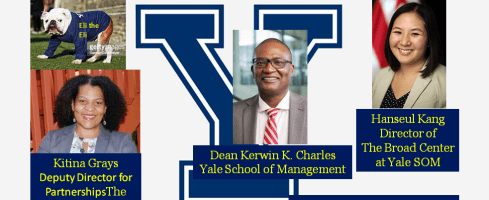
On July 1, 2019, Kerwin K. Charles was selected as dean of the Yale School of Management (SOM). Evidently, while looking around for a way to secure his Broad Center legacy, Eli Broad found the new leadership at Yale SOM a comfortable fit.

Blogger Jan Resseger says the $100 million gift means “that mega philanthropist, Eli Broad is buying a prestigious institutional home for a training program he alone devised.” The development of the Broad program was quite stunning. A billionaire with no education training or experience just decided he would start an education management training program. Broad’s only qualification was his immense wealth derived from business.

This June, The Broad Center at Yale SOM enrolled its first cadre of 17 Fellows into the Fellowship for Public Education Leadership program.

Continues Anti-Public School Ideology

In January, The Broad Center at Yale SOM hosted a virtual forum for The Broad Center (TBC) alumni. Their report paraphrased Professor Charles as saying, “The 2021 gathering … exemplified how Yale SOM will draw on the expertise of TBC alumni as it applies its approach to education leadership.”

The inaugural Executive Director of the new Broad Center is Hanseul Kang. She comes to New Haven from her post as Superintendent of Education for the District of Columbia. At the forum she stated,

“We will continue to draw inspiration and strength from what The Broad Center has been historically. Our engagement with all of you in the alumni network is going to continue.”

Kang was a member of the Broad Residency class of 2012-2014. At that time, she was serving as Chief of Staff for the Tennessee Department of Education while her fellow Broadie, Chris Barbic, was setting up the doomed to fail Tennessee Achievement School District.

Last month, the Broad Center at Yale SOM posted,

“We are thrilled to share the news that Katina Grays … will be joining The Broad Center at Yale SOM as our new Deputy Director for Partnerships!”

“As a Broad alum herself, Katina has developed strong relationships with transformative leaders across the TBC network.  Katina has led high-impact work and complex initiatives in senior leadership roles at KIPP NYC and at the Tennessee Department of Education, and previously worked at the Connecticut Department of Education.”

At the January forum, one of the key presenters was Pedro Martinez (Broad Academy 2009), Superintendent of the San Antonio Independent School District.

The post Big Spending on Privatizing Public Schools in San Antonio shares,

“Martinez is not an educator. He has never run a classroom or studied pedagogy. However, he does have a Masters in Business Administration from DePaul University and got his start in education working for Arne Duncan at the Chicago Public Schools (CPS).”

Yale’s Inaugural Fellowship for Public Education Leadership

The new Broad Center’s original seventeen trainees are comprised of 6-people from charter management organizations and 11-people from public education organizations. Naturally, the six charter school people are there to advance their careers supporting the privatization of public schools. Likewise, the 11-public school employees appear to be there to advance their own careers but not necessarily to advocate for privatizing public schools. There are two public school people that do appear to be angling for the billionaire financed privatization track.

Melissa Kim is Deputy Chancellor, District of Columbia Public Schools which has a reputation for facilitating public education privatization. She certainly had a working relationship with Broad Center Director Hanseul Kang in DC and is now in the first cohort training at The Broad Center Yale SOM.

Antonio Burt is Chief Academic Officer, Shelby County Schools, Tennessee. He appears to be on the fast track to a school privatization career. He is a board member of the new non-profit First-8-Memphis.  It was launched in 2019 as the fiscal agent to oversee public and private funding for early education initiatives. Burt joins a board made up predominately of local financial institution leaders. First-8 praises Burt as an education “reformer” who has led schools to success:

“One of those schools, Ford Road Elementary, was named a “Reward School” (performing in the top 5%) by the state of Tennessee after having been performing in the bottom 5% of all schools in the state of Tennessee. Ford Road achieved this honor two consecutive years (2012-2014).”

This is not totally a lie; just mostly. Their misleading framing has to do with the “Reward School” definition. The reality is that Ford Road Elementary which serves a high poverty community does not test well and has never escaped Tennessee’s bottom 5% of schools based on testing results. The last evaluation report for the school in 2019 listed it as targeted for support and improvement.

Conclusion

The former US Assistant Secretary of Education, Diane Ravitch, recently wrote about the merger of the National Superintendents Roundtable and the Schlechty Center noting, “If your school board is looking for a new superintendent who believes in public schools, these are the go-to sources.”  This contrasts to Broad trained Superintendents who have a history of bloated staffs, financial problems and are notorious for top down management that alienates teachers and parents. If your district hires a Broadie, it has become a target for disruption and privatization.

Significantly, Eli Broad chose a business institute instead of an education school to continue his training program. The Broad Center at Yale SOM appears to be in complete fidelity with the late Eli Broad’s privatize the commons ideology.

PTA: Reform Obstacle or Trusted Parent Advocate?

12 Jul

By Thomas Ultican 7/13/2021

Founded in 1897, the ubiquitous PTA has been a long time powerful voice in legislative halls. With their many victories, they have developed enemies especially among school privatization advocates. However, the reports of their imminent demise have proven inaccurate. PTA’s robust 2019 tax form (EIN: 36-2169155) and a reported membership of more than 4 million indicates they will be viable for some time to come.

Radical Right Opposes another American Institution

One of the first big hit pieces on the PTA came from the Brookings Institute in 2001. Thomas Toch claimed that the PTA was floundering because they were “out of step with many parents’ demands for change in public education.”

Toch also claimed that the PTA was working with teachers to slow the pace of reform, “The organization rejects the belief of many would-be school reformers today that public schools would work harder to improve if they had to compete for students and financing.”

Toch concluded,

“There is a big role for PTA’s to play in rallying parents to the cause of school improvement. But critics say that unless the National PTA relinquishes its defense of the educational status quo, and unless local chapters define parent involvement far more ambitiously, the century-old cultural icon is likely to continue its decline, a consequence, they say, that would make little difference in the schools.”

Tom DeWeese writes for the ultra-right American Policy Center. They advertise themselves as having “30 years leading the fight for property rights and sovereignty” and “speaking out on the threat of UN Agenda 21/Sustainable Development Policy.” In a post, Deweese says,

“Over the past two or more decades the NEA and the American Federation of Teachers (AFT) have been actively pursuing control of the PTA. They saw its potential to be just what it has become – a tool in the arsenal to push union agendas.”

For their Summer 2021 Journal, Harvard University’s Education Next decided to rerun a 2011 article by Bruno Manno called NOT Your Mother’s PTA.” Manno is senior advisor for K–12 education reform at the Walton Family Foundation. He wrote,

“The PTA has worked to advance social changes that improved the lives of young people, including championing the creation of child labor laws, reorganizing the juvenile justice system, and improving a variety of children’s services. But today, its orientation to K–12 issues is most aptly described by education analyst Charlene Haar as an ‘echo…of the teachers unions.”’

Manno says, “Truth be told, few in today’s K–12 education reform movement look to the PTA to fight for dramatic change or engage in direct conflict with the public education establishment.” He recommends three organizations he says will enlist parents in education reform; Parent Revolution, Education Reform Now, and Stand for Children. The fine print at the end of the article informs the reader that all three organizations are funded by America’s wealthiest family through their Walton Family Foundation.

This March, the Daily Wire ran the post, How The PTA Sold Out Parents For Politics During Schools’ Biggest Crisis.” Daily Wire is owned by the billionaire Wilks Brothers, who made their money through fracking. The Wilks are part of the extreme Christian right.

The article attacks the PTA for being “essentially absent from the public debate on reopening schools.”  It also says they engage in an “embrace of divisive racial rhetoric that has alienated parents…” The Wire is aghast that at the PTA March Legislative Conference “the agenda focused not on getting kids back into school, but on a series of liberal political priorities.”

Great History but Some Questionable Positions

In the era before women successfully demanded the right to vote, Alice McLellan Birney and Phoebe Apperson Hearst founded the Congress of Mothers to support public schools. Hearst’s wealth gained during the California gold rush provided the organization with funding.  The name was officially changed to the National Congress of Parents and Teachers in 1924 when they started referring to themselves as the PTA.

In 1926, the National Congress of Colored Parents and Teacher was founded by Selena Sloan Butler. In 1970, the two organizations united with leaders from both groups taking key leadership roles.

Through its advocacy, the PTA has successfully lobbied for legislation to:

  • Create kindergarten classes
  • Establish child labor laws
  • Implement public health service
  • Supply hot and healthy lunches
  • Devise a juvenile justice system
  • Institute mandatory immunization
  • Include arts in education
  • Initiate enhanced school safety

PTA’s century and a quarter of activism supporting children’s education has seen it battling the enemies of public school:

In 1978, the PTA helped to form a national coalition to Save Public Education; to fight tuition tax credit legislation. The coalition succeeded in the 95th Congress.

In 2002, a PTA news release opposing school vouchers was picked up by Good Morning America, ABC World News Tonight, and 20/20.

In 2003, PTA collaborated with the National Education Association to develop guides on parent involvement, supplemental services for children, and help children in math, science, and reading.

Unfortunately, PTA has bowed to the billionaire financed education reform agenda. In 2009, it became an endorsing partner for the Common Core State Standards.

The PTA has two glaringly errant education policy positions. It endorsedpublic charter” schools and embraced standards and testing. There is no real difference between for profit and non-profit charter schools. They are both about profits. Generally by being a non-profit, a charter school is labeled a “public charter,” but they are often run by for profit charter management companies and these non-profits tend to pay high administrative salaries. When it comes to testing, there is a mountain of evidence against it.

The radical UN-American ultra-right disparages public education, teachers, democratically elected school boards, reasonable public health policies, vaccinations against a pandemic and the PTA. They are a menace.

Questioning Mastery Learning and Growth Mindset

6 Jul

By Thomas Ultican 7/6/2021

This summer the Los Angeles Unified School District is offering professional development and a salary point credit to teachers for taking the “Mastery Learning” training. The district’s statement of introduction says, “Mastery Learning and Grading is a growth-mindset approach to K-12 teaching and learning…” They further state that by, “… implementing research-based systems honoring individual variation in learning styles, Mastery Learning and Grading allows more students to succeed …”

Unfortunately, these are known failed teaching strategies. Mastery learning failed spectacularly in the 1970s and growth-mindset implementation in classrooms has been a disaster. “Research-based systems honoring individual variation in learning styles”, is a totally debunked theory. In the abstract to his 2016 paper, Paul Kirschner pleads,

“Finally, nearly all studies that report evidence for learning styles fail to satisfy just about all of the key criteria for scientific validity. This article delivers an evidence-informed plea to teachers, administrators and researchers to stop propagating the learning styles myth.”

Mastery Learning

The roots of mastery learning theory reach back to the beginning of the 20th century. In his 1916 book, Democracy and Education (page 122) John Dewey stated,

“An aim must, then, be flexible; it must be capable of alteration to meet circumstances. An end established externally to the process of action is always rigid.”

Another professor at Columbia University contemporary to John Dewey was Edward Thorndike. He became famous in psychology circles for his work on learning theory. That work led to the development of operant conditioning practices within Behaviorism. In 1910, he created the first widely accepted standardized achievement test; it measured handwriting skills. In the 1920s, he focused on intelligence testing.

Ellen Lagemann, an education historian, wrote (Kohn page 7), “One cannot understand the history of education in the United States during the twentieth century unless one realizes the Edward K. Thorndike won and John Dewey lost.”

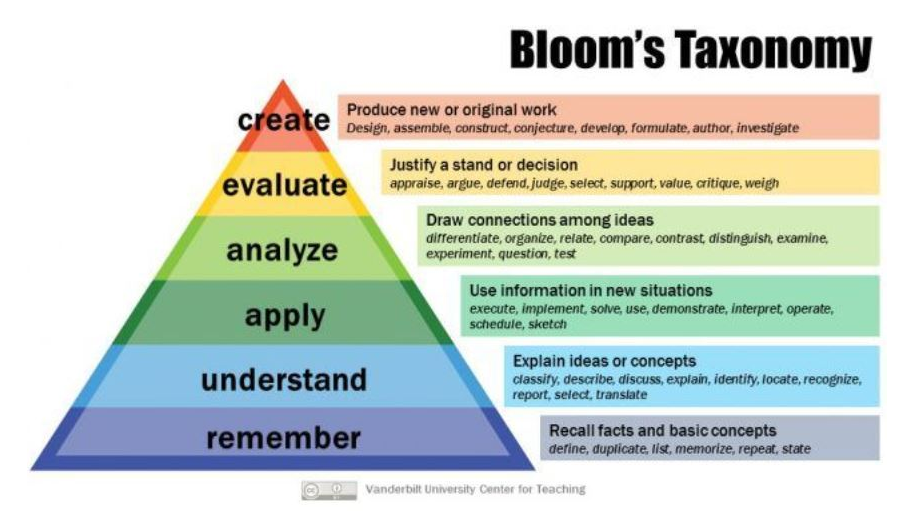
In the 1930s, Benjamin Bloom appeared at Pennsylvania State University where he earned a Bachelors and Masters in psychology. Not long after completing his doctorate in education at the University of Chicago, he became University Examiner; a position he held until 1959. In 1948, Bloom convened a meeting of college and university examiners from throughout the country to discuss the possibility of designing a common framework for classifying the wide variety of intended learning outcomes that the examiners routinely encountered. Based on this work, Bloom published The Taxonomy of Educational Objectives, The Classification of Educational Goals. By 1960, it was simply known as Bloom’s Taxonomy.

Vanderbilt University Published this Bloom’s Taxonomy Graphic

In 1968, Bloom published a small paper titled “Learning for Mastery.”His central thesis was that most students (perhaps more than 90%) could master what they were expected to learn in school if they were given enough time. Bloom, unlike Thorndike, believed that intelligence was not fixed and that it could grow. The paper, the taxonomy and work by John Carroll were combined to become “Mastery Learning.”  

The theory proposed that learning goals must be clearly stated for the student. Students were to be provided with some sort of lesson (mostly direct instruction) and upon completing the lesson the student was to be assessed. If they passed the assessment, they moved on to the next lesson. If they did not pass, they were assigned another lesson on the same goal. This process was to be repeated until mastery was achieved.

The “mastery learning” theory violated Dewey’s admonition that goals (aim) must be flexible but it fit perfectly with Thorndike’s behaviorist ideology.

In 1977, the Chicago and Washington DC public school systems adopted master learning. By 1980, they had abandoned the scheme as a failure. The failure was so glaring and so public that the founder of Outcome Based Education (OBE), William Spady, is quoted as saying,

“In January of 1980 we convened a meeting of 42 people to form the Network for Outcome-Based Schools. Most of the people who were there … had a strong background in Mastery Learning, since it was what OBE was called at the time. But I pleaded with the group not to use the name “mastery learning” in the network’s new name because the word “mastery” had already been destroyed through poor implementation.”

Spady blamed poor implementation but a 2018 research study said of “Mastery Learning”,

“Our objection to mastery/competency/personalized learning is about how a learner comes to develop that mastery/competency … Passing an MCQ test isn’t the objective of education; being able to “learn … how to learn…” and being able to solve uncharted problems are the objectives of education.”

Growth Mindset

Graphic from Page 11 of the 2017 National Education Technology Plan

The Technology Plan states without evidence,

“A key part of non-cognitive development is fostering a growth mindset about learning. Growth mindset is the understanding that abilities can be developed through effort and practice and leads to increased motivation and achievement.”

The US Department of Education made many claims like this one with no evidentiary support. To her credit, the creator of Growth Mindset, Carol Dweck, has acknowledged issues with implementation of the theory. She says,

“Growth mindset is even more complex than we imagined. In the beginning, as I have freely admitted, we did not recognize the complexity of the implementation.”

A large-scale study of 36 schools in the UK, in which either pupils or teachers were given training, found that the impact on pupils directly receiving the intervention did not have statistical significance, and that the pupils whose teachers were trained made no gains at all.

Scholar Carl Hendrick notes that Dweck’s growth mindset research has not been replicated robustly and “like its educational-psychology cousin ‘grit’ – can have the unintended consequence of making students feel responsible for things that are not under their control: that their lack of success is a failure of moral character.”

Incentivizing teachers to study unproven and debunked education theories is like feeding them pedagogical poison.