Archive | May, 2021

i-Ready, Johns Hopkins and Oakland Public Schools

26 May

By Thomas Ultican 5/26/2021

The Oakland Unified School District (OUSD) signed an agreement on March 10 to substitute i-Ready diagnostic testing for the Smarter Balanced Assessment Consortium (SBAC). The no cost agreement calls for the data to be given to Johns Hopkins University for comparative analysis with SBAC. Oakland teachers administering the program claim that the project is being financed by the Kenneth Rainin Foundation.

An Oakland fourth grade math teacher who administered the test stated that the it appeared to be designed to insure that students missed at least 50% of the problems. She observed,

“1) Multi-step unit conversions in the context of a word problem”

“2) Definitions/examples of independent and dependent variables”

“3) Simplification of algebraic equations with two variables”

These skills all appear to be well beyond what should be expected of 9- and 10-years-old students.

i-Ready is a product of Curriculum Associates (CA) out of Billerica, Massachusetts. It was originally formed in 1969 to publish workbooks. Ron Waldron an equities manager at Berkshire Partners took the reins in 2008 and immediately converted it to an ed-tech company.

That was the same year that former Florida Governor, Jeb Bush, launched Foundation for Excellence in Education (FEE) and in close cooperation with the American Legislative Exchange Council and his major contributor, Bill Gates, FEE launched Digital Learning Now. (FEE has been renamed ExcelinEd)

 i-Ready is a technology-based diagnostic testing program that also provides screen based instructional programs for math and reading.

Evidently many junior-high students who use i-Ready in the classroom are making internet searches for information about it. Possibly that explains why my i-Ready article written three years ago is still getting traffic. This May, it has received more than 1600 clicks. The latest two comments out of hundreds to the article are typical:

“i agree iready has caused a ton of stress for me as a 7th grade student.”

“I-ready needs to Die!”

Sales spiels normally tout the research evidence supporting i-Ready. However, there is no independent peer reviewed research backing CA’s claims. A 2019 study from WestEd is typical. The study was paid for by two billionaire non-profits reputed to favor privatizing and monetizing public education – The Bill and Melinda Gates Foundation and the Silicon Valley Education Foundation. In paragraph one the study says,

“Our quantitative analysis showed that students, regardless of their math proficiency, who spent a minimum of 45 minutes a week or more on the i-Ready lessons had a significant improvement in their scores on the Smarter Balanced Assessment Consortium Math Summative Assessment (SBAC) over students who did not.”

However, the next paragraph admits,

“During the observations, it was noted that the product was challenging for less proficient students to use, which was later confirmed by our quantitative analysis — many students who used i-Ready consistently enough to see its benefits were already meeting or exceeding standards in mathematics on the SBAC.”

This shows that better students willing to put in the time got better scores than weaker students who did not. Not too surprising; that would have been the case without i-Ready.

The Evaluator Appears Biased
Chiefs for Change and Johns Hopkins Wrote Joint 2020 Paper – The Return

The Institute for Education policy at Johns Hopkins joined Jeb Bush’s Chiefs for Change in calling for more testing. Their claim,

“As leaders prepare their school communities for the challenge of re-starting face-to-face as well as hybrid models, a coherent pathway for learning recovery and acceleration needs to include greater reliance on high-quality materials and instruction, and completing the circle with curriculum-based assessments.”

“We recommend formative and summative assessments tied to specific curricula that can be implemented under various circumstances.”

Johns Hopkins was also integral to the attack on the public schools in Providence, Rhode Island. In May 2019, the Johns Hopkins Institute for Education Policy led a review of the Providence Public School District (PPSD). They did so at the invitation of the Rhode Island Department of Education Commissioner, Ms. Angélica Infante-Green, with the support of Governor Gina Raimondo and Mayor Jorge Elorza. The Partnership for Rhode Island funded the review.

The Johns Hopkins study was commissioned in May and presented in June and based on the report  Mayor Elorza officially petitioned the state to takeover Providence Public Schools on July  19.

Kenneth Rainin Foundation Lost Their White Hats
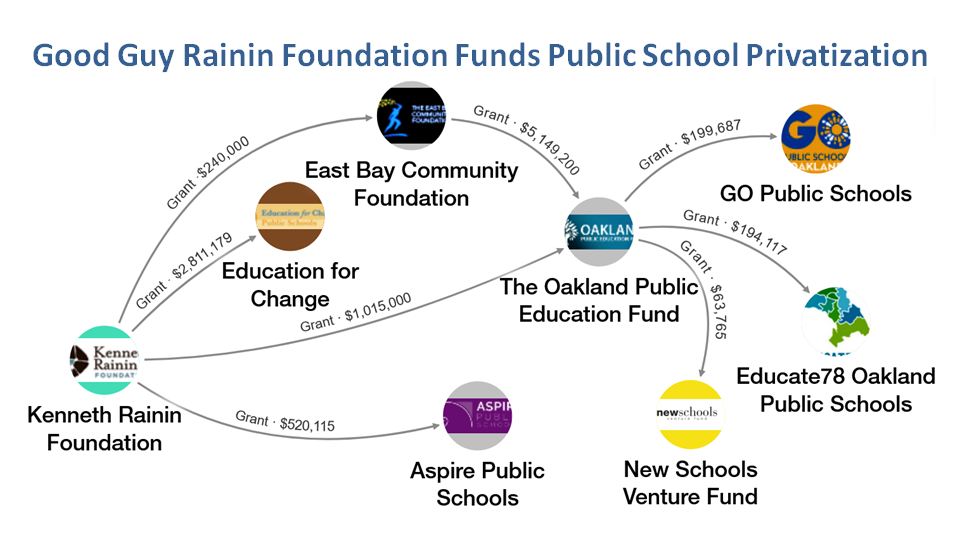
The foundation being cited as funding the i-Ready and Johns Hopkins study has assets of more than $600 million. Founder Kenneth Rainin was an entrepreneur from Toledo, Ohio who became wealthy manufacturing and selling laboratory pipettes. When he died in 2007, the foundation became the beneficiary of the majority of his estate.

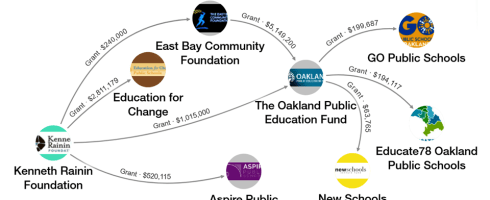
The Rainan Foundation has spent significant sums on advancing its “Seeds of Learning” reading program and the corporate control of public education. As the LittleSis map depicted above shows, the foundation sends large grants both directly and indirectly to billionaire funded “school choice” promoting organizations.

The “Seeds of Learning” program is supposed to improve reading education results through its preschool efforts. The lead story on the foundation’s web page is “Research Show Seeds of Learning Produces Quick Gains.” The research is not peer reviewed or independent. The Kenneth Rainin Foundation has spent more than $3 million for a Chicago company to produce the results. Report briefs are made available but not the study itself.

The dark side of the study is that they are testing 4- and 5-year olds in alliteration, letter naming, letter sounds, rhyming and vocabulary. That is child abuse. This appears to be an amateur created program that ignores the much greater need for babies to engage in self-directed play in safe and stimulative environments. “Seeds of Learning”  is likely more personality damaging than it is helpful for reading.

Amateurs need to stop using their financial power to control education policy.

A Scholarly Masterpiece: William Frantz Public School

19 May

By Thomas Ultican 4/18/2021

My wonderful friend from New Orleans, Mercedes Schneider, said of this meticulously researched book, “Intense, captivating, and horrible in its reality, William Frantz Public School is a story overdue for the telling – a must read for those seeking to understand New Orleans’ history and the lingering impact of White racial superiority upon the Black community and city infrastructure.” I concur. It is a captivating read.

At its 1938 founding, speakers proclaimed the new William Frantz Public School (WFPS) a “protection for democracy” and a “fortification against encroachment of those terrible ‘isms.’” (WFPS page 3)

However, racism did not just encroach; it dominated. WFPS was built to be a White students only school. Sitting on the border between the all white Florida neighborhood and the all Black Desire neighborhood, WFPS only served the White families. Worse still; the authors report,

“The Orleans Parish School Board built no schools between 1941 and 1951. As a result, existing neighborhood schools throughout the city faced overcrowding. The problem was particularly acute in Desire. Due to the severe overcrowding, many Black children attended school for only a fraction of the time as their White peers living in the Florida neighborhood.” (WFPS 9)

With the Brown versus the Board of education decision in 1954, the Supreme Court declared racial segregation as a school enrollment policy unconstitutional. Louisiana segregationists quickly coalesced to become leaders of their state’s “massive resistance” movement to oppose integration.

In 1955, a wealthy lawyer named Leander Perez and a state senator named William Rainich established the White Citizens’ Council in Louisiana. By that fall, the white supremacist organization had chapters in half of the state’s parishes and a statewide membership of 100,000. The New Orleans chapter would eventually grow to over 50,000 members. (WFPS 21)

As the White Citizens’ Council started calling for the public schools to be closed rather than integrated, a group named Save Our Schools (SOS) formed to oppose closing schools. The book notes, “Although ardent in their work, many perceived SOS as elite and ‘liberals allied with the Urban League, the Council of Jewish Women, [and] the league of Women Voters.’” (WFPS 24) Many SOS members sent their own children to all white public schools and though disagreeing about the Brown decision, they all agreed it was settled law.

The authors document political strong-arming, horrific acts of cruelty and the hysterical fear with which white racists fought to stop school integration. Their greatest horror was realized when one 6-years-old girl named Ruby Bridges was escorted into WFPS on November 14, 1960.  

The Times-Picayune ran an editorial with the headline “Dreadful Day Comes at Last” and the White Citizens’ Council started pressuring White parents to pull their children out of WFPS. Protestors surrounded the school, chanted racist slogans and intimidated anyone approaching the school. (WFPS 35)

In an attempt to keep some of the White children in WFPS, President Mary Sand and others from SOS organized car pools to deliver students to the front of the school so they would not be forced to go through the heckling crowd. “Like the families of the students they transported to WFPS, SOS drivers received crude and threatening telephone calls, up to 200 per day, from people who told the women they would ‘cut your cunt out and stuff it down your throat.’” (WFPS 59-60)

As a result of the intimidation tactics, New Orleans was able to defy court orders and schools remained virtually segregated. The following year:

“Black citizens started an unofficial boycott of White-owned department stores and threatened to cancel the Zulu parade, a traditional and popular Black parade, during the upcoming Mardi Bras. Rumors circulated that the entire Mardi Gras celebration would be canceled … By mid-December, city business leaders along with the Times-Picayune finally called for the end of the protests, intimidation, and vandalism.” (WFPS 69)

As the decade of the 90s opened the neighborhood around WFPS was in trouble. “Prostitutes worked the streets outside some schools, and an early 1990s poll of Black students from the Desire projects located near WFPS found 40% of Black students had seen a dead body and 72% had seen weapons being used.” (WFPS 121)

Seventy-five thousand Black children and 19,000 White children constituted Orleans Parish school district in the early 1990s with extreme poverty gripping the Black community. (WFPS 117)

By 1993, there were no White students attending WFPS. (WFPS 111)

In 1997, the state established its test based accountability scheme. (WFPS 128)

In 1998, WFPS was judged academically unacceptable. (WFPS 132)

In 2005, WFPS was put on the National Register of Historic Places. (WFPS 155)

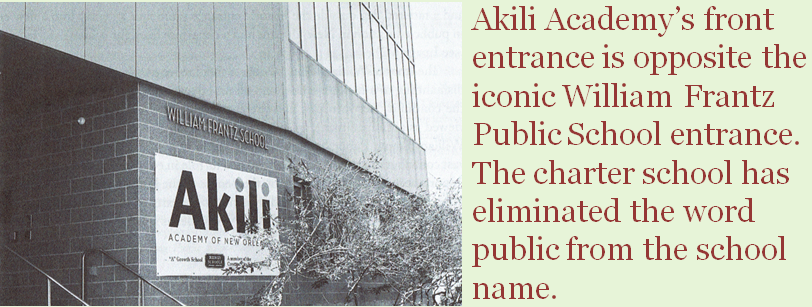
In 2013, like the rest of the post Katrina schools in New Orleans, WFPS became a charter school. (WFPS 258)

Three white women who are not from New Orleans – Connie L. Schaffer, Meg White, and Martha Graham Viator – say they considered not writing this book because of that. It is our great good fortune that they did. Their scholarly and extremely readable effort shines some much needed light on the horrible racism and mistreatment the Black citizens of New Orleans.

Testing Industry Scores Big in California

13 May

By Thomas Ultican 5/13/2021

At 1:45 PM this Wednesday, the California State Board of Education (SBE) adopted a “student growth model” to evaluate student learning. It is a method fans of standardized test based accountability have been trumpeting. The big winner here is the testing giant Education Testing Services (ETS) who created the model to be used.

Board member Sue Burr who was appointed to the board by then Governor Jerry Brown made the motion for using the growth model. She carefully presented her motion directly from the state’s California Department of Education (CDE) staff report which recommended:

“The student growth model methodology, which includes using RG [residual growth] scores and the EBLP [Empirical Best Linear Prediction] hybrid approach to report aggregated student growth, and that the following score reporting be adopted:

“1.        Report the EBLP weighted average for:

“1. Schools

“2. Student groups in a school

“3. The “All” student group in an County or District

“4. Student groups in a district with 500 or fewer students (with test scores)

“2.       At the Local Education Agency level, report the simple average for all race/ethnicity and program participation student groups with more than 500 scores.”

Board member Patricia Ann Rucker seconded the motion. She is a legislative advocate for the California Teachers Association.

The measure was adopted by a unanimous 10-0 vote. The only member of the eleven-member board not voting for it was Board President Linda Darling-Hammond who was absent.

Developing an Accountability Model to Satisfy ESSA

In January 2016, the SBE discussed how to bring the state’s accountability vision in line with the federal Every Student Succeeds Act’s (ESSA) new accountability requirements. SBE received an information memorandum from the CDE stating,

One such indicator would be a student-level growth model. This memorandum provides an overview of student-level growth models that can be used to communicate Smarter Balanced Summative Assessment results.”

In 2017, the state joined with testing vendor ETS to develop a Growth Model. After exploring several different models, the SBE selected the “residual gain” method for further study.

Again the state hired testing vendor ETS to evaluate the residual gain model in 2018. In a report, ETS stated that the model had low “cross-year stability.” In other words the results were not consistent. ETS developed an arithmetic manipulation method to solve the stability problem that they named the “Empirical Best Linear Prediction (EBLP).”

Student Growth Model Requires Opaque Math

The graphic above shows two types of growth models. One is the gain model which simply subtracts the third grade testing data from the fourth grade data to get a gain score. However, it is not really that simple. Mathematical manipulation is required to make the scale from the 3rd grade match the scale in 4th grade. This requires several assumptions that affect the results.

The method California has chosen adds another set of mathematical assumptions to create an expected outcome. That expected outcome is then subtracted from the 4th grade data to get the residual gain score. However since those scores are not stable, the ETS averaging scheme is being applied to make the results appear stable.

ETS is the Goliath of the standardized testing industry. It administers America’s most important standardized tests (including the SAT, PSAT, CLEP, AP, TOEFL, and Praxis exams) and develops many of them. ETS was organized as a non-profit in 1948. Today, their 2018 tax document shows this “non-profit” has revenues in excess of $1.5 billion. It also shows that 17 board members working 2-hours or less per week had an average income of $73,000 and 33 key employees had average incomes of over $533,000 per year with President Walter McDonald taking in $1,350,474.

The ETS “non-profit” is actually diving up a lot of profits.

Standards Based Education and Testing is Harming Kids

In December, Peter Greene put together a compendium of articles he has posted about the stupidity associated with standardized testing in schools. One particularly important article is about Daniel Koretz book the Testing Charade. This recognized testing expert from the Harvard Graduate School of Education gives us one more well-founded dismantling of the myth that standardized testing is anything other than destructive.  

Student testing data does not indicate learning, teacher effectiveness or school quality and it is statistically noisy. A correlation study of how testing data is affected by various factors assigns r-values of between 1 and 0. A value of 1 means 100% correlated and a value of 0 means not correlated at all. When correlation studies are done with standardized testing data there is only one factor that has an r-value greater the 0.3 (weakly correlated) and that is family wealth which has an r-value of 0.9.

So if Burrito Canyon high school has excellent testing data that is always better than the scores at Pawn Valley high school, there is nothing known about the learning and teaching, but you can be confident students at Burrito Canyon have wealthier parents.

These growth models – that are now being used in almost every state in America – take in noisy testing data that has little valuable meaning and applies fancy arithmetic. It is the classic garbage in – garbage out situation.

Not only is standardized testing removing almost $2 billion dollars from America’s classrooms every year, it is doing damage to students. Standards based education is bad education theory because there are no standard children. Testing forces educators to teach to the test and it further narrows curriculum. Gifted education professionals have shown repeatedly that this methodology driven by corporations and billionaires is harmfully misguided.

Authentic Education Reform Based on Diversity Research

7 May

By Thomas Ultican 5/7/2021

“Dedicated with admiration and respect to public school teachers who opt-out of commercial standardized tests.”

These are the words of dedication for Garn Press’s new book in their “Woman Scholars Series,” Diversity Research in Action. In this book, lengthy excerpts from published research by three PhD’s in education Anne Haas Dyson, Denny Taylor and Catherine Compton-Lilly are introduced and woven together by a forth doctorate of education Bobbie Kabuto. It seems like decades since this kind of authentic thinking about how to improve education and equity in our schools has been widely shared.

On a personal note, I began my masters of education program in 2001 and found the kind of pedagogy being advocated by these women very appealing. Unfortunately, that was precisely at the time when Ted Kennedy and George Bush teamed up to smoother it. It was obvious to me that we needed to meet our students at whatever attainment level they had and begin there. Students are not standard so it made no sense to follow some standards arrangement when teaching them.

Most educators found teaching to the standards and administering testing mandated by the No Child Left Behind act – the 2002 rewrite of the US federal education law – heartbreaking. In my remedial high school algebra classes, students were learning but just not fast enough. Instead of being encouraged to continue growing, they were labeled failures.

Building Biographic Literature Profiles

At a time when the president of the United States, George H. W. Bush, and the governor of Arkansas, Bill Clinton, joined with CEO’s like IBM’s Louis Gerstner to call for education standards, Denny Taylor was conducting research which showed how foolhardy they were.

Hundreds of students, dozens of teachers and administrators participated in Taylor’s “Biographic Literacy Profiles Project” from 1989 – 1991. Essentially, she turned kindergarten thru third grade teachers into ethnographers studying their students and how they made sense of literary learning. They collected into portfolios every scrap of paper available that showed how students were using symbols, drawings and invented writing methods to communicate. They added to these portfolios notes describing what the students were doing, what kind of growth they were exhibiting and how they were successful.

Taylor wrote,

“…, while I would rather have the child’s production than some simplistic (asinine is probably a better descriptor) ‘text’ copied from the board, the child’s writing without notes written by the teacher still only provides a part of the ‘picture.’ Portfolios are not enough. To understand how individual children actively engage in the reconstruction of the functions, uses, and forms of written language we need to observe them at work.” (p 117)

Taylor published the findings of the “Biographic Literature Profiles” under the title Teaching Without Testing.” The profiles show how unique each student is and therefore, how useless education standards and testing are.

“They leave teachers and administrators with no alternative but to teach to the test. Children’s lives are altered, drilled, and skilled – the natural rhythm of their learning is changed to a solemn beat.” (p 150)

One of the school principals participating in the project noted,

“Change should be teacher initiated, teacher implemented, and teacher controlled. But teachers don’t have the power.” (p 140)

Over the last thirty years this has persisted. Peter Greene a Forbes commentator and decades-long educator tweeted.

Permeable Curriculum

In introducing this section, Bobbie Kabuto states,

“Curriculum is the heart and soul of educational systems, and it is in jeopardy of a coup d’état by corporate and political forces. It has not always been this way. As a teacher in the mid 1990s, I knew a time when money was invested in the professional development of teachers rather in than in high-stakes testing.”

Here, Professor Anne Hass Dyson takes the reader through negotiating a permeable curriculum and why it is required. Often teacher world and student world require interplay between children’s language and experience and that of the teacher. The distance between the two is exacerbated by diverse sociocultural backgrounds. Teachers and students do feel disconnected. Dyson states,

“On the one hand, we must allow – indeed, support – the embedding of written language in children’s social worlds, so that they find it a useful symbolic tool (a suggestion made by educators as separated in time and space as Ashton-Warner, Freire, and Vygotsky). But, on the other hand, we must also help children expand and negotiate among the sociocultural worlds – the dialogues – in which they participate.” (p 205)

It requires the educator to deeply understand the student’s home culture and what children are currently fascinated by in order to design curriculum that meets their needs.

Habitus and Chronotype

Researcher Catherine Compton-Lilly’s research is focused on habitus and chronotype. Habitus explains the complex interactions between culture, social structures, and individual agency. In other words what are the environmental factors linking to the way a student talks, acts and believes. These are the factors crucial to the development of cultural capital. Chronotype literally means time-space. Compton-Lilly applied the chronotype motifs from literature to motifs in literacy and schooling.

Compton-Lilly observes,

“Significantly, expanded notions of time invite educators and scholars to think about inequity ‘because time is largely taken for granted and therefore invisible, the social relation of time can continue to maintain existing inequalities and create new ones in the globally constituted world.’” (p 311)

She also shared,

“As Sorokin (1943) argued ‘Observation shows that persons equally old according to the physical clock are physiologically at quite different stages of development.” Yet there are areas in educational research that attempt to normalize development, create age- and grade- level expectations, and require students to make adequate yearly progress.”

Top flight education scholars like the authors of Diversity Research in Action are why billionaires are funding non-university based teacher development programs like the academically inferior Teach For America spinoff TNTP and the late Eli Broad’s superintendents’ academy. They know that authentic professional educators oppose their uninformed theories of education and disruption of public schools.

If you are interested in a deeper perspective on teaching and learning, I recommend this book.