
By Thomas Ultican 11/27/2020
“Personalized learning” is being driven by foundations derived from companies that stand to profit by its implementation. Last year, George Mason’s Priscilla Regan and the University of Ottawa’s Valerie Steeves wrote the peer reviewed paper “Education, privacy, and big data algorithms: Taking the persons out of personalized learning” in which they state, “Other than the Carnegie Corporation, the private foundations who have been most supportive of personalized learning are those supported by the technology companies, including the Bill and Melinda Gates Foundation, the Chan Zuckerberg Initiative, and the Google Foundation.”
In the case of the Carnegie Corporation, the authors note that the philanthropy has been supporting education causes since its founding in 1911. Recently, Carnegie has given monetary support to “personalized learning” but “typically in partnership with one of the tech foundations.”
Based on a listing of the fifteen largest education spending philanthropies in the first decade of the millennium, the paper’s authors selected the technology linked Bill & Melinda Gates Foundation (the largest donor); Michael and Susan Dell (fourth largest donor); and William and Flora Hewlett Foundation (#8 in 2010) for analysis. They added two newer giving organizations, the Google Foundation and the Chan Zuckerberg Initiative, to complete their list of five tech associated education grant making companies to analyze.
In their review of scholarly papers and the popular press, they identified five types of activities supported by tech foundations with their K-12 spending:
“The first activity … involves grants to public schools for adoption of edtech applications, including personalized learning initiatives, or to educational initiatives to organizations working in public schools (such as Teach for America) or to organizations providing alternatives to public schools (such as charter schools).
“The second entails grants or some form of funding support for edtech companies.”
“The third area of activity is tech foundation support for coverage of edtech, especially coverage in publications directed to education professionals.”
“A fourth area of activity is tech foundation funding for research into studies evaluating the results of edtech applications, including personalized learning.”
“The fifth area of activity is tech foundation funding for advocacy groups who work in K-12 education.”
Three important observations from Regan and Steeves paper:
“We argue that, although there has been no formal recognition, personalized learning as conceptualized by foundations marks a significant shift away from traditional notions of the role of education in a liberal democracy and raises serious privacy issues that must be addressed.”
“It presents yet another example of the transformation of the traditional role of public education as educating citizens to one of educating future workers and consumers, a contrast of liberal democracy with neoliberal democracy.”
“The edtech sector has been focused on the notion [of personalized learning] …. While companies have generated hundreds of products and a smattering of new school models are showing promise, there is little large-scale evidence that the approach can improve teaching and learning or narrow gaps in academic achievement.”
After investigating education journalism, the authors chose to focus on Education Week as representative. The 1981 non-profit bills itself as “American education’s newspaper of record.” It has a print circulation of 50,000 and an online subscribership of 750,000 made up predominately of educators. Education Week has gotten an infusion of grant money from philanthropic foundations including $10 million from the Gates Foundation since 2005.
The authors concluded, “It accordingly is a site where various actors involved in personalized learning, including, teachers, school administrators, developers, policy-makers and foundations, share their views.” They also note that Education Week intersects with all five of the activity types supported by the tech foundations. For the study, they reviewed articles from the five year period 2013 to 2017.
What is being Sold?
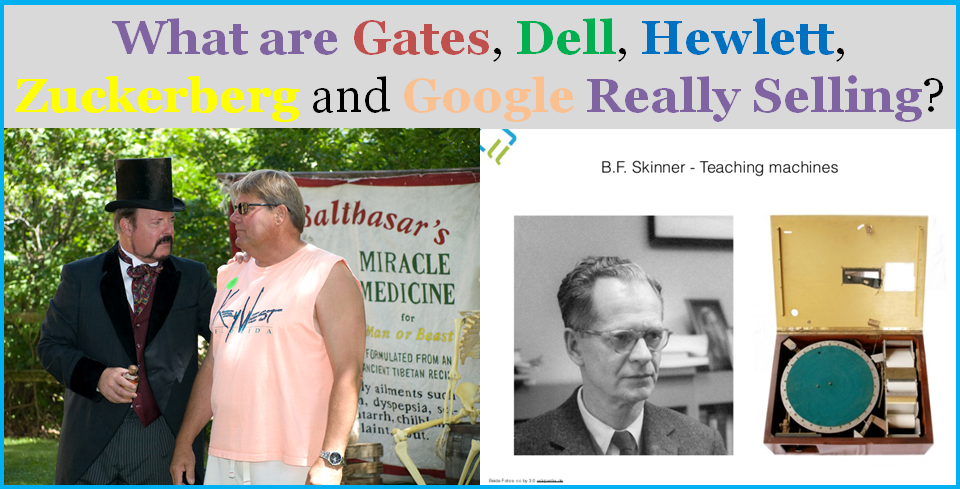
“Personalized learning”, “blended learning” and standardized testing are three of the bigger items being promoted. Huge lobbying by big tech has turned the United States Education Department (USED) into a de facto tech sales firm. Statements like this abound on the USED web site,
“Transitioning away from seat time, in favor of a structure that creates flexibility, allows students to progress as they demonstrate mastery of academic content, regardless of time, place, or pace of learning. Competency-based strategies provide flexibility in the way that credit can be earned or awarded, and provide students with personalized learning opportunities. These strategies include online and blended learning, dual enrollment and early college high schools, project-based and community-based learning, and credit recovery, among others. This type of learning leads to better student engagement because the content is relevant to each student and tailored to their unique needs. It also leads to better student outcomes because the pace of learning is customized to each student.”
This grotesque distortion of reality is little more than propaganda backing technology based bad pedagogy. Tech provided schemes like “personalized learning” are founded on the behaviorist based mastery education theory. Besides promoting tech industry products, USED champions age inappropriate learning and publishes unfounded blather about better student outcomes.
The 1970’s “mastery learning” was so detested that it was renamed “outcome based education” in the 1990s and now is called “competency based education” (CBE). The name changes are due to the five-decade long record of failure. CBE is simply putting “mastery leaning” on a computer instead of using worksheets and paper assessments. In the 1970s teachers began calling it “seats and sheets.”
“Personalized Learning” is a euphemistic term that indicates lessons delivered on a digital device. These lessons are often organized with a playlist and come with a claim of using artificial intelligence to tailor the lessons to the recipient. The scheme is based on mastery learning theory.
“Credit recovery” is the fraud that has engendered soaring graduation rates. It is another way of implementing “personalize learning.” Students are completing semester long classes and receiving full credit for them in as little as one day. America’s high school graduation rates peaked at about 77% in 1970 and then drifted down for almost four decades to 69% in 2007. Today, fueled by this technology based scam, graduation rates are approaching 90%.
The current version of the national education law, The Every Student Succeeds Act, defines “blended learning”:
‘‘The term ‘blended learning’ means a formal education program that leverages both technology-based and face-to-face instructional approaches—(A) that include an element of online or digital learning, combined with supervised learning time, and student- led learning, in which the elements are connected to provide an integrated learning experience; and (B) in which students are provided some control over time, path, or pace.”
This means that a student gets lessons delivered to their digital device from a provider like the Khan Academy. Later the student’s teacher takes on the roll of tutor and helps them with their assignments during class. It is another way to de-professionalize teaching and sell technology.
There are many dark sides to education technology including personal privacy being sundered.
Education psychologist and author of “Failure to Connect: How Computers Affect Our Children’s Minds”, Jane Healy, spent years doing research into computer use in schools and, while she expected to find that computers in the classroom would be beneficial, now feels that “time on the computer might interfere with development of everything from the young child’s motor skills to his or her ability to think logically and distinguish between reality and fantasy.”
Dr. Nicholas Kardaras wrote “Screens In Schools Are a $60 Billion Hoax” for Time magazine. When discussing health risks associated with student screen time, he stated, “over two hundred peer-reviewed studies point to screen time correlating to increased ADHD, screen addiction, increased aggression, depression, anxiety and even psychosis.”
Jean M. Twenge, professor of psychology at San Diego State University and the author of Generation Me and iGen recently wrote an article for Atlantic magazine about the damage screen time is doing. She shared about the current group of teenagers she labels iGen,
“Psychologically, however, they are more vulnerable than Millennials were: Rates of teen depression and suicide have skyrocketed since 2011. It’s not an exaggeration to describe iGen as being on the brink of the worst mental-health crisis in decades. Much of this deterioration can be traced to their phones.”
Not all edtech is bad. In fact some is necessary and some greatly enhances learning. In my personal experience, I found Jupiter Grades, the online grade book to be a very valuable tool for communicating with both students and their parents. Student management systems like those provided by Illuminate Education are essential for managing attendance, enrollment and other things schools legally must track.
In the classroom, high speed data acquisition equipment, word processing capabilities and high end calculators are a boon. Textbooks that take advantage of technology to create hints and provide tools for exploration are excellent learning tools.
The difference between technology that enhances pedagogy and bad edtech is the underlying purpose. Technology that is designed to fill a need and enhance learning is normally a good thing. Technology that is designed to improve system efficiency the way robotics has increased production outputs per worker is generally bad for learning.
In the new book A Wolf at the Schoolhouse Door, Jack Schneider and Jennifer Berkshire explain,
“Because learning is deeply rooted in relationships, it can’t be farmed out to robots or time-saving devices. Technology, of course, is rapidly moving into classrooms. But just having more Chromebooks or online learning platforms hasn’t allowed for faster or larger batch-processing of students.”
Looking at the Scholarly Analysis
Regan and Steeves wrote,
“With respect to personalized learning, all five of the foundations emphasize that there are differences in the ways student learn and the importance of ‘flexible learning opportunities’ (Hewlett), ‘the right experiences to help students learn’ (Dell), ‘a truly transformative, personalized learning experience’ (CZ), and ‘the right learning materials’ (Google), which leads to the importance of ‘real-time assessments for gauging student learning’ (Gates) and ‘formative data … gathered as learning is happening … in-the-moment use of data in the classroom’ (Dell). None of the five foundations, however provide a definition of what they actually mean by personalized learning instead describing the importance of data and differences.
“Moreover, none of the five foundations offers actual evidence for the effectiveness of the innovations they are advancing although all discuss the importance of evidence.” (Emphasis Added)
“Perhaps most interesting in our review of foundations’ Web sites was the almost universal absence of any mention of privacy or the implications of collecting all this data on students’ learning and personal characteristics that would be a necessary component to implement personalized learning, as well as an outcome of that implementation. … The absence of this topic from their overviews is startling given the attention companies like Google and Facebook have been forced to pay to both privacy and security.”
When looking at the EdWeek material the authors observed,
“The EdWeek data set … bifurcates into two, mostly separate, discourses. The first replicates the same themes we found in the foundation Web site materials. It consists of 14 articles written by eight authors, including senior EdWeek writers …; all eight authors are explicitly assigned to cover ed-tech from a business perspective …. For simplicity sake, we refer to this as the dominant discourse.”
“The second discourse appears almost exclusively in 14 articles written by Benjamin Herold, a staff writer who came to EdWeek from public radio and who covers ‘ed-tech, newsroom analytics, digital storytelling and Philadelphia’.”
One of the main themes from the dominant discourse is diminishing the roll of teachers.
“From this perspective, teachers are not experts in the education process equipped to make decisions about how and when to use edtech; instead, they must embrace the fact that, because of technology, ‘they don’t need to know it all. They’re not the experts’ …. Expertise resides in the edtech itself.”
The authors note, “And ultimately, when faced with hard numbers that suggest personalized learning is not effective, the dominant discourse falls back on the need to believe in the technology.”
Benjamin Herold’s articles pushed back against the dominant discourse. His basic argument is captured in the following quote attributed to a parent activist,
“As parent Karen Effrem, ‘the president of … an advocacy organization that supports parents’ right to control their children’s education’ says, ‘We’re sacrificing our children’s privacy, and we’re allowing corporations to make potentially life-changing decisions about our kids, all for technology that doesn’t actually help them.’”








 tultican
Recent Comments