Archive | August, 2020

Center for Reinventing Public Education the Billionaires’ Advocate

27 Aug

By Thomas Ultican 8/26/2020

In 1993, Political Science Professor Paul T. Hill established the Center for Reinventing Public Education (CRPE) at the Daniel J. Evans School of Public Affairs on the University of Washington campus. The research group Hill founded is steeped in public school failure ideology. On their web site Hill let it be known “The Center has a definite point of view.” Among the points listed are:

“The ineffectiveness of big city public schools clouds the futures of millions of children.”

“Incremental efforts to improve urban public education without disturbing the school boards, unions, and central office administrators have failed, largely because roles, missions, and interests of those organizations are incompatible with effective schooling.”

“There are now far too few good public schools in big cities, in part because the entire structure of city school systems, from regulation and funding to teacher selection and professional development, is hostile to school quality.”

“To create good schools in urban areas where academic failure is the norm, we need an entirely different way of creating and operating schools.”

The CRPE 1999 “about” statement says,

“The Center pursues a national program of research and development on such proposals as charter schools, school contracting, choice, and school system decentralization, via alliances with the Brookings Institution, The RAND Corporation, Vanderbilt University, and the University of Chicago.”

Professor Hill, a Non-Resident Senior Fellow at the Brookings Institute, was a member of Brookings’ cadre of researchers convinced that American public education was failing. Furthermore, they shared a general agreement that market based business principles were central to the solution. They believed teacher’s unions and governance by locally elected school boards must overturned.

In 1990, Bookings had published John Chubb’s and Terry Moe’s book, Politics, Markets, and America’s Schools in which they asserted that poor academic performance was “one of the prices Americans pay for choosing to exercise direct democratic control over their schools.” A few years later, Brookings published Fixing Urban Schools co-written by Hill and Mary Beth Celio. It was a call for running schools by contracting with private operators like the Edison Project.

From its 1993 founding thru 1999, CRPE survived by doing research projects for the Brookings Institute, the Rand Corporation, the United States Department of education, the National Business Roundtable and a few others.
crpe-robinpaul

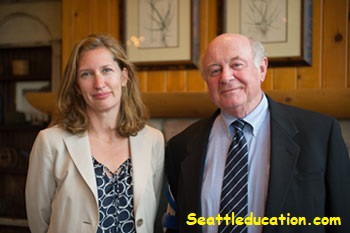
Hill hired researcher Robin Lake the year after founding CRPE. Lake conducted research on charter schools, contracting, and standards-based school decentralization. She led the evaluation of The National Business Roundtable’s national systemic reform initiative.

Big Money Started Arriving

CRPE was fortunate to be in Seattle, Washington where the world’s richest man decided to implement his opinions concerning education. The fact that he was so rich appeared to be his only qualification for what became an outsized influence over public education.

Bill Gates first big education “reform” initiative was his small schools agenda. He believed that smaller schools were more conducive to learning and retention than larger ones. To implement his small schools scheme, he contracted with CRPE to do evaluations and provide implementation advice.

The CRPE web site reported their involvement stating, “The project, supported by a generous gift from the Bill & Melinda Gates Foundation, provides a range of services to new and emerging small schools that have an organizational structure and philosophical commitment compatible with the attributes of high achieving schools.”

Because all donations to CRPE go through the University of Washington Foundation, it is often difficult to identify the specific amounts of money granted to CRPE. In 1999, the Gates Foundation donated $2,000,000 to the Daniel J Evans School of Public Affairs to support Northwest Education. It is likely most of that money went to CRPE but not certain.

In 2000, Gates donated another $750,000. This time stating the donation is ‘to develop resources which will promote the creation of small high schools.” It is a reasonable assumption that all of this money was directed to CRPE.

In 2004, CRPE proudly reported,

“Over the past 10 years the Center has received support from many organizations and foundations. We would like to recognize and thank the

In 2009 CRPE Struck Gold

“School choice” has a long history of fermenting segregation. That history stems back to the negative reaction in the South to the Supreme Court’s 1954 ruling in Brown v Board of Education. In Brown, the court overturned the public school policy of “separate but equal” saying it was “inherently unequal” and that it deprived the plaintiffs of the “equal protection of the law” prescribed in the 14th amendment.

Modern “school choice” ideology promoted by many white billionaires is little different from the strategies of southern segregationist in the 1950s and 60s. It still increases segregation and creates an “inherently unequal” and racist education system.

Promoting “school choice” has become a specialty at CRPE.

Doing School Choice Right” was a CRPE project funded by the Lynde and Harry Bradley Foundation, Annie E. Casey Foundation, and Bill and Melinda Gates Foundation. CPRE listed two salient goals for their study:

    • “Create models for how school districts can oversee public schools in multiple ways—including direct operation, chartering, contracting, and licensing private schools to admit voucher students. This study is conducted in partnership with the National Charter School Research Project.”
    • “Examine issues involved in moving toward pupil-based funding, particularly technical, legal, and regulatory barriers.”

Out of this study, the “portfolio school” management model was created. In October 2009, CRPE published Portfolio School Districts for Big Cities: An Interim Report.” Lead author Paul Hill and associates stated,

“The report introduces the idea of a ‘portfolio school district,’ and shows how some leading school districts have put the idea into practice. A portfolio district is built for continuous improvement through expansion and imitation of the highest-performing schools, closure and replacement of the lowest-performing, and constant search for new ideas.”

In other words, it is an organized idea for managing the charter schools, innovation schools, public schools and voucher schools that make up the mix of schools in a district. Using standardized testing as a proxy for measuring quality, some percentage (5%) of the lowest performing schools will be closed every year. Invariably, the closed school will be replaced by a privatized structure outside of the purview of an elected school board.

Professors David Berliner and Gene Glass are leading experts in the education research community. In a recent article they convincingly demonstrated – again – that the only strongly correlated outcome associated with education standardized testing is family wealth.

That means that under the “portfolio school district” scheme public schools in poor neighborhoods will be closed and replace by privatized “choice” schools.

This novel idea brought CRPE a new mix of funders. Between 2012 and 2018, foundation tax records show that the Walton Family Foundation (EIN: 13-3441466) granted almost $4 million, the Bill and Melinda Gates Foundation (EIN: 56-2618866) granted over $6 million, the Laura and John Arnold Foundation (EIN: 26-3241764) granted more than $4.5 million and the Michael & Susan Dell Foundation (EIN: 36-4336415) gifted more than $1.3 million.

Unlike the other contributors to the University of Washington Foundation, The Gates Foundation does not explicitly name CPRE in its tax records. The $6 million dollar figure is a conservative estimate made from tax record descriptions.

This year, a CRPE news release stated that the Walton family had granted another $650,000 in support of 2020 operations. The new portfolio model induced funding stream appears to be continuing.

For the fiscal year ending June 30 2018, The University of Washington Foundation (EIN 94-3079432) took in grants totaling $132,838,893. After distributing the money they had a balance of $9,300,536 which is consistent with its past practices. Interestingly, Bill Gates Sr. is a Director of the fund.

By 2019, CRPE quit sharing who it funders are. In 2018, their listed funders were:

    • The Bill & Melinda Gates Foundation
    • Carnegie Corporation of New York
    • Laura and John Arnold Foundation
    • Michael and Susan Dell Foundation
    • US Department of Education
    • Walton Family Foundation  

Changes at CRPE

CRPE went through big changes in 2012. Paul Hill stepped down as director (semi-retired) and was replaced by his longtime associate Robin Lake. The Center moved from the Daniel J. Evans School of Public Affairs to the Bothell campus also on the University of Washington campus.

That same year, CRPE for the first time announced “policy partners.” They stated, “CRPE is one of five national education policy organizations that co-founded the Policy Innovators in Education (PIE) Network, whose mission is to build, support, and promote a network of education advocacy organizations working to improve K-12 education in their states so that every student graduates world-ready.”
Image Clipped From PIE Home Page

The other “policy partner” listed in 2012 was CEE-Trust. In 2010, Doug Harris and Ethan Gray of The Mind Trust founded CEE-Trust. Its mission was to become a catalyst for new Mind Trust style organizations nationwide promoting school choice. The CEE-Trust web site revealed,

“CEE-Trust is funded by the Bill & Melinda Gates Foundation and The Joyce Foundation. CEE-Trust is also grateful for the past support of the Carnegie Corporation of New York.”  

After a debacle in Kansas City, CEE-Trust changed its name to Education Cities in 2014. By 2015, CRPE was listing three “policy partners:” Education Cities, Policy Innovators in Education and a new one the National Center for Special Education in Charter Schools (NCSECS). Today, CRPE Director Robin Lake is the board chair of NCSECS.

Education Cities was broken up into two new organizations in 2018. The founder, Ethan Gray, became a founding partner at John Arnold’s and Reed Hastings’ new organization The City Fund. Matt Barnum of Chalkbeat reported, “With big names and $200 million, a new group is forming to push for the ‘portfolio model.”’

It appears CRPE has found another deep pocketed “policy partner.”
Charter School Experiment FAILURE Documented Again

17 Aug

By Thomas Ultican 8/17/2020

Marketing and lack of oversight have obscured the failure of the charter school industry. The latest research reported by Carol Burris and her team at the Network for Public Education (NPE) documents the atrocious going out of business rate among charter schools.

The United States Education Department (USED) has invested more than $4 billion promoting the industry but has not effectively tracked the associated fraud, waste and failures. After 25-years of charter schooling, Broken Promises is the first comprehensive study of their closure rates.

Charter School Myths and Promises

Former American Federation of Teachers (AFT) union President, Albert Shanker, is often cited as the father of charter schools. His Wikipedia entry says, “In 1988, Shanker was the first to propose charter schools in the U.S.” He was not, nor was he central to charter school development.

Five years before Shanker’s famous 1988 speech in which he mentioned charter schools, the Reagan administration had published the infamous A Nation at Risk. In his speech, Shanker was clearly responding to that report as well as President Reagan’s call for choice in education and his own belief that American education was not serving the majority of students well.

At the time, Shanker was reading Ray Budde’s book from which he appropriated the terminology “charter.” In his 1988 speech, Shanker proposed,

“The school district and the teacher union would develop a procedure that would encourage any group of six or more teachers to submit a proposal to create a new school.”

“That group of teachers could set up a school within that school which ultimately, if the procedure works and it’s accepted, would be a totally autonomous school within that district.”

“I would approve such a proposal if it included a plan for faculty decision making, for participative management; team teaching; a way for a teaching team to govern itself; and a provision that shows how such a subunit would be organized so the teachers would no longer be isolated in the classroom throughout their professional lives, but would have the time to be available to share ideas and talk to and with each other.”

The actual development of charter schools was far different. Education Writer Rachel Cohen described what arose,

“At its outset, the real power in the charter coalition was what might be termed the ‘technocratic centrists’: business leaders, moderate Republicans, and DLC members looking for Third Way solutions that couldn’t be labeled big-government liberalism. While charters have drawn praise from other quarters—for instance, some educators and progressive activists see them as tools for racial and economic justice—these groups have never formed the heart of charters’ power base.”

In 1991, Bill Clinton – then Arkansas Governor and Chairman of the Democratic Leadership Council (DLC) – embraced the technocratic version of charter schools as a “Third Way” solution. Shanker would later complain, “It is almost impossible for us to get President Clinton to stop endorsing [charters] in all his speeches.”

By the time charter schools were birthed in Minnesota, Albert Shanker had agreed with several of the main points presented in “A Nation at Risk.” In accord with the DLC, Shanker stated,

“The reforms that resulted from A Nation At Risk and the other reports constituted a much-needed corrective to the softness of schools in the late ’60s and throughout the ’70s. Yes, we needed schools that had standards, and we still do.”

However, the public school failure belief was based on little more than illusion.

While writing an NPR article on the 35th anniversary of “A Nation at Risk,” Anya Kamenetz discovered that the report “never set out to undertake an objective inquiry.” Two of the authors admitted to her that they were “alarmed by what they believed was a decline in education, and looked for facts to fit that narrative.” The dubious evidence presented in their report would have never withstood a rigorous peer review process.

Some powerful evidence points in the opposite direction and indicates that the results from US public schools in the 60s and 70s were actually a great success story.

One measuring stick demonstrating that success is Nobel Prize winners. Since 1949, America has had 383 laureates; the second place country, Great Britain, had 132. In the same period, India had 12 laureates and China 8.

Stanford’s Center for Education Policy Analysis report on education achievement gaps states, “The gaps narrowed sharply in the 1970s and the first half of the 1980s, but then progress stalled.”

The digital revolution and the booming biotech industry were both created by students mostly from the supposedly “soft public schools” of the 60s and 70s.

In his 1999 book, The Schools Our Children Deserve, Education writer Alfie Kohn described the philosophy of current education reform saying it “consists of saying in effect, that ‘what we’re doing is OK, we just need to do it harder, longer, stronger, louder, meaner and we’ll have a better country.”’

Corporate groups, Third Way Democrats and the AFT all called for manufacturing style standards to be applied to public education. Unfortunately, standards based education has proven to be toxic; leading to jejune classes and the sundering of creativity. Children are learning to hate learning.

In his book Winners Take All, Anand Giridharadas calls modern social reform based on the belief that business leaders and market forces are the sure way to a better society “MarketWorld.” Charter schools are a “MarketWorld” education reform that has brought disruption, harm to public schools and accelerating segregation. They have produced superior marketing not superior education.

Broken Promises

Broken Promises opens by quoting the words of student mother Elouise Matthews to the Orleans Parish School Board:

“I am a parent of Mary D. Coghill [Charter School]. For the last three years I have had to place my kids at different schools each year because the schools keep closing. My child was attending MCPA, that school closed. He then went to Medard Nelson, that school closed. Now, he is at Coghill and y’all are trying to close that school. I am tired of moving my child every year because y’all are closing schools.”

In the modern era of school choice, the one choice New Orleans parent do not have is sending their children to a stable public school. New Orleans is a 100% privatized school district. It is the epitome of “MarketWorld” education reform.

“Broken Promises” looked at cohorts of newly opened charter schools between 1998 and 2017. Ryan Pfleger, Ph.D. led the analysis of charter schools closures utilizing the Department of Education’s Common Core of Data (CCD).

Before 1998, the massive government data base did not uniquely identify charter schools and the last complete data set available for all schools in America was 2017.

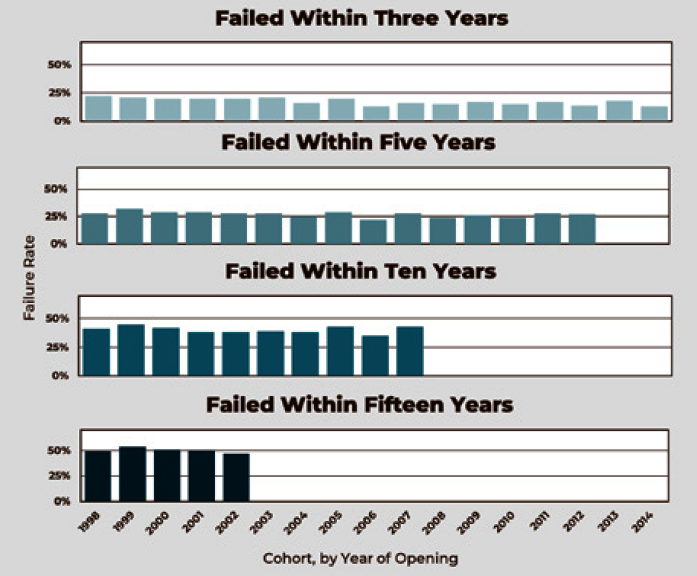
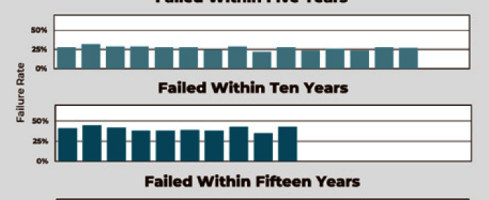
Startup charter school cohorts were identified by year and the cohort closure rates were tracked at 3, 5, 10 and 15 years after opening. The overall failure rates discovered were 18% by year-3, 25% by year-5, 40% by year-10 and 50% by year-15.

The NPE team discovered that half of all charter schools in America close their doors within fifteen years.

All Cohort Failure Graphic

Graphic from Broken Promises Showing Charter School Failure Rates

Many charter schools close within their first year of operations. “Broken Promises” shares the story of several of these quick failures. The following story was based on a TV newscast in North Carolina:

On a Thursday morning in September of 2014, parents dropped their children off at the Concrete Roses STEM Academy charter school in Charlotte, North Carolina. Families were handed a notice that the school would close the very next day. The school had claimed (and was funded for) an enrollment of 300 students although actual enrollment was only 126.

 Concrete Roses STEM Academy was open for only one month.

Because Concrete Rose STEM Academy closed before officially reporting attendance to the federal government in October, they do not count as a failed school. In the CCD database, they never showed students thus did not meet the criteria for having opened.

Burris and team document close to a million students being displaced by school closures. These displaced students then put tremendous pressure on public schools which are required to take them in.

“Broke Promises” also cites National Education Association research showing that “52 percent of students displaced by charter closings receive free or reduced-price lunch.”

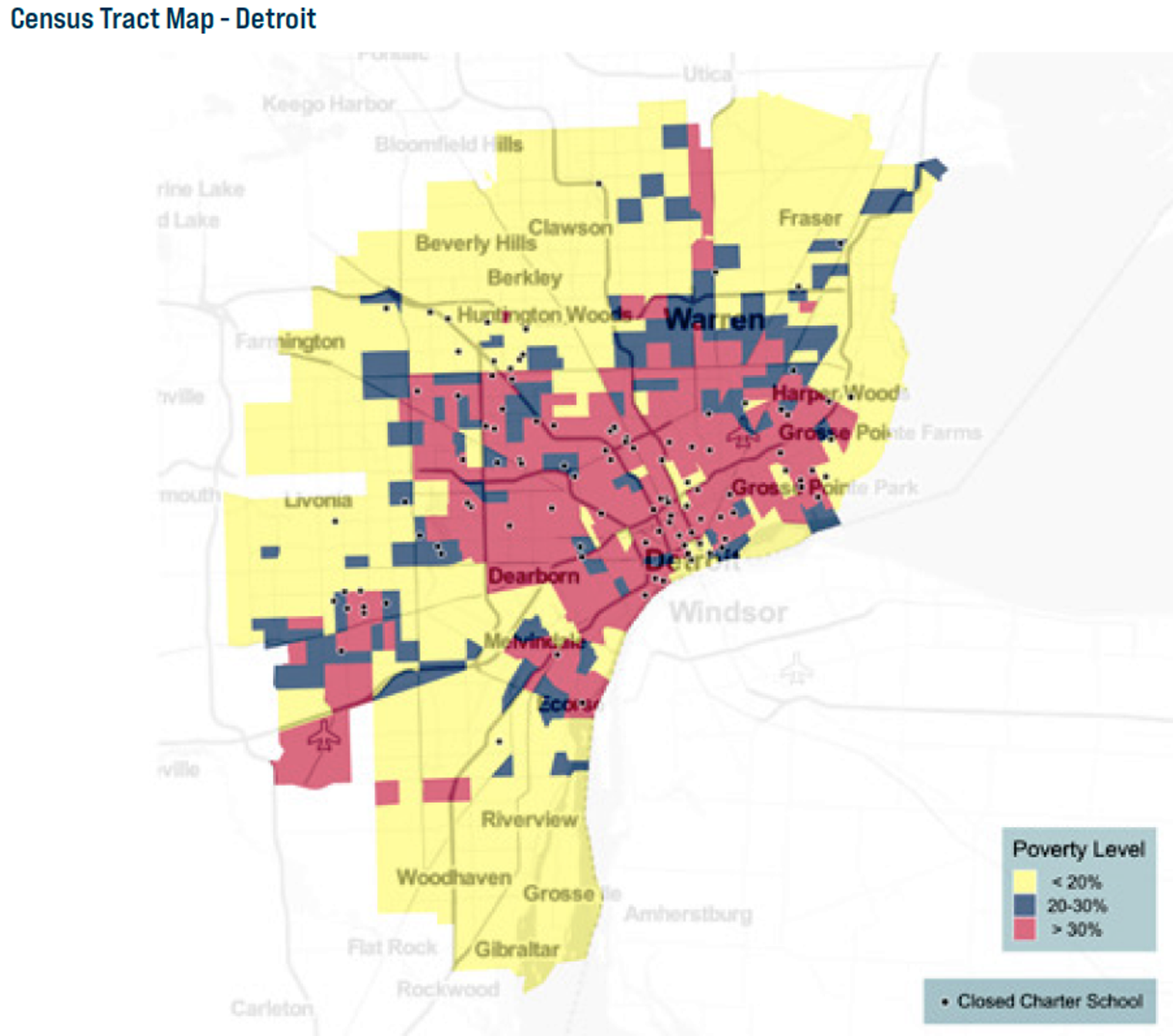
Census tract maps collated with charter school closures were utilized to understand where the closures were happening. In Detroit for example, they noted that between 1998 and 2015 245-charter schools opened of which 106 had closed (43%) by 2017.

The report states, “Fifty-nine percent of the failures were located in tracts with 30 percent or above rates of poverty, although there were a far greater number of tracts with lower levels of poverty.”

Census Tract Map Showing High Poverty Neighborhoods with Highest Charter Churn.

Mounting Evidence Shows Charter Schools Are Bad Policy

As charter schools started becoming a more significant part of local school districts, fiscal impacts mounted. In 2014, researchers Robert Bifulco from Syracuse University and Randall Reback from Bernard College published a study of the fiscal impacts in the public schools of Buffalo and Albany, NY. They estimated that the net costs in Buffalo were between $633 and $744 per pupil and in Albany between $976 and $1,070 per pupil. Thus, public school students were suffering reduced fiscal support in order to finance charter schools.

In 2016, Professor Bruce Baker of Rutgers University produced Exploring the consequences of charter school expansion in U.S. cities for the Economic Policy Institute. In the summary of this report he stated,

“Other reports have shown how high test scores and popularity of charter schools could be the byproducts of using data from cherry-picked charter schools that serve cherry-picked or culled populations. This report adds further insights for the debate on how expanding charter schools as a policy alternative achieves the broader goal. Specifically, it shows that charter expansion may increase inequity, introduce inefficiencies and redundancies, compromise financial stability, and introduce other objectionable distortions to the system that impede delivery of an equitable distribution of excellent or at least adequate education to all children.”

In 2017, NPE Executive Director Carol Burris produced “Charters and Consequences.” In it she stated,

“… nearly every day brings a story, often reported only in local newspapers, about charter mismanagement, failure, nepotism or outright theft and fraud.”

“This report … is the result of a year-long exploration of the effects of charter schools and the issues that surround them.”

To accompany the report, NPE started an ongoing web page, #AnotherDayAnotherCharterScandal, which catalogues and makes available the horrific charter industry record of fraud and malfeasance.

In 2018, Professors Helen F. Ladd of Duke University and John D. Singleton of Syracuse University published The Fiscal Externalities of Charter Schools: Evidence from North Carolina. Like the study of Buffalo and Albany they found powerful evidence that it was costing schools in Durham, NC $3600 per student lost to charters. The paper also stated, “We find smaller, though sizable, Net Fiscal Impacts in the non-urban districts and considerable heterogeneity across them.”

That same year professor Gordon Lafer of the University of Oregon published Breaking Point: The Cost of Charter Schools for Public School Districts.” Lafer stated,

“In 2016-17, charter schools led to a net fiscal shortfall of $57.3 million for the Oakland Unified School District, $65.9 million for the San Diego Unified School District, and $19.3 million for Santa Clara County’s East Side Union High School District. The California Charter School Act currently doesn’t allow school boards to consider how a proposed charter school may impact a district’s educational programs or fiscal health when weighing new charter applications.”

Last year, NPE published two investigations of the federal Charter Schools Program (CSP). In Asleep at the Wheel, they stated, “We estimate that program funding has grown to well over $4 billion. That could bring the total of the potential waste to around $1billion.” At a congressional hearing, Education Secretary Betsy DeVos speaking about the report testified, “The report that you referenced has been totally debunked as propaganda.”

In response, NPE redoubled efforts and in December published Still Asleep at the Wheel where they documented that their conservative claims in the first report under-reported the extent of wasted money and negligence associated with the CSP.

Time to join with the NAACP in their 2018 call for a charter school moratorium. With the industries record of creaming, advancing segregation and self-dealing, charter profiteering can not be accepted. Charters have not delivered significant education improvements just disruption, community harm and fraud. School chartering is a FAILED experiment.

School Choice and White Supremacy like Two Peas in a Pod

9 Aug

By Thomas Ultican 8/9/2020

In Overturning Brown, Steve Suitts provides overwhelming evidence for the segregationist legacy of “school choice.” He shows that “Brown v Board” has been effectively gutted and “choice proved to be the white supremacists’ most potent strategy to defeat it. In the 21st century, that same strategy is being wielded to maintain segregation while destroying the separation of church and state.

(Note: In this article references to “Overturning Brown” given as Suitts page#)

Defeating Brown

On May 17 1954, the United States Supreme Court handed down a unanimous decision in the case of Brown versus the Board of Education of Topeka, Kansas. Chief Justice Earl Warren stated, “In the field of public education the doctrine of ‘separate but equal’ has no place.” He added it is “inherently unequal” and plaintiffs were “deprived of the equal protection of the laws guaranteed by the 14th Amendment.”

A large portion of the United States was not intensely affected by the ruling but in the Deep South, the response was hostility and a determination to fight. Southern politicians organized a “massive resistance” movement. In Jackson Mississippi, the editor of the Jackson Daily news declared, “This is a fight for white supremacy” (Suitts 31).

Governors and state legislators established commissions or committees “to develop options for preserving segregation.” (Suitts 18)

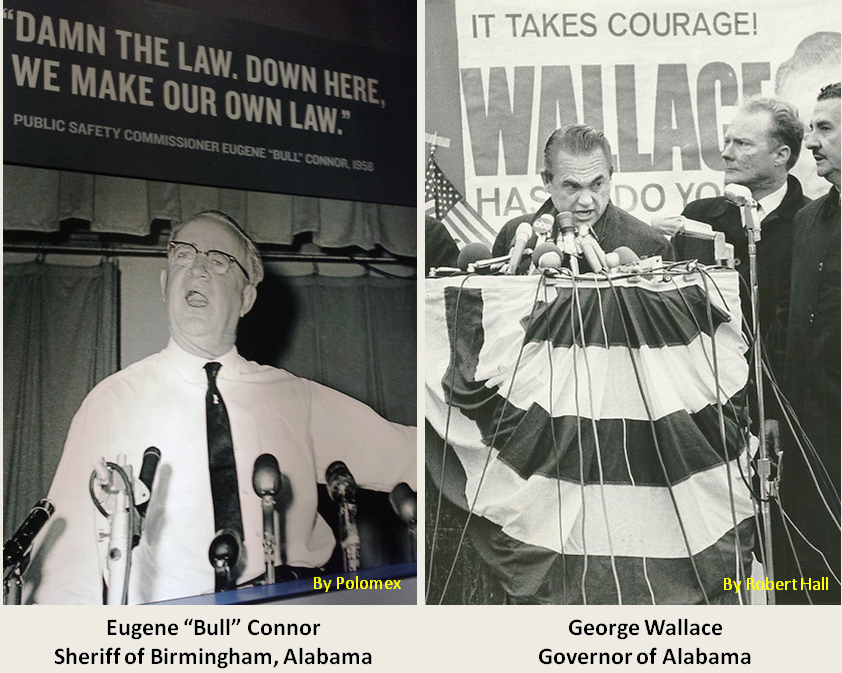
Wallace and Connor

People like Mississippi Senator James Eastland, Birmingham Commissioner of Public Safety Bull Connor and Alabama Governor George Wallace are well remembered for their egregious support of “white supremacy.”

Eastland who served in the US Senate for 30-years stated, “I have no prejudice in my heart, but the white race is the superior race and the Negro race an inferior race and the races must be kept separate by law.”

Bull Connor employed Birmingham firemen and policemen using water hoses and police dogs against African-American demonstrators. It was after his arrest during those demonstrations that Martin Luther King wrote his famous Letter from the Birmingham Jail. He stated in the missive, “We know through painful experience that freedom is never voluntarily given by the oppressor; it must be demanded by the oppressed.”

In 1958, John Patterson, bested George Wallace for Governor of Alabama. Patterson, a proven segregationist and former Alabama attorney general, had attempted to put the NAACP out of business through a series of harassing lawsuits. The loss prompted Wallace to vow, “No other son-of-a-bitch will ever out-nigger me again.” (Suitts 26)

In 1963, Wallace won the Alabama Governor’s office. In his inaugural address, he attacked governmental overreach in Washington DC and “the illegal 14th amendment.” That is the amendment to the constitution that guarantees all citizens “equal protection under the law.” It was the central argument under-girding the Supreme Court’s “Brown” decision. In the address written by soon to be Klan leader Asa Carter (Suitts 26), Wallace famously called for “segregation now … segregation tomorrow … segregation forever.”

These infamous segregationists were not decisive in stopping what they called the “forced mixing” of students in school. It was the committees and commissions with their schemes for school choice leading to “virtual segregation” that effectively frustrated “Brown”.

Soon after the “Brown” decision, Alabama’s Boutwell Committee reported their plan which aimed for “virtual segregation.” The report decried “forced integration” claiming it would lead to “violence, disorder, and tension for the state and its children.” (Suitts 20)

The primary intellectual force behind the plan was a corporate attorney in Birmingham, Forney Johnston. He was a staunch segregationist who represented Alabama’s Big Mules:” coal, railroads, wealthy industrialists and investors. (Suitts 19)

The Boutwell plan posited four basic strategies for stopping compulsory “mixing” of races in schools. The key to the plan was school choice and not mentioning race as a reason for not admitting a student. The four main points:

  • Eliminate all prohibitions against the operation of mixed schools.
  • Remove from the state constitution any suggestion that there is a right of education and an obligation of the state to fund public school children. The state is to promote education in a manner and extent consistent with available resources, and the willingness and ability of the individual students.
  • Give local school officials the power to refuse admission to individuals or groups whose scholastic deficiencies would compel undue lowering of school standards.
  • Provide vouchers and other tax funds for both black and white children. (Suitts 21)

The plan called for a school choice system that enabled children “to attend all-White schools, all-Black schools, or desegregated schools in a state-financed system of public and private schools.” They called it the “Freedom of Choice Plan.”

The editor of the Montgomery Adviser called it “manicured Kluxism.” The plan was ratified by 61% of Alabama voters in 1956. (Suitts 22)

Southern segregationists often “condemned integration as the work of communists.” (Suitts 32) Adopting the language of University of Chicago libertarian economist Milton Friedman, they began denouncing the “monopoly of government schools” calling it “socialism in its purest form.” (Suitts 59)

By 1965, most voucher programs adopted in Southern states had been declared unconstitutional including indirect expenditures such as tax credits. (Suitts 49) Sill it is estimated that by the 1980s in the eleven states of the former Confederacy as much as 75% of private school white students were virtually segregated. (Suitts 64)

Cornell’s Professor Noliwe Rooks noted in Cutting School that using the federal government’s economic power finally broke the back of state-sanctioned segregation in the South. Rooks shared, “By 1973, almost 90 percent of southern schoolchildren attended integrated schools.”

Re-segregating America’s Schools

When nominating Ronald Reagan in 1984, the Republican Party platform stated its opposition to busing for desegregation, support of private school tuition tax credits and vouchers for low-income students to attend private schools. It was the first time a major political party had called for vouchers.

In his acceptance speech, President Regan asserted, “We must continue the advance by supporting discipline in our schools, vouchers that give parents freedom of choice; and we must give back to our children their lost right to acknowledge God in their classrooms.” (Suitts 72)

Steve Suitts observed:

“…, the southern states’ first plan for defeating court-ordered desegregation, the one that Johnston and Boutwell devised in 1954 in Alabama, is exactly what today’s advocates and supporters of vouchers seek to implement: no compulsory ‘race-mixing’ in schools and no mention of any intent to discriminate. What could be more American than the freedom of parents to choose their children’s school – private or public – with public financial support? (Suitts 91)

Segregation by caste and segregation by class are the two common types of segregation. Caste segregation is by skin tone and class segregation is by economics.

With class segregation, it is perfectly acceptable for a few Black and Brown students to be in a school with a majority of White students if their parents hold the requisite wealth. Both types of segregation are harmful to all students.

The 1975 Supreme Court decision, Milliken versus Bradley, struck down inter-district remedies to segregation. Professor Jack Schneider of the University of Massachusetts claims this decision was the “beginning of the end of school desegregation.” He stated, “In determining that school districts could not be compelled to integrate students across their borders, Milliken dramatically narrowed the promise of the 1954 Brown v. Board case.”

In his Milliken dissent, Justice Thurgood Marshall stated, “Unless our children begin to learn together, there is little hope that our people will ever learn to live together.”

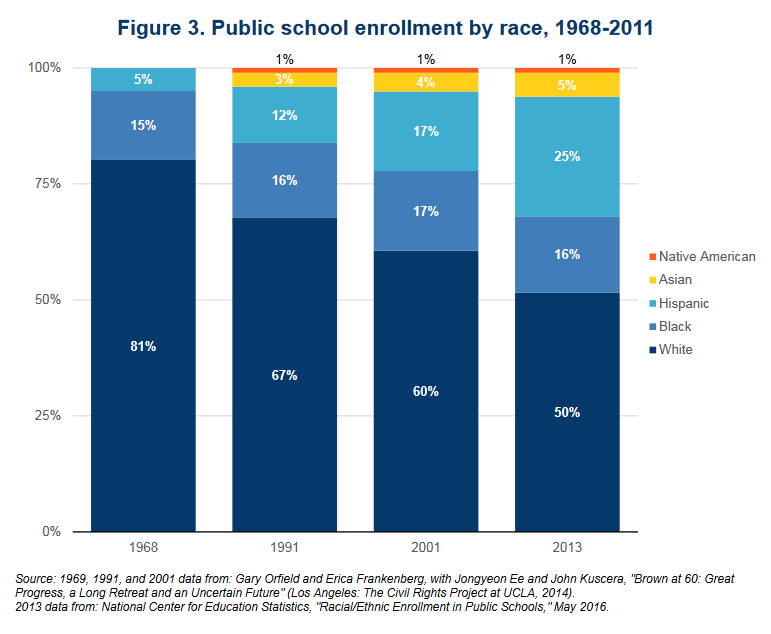
Public School Enrollment by Race Graphic

Brookings Chart Shows Growing Pluralism in American Schools

A paper from the Brookings Institute says, “School districts and metro areas that were released from court-ordered desegregation plans during the 1990s and 2000s showed a marked trend towards greater segregation, especially in the South.”

On the subject of desegregation trends, a Civil Right Project report from UCLA added,

“These trends began to reverse after a 1991 Supreme Court decision made it easier for school districts and courts to dismantle desegregation plans. Most major plans have been eliminated for years now, despite increasingly powerful evidence on the importance of desegregated schools.” (Emphasis Added)

In the 2002 Supreme Court ruling Zelman v. Simmons-Harris, the court ruled that publicly funded vouchers could be used to send children to religious schools providing that certain constitutional prerequisites were met. The divided court’s 5-4 decision allowed for taxpayers being forced by state law to send their dollars to religious schools.

In the Espinosa decision handed down this year, the Supreme Court again split 5-4 along what looks more like political lines than lines of legal judgment. Their decision means that if a state gives money to any private schools it cannot refuse money to religious schools.

Last week leaders of the Catholic Church in America penned an opinion piece championing a federal bailout. Cardinal Dolan, Cardinal O’Malley and Archbishop Gómez called for help with their fiscal problems. They stated,

“The most effective and immediate way to accomplish this is to fund scholarship assistance this summer to families who are economically disadvantaged and need such support. The scholarships would be used at Catholic or other non-government elementary or secondary schools. This approach would be similar to providing Pell grants that can be used at any institution of higher education, including religious institutions.”

In her fascinating book The Good News Club, Katherine Stewart quotes President Ulysses S. Grant’s diametrically opposite advice from that of the Catholic Church leaders. He said in 1876,

“Leave the matter of religion to the family altar, the church, and the private school, supported entirely by private contributions. Keep the church and state forever separate. With these safeguards, I believe the battles which created the Army of Tennessee will not have been fought in vain.”

Last fall, the Urban Institute studied where school segregation occurs. They concluded, “Holding school size constant, private and charter schools tend to have higher average contributions to segregation than traditional public schools.”

In the 1990s, charter schools first appeared. Since then, they have been significantly contributing to the re-segregation of America’s K-12 schools. A Brookings Institute study of segregation in schools reported,

“Charter schools are more segregated than TPS [traditional public school] at national, state, and metro levels. Black students in charter schools are far more likely than their traditional public school counterparts to be educated in intensely segregated settings. At the national level, 70 percent of black charter school students attend intensely segregated minority charter schools (which enroll 90-100 percent of students from under-represented minority backgrounds), or twice as many as the share of intensely segregated black students in traditional public schools.”

The growth of both charter schools and private schools has engendered growing segregation among America’s school children. This trend portends a divided inefficient society.

Professors Linda R. Tropp and Suchi Saxena along with many other sociologists and educators have conducted research identifying the clear benefit of and need for school integration. They state, “New social science research demonstrates the importance of fostering sustained interracial contact between youth in order to prepare them to thrive in a multiracial society.”

A research brief by Professor Genevieve Siegel-Hawley of Virginia Commonwealth University states,

“What is clear, however, is that racially diverse schools are not linked to negative academic outcomes for white students. And in a number of subjects, like math and science, diverse educational settings are consistently linked to higher test scores for whites. One analysis of 59 social science articles related to school composition effects on mathematics outcomes found, for instance, that math out-comes were higher at every grade level for students from all racial and SES backgrounds who attended racially and socioeconomically integrated schools.”

Conclusions

Steve Suitts book Overturning Brown: The Segregationist Legacy of the Modern School Choice Movement is strongly recommended for anyone interested in American education history or school policy.

To reverse the re-segregation of schools in America, stopping public school privatization is necessary.

The separation of church and state must be reestablished.