Archive | June, 2020

Reopening Schools and Debunking Demagoguery

21 Jun

By Thomas Ultican 6/21/2020

Education professionals throughout America are feverishly engaged in preparing for the first school year in the unprecedented Sars-Cov-2 era. Simultaneously, demagogues are pushing an often uninformed agenda.

For example, congressmen Jim Banks of Indiana and Tom Tiffany of Wisconsin have introduced legislation to force all schools to open with in-person classes by September or else lose federal funding.

At the same time McKinsey and Company, the 74 and other school privatization friendly groups are loudly proclaiming that an education gap disaster will devastate Black and Brown children if we do not reopen brick and mortar schools immediately.

Education Leaders are Getting Ready for Fall

Across California and the whole of the US, parents, students, teachers and administrators are involved in intense school reopening discussions with less than two months to go in some cases. County Health Departments in both Los Angeles and San Diego have indicated that masks will be mandatory for all students and school personnel.

California’s second largest school district, San Diego Unified School District (SDUSD), and other districts plan in-person, online and “hybrid” learning options. However, SDUSD will need an infusion of federal dollars to operate for the full year. Board President, John Lee Evans, says without financial help they will be forced to revert to all online learning in the winter semester.

On June 18th, Sweetwater Union High School District in Chula Vista, Calafornia held a virtual meeting for all stakeholders to lay out plans for starting school on August 3rd. It will include distance learning through August 28th and then implements students on campus in three phases. The initial transition to on campus learning limits the number of students to 10% of the student body at any one time. This would be ramped up to 20% and then eventually 50% of students would be allowed on campus at one time.

Districts are busy stockpiling surgical face masks and placing future orders. They are also ordering infrared thermometers, specialized cleaning supplies and personal protective equipment.

This kind of reopening planning is happening everywhere in America as the new school year approaches.

Perspective of the Pros in the Field

With school teachers facing a new school year, five veteran educators from San Diego County were interviewed. When all school campuses closed on March 13, these teachers participated in distance learning for the final three months of the school year.

They all felt that because of the hold harmless policies their districts embraced, the three months were not representative of what is possible. These five educators all taught at the high school level and when their students realized grades could only go up many students completely disengaged.

There was a large difference in engagement correlated with age. The more mature students were more engaged.

Student performance was related to type and level of classes. An AP physics teacher saw 90% attendance and felt most of his students did okay but not as well as his previous in person classes. He commented that, “some students seem to need the social environment in the classroom and became lost.”

On the other hand, the special education teacher co-teaching entry level math and English classes saw attendances of 25%-30%. As soon as his students found out about hold harmless, only a minority of students who were trying to raise their grades participated.

The Spanish teacher with 170 students on her rolls reports that 150 checked in but only about 40 who were trying to raise their grade actually engaged.

An AP literature teacher said that all of his AP students stayed with him until the AP exam but his one English 12 class, with the few exceptions of those who needed to raise their grades, basically checked out on March 13.

The literature teacher also mentioned that he felt like 100% distance learning was undermining his in-person credibility. Students communicate about their teachers and pass on who are the good teachers, whose classes are fun and who is interesting. They give each other tips on how to best navigate a certain teacher’s class. In cyber space, student-to-student communication is limited and it is almost impossible for a teacher to express their personality; be humorous, subtly sarcastic or employ irony.

The English and AP psychology teacher said after shifting to distance learning she thought she had found “nirvana.” Working from home, no commuting, grading was easy and then she started teaching a summer school session with 45 students who are re-taking a class they failed. She says, “Now, I am dealing with a different student population, the workload is overwhelming and students fake being in class.” She misses face to face classes.

The oldest teacher interviewed said if the fall reopening safety precautions were not robust, he might quit. One teacher was concerned about the possibility of bringing the virus home to her 85-years-old mother and another expressed mild concern about the implications of having been asthmatic as a child. The two youngest teachers expressed no concern about risk to their own health.

All five teachers were in favor of some form of hybrid model this fall. That would entail meeting all of their students on a weekly basis and conducting most lessons using distance learning principles. They seemed quite confident that this could be a successful model given the circumstances. Learning would still be at a high level but the social engagement teenagers need for mental health would be undermined.

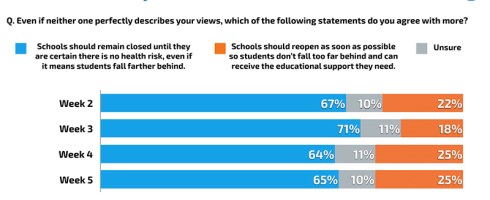
Echelon Insights at the Harvard Kennedy School recently queried parents about their concerns regarding education and Covid-19. Weekly surveys (April 27 – May 25) of 500 K-12 parents were conducted. It seems the San Diego teachers and American parents have aligned beliefs about the need for safety and the promise of strong learning.
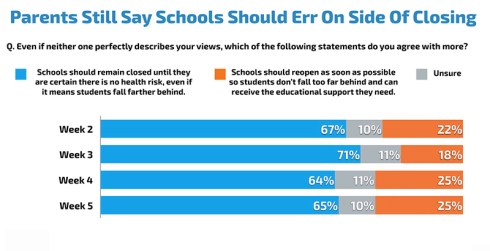
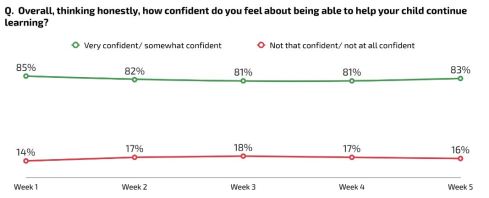
Parent-surveyParent-survey Continue Learning

Parents are more concerned about safety than getting school opened as fast as possible and it appears they believe their child will continue learning.

Schools Must Reopen Immediately!!!

The headline on a June 1st article by McKinsey and Company screams, “COVID-19 and student learning in the United States: The hurt could last a lifetime.” The sub-title says, “New evidence shows that the shutdowns caused by COVID-19 could exacerbate existing achievement gaps.”

Much of the McKinsey article is based on the theoretical work of Erik Hanushek and Paul E. Peterson who have made careers out of creating biased studies designed to promote privatization of public education and undermine teacher professionalism. In addition, McKinsey relies heavily on information developed by Curriculum Associates the owners of I-Ready and data from NWEA the Portland based testing publisher that sells MAP testing.

Sounding very much like the authors of the infamous A Nation at Risk”, McKinsey claims:

“All told, we estimate that the average K–12 student in the United States could lose $61,000 to $82,000 in lifetime earnings (in constant 2020 dollars), or the equivalent of a year of full-time work, solely as a result of COVID-19–related learning losses.”

“Furthermore, if other countries mitigate the impact of lost learning and the United States does not, this will harm US competitiveness. By 2040, most of the current K–12 cohort will be in the workforce. We estimate a GDP loss of $173 billion to $271 billion a year—a 0.8 to 1.3 percent hit (Exhibit 5).”
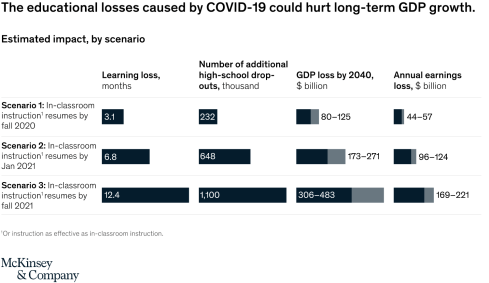
Exibit 5 GDP Harmed

Exhibit 5 – What Magic Algorithms Produced this Fantasy?

At the billionaire created publication, The 74, a June 9th article ran under the heading, “New Research Predicts Steep COVID Learning Losses Will Widen Already Dramatic Achievement Gaps Within Classrooms.” The widening is supposed to happen because of poor parenting, lack of resources at home and learning gaps expanding during school closures.

They also make the senseless claim, “But now, especially without spring exams to guide them, schools will have no idea on day one of the 2020-21 school year what the array of needs in each class is.”

It should be noted that most teachers do their own student evaluations because they find the standardized testing data almost useless even if it is available when needed.

Republican Congressmen Jim Banks of Indiana and Tom Tiffany of Wisconsin have introduced the Reopen Our Schools Act. Congressman Banks stated,

“Reopening our schools is the lynchpin to reopening our economy. Many parents rely on their kids going to school so they can go to work. To get our society up and running again, we need our children back in school.”

Congressman Tiffany who joined congress this May added,

“These open-ended school shutdowns have set students back, made it harder for teachers to teach, and pushed parents to the breaking point. It’s time to reopen America and get back to school.”

In their announcement the congressmen referenced a Wall Street Journal report claiming remote learning this spring “didn’t work.” Like McKinsey and The 74, the Wall Street Journal references projections made in a May 27 paper by NWEA.

The Northwest Evaluation Association was founded in 1977 when a group of researchers and testing directors met at the Jolly Roger restaurant in Chehalis, Washington. The participants were unhappy with current standardized testing in the United States because it was the same test everywhere and unaligned with curriculum. They chose the small town of Chehalis because it was half way between Portland, Oregon and Seattle, Washington where most of the members lived. Today, the organization is known as NWEA.

NWEA is another education service business that abuses the non-profit federal tax laws. In 2018, they sold over $148,000,000 in testing services and their tax document shows sixteen people with salaries ranging from $200,000 to $513,172.

NWEA publishes MAP testing which tests mathematics and English three times each school year; fall, winter and spring. The tests are not aligned to one class level so they are only partially aligned with state curricular standards. That is in part why teachers at Seattle’s Garfield High School boycotted MAP testing contending, “the MAP is not worth the time and energy it takes to give.”

Using data from approximately 350,000 students who took MAP tests in school years 2017-18 and 2018-19, analysts at NWEA created a report based on projections that guessed at what the negative education effects from the school shut downs would be.

NWEA is known to have first rate psychometricians, however their expertise cannot make up for the noisy data known to exist with education testing or the fact that the growth models they use has never been satisfactorily validated or that their parabolic data fits might be inappropriate.

NWEA’s paper is well documented but still little more than a guess about education results made by people who are not professional educators. This is hardly the basis for insisting that we recklessly endanger the health of students, teachers and families by opening schools without making safety the number one priority.

Conclusion

The hybrid model for opening schools appears to be the best pandemic alternative. Students attend schools that are employing best health practices once a week. The rest of the week they participate in distance learning.

It has been widely espoused that poorer children do not have adequate equipment and connections for distance learning. However, most school districts have been providing devices and it should be possible for schools to setup socially distanced homework centers for students who don’t have available internet connections. For example, high school gymnasiums could easily accommodate 70 students safely distanced.

The reality is that we are facing a highly contagious virus to which human beings have no defense. This means that some cultural norms are not possible. Formerly in addition to academics, schools also were effectively daycare centers. In this environment, they cannot safely perform that function. Businesses, parents, schools and communities must work together to mitigate this unmet need.

Extra-curricular activities like sports, chorus, band and club meetings are not possible. That is a harsh consequence of the pandemic.

However, if professional educators and schools are supported, there is every reason to believe student learning can safely continue at a high rate, academic gaps will not increase and intellectual development will remain on track.
Organized to Disrupt

10 Jun

By Thomas Ultican 6/10/2020

The New Schools Venture Fund (NSVF) is the Swiss army knife of public school privatization. It promotes education technology development, bankrolls charter school creation, develops charter management organizations and sponsors school leadership training groups. Since its founding in 1998, a small group of people with extraordinary wealth have been munificent in their support. NSVF is a significant asset in the billionaire funded drive to end democratically run public schools and replace them with privatized corporate structures.

1990’s Silicon Valley was a Happening Place

Mark Andreessen had just co-written the world’s first web-browser, Mosaic, before he came to town from the University of Illinois to co-found Netscape. John Doerr left Intel in 1980 to join the venture capital firm Kleiner Perkins where his reputation for picking winners became legendary. His wins include Amazon, AOL, Compaq, Electronic Arts, Google, Netscape and Twitter. Internet search engines were in their infancy when in 1999 Doerr convinced his partners to put $12.5 million into Google. Five years later that investment turned into billions.

Like elsewhere in America, every little strip mall in San Jose, California had a Blockbuster video rental store. In 1997, Reed Hastings and Netflix co-founder Mark Reynolds came up with a disruptive idea that put Blockbuster out of business. For a monthly fee, they offered DVD’s by mail with no late charges. Blockbuster did not adapt fast enough and went bankrupt.

In the Valley, everyone was aware that their business could be just one new technology innovation away from being the next Blockbuster.

“DoWopDon” Shalvey was the superintendent of schools in San Carlos, California a bedroom community about a third of the way up the peninsula between San Jose and San Francisco. When California passed its 1992 charter school legislation, Shalvey’s application for a charter turned into California’s first charter school. It officially opened in August 1994.

Apparently, Don Shalvey was an amateur DJ and very into music. His twitter handle is @dooWopDon.

Shalvey joined with Reed Hastings in writing a statewide initiative for the 1998 ballot that lifted the cap on charter schools and eased restrictions on starting one. At that time, Hastings was made president of Technology Network, a bipartisan lobbying group formed by Silicon Valley CEOs. With their support, the initiative quickly amassed more than a million signatures. Opposition from the teachers union ended as they were also fighting against other education proposals coming from Governor Pete Wilson’s office.

A deal was struck making the initiative unnecessary. Legislative leaders passed a bill containing the initiative’s key ingredients and union leader withheld their objections. The new bill green-lighted an unlimited number of charter schools and just as importantly the bill authorized a single board to oversee multiple charter schools. It was the birth of charter management organizations and a massive acceleration in new charter school development.

When Pete Wilson signed the new bill into law in May 1998, Shalvey and Hastings had $403,000 left in their initiative campaign fund. They decided to shift the money into a non-profit and founded what became the Aspire charter school network.

Meanwhile on the other side of the continent, Ann Smith graduated with a degree in political science and psychology from Columbia University in 1989 and started working for Wendy Kopp and the Teach For America (TFA) founding team. In 1993, she moved to the Silicon Valley area and co-founded the Bay Area Youth Consortium – AmeriCorps. In 1996, she left AmeriCorps to pursue a Masters in Business Administration at Stanford University.

Smith was co-chair of the Stanford business school’s entrepreneur club and she wanted to get Amazon founder Jeff Bezos as a speaker for the club. She asked her friend John Doerr to help and he agreed on one condition. In an education session at Al Gore’s house, the name NewSchools had been created. Doerr wanted her to come up with a use for the name.

Bezos spoke at the club and Smith worked on her assignment. She wrote a two page paper outlining the NewSchools Venture Fund. She had been inspired by what Don Shalvey and Reed Hastings had accomplished and thought to herself, “Why couldn’t entrepreneurial philanthropists come together to create networks of entrepreneurial education organizations?” Smith labeled the paper “Creating CMOs — scaling up with quality — with the help of venture-capital-style philanthropic investing.”

The history at the NSVF web-site says,

“NewSchools Venture Fund was created in 1998 by social entrepreneur Kim Smith and venture capitalists John Doerr and Brook Byers.” (Byers is a colleague of Doerr’s from Kleiner Perkins)

“We were among the first and largest investors in public charter schools and the first to identify and support multisite charter management organizations, which launch and operate integrated networks of public charter schools.”

“NewSchools’ work to support digital learning tools began at our inception in 1998.”

Philanthropy Magazine notes that Reed Hastings helped, “to launch the NewSchools Venture Fund.”

Big Money and Political Connections

LittleSis NSVF Map

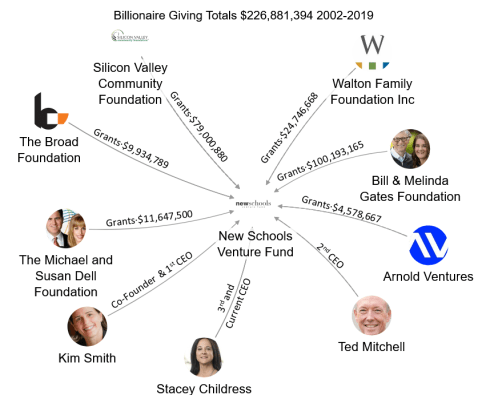
LittleSis Map of NSVF Massive Funding By Billionaires

While there is little doubt the Bill Gates and The Walton Family Foundation are the largest individual donors to NSVF, the $226,881,394 in grants documented in the map above are only a fraction of the total billionaire largess. Besides receiving help from Reed Hastings, over the last 20-years, billionaires John Doerr, Laurene Jobs Powell and John Sackler have served on the board, but there is no information about any of their monetary contributions.

Kim Smith was the founding CEO of NSVF. The second CEO was Ted Mitchell the former President of Occidental College and a founding board member of NSVF. Mitchell replaced Kim Smith as CEO in September 2005 and held the position until 2014. From 2008-2010, he was simultaneously President of the California State Board of Education.

Mitchell has also served on the boards of New Leaders, Khan Academy, California Education Partners, Teach Channel, ConnectED, Hameetman Foundation, the Alliance for College-Ready Public Schools, Silicon Schools, Children Now, Bellwether Partners, Pivot Learning Partners, EnCorps Teacher Training Program, the National Alliance for Public Charter Schools, and the Green DOT Public Schools.

On May 8, 2014 EdSource reported, “Former State Board of Education president Ted Mitchell was confirmed Thursday as under secretary of education, the third-highest ranking official at the U.S. Department of Education.”

NSVF’s 2010 990-tax form had a note that claimed, “To date, the Organization has successfully received support from … the U.S. Department of Education.” From 2003-2007, NSVF reported $5,997,900 in grants from governmental sources. In 2008, the line requiring listing governmental grants separately disappeared from the 990-tax form. There is no longer an easily accessible method for gaining that information.

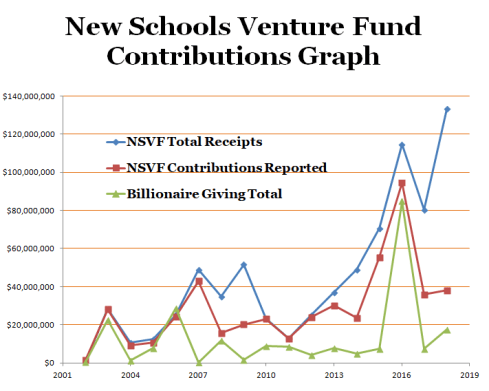
Contribution Graph

Enormous Grant Amounts Reported by NSVF and Selected Billionaires

In the graph above the billionaire giving in green is for yearly totals from the tax reports by the billionaires in the LittleSis Map above. The 2016 spike occurred because some unknown entity contributed $68,000,000 to NSVF through the donor directed foundation Silicon Valley Community Fund.

In 2016, Reed Hastings created a $100,000,000 fund within the Silicon Valley Community Fund. At the same time, Laurene Jobs Powell was serving on the board of NSVF when her XQ Institute was granted $24,750,000 in 2015 and $57,402,973 in 2016. Either one of them could have made the large contribution or maybe it was someone else.

Every year NSVF hosts a “Summit” in Oakland, California which they state brings together more than 1,200 educators, entrepreneurs, community leaders, funders, and policy makers to share ideas on how to “reimagine learning.” These “Summits” are a must attend for the disrupter community and they drive contributions.

To replace Mitchell as CEO when he left for the Department of Education in 2014, NSVF brought in Stacey Childress from the Bill and Melinda Gates Foundation. Childress earned an MBA from Harvard Business School in 2000. Afterwards, she spent a year co-founding an enterprise software sales company and then returned to Harvard where she was a Senior Lecturer and Executive Director. In 2010, Childress became Deputy Director of the Gates Foundation. She has been CEO of NSVF since arriving in 2014.

Both Mitchell and Childress have received NSVF salaries in excess of $500,000. The 2018 NSVF tax-form explanation of their compensation method reads,

“The organization obtained compensation studies from several independent sources to compile information used as a metric for salary increases … A subcommittee of the Board of Directors (BOD) conducts the review of the CEO and develops a recommendation for the full BOD.”

This is similar to the method that has ballooned executive pay in corporate America while line worker wages have stagnated. It is a method that justifies those at the top getting an ever greater share.

Investing in Privatization and Education Technology

NSVF claims they have invested in 117 Ed Tech companies, 187 charter schools and 55 diverse leaders programs.

Among their Ed Tech investments are Class Dojo, EdSurge, LearnZillion, Phet Interactive Simulations and Education Elements. When NSVF makes a major investment in an Ed Tech startup, they require a position on the companies governing board.

One of NSVF’s founding board members, Dave Whorton, is also the founder of Tugboat Ventures. When NSVF invested in Education Elements so did Tugboat Ventures. Dave Whorton was made a member of Education Elements Board of Directors where he efficiently keeps an eye on funds from both Tugboat and NSVF.

When first founded, NSVF invested heavily in Aspire Public Schools because of their plan to create a charter management organization. In 2001, they granted $1,095,000 of their total of $2,468,000 in giving to Aspire.

As their wealth grew the grants to charter schools became very similar to the grants their funders were making. They have funded DC Prep, Phalen Leadership Academy, Rocketship Education, Success Charter Network, Yu Ming Charter School and almost 200 more.

The Yu Ming Charter is essentially a private Mandarin immersion school that has just submitted a material revision to their expansion plan that was rejected in December. It has been alleged the Yu Ming does not want new students above the kindergarten level. A parent comment on the Berkeley Parent Network says, “The teachers seem reluctant to admit kids who aren’t quite up to par in Mandarin as it can be really overwhelming for students to be new and they don’t want to see them struggle and be under water from the get-go.” To which Oakland Educator Jane Nylund responded,

“Real, authentic public education is hard; we deal with struggling students every day as expected, standard educational practice. We don’t find a way to reject them because they are ‘struggling’. This honest assessment by an involved parent is just more evidence of a ‘public school’ in name only, and not in practice.”

NSVF’s diverse-leaders investing is aimed at replacing quality teacher education at universities with for profit organizations that have very limited expertise. It is also aimed at selling the privatization agenda. NSVF invested in Branch Alliance for Education Diversity, edfuel, MindWorks Collaborative, National Charter Collaborative, School Board Partners, TNTP and fifty more organizations.

School Board Partners came out of Education Cities when The City Fund was established. They appear to want influence over school board members by offering training; a function every state already provides. They are a part of selling the privatization agenda.

TNTP was rolled out of TFA by Wendy Kopp and Michelle Rhee. Before the billionaire driven push to privatize public education a “non-profit” company like TNTP would have gotten no consideration for training teachers because they are unqualified.

Final Comments

Kim Smith staid on the board at NSVF and in 2011 co-founded Bellwether Education Partners. The next year she founded the Pahara Institute where she is the CEO. Her 2016 pay reported on tax forms signed by her was $419,576. (Update: Smith recently stepped down as the Pahara CEO.)

DoWopDon (Don Shalvey) is now Deputy Director of the College Ready Team at the Bill and Melinda Gates Foundation.

NSVF along with scores of billionaire funded Foundations has been spending staggeringly large amounts of money to privatize public education and monetize it. This spending has been going on for decades now. So, why are about 90% of America’s students still attending public schools? The answer is simple.

The “disrupter” products are bad and Americans are not buying what their selling.