Archive | May, 2020

Persistent Billionaire Financed Attack on Oakland Public Schools Continues

29 May

By Thomas Ultican 5/29/2020

This month, a survey was launched in Oakland, California with the claim “This survey is a primary partnership between OUSD and GO Public Schools Oakland.” Apparently some Oakland Unified School District (OUSD) board members were stunned by the news and were not happy about raising the stature of a billionaire financed organization dedicated to privatizing public schools. It seems the survey resulted from a secret negotiation between OUSD administrators, GO and possibly some OUSD board members.

On May 13, when OUSD Director Shanti Gonzalez learned about the Survey, she wrote to Superintendent Kyla Johnson-Trammell,

Hi Kyla. Can you tell me more about the robocall that went out today that referred parents to GO’s website/survey and why it was decided to send this to parents? We don’t typically use our infrastructure to refer people to groups that engage in political activities, so I am curious.”

Two days later Gonzalez wrote again,

“I understand the desire to collaborate and avoid duplication of efforts, but please remember that GO plays two roles in the Oakland education arena. In this case, their intent was to support our efforts to understand families’ needs. Their other role is to shape the composition of the board of OUSD and ACOE [Alameda County Office of Education], and to support the growth of charter schools, at least historically.”

OUSD Director Roseann Torres was characterized as being hopping mad when she found out about the survey. In an interview Torres stated,

“The Superintendent will not respond to my emails about the survey. She doesn’t care that as a Director, I am her boss.”

On the other hand Director Jody London’s response to constituent questions about the survey indicates that she was informed. She writes,

“The OUSD Office of Equity and family engagement team are collaborating with GO and a number of other Office of Equity partners to reach as many families as possible with the survey that will provide very important information about our planning the reopening of school. The survey is standalone and initially only directed participants to GO if they wanted to provide information to receive the mailed school supplies thank you gift. That has now changed …”

“This more collaborative approach with a number of partners on the family survey will give us the best opportunity for a strong level of participation and useful feedback about reopening.”

Survey Sponsors 

Logos of the OUSD Survey Partners

Originally the above logos were depicted at the top of every page of the survey and a gift offering at the end of the survey required the takers to give their email addresses to GO Public Schools. After Oakland Education Association President Keith Brown became involved, the direction to GO Public Schools was replaced and logos at the top of each page were eliminated. People were directed to the OUSD web site to apply for the gift and the only logos shown were from OUSD and GO on the bottom of the intro page.

This survey is transparently GO’s and there is another survey by OUSD which is somewhat similar. The committee that created the second survey includes Teach For America (TFA), KIPP charter schools and others. It appears the content of both surveys are important to the charter industry. The GO survey seems to bias towards technology implementation and the other survey appears to be priming a unified enrollment system.

Privatization in Oakland Driven by Billionaire Dollars

Chris Stewart is a 2014 Bush Fellow, the CEO of Brightbeam and sits on the board of Great Schools. He feels the claims of billionaire dollars are unfair. He sees them as working to create “quality schools” or does his high six figure billionaire paid salary cause that opinion? Without billionaire dollars and a state take-over, Oakland public schools would be much healthier and the community would not be so divided.

The billionaire spending to privatize public schools in Oakland has been enormous.

Tax records document that just two foundations, The Bill and Melinda Gates Foundation (EIN: 56-2618866) and the Walton Family Foundation (EIN: 13-3441466) have spent more than $240,000,000 on privatization efforts in Oakland.

The Silicon Valley Community fund was formed in 2006. It has become an extremely large donor directed fund with reported assets of about $8 billion dollars. In 2018, it took in almost $6 billion dollars. Only three years of their 1,500 page long tax reports (EIN: 20-5205488) are searchable but just those three years show more than $15,000,000 spent on privatizing schools in Oakland including a 2017 gift to GO of $1,000,000.

This year, The City Fund – which was founded by two billionaires in 2018 – reported spending $7,591,666 on privatizing Oakland public schools. The City Fund supports the implementation of the “portfolio model” of school administration to drive privatization.

The portfolio model directs closing schools that score in the bottom 5% on standardized testing and reopening them as charter schools or Innovation schools. Oakland’s school board implemented this model in 2018 under the name “Citywide Plan.” The method makes it almost certain that schools in poorer and minority communities will be privatized.

In 2004, Don Fisher of the GAP and Buzz Wooley a San Diego investor put up $100,000 each to establish the Charter School Growth Fund. In 2005, Buzz Wooley resigned from the presidency and Jim Walton took his seat on the board. Since then the Walton Family Foundation has had significant influence over the fund. Between 2012 and 2017 the Charter School Growth Fund (EIN 05-0620063) spent $12,998,570 supporting privatized schools in Oakland.

The Ely and Edythe Broad Foundation (EIN 95-4686318) has spent a relatively modest $3,457,664 on privatized schools in Oakland. However, four different graduates of Broad’s strange education leaders training academy have served as superintendents of OUSD between 2003 and 2018. Diane Ravitch recently noted that “Broad Institute got accredited even though it has no faculty, no campus, no course catalogue ….” It was accredited by the Western States Schools and Colleges. There have been two common outcomes wherever “Broadies” serve; labor and community unrest accompanied by extreme budget issues.

The latest budget problems in Oakland trace directly to the tenure of Antwan Wilson the last Broad trained superintendent to run Oakland’s schools.

Are Billionaire Bought Board Members Now a Board Majority?

Roseann “Rosie” Torres is a lawyer who moved from her hometown of Stockton to Oakland in 2004. A civic organization she joined gave her a homework assignment to study the public school district budget. This opened her eyes to the tremendous inequities between the schools in the hills where she lived and those in the flats where much of Oakland’s minority population lived.

In 2012, school board member Noel Gallo convinced Rosie to run for the seat he was vacating so he could run for city council. Before his tenure on the school board SFGate reports, “In the mid-1990s, Gallo was a city employee during then-Mayor Jerry Brown’s two terms in office, working as a staff member for former City Manager Robert Bobb.” That is the same Robert Bobb who would take the Broad training course in 2005 and become the Detroit public school’s first emergency manager in 2009. Gallo introduced Rosie to GO Public Education.

In 2012, GO provided Torres with $37,847 in independent expenditures and helped her raise $36,635 in direct campaign contributions. These were historically large numbers but that same year GO was providing even larger campaign assistance to James Harris and Jumoke Hinton-Hodge. All three candidates were successful.

In addition, GO representatives introduced Torres to many Democratic politicians serving locally, at the state capital and in congress. Torres said she really did not know who GO was and it took her about six months after the election to figure it out.

After Torres turned against the GO privatization agenda, there assistance unsurprisingly ended. In 2016 when she ran for reelection, her total campaign money fell from the 2012 $74,000 to $17,725, however a group of local activists went to work for her and she won.

Torres will not be running for reelection this year. She needs a break from the pressure and drama.

In 2012, billionaires started actively engaging in local school board elections. All at once, school board elections in cities like Dallas became well funded and prohibitively expensive. That same year billionaires including Stacy Schusterman of Tulsa, Oklahoma, Michael Bloomberg of New York City, Laurene Jobs Powell of Palo Alto, California and others started making max donations to certain Oakland school board candidates.

The direct contribution limits of $700 made the independent expenditures with unlimited spending the place where most of their money went. In Oakland, that independent expenditure money was funneled though the GO Public School Advocates committee.
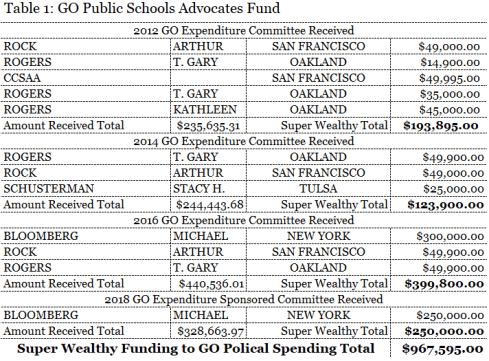
Table of Independent Expenditures

In 2018, $146,000 of Michael Bloomberg’s $250,000 contribution was put into the campaign to elect Gary Yee. Six years earlier, Yee was the focus of a recall campaign which was mainly about his push for closing schools. With Yee’s election, forces for privatization and school closing seem to have gained a solid majority on the OUSD board.

Some Closing Observations

The state government is also being corrupted by the prolific billionaire spending that is undermining democracy in America. In 2018, AB1840 which provided extra funding for financially strapped Oakland and Inglewood school districts was signed by Governor Brown. The root of their financial problems was the same; paying the extra unfunded costs associated with charter school openings and financial mismanagement by Broad trained superintendents.

One of the mandates for receiving financial help was the involvement of the Fiscal Crisis Management Assist Team (FCMAT) in stabilizing the budget. FCMAT was created and signed into law in 1991 by Governor Pete Wilson. The Kern County Superintendent of Schools office was selected as the administrative and fiscal agent for FCMAT. The purpose of FCMAT was to provide districts experiencing budget issues with professional leadership. However, this non-profit organization has developed a reputation for being more about helping political allies than struggling school districts.

FCMAT appears to have two strategies for solving district financial issues; laying-off personnel and closing schools.

On Memorial Day (May 25), the State Senate Fiscal Review Committee met to consider the May revise including AB1840 money for Oakland and Inglewood. Jane Nylund an Oakland resident and educator submitted a comment that reads in part,

“I strongly oppose the amendments of the Trailer Bill to AB 1840 regarding disbursements to Oakland Unified School District for 2020-21.”

“These amendments strip our local discretion to draw from the variety of strategies for fiscal solvency, listed as (c)(1)-(5). The language is clear:  the District “MAY” use the strategies. It is not mandated to use any particular one of them.

“Given the current situation with Covid-19, and all the unknowns that come with it regarding schools, it is completely inappropriate that OUSD is held hostage to sell property that it may find necessary to keep open in order to mitigate health risks of Covid-19.”

Community based schools run under the authority of an elected school board have served as the foundation for American democracy for two centuries. Feckless billionaires operating from hubris or theological commitment or a desire to avoid taxes or a pursuit of more wealth are sundering those foundations.

Will activists of good will be able to throw off the yoke of billionaire financed tyranny and defend their public schools in Oakland?
Eckhart Tolle Meets John Dewey

20 May

By Thomas Ultican 5/20/2020

Professor Michael J. Hynes new book Staying Grounded; 12 Principles for Transforming School Leader Effectiveness inspired this title. I have an aversion to self-help writings and new-age philosophy. After reading two chapters, that is exactly how I saw this book. It made me wonder why my friend Diane Ravitch recommended it. After reading a few more chapters, I got it. There is a lot to like. If the principles taught in this book were widely embraced, it would be a boon to education everywhere.

Staying Grounded Picture

In the introduction Hynes tells the reader that he will reveal his ideas concerning the purpose of schooling and how to ensure that each child reveals their potential. He opens by recommending the “philosophy that recognizes the fact that all children are different and meet them where they are.”

This a great starting point but it runs squarely into the devilish nature of standards based education. At the beginning of the new millennia, the cruel standards based philosophy began dominating classrooms. It was heartbreaking to observe students who although learning; were not learning fast enough. Instead of being encouraged while their intellectual abilities grew, they were crushed and taught to hate learning. That definitely was not meeting “them where they are.”

The book started naturally enough with principle one. It opened by quoting the Buddha, “It is better to conquer yourself than to win a thousand battles.” The point was that a busy administrator needed some regular self care. Buddhist philosophy is known as the inner path. Principle one was all about entering the inner path. It ends with another of the Buddha’s admired philosophical points, “When things change inside you … things change around you.”

Principle two continued imparting more new age philosophy to fix the budding administrator’s attitude. The reader is assured attitude is more important than aptitude in the life of a successful school leader. A positive attitude is held up as key. Hynes notes, “90% of the people you complain to don’t care and the other 10% are glad you have the problem.” An amusing and insightful quote, but it still only obliquely addressed education philosophy and leadership.

Principle three, “It’s All About Relationships” brought a big change to the tenor and usefulness of the book. In a vignette, a Deputy Superintendent named Julio V. Delgado shared, “Like many administrators, I was chasing scores, looking for a magic curriculum to close the achievement gap, and best of all, looking at what other districts were doing so I could replicate it ‘back home.’” He recognized a fundamental error in his approach and concluded, “It’s the connections and relationships we make and foster among others, that lead us to success and serve as the ultimate model for children as they develop.”

In the organization of each chapter the principle is stated, personal stories are shared by various school leaders interspersed with explanations of the principle. There are descriptions of the principles benefit to all stake holders – leaders, teachers, parents and students. The conclusion is practical guidance for how to implement the principle. Starting with principle three this section becomes specific and challenges the budding school leader with concrete suggestions. This is where I started seeing the great value in what Professor Hynes was sharing.

What is the Purpose of Education?

This is a question of central importance to the development of our culture and civilization. Professor Hynes addresses it by stating,

“It is important to recognize that other people, including many of your fellow educators, administrators, and our students’ parents might have a different point of view concerning what education should be all about. That’s okay! What’s important is that you define in your own words, your purpose of what education is to you.”

In responding to the question, I decided to look a little at what Hynes and others have written. Hynes quoted James Harvey, the President of the National Superintendents Roundtable, “K-12 education should prepare students for life – for college, for work, for living within a family and within a community, and for participating effectively in the democratic process.” Although future employment is needed for most young people, Harvey believes K-12 education is more than just job training.

Hynes also looked back to the great humanist Eleanor Roosevelt’s thoughts on the issue. In 1930, she wrote,

“Perhaps because there are so many books and the branches of knowledge in which we can learn facts are so multitudinous today, we begin to hear more frequently that the function of education is to give children a desire to learn and to teach them how to use their minds and where to go to acquire facts when their curiosity is aroused. Even more all-embracing than this is the statement made not long ago, before a group of English headmasters, by the Archbishop of York, that ‘the true purpose of education is to produce citizens.’”

“But there still remains a vast amount to be done before we accomplish our first objective-informed and intelligent citizens, and, secondly, bring about the realization that we are all responsible for the trend of thought and the action of our times.”

There is a danger lurking in Roosevelt’s view. While production of good citizens is an admirable goal, there is a dystopian risk of reinforcing the utilitarian view of human life. When she was writing these words, the Japanese and German education systems were focused on producing a certain type of personality reduced to a subordinate position and viewed as a means to other ends.

Daisaku Ikeda, the Buddhist teacher and founder of Soka schools, writes that Japan is suffering “the consequences of making education subordinate to bureaucratic and political agendas under the control of the Ministry of Education.” With the passage of the “No Child Left Behind” Act, the US abandoned the philosophy of local control and embraced the concept of a powerful bureaucracy steering education. As a society, we turned our backs on two centuries of steadily improving free universal public education and adopted a system vulnerable to political agendas.

That 2002 decision was a huge backwards step for “a society that serves the essential needs of education.” Columbia University’s Professor Robert Thurman, in an interview at Boston’s Ikeda Center, responded to the question, “How do you view the role of education in society…?” He replied,

“I think the question should rather be, What is the role of society in education? Because in my view education is the purpose of human life. It’s not that the purpose of education is to fit out humans to go and produce something.”

In his book Democracy and Education, John Dewey stated,

“Discipline, culture, social efficiency, personal refinement, improvement of character are but phases of the growth of capacity nobly to share in such a balanced experience. And education is not a mere means to such a life. Education is such a life. To maintain capacity for such education is the essence of morals. For conscious life is a continual beginning afresh.”

Dewey’s contemporary in Japan, Tsunesaburo Makiguchi, wrote,

“What is the purpose of national education? Rather than devise complex theoretical interpretations, it is better to start by looking to the lovely child who sits on your knee and ask yourself: What can I do to assure that this child will be able to lead the happiest life possible?”

The purpose of education is to create the space for people to fully manifest their abilities and express their inner essence while going through the natural stages of human development. In accord with Dewey, I believe, “To maintain capacity for such education is the essence of morals.” As Makiguchi said, assure that students can “lead the happiest life possible.”

Create a Better Education Structure

The rest of Michael Hynes book is filled with ideas for improving leadership skills in education. He advices superintendents to substitute teach and goes into great detail about how to derive the maximum benefit from the experience. Hynes spends four pages discussing shadowing students. He describes how to do it and its benefits. Hynes addresses many if not most of the issues a budding administrator needs to excel at in order to be a positive change maker. Administrators adopting Hynes 12-principles will benefit not only themselves but also their schools, students and communities.

However, this book can also be seen as dealing with the unfortunate outcomes of the authoritarian structural flaw innate to schools. The central figure (principal or superintendent) have the predominance of power in a system where administrators rule. Under this organization the only path to professional advancement is leaving the classroom to become an administrator.

I suggest changing this undemocratic autocratic scheme by employing democratic principles of governance that shares power between students, teachers and administrators.

Create an educator’s track the leads to advancement as a master teacher, department leader and curriculum expert. Teaching assignments and professional evaluations would fall under the responsibilities of this group. They would hold sway over new hires to their department.

When it came to school policies and final curricular decisions, students would be consulted and their input would have real significance.

Administrators would be responsible for facilities, daily discipline issues and communicating with parents.

The three groups would meet regularly and continually engage in dialog to reach consensus on all school issues.

Conclusion

Michael Hynes’s Staying Grounded is a good read filled with many wonderful concepts for improving school operations. I recommend the book.

Finally, I really liked this quote Hynes shared from Aristotle,

“It is the mark of an educated mind to be able to entertain a thought without accepting it.”

CREDO’s New Study Biased against Public Schools

14 May

By Thomas Ultican 5/14/2020

The Center for Research on Education Outcomes (CREDO) started releasing the results of its new Cities Study Project in mid-2019. It is not a coincidence that the cities chosen for the study have long been targeted for public school privatization. The ten cities selected are: Indianapolis; Baton Rouge; Camden; Kansas City; Memphis; New Orleans; Oakland; St. Louis; San Antonio; and Washington DC. This CREDO study is even more opaque and biased than its previous efforts.

Who is CREDO?

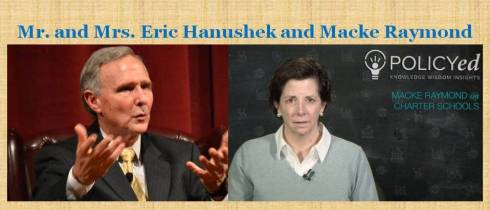
Hanushek and Raymond

Husband and Wife Team Who Founded CREDO

In the early 1980s, Margaret (Macke) Raymond was completing a lengthy graduate school agenda at the University of Rochester, a relatively small private university in Rochester, New York. She garnered an MS of public policy in 1980, a community medicine MS in 1982, an MA of political science in 1983 and finished with a PhD in political science in 1985. From 1985 to 2000 she ran Raymond Consulting and worked a few years in the telecommunications industry.

At that same time, Eric Hanushek was Professor of Economics and Political Science at Rochester University. The former Air Force cadet had earned a doctorate of Economics from the Massachusetts Institute of Technology in 1968. It was Hanushek’s 1981 paper “Throwing Money at Schools” that put him on the watch list of right leaning philanthropies and institutions. In his notice making missive he stated,

“The conventional wisdom about public schools is that they face serious problems in terms of performance and that improving schools requires additional money. However, the available evidence suggests that there is no relationship between expenditures and the achievement of students and that such traditional remedies as reducing class sizes or hiring better trained teachers are unlikely to improve matters.”

In a 1981 Ed Week commentary referencing this paper, Hanushek points to SAT testing as the gold standard for judging school performance. In complete accordance with the old aphorism, “to a man with a hammer all problems look like a nail,” Hanushek brags, “Advanced statistical techniques are employed to disentangle the influences on achievement of schools and teachers from those of other factors such as family backgrounds and student abilities.”

A 1999 announcement from Rochester University said, “The Center for Research on Education Outcomes has been established at the University of Rochester’s Wallis Institute of Political Economy…” In the same posting, it was revealed, “Two foundations have committed $1.25 million to fund a three-and one-half year initiative to address the current shortage of evaluation research in education policy matters.” CREDO never made the name of the two foundations public, but a knowledgeable academic says one of them was the Walton Family Foundation.

The announcement listed two employees of the new center, Eric Hanushek and Margaret Raymond. Hanushek was listed first but Raymond was cited as the founding Director.

CREDO moved from the University of Rochester to Stanford University’s Hoover Institute in July, 2000 which made networking in conservative circles much easier.  In CREDO’s 2nd year report, they stated that moving to the Hoover Institute brought them many new contacts including the New Schools Venture Fund, the District of Columbia Charter School Board, the Teacher Union Reform Network and others.

A description of the Hoover Institute from Source Watch says,

“The Hoover Institution is influential in the American conservative and libertarian movements, and the Institution has long been a place of scholarship for high profile conservatives with government experience. A number of fellows have connections to or positions in the Bush administration, and other Republican administrations. … Other fellows of the Institution include such high profile conservatives as Condoleezza Rice, George Shultz, Thomas Sowell, Shelby Steele, and Edwin Meese.”

Macke Raymond’s 2015 Hoover Institute Fellow’s profile says in part, “In partnership with the Walton Family Foundation and Pearson Learning Systems, Raymond is leading a national study of the effectiveness of public charter schools.” 

Valerie Strauss of the Washington Post has pointed out that Eric Hanushek

“… a Hoover economist was a pioneer in creating systems that evaluate teachers by student standardized tests, a method that many assessment experts say should not be used in the high-stakes ways that school reformers are using them. He is often cited in CREDO studies as a ‘principal investigator.”’

Discredited and Biased

The Forbes commentator, Peter Greene, wrote about Eric Hanushek for his popular blog Curmudgucation:

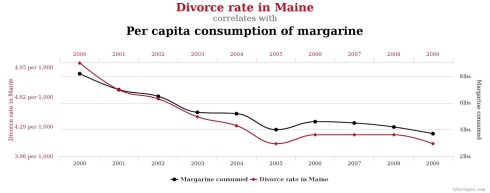
“Now when Hanushek says that teachers make a huge difference, he is obliquely referencing his own crazy-pants assertion that having a good first grade teacher will make you almost a million bucks richer over your lifetime (you can also find the same baloney being sliced by Chetty, Friedman, and Rockoff). Both researchers demonstrate their complete lack of understanding of the difference between correlation and causation.”

Greene also shares the following graphic that clearly highlights the difference between correlation and causation.

Divorce caused by Margarine consumption

Does Margarine Consumption Cause Divorce?

Business writer Andrea Gabor states that CREDO studies which compare charter schools with public schools start with two key assumptions “A) That standardized-test scores are an adequate measure of school quality and B) that creaming in charter schools does not exist.”

With regards to assumption ‘A’, using standardized testing for this purpose has been shown faulty from studies dating back to the eugenics movement (which originated high stakes standardized testing) to recent works debunking them for mistaking correlation versus causation and for not being able to compensate for the problem of error.

As for assumption B, there is no doubt that most charter schools push out and avoid students that are classified as special education, language learners or discipline problems. The data proving that is in state enrollment reports wherever charter schools exist.

In the new research labled “Cities Studies Project”, the Technical Appendix says the reports uses growth models but doesn’t share which of the many growth models it uses. It also says,

“In our study, scores for all these separate tests are transformed to a common scale. All test scores have been converted to standardized scores to fit a ‘bell curve’, in order to allow for year-to-year computations of growth.”

The Education Growth Model Handbook lists seven types of growth models in general use and their requirements. Most growth models require vertical scales but that does not seem possible with CREDO’s use of multiple tests many of which are not vertically scaled. Their mathematical conversions add another locus of error. Growth models have proven to be unstable and have never been satisfactorily validated.

The research methodology used in the “Cities Studies Project” appears to be the same as that used in CREDO’s 2015 Urban Charter School Study Report on 41 Regions.” A particularly troubling practice employed then and apparently still being used is the “virtual twin” method which creates a pro-charter school bias.

Professor Andrew Maul of UC Santa-Barbara reviewed the 2015 study for the National Education Policy Center. He noted the CREDO method does not compare charter school performance to actual public schools; rather it creates mathematical simulations. Maul described the “virtual twin” schema employed to develop a “virtual control record.” He reports,

“CREDO’s approach to this estimate is the construction of a ‘Virtual Control Record’ (VCR) for each student in a charter school, obtained by averaging together up to seven students in “feeder” public schools (i.e., those schools whose students transfer to charters) with the same gender, ethnicity, English proficiency status, eligibility for subsidized meals, special education status, grade level, and a similar score from a prior year’s standardized test (within a tenth of a standard deviation) as the specified charter student.”

Maul adds, “The study’s “virtual twin” technique is insufficiently documented, and it remains unclear and puzzling why the researchers use this approach rather than the more accepted approach of propensity score matching.”

The stipulation that “virtual twins” come from “feeder schools” biases the study in favor of charter schools. Andrea Gabor explained that in practice, CREDO used less than five students transferring to a charter school as the cutoff for using a particular public school’s data. She reports that the, “study excludes public schools that do NOT send students to charters, thus introducing a bias against the best urban public schools, especially small public schools that may send few, if any, students to charters.” Gabor gave the example of two well regarded New York title-1 schools, Global Technology Preparatory and West Side Collaborative which were excluded. They are noted for scoring well on testing, but did not meet the transfer criteria yet easily matched the required demographics.

The CREDO study is singularly focused on test results as determinate of school quality and ignores other advantages of public schools. It is a well known fact that many charter school systems like IDEA and Success Academy spend an inordinate amount of time teaching to and preparing for standardized tests. To these criticisms, Professor Mark Weber of Rutgers University adds a few more observations:

“Cities Studies Project” Technical Appendix states,

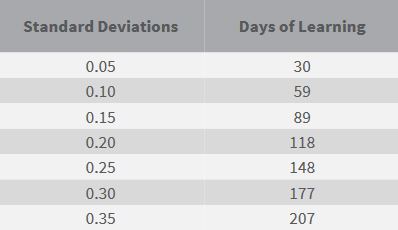
“To assist the reader in interpreting the meaning of effect sizes, we include an estimate of the average number of days of learning required to achieve a particular effect size. This estimate was calculated by Dr. Eric Hanushek and Dr. Margaret Raymond based on the latest (2017) 4th and 8th grade test scores from the National Assessment of Educational Progress (NAEP).”

Converstion to Days of Learning

The CREDO Days of Learning Conversion Table from “Cities Studies Project”

This metric seems to have been created with next to nothing validating it. Mark Webber quoted the psychometrician Michael T. Kane,

“The 2015 study (p. 5) cites a paper published in Education Next (Hanushek, Peterson & Woessmann, 2012) that asserts: “On most measures of student performance, student growth is typically about 1 full std. dev. on standardized tests between 4th and 8th grade, or about 25 percent of a std. dev. from one grade to the next.” (p. 3-4) No citation, however, is given to back up this claim: it is simply stated as a received truth.”

CREDO tells us that Hanushek and Raymond did something with NAEP data from 2017 but still do not offer any justification for the conversion. It appears at best to be sloppy science and the headlines engendered from it are nothing short of propaganda.

Using CREDO Claims to Sell Privatizing Public Schools

Neerav Kingsland the Managing Partner of the City Fund posted to his Blog last July when the first results from “Cities Studies Project” arrived explaining,

“Last year, Arnold Ventures commissioned CREDO (out of Stanford University) to study the effects of charter, innovation, and traditional schools in select cities across the country.”

“Most of the cities included in the study were cities where Arnold Ventures (and now The City Fund) have partnered with local leaders to expand high-quality schools.”

“Camden’s city level effects are large.”

“In just two years, scores are up ~.15 standard deviations in math and ~.05 standard deviations in reading (compared to similar schools across the state).”

The reality is those changes are very small. Noise in the data is a better explanation than awesome charter schools for these tiny differences.

In Indianapolis, the CEO of The Mind Trust, Brandon Brown, just wrote an Indy Star opinion piece stating,

“A 2019 study from Stanford University found that students who attend Innovation Network Schools achieve the equivalent of 53 additional days of learning in English and 89 additional days of learning in math each year when compared to their traditional public school peers. This equates to several years of additional learning during the span of a K-12 academic career, and the gains are largest for students of color and students from low-income backgrounds.”

In the billionaire financed effort to privatize public education, CREDO has become their source for data proving things like smaller class sizes and teacher professionalism are not important. The “Cities Studies Project” commissioned by an organization intent on privatizing public schools through promoting the portfolio management scheme – The City Fund – is biased toward the privatization agenda. Rather than shining the light of scholarly work on education policy, it obscures reality with obfuscation.

Responding to the Washington Post’s Jay Mathews

5 May

By Thomas Ultican 5/5/2020

It came as a surprise when Washington Post columnist Jay Mathews reached out to me. After indicating that he was writing a book, Mathew’s said that he had just come upon my pieceA Texas Sized Destroy Public Education IDEA.He flatteringly wrote, “… your analysis is impressive and I want to include some of it in my book.” He also sent an article and a book chapter asking for comments.

In the article about IDEA, I had written,

In 2016, Jay Mathews of the Washington Post rated IDEA charter high school the most challenging in the nation. Mathews rates schools by what he calls “the Challenge Index,” which takes the total number of Advanced Placement, International Baccalaureate and Cambridge tests given at a school each year and divides by the number of seniors who graduated in May or June. Charter schools that shed students without replacing them now own all of the top spots in this index; not deeply meaningful.”

Jay’s message to me was very respectful with a genuine feeling of interest in my opinion; however, we do have very different views. I will endeavor to address those differences honestly and respectfully.

The chapter he sent me is focused on his “Challenge Index” and its rationale. The article was a piece he did for his Washington Post column in November about a high school teacher who teaches AP English Language arts. He explained how that teacher came to appreciate the value of expanding AP access.

Some Personal Background

I grew up on a ranch in rural Idaho with a cowman for a father, a sheepherder for a grandfather and a school teacher for a mom. She studied teaching at Albion Normal School in the southern Idaho Mountains. Coincidentally, it is the same school attended by the force behind “A Nation at Risk,” Ronald Reagan’s Secretary of Education, Terrel Bell.

My mother often claimed that the key difference that made public education in America superior and more democratic than any other system in the world was that in America there was no high stakes testing.

In the 1960’s, before education standards and AP curricula there was an aphorism,

“American high school students are the laziest in the world. They seldom study and spend their time playing, socializing and competing in sports. Then they graduate from high school and over the summer a miracle occurs. They arrive at college to become the world’s leading scholars.”

After an engineering career in Silicon Valley as a researcher in the disc drive industry, I decided to become a teacher. During my fifteen years in the classroom, I taught advanced mathematics, conceptual physics, two flavors of AP physics and AP environmental science. In the end, I have concluded that my mother was right about high stakes testing and that the aphorism about American students captures an important reality.

Most surprisingly, I now believe that AP style college level classes in high school are bad pedagogy.

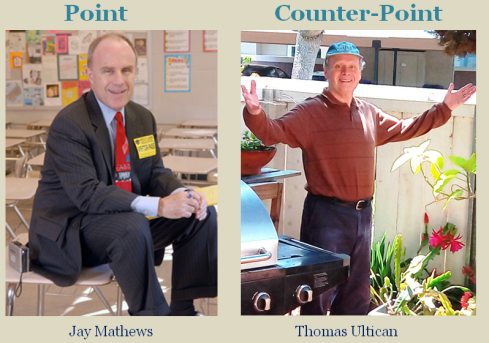
Mathews and Ultican

AP, IB or Cambridge Courses are Bad Pedagogy

This will probably be viewed as heresy by many of my fellow educators. It certainly would be by Will Robertson, the AP English teacher Jay wrote about in November. In 2005, Roberson’s Corbett High School near Portland, Oregon required that every student take at least seven AP classes. Robertson wrote a lengthy memo to the administration about why it was such a mistake. After three years, he realized that the students he feared would be defeated by the AP rigor were meeting the challenge and wrote another lengthy memo admitting his error.

I contend that the challenge Robertson’s students are meeting is not appropriate for their mental health and development.

A fundamental flaw in modern education reform is the push toward inappropriate curricular pacing. Kindergarten has become the new first grade where students who should be learning through play are sitting at desks doing math and language arts work sheets.

In their recent book, Let the Children Play, Pasi Sahlberg and William Doyle write, “The global education race for ‘higher standards’ at lower financial costs have turned many schools to factories that try to produce standardized products efficiently on tight schedules.” Modern education reform is developmentally inappropriate. As Gloria Ladson-Billings, Distinguished Professor in Urban Education, University of Wisconsin-Madison states, “Anyone who fully understands child development knows that children’s ‘play’ is children’s ‘work.’”

This problem is infecting all levels of k-12 education. High school is not the appropriate level for college work. Young brains need to be protected from high stress during a period of rampant hormonal changes and emotional immaturity. Vicki Abeles, the director of the documentary film “Race to Nowhere”, describes in her book, Beyond Measure, the damage modern education reform is reeking on children and our culture.

When we start talking about challenging teenagers we need to make sure those challenges are appropriate for healthy development. Two quotes from Abeles’s book strongly imply that we have moved way past appropriate.

Adele opens chapter one, “Sicker, Not Smarter”, with a quote from Saint Louis University School of Medicine professor and pediatrician Stuart Slavin:

“My personal feeling is that we are conducting an enormous and unprecedented social experiment on an entire generation of American children, and the evidence of a negative impact on adolescent mental health is overwhelming. This is particularly disturbing given the fact that having mental health problems in the teen years predisposes to mental health problems in adulthood.” 

Abeles also shared a powerful anecdote from a student named Emily:

“Junior year is supposedly the most important in high school and my effort just wasn’t going to cut it, not if I wanted to go to a decent college, and without a degree from a top university I was not going to be successful…. I had failed. All those years of late nights studying for AP classes followed by 5 AM water polo or swim practices, what would they come to? Nothing, just like me. In a world where we must excel in not one but many areas, I had not done so in any. I would rather be dead than face the years to come, sure to be filled with constant reminders of my failure. In my mind, there was only one way out.”

Last year a report in the Journal of the American Medical Association documented the significantly rising suicide rates for ages 15-19 in America.

AP and other similar programs are a net negative for the holistic growth of students and undermines their positive social development in the crucial teenage years. Just like kindergarten is not developmentally appropriate as the new first grade, high school is not developmentally appropriate as the new college.

Unlike genuine college courses taught by gifted professionals operating in a sphere of respected autonomy, these high school level college courses employ the enfeebled teach to the test methodology. An AP syllabus must be approved by College Board and in practice that means using an approved syllabus provided by College Board as a template. Worse yet, the entire course is centered on preparing for the end of year AP exam which is supported by a large test preparation industry.

I have read your opinion that “teaching to the test” is not a problem but we just disagree. I think it leads to lifeless uninspired classrooms.

The “Challenge Index”

Since I view college level work in high school as a negative, I obviously disagree with a system that rates schools higher if more of their students participate in these programs. However, I will respond to some of the points you make in your “Challenge Index” book chapter.

You definitely deserve credit for trying to come up with a method for evaluating schools that eliminates the standardized testing advantages schools in wealthy communities have. When reading about what you learned studying Garfield High in East Los Angeles, I appreciated the egalitarian motivation for the approach you invented. You wrote,

“I decided one way to draw attention to the issue was to rank high schools in a unconventional way that illuminated the hidden strengths I had found at Garfield. Instead of measuring them by state, SAT or ACT test scores, I assessed them by their success in getting less than stellar students into the most challenging courses and tests.”

As I was entering the classroom, the disparity in AP course offerings between schools in wealthier neighborhoods and those in poor and minority communities was a hot topic of discussion. What we were not discussing is whether AP, IB and other courses of their ilk were appropriate. It was assumed they were. As a new teacher, I was an enthusiastic advocate for my AP classes at the 90%+ minority populated high school where I taught.

The following quotes from the “Challenge Index” chapter highlights a problem facing public education. You write that after introducing the “Challenge Index,”

“Newsweek asked me to do another national Challenge Index list in 2000 and again in 2003. In 2005 the magazine decided to make it an annual feature, calling it “America’s Best High Schools.” It assigned two researchers to help me collect information. In 2009 the list got more than 20 million page views.”

“Principals and superintendents at a few public schools, mostly in affluent parts of New England, told me they did not want to participate. They said their schools were not accurately represented by such a simple ratio, just one number. I explained to them why this was a useful tool for parents choosing schools and policy makers analyzing achievement. I said it might not appeal to everyone, but newspaper readers liked it, as they did other newsworthy ratios like Wall Street’s Dow Jones Average or baseball’s Earned Run Average.”

The arithmetic behind the “Challenge Index” is a simple ratio of the number of college level tests taken at a school divided by the number of graduating seniors. It is an easily understood metric but like standardized testing it does not meaningfully evaluate schools. Education is an extremely complex system and a simple explanation may be popular but damagingly misleading.

The over-representation of charter schools in the “Challenge Index” is an arithmetic issue. Charter schools typically do not replace students who leave. By their senior year, the graduating class is often only a third the size it was in freshman year. Public schools do not see that big decline in class size so the smaller denominator for charter schools misleadingly engenders large “Challenge Index” ratios.

The No Child Left Behind rules, the Race to the Top rules and your “Challenge Index” all try to evaluate schools with a simple metric, but education is so complex that these simple metrics are counter-productive.

For many decades, states have had agencies send teams to schools for more than a week to evaluate every aspect of the school and write detailed reports. Here in California that work is done by the Western Association of Schools and Colleges (WASC). I have been involved in four WASC reviews. They were conducted by teams of administrators from around the state. WASC not only did a detailed evaluation of every aspect of the school but also worked collaboratively with the school to improve its roadmap for continuous improvement.

My bottom line is that simplified indexes run in popular news magazines may sell advertising but they are misleading and do damage. Many wonderful schools were erroneously deemed failures by No Child Left Behind testing. If education leaders had looked at the accrediting agency reports instead of just the simple standardized testing results, they would have never destroyed those schools operating mostly in poor minority neighborhoods. Likewise, your “Challenge Index” with its easy to understand ratio runs the risk of promoting unhealthy education practices.