Tag Archives: Thomas Jefferson

The South’s Long War on Black Literacy

14 Apr

By Thomas Ultican 4/14/2025

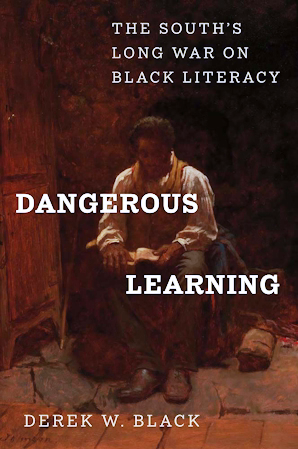
Derek Black’s masterpiece of research, Dangerous Learning, reveals the centuries of struggle for Black Americans to become educated. When I arrived at the Network for Public Education conference April 4, I ran into Professor Black (University of South Carolina Law School) and mentioned to him I almost finished reading his book on the airplane. He absurdly wanted to know how boring I found it. The truth is that this beautifully written book is extremely engaging.

Denmark Vesey

Growing up in Idaho, my knowledge of American slavery is quite lacking. I had never heard of Denmark Vesey, who played a major role in the suppression of education for slaves.

Joseph Vesey was a slave trader who brought 390 enslaved people including Demark to St. Thomas and Saint-Domingue (now known as Haiti) in 1781. Joseph’s slave ship brings the first record of the approximately 14-year-old Denmark. He was sold in Haiti along with the other 390 people but it seems he feigned epilepsy and Joseph was forced to take him back. Soon after, Denmark became Captain Vesey’s trusted assistant.

Black tells this story in about 20 pages in the book. I will cut it down a little.

Denmark learned to read and in 1799 he won the lottery ($1500). He paid Joseph $600 for his freedom and through various means; Denmark became highly educated. He was also inspired by the slave revolution in Haiti. Denmark became an authority on the Bible being known in the community as “a man of the book”. (Page 16) He taught classes at the African Church which became the famous African Methodist Episcopal Zion Church also known as the AME Church. Denmark was obsessed with learning and read widely including classical literature.

In the Old Testament, Vesey found the story of the Israelites’ path from slavery. He taught his friends how the children of Israel were delivered from bondage in Egypt. Professor Black explains:

“In it [the Old Testament], Vesey found a God who stood on the side of the oppressed, not the oppressor, and who intervened in the world not to reinforce slavery but to free the Israelites from it. God consistently assured the Israelites that He would deliver their enemies into their hands if they would follow His will. And following His will did not mean turning the other cheek, fleeing from conflict, or suffering in silence. It often meant smiting those who stood against them, including women and children.”   (Page 20)

In 1822, Vesey having been deeply and fundamentally changed by his literacy planned a slave rebellion. He chose July 14th for the liberation of Black people in Charleston.  The plan was workable but an enslaved man came forward on May 30th claiming he had been recruited to participate in a slave revolt. After that, Vesey’s plans fell apart and he along with his co-conspirators were put to death. Black noted, “When Frederick Douglass implored crowds of Black men to join the Union Army in 1863, he offered a simple message: ‘Remember Denmark Vesey of Charleston.’” (Page 35)

Unfortunately, it was remembering Denmark Vesey that pushed southerners into an all out suppression of Black literacy that lasted well into the twentieth century.
Suppressing Education

The last open debate on slavery in the South was conducted by the Virginia legislature in 1832. William M. Rivas, a lawyer and member of a wealthy colonial family claimed that elite planters had “held the state’s democratic process in a death grip for decades.” (Page 107) He said they had intentionally limited education not just for slaves but for poor and middle-class White people as well.

While the North was engaged in developing a state supported public education system, the South, under the influence of wealthy elites, absolutely opposed state funding for education.

It was a shock for me to discover that Thomas Jefferson was a white supremacist. In Notes on the State of Virginia he wrote that Black people were “inferior to whites in the endowments of both of body and mind.” (Page 65) He said that this reality posed a powerful obstacle to emancipation.

After the 1832 debate, censorship and anti-literacy in the South took on a life of their own. The South became more and more isolated and intolerant.

For the slaves, seeking literacy was hidden and secretive. Finding the time to study was difficult and a flickering candle could draw attention and suspicion. It is reported that enslaved people would study in caves or in holes they created in the woods.

“In Mississippi, people told of holes large enough to accommodate a group. They called them ‘pit schools.’” (Page 188)

After the Civil War, former slaves were able to openly attend school and the Reconstruction Act of 1867 attempted to force states to pay for it. The Act created three requirements for states to be readmitted to the Union: extend the vote to black men, ratify the 14th Amendment and guarantee a republican form of government. Black noted, “A republican form of government meant, among other things, ensuring public education.” (Page 244)

However the citizens of the south were not going to accept Black people having equal rights. Terrorist groups attacked schools and teachers. The more Union troops were drawn down, the greater the violence became.
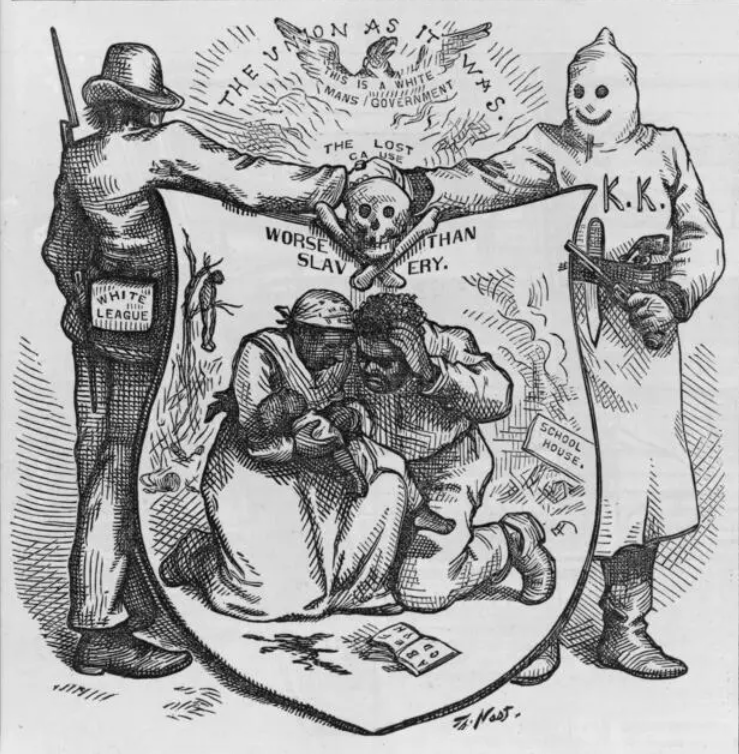
1874 Harper’s Political Cartoon by Thomas Nast

During Reconstruction, 631 attacks on black schools have been documented. White citizens of Tennessee under the leadership of the KKK destroyed 76 Black schools. (Page 261)

In order to secure victory in the 1877 Presidential race, Rutherford B. Hayes agreed to a compromise between southern Democrats and pro-business Republicans to end Reconstruction. Soon after, southern states started rewriting the required constitutions they needed to rejoin the Union. There was a two pronged agenda: “disenfranchise Black voters, and segregate and underfund Black education.” (Page 168) Jim Crow laws became enshrined in the new southern state constitutions.

In 1896, the Plessy v. Ferguson case held up the bogus concept of separate but equal facilities. That same year saw a new Louisiana law that took Black male voter registration from 95.6% of the population to 1.1% by 1904. In 1902, Nicolas Bauer, a man that would become superintendent of public schools in New Orleans, wrote:

“I realize from my limited observation that to teach the negro (sic) is a different problem. His natural ability is of a low character and it is possible to bring him to a certain level beyond which it is impossible to carry him. That point is reached in the fifth grade of our schools.”

The lack of justice and abundance of ignorance is what the Supreme Court tried to rectify with Brown v. Board of Education.

The fact is these two centuries of hostility toward educating all American citizens is still causing harm. Derek Black’s Dangerous Learning is a must read for anyone that cares about justice.

Why I Support Public Education

29 Mar

By Thomas Ultican 3/29/2021

The original cause for my supporting public education was that my rancher father married a school teacher. Growing up in southern Idaho, I learned many philosophical and theoretical reasons for supporting the establishment and maintenance of public schools from my mother. However, it was from watching mom and her dedicated colleagues in action that I learned to truly respect and appreciate public school.

I remember stories of my father being warned that he better not treat that woman wrong. For several years in a row she won the Elmore County sharp shooting contest. She didn’t like to chop a chicken’s head off so she would pull out her rifle and shoot it off.

Mom had some old school attitudes but maintained a mind of her own. There was a period in which she had to come home at lunch time and milk the cow. One Friday, after having to chase the cow across King Hill creek again, she had had enough; didn’t discuss it just loaded that cow into a trailer and took it to market.

In my home, there was no doubt about the value of education and also an abiding belief that the American public education system was unparalleled. My father was a high school basketball referee and an ardent supporter of music study.

As was common in the community, school events were family events. Helping the local school was one of the main missions of our civic organizations whether it was building viewing stands at the football field or sewing costumes for school plays.

My grandfather was an immigrant from Scotland who came to America on the Lusitania. Three years after his arrival that ship was sunk by a German U-boat killing 1,800 passengers and further pushing America into engaging with World War I.

It was through family in Scotland that my mother became familiar with the British Education system. She learned of its high stakes testing which was deciding a child’s education path; if that education would continue and whether it would be academic or vocational. To her, the great advantage for America’s schools was they did not have these kinds of tests determining a child’s future. American students were not immersed in testing hell.

Instead of being sorted out by testing, American students had multiple opportunities to reenter the education system in whatever capacity they desired. Immature 11-year olds, did not have their futures decided by dubious testing results.

Still today, Idaho has a greater than 90% white population making it one of the whitest places in the world. It used to be even whiter.

I did not meet a Black person until I was a 17 years-old high school student. That year the University of Idaho Vandaleers gave a concert at my high school. A local rancher’s wife threw an after party for the choir and that is where I met Ray McDonald. Not only was he a talented singer, he was also one of the top running backs in America who would soon be drafted in the second round by the Washington DC professional football team. All I really remember is I was star struck and he was a friendly guy who played piano.

Although there was very little racial diversity in the community there was significant religious diversity. We had Mormons, Mennonites, Catholics, Lutherans, Methodists, Assembly of God and other denominations attending our schools.

In a 2001 interview conducted at the Gathering, Richard DeVos lamented that it was awful that public schools had replaced churches as the center of communities. He did not identify whose church was going to be accepted as the community center.

The unifying factor in Glenn’s Ferry, Idaho was the public schools. Children from rich families and poor families grew up together in those schools. At school functions, parents from the disparate religious sects came together and formed common bonds. Political decisions concerning community governance were developed through these school based relationships.

Public schools became the foundation for democratic governance in the region plus it was literally where people voted. To me, it is unfeasible that a healthy American democracy does not include a healthy public school system.

America’s Founding Fathers Believed in Public Education

The second and third presidents of the United States advocated powerfully for public education. Thomas Jefferson saw education as the cause for developing out of common farmers the enlightened citizenry who would take the rational action a successful republican democracy requires. Jefferson contended,

“The qualifications for self government are not innate. They are the result of habit and long training.”

When Jefferson who was a former ambassador to France was queried about the French Revolution, he responded, “It has failed in its first effort, because the mobs of the cities, the instrument used for its accomplishment, debased by ignorance, poverty and vice, could not be restrained to rational action.” He called for the establishment of universal free public education claiming it as a requisite for the survival of a democratic republic.

Jefferson and his peer John Adams were integral to the founding of the United States. Jefferson is credited as the main author of the Declaration of Independence. Our system of government with its bi-cameral legislative branch, judicial branch and executive branch came about in great measure because of John Adams’ advocacy.

Like Jefferson, Adams also saw public education as crucial for the survival of our fledgling democracy. In a 1775 essay, he wrote:

“reformation must begin with the Body of the People which can be done only, to affect, in their Educations. the Whole People must take upon themselvs the Education of the Whole People and must be willing to bear the expences of it. there should not be a district of one Mile Square without a school in it, not founded by a Charitable individual but maintained at the expence of the People themselves”

Shortly before the American Revolution, Jean-Jacques Rousseau had published the controversial novel Emile, or On Education. He was widely condemned by the ruling elite for the religious views expressed in the book. However, the main portion of the book was about education. Rousseau’s character in the book was a tutor for children of the wealthy. That was the nature of education in the 18th century. Only children of the wealthy had the wherewithal to be educated by private tutors or in one of the few private schools.

Jefferson and Adams were calling for egalitarian progress giving common people the tools required to be self-governing. They were calling for a public school system.

Between 1820 and 1860, the Massachusetts education advocate Horace Mann – more than any other American political leader – was responsible for the nationwide spread of public schools. With the challenges of industrialization, immigration and urbanization, public schools became the tool of social integration. Horace Mann became the spokes-person for schools being that instrument.

It was Mann’s point of view that children in the common school were to receive a common moral education based on the general principles of the Bible and on common virtues. The moral values to be taught in public school were Protestant values and the political values were those of republican democracy.

Integrating the Protestant religious view into the common schools caused a split in communities. The burgeoning Catholic immigrant population did not want their children indoctrinated with an anti-Catholic ideology. Following the civil war, these influences irrupted into the “Bible Wars.” Author Katherine Stewart shared that it was in this atmosphere that “President Ulysses S. Grant declared that if a new civil war were to erupt, it would be fought not across the Mason-Dixon Line but at the door of the common schoolhouse.”

Stewart also noted an insightful admonition from Grant:

“Leave the matter of religion to the family altar, the church, and the private school, supported entirely by private contributions. Keep the church and state forever separate. With these safeguards I believe the battles which created the Army of Tennessee will not have been fought in vain.”

Early in the 20th century, public schools had been established serving every community from coast to coast. The results from this vast American public education experiment shine like a lighthouse beacon on the path of Democracy and social happiness. A nation that entered the century as a 2nd rate power ended the century as the undisputed world leader in literacy, economy, military power, industrial might, cultural influence and more.

Today, unbelievably, more and more forces are agitating to undo public education and even American Democracy itself.

As the 21st century dawned, the American public education system was facing a billionaire financed attack. Instead of financially enhancing public schools, libertarians called them “failures” and too expensive. They called public schools “monopolies” shutting out private business that would surely outperform “government schools.”

Hopefully the aphorism attributed Lincoln is true: “You can fool some of the people all of the time, and all of the people some of the time, but you can not fool all of the people all of the time.”