Tag Archives: San Diego Unified School District

GOP Activist Attacks Teachers’ Contract

16 Jul

By Thomas Ultican 7/16/2023

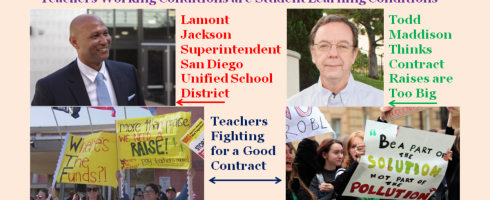
On June 12 2023, San Diego Unified School District (SDUSD) ratified a new 3-year contract with the teachers and paraeducators unions (San Diego Educators Association (SDEA) – California School Employees Association Paraeducators Chapter 759). Before the month ended, Todd Maddison of the conservative Parents Association placed a scathing indictment of the new contract in the Voice of San Diego. This relentless GOP led disparagement of teachers and public schools has become the standard operating procedure throughout America.

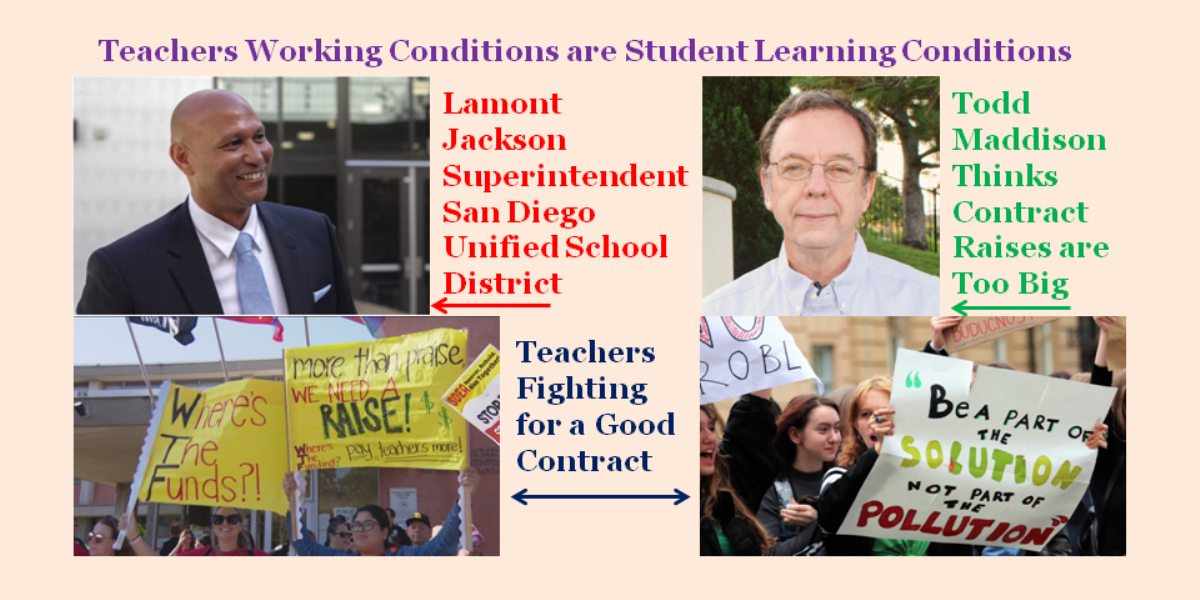
It is not obvious what Maddison wants. The headline for his opinion piece says “San Diego Unified Is Putting Adults First, Not Students.” It is incongruent with the new contract. He apparently thinks teachers are overpaid and a 15% pay raise is a theft of public money.

Contract Details

SDEA had been negotiating this 3-year deal with the district for more than a year. The last contract expired June 30, 2022. They demanded an 18% pay raise and settled for 15%.

Several other issues were also negotiated.
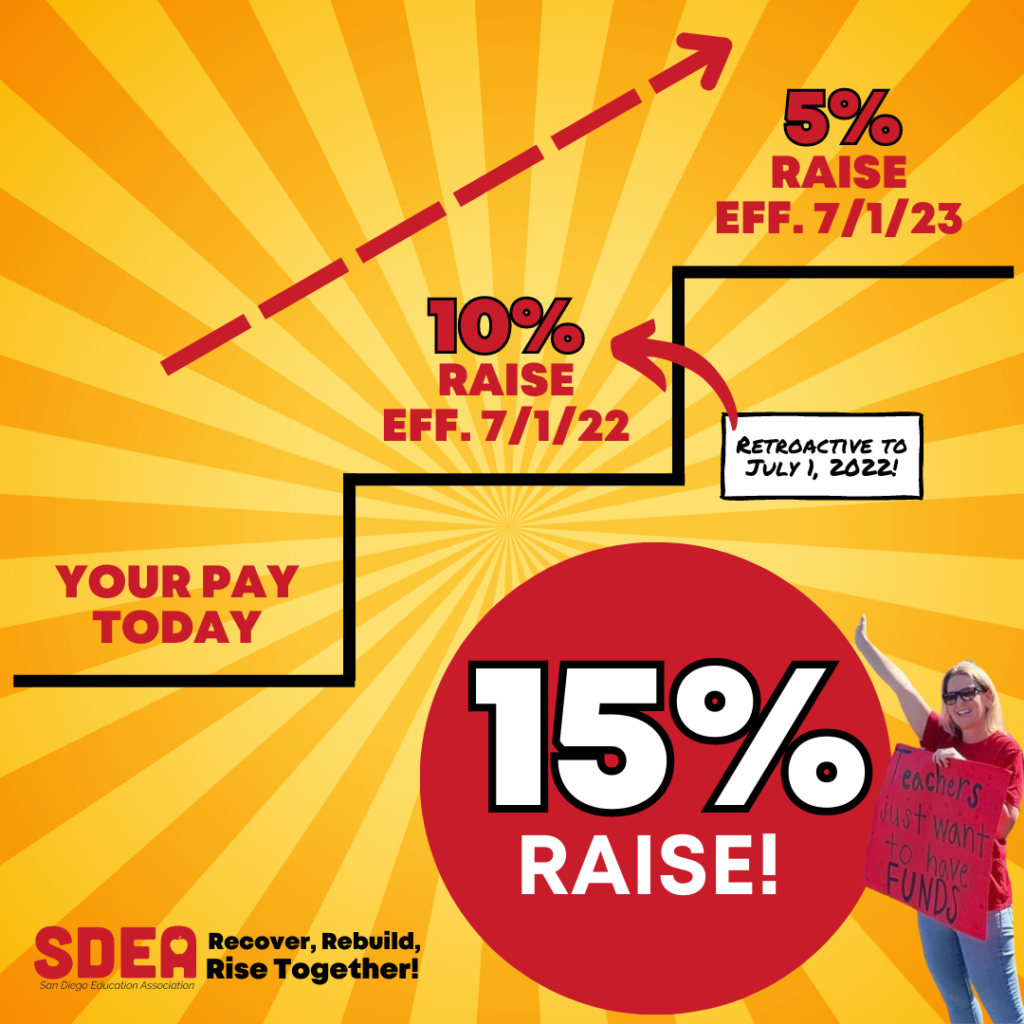
SDEA Chart Negotiated Pay Raise

The contract was ratified on June 12th by a 98% positive vote from SDEA members. Board Trustee Richard Barrera said, “With the agreement, we’re on our way to being able to tell young people you can pursue a career as an educator and still be able to raise a family in a place like San Diego at the same time. He said that first-year teachers can make $64,000 a year, those in the middle of their careers $105,000 and veterans, up to $124,000.

Other issues agreed to included:

  1. Community schools require a part-time community school coach at each campus
  2. Elementary schools, with more than 250 students, get a counselor three days a week, those with more than 375 students get one four days a week and schools with more than 500 students get a full-time counselor
  3. Full-time nurses remain in every comprehensive high school
  4. Middle and high school physical education classes capped at 50 students, down from 60
  5. Middle and high schools add a part-time restorative-justice position
  6. Transitional kindergarten classes are capped at 24 students and first grade through third-grade capped at 29 – all were previously capped at 35
  7. Every transitional kindergarten classroom will have an early-childhood teacher and a teacher with multiple-subject credentials
  8. Paid maternity leave doubled to six weeks

This negotiation ended with a substantial pay raise for teachers. Students got smaller classes throughout the K-12 system and improved staffing ratios in kindergarten. Both administration and teacher negotiators actually paid considerable attention to improving the plight of students.

Yet, Maddison claimed, “San Diego Unified Is Putting Adults First, Not Students,”

More Maddison Assertions…
He opened by saying:

“Anyone who follows K-12 education will tell you we’re facing a crisis. The latest National Assessment of Educational Progress (NAEP) numbers expose declines in academic performance to unprecedented levels …”

I follow K-12 education closely and do not see a crisis because the 2022 test scores wiggled down a few points. We just came through a pandemic and test preparation was not a priority. Give the children a chance to recover from the recent trauma and they will be fine unless faux educators convince us to do crazy things like high intensity tutoring, double math and mandatory summer school.

Maddison, the data analyst for Transparent California said:

“From SDUSD’s own payroll records, obtained using a legal public records request and posted for anyone to see on the Transparent California website, data show in 2022 the median total pay of a full time certificated employee was $102,024. For comparison, the latest U.S. Census Bureau data shows private workers with equivalent education in San Diego County made $87,784.”

His teacher salary data seems reasonable but professionals with “equivalent education” and time on the job are generally paid more than teachers.

San Diego is very expensive. Multiple rent tracking web sites report that the average two-bedroom apartment rents for over $3,200 a month. To attract and retain quality educators, a living wage is required to support more than bare survival.

Maddison writes:

“Last year, teachers had 27.8 percent of their pay contributed to their retirement. That’s a whopping 17.6 percent more than private workers, where total retirement contributions typically average 10.2 percent.”

This is disingenuous.

California teachers are not part of the Social Security system. They and their employers pay into the California teachers’ retirement system and have to contribute more to match the amount non-teachers accumulate.

He concludes his editorial claiming that SDUSD is financially unsound and quotes from the County Board of Education July 2022 response to the district’s budget proposal: “[T]he district will need to make budget reductions of approximately $129 million by fiscal year 2024-25 and an additional $53 million in 2025-26 in order to remain fiscally solvent and meet the required minimum reserve.”

On the same issue, he ignores the County’s September 2022 comment:  

“The Adopted Budget shows the district will be unable to meet its multi-year financial commitments in subsequent fiscal years without additional budget solutions; however, the district’s adopted budget was developed prior to adoption of the 2022-23 state budget. Actual state budget data should be incorporated into the district operating budget and multi-year projection during the First Interim Report process. Any necessary budget reductions should be detailed and approved by the board along with submission of the First Interim Report.”

The County was not concerned with the district’s solvency. They merely stated that under the current revenue stream, the budget needed to be adjusted for future requirements. As of September 2022, without knowing how much money was coming from the state, once enrollment was finalized and state contribution known, the district was directed to make any necessary budget adjustments and report.

The Parent Association

Todd Maddison’s biography says, “Todd is also a founding member of the Parent Association and is the San Diego County Chair of the California School Choice Foundation.”

Parent Association apparently grew out of the loud, right-leaning, pandemic protest movement. They were responding to President Trump and Education Secretary DeVos who were calling for schools to be opened in person. Maddison immediately joined in the call. In 2020, a July 12th Union Tribune article on the protest quoted him extensively.

It is true that children are less susceptible to COVID-19 infections but not immune. People working in schools, especially teachers, would be at risk, as would the children’s adult family members. On July 12 2020, with the first vaccines more than six months away, San Diego County reported 508 new infections with 2 more deaths. By November, the number of new cases was more than 1,000 per day.

On April 21 2021, the IRS granted the Parent Association tax exempt status as a charity under the 501-c3 rule (EIN 87-1693090), meaning donations are tax deductible. In July, their sister organization, the Parent Advocacy Center, was granted 501-c4 status (EIN 87-1487817). This means they don’t pay taxes but because they are a political action group, donations to them are not tax deductible.

Both organizations are registered in San Francisco, care of the James Sutton law firm, the campaign lawyers. The executive director of the Parent Association is Ginny Merrifield, a very connected operator in San Diego Republican circles and trustee of the E3 Civic High. She was also co-founder and trustee of the private and pricey Pacific Ridge School in Carlsbad, California and boardmember of governors for the $750 million San Diego Foundation. Her husband, Marshal, ran for San Diego city council as a Republican but was not elected.

When billionaire, Arthur Rock, put up hundreds of thousands to remove the San Francisco school board, Sutton and hedge fund founder Patrick Wolff of Grandmaster Capital, took the lead. Wolff founded Grandmaster Capital with seed funding from his billionaire friend, Peter Thiel. According to the hedge fund journal, they were initially brought together by a common interest in chess.

As county chair of the California School Choice foundation, Maddison campaigns for Education Savings Accounts, another name for vouchers. He writes about not being able to make the changes that failing public schools need and realized “The best way to give parents real power over school districts is to have the ability to take their money somewhere else.”

Are you sure that is not taxpayer money?

Observation

Research paper after research paper have over the last more than a decade consistently found terrible results from voucher schools. Last year, Professor Joshua Cohen wrote in the Hechinger Report, “After two decades of studying voucher programs, I’m now firmly opposed to them.”

Todd Madison and the wealthy right want to privatize public education and undermine teacher professionalism.

That is a mistake.

Public schools have been under assault by a well-funded group of oligarchs for more than 40 years. We have the best school system in the world. They are not now nor ever have been “failing.”

It is the height of foolishness to diminish this national treasure, the bedrock of American democracy. 
Reopening Schools and Debunking Demagoguery

21 Jun

By Thomas Ultican 6/21/2020

Education professionals throughout America are feverishly engaged in preparing for the first school year in the unprecedented Sars-Cov-2 era. Simultaneously, demagogues are pushing an often uninformed agenda.

For example, congressmen Jim Banks of Indiana and Tom Tiffany of Wisconsin have introduced legislation to force all schools to open with in-person classes by September or else lose federal funding.

At the same time McKinsey and Company, the 74 and other school privatization friendly groups are loudly proclaiming that an education gap disaster will devastate Black and Brown children if we do not reopen brick and mortar schools immediately.

Education Leaders are Getting Ready for Fall

Across California and the whole of the US, parents, students, teachers and administrators are involved in intense school reopening discussions with less than two months to go in some cases. County Health Departments in both Los Angeles and San Diego have indicated that masks will be mandatory for all students and school personnel.

California’s second largest school district, San Diego Unified School District (SDUSD), and other districts plan in-person, online and “hybrid” learning options. However, SDUSD will need an infusion of federal dollars to operate for the full year. Board President, John Lee Evans, says without financial help they will be forced to revert to all online learning in the winter semester.

On June 18th, Sweetwater Union High School District in Chula Vista, Calafornia held a virtual meeting for all stakeholders to lay out plans for starting school on August 3rd. It will include distance learning through August 28th and then implements students on campus in three phases. The initial transition to on campus learning limits the number of students to 10% of the student body at any one time. This would be ramped up to 20% and then eventually 50% of students would be allowed on campus at one time.

Districts are busy stockpiling surgical face masks and placing future orders. They are also ordering infrared thermometers, specialized cleaning supplies and personal protective equipment.

This kind of reopening planning is happening everywhere in America as the new school year approaches.

Perspective of the Pros in the Field

With school teachers facing a new school year, five veteran educators from San Diego County were interviewed. When all school campuses closed on March 13, these teachers participated in distance learning for the final three months of the school year.

They all felt that because of the hold harmless policies their districts embraced, the three months were not representative of what is possible. These five educators all taught at the high school level and when their students realized grades could only go up many students completely disengaged.

There was a large difference in engagement correlated with age. The more mature students were more engaged.

Student performance was related to type and level of classes. An AP physics teacher saw 90% attendance and felt most of his students did okay but not as well as his previous in person classes. He commented that, “some students seem to need the social environment in the classroom and became lost.”

On the other hand, the special education teacher co-teaching entry level math and English classes saw attendances of 25%-30%. As soon as his students found out about hold harmless, only a minority of students who were trying to raise their grades participated.

The Spanish teacher with 170 students on her rolls reports that 150 checked in but only about 40 who were trying to raise their grade actually engaged.

An AP literature teacher said that all of his AP students stayed with him until the AP exam but his one English 12 class, with the few exceptions of those who needed to raise their grades, basically checked out on March 13.

The literature teacher also mentioned that he felt like 100% distance learning was undermining his in-person credibility. Students communicate about their teachers and pass on who are the good teachers, whose classes are fun and who is interesting. They give each other tips on how to best navigate a certain teacher’s class. In cyber space, student-to-student communication is limited and it is almost impossible for a teacher to express their personality; be humorous, subtly sarcastic or employ irony.

The English and AP psychology teacher said after shifting to distance learning she thought she had found “nirvana.” Working from home, no commuting, grading was easy and then she started teaching a summer school session with 45 students who are re-taking a class they failed. She says, “Now, I am dealing with a different student population, the workload is overwhelming and students fake being in class.” She misses face to face classes.

The oldest teacher interviewed said if the fall reopening safety precautions were not robust, he might quit. One teacher was concerned about the possibility of bringing the virus home to her 85-years-old mother and another expressed mild concern about the implications of having been asthmatic as a child. The two youngest teachers expressed no concern about risk to their own health.

All five teachers were in favor of some form of hybrid model this fall. That would entail meeting all of their students on a weekly basis and conducting most lessons using distance learning principles. They seemed quite confident that this could be a successful model given the circumstances. Learning would still be at a high level but the social engagement teenagers need for mental health would be undermined.

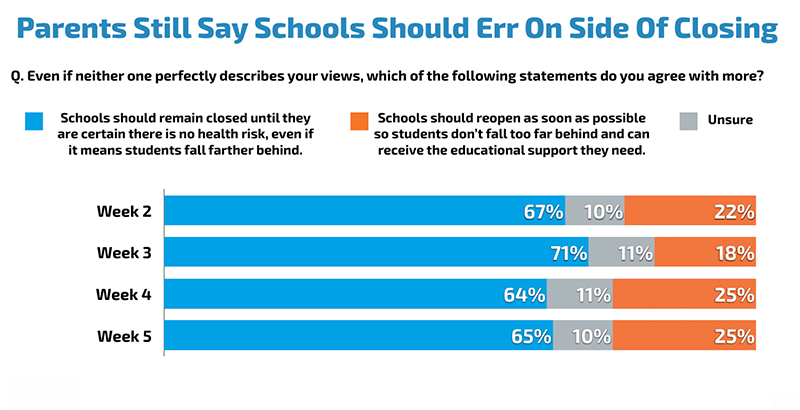
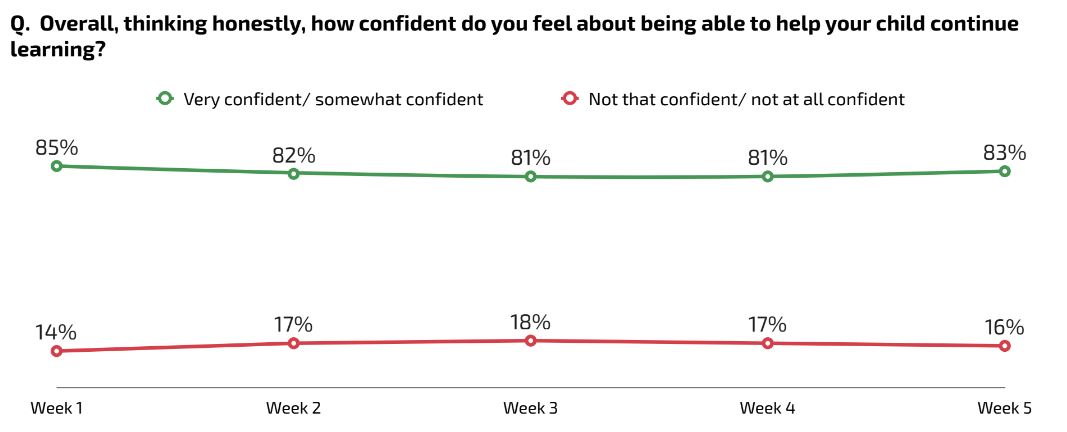
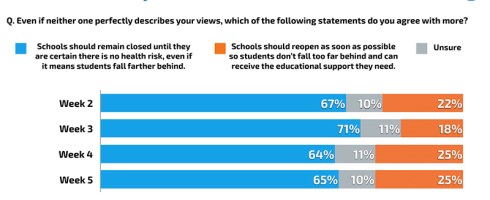
Echelon Insights at the Harvard Kennedy School recently queried parents about their concerns regarding education and Covid-19. Weekly surveys (April 27 – May 25) of 500 K-12 parents were conducted. It seems the San Diego teachers and American parents have aligned beliefs about the need for safety and the promise of strong learning.

Parent-surveyParent-survey Continue Learning

Parents are more concerned about safety than getting school opened as fast as possible and it appears they believe their child will continue learning.

Schools Must Reopen Immediately!!!

The headline on a June 1st article by McKinsey and Company screams, “COVID-19 and student learning in the United States: The hurt could last a lifetime.” The sub-title says, “New evidence shows that the shutdowns caused by COVID-19 could exacerbate existing achievement gaps.”

Much of the McKinsey article is based on the theoretical work of Erik Hanushek and Paul E. Peterson who have made careers out of creating biased studies designed to promote privatization of public education and undermine teacher professionalism. In addition, McKinsey relies heavily on information developed by Curriculum Associates the owners of I-Ready and data from NWEA the Portland based testing publisher that sells MAP testing.

Sounding very much like the authors of the infamous A Nation at Risk”, McKinsey claims:

“All told, we estimate that the average K–12 student in the United States could lose $61,000 to $82,000 in lifetime earnings (in constant 2020 dollars), or the equivalent of a year of full-time work, solely as a result of COVID-19–related learning losses.”

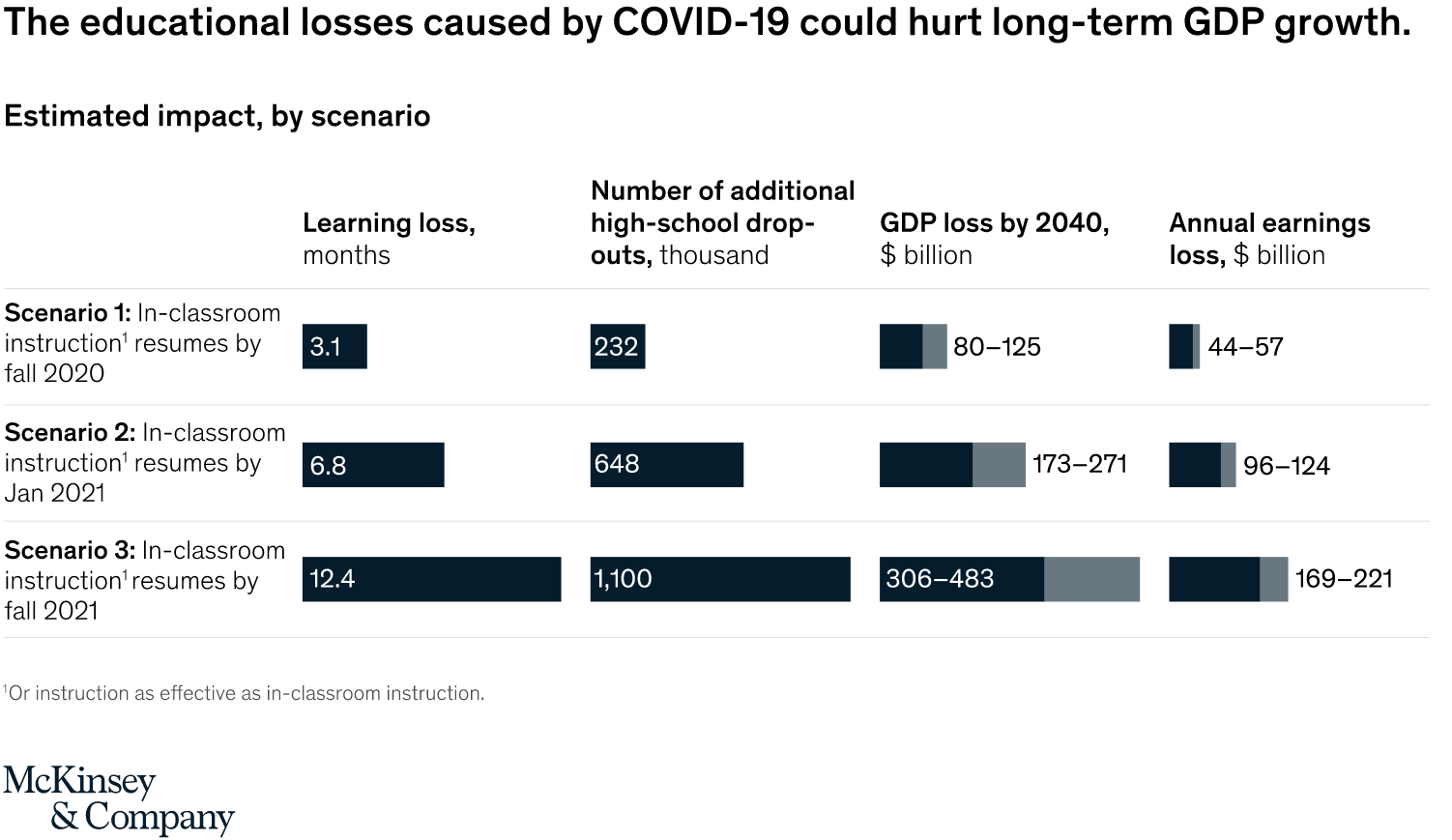
“Furthermore, if other countries mitigate the impact of lost learning and the United States does not, this will harm US competitiveness. By 2040, most of the current K–12 cohort will be in the workforce. We estimate a GDP loss of $173 billion to $271 billion a year—a 0.8 to 1.3 percent hit (Exhibit 5).”

Exibit 5 GDP Harmed

Exhibit 5 – What Magic Algorithms Produced this Fantasy?

At the billionaire created publication, The 74, a June 9th article ran under the heading, “New Research Predicts Steep COVID Learning Losses Will Widen Already Dramatic Achievement Gaps Within Classrooms.” The widening is supposed to happen because of poor parenting, lack of resources at home and learning gaps expanding during school closures.

They also make the senseless claim, “But now, especially without spring exams to guide them, schools will have no idea on day one of the 2020-21 school year what the array of needs in each class is.”

It should be noted that most teachers do their own student evaluations because they find the standardized testing data almost useless even if it is available when needed.

Republican Congressmen Jim Banks of Indiana and Tom Tiffany of Wisconsin have introduced the Reopen Our Schools Act. Congressman Banks stated,

“Reopening our schools is the lynchpin to reopening our economy. Many parents rely on their kids going to school so they can go to work. To get our society up and running again, we need our children back in school.”

Congressman Tiffany who joined congress this May added,

“These open-ended school shutdowns have set students back, made it harder for teachers to teach, and pushed parents to the breaking point. It’s time to reopen America and get back to school.”

In their announcement the congressmen referenced a Wall Street Journal report claiming remote learning this spring “didn’t work.” Like McKinsey and The 74, the Wall Street Journal references projections made in a May 27 paper by NWEA.

The Northwest Evaluation Association was founded in 1977 when a group of researchers and testing directors met at the Jolly Roger restaurant in Chehalis, Washington. The participants were unhappy with current standardized testing in the United States because it was the same test everywhere and unaligned with curriculum. They chose the small town of Chehalis because it was half way between Portland, Oregon and Seattle, Washington where most of the members lived. Today, the organization is known as NWEA.

NWEA is another education service business that abuses the non-profit federal tax laws. In 2018, they sold over $148,000,000 in testing services and their tax document shows sixteen people with salaries ranging from $200,000 to $513,172.

NWEA publishes MAP testing which tests mathematics and English three times each school year; fall, winter and spring. The tests are not aligned to one class level so they are only partially aligned with state curricular standards. That is in part why teachers at Seattle’s Garfield High School boycotted MAP testing contending, “the MAP is not worth the time and energy it takes to give.”

Using data from approximately 350,000 students who took MAP tests in school years 2017-18 and 2018-19, analysts at NWEA created a report based on projections that guessed at what the negative education effects from the school shut downs would be.

NWEA is known to have first rate psychometricians, however their expertise cannot make up for the noisy data known to exist with education testing or the fact that the growth models they use has never been satisfactorily validated or that their parabolic data fits might be inappropriate.

NWEA’s paper is well documented but still little more than a guess about education results made by people who are not professional educators. This is hardly the basis for insisting that we recklessly endanger the health of students, teachers and families by opening schools without making safety the number one priority.

Conclusion

The hybrid model for opening schools appears to be the best pandemic alternative. Students attend schools that are employing best health practices once a week. The rest of the week they participate in distance learning.

It has been widely espoused that poorer children do not have adequate equipment and connections for distance learning. However, most school districts have been providing devices and it should be possible for schools to setup socially distanced homework centers for students who don’t have available internet connections. For example, high school gymnasiums could easily accommodate 70 students safely distanced.

The reality is that we are facing a highly contagious virus to which human beings have no defense. This means that some cultural norms are not possible. Formerly in addition to academics, schools also were effectively daycare centers. In this environment, they cannot safely perform that function. Businesses, parents, schools and communities must work together to mitigate this unmet need.

Extra-curricular activities like sports, chorus, band and club meetings are not possible. That is a harsh consequence of the pandemic.

However, if professional educators and schools are supported, there is every reason to believe student learning can safely continue at a high rate, academic gaps will not increase and intellectual development will remain on track.