
By Thomas Ultican 2/20/2025
December 4, 2024, two law firms from New York and Chicago respectively filed a class action law suit against reading curriculum developers not steeped in science of reading (SoR). One of the attorneys behind this Massachusetts suit, Benjamin Elga, said he listened to the Sold a Story podcast and immediately saw “an injustice that cried out for redress.” Their main claim is that “the National Reading Panel commissioned by Congress in 1997 confirmed, all credible education and literacy research shows that daily phonics instruction is necessary for literacy success” and that these curriculum developers were deliberately deceiving schools and parents when they did not focus on systematic phonics instruction.
The suit was brought against: Lucy Calkins and her Units of Study, Irene Fountas and Gay Su Pinnell and their Reading Resources, The Reading and Writing Project at Mossflower, Teachers College Columbia University, Greenwood Publishing Group, Heinemann Publishing and HMH Education Co.
First of Its Kind Law Suit
Never before have curriculum providers been targets of this type of suit.
In paragraph-22 of the filing, the plaintiffs claim, “For decades, scientists and educators have understood that the first step in teaching literacy is robust, daily, and extensive instruction in phonics.” Unfortunately, this statement is not true.
The ideology supporting phonics comes from the National Reading Panel (NRP) that was supervised by the National Institute of Child Health and Development (NICHD). NRP was founded in 1997 and presented its findings in 2000. The report was supposed to end the reading wars but it came under immediate attack including in the minority report by Joanne Yatvin, who wrote: “At its first meeting in the spring of 1998, the Panel quickly decided to examine research in three areas: alphabetics, comprehension, and fluency, thereby excluding any inquiry into the fields of language and literature.”
Yatvin was the superintendent of a school district in Oregon, held a PhD in education and was the only panel member with classroom experience teaching reading.
Yatvin published “Babes in the Woods: The Wanderings of the National Reading Panel” for Kappan (January 1, 2002) in which she directly addressed the phonics piece:
“The situation worsened when the phonics report was not finished by the January 31 deadline. NICHD officials, who wanted it badly, gave that subcommittee more time without informing the other subcommittees of this special dispensation. The phonics report in its completed form was not seen, even by the whole subcommittee, of which I was a member, until February 25, four days before the full report was to go to press. By that time, not even all the small technical errors could be corrected, much less the logical contradictions and imprecise language. Although a few changes were made before time ran out, most of the report was submitted ‘as is.’ Thus the phonics report became part of the full report of the NRP uncorrected, undeliberated, and unapproved. For me, that was the last straw, and I informed my fellow panel members that I wanted my minority report to be included.”
The blow-back to the original report was strong. Elaine Garan is an award-winning researcher, author of “Resisting Reading Mandates” and educator with 24 years of experience as a reading teacher. In March 2001, she wrote, “Beyond the Smoke and Mirrors: A Critique of the National Reading Panel Report on Phonics” published by Kappan. When two NRP panel members, Linnea Ehri and Steven Stahl, attacked her in their Kappan article, she responded:
“I used the data and words of the National Reading Panel (NRP) to establish that its report was fatally flawed in terms of the fundamental research protocols, including validity, reliability and generalizability. I established that, rather than living up to the highly publicized claims of ‘scientific’ accuracy, the report was riddled with errors.”
Garan was right. There are no “strong correlative and causal relationships between systematic phonics instruction and reading success.”
Despite the suits claim that “all credible education and literacy research shows that daily phonics instruction is necessary for literacy success”, there are in truth many highly credentialed scholars who disagree. Posted on Ferman University Professor Paul Thomas’s blog are many articles with links to hundreds of scholars opposing SoR. In a recent post, he noted,
“The hand wringing over the 2024 NAEP reading results, however, seems to focus on learning loss and post-Covid consequences—not that reading achievement on NAEP was flat during the balanced literacy era and now has dropped steadily during the SOR era:”
Peter Johnston and Deborah Scanlon of the University at Albany debunked the Science of Reading (SoR) in this report.
Maren Aukerman is currently a Werklund Research Professor at the University of Calgary who focuses on literacy education and formerly served on the faculties at Stanford University and the University of Pennsylvania. She warns of journalists using logical fallacies to promote science of reading (SoR). For example, not reporting research showing students taught to read without systematic phonics “read more fluently.”
In 2023, a major study of teaching reading in the United Kingdom was released. The UK embraced a phonic first reading paradigm similar SoR in 2012. The researchers conclude an over-emphasis on phonics instruction caused reading test scores to go down. This matches what we have seen with this year’s National Assessment of Education Progress (NAEP) testing.
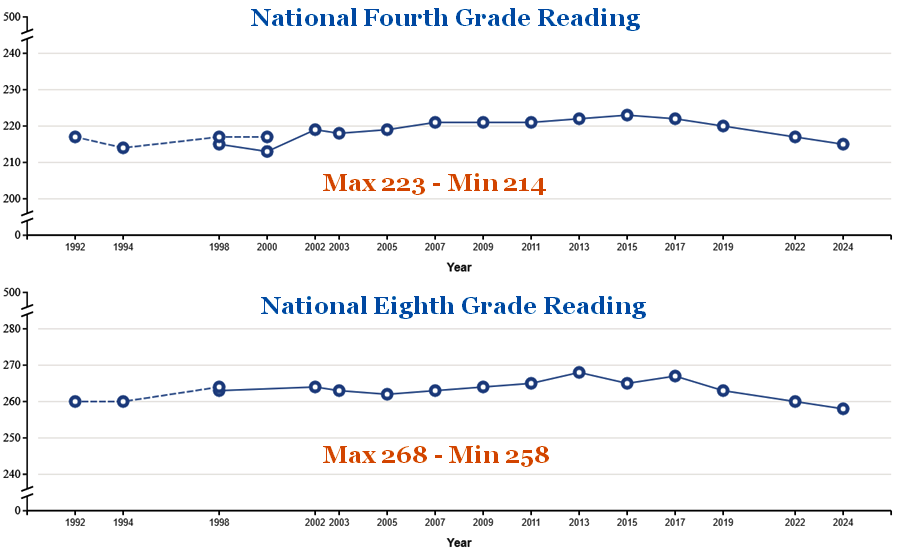
2024 NAEP Reading Results
Both nationally and internationally, many education researchers are openly opposed to SoR. Its support comes almost exclusively from billionaire sponsored researchers and publications.
Lawyers versus Educators
Two scholars, Robert J. Tierney, Dean Emeritus of the Faculty of Education at University of British Columbia, and Paul David Pearson, Evelyn Lois Corey Emeritus Professor of Instructional Science in the Berkeley School of Education at the University of California Berkeley, published the free to download “Fact-Checking the Science of Reading.”
Lawyer Benjamin Elga said he listened to the Sold a Story podcast and it motivated his law suit. The education professionals wrote:
“Undoubtedly, for both of us, the precipitating event was Emily Hanford’s (2022) release of the six-part podcast, Sold a Story, broadcast by American Public Media beginning in late 2022. Hanford’s series motivated us to accelerate our response for many reasons—two of which were most pressing to us:
- A consistent misinterpretation of the relevant research findings; and
- A mean-spirited tone in her rhetoric, which bordered on personal attacks directed against the folks Hanford considered to be key players in what she called the Balanced Literacy approach to teaching early reading.” (Pages xiii and xiv)
Paragraph 39 of the law suit states, “Cueing methods have been roundly criticized for teaching children to guess rather than read.”
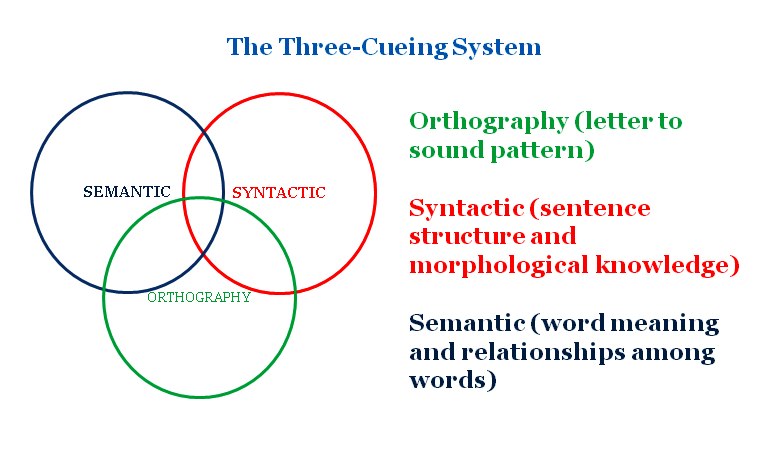
This above is a diagram of what they mean by cueing. Orthography uses phonics type approaches to sound out unknown words. Does it look right? With the second cue, syntactic, a student tries to understand what is written. Does it sound right? What would make it conform to grammar rules? Semantics is the last of the three cues. Does it make sense?
Cueing methods like all widely used reading curriculums embrace phonics as a tool but not as part of a daily structure.
Tierney and Pearson observed,
“It seems overly limiting to discredit the use of cueing systems based on what some might consider a restrictive assumption—that reading is entirely the accurate naming of words, rather than an act of meaning making that involves hypothesizing. To dismiss the use of context as an over-reliance on ‘guessing’ or ‘predicting’ ignores important evidence.” (Page 65)
Who Are These People?
With five lawyers listed on the class action law-suit, Kaplan & Grady is a firm in Chicago specializing in commercial and civil rights cases. Justice Catalyst Law (JCL) is a non-profit law firm from New York with two lawyers listed on the case. Both firms are fairly new, Kaplan & Grady was founded in 2022 and JCL was formed in 2018 per their tax filings (TIN 83-0932015).
Not much is known about the private company but in 2022, the non-profit took in $2,185,000 in contributions and Partner Benjamin Elga has connections to big Silicon Valley money. He is a Senior Fellow at American Economic Liberties Project to which The Irish Times reports that eBay founder Pierre Omidyar is a large contributor.
New court filings are due in March and the lawyers are demanding a jury trial.


 tultican
Recent Comments