Tag Archives: racism

Charter Schools in a Racist Big Easy

8 Dec

By Thomas Ultican 12/8/2025

New Orleans was the site of the largest slave market in America. In the late 18th and early 19th centuries, more than 135,000 slaves were purchased in the Big Easy. This racist legacy has survived up until today in many of its White citizens, business leaders and politicians. The book William Frantz Public School states, “By the 1920s, Orleans Parish School Board members and district administrators vehemently voiced their belief that White supremacy should guide public policy and stated their willingness to employ any means, including the use of force, to maintain inequality between the two races.” (William Frantz Page 4) After the Supreme Court’s Brown decision, long-time state senator William Rainach headed a strategy committee that condemned integration as the work of communists and created the all-White Louisiana’s Citizens’ Councils (Overturning Brown page 34). Leading up to hurricane Katrina, many White citizens continued working to maintain the ideal of White supremacy.   

This summer, Tulane University’s Education Research Alliance (ERA) created and published The New Orleans Post-Katrina School Reforms: 20 Years of Lessons.” This report was published June 2, 2025 by authors Douglas Harris and Jamie Carroll. In an alliance with Network for Public Education (NPE), Kristen Buras PhD, who has been studying New Orleans schools since the hurricane, wrote a paper countering many of the claims made in the ERA paper.

There is reason to believe the two ERA writers are incapable of doing unbiased research in the education realm.

In 2023, Diane Ravitch disclosed that while serving as Secretary of Education, billionaire Betsy DeVos gave $10 million to establish a research center on school choice. The longtime advocate of school choice was not apt to give the money to academics likely to throw cold water on her life’s work. The grant went to Tulane University in the only American city that has no public schools. Ravitch noted, “The organization she funded is called the National Center for Research on Education Access and Choice (REACH), led by economist Douglas Harris.”

Jamie Carrol who attended an all-girls high school in Maryland was a Teach for America (TFA) teacher 2008-2010 in New Orleans. She went on to earn a Doctorate of Philosophy from the University of Texas. Today, she works as a researcher for Betsy DeVos’s REACH.

In her Paper, The Stories Behind the Statistics: Why a Report on “Large Achievement Gains” in Charter Schools Harms New Orleans’ Black Students”, Kristen Buras shares that the amazingly pro-charter school Arnold Foundation has spent lavishly to advance charter schools in New Orleans; in 2012 $15 million for “education reform” in New Orleans, then another $25 million to be managed by the Charter School Growth fund and New Schools for New Orleans (NSNO), and 2014-2017 grants to Tulane University and ERA of more than $5 million. Buras comments, “Grants from this consistently pro-charter foundation helped launch and sustain ERA’s work.”  (Buras Page 17) 

Recently, two of America’s most active funders of charter schools awarded nearly $1 Million to REACH: the Walton Foundation and the City Fund (Buras Page 18). The Walton family, who owns Walmart, is the wealthiest family in the world and the largest private funder of charter schools in the US. The City Fund was created by billionaires Reed Hastings and John Arnold. They each put in $100 million to create an organization specifically for spurring the spread of charter schools.

Do Not be Naïve

Even before hurricane Katrina, there were efforts for the state to take over New Orleans’s public schools. Tulane University President Scott Cowen was quite influential in the development of the state of Louisiana’s education policies. In 2003, Cowen was involved in the creation of the Recovery School District (RSD) that was to take control over “failing schools” in New Orleans and reform them. After Katrina, Cowen headed the education committee of Mayor Nagin’s Bring Back New Orleans Commission. In early 2006, Cowen’s committee released a report recommending that New Orleans become the nation’s first all-charter school district (Buras Page 18). 

Scott Cowen established Tulane University’s Cowen Institute, a predecessor of ERA. Buras reported on conducting interviews with Cowen’s staff in 2009 noting:

“I asked about the institute’s mission. Like ERA, they characterized their work as neutral. One staff member shared: ‘We don’t advocate for an all-charter system because we don’t feel there’s adequate research [at this point] to indicate that charters will outperform non-charters.’ Instead, the staff portrayed the Cowen Institute as an ‘honest broker’ and ‘objective observer.’ Yet, NSNO, TFA, and other pro-charter school groups were given free office space in the same suite as the Cowen Institute.” (Buras Page 18)

To this day, ERA shares office space on the seventh floor of 1555 Poydras Street with NSNO.

Since its inception, NSNO has been all about building the all-charter school system in New Orleans. A peak at their tax records (EIN: 02-0773717) shows Neerav Kinsland appearing on the board in 2010 and earning $117,000 as chief of strategy. In 2011 he became CEO earning $146,000 and over the next two years he was paid $207,000 and $223,000 as CEO. But that wasn’t good enough. Since then, he has worked for billionaires John Arnold and Reed Hastings, served on the California Charter School Association board and is now leading the City Fund.

After Katrina, Black teachers decreased from 71% in 2005 to 49% in 2014, then rose to 56% in recent years. They were paid less than white counterparts in the same teaching and administrative positions (Buras Page 13). Experienced Black teachers were replaced by mostly White college graduates from TFA with just 5 weeks of training as an educator.

Students in the Big Easy are forced to take long bus rides often past, within walking distance neighborhood schools, to get their assigned charter school. It is not unusual for them to soon be traumatized by one of New Orleans multiple school closures. Somehow, white children in New Orleans rarely experience school closures.

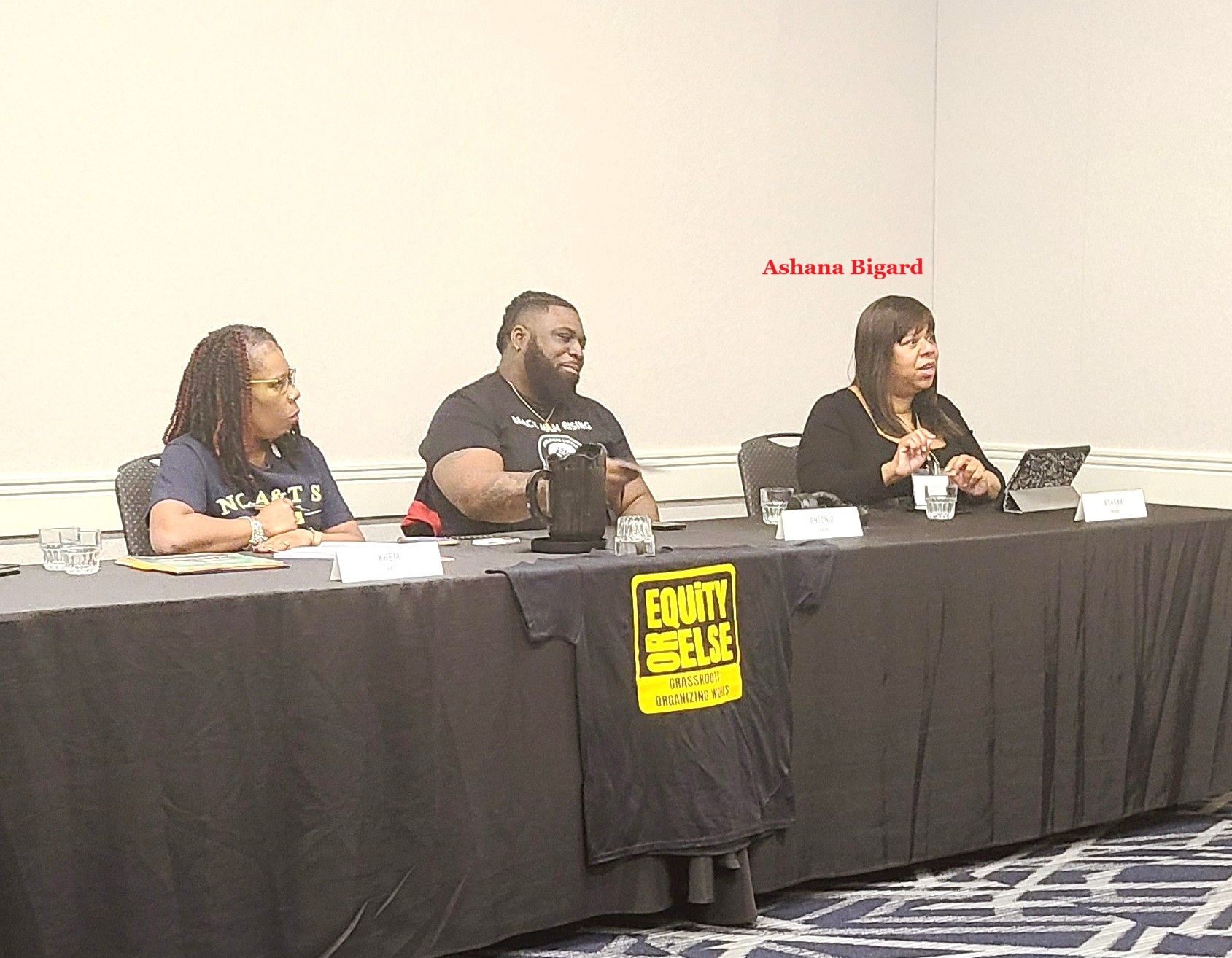
Ashana Bigard shared in her book “Beyond Resilience Katrina 20about the racist enrollment process in the all-charter school system. To enroll children, parents must use OneApp. It runs the school choice algorithm but strangely only white children get into the best schools, not even if you’re a Black family in the upper middle class do you get a seat. It is common to see White people move to the city and magically get their children into schools with 100 children on the waiting list. Ashana notes, “They didn’t even know the school existed prior to moving to the city, but racism and classism still existed heavily within the new system.” (Bigard Page 268)

Cheating Charters

The state cheated to create the conditions for developing the all-charter school system. Before Katrina, the cut point for school failure was 60 on a 200-point scale. After Katrina, through Act 35, the state legislature raised the cut point to 87.4, which was just below the state average. This maximized the number of public schools that the RSD could seize. Then, as charter schools were opened, the cut point for failure was lowered back to 60 (Buras Page 19).

The Times-Picayune reported that “data published by the Louisiana Department of Education vastly underreported the number of expulsions in charter schools.” For the 2007-2008 period, state data from a sample of 19 RSD charter schools listed only 4 students as having been expelled. The Lafayette Academy admitted to the Times-Picayune that 14 students were expelled that year; the state reported zero for Lafayette. (Buras Page 16)

In 2011-2012, 34% of schools in New Orleans had an out of school suspension (OSS) rate at or above 20%. Since 2009, charter schools have suspended students at rates sometimes double and triple the state average which was not that great to begin with. (Buras Page 15)

In 2015, SciTech Academy allowed students to take tests for one another, at home or multiple times (Buras Page 21).

Students coded as “transferred out of state” are excluded from the state’s metric. The inordinate use of the out of state code by charters seemed to be masking the true dropout figures which improved their state ratings (Buras Page 21).

At Landry-Walker, 78% of students scored “good” or “excellent” on the biology EOC and 78% on the geometry EOC. Only “good” or “excellent” scores earn points on the state’s metric. Yet, 52 of the 257 students who scored “good” or “excellent” on the EOC exam received a D or F in the class. By 2017, the Louisiana inspector general’s office had uncovered enough evidence of criminal wrongdoing at Landry-Walker that the local district attorney was alerted (Buras Page 21).

In her report, Buras says these are likely just the tip of the iceberg when it comes to charter school test cheating. Yet these inflated scores and school ratings are used by ERA to claim good academic results in New Orleans’s charter system. The willingness to ignore the cheating problem is appalling.

Beyond Resilience Katrina at 20

14 Oct

By Thomas Ultican 10/14/2025

The book William Franz Public School is a well documented work that shines a light on the deep racism in New Orleans and especially in its public schools. The title is the school where 6-years-old Ruby Bridges accompanied by federal officers desegregated New Orleans’ schools to the chagrin of the 1,000 plus protesters out front. “The message rang clear; Louisiana’s strong commitment to the education of its White, wealthier children paralleled an equally strong commitment to keep its Black, poor residents uneducated and isolated, and thus economically and politically powerless.” (WFPS 11) That ugly racism still permeates New Orleans which made me question what are their Black residents thinking and feeling. Ashana Bigard’s book, “Beyond Resilience Katrina 20, brilliantly provides some answers.

Bigard and her family have been in New Orleans forever; she is at least fifth generation. Her large family is a big part of the soul of New Orleans. Ashana takes her readers into the Black community that has refused to be beaten down and defeated by wealthy White supremacists.

After Katrina, the people in power stole the public community schools, fired the mostly Black teaching force and brought in predominantly white kids from Teach for America (TFA) to teach. Ashana shares that story beginning with running from the storm and then fighting against injustice for the last 20-years.

Katrina Arrived

Hurricane Katrina arrived about a week before payday for much of the New Orleans community. Like many others, Ashana and her family had experienced hurricanes before. They really could not afford to travel so they chose to wait it out at home. The storm came through and made a direct hit on the city, it was loud and intense but the next morning things seemed OK.

It was a tough night, but they had successfully ridden out the storm and it was beautiful outside. Ashana decided to walk to the old New Orleans community of Carrollton to check on a friend. Downed trees were everywhere. On the way an old man informed her that if she did not “have a boat in your pocket” she better get out of there because the levees had failed and the water was coming. (Bigard Page 11)

Some people in the community believed the levees had been purposefully blown up. Ashana and her family quickly got it together to load up and head out for Houston where they stayed until New Orleans opened again.

NPE 2025 Photo by Ultican

Back in New Orleans “the fraud was staggering” and media racism was appalling. Ashana noted:

“It seemed like every opportunity afforded to them, the media disparaged us calling us refugees and calling us looters. … White people getting food from stores to help each other … were described as ‘finding food.’ Black people doing the exact same thing were ‘looters’ and criminals who should be shot on sight, despite the fact that they had been left to die with no water, no food for days on end.” (Bigard Pages 32 and 33)

Rebuilding New Orleans

The work force in New Orleans is dominated by the Black community. However, when the rebuild started, local unions were frozen out. Wealthy carpetbaggers were running the show. Ashana sarcastically asks, “how could everybody get their money off the top if they were actually paying people real wages?”

There were no longer community schools that welcomed children or a city that was welcoming to its people. They soon began referring to their children’s schools as “test prep factories” and the kids called them “preparatory prison practice.” The youths of New Orleans named the new Knowledge is Power Program (KIPP) schools “kids in prison practice.” (Bigard Page 34)

Ashana worked at various non-profits as a student, parent and community counselor and advocate. She worked for families and friends of Louisiana’s incarcerated children where family members wanted to understand how their children first came into contact with the legal system.

Where were the arrests happening? Where were the summons coming from?” (Bigard Page 44)

The discovery didn’t take long. Ashana states, “The police inside the schools were arresting children for almost anything.” (Bigard Page 45) Best practices in adolescent development call for supportive environments, recognition of the biological realities of the teen years, and second chances not criminalization and punishment. This new school-to-prison pipeline was a complete abandonment of reason.

What developed in New Orleans was a harsh unforgiving no-excuses approach. This led to high expulsion rates and a 61% graduation rate.

Ben Kleban of College Prep charters told Ashana he would run his schools the way he wanted and if you don’t like it do what I did and start your own school. However, many PHDs, principals and academics from New Orleans applied to start schools almost none of them received a charter. (Bigard Page 54)

Ashana tells the story of counseling a teenage boy, a good student whose grades began falling for no apparent reason. Also he was becoming more and more despondent. After a week of discussion, he finally opened up about being sexually assaulted by a female TFA teacher. Apparently, the teacher succumbed to the adultification of young Black people. The student was blaming himself and tried to protect the teacher saying, “She came from Teach for America: they don’t give them much training.” (Bigard Page 98)

Ashana and her team were brought in to conduct a workshop on trauma: signs of trauma, solutions for trauma and how to deal with trauma in your classroom. Ten minutes into the workshop all 26 of the young White women were in tears. Ashana states:

“They were crying saying they were overwhelmed, suffering from secondary trauma, felt like they were crazy, and they all felt they were doing more harm than good. They had no support and when they went to Teach for America for support, they told them to try harder, and if they weren’t connecting, it was their fault because everyone else was doing a great job.”

The training developed into multiple unscheduled workshops that day as teachers went out and encouraged their colleagues to attend. Ashana says:

“I left the workshop understanding you never know all sides of the story and that there was a second wave of victims, and that was young, hopeful, starry-eyed white young people who thought this would be a great city to live in and a great opportunity and they could come and help out because of the teacher shortage which was caused by the firing of all our teachers and subsequently telling them that they had to take multiple tests to qualify to come back to teach while simultaneously telling young white children they only needed two weeks of training to do so.” (Bigard Pages 119-121)

The Legacy of Racism Lives On

To enroll children into the almost all charter system in New Orleans, parents must use OneApp. It runs the school choice algorithm but strangely only white children get into the best schools, not even if you’re a Black family in the upper middle class do you get a seat. It is common to see white people move to the city and magically get their children into schools with 100 children on the waiting list. Ashana notes, “They didn’t even know the school existed prior to moving to the city, but racism and classism still existed heavily within the new system.” (Bigard Page 268)

Ashana tells black people in New Orleans that poverty is not a moral failing. She says, “We start understanding that we are not broke we are stolen from.” (Bigard Page 318)

I have presented a few highlights in this delightful and insightful book. For me, Ashana’s book offers a rare view into the life of Black people fighting White supremacy and a story of love and family.

Bravo Ashana Bigard!

Teach Truth

23 Feb

By Thomas Ultican 2/23/2021

In “Teach Truth: The Struggle for Antiracist Education,” Author Jesse Hagopian takes his readers inside the struggle and shares Black culture. At the 2018 Indianapolis Network for Public Education conference, Journey for Justice Chairman, Jitu Brown, introduced Jesse as “a freedom fighter who happens to be a teacher.” What I did not understand then is that he also happens to be man who can write.  This book is exceptional.

Jesse defines two concepts that he uses throughout the book: uncritical race theory and truthcrime law.

He states, “Uncritical race theory denies that racism exists at all, or maintains that racism primarily victimizes white people, or rejects any systemic or institutional analysis in favor of an inter personal explanation that understands racism as only sporadic and merely the product of individual bias.” (Page 7)

He explains:

“A truthcrime is any act of honest pedagogy in a jurisdiction where truthful teaching has been outlawed. Truthcrime is enforced disremembering. A truthcrime law, then, is one that makes lying to children obligatory and effectively renders honest educators as truthcriminals.” (Page 16)

Interesting Take on CRT

A goofball white guy from Seattle, Washington became famous by attacking critical race theory (CRT) in a completely dishonest way. Unfortunately, right-wing billionaire money trumpeted his assertions. At a time when the vast majority of America’s teachers had never heard of CRT, he claimed that public schools were indoctrinating students with CRT. For a short period of time, CRT became the racist rights number one anti-public schools slogan and a Republican campaign tool.

CRT emerged amongst scholars and lawyers in the late 1970s and early 80s as a way to understand the forces upon Black citizens after Brown v. Board of Education in 1955, The Civil Right act of 1964 and the Voting Rights act of 1965. It was pretty much the purview of graduate school seminars. (Page 6)

At a June, 2022 “Road to Majority Policy Conference” in Nashville, Tennessee, Texas Senator Ted Cruz declared, “Let me tell you right now, critical race theory is bigoted, it is a lie, and it is every bit as racist as the Klansmen in white sheets.” Hagopian observed, “The irony here is profound; while Cruz compares those who teach CRT to the KKK, his own attack on antiracist education aligns with one of the Klan’s primary objectives: thwarting Black education and antiracist pedagogy—which they have done ferociously throughout US history.” (Page 40)

Hagopian discusses why feckless Democrats did not effectively respond to the GOP’s CRT attacks. He gives the example of Democrat Terry McAuliffe’s race for the Virginia Governorship against Glenn Youngkin. When Youngkin made a full throated attack on CRT calling it “toxic” and “flagrant racism, plain and simple” that is a “poisonous left-wing doctrine,” McAuliffe replied, “I don’t think parents should be telling schools what they should teach.” This response might have cost him the race. (Page 150)

Why was McAuliffe’s answer so weak in this contest between two multimillionaire white men? Hagopian think he knows. He says, “Because many liberal politicians don’t actually support CRT, they are placed in a difficult spot during elections when Republicans attack it.” Although opposing bigotry, they do not want to support a movement that could upset their corporate sponsors. (Page 150)

Diane Ravitch wondered why so many people were silent in the face of a coordinated effort to teach inaccurate history? She wrote:

“Where was Bill Gates? Although right-wing nuts attacked Bill Gates for spreading CRT, Gates said nothing to defend schools and teachers against the attacks on them. He is not known for shyness. He uses his platform to declare his views on every manner of subject. Why the silence about teaching the nation’s history with adherence to the truth? Why no support for courageous teachers who stand up for honesty in the curriculum?” (Page 153)

Hagopian concludes, “Their lack of gusto for racial, economic, and social justice stems instead from the fact that, as with the GOP, they are predominantly funded by white billionaires who see no advantage to teaching students about systematic racism or capitalist exploitation.” (Page 156)

President Trump invokes maximum hyperbole with his unenlightened view of CRT:

“Getting critical race theory out of our schools in not just a matter of values, it’s also a matter of national survival. We have no choice, the fate of any nation ultimately depends upon the willingness of its citizens to lay down—and they must do this—lay down their very lives to defend their country” (Page 79)

Billionaire Dollars Push the Lie

Jesse began his career as a teacher at Hendley Elementary School in South Washington DC. The school’s neighborhood had a dearth of grocery stores and jobs. Hendley had a completely segregated 100% African American student population. It was 2001 and that September, the World Trade Center attack was coincident with him becoming an educator.  (Page 223)

He tells the story of his first year teaching noting seeing a police officer jack-up a fifth grade boy against a wall; the boys feet were dangling. The student was accused of throw paper in class. Jesse also describes a whole in the middle of the classroom chalkboard that his students called a bullet hole.

A poster session on US history revealed another hole in the classroom. The posters were all hung on a Friday and that weekend it rained. Upon arriving at school on Monday morning, Jesse found the floor flooded and the posters soaked. After the second classroom flooding, he wised-up and put a large trash bin below the hole in the roof. His work orders to fix the roof were never filled.

Hagopian observes, “I received a graduate degree in education theory that year by witnessing the cynicism of our nation’s ability to mobilize armies to bomb people on the other side of the world while refusing to find the money to fix the hole in the ceiling of my classroom or properly care for these children in the shadow of the White House.” (Page 224)

The attack on teaching truth in America’s classrooms is being financed by right-wing billionaires. People like Julie Fancelli, an heir of the Publix grocery fortune, former secretary of public education, Betsy DeVos, oil magnate, Charles Koch, the secretive electronics billionaire, Barre Seid, and so many more.

Jesse notes that:

“Maintaining an economic system such as ours, where eighty-one billionaires have more wealth than the bottom half of all people on Earth, doesn’t just happen by accident. It takes careful investment in institutions that shape ideas, and those investments see the biggest returns in the mass media and the system of schooling.” (Page 157)

A Surprise to Me

I was aware that homosexuality was illegal in America until the 1970s and that the legal turning point came in 1969 at the Stonewall Inn. This gay bar in Greenwich Village was the site of a gay uprising when police raided the bar. Today’s annual pride festivals originate from and celebrate the Stonewall riot.

What I did not know until reading Teach Truth is that the rebellion was led by Marsha P. Johnson and a host of Black and Brown queer people. (Page 97-98)

I highly recommend reading this book. It is full of surprises like this one.

Sweetwater Schools Financial Problems Became Political Cudgel

9 Jan

By Thomas Ultican 1/19/2019

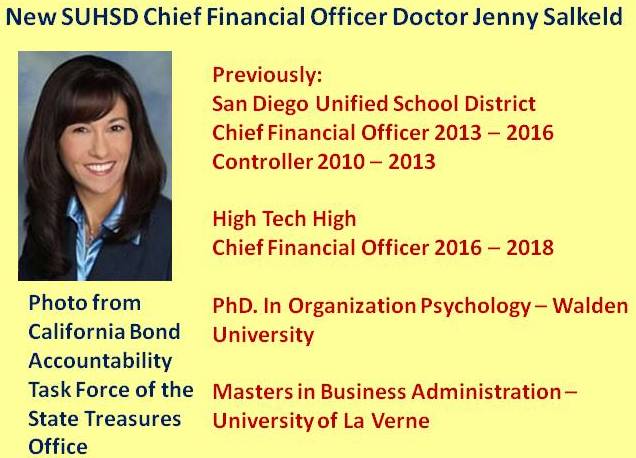
The newly hired Chief Financial Officer of Sweetwater Union High School District (SUHSD), Jenny Salkeld, discovered a significant problem with the budget she inherited. She presented her findings to the Sweetwater leadership team in early September which forwarded her report onto the County Office of Education (COE). The SUHSD board also called in all bargaining units to suspend contract negotiations and inform them of the budgetary uncertainties. Sensationalism and subterfuge became the new reality in Chula Vista, California.

An October San Diego Union article reported,

“On June 25, the school board approved a budget for this school year that assumed the district had spent $328 million in unrestricted funding last school year and had $17 million in reserves going into this school year. In September, Salkeld presented a report showing that the district actually had spent $20 million more than that and started this school year with a negative reserve balance of $4 million.

“On top of spending more than previously estimated, the district received $6 million less in one-time state funding than it had expected.”

salkeld brief bio

After receiving Sweetwater’s alert about the accounting errors, the COE officially disapproved the 2018-19 budget the district had submitted. The reasons for disapproving the budget were the reasons Salkeld had reported. The county’s September 18 letter stated,

“The disapproval of the adopted budget is based on an assessment and analysis of the following major components of the district’s budget.

  • Preliminary 2017-18 negative unrestricted General Fund ending balance
  • Projected 2018-19 revenues overstated
  • Projected 2018-19 expenditures understated
  • Structural deficit in current and upcoming fiscal years
  • Cash concerns”

Apparently someone at the county leaked the budget information to the Voice of San Diego. The district which was in the process of understanding the extent of the problem did not have that opportunity. Instead they were faced with a withering public attack in both the San Diego Union and The Voice of San Diego. The headlines implied that a group of incompetent people at SUHSD were incapable of managing their affairs and were involved in possible fraud.

In the more than twenty reports in these two publications from September through December, it was obscured that it was the Sweetwater District which found the problem and informed the county. It was also never pointed out that budget analysts at the COE failed in their oversight responsibilities.

In November, the county approved Sweetwater’s revised budget.

Budget Shortfalls Throughout the State

Kristen Taketa reporting for the San Diego Union noted,

At least 10 districts in the county are projecting that they will not be able to meet their financial commitments next school year, including Chula Vista Elementary, Jamul-Dulzura Union, Mountain Empire Unified, Oceanside Unified, San Diego Unified, San Marcos Unified, San Ysidro, Sweetwater and Vista Unified. More districts won’t be able to meet their financial commitments after next year.

Teketa provided three reasons for what is a statewide public school funding problem:

  1. Rising pension costs: To address looming pension debt, the state in 2014 started increasing school districts’ share of pension costs. In 2013-14, school districts paid 8 percent of their teachers’ salaries to the state’s teacher pension fund. This year, they had to pay 16 percent.
  2. Rising special education costs
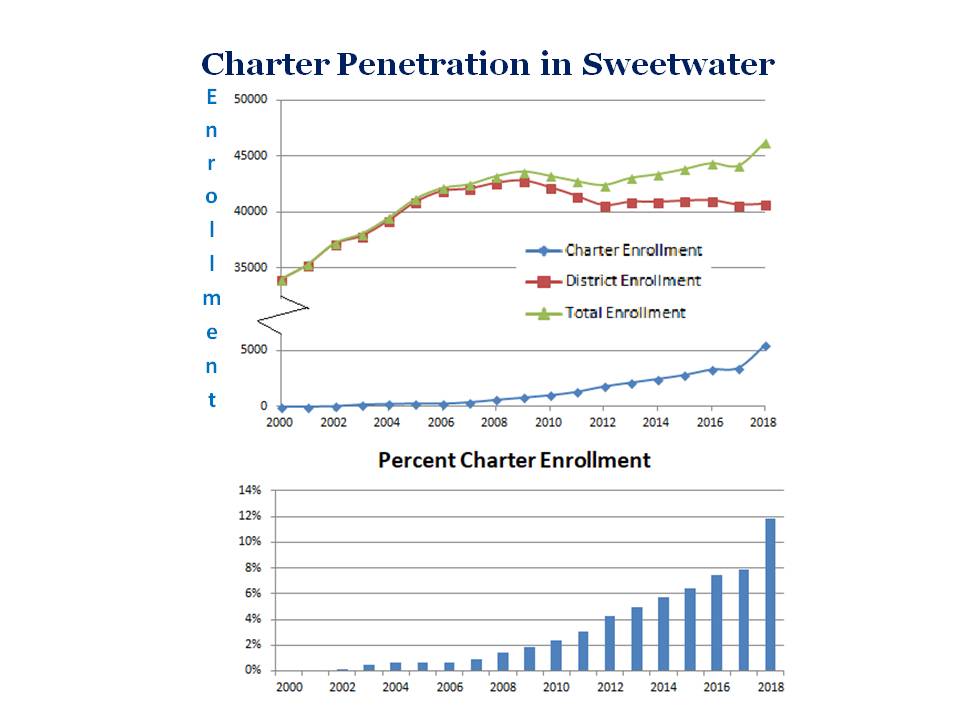
  3. Declining enrollment: Oceanside officials estimate that they can only compensate for 40 percent of revenue lost when they lose students. The student enrollment losses are attributed mostly to charter schools. California, unlike some states, does not financially mitigate the burden caused by charter schools on public school districts. The only option districts have is to reduce services to the remaining students.

Last May, In the Public Interest published a paper by University of Oregon’s Professor Gordon Lafer called “Breaking Point: The Cost of Charter Schools for Public School Districts.” He looked specifically at the impact of charter schools on San Diego Unified School District. Lafer found that the annual impact of student losses was $65,902,809 and that the cost per charter school student was $4,913.

By taking the 5500 students in charter schools instead of Sweetwater schools and multiplying that number by a conservative estimate of $4,000 in cost per student the total is $22,000,000 in stranded costs for the district; more than the budget error Salkeld discovered.

enrollment graphs

Charter Student Growth Compared with District Enrollment

What Caused the Budget Error?

Gene Chavira, President of the Sweetwater Education Association (affiliate of the California Teachers Association) said he believes this budget problem has roots that stretch back to the early 2000’s when Ed Brand was serving his first term as Superintendent. Chavira referenced some strange land sales from that period. Later, during Brand’s second stint as Superintendent, he and SUHSD CFO Diana Russo established two charter schools; another move Gene found suspicious.

The two charter schools were elementary schools belonging to SUHSD. The neighboring elementary school districts were unhappy and reacted by expanding their own charter schools to include the grades 7 – 12 that were serviced by Sweetwater.

After Brand came Jesus Gandara. In 2006, two Sweetwater board members, Jim Cartmill and Arlie Ricasa, flew to Texas and personally interviewed Gandara before he was hired as the Superintendent of Sweetwater schools. It appears that the board members and their search firm ignored some obvious warning signs when they made the hire. In 2011, the board voted to fire Gandara for abuse and brought back Ed Brand to lead the district. Another odd decision, since he had just been forced out as Superintendent of San Marcos Unified under accusations of nepotism.

In April of 2014, four of the five Sweetwater board members (Jim Cartmill, Bertha Lopez, Pearl Quinones and Arlie Ricasa) plus Superintendent Jesus Gandara pled guilty to corruption charges and resigned.

In 2015, five new board members and a new superintendent took leadership of SUHSD. Chavira recalled vividly that he and many others called on the new board to conduct a forensic audit, but the board – though for it in principal – rejected spending the more than $1,000,000 required. Chavira feels that was one of two big mistakes made. The second was that they did not replace the existing finance team.

board group photo 2018

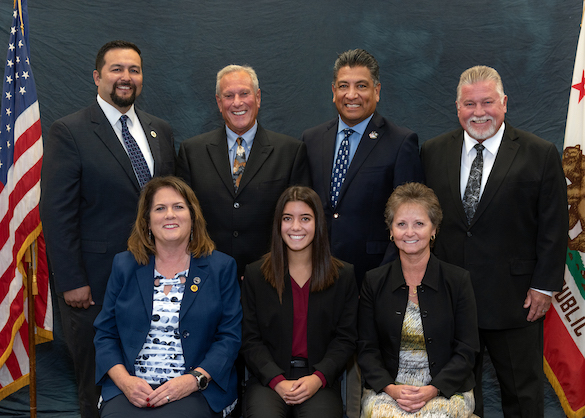
2018 SUHSD Board – Standing from the left: Arturo Solis, Frank Tarantino, Nicholas Segura, Kevin Pike. Seated from the Left: Paula Hall, Student Member Brenna Pangelinan, Superintendent Karen Janney. Photo from District

Throughout the lead up to this current budget problem, the new board has been extremely popular. In the 2018 election, Hall, Solis and Tarantino ran for reelection unopposed. Professor Karen Janney was a student, a teacher and an administrator in SUHSD. She was forced out of the district by then Superintendent Gandara. After which, she taught education leadership at San Diego State University.

This group has accumulated some amazing talent and support. The 2016 audit committee added two new members, Maricela Garcia-Centeno and Bill Kowba making this a power house committee. Existing committee member, Trustee Paula Hall, works as a financial analyst in San Diego Unified School District (SDUSD). Garcia-Centeno is a Certified Internal Auditor and Certified Fraud Examiner. Bill Kowba is a retired Rear Admiral who served both as Chief Financial Officer and Superintendent of SDUSD.

The audit committee’s 2016 report showed concerns regarding transparency and the need for more light shined on budget internals. They stated, “We are recommending the District direct the audit team so that work is not disproportionally focused on well regulated programs but performs a ‘deeper dive’ into areas that have potential of higher risk.

In 2017, the audit committee was recommendingdeeper testing for certain elements of the 2016-17 audit along with a recommendation for a special audit focusing on accounts payable, purchasing and contracts including ….” The implicit message was that the committee was not happy with the answers they were getting or perhaps not getting.

CFO Karen Michel and three members of her small team retired upon completion of the 2018-19 Sweetwater budget. All indications were that these were planned retirements.

After Salkeld’s report showing a $20,000,000 budget error, the county called in the state’s Fiscal Crisis and Management Assist Team (FCMAT). On December 17th the FCMAT study was presented to the Sweetwater board. The Voice of San Diego reported,

“FCMAT’s chief executive officer Michael Fine told board members that 302 entries in the district’s accounting system were doctored to create the impression the district had more money than it really did. ‘That my friends and colleagues, is a cover-up,’ he said, …”

This is a puzzling statement. In the report Fine says, “While the district prepares budget revisions throughout the fiscal year, detailed information provided by the district shows that budget revisions totaling millions of dollars include negative budget entries that lack sufficient supporting documentation.”  His study comes to several conclusions tending against Sweetwater that lack strong evidentiary basis and it has no details about what he later labeled “a cover-up.” Now, Fine will be conducting a fraud audit. If he does not find fraud, won’t he be open to a libel charge? Can his audit be trusted?

A December 21st Voice of San Diego headline states, “County Ed Office Takes Control of Sweetwater’s Board.” The county had issued a “stay and rescind” order which gives them veto power over some decisions made by the SUHSD board. This begs the question, why did the county which dropped the ball here jump so quickly into this drastic step when the district team which found the problem has been addressing it aggressively?

The SUHSD web-site has a response to the issues raised. The opening paragraph says,

“Over the past few months the Sweetwater Union High School District has faced significant challenges with respect to our organizational budget. … We realize that these issues may seem insurmountable at times, but we want to assure you that despite some of the doubts being cast in the public, we are moving forward with a stabilization plan that will ensure positive financial health.”

There is also a letter from Superintendent Janney about the “stay and rescind” order. She cites remarks by Dr. Mark Skvarna, a financial advisor from the county, about the limitations on the order. Janney writes, “This authority is specific to the actions that are ‘inconsistent with the district’s ability to meet its financial obligations.’”

The San Diego Union and the Voice of San Diego are Biased Against Public Education

Editorials in the San Diego Union continually attack teachers and their unions. An editorial leading up to the 2018 general election called for a former banker and charter school chief as Secretary of Public Instruction (SPI). Following a familiar destroy public education (DPE) script; another editorial created a false crisis as the predicate for an urgent plea to elect charter school executive, Marshall Tuck, over California State Assemblyman, Tony Thurmond.

In 2005, Buzz Woolley founded Voice of San Diego. It was the first digital nonprofit news organization to serve a local community in the country. Besides his interest in using new technologies for media, Woolley also is enthusiastic about education technology in the classroom. In 2013 Woolley’s Girard Foundation sent over $500,000 to companies developing software for “personalized” education and competency-based education.

The year before starting the Voice of San San Diego, Woolley and Gap Founder Don Fisher established the Charter School Growth Fund. John Walton (Walmart heir) and Greg Penner (Walmart heir) joined the board. In 2016, that fund had assets of $217,176,094 with a yearly income of $95,184,785.

A local media watch dog report tells the story of an education reporter losing her job while perusing a store about the COE. Blogger Maura Larkins wrote,

“Voice of San Diego dropped its coverage of SDCOE attorney shenanigans, and laid-off its stellar education reporter Emily Alpert.”

“Voice of San Diego benefactors Buzz Woolley and Irwin Jacobs [founded Qualcomm], who claim to care about education, could have easily paid Emily’s salary with their pocket change if they’d wanted her to stay.”

“It seems Buzz Woolley, Irwin Jacobs and Emily Alpert weren’t on the same page.”

Some Concluding Words

Superintendent Janney may have been wrong to retain the inherited financial team; however, in 2015 she had a lot on her plate. A Trustee said that Janney began by focusing on education leadership in the district. There was a widely shared belief that several administrators were in positions by dint of cronyism and that many of them were incompetent. When she was alerted to the budget issue, Janney reacted professionally. She immediately informed stakeholders and the COE.

The budget error appears to have originated within the financial department. FCMAT Director Fine claimed it was a “cover-up.” Maybe he is right but he did not present much convincing evidence; only reporting that some entries that subtracted from the deficit were not sufficiently documented. It is hard to see the motive for financial professionals engaging in this “cover-up,” but people sometimes make strange decisions.

Two mainstream media outlets in San Diego that have regularly promoted privatizing public education and “corporate education reform” have been ruthlessly attacking SUHSD. They have indicated that the leaders in Chula Vista are incompetent and corrupt. The obvious dog-whistle here is that there are too many non-whites in SUHSD leadership.

The truth is that the SUHSD team is highly competent and has delivered a refreshing era of ethics and openness to the South-bay. Karen Janney is an educator with deep knowledge and experience, plus she is a gifted leader and public speaker. The present financial team led by Jenny Salkald is much more impressive than the county or state teams who have been nothing short of unprofessional.

The real investigation should be into whom or what is motivating this unjust attack on SUHSD? Also, why are we paying all those bloated salaries at the San Diego County Office of Education and for what?

Twitter: @tultican

“After the Education Wars”

19 Dec

By Thomas Ultican 12/19/2018

Andrea Gabor has written another outstanding book. After the Education Wars advocates a radical departure from the top-down models of education reform that have dominated the last two decades. Gabor, a Bloomberg chair of business journalism, uses five case studies to convincingly argue that business leaders brought the wrong lessons to education when they imposed Fredrick Winslow Taylor’s scientific management while shunning William Edwards Deming’s continuous improvement.

Taylor was a mechanical engineer who became intrigued by the problem of efficiency at work. He is widely viewed as inventing industrial engineering; his 1911 Principles of Scientific Management became the most influential book on American management practices during the twentieth century. In it he wrote,

“It is only through enforced standardization of methods, enforced adoption of the best implements and working conditions, and enforced cooperation that this faster work can be assured. And the duty of enforcing the adoption of standards and enforcing this cooperation rests with management alone.”

Taylor was strongly anti-union. He saw them as wastefully introducing inefficiencies into the work place.

Andrea Gabor’s first book The Man Who Discovered Quality was about William Edwards Deming. That book was reviewed by Business Week in 1991. Some key statements in the review:

“A trio of reverential new books celebrates Deming’s management principles. In Deming Management at Work, Mary Walton, a writer for The Philadelphia Inquirer Magazine, focuses on how six organizations, including the U. S. Navy, have applied his methods. You get much of the same from both Rafael Aguayo’s Dr. Deming: The American Who Taught the Japanese About Quality and Andrea Gabor ‘s The Man Who Discovered Quality, even though their titles suggest biographical accounts. Aguayo, a former bank executive, essentially offers a schematic for putting Deming’s teachings to work.

“Gabor, formerly a staff editor for this magazine and now a senior editor at U. S. News & World Report, provides far more insight into the man, which makes hers the most accessible and enjoyable of the three books. Born in Iowa, Deming grew up in a tarpaper shack in Wyoming. He earned a scholarship to Yale University, where he graduated in 1928 with a PhD in mathematical physics. He worked for the Agriculture Dept. and then the U. S. Census Bureau before the War Dept. sent him to Japan in the late 1940s to help rebuild that war-torn nation. Gabor vividly describes Deming’s early visits, using his personal diary to bring to life his rise to prominence.”

The Business Week review ended with,

“How great is Deming’s influence in Japan? On the walls in the main lobby of Toyota’s headquarters in Tokyo, three portraits hang. There is one of the founder and one of the current chairman. But Deming’s is the largest of all.”

In 1979, Ford would lose a billion dollars and General Motors would lose a whopping 2.5 billion dollars. Many people blamed President Jimmy Carter. Industry leaders blamed unions and lazy workers. When out of desperation they called on Deming, he blamed management.

In the forward to her new book, Gabor highlights two key points of Deming’s teaching:

“Ordinary employees – not senior management or hired consultants – are in the best position to see the cause-and-effect relationships in each process …. The challenge for management is to tap into that knowledge on a consistent basis and make the knowledge actionable.”

“More controversially, Deming argued, management must also shake up the hierarchy (if not eliminate it entirely), drive fear out of the workplace, and foster intrinsic motivation if it is to make the most of employee potential.”

The Bush-Kennedy No Child Left Behind (NCLB) legislation with its test and punishment philosophy of education improvement was a clear violation of Deming’s core principles. Today, NCLB is widely seen as a damaging failure. Obama’s Race to the Top (RttT) had a school “turn-around” strategy of hiring consultants or charter management organizations to fix schools that didn’t reach testing benchmarks. It was a consistent failure because they did not understand the cause and effect relationships starting with their completely incapable testing instrument for measuring failure.

Instead of removing fear from teacher ranks, NCLB and RttT injected more fear into them. I am one teacher who will never forget the President of the United States congratulating the Central Falls, Rhode Island school board for firing all 88 teachers at Central Falls High School because the test scores were too low.

NCLB and RttT were bad policy based on bad ideology because they embraced Taylorism and ignored Deming. However, there are wonderfully successful examples of schools and even states embracing Deming style continuous improvement through bottom up leadership. Gabor’s deeply researched book shares a few of their stories which demonstrate success in education leadership.

The Small School Progressives

The progressive education grassroots movement appears to have gotten its inspiration from Britain’s 1960’s open-education which had intellectual roots going back to Friedrich Froebel, John Dewey and Jean Piaget. Lillian Weber, a City College professor who studied in England brought open-education to the attention of New York’s reformers. That is where Deborah Meier became her star mentee. Sixties student activists Ann Cook and Herb Mack traveled to London in the 1960’s to observe open-education first hand. They became small school advocates consistent with Gabor’s description of the progressive leaders as “for the most part, anti-establishment ‘lefty hippies’…”

Gabor observed that surprisingly, these progressives ran schools that were lean, entrepreneurial and efficient.

One antidote from Gabor shows the stark difference between schools envisioned by the New York progressives and today’s no-excuses charter school leaders:

“As Meier, a protégé of Weber, explained it, the hallways and lobbies of schools ‘work best if we think of them as the marketplaces in small communities – where gossip is exchanged, work displayed, birthdays taken note of; where clusters of kids and adults gather to talk, read and exchange ideas.’”

In 1973, Tony Alvarado was named Superintendent of District 4 in New York City which is in a poor largely black and Latino neighborhood. Alvarado fostered an educator driven approach to school improvement. He encouraged educators to start new schools and schools within a school. Gabor notes, “Put simply, Alvarado was a master at fostering both improvements from grassroots up and creative non-compliance.”

In 1974, he heard about Deborah Meier and together they launched Central Park East which brought open-education to District 4. This was the first of what would eventually run into the hundreds of these small progressive schools across New York City. When Alvarado arrived, district four had the lowest reading score among the cities 32 districts. In ten years, it climbed to fifteenth.

Alvarado went to District 2 in 1988. It was ranked near the middle of the cities districts and in a decade it was ranked number 2.

Another important factor in the success of the New York Progressives was the support of Ted Sizer’s Coalition of Essential Schools. As the small school movement progressed, Sizer’s organization and Meier’s Center for Collaborative Education provided important infrastructure such as training, funding and political support. The pedagogic emphasis was on learning depth over quantity which is one of the stated goals of the now loathed top down imposed common core state standards.

I cannot do justice to Andrea’s well written readable and engaging account of the New York’s small school progressives. However, I wanted to share this much because I have a personal experience with two of the protagonists of this story; Tony Alvarado and Deborah Meier.

Chapter four in Diane Ravitch’s startling change of view book The Death and Life of the Great American School System tells the story of the unlikely school reform effort in San Diego, California. A non-educator and politically connected former federal prosecutor, Alan Bersin, was named Superintendent of Schools in 1998. He was given carte blanche powers to reform the district.  Ravitch noted that San Diego was an unlikely place to launch a reform movement because it was seen as “one of the nation’s most successful urban school districts.”

Bersin was a Harvard man so he went to Harvard for direction and that is where he heard about District 2 in New York City and Anthony Alvarado. Bersin brought Alvarado to San Diego to be in charge of the education agenda while he took care of the politics.

For some reason, Alvarado completely abandoned his “grassroots up and creative non-compliance” that had led to such success in New York. In 1999, two-thousand teachers demonstrated at a San Diego Unified School District board meeting to protest the administration’s top-down mandates. Ravitch reported that the Bersin-Alvarado management employed “centralized decision making and made no pretense of collaborating with teachers.”

In 2002, my first teaching job was working under Bersin-Alvarado. It was a miserable experience characterized by fear and loathing everywhere. It seemed that besides the no-input mandates, there was a quota on number of teachers to be fired. The belief among teachers was a certain number teachers were to be fired as an example for the rest.

I was a fifty-one year-old first year educator teaching five sections of physics to ninth-graders at Bell Junior High School, a poor, non-white and low scoring school. My classes actually did well on the end of course exams including my honors class being the second highest scoring in a large district with many wealthy communities.

I was evaluated as “not moving my students to achieving standards.” A designation that meant I could not even apply to be a substitute teacher.

In 2015, I was able to spend an hour talking with Deborah Meier and her niece from Denver. Both of them were discouraged by the turn events in public education. Especially the niece from Denver was seeing little hope for the future of America’s public schools. Later, I investigated the destruction of Denver’s public education and I understand why she was so down.

I asked Deborah “what happened to your friend Tony Alvarado when he came to San Diego.” She had no explanation why he abandoned the model of teacher led continuous improvement after his own twenty-five year history of successfully applying it.

Deborah had been a larger than life figure to me for a few decades. When I had the opportunity to speak with her, I was so happy to discover that she is just as warm and humble as she is brilliant.

A Tale of Two States: Michigan and Massachusetts

Brockton, Massachusetts the birthplace of Rocky Marciano and Marvin Hagler is home to Brockton High School (BHS) famous for its athletics. By 1993, BHS became a rallying cry for school reform in the state. Even Republican Governor William Weld’s own commission agreed that BHS was not funded properly.

Gabor takes the reader through the motivation for Massachusetts’ education reform and its bottom up development.  She notes there was broad-based leadership from the governor, from business, from legislators, from the judiciary, from teachers and their unions. They created “a clear vision of what education reform should look like.”

There was a “grand bargain” to increase spending in exchange for increased accountability. A “collaborative, transparent, and iterative approach to developing both a new curriculum and a standardized test that became the graduation requirement” was carried out. Gabor writes, “… Massachusetts reforms grew out of a deliberate, often messy and deeply democratic process…”

Much of the story of the Massachusetts reform is told through the transformation of the giant 4,000 plus students BHS. It was the story of home grown reform led by locals who themselves attend BHS. They proved a large school can succeed. Gabor shares,

“Within a little over a decade, Brockton would go from one of the lowest performing schools in the state to one of the highest and, in 2009, it would be featured in a Harvard University report on exemplary schools that have narrowed the minority achievement gap. Today, 85 percent of Brockton students score advanced or proficient on the MCAS, the state’s standardized tests, and 64 percent score advanced or proficient in math.”

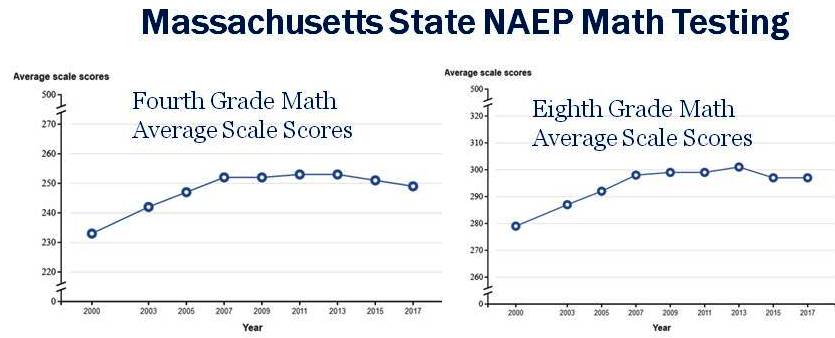
In 2010, Massachusetts abandoned parts of their successful education reform agenda in order to win a $250 million dollar RTTT grant. They abandoned their state standards and curriculum to adopt the Common Core State Standards. The result looks bad. It seems that after more than a decade of continuous improvement, progress has slowed or possibly reversed as suggested by National Assessment of Education Progress (NAEP) data.

Mass scale data

Graphs Created Using the NAEP Data Explorer

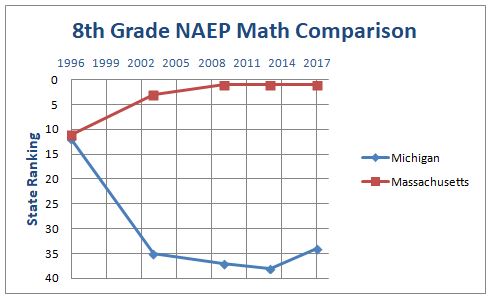
In the late 1990’s, Michigan and Massachusetts chose opposite paths of education reform. Michigan embraced school choice while Massachusetts rejected it. Massachusetts increased school spending. Michigan did not.  Michigan imposed school reform in a top-down fashion with little educator input. Massachusetts embraced educator contributions to education reform. Eighth grade math NAEP results provide stunning evidence for which choices were better.

Comparing Mich and Mass

The Nations Report Card Provided the Data

Conclusions

Gabor found a school district in Texas that embraced Deming’s quality ideas thirty-five years ago. Leander school district is non-urban and is in a right to work state in the middle of a mostly white Christian and Republican community. I find this all important, because it shows that the continuous improvement model led by educators, students and parents works in any political environment. It is not a red state – blue state or union dependent thing. It shows Deming’s leadership principles are sound and perhaps universal.

I met Andrea Gabor in Raleigh, North Carolina at the Network for Public Education conference of April, 2016. She had come there from New Orleans accompanied by friends she made there while researching this book. For a guy like me who grew up in rural mostly white Idaho and then moved to pluralistic California to serve in the integrated US Navy, the story of profound and continuous racism in New Orleans were beyond my ability to apprehend. There was a conscious centuries long effort made there to limit education among the black population!

When all of the black professional educators in New Orleans were fired after hurricane Katrina and replaced with mostly white college graduates from Teach for America, it was a continuation of that same centuries of racial injustice.

In Raleigh, Andrea made it clear that she was not anti-charter school and in her book she presents the story of one particularly successful school, Morris Jeff, that exemplified the Deming approach. Morris Jeff is one of the few mixed race schools in New Orleans and their students are outperforming the cities “no-excuses” charters.

Bottom line, this is a special book and I encourage you to read it. It’s ideas are both thought provoking and promising.

History of Institutional Racism in U.S. Public Schools

20 Jun

By T. Ultican 6/20/2018

Susan DuFresne a pre-school and special education specialist from Seattle, Washington just published the book History of Institutional Racism in U.S. Public Schools. Dufresne is also a self-taught artist with a heart that screams for justice. She began her project with three fifteen feet long four feet high pieces of canvas and painted images of racial injustice and its effect on schools from the 16th century until today. These illustrations are supported by the notes Susan developed about each issue depicted and hand wrote in the margins.

I met Susan in 2014 at Seattle’s iconic Westgate Park, home of political expression and protest for five decades. For me, it brought back childhood memories of a 1962 trip with my parents and a sister to the Seattle World’s Fair. At Westgate Park, my family boarded the mono-rail for the fairgrounds now called the Seattle Center, still home of the Space Needle and today, home to the Bill and Melinda Gates Foundation. That 2014 teacher’s march was the first public event organized by the Washington State Bats. We were protesting the Gates Foundation. Two motorcycle police went ahead of us closing streets to cross traffic and we happily marched toward the Seattle Center to enthusiastic cheers from locals along the route.

Marching in Seattle 2014

  1. a) Making Signs in Westgate Park Before the March b) Anthony Cody and Susan DuFresne Lead 250 Bats Toward the Gates Foundation – Photo by Ultican

Last year, I met Susan again at the National Public Education (NPE) annual conference in Oakland, California. She displayed her amazing art work in the main conference room. The room was large enough to accommodate more than 1,000 people seated at round tables. Her illustrations covered most of the north wall.

I would be very surprised if Susan could pick me out of a lineup, but she certainly made a positive impression on me.

School teachers in general abhor injustice and activists like Susan are particularly sensitive to the least protected among us. Garn Press, who is publishing Susan’s book says of her,

“Susan DuFresne is an artist and educator who advocates across all intersectional groups, organizing for social justice. She works alongside colleagues and friends who are leaders in the Black Lives Matter Movement and the Badass Teachers Association. She is a vocal supporter of Indigenous peoples, the Women’s Movement, and LGBTQIA activists, and cares deeply about environmental issues.”

“One of the important battles she fights is for democratically run schools, as well as a child’s right to play. She pushes against the use of high stakes testing, agreeing with many students, parents, and educators who denounce these tests as racially biased, advocating for their right to opt out.”

Both Susan and her publisher have pledged to donate a part of net profits to Black Lives Matter and to the Lakota People’s Law Project.

Yohuru R. Williams is Professor of History, Dean of the College of Arts and Sciences at the University of St. Thomas, Minnesota. In a foreword to Susan’s book he wrote,

“As a historian of the Civil Rights and Black Power Movements I am keenly aware of the power of art, in all of its forms, to rouse interest, stir the conscience, and encourage resistance to inequality. Inspired by the need to communicate a deeper truth, the poet’s words, the dancer’s feet, and the artist’s palette explode with an unharnessed creativity driven by a desire to educate, instigate and re-imagine.”

“United States Congressman and Civil Rights icon John Lewis is fond of sharing that one of the primary inspirations for him to write to the Reverend Dr. Martin Luther King and join the Civil Rights Movement was a 1958 comic book Martin Luther King and the Montgomery Story, which in vivid illustration told the story of Dr. King, Rosa Parks and the 1955 Montgomery Bus Boycott. Beyond a mere recounting of those events the comic was also an education tool, identifying various ways that young people could get involved with the movement following what it termed the “Montgomery Method,” Nonviolent Direct-Action protest strategies derived for, and aimed at toppling segregation without losing sight of the shared humanity of the oppressor and the oppressed.”

The Dark History of Ignorance and Bigotry

Panel 1

NPE Oakland 2017 Photo of Susan’s Original Panels (1) – Photo by Ultican

The foundations of America have some very unsavory aspects. Susan illustrates these realities of racism dehumanizing people with different features and languages. She makes the point that this history is not being appropriately studied. This opportunity to remove the talons of evil that led to injustice is not being exercised. Those dark tendencies are still plaguing modern society and children are growing up ignorant of this hidden heritage.

In two of the panels DuFresne addresses the atrocities foisted upon the indigenous peoples of America.

In 1830, President Andrew Jackson, just a year after taking office, narrowly pushed through a new piece of legislation called the “Indian Removal Act”. In an infamous 1838 episode depicted on one of Susan’s panels, the US government sent in 7,000 troops to remove the Cherokee nation from the Carolinas. They forced the Cherokees into stockades at bayonet point. They were not allowed time to gather their belongings, and as they left, whites looted their homes. Then began the march known as the Trail of Tears, in which 4,000 Cherokee people died of cold, hunger, and disease on their way to the western lands.

By 1837, the Jackson administration had removed 46,000 Native American people from their land east of the Mississippi and had secured treaties which led to the removal of a slightly larger number. Most members of the five southeastern nations had been relocated west, opening 25 million acres of land to white settlement and to slavery.

Supreme Court Rules Segregation Legal

The Plessy versus Ferguson court case of 1896 ended in a 7 to 1 decision by the US supreme court ratifying segregation. In this case, a shoemaker named Homer Plessy who happened to have one black great-grand-parent purposely broke Louisiana’s Jim Crow law that require black people to use separate facilities from whites. In the key passage of the opinion, the Court stated that segregation was legal and constitutional as long as “facilities were equal.” Thus the “separate but equal doctrine” that would keep America divided along racial lines for over half a century longer came into being.

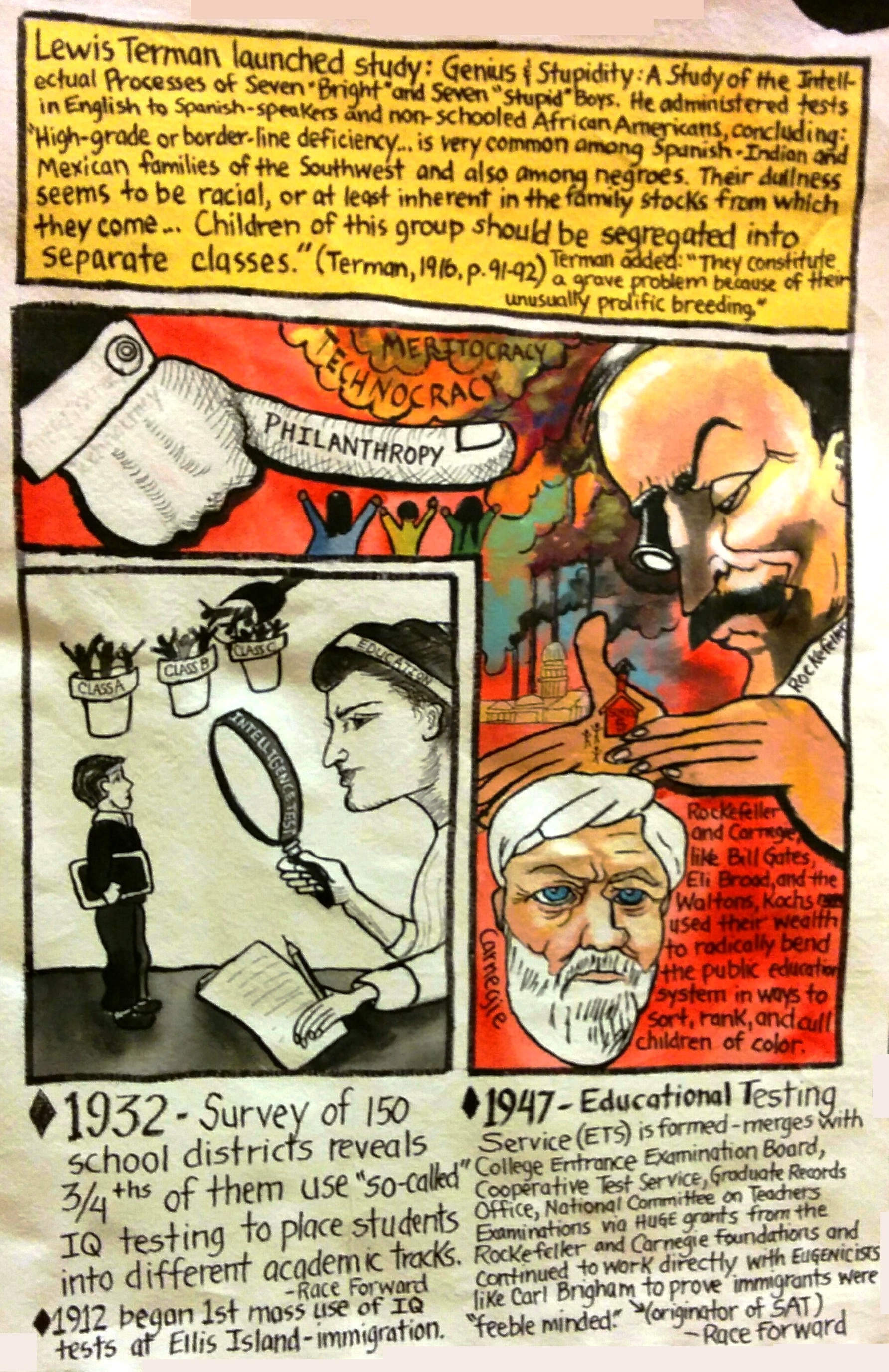
DuFresne put Plessy on the same panel of art as the “science” of eugenics that “proved” white people superior. The 1905 IQ tests developed by Alfred Binet were also used to justify forced sterilization. One of Susan’s notes says that the last forced sterilization in America occurred in Oregon (1981). Clinical psychologist Natalie Frank states,

“The eugenics movement began with the advent of testing for individual characteristics in children. Although intelligence testing was created to determine school readiness, it became one of the unintended foundations of eugenics. This occurred when three of the influential psychometricians, Lewis Terman, Henry Goddard and Robert Yerkes, began advocating testing as a method of differentiating who should be permitted to reproduce based on intelligence. These scientists built momentum for the idea of selective breeding and the call for using the process to strengthen the gene pool was taken up by some of the upper echelon of American and European society.”

Panel 14

NPE Oakland 2017 Photo of Susan’s Original Panels (2) – photo by Ultican

Dictionary Dot Com defines eugenics: “the study of or belief in the possibility of improving the qualities of the human species or a human population, especially by such means as discouraging reproduction by persons having genetic defects or presumed to have inheritable undesirable traits (negative eugenics) or encouraging reproduction by persons presumed to have inheritable desirable traits (positive eugenics).”

Binet died in 1911 after having warned against the test’s potential for misuse, calling the notion that intelligence could not be improved a “brutal pessimism.” By 1916, Stanford’s Lewis Terman had come to quite a different conclusion. He wrote,

“The fact that one meets this type [feebleminded individuals] with such extraordinary frequency among Indians, Mexicans, and negroes suggests quite forcibly that the whole question of racial differences in mental traits will have to be taken up anew and by experimental methods. 

“Children of this group should be segregated in special classes and be given instruction which is concrete and practical. They cannot master abstractions, but they can often be made efficient workers, able to look out for themselves. There is no possibility at present of convincing society that they should not be allowed to reproduce, although from a eugenic point of view they constitute a grave problem because of their unusually prolific breeding.”

Terman’s reasoning has been updated and today it is used to justify privatizing public schools. The drill and skill pedagogy and discipline practices of the no excuses charter school movement flourishes in politically weak minority communities. It is child abuse justified by bigotry.

It is the same irrational ideology that has led to today’s high profit standardized testing industry. In fact, Carl C. Brigham, the father of the SAT, became interested in mental testing while a student a Princeton. He later became a psychology professor at the university, where he was an enthusiastic member of the eugenics movement. During the 1920s he developed his own objective admissions test for students applying to Princeton.

A Frontline story on PBS reported,

“Brigham later worked on the Army Alpha Test, an intelligence test given to millions of recruits during World War I. In 1923, he wrote A Study of American Intelligence, which analyzed the findings of the Alpha Test by race. Its conclusion, which Brigham insisted was without prejudice, was that American education was declining and ‘will proceed with an accelerating rate as the racial mixture becomes more and more extensive.’”

The Authors Motivation

About creating this massive work of art and latter turning it into a book, Susan shares,

“I thought too of the African men, women and children who were brought to America and enslaved. The Southern Poverty Law Center has raised the concern that even today public school students still do not study slavery or consider how racism and discrimination impact the lives of children and their families. With a marker I wrote the following notes in the margins of the first panel.

  • Enslavement of Indigenous people, Native Americans, murder and disease enabled the colonizers to seize land.
  • Enslavement of Africans enabled profit as well.
  • Oppressive schooling became possible via acts of terror.”

“Notes for panel 5:

  • 1899 – Supreme Court allows a state to levy taxes on Black and white citizens alike while providing a public school for white children only. (Cumming v. Richmond, (GA) County Board of Education).
  • 1893 – Mandatory education for Indian children in Boarding Schools – Native language forbidden. If parents refused, annuities or rations could be withheld or send them to jail. Educators had quotas to fill. Many died at school.
  • 1913 – U.S. v. Sandoval, Supreme Court, American Indians ‘simple, uninformed & inferior people’ – incapable of citizenship.”

Destroy Public Education Movement

Dufresne concludes her history by addressing the modern forces that are destroying public schools in poor non-white neighborhoods.

Panel 11

NPE Oakland 2017 Photo of Susan’s Original Panels (3) – Photo by Ultican

The 2002 No Child Left Behind Act used the tools developed by the eugenicists to label the schools of black and brown children failures. The standardized testing used to destroy their schools had “roots deeply embedded in racism.”

Susan highlights Secretary of Education in the Obama administration, Arne Duncan’s infamous statement, “I think the best thing that happened to the education system in New Orleans was hurricane Katrina.” This statement is disgusting and makes it clear that the attack on schools in minority communities is bipartisan. It is not conservatives or liberals attacking public education. It is wealthy elites who lead both the conservative and liberal movements in America destroying the foundations of democracy because they fear it.

Conclusion

I have touched briefly on a small portion of the historical abuse of “those people’s children” that Susan is teaching about. As I was writing this, I looked closely at each panel of art and their associated notes. The more I looked the more I saw. This work exemplifies the creative use of art to teach. It shines a light on injustice motivated by racism and the damage reeked.

Every school library at every level should contain this book and have it prominently displayed. Every parent should get this book and study it with their children. This book is a masterpiece of art and history.