
Tag Archives: P David Pearson

Strange Science of Reading Law Suit

20 Feb

By Thomas Ultican 2/20/2025

December 4, 2024, two law firms from New York and Chicago respectively filed a class action law suit against reading curriculum developers not steeped in science of reading (SoR).  One of the attorneys behind this Massachusetts suit, Benjamin Elga, said he listened to the Sold a Story podcast and immediately saw “an injustice that cried out for redress.” Their main claim is that “the National Reading Panel commissioned by Congress in 1997 confirmed, all credible education and literacy research shows that daily phonics instruction is necessary for literacy success” and that these curriculum developers were deliberately deceiving schools and parents when they did not focus on systematic phonics instruction.

The suit was brought against: Lucy Calkins and her Units of Study, Irene Fountas and Gay Su Pinnell and their Reading Resources, The Reading and Writing Project at Mossflower, Teachers College Columbia University, Greenwood Publishing Group, Heinemann Publishing and HMH Education Co.

First of Its Kind Law Suit

Never before have curriculum providers been targets of this type of suit.

In paragraph-22 of the filing, the plaintiffs claim, “For decades, scientists and educators have understood that the first step in teaching literacy is robust, daily, and extensive instruction in phonics.” Unfortunately, this statement is not true.

The ideology supporting phonics comes from the National Reading Panel (NRP) that was supervised by the National Institute of Child Health and Development (NICHD). NRP was founded in 1997 and presented its findings in 2000. The report was supposed to end the reading wars but it came under immediate attack including in the minority report by Joanne Yatvin, who wrote: “At its first meeting in the spring of 1998, the Panel quickly decided to examine research in three areas: alphabetics, comprehension, and fluency, thereby excluding any inquiry into the fields of language and literature.”

Yatvin was the superintendent of a school district in Oregon, held a PhD in education and was the only panel member with classroom experience teaching reading.

Yatvin published Babes in the Woods: The Wanderings of the National Reading Panelfor Kappan (January 1, 2002) in which she directly addressed the phonics piece:

“The situation worsened when the phonics report was not finished by the January 31 deadline. NICHD officials, who wanted it badly, gave that subcommittee more time without informing the other subcommittees of this special dispensation. The phonics report in its completed form was not seen, even by the whole subcommittee, of which I was a member, until February 25, four days before the full report was to go to press. By that time, not even all the small technical errors could be corrected, much less the logical contradictions and imprecise language. Although a few changes were made before time ran out, most of the report was submitted ‘as is.’ Thus the phonics report became part of the full report of the NRP uncorrected, undeliberated, and unapproved. For me, that was the last straw, and I informed my fellow panel members that I wanted my minority report to be included.”

The blow-back to the original report was strong. Elaine Garan is an award-winning researcher, author of Resisting Reading Mandatesand educator with 24 years of experience as a reading teacher.  In March 2001, she wrote, “Beyond the Smoke and Mirrors: A Critique of the National Reading Panel Report on Phonics” published by Kappan. When two NRP panel members, Linnea Ehri and Steven Stahl, attacked her in their Kappan article, she responded:

“I used the data and words of the National Reading Panel (NRP) to establish that its report was fatally flawed in terms of the fundamental research protocols, including validity, reliability and generalizability.  I established that, rather than living up to the highly publicized claims of ‘scientific’ accuracy, the report was riddled with errors.”

Garan was right. There are no “strong correlative and causal relationships between systematic phonics instruction and reading success.”

Despite the suits claim that “all credible education and literacy research shows that daily phonics instruction is necessary for literacy success”, there are in truth many highly credentialed scholars who disagree.  Posted on Ferman University Professor Paul Thomas’s blog are many articles with links to hundreds of scholars opposing SoR. In a recent post, he noted,

“The hand wringing over the 2024 NAEP reading results, however, seems to focus on learning loss and post-Covid consequences—not that reading achievement on NAEP was flat during the balanced literacy era and now has dropped steadily during the SOR era:”

Peter Johnston and Deborah Scanlon of the University at Albany debunked the Science of Reading (SoR) in this report.

Maren Aukerman is currently a Werklund Research Professor at the University of Calgary who focuses on literacy education and formerly served on the faculties at Stanford University and the University of Pennsylvania. She warns of journalists using logical fallacies to promote science of reading (SoR). For example, not reporting research showing students taught to read without systematic phonics “read more fluently.”

In 2023, a major study of teaching reading in the United Kingdom was released. The UK embraced a phonic first reading paradigm similar SoR in 2012. The researchers conclude an over-emphasis on phonics instruction caused reading test scores to go down. This matches what we have seen with this year’s National Assessment of Education Progress (NAEP) testing.
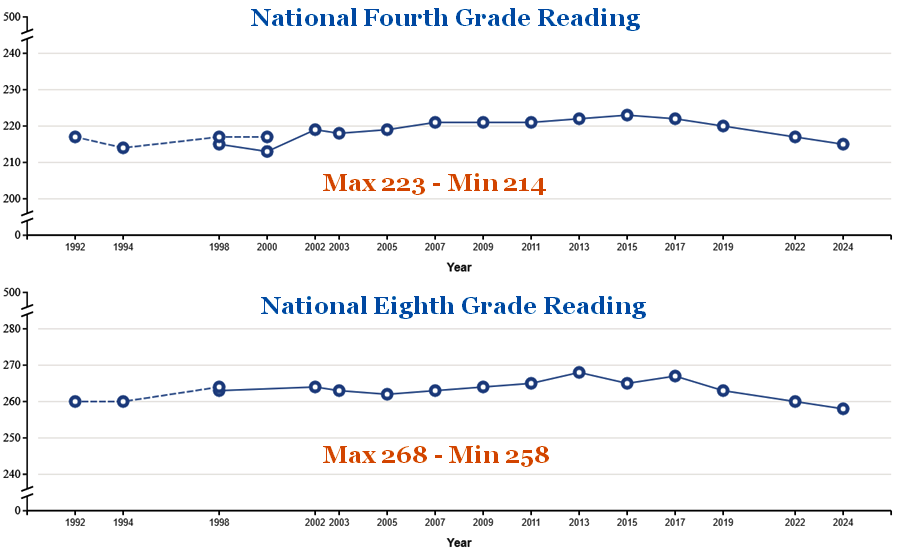
2024 NAEP Reading Results

Both nationally and internationally, many education researchers are openly opposed to SoR. Its support comes almost exclusively from billionaire sponsored researchers and publications.

Lawyers versus Educators

Two scholars, Robert J. Tierney, Dean Emeritus of the Faculty of Education at University of British Columbia, and Paul David Pearson, Evelyn Lois Corey Emeritus Professor of Instructional Science in the Berkeley School of Education at the University of California Berkeley, published the free to download “Fact-Checking the Science of Reading.”  

Lawyer Benjamin Elga said he listened to the Sold a Story podcast and it motivated his law suit. The education professionals wrote:

“Undoubtedly, for both of us, the precipitating event was Emily Hanford’s (2022) release of the six-part podcast, Sold a Story, broadcast by American Public Media beginning in late 2022. Hanford’s series motivated us to accelerate our response for many reasons—two of which were most pressing to us:

  1. A consistent misinterpretation of the relevant research findings; and
  2. A mean-spirited tone in her rhetoric, which bordered on personal attacks directed against the folks Hanford considered to be key players in what she called the Balanced Literacy approach to teaching early reading.” (Pages xiii and xiv)

Paragraph 39 of the law suit states, “Cueing methods have been roundly criticized for teaching children to guess rather than read.”
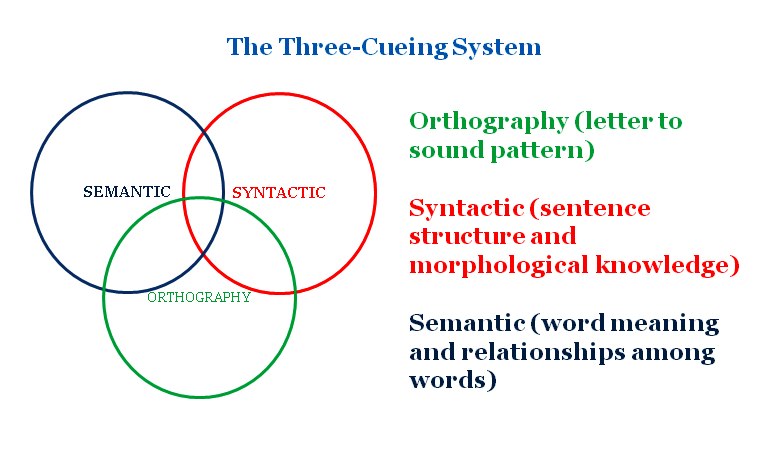
This above is a diagram of what they mean by cueing. Orthography uses phonics type approaches to sound out unknown words. Does it look right? With the second cue, syntactic, a student tries to understand what is written. Does it sound right? What would make it conform to grammar rules? Semantics is the last of the three cues. Does it make sense?

Cueing methods like all widely used reading curriculums embrace phonics as a tool but not as part of a daily structure.

Tierney and Pearson observed,

“It seems overly limiting to discredit the use of cueing systems based on what some might consider a restrictive assumption—that reading is entirely the accurate naming of words, rather than an act of meaning making that involves hypothesizing. To dismiss the use of context as an over-reliance on ‘guessing’ or ‘predicting’ ignores important evidence.” (Page 65)

Who Are These People?

With five lawyers listed on the class action law-suit, Kaplan & Grady is a firm in Chicago specializing in commercial and civil rights cases. Justice Catalyst Law (JCL) is a non-profit law firm from New York with two lawyers listed on the case. Both firms are fairly new, Kaplan & Grady was founded in 2022 and JCL was formed in 2018 per their tax filings (TIN 83-0932015).

Not much is known about the private company but in 2022, the non-profit took in $2,185,000 in contributions and Partner Benjamin Elga has connections to big Silicon Valley money. He is a Senior Fellow at American Economic Liberties Project to which The Irish Times reports that eBay founder Pierre Omidyar is a large contributor.

New court filings are due in March and the lawyers are demanding a jury trial.
Billionaires Driving Science of Reading

21 Jan

By Thomas Ultican 1/21/2025

On January 2nd, billionaire created education news source, The 74, declared there is a reading crisis in Los Angeles Unified School District (LAUSD). This was based on an LA School Report article stating that on the 2023-24 California assessments “43.1% of all LAUSD students met state proficiency targets in reading, compared with 44.1% in the 2018-19 school year, the last before the pandemic.” In math, 32.8% met standards, compared to 33.5% in 2018-19. It seems ludicrous to believe that a 1% drop in testing results, that are known to wiggle up and down, is a crisis. Furthermore, in 2021-22 those proficiency numbers were 41.7% ELA and 28.5% math and in 2022-23 were 41.2% ELA and 30.5% math which suggests that school district testing results are on an upswing.

The 74 was founded in 2015 by former CNN news anchor, Campbell Brown, along with Michael Bloomberg’s education advisor, Romy Drucker. Its original funding came from billionaires via the Dick and Betsy DeVos Family Foundation, the Walton Family Foundation, the Doris and Donald Fisher Fund and Bloomberg Philanthropies. Since then, it has been the vehicle for spreading their message of school privatization. In 2016, The 74 took over the LA School Report.

Creating an Expert

The title of The 74’s crisis article isReading Crisis in LAUSD: ‘This is… a Problem With a Responsibility That Falls on All of Us’. And it has the subtitle, “Literacy Activist Olga de la Cruz says the science of reading is the will solve (sic) literacy losses suffered mostly by poor kids of color in the pandemic.” Literary activist Olga has a BA from UCLA and a Masters of Public Administration from USC. What makes her a literary expert is mystifying. She is also senior campaign director at Families In Schools.

“Reading Crisis in LAUSD …” is an edited version of The LA School Reports interview with Olga. She states, “We need to be more intentional about listening to families, collaborating with community leaders, designing programs that directly support the needs of our students.” The LA School Report asked, “Why is the science of reading important as part of that effort?” Olga answered:

“Science of reading is not a method nor a curriculum nor an approach. It is a body of evidence based on decades of research that explains how the brain learns to read and the foundational skills that students need to become proficient readers.

“It’s about how the brain works and how children learn to read. So this requires explicit, systematic instruction, what are called the foundational skills, which are phonics, phonemic awareness, vocabulary, comprehension, fluency and oral language.”

Olga’s employers, Families In Schools, just published a report which reads more like propaganda for the Science of Reading (SoR) than a scientific review of reading education methodologies. They claim:

“Unfortunately, in many classrooms, students are still receiving reading instruction that is not based on evidence about what works …. For example, the ‘whole language’ approach is based on the idea that students learn to read naturally through exposure to literacy-rich environments, the use of context clues, and word memorization. “Balanced literacy” is a variation thereof that embraces elements of multiple approaches, including small doses of phonics instruction while retaining ineffective elements from the whole language approach.”

Last year, two highly regarded literary professors, P David Pearson of UC Berkeley and Robert J. Tierney of University of British Columbia, published Fact-Checking the Science of Reading. Unlike Olga de la Cruz, these are two actual literary experts.

In looking at the charges against balanced literacy, they detect bad testing science and assert, “As current policy pundits and reporters have done, we ask more of these assessments than they were designed to accomplish, as they spread unwarranted—and potentially harmful—claims about both the positive (phonics first will solve our woes) and negative (Balanced Literacy is the culprit) effects of curricular change.” (Page 78)

Person and Tierney also addressed Olga’s claim about “research that explains how the brain learns to read”. The professors noted, “Many fail to understand that the contribution of neuroscience to the practical task of assessment and intervention in reading disability is still rudimentary, and scientific understandings continue to be undermined by methodological difficulties and the selective use of evidence.” (Page 97)

Maren Aukerman is currently a Werklund Research Professor at the University of Calgary who focuses on literacy education and formerly served on the faculties at Stanford University and the University of Pennsylvania. She warns of journalists using logical fallacies to promote science of reading (SoR). For example, not reporting research showing students taught to read without systematic phonics “read more fluently.”

The Orwellian labeled SoR is not based on sound science. In 1997, congress passed legislation, calling for a reading study. Establishment of the National Reading Panel (NRP) was a doomed effort. They were given limited time for the study (18 months), which was a massive undertaking, conducted by twenty-one unpaid volunteers. NRP fundamentally did a meta-analysis in five reading domains, ignoring 10 other important domains. They did not review everything and there was no new research. Their search for reading studies and averaged results is the basis for “science of reading.”

SoR’s real motivation is to sell products, not helping children struggling to read. Scholars like Pearson and Tierney are ignored while pseudo-experts with limited credentials are trumpeted.

 In 2021, EdReports, which rates curricula for their alignment to Common Core or similar standards, gave both Lucy Calkins’s Units of Study and Fountas and Pinnell’s curriculum its lowest ratings. In January 2020, Student Achievement Partners (SAP) issued a report finding that Calkins’ approach to phonics was “in direct opposition to an enormous body of settled research.” Both EdReports and SAP are billionaire founded and financed companies.

Billionaire Financed Companies Selling SOR

The Families In Schools report was funded by the following philanthropies.

Supporting Families In Schools Report

The Ballmer Group is financed by the former Microsoft CEO Steve Ballmer.

Sobrato is a Silicon Valley real estate developer’s philanthropy.

Heising-Simons is also a bay area foundation which last year co-created the Early Educator Investment Collaborative, a group of early-childhood funders that also includes the Ballmer Group, the Bezos Family Foundation, the Bill & Melinda Gates Foundation, the Buffett Early Childhood Fund, the David and Lucile Packard Foundation, the Foundation for Child Development and the Stranahan Foundation.

EdVoice was established in 2003 by Eli Broad, John Walton, John Doerr, Don Fisher, Reed Hasting, Laurene Jobs Powell, Buzz Woolley and others to advance their billionaire public school privatization agenda. (See 2003 form 990 TIN 94-3284817)

GPSN is led by former charter school executives and Eli Broad employees.

Billionaires are the main support driving SoR. One of the reasons for that is having a tightly defined curriculum makes it much easier to develop a software-driven-kids-at-screens program and profit while reducing costs; think iReady or Amplify.

Conclusion

SoR advocates are trying to force everyone to use a reading education approach that is not proven and failed miserably in England. Authoritarians want to take over public education and turn it into a profit center, claiming it’s based on decades of research. That is not true and it is more likely to harm children than help. Forty states have already adopted laws that comply with billionaire wishes and in California legislation has been written and submitted. It was tabled this year but it is sure to come up again.

This is a billionaire sponsored tragedy requiring as many people as possible to become aware and oppose it.

A Conversation on the Science of Reading

27 May

By Thomas Ultican 5/27/2024

Two eminent professors of instruction and literacy teamed up to write Fact-Checking the Science of Reading.” P David Pearson of UC Berkeley and Robert J. Tierney of University of British Columbia are Emeritus Professors with high reputation in their respective countries.

In the introduction, they inform us that Emily Hanford’s 2022 “Sold a Story” podcasts motivated them to write. In particular, they noted:

  1. “A consistent misinterpretation of the relevant research findings; and
  2. “A mean-spirited tone in her rhetoric, which bordered on personal attacks directed against the folks Hanford considered to be key players in what she called the Balanced Literacy approach to teaching early reading.” (Page XIV)

Their book presents 10 claims related to science of reading (SoR), each followed up with a three-step evaluation: “a) Unpacking the evidence presented for its validity; b) Offering our reading of the evidence; and c) Concluding with a revised version of the claim that we can support.”

An Example

The 5th claim cited states, “The Three-Cueing System (Orthography, Semantics and Syntax) has been soundly discredited.”

Orthography uses phonics type approaches to sound out unknown words. Does it look right? With the second cue, syntactic, a student tries to understand what is written. Does it sound right? What would make it conform to grammar rules? Semantics is the last of the three cues. Does it make sense?

The authors presented three pages of evidence about claim 5. For example they shared:

“Consequently poor readers fail to develop the decoding skills necessary for facile word identification, and their accuracy and fluency appear to flounder. Good readers, on the other hand, are able to successfully enlist phonemic awareness and the letter-sound correspondences to decode, and then understand, words. These differences between good and poor are taken as evidence that accurate and automatic word recognition is key to developing fluent reading for meaning. This view lends credence to the argument that phonics is the more expeditious approach to beginning reading expertise—and that approaches enlisting multiple cueing systems are flawed, misguided and perhaps even harmful to young readers (Hanford, 2018; 2019; Moats, 2000) (Page 57)

They, with years of experience studying reading education, noted:

“Criticisms of the three-cueing system are based on a combination of anecdotal evidence and opinion (Seidenberg, 2017; Moats, 2000), including extrapolations from static comparisons of the strategies of good and poor readers. They do not examine specific interventions involving the three-cueing system, such as the Interactive Strategies Approach (Vellutino & Scanlon, 2002; Scanlon et al., 2024), or the work of Marie Clay (1993: 1998) on Reading Recovery.” (Page 57)

The two quotes above came from the “unpacking the evidence presented for its validity” section of evaluation. Their next section, “offering our reading of the evidence”, stated:

“The only way we can make sense of the arguments marshaled against the three-cueing system is to infer that the opponents object to its use in pedagogy rather than in reading theory. Many of the most vocal critics of the three-cueing system either espouse or support models of the expert reading process that posit an important role for all three of these information sources.” (Page 58)

This part became fairly dense with descriptions and graphics for three reading models, David Rumelhart’s Interactive Model of Reading, PB Gough’s One Second of Reading Model and Rumelhart’s & McClelland’s Parallel Distributed Processing Model. Interestingly, these employed all three of the Three-Cueing domains: Semantics, Syntactic and Orthography. Today, the models are widely praised by many of those objecting to the Three-Cueing system.

They concluded “reading of the evidence” by stating, “Significant support for a more inclusive orientation has also emerged from several studies comparing multiple cueing approaches with singular emphasis on phonics,” citing examinations of the Interactive Strategies Approach (ISA) by Vellutino and Scanlon 2002, Scanlon and Anderson 2020 and Scanlon et al. 2024. It is a plan that intends to help readers develop word-solving strategies and uses orthographic, phonological, syntactic, semantic and lexical cues. (Page 63)

Pearson and Tierney asserted:

“Drawing from 25 years of research regarding the use of this approach with beginning and struggling readers as well as middle grade students, they found that the ISA, more so than other approaches, offers readers a form of self-teaching. This advantage supports readers’ successful, ongoing enlistment of phonics for word learning in the context of their engagement with ‘natural’ texts (i.e., texts that are not contrived to ensure a preset repetition of selected words or word families, or not specifically designed for research purposes).” (Page 64)

The final part of their analysis created a revised version of the claim they can support. The authors don’t disparage the claim. Rather they state:

“To rely on extrapolations from comparisons of good and poor readers while ignoring research on the efficacy of multiple cueing pedagogical approaches seems short-sighted. Prudently, in her discussions of cueing systems, Adams (1998) did not deny their possible role, but instead suggested the need for more research on their use with beginning readers. We believe that the work of Scanlon and her colleagues (2024) has answered Adams’ call by demonstrating that a ‘full tool box’ of word solving strategies, as reflected in their ISA interventions, enhances word solving, word reading, orthographic mapping, and understanding connected text.”

Pearson and Tierney do not agree that Three-Cueing has been soundly discredited; they provide evidence that cueing systems are successful teaching strategies. For example, when developing student comprehension, focusing primarily on phonics instruction does not measure up to cueing systems.

Settled Science is an Oxymoron

Science is a natural commitment to modesty “is always provisional; ever-ready to be tweaked, revised, or replaced by the next theoretical insight or empirical findings.” As Reinking, Hruby and Risko (2023) stated “settled science is an oxymoron.” In the case of SoR, not only is it not settled science, many literacy researchers believe it is a substandard approach. (Page 20)

SoR advocates say when teaching reading, the “settled science” of phonics “first and fast”, should be applied. They are working to make it against the law to disagree, claiming other forms of instruction cause child harm. SoR reading theory may have some holes but their political power is unquestioned and global. Laws mandating SoR have been enacted in 40 US states, UK, Canada, Australia, New Zealand and other English-speaking countries. These rules limit teacher autonomy and attempt to make reading a scripted subject. (Page XII)

The Orwellian labeled science of reading (SoR) is not based on sound science. It more accurately should be called “How to Use Anecdotes to Sell Reading Products.” In 1997, congress passed legislation, calling for a reading study. From Jump Street, establishment of the National Reading Panel (NRP) was a doomed effort. The panel was given limited time for the study (18 months) which was a massive undertaking, conducted by twenty-one unpaid volunteers. NRP fundamentally did a meta-analysis in five reading domains, ignoring 10 other important reading domains. In other words, they did not review everything and there was no new research. They simply searched for reading studies and averaged the results to give us “the science of reading.”

SoR’s real motivation is to sell products, not helping children struggling to read. Scholars like Pearson and Tierney are ignored and swept away by a podcaster with no credentials.

For the sake of the future, we must stop legally mandating SoR as a solution to a fraudulent “reading crisis” and put our trust in education professionals.