Tag Archives: Nancy Bailey

NPE2025 Columbus Impressions

8 Apr

By Thomas Ultican 4/8/2025

Last weekend, it was a rainy sad environment greeting the 2025 Network for Public Education (NPE) conference but inside the Columbus Hyatt it was blue-skies. When I left Ohio Monday morning, the local environment matched the hope and determination generated for three days.

The first conference event was a Friday evening session with Diane Ravitch and Professor Josh Cowen discussing vouchers. They made three things abundantly clear. As Cowen noted, “By every standard of the policy debate, vouchers have failed.” They always get defeated by voters at the poles and have become welfare for the wealthy. Funding for vouchers is wrecking state budgets.

As people were exiting the room, I got Diane and Pastor Charles Foster to pose for a picture. This created a wonderful example of tolerance and communication needed today. Ravitch is a Jew from New York City, Charles is a devout Baptist from Texas and I am a Nichiren Buddhist from California; yet we are all three genuine friends.

Charles and Diane

Day 2, Saturday

It was a marathon of sharing. At 8 AM, participants gathered in a large room for breakfast and speeches. Ravitch shared that “The Department of Education was not created to raise test scores but to raise equity.” She noted that America is a diverse country and that we must live with diversity and not deny it.

Jesse Piper, an NPE board member from rural Missouri, passionately ended the breakfast meeting claiming that when you start defunding schools, the community goes next. Jesse used the demise of her on small town as an example. Piper also stated, “Christian nationalism is teaching women to be submissive to their husbands and husbands to be submissive to their bosses.” She concluded by asserting to this large room full of public school educators, “You’re not indoctrinating students, that is what religious and private schools do.”

Jesse Piper

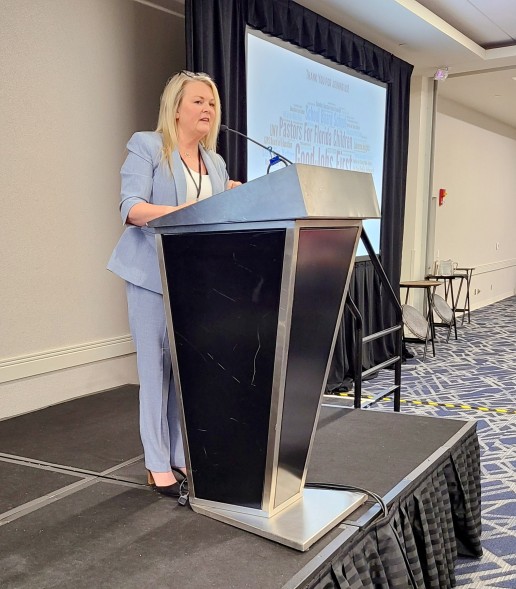
From there we broke into sessions in several rooms. Unfortunately, wonderful sessions were occurring at the same time making it hard to pick which one to attend. I presented on Science of Reading (SoR) in the first breakout presentations of the day. Nancy Bailey and Elena Aydarova PhD joined in the sharing. We had a large audience and people kindly told us they liked the presentations. (I am willing to share the Power Point file I used.)

Nancy Bailey

After lunch and a wonderful speech by John H. Jackson president of the Schott Foundation, I went to learn about Lifewise. I had no idea how fast that organization is growing. It was founded in 2018 in Ohio. There are now organizations in 26 states including California. Lifewise promotes RTRI (Release Time for Religious Instruction). Schools that participate must release children during the school day for a bus trip to the Lifewise facility where they learn a benighted form of Christianity based on the ancient Nicene Creed.

There are two types of states that authorize Lifewise, may-states and shall-states. Ohio just became a shall-state that mandates schools to participate if it is offered.

Lifewise wants kids younger than 14 because they are more successfully indoctrinated. When the kids come back to class, they show their presents and tell stories of ice cream parties. Kids that are at Lifewise often miss out on important learning. An Ohio science teacher showed pictures of his kids getting ready for the total eclipse that the Lifewise students missed.

That evening, we enjoyed a speech by the 2022 national teacher of the year, Kurt Russell. Russell says he no longer thinks of public education as important. Rather because it is the foundation of our democracy, it is vital, it is essential and “it is bigger than that; it is life.” Usually I am not impressed by someone being named teacher year whether it is of the school, district, county, state or the country. In this instance, he seemed totally deserving of the accolade.

Kurt Russell

Day 3, Sunday

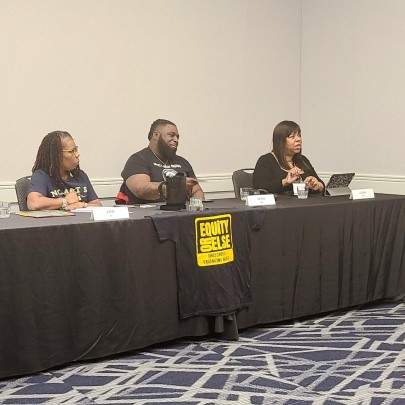
I was really moved by the New Orleans presentation. We heard from a former charter school student and a brilliant mom. They made it clear that control is the byword in the district’s charter schools. The young man, a former charter school student, described a hair-raising ordeal which sounded like child abuse designed to keep the black community in its place.

Last year, when a charter school failed the superintendent replaced it with the first New Orleans public school since 2017. She was fired, but that is what the mom speaking to us claimed parents want. She said they desire that every time a charter school fails it is replaced by a more stable public school. Charter schools have become a revolving door with a large percentage of schools going out of business every year. Unfortunately, those in power want to maintain their portfolio model school district that does not include public schools.

She also said that charters in New Orleans are being sued regularly for some of their practices with children. However, there is almost no reporting about the suits because the settlements always include a non-disclosure agreement (NDA). She told the story of asking a KIPP administrator how many NDA’s they had created. He said none but when she retorted that she was in court just the week before and saw a KIPP NDA created, he backed off and promised to get back to her. She is not holding her breath.

The New Orleans Panel

The brunch time speaker was state representative from Texas, Gina Hinojosa, who has been in an all out battle with Texas Governor Greg Abbott to stop his universal voucher scheme. She says private equity is the plan that is causing billionaires Dunn, Wilks, Yass, Musk and others to finance vouchers in Texas. Hinajosa stresses that the most sinister aspect of the voucher plan is profiting through finance. She reports that a Texas Catholic Credit Union has already been established.

Gina Hinohosa

The last event on Sunday afternoon was special. American Federation of Teachers President, Randi Weingarten, presented us with a fiery speech when she introduced the final keynote speaker of the conference, Governor Tim Waltz of Minnesota.

Waltz was definitely not a disappointment. He made many vintage Waltz type statements:

“I know in this room I’m preaching to the choir. The choir needs to sing louder.”

“Some people say ‘I’m just not into politics.’ Well too damn bad, politics is into you.”

“We should not call them oligarchs, we should call them what they are greedy bastards.”

He was proud of the fact of being cited as the least wealthy person ever to run for Vice-President of the United States.

Waltz asserted that the middle class was built by public education and labor unions. As for what we are going through now, he speculates that it will get worse; so be ready for it.

Governor Waltz surprised us by staying in the room and taking picture with hundreds of us.

Tom and Tim

My impression was that this was the best NPE event to date. The breakout sessions that I attended were amazing and I did not hear of any disappointments. The keynote speakers were excellent and finishing with Governor Waltz was the cherry on top.

The Undermining of Rhode Island Public Schools

23 Jul

By Thomas Ultican 7/23/2024

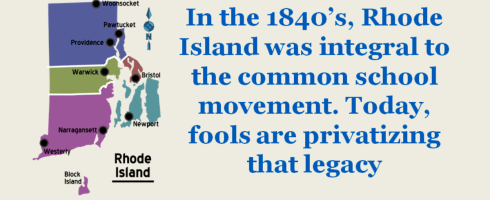
Gina Raimondo, Rhode Island’s unpopular governor, appointed the clearly unqualified Angélica Infante-Green as Commissioner of Education, in 2019. That was the year before Joe Biden selected Raimondo as Secretary of the Treasury. Infante-Green’s qualifications amounted to recommendations from New York’s Joel Klein and Jeb Bush. She was a former Teach For America (TFA) teacher in New York city who had never led a district nor been a school principal. Her first action on the job was to take over the Providence school district, the state’s largest.

Like all corporate sponsored “reformers,” Infante-Green took to propaganda rag, The 74, and updated on when, if ever, Providence will exit state control. However, Rhode Island exiting state control matters less than in most states with elected school boards because Mayors run schools. Providence Mayor Jorge Elorza officially petitioned the state to take over his schools, one of the poorer school districts in America. Politicos decided that schools were “failing” because of poor test scores.

Besides poverty, Providence’s schools are almost 70% latinx with 40% language learners. Famous educators like Pestalozzi, Herbert and Dewey would not have gotten test scores acceptable to the local business community. It was a case of testing to privatize, without care for public education and little comprehension of teaching or learning.

Hope High School in Providence

Infante-Green did not actually give much information about her plans for turning over management of the Providence school district to the city. She only shared:

“We said that in 2024, we’d look at how much progress has been made. But when that was decided in 2019, nobody anticipated a pandemic.”

Does she envision semi-permanent state control?

Feeding Corporate Friends

Part of the requirements in Rhode Island for a school to exit state receivership is an independent review. Of course, Infante-Green did not ask Brown University, Providence College or University of Rhode Island to conduct the review. She contracted with Massachusetts-based consulting firm, SchoolWorks, to lead an independent review.

SchoolWorks has a long history of supporting charter schools and privatization of public education. A tab on their web page advertises the only two categories of training they offer: For Charter School Authorizers and For Charter School Founders.

About For Charter School Founders, SchoolWorks says:

“Behind every successful charter school is a passionate group of individuals who dedicated their time and talent to envisioning a new school, garnering community support, and crafting a thoughtful and comprehensive charter school application. These are challenging, time-consuming tasks; and we celebrate pioneers like you for your commitment to innovating education.”

A link on the LittleSis data base provides some historical background for SchoolWorks. The CEO in 2016, Scott Blasdale, was a founding board member of the Massachusetts Charter School Association. He also was executive director and founding teacher of Academy of the Pacific Rim Charter Public School.

In the period that Richard Daley and Rham Emanuel were mayors of Chicago, SchoolWorks held consulting contracts for local public schools. They also consulted for KIPP schools, the Ewing Marion Kauffman Foundation and National Heritage Academies. The billion dollar Kauffman Foundation’s (EIN: 43-6064859) spending aligns with funding by Arnold, Dell, Gates and Walton, including generous gifts to TFA, Thomas B. Fordham Foundation, TNTP and Digital Promise.

Testing to Privatize

Johns Hopkins University was integral to the attack on public schools in Providence, Rhode Island. In May 2019, at the invitation of Infante-Green, Johns Hopkins Institute for Education Policy led a review of the Providence Public School District. The Partnership for Rhode Island, a group of local business leaders, funded the review.

The Johns Hopkins study was commissioned in May and presented in June. Based on the report, Providence Mayor Elorza officially petitioned the state to takeover Providence Public School District on July 19, 2019.

This request was based on testing data and Johns Hopkins not so unbiased report. In 2020, the Institute for Education policy at Johns Hopkins joined Jeb Bush’s Chiefs for Change to write a paper, calling for more standardized testing. This collaboration clearly indicated a penchant for school privatization and a tilt against public schools.

Adopting the Science of Reading

Infante-Green defended her school takeover methods stating:

“We have something called the Right to Read Act [which requires teachers to be trained in the science of reading]. By 2025, our K-8 teachers will all be trained, but we’re at about 75 percent.”

Science of Reading (SoR) is much more about profits and control than good teaching. SoR is not based on sound science and, more accurately, should be called “How to Use Anecdotes to Sell Reading Products.”

Professor Maren Aukerman, currently Werklund Research Professor at the University of Calgary, focuses on literacy education and democratic citizenship. She previously served on the faculty at Stanford University and University of Pennsylvania. Her recently published paper in the Literary Research Association on work by Goldstein, Hanford and others promoting SoR noted:

“The problem is not with recognizing that teaching phonics can play a facilitative role in having children learn to read; that insight is, indeed, important, if not particularly new. The problem is that this narrative distorts the picture to the point that readers are easily left with a highly inaccurate understanding of the so-called ‘science of reading.”’

Professor Paul Thomas of Furman University, with a deep background in teaching and education research, criticized of American Public Media’s Emily Hanford writing:

“As I have pointed out numerous times, there is a singular message to Hanford’s work; she has never covered research that contradicts that singular message.

“For example, not a peep about the major study out of England that found the country’s systematic phonics-first policy to be flawed, suggesting a balanced approach instead.

“And not a peep about schools having success with one of Hanford’s favorite reading programs to demonize.”

Nancy Bailey is an expert in special education and early reading instruction. In a recent posting, she declared:

“A troubling feature of the Science of Reading (SoR) is the connection between those who believe in the power of phonemes (and more) and those who want to privatize public schools. The old NCLB crowd has been rejuvenated and seems onboard with digital instruction replacing public schools and teachers.

Infante-Green’s claim that SoR is something wonderful and positive for public schools in Rhode Island is malarkey. It is a giveaway to corporations that harms students and undermines educators.

An Intriguingly Strange Claim

Infante-Green is quoted by The 74 stating:

“What’s interesting about Providence is that about 19,000 children apply to charter schools and there are only 22,000 students in the district. So they want charter schools.”

This assertion makes no sense. While it is not surprising that charter school enrollment in Rhode Island increased, the most recent (2021) available enrollment data showed 10,547 charter students. Claiming 19,000 student applications for privatized schools in Providence alone strains credibility.

Rhode Island’s Commissioner of Education promotes privatization.

It is true that since the pandemic, student enrollments have dropped and chronic absenteeism has grown throughout the nation. In Providence, both of these have soared. Even Central Falls, the most impoverished school district in Rhode Island, had a significantly lower absentee rates and better attendance than Providence. Commissioner of Education, Angelica Infante-Green, took over Providence schools five years ago, making no effective action while dropout rates climbed, students disappeared and many scholars coming to class sporadically.

Clearly, these schools would be in a better state if her takeover never happened.

It is time to quit playing privatization games with the public school system and return them to professionals in the district.

State takeovers have a nationwide record of failure and Providence is adhering to that history.

New Guides for Researchers, Bloggers and Parents

4 Apr

By Thomas Ultican 4/4/2020

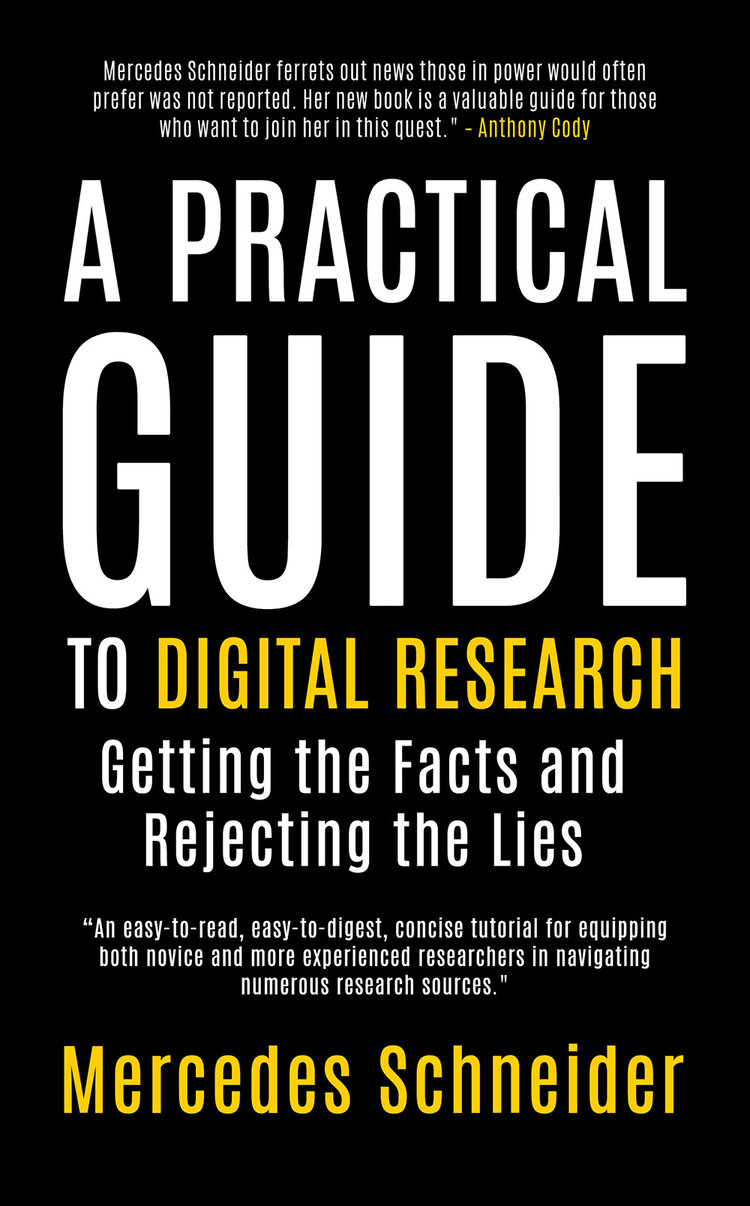
Two new sources provide guidance for researching and decoding education jargon. At the beginning of the year, Teacher College Press published Diane Ravitch’s and Nancy Bailey’s EdSpeak and Doubletalk; A Glossary to Decipher Hypocrisy and Save Public Schooling. Near February’s completion, Garn Press published Mercedes Schneider’s new book, A Practical Guide To Digital Research: Getting the Facts and Rejecting the Lies , in which Schneider explains the investigative tools and techniques she uses plus provides examples from her own work.

A Practical Guide to Digital Research

Practical Guide

The fifth Network for Public Education (NPE) conference was held in Indianapolis, Indiana during October of 2018. I attended the session “Where did all this Money Come from: Locating and Following the Dark Money Trail” which was presented by Darcie Cimarusti, Andrea Gabor and Mercedes Schneider.

Cimarusti writes a blog called Mother Crusader which opens with the line “Never intended to become a parent advocate until I watched the great schools in my little town come under attack.” Darcie also works part time for NPE where she is half the two person staff and does research. Gabor is a Bloomberg chair of business journalism at Baruch College. She is a researcher who currently has ten books listed on Amazon. The MC of the session was the author of Guide to Digital Research, Mercedes Schneider.

The session had three presentations and a question and answer period. Darcie introduced the LittleSis data base and oligrapher. She shared her LittleSis map creation  “Louisiana 2011: Jeb Bush Calls and Billionaire Dollars Follow” and demonstrated its interactive functions. Andre presented “990S: Mining Nonprofit Tax Returns” where she used forms from the Eli and Edythe Broad Foundation and the Walton Family Foundation to explain how to read them and where to find them. Finally, Mercedes used examples from New York to share how she researches campaign finance data.

In her new book, Mercedes reflects back on that NPE session and notes:

“In preparing for our presentation, Darcie asked me to send her the information I wished to include in my presentation slides.

“In that moment, I thought, ‘To do this justice, my slides would need to be the length of a book. And there’s no time for me to write a book before we present.

“So, the book was on my mind, particularly on one Saturday after the 2018 NPE.”

Schneider also shares, “Thus, the initial idea for this publication stemmed from my desire to equip parents and other community members to investigate the activities and spending of individuals and groups associated with market-based ed reform.”

This is Mercedes Schneider’s fourth book. She is a Louisiana native with secondary education degrees in English, German and guidance counseling.  Mercedes also has a PhD in applied statistics and research. Her three previous books are A Chronicle of Echoes: Who’s Who in the Implosion of American Public Education, The Common Core Dilemma: Who Owns Our Schools? and School Choice: The End of Public Education?

The educator, blogger and Forbes commentator Peter Greene when praising Mercedes work and her new book stated,

“… A Practical Guide To Digital Research: Getting the Facts and Rejecting the Lies is a thorough look at how to go cyberdigging, looking at both the techniques and the tools that can be used to uncover whatever truth is lurking out there. Because she provides plenty of examples and demonstrations of how these tools and techniques have worked for her, Schneider also gives us a sort of greatest hits collection.”

An example of one of those greatest hits Greene alludes to is when she reported in Chronicle of Echoes that Randi Weingarten, the President of the American Federation of Teachers only taught full time for one semester. In the new book, she reveals how she found this information and that Weingarten’s legal name is Rhonda Weingarten.

Another hit was how she was able to discover who the anonymous donor to Education Post was. In 2014, the Washington Post introduced the new ed reform organization Education Post and stated its initial funding came from “the Broad Foundation, Bloomberg Philanthropies, the Walton Family Foundation and an anonymous donor.” By reviewing the 2014 tax forms of the known donors, she was able to learn that they were actually giving their grants to the Results in Education Foundation which was financing Education Post. Once she found the name of the actual foundation she was able to reveal that Laurene Powell Jobs was the anonymous donor.

Schneider uses many episodes like the two mentioned above to demonstrate how to use different investigative tools and provides practical evidence for how she has applied them. The book is a wonderful extension to that 2018 NPE presentation.

EdSpeak and Doubletalk

EdSpeak

Thanks to the authors and the facilities at Teacher’s College, this is a living book. At the book’s cyber address, there is a link to a 58 page downloadable supplement as well as an updates tab.

Diane Ravitch explains in the introduction that she originally published EdSpeak in 2006, however she concludes:

“In the years since, a sea change has occurred in education and in the vocabulary used to describe plans, policies, pedagogy, and priorities. I realized that EdSpeak had become obsolete because times had changed.”

Diane says she found the perfect collaborator, Nancy Bailey, who is passionate about education and “knew more than I did about the language of the classroom, and who, as an experienced teacher, had firsthand experience of the impact of policy at the school and classroom level.”

Regents’ Professor of Education Emeritus at Arizona State University, David Berliner applauded the book. He writes,

“This glossary provides excellent and accurate definitions of the educational terms common to our times. Novice educators, school board members, and parents of school-age children can all use this book to decode the specialized vocabulary of this profession. In addition, the authors are unapologetically strong believers in our public schools, and it shows, making this book much more valuable. This is a glossary with an attitude, and because of that, I endorse it even more strongly.”

Concerning that last line, Ravitch states,

“This book is more than a glossary. It has a point of view – about public schools, about teachers and teaching, and particularly about the insidious efforts to undermine public schools and the teaching profession.”

The book is arranged into 18 chapters with each chapter arranged alphabetically. The online supplement has another 9 chapters.

How to use this reference book. One might have heard of a group called School Board Partners. A quick look at the books index would send you to page 78 in “Chapter 11: School Reform Groups and Terms, or ‘Money Talk.’” There you would find the description of School Board Partners:

“A group that pretends to be concerned about public schools and communities, but that encourages choice and privatization goals. School Board Partners claims that school boards are failing kids, and school board members need the help of outside mentors so they will make the right decisions to promote change and ‘buck the status quo.’ Their deceptive title is intended to confuse the public and to substitute themselves for existing state and national school board associations, which advocate on behalf of public schools. School Board Partners is currently funded by the same corporate reform groups that fund Education Cities, which include the Arnold, Dell, Gates, Kauffman, and Walton Family Foundations. Its real goal is to dissolve the school board’s connection to its own community and make it part of the privatization movement. Their current targeted cities include Atlanta, Baton Rouge, Denver, Detroit, Indianapolis, Los Angeles, Memphis, New Orleans, Oakland, and Stockton.”

In the book supplement there are definitions of terms like “restorative justice” and “backward mapping.” One of my favorite definitions, I found in the supplement was “research shows.” It is defined as,

“A phrase often used to evoke authority and end discussions even when research is equivocal. Parents and other non-educators must be wary of accepting the claim that ‘research shows’ a given outcome unless they receive a clear, impartial summary of the evidence.”

These two books bring light to the corrupt billionaire led privatization of America’s public schools and provide some tools that citizens can use to fight back. As an unapologetic advocate for elected school board led public schools, I hardily recommend these two new publications.