Tag Archives: Mary Bixby

Have California Charter Schools Stopped Growing?

20 Nov

By Thomas Ultican 11/18/2023

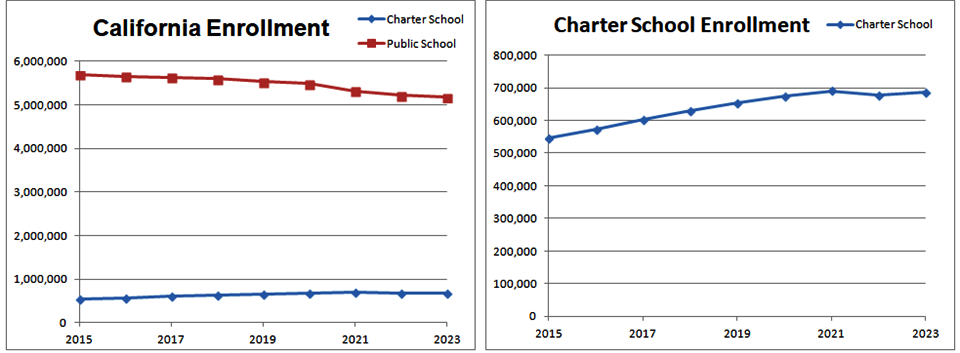
Last year, John Fensterwald reported in EdSource, A new chapter for charter schools in California as enrollment drops for first time in 3 decades. The 2023 charter movement showed, year over year, attendance growth but it was not half that of previous years and 5,104 students less than 2021.

Has the bloom come off the charter school rose?
Looking at some board of directors for EdSource adds significance to Fensterwald’s article. Don Shalvey founded California’s first charter school, partnered with Reed Hastings CEO of Netflix and Microsoft founder, Bill Gates, is on the board. Then there is Robert Sheffield, President of CORE, a pro-testing billionaire funded organization. Jannelle Kubinec, the CEO of WestEd, and Mary Jane Burke, on the WestED board also serve on the 10-member EdSource board.

EdSource is a big-wealth supported pro-charter school publication.

Fensterwald noted,

“Not since the first charter school opened in San Carlos, south of San Francisco, in 1994, has charter school enrollment fallen year over year.

“In 2020-21, the first full year of the pandemic, total enrollment statewide fell 4.4% while charter school enrollment actually increased 3.4%. But this year, enrollment in TK-12 school districts and charter schools both fell 1.8%: 110,000 students in district schools, 12,600 in charter schools, as measured as of Census Day last October.”

Why Charter School Growth Cooled

Corruption, instability and segregation are endemic to charter schools, developing a reputation for avoiding special education students and English language learners. Researchers and organizations, like the Network for Public Education (NPE), have made sure these issues stay in front of the public.

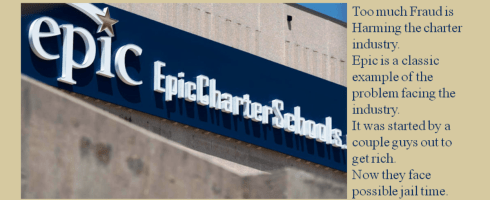
Law enforcement has taken down many charter scofflaws, especially in the cyber charter arena. The largest charter school theft occurred in California when A3 Charter School conspirators fraudulently collected $400 million from the state, misappropriated more than $200 million, and according to the Voice of San Diego, outright stole $80 million. This led to a few years of corrupt charter school stories in the media.

For a decade, NPE has been updating “Another Day Another Charter School Scandal.” This searchable site catalogs charter school thefts, school closures, profiteering and more.

The profiteering field takes the user to articles about people like John Helgeson, vice-president at Learn4Life, who according to Voice of San Diego’s reporting, “discovered a way to collect not just one, but two paychecks from California’s cash-strapped public school system.”
In her paper, Charters and Consequences,” Carol Burris addressed the phenomena of independent learning charter schools:

“There are 225 independent learning charter schools comprising nearly 20% of all charters in California. In San Diego County alone there are 35, including three associated with Learn4Life. The 2014 graduation rate for all of the students enrolled in San Diego’s independent center charters, including the more successful home-school programs, was only 44%. (Page 8) (San Diego Unified graduation rate was greater than 91%)

The infamous A3 Charter Schools were independent learning-centers. Mary Bixby is San Diego’s pioneer of the strip mall charter school business. In 1994, her Charter School of San Diego became the first charter school in the County. By 2015, Mary earned$340,810 from the non-profit she founded and her daughter, Tiffany Yandell, received $135,947.

Burris observed:

“Bixby, a board member of the charters and a full-time employee of one of the schools, also receives compensation for being ‘on-loan’ to two other Altus schools. Such obvious conflicts of interest would be illegal in a public school.” (Page 9)

Julian Vasquez Heilig, Provost and Vice-President for Academic Affairs Western Michigan University, joined T. Jameson Brewer from University of North Georgia and Yohuru Williams from University of St. Thomas to study segregating effects of charter schools. They concluded, “Charters are more likely to be segregated, even when controlling for local ethnoracial demographics” (Page 1) and discovered that “Many of the nation’s charters can even be classified as ‘apartheid schools’” (Page 2)—a term coined by UCLA Professor Gary Orfield for schools with a White student enrollment of one percent or less.

A 2016 Brookings Institute study of segregation in schools reported:

“Charter schools are more segregated than TPS [traditional public school] at national, state, and metro levels. Black students in charter schools are far more likely than their traditional public school counterparts to be educated in intensely segregated settings.” (Page 32)

My personal 2019 study of Washington DC charter schools revealed that 64 of the 116 charter schools would be classified “apartheid schools,” using Professor Orfield’s definition.

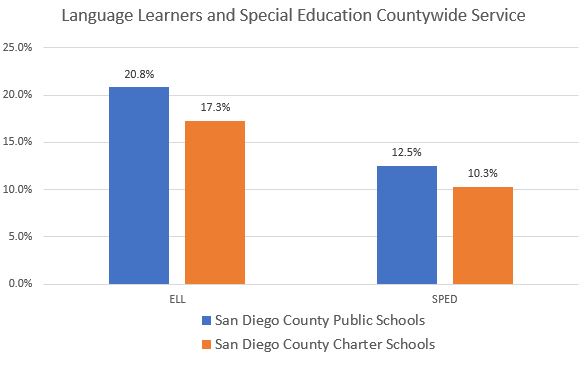
Since their inception, charter schools have been taking less special education and English language learners than public schools. A look at the data from any section of the country supports this statement. I made the following 2018 graph from San Diego County data.
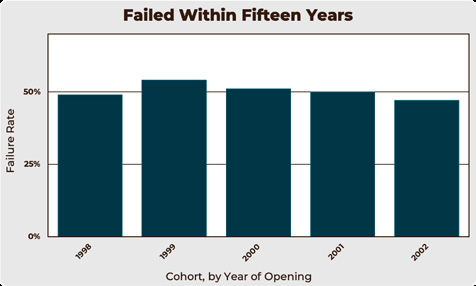
The most glaring problem for charter schools is instability, closing and going out of business at extremely high rates. Parents sometimes get a Friday notice about a Monday school closing. Carol Burris and team at NPE produced three reports, Asleep at the Wheel, Still Asleep at the Wheel and Broken Promises, detailing this tragedy with significant documentation.

The following graph presents the charter school failure rates within 15 years of opening.
How Charter Schools Continued to Expand

With a well-documented legacy of instability, corruption and segregation, it seems unreal that this privatized system still expands. Boatloads of billionaire dollars keeps it growing along with large incentives from the federal government.

The charter school movement in California was designed to create market-based solutions for public education, cut taxes and develop profit streams. Don Shalvey’s San Carlos Learning Center was the first charter school in California and site of Bill and Hillary Clinton’s 1997 roundtable discussion. At the meeting, Reed Hastings introduced himself to Shalvey; writer, Lily Geismer, claims Hastings needed Shalvey to give his education plans credibility. (Left Behind Page 249)

Two organizations, developed to accelerate and sustain charter schools, are NewSchools Venture Fund (NSVF) and California Charter Schools Association (CCSA).

The history tab at the NSVF website states:

“NewSchools Venture Fund was created in 1998 by social entrepreneur Kim Smith and venture capitalists John Doerr and Brook Byers.” (Byers and Doerr are colleagues from the Kleiner Perkins venture fund.)

“We were among the first and largest investors in public charter schools and the first to identify and support multisite charter management organizations, which launch and operate integrated networks of public charter schools.”

Philanthropy Magazine notes that Reed Hastings helped “launch the NewSchools Venture Fund.”

While there is little doubt Bill Gates and The Walton Family Foundation are the largest individual donors to NSVF, $226,881,394 of grants documented in Organized to Disrupt represents only a fraction of the total billionaire largess. Besides receiving help from Reed Hastings over the last 20 years, billionaires John Doerr, Laurene Powell Jobs and John Sackler also served on the board.

The hundreds of millions of dollars from these billionaires have have financed the startup of many charter schools, including Reed Hastings’ and Don Shalvey’s first-ever charter management organization. It created a continuous inventory of replacement schools for all of the schools that go out of business. To the billionaires, this churn looks like a good thing but it is a nightmare for students and parents.

 CCSA was formed as a nonprofit in 2003 with Caprice Young as CEO. John Walton, head of the Walton family, was an original board member. After John died, his niece, Carrie Walton Penner, joined the board in 2006. The next year Reed Hastings came onto the board. Penner and Hastings served until 2016 when both of them left and were replaced by employees.

Carol Burris conducted a yearlong study of the California Charter School Industry and published a lengthy report called Charters and Consequences, noting:

“CCSA does not disclose its funders on its website nor on its 990 form, but given its Board of Directors, who makes the list of big donors is not difficult to guess.

“The 2017 Board of Directors include New York’s DFER founder, Joe Williams, a director of the Walton Education Coalition; Gregory McGinty, the Executive Director of Policy for the Broad Foundation; Neerav Kingsland, the CEO of the Hastings Fund; and Christopher Nelson, the Managing Director of the Doris & Donald Fisher Fund. …

 “The real power, however, sits in CCSA’s related organization, CCSA Advocates, a not-for-profit 501(c)(4) whose mission is to increase the political clout of charter schools on local school boards, on county boards, and in Sacramento. It is at all three levels that charters can be authorized in the state.”

It is through CCSA Advocates that much of the huge spending on recent Los Angeles Unified School District board elections has been directed.

Opinion

With billionaire funding, it is difficult for the charter industry to fail.

Some people viewed charter schools as an experiment to prove how much better businesses could run schools than the public school system. There is a big lie being told that charter schools soundly outperform public schools. They do not. The fact is this 30-year old experiment has been a damaging and disruptive failure.

Reed Hastings, the Walton family, Michael Bloomberg, Bill Gates and other billionaires may never tire of trying to prove they were right.

It is past time to stop harming public schools.

Join NPE in the call for:

  • An immediate moratorium on creating new charter schools, including no replication or expansion of existing charter schools
  • End the federal charter school program that subsidizes and encourages charter expansion
  • Require certification of all charter school teachers and administrative staff, in accordance with public school requirements
Charter Schools of San Diego County

6 Jul

By Thomas Ultican 7/6/2018

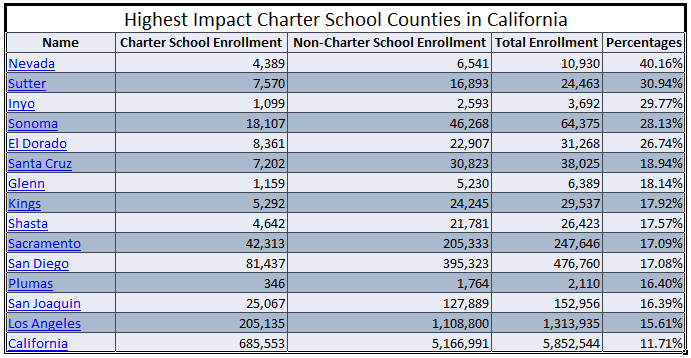
The California charter school law is doing serious harm to public schools. Few counties in the state have been more impacted by charter schools than San Diego County. This past school year 75,473 of the 508,169 publicly financed students enrolled in charter schools. In other words, 14.9% of San Diego’s students attended privatized schools and in the San Diego Unified School District, that percentage was greater than 17%.

San Diego’s charter school students attended one of the county’s 129 active charter schools some of which will close their doors next year. In the past five years, more than one out six charter schools – a total of 27 schools – went out of business. This presents an additional financial burden to public schools because they must be ready to take in all students from failed charter schools at any time. Charter schools typically do not add students during a school year.

When students from the public system exit to the privatized charter school system, the cost to the district schools is substantially more than just the loss of state daily attendance money. A recent study that Professor Gordon Lafer did for In The Public Interest is the third major report in five years to demonstrate this point. Professor Lafer noted:

“As the charter industry has grown, public officials across the country have become increasingly concerned with the sector’s impact on public school districts. A 2013 report from Moody’s Investors Service, for instance, warned that charter expansion threatened school districts’ viability in a growing number of cities, as ‘charter schools … pull students and revenues away from districts faster than the districts can reduce their costs.’ In response, a series of studies have been carried out by both academic scholars and consulting firms aimed at the same question that this report seeks to address. … in every case, studies found that charter growth has caused school districts to suffer much more in lost revenue than they are able to make up in reduced expenses—resulting in large net shortfalls for district students.” (emphasis added)

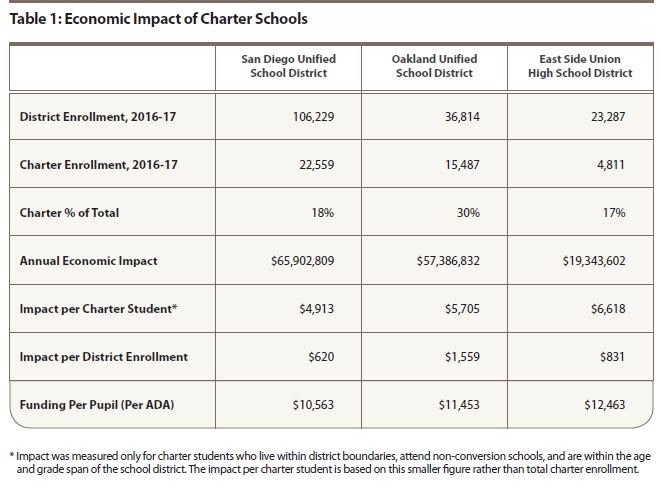
Lafer’s study also looked specifically at the effects of charter school enrollment on San Diego Unified School District (SDUSD). He described the nature of data reported that led to the table of values shown below:

“In short, at every point where the data was less than complete, we chose to err on the side of conservative assumptions—that is, assumptions that lead to understating the cost of charter schools to public school districts. Thus the numbers presented in this study should be considered a conservative, minimum estimate.”

Cost of losing charter students

Chart from Gordan Lafer’s Breaking Point Study (page 9)

In addition to the stranded costs related to charter school students leaving district schools, there is a permanent cost to public schools due to unequal distribution of the most expensive students to educate, special education students. Not only do charter schools accept fewer special education students, they also shun the costlier ones. Lafer reported on the results he found in Oakland, California, where charters educate 30% of the district’s students:

“Of the total number of emotionally disturbed students attending either charter or traditional public schools in Oakland, charter schools served only 15 percent. They served only eight percent of all autistic students, and just two percent of students with multiple disabilities.”

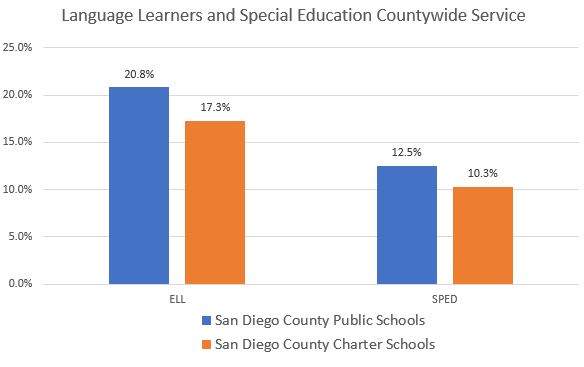
State data shows that the trend is similar in San Diego and charter schools here also attract fewer language learners.

ELL and SPED graphic

Based on State Education Department San Diego County 2017-1018 Enrollment Data

Entering the 21st century, California’s public education system was an efficient system utilizing its vast economies of scale to educate students for relatively less cost than most other states. The charter school experiment has introduced many inefficiencies. This development is being paid for by reducing services to the more than 85% of the counties students attending public schools. Their classes are larger, their facilities are not as well maintained and there are fewer course offerings available to them.

The Altus Franchise

Throughout 2017, Carol Burris, Executive Director of Network for Public Education (NPE), studied and wrote about California’s charter schools. In her culminating report, “Charters and Consequences,” she addressed the phenomena of the independent learning charter schools. Burris wrote,

“There are 225 independent learning charter schools comprising nearly 20% of all charters in California. In San Diego County alone there are 35, …. The 2014 graduation rate for all of the students enrolled in San Diego’s independent center charters, including the more successful home-school programs, was only 44%. (emphasis added – the SDUSD graduation rate was greater than 91%)

“Given the results, why are so many Independent Learning charter corporations springing up across the state? Unlike brick and mortar charters, independent learning centers are relatively easy to set up and run. They appeal to disadvantaged students who want to work and finish high school, dropouts who want to return to school, students who have emotional or physical health issues, homeschoolers, and teenagers who would prefer to not have to get up in the morning and go to school.”

Carol did this research using the 2016-2017 school year data showing 35 independent learning center charters in San Diego. The 2017-2018 data shows that San Diego County has added five more independent learning charters for a total of 40 and that number does not reflect all the independent learning locations.

Mary Bixby is San Diego’s pioneer of the strip mall charter school business. In 1994, her Charter School of San Diego was the first charter school in San Diego County. She puts children at computers running education software and her approximately 3200 students are making her wealthy. In 2015, the non-profit Mary founded paid her a total compensation of $340,810 and her daughter Tiffany Yandell received $135,947. Burris observed,

“Bixby, a board member of the charters and a full-time employee of one of the schools, also receives compensation for being “on-loan” to two other Altus schools. Such obvious conflicts of interest would be illegal in a public school.”

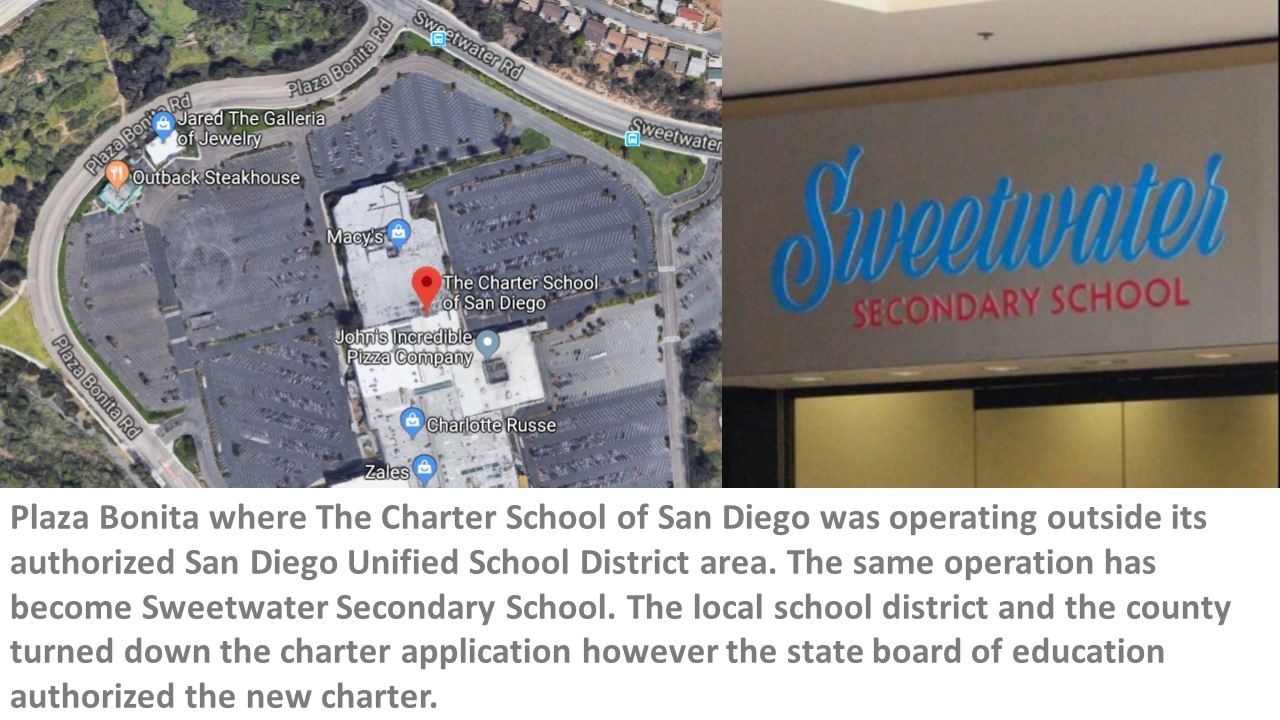
Chaarter in the mall

Images are from Google Maps

Bixby’s empire is run out of her headquarters at 10170 Huenneken Street in San Diego. In 2010, someone or some entity gifted Bixby this new building. The Altus Institute’s 2012 tax form valued it at $4,500,000.

In 2016, the Altus organization consisted of a central administrative corporation (Altus Institute) overseeing four non-profit corporations: (1) Audeo Charter School, Inc., (2) Student Success Programs, Inc. (3) Altus-Mirus, Inc.; and (4) Altus-Laurel, Inc., which in turn operate five separate charter schools: Audeo Charter School, Audeo II, Charter School of San Diego, Laurel Preparatory Academy, and Mirus Secondary Academy. Together these five charter schools serve students at 34 or more resource center facilities.

When Sweetwater Union High School District (SUHSD) responded to Bixby’s charter school proposal, they listed their many reasons for the denial. They were troubled by the complexity and secretive nature of the Altus operation; the number of unlawfully running centers; the fact that locations for the resource centers are very difficult to find and several other objections. The Sweetwater legal filing stated,

“It remains unclear why Petitioners need so many different charters and so many different authorizers to operate carbon copy programs at numerous resource centers. The GUHSD [Grossmont Union High School District] Board denied the Petition to establish GSS [Grossmont Secondary School] on November 15, 2016, for many of the same reasons we recommend denial of SSS [Sweetwater Secondary School].

“What is clear is that all of the public funding for these charter schools would be managed centrally by the same administrators, who appear to be able to move funds around at will, making it difficult, if not impossible, for SUHSD to monitor the Charter School’s fiscal status at the level mandated by Board policy and regulation, given that only a portion of the school’s books would be open for SUHSD review.”

The San Diego County Board of Education concurred with both the Sweetwater and the Grossmont denial, however the California State Board of Education authorized both charters.

Last year the San Diego Union reported that of the fifteen schools with the highest percentage of chronically absent students four of them were from the Altus group: Audeo Charter II — 34.3 percent; Charter School of San Diego — 31.9 percent; Audeo Charter — 31.4 percent and Laurel Preparatory Academy — 27.7 percent.

The High Tech High (HTH) Franchise

A puff piece in the Voice of San Diego says,

“It all began in 1998 when local business leaders were discussing ways to prepare young people for the high-tech workforce. They eventually opened the Gary & Jerri-Ann Jacobs High Tech High charter school in 2000, and later added on middle and elementary schools.”

Larry Rosenstock is the CEO and founding principal of High Tech High. In the Voice article he explains,

“Well Gary Jacobs (former director of education programs at Qualcomm) was part of a 40-person effort to look at education in San Diego. They were a bunch of business people who wanted to create future leaders in San Diego for various sectors of the economy. They thought they would create their own independent public school and they didn’t know how to do that. I was here to do other work. I had just moved here from Cambridge (Mass.) and they asked if I could come over and describe to them how you can have a public school that’s autonomous rather than part of the district. I explained that to them and they decided they wanted to create a charter school.”

Gary Jacobs is the son of Irwin Jacobs, the billionaire founder of Qualcomm. These wealthy San Diegans knew nothing about education, but they were still willing to experiment with other people’s children. It seems they were convinced that if they hired the right consultant, they could create something wonderful.

They created charter schools reminiscent of the experimental school developed by Corinne A. Seeds at UCLA.

Tufts University Education Professor, Kathleen Weiler, wrote the book Democracy and Schooling in California: The Legacy of Helen Heffernan and Corinne Seeds. Weiler shared,

“Helen Heffernan and Corinne Seeds were nationally recognized as leaders of the progressive education movement and were key figures in what was probably the most concerted attempt to put the ideals of progressive education into practice in a state-wide system of public education in the United States.”

Heffernan was the California Commissioner of Rural and Elementary Education between 1926 and 1965, and Seeds, the Director of the University Elementary school at UCLA between 1925 and 1957.

My friend Professor Larry Lawrence worked at the Seeds school under Jonathan Goodlad. When the charismatic Goodlad left the Seeds school in 1987, the school floundered. When Heffernan retired, the progressive education movement in California slowed and reversed. After meeting with HTH founding principal and CEO, Larry Rosenstock and touring one of the schools, Professor Lawrence concluded based on his personal experience that when Rosenstock leaves, the HTH system will falter. Lawrence also questioned the quality of the school’s math education.

The HTH system is one of three charter management groups to be designate a “state benefit charter”, meaning that they can open schools anywhere in the state of California. The other two groups are the Magnolia Schools which are part of the Turkish Imam, Fethullah Gulen’s national charter school empire and the state’s largest charter school system, Aspire Public Schools.

In 2013 Aspire and the state board of education conceded victory to the California School Boards Association, the California Teachers Association and other education groups that had filed suit against the Aspire designation as a state benefit charter. They claimed that the law allowing state and county benefit charter was violated. They pointed to the legal requirement that state benefit charters “will provide instructional services of statewide benefit that cannot be provided by a charter school operating in only one school district.”

The California School Boards Association has not sued the State Board over the HTH or Magnolia designations as state benefit charters.

There are 13 High Tech schools in San Diego County. The data reveals a statistical concern. In San Diego County public schools, 20.8% of students are language learners, in county charter schools 17.3% of students are language learning, but in the High Tech system less than 10% of students are language learners.

“Not with Those People’s Kids”

Very few people believe that charter schools provide better education. However, many people believe they can select a charter school that protects their child from bad influences. The truth is that being in an integrated school provides a superior education. The idea that putting your child in a school with students that are of the same race or class will protect them is an illusion.

The Old Town Academy is like a private school financed with public school dollars. A Voice of San Diego report states,

“Chris Celentino, OTA’s current board chair and one of the school’s founding members, said when the school opened with a class of 180 students, half came from families that would otherwise send their kids to private schools.” 

“Whether it’s a product of innovative instruction, or has more to do with the fact that unlike at many traditional district schools, few OTA students live in poverty, test scores have remained consistently above the district average.”

It is not just Old Town Academy, there are several San Diego charter schools that appear to have been motivated by the “not with those people’s kids” ideology. Nationwide the choice movement is known to be causing schools to re-segregate.

A Perspective

Many broad-minded educators I know are not against charter schools per se and think they can be done right. I am not one of them. Even a wonderful privatized school is diminishing the education provided to the overwhelming majority of students educated by tax dollars. If the extra costs of running a dual system is not provided by taxpayer, it is unjust to finance those private schools by reducing the quality of public schools.

I join with the NAACP’s call for a moratorium on charter schools until:

  • “Charter schools are subject to the same transparency and accountability standards as public schools.
  • “Public funds are not diverted to charter schools at the expense of the public school system.
  • “Charter schools cease expelling students that public schools have a duty to educate.
  • “Charter schools cease to perpetuate de facto segregation of the highest performing children from those whose aspirations may be high but whose talents are not yet as obvious.”

Twitter: @tultican