By Thomas Ultican 10/25/2024
Two new reports detail the high closure rates of charter schools and the negative effect of school closures on students. In 2020, Network for Public Education (NPE) produced “Broken Promises,” the first ever comprehensive study of charter school closure rates. Their just released new report, “Doomed to Fail,” updates “Broken Promises.” In May, Houston researcher, Jeonghyeok Kim, published “The Long Shadow of School Closures: Impacts on Students’ Educational and Labor Market Outcomes.” Taken together these two new studies demonstrate why the charter school industry is a dangerous failure.
Since the inception of charter schools in the 1990s, billionaires and entrepreneurs have worked to sell these privatized schools. Under Bill Clinton’s leadership, the Democratic Leadership Council embraced school choice believing in the power of the entrepreneurial economy to reform schools (Left Behind Pages 122-127). The federal government started experimenting with charter schools. A rewrite of the 1994 Elementary and Secondary Education Act included a provision for a new federal Charter School Program. In 1995, the new program granted a total of $4,539,548 to nine states. Today, $400 million federal dollars are spent yearly to promote charter schools and oversight is relatively weak.
There is no denying that some charter schools are excellent, however, in general they are unstable. As NPE has documented their closure rates are so high as to be a big risk for parents and students.
Doomed to Fail
Reformers believed that a large-scale charter experiment would either prove or disprove the superiority of charter schools. In 2006, after Hurricane Katrina, Louisiana turned to the new Recovery School District (RSD) and all the schools in New Orleans became charter schools. However, because the students who returned to New Orleans were different from those in the city before, and there was an enormous influx of philanthropic funding, it was impossible to determine if the charter experiment worked.
Gary Rubenstein explained:
“Reformers needed a new experiment where the schools would keep the same students they already had, but the staff at those schools would be replaced with nonunion charter school educators, and charter chains or start-up charter boards would run the schools. Race to the Top provided Tennessee the funding and incentive to test the reformers’ hypotheses.” (Doomed page 19)
The theory was that “failing” schools in the bottom 5% of testing data would be taken over by charter schools. The goal was to show that these privatized schools would soon be in the top 25% of schools on testing results. It was a complete failure. None of the 33 charterized schools ever left the bottom.
This experiment demonstrated that it was not the public schools causing poor performance and privatizing them provided no improvement. The type of school, charter or public, made no difference. However, unstable schools are harmful and “Doomed to Fail” shows that charter schools induce a failure rate crap shoot.
The NPE report describes how professional marketing campaigns convince parents that the new charter school is different and better than the nearby public school. “Doomed to Fail” states:
“However, as hundreds of thousands of families have found, enrolling your child in a charter school comes with enormous risk. Charter schools close at far higher rates than public schools. And, unlike public school districts where infrequent closures are orderly with the district finding a new school for the child, charter school closures are often chaotic and abrupt, taking parents by surprise.” (Doomed Page 1)
“Doomed to Fail” Page 11
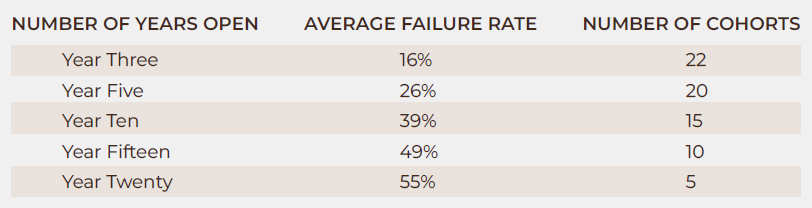
Researcher Ryan Pfleger, Ph.D. used the federal Common Core of Data to create the table above. Each cohort is comprised of every year’s batch of new charter schools. The table informs us that 16% of new charter schools close their doors within the first three years. The ten 15-year cohorts failed at a 49% rate which is a 1% improvement over the 2020 “Broken Promises” report. However, the huge federal COVID payments of 2021 probably kept many schools in business that otherwise would have failed. The 20-year failure rate of 55% makes it clear that failure keeps happening and that more than half of all charter schools close their doors forcing families to make other arrangements.
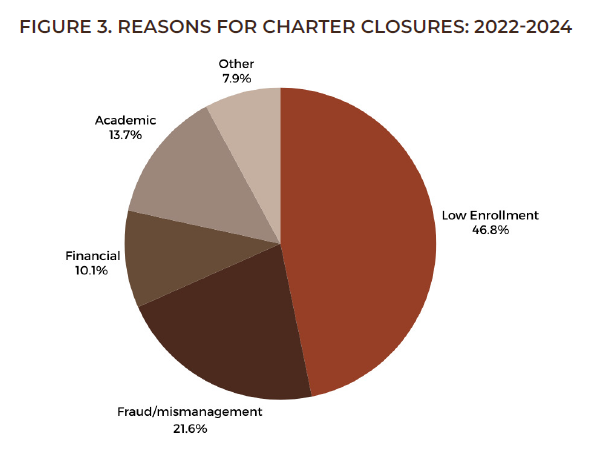
The charter industry says their schools are more academically accountable and are closed if they do not meet the agreed to goals. However, NPE’s research discovered that this was the cause for only a minority of the schools that closed. Not being able to maintain enough enrollment to be viable or corruption and mismanagement were the cause in more than 68% of closures.
“Doomed to Fail” Page 13
Closures Bring Long Term Negative Effects
In 2019, Matt Barnum of Chalkbeat reported on 17 studies of the effect of school closures on students. There were differing results but in general reading and math scores suffered but after three years, the academic effects seemed to have disappeared.
Researcher Jeonghyeok Kim took a longer range look at the student outcomes and the results were surprising. Like other studies, Kim’s showed a short term academic decline and then recovery within three years. However, he also discovered long term discipline issues, lowered college completion rates and reduced incomes.
In EdWeek, Libby Stanford reported, “Kim centered his research around a dataset of 470 Texas schools that closed from 1998 to 2015.” Stanford also noted, “In a study of federal enrollment data from 2000 to 2018, researchers at the Stanford Graduate School of Education found that majority-Black schools were three times more likely to close than schools with smaller enrollments of Black students.” Since Kim associated the harshest closed school outcomes with economically disadvantaged families, this represents a double whammy.
The abstract from Kim’s paper states:
“Each year, over a thousand public schools in the US close due to declining enrollments and chronic low performance, displacing hundreds of thousands of students. Using Texas administrative data and empirical strategies that use within-student across-time and within-school across-cohort variation, I explore the impact of school closures on students’ educational and labor market outcomes. The findings indicate that experiencing school closures results in disruptions in both test scores and behavior. While the drop in test scores is recovered within three years, behavioral issues persist. This study further finds decreases in post-secondary education attainment, employment, and earnings at ages 25–27. These impacts are particularly pronounced among students in secondary education, Hispanic students, and those from originally low-performing schools and economically disadvantaged families.”
Kim’s ground breaking research shows that the negative effects of experiencing a school closure are not just short term, but appear to be a life long hindrance.
Conclusion
NPE’s new study, “Doomed to Fail,” makes it clear how unstable privatized schools are. The study also reports on charter skullduggery and specific school closures like Jubilee academy, sharing:
“On August 14, 2023, Jubilee Academies Highland Park in San Antonio, Texas, began the school year. Two weeks later, parents were informed that the school would close by mid-September. Families would have to find another school or agree to bus their child to another Jubilee school. Two hundred and ten students were displaced.” (Doomed Page 14)
When “Doomed to Fail” is combined with Jeonghyeok Kim’s new research, it is clear that parents are risking the future of their children when they enroll them in a charter school.
To be clear, trusting your child to a charter school is a bad idea.

 tultican
Recent Comments