Tag Archives: Gloria Ladson-Billings

Network for Public Education Was in Washington DC

2 Nov

By Thomas Ultican 11/2/2023

NPE met at the Capitol Hilton for a weekend conference beginning on Friday, October 27. The old hotel seemed well maintained. That first evening, Diane Ravitch interviewed James Harvey who was a key contributor to “A Nation at Risk.” We gathered in a larger conference room which caused Mr. Harvey to comment, “I remember being at a meeting in this room fifty years ago when we heard that Alexander Butterfield had just testified that there were tapes of the oval office.”

With that historical reference, the conference was off to a wonderful start.

“A Nation at Risk” is seen as an unfair turning point that undermined public education. Mr. Harvey’s job was to synthesize the input from members of the National Commission on Excellence in Education, created by Secretary of Education, Terrence Bell, and produce the report. He shared that two famous academics on the panel, Nobel Prize winner, Glen Seaborg, and physicist, Gerald Holton, were the driving forces for politicizing public education.
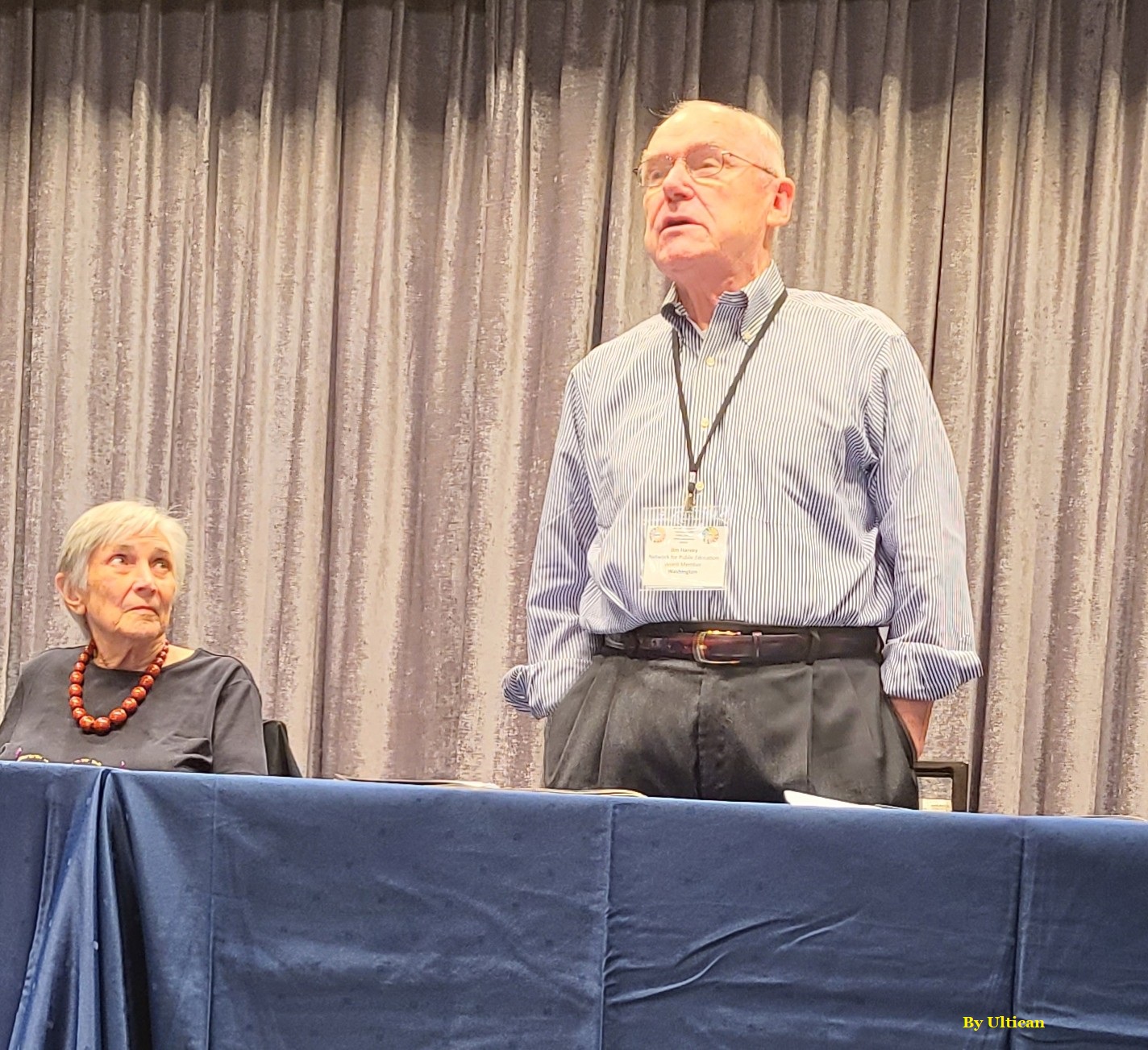
Diane Ravitch and James Harvey

That first night’s presentation was actually an added event for the benefit of us coming in on Friday afternoon. The conference had three keynote addresses, two panel discussions and seven breakout sessions. It was difficult to choose which breakout sessions to attend.

Pastors for Children

For session one, I attended “Mobilizing Faith Leaders as Public Education Allies.”  The amazing founder of Pastors for Children, Charles Foster Johnson, and his two cohorts were well reasoned and did not proselytize us. Their movement really does seem to be about helping communities and not building their church. Among Johnson’s points were:  

  • “Privatized religion teachers believe ‘God likes my tribe best.”
  • “We are the reason there is not a voucher program in Texas.”
  • “Conservatives and liberals come together over education.”
  • “Faith leaders have a different effect when lobbying politicians.”
  • “We are making social justice warriors out of fundamentalist Baptist preachers.”

Houston School Takeover
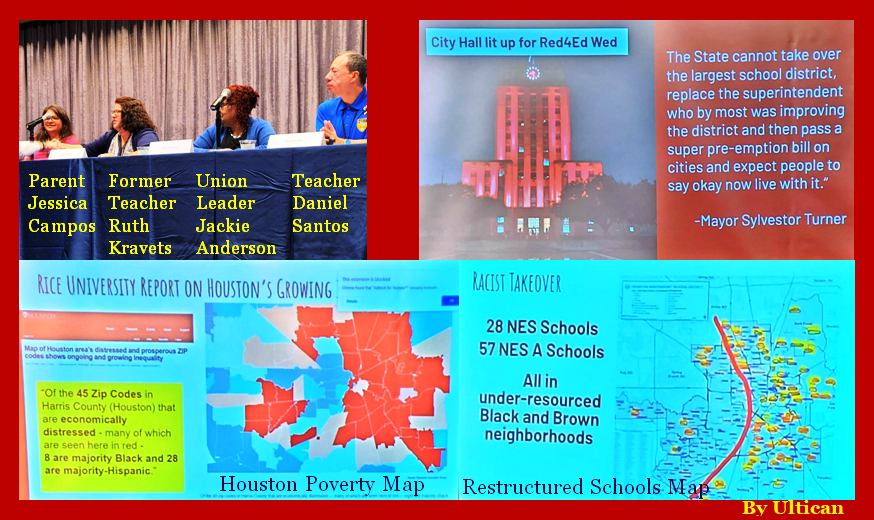
I have no intention of writing about each of the 7 sessions I attended, but the session on the Houston School District takeover needs mention.

Texas took-over Houston Independent School District (ISD) on June 1, 2023. It is the largest school district in the state and eighth largest in the country with more than 180,000 students attending 274 schools. The student demographics are 62% Hispanic, 22% African-American, 10% White and 4% Asian, with 79% identified as economically disadvantaged.

In 2021, Millard House II was selected by a unanimous vote of the Houston ISD school board to be Superintendent. Under his leadership, Houston ISD was rated a B+ district, a school in one of Houston’s poorest neighborhoods, and used to excuse the takeover received a passing grade on Texas’s latest STAR testing. The takeover board replaced House with Mike Miles, a charter school operator from Colorado, previously lasted 2 years of his five-year contract, to lead the Dallas ISD.

Ruth Kravetz talked at some length about the how angry Houstonians are and their effective grassroots organizing. Kravetz stated, “We want Mike Miles gone.” She noted that the local media started turning against the takeover when citizens were locked out of the first takeover board meetings.

Kravetz intoned:

  • “Teachers no longer need a certificate or college degree to teach in Houston ISD.”
  • “Seven year-olds are not allowed to use restrooms during instructional times. They must wait.”
  • “People are being fired for ridiculous reasons. Five people were fired last week over a made up story.”
  • Expect more student action against the takeover.
  • “Rolling sickouts are coming.”

Jessica Campos is a mother in one of Houston’s poorest communities. She said her school is made up of 98% Mexicans with 68% of them being Spanish speakers. She claims, “Our school community has been destroyed”, and reported all teachers were removed with many, replaced by uncertified teachers.

Daniel Santos (High School social studies teacher) said:

“It is all about dismantling our school district. We wear red-for-Ed every Wednesday and Mayor Turner lights up city hall in red.”

The Keynote Addresses

Gloria Ladson-Billings from the University of Wisconsin Madison delivered the first Keynote address on Saturday morning.

She said that we were really dealing with 4 pandemics:

  1. Covid-19
  2. George Floyd murder
  3. “Economic Shesession” (Large numbers of women were forced to leave the workforce.)
  4. Climate catastrophe

Professor Ladson-Billings claims the larger agenda is the complete eradication of public education in what she sees as an evolving effort:

  • The evacuation of the public spaces which are being privatized.
  • Affordable, Reliable and Dependable (public space keys) is being undermined.
  • Public housing is closing.
  • The last domino is public education!

Ladson-Billings says, “choice is a synonym for privatization.” There is money in the public and wealthy elites do not think the public should have it. Also noted was “We are in the business of citizen making.”  We do not want to go back to normal because it was not that great and ending on a positive note, “All is not lost – people on the ground in Florida are working hard to reverse it.”

History Professor Marvin Dunn from Florida was the lunch time keynote speaker. He has been working hard to educate the children of Florida about the states’ racist past, including giving guided tours of the site of the 1923 Rosewood Massacre of an African American community.

He noted that “Racism is in our national DNA” and shared that George Washington owned 500+ slaves. When he was 11 years-old, Washington was given his first slave. Still, 500 black soldiers were with him at the crossing of the Delaware river.

Another American icon mentioned by Professor Dunn was Thomas Jefferson. The third president of the United States was 41 years-old when first having sexual relations with Sally Hemings; she was 14.
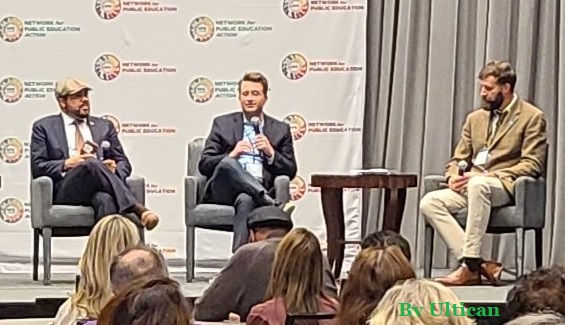
Julian Vasquez Heilig, Josh Cowen and Jon Hale held a late afternoon public discussion on Saturday. The moderator, Heilig, made the point that instead of funding one system, now many states are funding three systems with the same amount of dollars.

Josh Cowen, from Michigan State University, noted that using evidence based data since 2013, vouchers have been catastrophic. If we were using evidence informed education policy, vouchers would have died 5 years ago. Test score losses from voucher students are greater than those experienced in either Katrina or Covid-19. He also noted that 20% – 30% of children give up their voucher each year.

He added don’t believe a word coming out of Iowa Governor Kim Reynolds’ mouth. She has instituted vouchers, opposed abortion and supported child labor.

Reynolds is pushing Christian nationalism.

Jon Hale, from the University of Illinois says white architects of choice have a 70 year history. He says it was never about improving schools. The white supremacist movement sprung up after Brown versus the Board of Education in 1954.

Becky Pringle of the National Education Association and Randi Weingarten of the American Federation of Teachers joined in conversation with Diane Ravitch.

Becky Pringle stated that the attack on public education is deliberate and schools must be reclaimed as a common good noting that more than 50% of today’s students are of color.

Pringle claimed that every single social system in the country is under attack and declared forcefully that elections matter!!

Weingarten asked how many schools are not talking about what is going on in the Middle East right now because they are scared stiff? She made three important points:

  • “The tool of the autocrat is apathy.”
  • “Find the things that unite us.”
  • “Make schools fun.”

The last Keynote speaker was Georgina Perez, Texas State School Board member from 2017 until January 2023.

Georgina introduced herself as a chick from west Texas and obviously there was real steel there. She said, regarding vouchers, “It is completely asinine to take a nickel from the 95% of students and give it to the 5%.”

Being from the border area, she naturally was looking out for the border raised students. Georgina said I could see that all of the “Spanish language EL’s were not dropping out; they were being pushed out.” In order to get what she wanted for them, she needed to work with some very staunch conservatives and was quite successful at it. For example, she got ethnics studies by having a steak dinner and drinking with David Bradley, making a friend. She is a powerful example of how conservatives and liberals can work together for education.

What I Found

Several participants showed up kind of down in the mouth. However, by the end of the conference they were heading back home with new energy and resolve. Billionaires are spending vast sums of money trying to end public school because if public education goes then all of the commons will follow. Their big problem is that vast wealth and spending is not a match for the grassroots organizing that is happening throughout America.

Diane Ravitch, Carol Burris and the members of NPE have become a bulwark for democracy and public education.

Choosing to End Public Education

25 Feb

By Thomas Ultican 2/25/2022

In 2017, the new President of the United States was explicit in his intention to end public education. He appointed a dominionist as secretary of education and regularly invoked the libertarian inspired pejorative “government schools” when referring to public schools. He loudly supported a movement to end public education which started in earnest five decades before he took office.

Its foundation was the economic theories of Milton Friedman and opposition to integration in the old south. Neoliberals, libertarians and their billionaire financiers have unsparingly attacked public education. Their fundamental weapon for ending the public school system is “choice.”

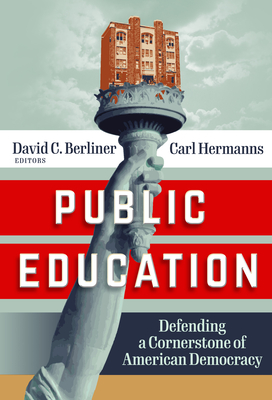
The newly published book Public Education: Defending a Cornerstone of American Democracy is a compilation of 29-essays edited by David C. Berliner and Carl Hermanns. All of the essays are written by accomplished award winning educators and historians. Gloria Ladson-Billings, known for her work on Culturally Relevant Pedagogy wrote,

“Some years ago, when the school choice movement began to gain attention, I argued that we were looking at the beginnings of the plan to destroy public education. There are those who declared I was being ‘alarmist.’ But I made this pronouncement after looking at the ways other aspects of public services have faced severe erosion.” (Education 226)

She also speculated that a contributing factor for the loss of consensus to support public schooling is the long-term campaign by powerful interest groups to portray public education as failing.

In another essay, Education Historian and former US Assistant Secretary of Education Diane Ravitch reported that in 1984 the Republican Party for the first time called for prayer in school and “choice.” She stated,

“Despite the sordid history of school choice and its origins in the segregationist movement, the term became a rallying cry for critics of public education. Right-wing think tanks, libertarian billionaires, and groups like the American Legislative Exchange Council – an organization that brought together far-right extremists, big corporate money, and other who wanted to reduce government regulation and unleash free enterprise – unleashed an unmodulated campaign of vilification against public schools.” (Education 27)

Duke University Professor of History and Public Policy Nancy MacLean, this past September published a new research paper at the Institute of New Economic Thinking – How Milton Friedman Exploited White Supremacy to Privatize Education.” She is the author of the must read book Democracy in Chains: The Deep History of the Radical Right’s Stealth Plan for America.” In her new paper MacLean states,

“This paper traces the origins of today’s campaigns for school vouchers and other modes of public funding for private education to efforts by Milton Friedman beginning in 1955. It reveals that the endgame of the “school choice” enterprise for libertarians was not then—and is not now–to enhance education for all children; it was a strategy, ultimately, to offload the full cost of schooling onto parents as part of a larger quest to privatize public services and resources.”

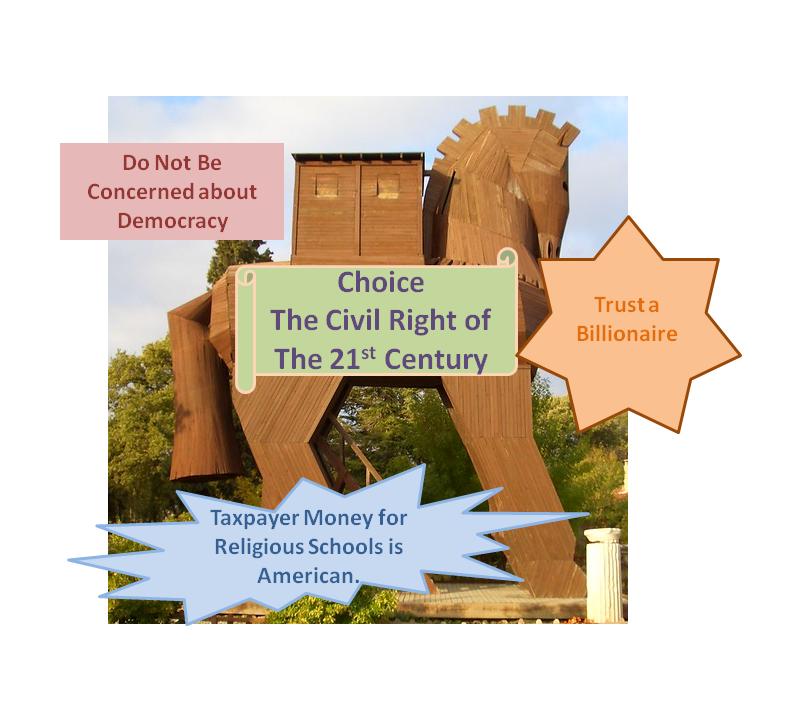
A New Trojan Horse

The Gateway Drug: Charter Schools

An article by the Education Law Center’s Wendy Lecker states,

“As noted in a 1996 Detroit Metro Times article, while the DeVos’ ultimate aim was to abolish public education and steer public funds to parochial schools, they knew not to be blatant about that goal. Thus, they chose a vehicle that blurred the lines between public and private schools- a “gateway drug” to privatizing public education: charter schools.”

After John Walton read the 1983 Reagan administration publication ‘“A Nation at Risk’ with its ominous warnings about the failings of public education,” he convinced his family to direct their philanthropy toward reforming public education. Throughout the 1990s he campaigned endlessly for new voucher legislation and saw his efforts repeatedly rebuffed. Shortly before his death in 2005, John joined Don Fisher and Buzz Woolley in establishing the Charter School Growth fund. Around the same time the Walton Family Foundation began financing charter school startups in communities across America.

Jeff Bryant interviewed Jeffry Henig of Teachers College about the Walton’s move to supporting charter schools. Bryant asserted,

“Henig believes many conservatives view charter schools as a way to ‘soften the ground’ for potentially more private options, though he isn’t entirely sure ‘the Waltons view charters as a Trojan Horse for eventually providing vouchers universally.’”

Former Secretary of Education Betsy DeVos has carried on a relentless attack on public education that continues today. One of the images she sells is viewing students as having a backpack full of taxpayer money which each school age child’s parents spends on education services. In her essay “Public Education at a Crossroads: Will Horace Mann’s Common School Survive the Era of Choice?” educator, administrator and public school advocate Carol Burris warns,

 “Given the anti-tax, anti-government proclivities of those who espouse this type of funding scheme, it is likely that fewer and fewer tax dollars would be place in the backpack over time. Parents once again would assume the sole responsibility for educating their children, buying what services they could afford, with the poor relying on charity.” (Education 239)

A Pillar of Democracy: Public Education

In the essay “Values and Education Policy” Edward Fiske and Helen Ladd tell us, “Good education policy making is rooted in coherent and enlightened educational values.” (Education 33) They begin by discussing the values expressed by Horace Mann who successfully implemented his vision of “common schools.” Today’s public school system is very much a result of that vision and his leadership. Some of the issues Mann addressed are the same issues driving “choice” today. Fisk and Ladd share,

“The idea of taxing all citizens, including those of the privileged classes who already enjoyed access to private education, in order to finance the education of poor and working-class children was viewed as both wasteful and as an infringement of property rights. Mann argued that free schooling served the collective interests of all citizens, rich and poor alike. ‘Jails and state prisons are the complement of schools,’ he wrote. ‘So many less as you have the latter, so many more you must have of the former.’”

“He famously declared, ‘Education, then, beyond all other devices of human origin, is the great equalizer of the conditions of men – the balance-wheel of the social machinery.’” (Education 34-36)

The authors conclude,

“Proponents of citizenship education are struggling to find a place in school curricula. Powerful private foundations and individuals, including the recent U.S. Secretary of Education, are raising millions of dollars to undermine the concept of universal education by privatizing public education and, by means of vouchers and charter schools, to break the link between publicly supported schools and democratically elected officials. Racial resegregation of schools is now pervasive, and courts are retreating from the notion that public funds should not be used to further sectarian religious instruction.” (Education 45)

For a long time, Richard and Betsy DeVos have been working to obliterate the separation of church and state, and privatize public education. In a 2001 interview conducted at the Gathering, Richard  lamented how awful it was that public schools had replaced churches as the center of communities. He did not identify whose church would be accepted as the new community center, but it seems certain to be some flavor of Christianity.

Public Education Shares Informed Discourse

Thirty-two of America’s most accomplished education thinkers and practitioners share their insights. All of them have more than two-decades of experience practicing, researching and debating education policy. None of them are billionaires trying to offload their tax burden or implement self-centered libertarian ideology.

In these pages, there is general respect for Horace Mann’s education advocacy and the public school system but also recognition of associated problems. The common schools were not just the “great equalizer” but also the great homogenizer. They indoctrinated students with a protestant Anglo-Saxon ethic. There is nuanced discussion here about the great foundation for democracy (public schools) needing to inspire not indoctrinate. And some of the authors reject the “great equalizer” belief as a myth.

Professor Ken Zeichner discusses the extreme segregation of public schooling in the United States, speculating they are “possibly more segregated today than it was in the 1960s.” (Education 178) He says in non-dominant communities, families and community members are excluded from real participation in school affairs. He recommends community centered engagement versus school centered engagement. Unfortunately he reports, “Both federal legislation and school practices have encouraged school-centric as opposed to community-centric family and community engagement, creating mutual distrust between families and schools.” (Education 179)

University of Georgia’s Peter Smagorinsky shares, “According to [Betsy] DeVos, those who direct the prevailing K-12 system are ‘trapped in an outdated education model,’ beholden to the ‘wrong and manipulative’ theories of Horace Mann and John Dewey.’” For people not on the extreme right this sounds like nonsense. However, Smagorinsky cautions that people’s positions “are largely emotional and the argumentative reasoning is used as a post hoc means of justifying an established position, … it’s unlikely the Culture Wars will end any time soon, because no one can win them with logic or facts.”

I will end my taste of what is in this wonderful compilation with a quote from one of the editors, David Berliner. He ran through a litany of the scandals arising from both the charter and voucher school movements fueled by unregulated taxpayer dollars. Then personally gratifying to me he wrote, “But Tom Ultican, a thoughtful and passionate defender of public schooling, has a reminder to Americans about the origins of the charter and voucher movement in our nation,”

“Birthed in the bowels of the 1950s segregationist south, school choice has never been about improving education. It is about white supremacy, profiting off taxpayers, cutting taxes, selling market-based solutions and financing religion. School choice ideology has a long dark history of dealing significant harm to public education.

“Milton Friedman first recommended school vouchers in a 1955 essay. In 2006, he was asked by a conservative group of legislators what he envisioned back then. PRWatch [published by the Center for Media and Democracy] reports that he said, ‘It had nothing whatsoever to do with helping ‘indigent’ children; no, he explained to thunderous applause, vouchers were all about ‘abolishing the public school system.’” (Education 280-281)