Tag Archives: FCMAT

FCMAT Attacks Weed Elementary

28 Jan

By Thomas Ultican 1/28/2025

In 1992, California inaugurated the Fiscal Crisis Management Assist Team (FCMAT) in the aftermath of the Richmond School District bankruptcy. It was set up as a quasi-autonomous non-governmental organization headquartered in Bakersfield. Unfortunately, from the beginning, FCMAT functioned as a tool of the politically connected and never provided actual assistance to districts dealing with financial matters. FCMAT, which is pronounced fick-mat, recently started attacking the Weed Union Elementary School District, a single-school district, based on little more than feelings and rumors.

Weed Elementary School is in Weed, California on the foothills of Mount Shasta, one of the twelve 14,000+ feet high mountains in California. Weed is 230 miles north of Sacramento along interstate-5 in Siskiyou County. Abner Weed came to the county in 1889 and became a business and political success. Weed founded the Weed lumber company and at one time his sawmills were the largest producers in the world. The town he built and its schools bear his name.

Weed California Entrance

Today, this small town of 2,900 people is not wealthy. The Weed Elementary school accountability report card shows 78% of its students are socioeconomically disadvantaged. This is the target of FCMAT’s warrantless attack.

Attack Background

Over the Thanksgiving break in 2019, there was some sort of flood at Weed Elementary School. The district took measures to clean up the district office, a conference room, two special day classrooms and the library. They believed that this was all that was required.

Soon after, the superintendent resigned and the district hired Jon Ray for the job in April, 2020. When Ray entered the school, he smelled an odder reminiscent of the mold infestation at a school where he previously worked. Ray hired a vendor to investigate and they found significant mold hidden in the walls.
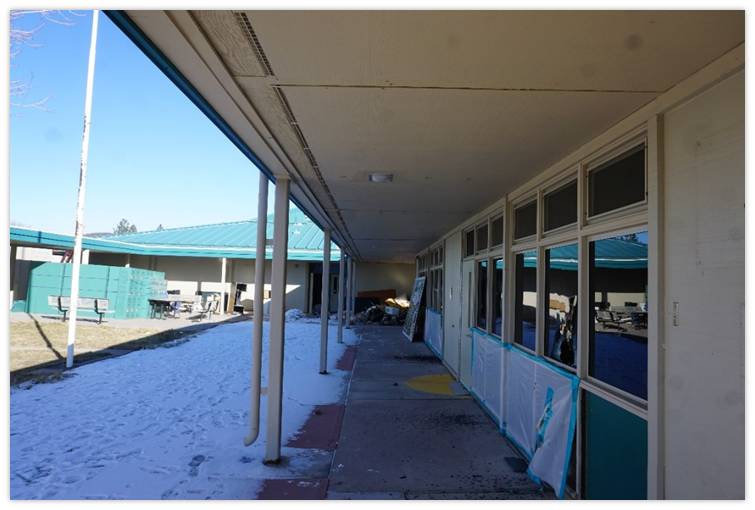
Weed Elementary School

It seems that there was some bad blood between the Siskiyou County Office of Education and Jon Ray at Weed Union Elementary School District. In an interview, Ray voiced the opinion that most of those bad feelings were generated by his decision to open school for in person classes in August, 2020.

When the county superintendent received anonymous allegations of possible fraud, misappropriation of funds or other illegal fiscal practices at the Weed Union Elementary School District, he decided to call in FCMAT at a cost of $250,000. This is probably a decision he now regrets.

As Superintendent Ray was informed, FCMAT was not here to help. They were there to find issues and concluded in their report, “Based on the findings in this report, there is sufficient evidence to demonstrate that fraud, misappropriation of funds and/or assets, or other illegal fiscal practices may have occurred specific to bid splitting and other areas reviewed.”  (Report Page 28)

However, Mr. Ray’s response to FCMAT’s report is more convincing than the report. Most of the criticism of Weed Elementary was cited as feelings. For example, FCMAT stated:

“The district’s decision to use construction management multiprime (CMMP) as its construction method seemed questionable to both FCMAT and the county superintendent. … To the county superintendent and FCMAT, it seemed the district was reacting to issues as they arose rather than following a comprehensive plan”. (Report Page 6)

Superintendent Jon Ray responded:

“These comments are exemplary of the type of impressions and feelings that permeate the entire Report. Since FCMAT is claiming that its evidence supports grave accusations like fraud and misappropriation, it is shocking to find so many instances where the basis for these charges is solely the way it ‘seemed’ to FCMAT.” (Response Page 3)

Once you go thru the FCMAT report and all of its feelings you come to one substantive charge, bid splitting. The California Department of Education web site definition of bid splitting states:

“Bid splitting is intentionally dividing purchasing to avoid getting price quotes or going out to bid using a more formal procurement method. Per Public Contract Code 20116, It shall be unlawful to split or separate into smaller work orders or projects any work, project, service, or purchase for the purpose of evading the provisions of this article requiring contracting after competitive bidding.

Mr. Ray and the district responded, “FCMAT has not provided any evidence, fact, or document indicating that the District ever split any bid to avoid a bid limit; they did not because none exists.”

Several of the FCMAT report findings seem to undermine the fraud and bid splitting allegations. Starting on page 6 in the report they site (1) the District determined that managing smaller contracts without paying a general contractor’s mark-up provided a cost savings; and (2) the district determined that it could purchase equipment, materials and supplies for projects to both reduce a contractor’s mark-up and to ensure supplies would be available during a country-wide supply chain crisis.

In 2021 and 2022, due to COVID, prices for raw materials were exploding and contractors were reticent to make commitments. Jon Ray and the board at Weed Elementary saw no choice but to act as contractor and purchase the needed materials. This was not something they wanted to do but while operating their K-8 school, concluded it was something they had to do.

Michael Fine Behind the Scenes was the Problem

Michael Fine is the chief executive officer of FCMAT. He and his team have found a Bakersfield, California money tree. Transparent California reveals that in 2023, Fine was paid $383,879.87 and there were 11 other FCMAT employees who received more than $279,000 for the year and five more workers made more than $158,000. It is a lot cheaper to live in Bakersfield than Los Angeles, San Diego, San Francisco or Sacramento. To keep their money tree alive, they just need to keep the rich and powerful happy. That is not the people in Weed, California.

The Data Center Reported that in 1992 that FCMAT had a budget of $562,000 which ballooned to $35.6 million by 2002. They also criticized its use of no-bid contracts and lack of accountability. Los Angeles State Assembly Woman Jackie Goldberg called for an audit of FCMAT in 2003. The state auditor reported that FCMAT was providing value to districts but did criticize the over use of no-bid contracts. That appears to be the only audit ever done of FCMAT.

FCMAT actually does bad financial investigating. For example, in 2022, a FCMAT study claimed that Stockton Unified School District (SUSD) was headed for serious financial difficulties when the one time spending from the federal government is gone in fiscal year 2024-25. They said the district is spending one time funding on $26.3 million in salaries, benefits and services that appear essential.

It turned out that a FCMAT consultant who previously worked for the Stockton schools, Susan Montoya, apparently created phantom positions that were the source of the $30 million dollar shortage. It was SUSD that discovered that the $30 million budget deficit was a rouge not FCMAT.

Time to Audit and End FCMAT

There are terrible FCMAT experiences all over the Golden state. What is never found is a good experience or a story of how FCMAT helped a school district. School leaders just talk about how they survived FCMAT, how costly it was and in the happy cases how they finally got FCMAT off their back.

The money going thru FCMAT needs to be examined. The salaries are outrageous and the services worse than stink.

California schools could use some expert help not a police force making money from struggling schools by finding something on them so the state can takeover.

Time to end FCMAT and start over.

Education Support, More Harm than Help

10 Oct

By Thomas Ultican 10/10/2024

In California, we have the Fiscal Crisis and Management Assist Team (FCMAT – pronounced fick-mat) which is more often the bane of its clients than a help. It is a quasi-autonomous non-governmental organization signed into law in 1992 by Governor Pete Wilson. FCMAT was a response to the financial collapse of the Richmond school district. Unfortunately organizations with this structure become bureaucratic and overtly support the political agenda of whoever is in power. The unhelpful nature of FCMAT recently reared its ugly head in Stockton Unified Schools District (SUSD).

The story of Stockton is that of a small city less than 50 miles south of Sacramento whose school district has become the target of unrelenting attacks by billionaires. It is a minority majority city of about 321,000 people. The demographic makeup is 45.2% Hispanic, 20.9% Asian, 31.3% White and 11.6% Black. The city has a little more than a 15.6% poverty rate; however, SUSD reports that 77% of their students live in poverty.

California’s Data Quest enrollment data for the 2023-24 school year shows charter schools with 6,282 students, public schools with 32,448. That means charter school enrollment is 16% of the 38,730 total publicly supported students in Stockton.

The two biggest problems for the schools is massive spending by billionaires to privatize them and an unrelenting superintendent of schools turnover. Since 2005, there has been a revolving door for superintendents. The longest serving one in that period was John Deasy and he resigned June 15, 2020 serving just 2 weeks more than 2 years.

Deasy was succeeded by Brian Beiderman who already worked in the district and appeared to have been Deasy’s choice. Beiderman was interim superintendent for 8 months and then resigned. He was replaced by John Ramirez Jr., who resigned under a cloud just over one year from being appointed interim superintendent. Going into the 2022-23 school year, the SUSD board settled on Dr. Traci E. Miller as interim superintendent.

In December 2022, Superintendent Miller was informed that “we have decided to go in another direction” six months before her contract was allowed to expire. She says the call was from Don Shalvey, CEO of San Joaquin A+, and Fritz Grupe a real estate developer, who leases charter facilities. It is of note that neither of these gentlemen had any actual standing in SUSD.

June 30 2020, was the 75 year old Shalvey’s last day at the Gates’ Foundation. For the entire 11 years he worked for Bill Gates, Shalvey commuted from his ranch in Linwood, California where he lived with his wife Sue. Linwood is 10 miles outside of Stockton.

San Joaquin A+ was a small non-profit (TIN: 51-0536117) supporting education initiative with modest holdings of less than $40,000. Coincident with Shalvey’s availability, Helen Schwab, a San Francisco billionaire, donated $400,000 to A+ and Shalvey was named CEO. In the three years prior to his arrival, A+ had taken in $15,169. The haul in 2020 was $3,176,833 and in 2021, $3,942,790. Shalvey’s new part-time job was paying him a high six-figure salary and billionaire dollars were flooding Stockton.

FCMAT Arrived

FCMAT Main Web-Page

John Ramirez, who was interim superintendent in 2021, appeared concerned about the reliability of his district’s budget. He contacted FCMAT for help. In June 2022, an odd Stockton grand jury reported on the district. Local news group Stocktonia briefed:

“The biggest concern: SUSD is “headed toward at least a $30 million deficit by `the fiscal year 2024-2025.” And if the current management practices continue, that deficit will “likely escalate.”’

Despite Ramirez having called on FCMAT months before this grand jury report, the San Joaquin County office of Education stated:

“The SJCOE can confirm that it has contracted with the Fiscal Crisis Management Assistance Team (FCMAT) in order to conduct a comprehensive review of the school district.  The San Joaquin County Superintendent of Schools initiated the AB139 Extraordinary Audit earlier this year.”  (An AB139 audit gets its name from the assembly bill 139 that authorized these audits of school district budgets.)

In 2023, FCMAT issued two reports. February saw the release of their Extraordinary Audit which was a bureaucratic nightmare. On page 33, the report states, “Based on the findings in this report, there is sufficient evidence to demonstrate that fraud, misappropriation of funds and/or assets, or other illegal fiscal practices may have occurred in the specific areas reviewed.” The audit cost the district $50,000 and provided no insight into the looming $30 million dollar deficit or what evidence of fraud and illegal fiscal practices had been unearthed.

The same unfounded claims of criminality were lobbed by FCMAT CEO Michael Fine at Sweetwater Union High School District where I worked. No serious legal charges were ever made and the district finally got FCMAT off their back.

The final report, Fiscal Health Risk Analysis, was presented in August. FCMAT has developed a group of tables with a series of questions having three possible responses, yes, no or N/A. They then use some secret formula to turn these answers into numbers which guides the conclusion. They determined that SUSD’s solvency risk factor was high. The report is not that convincing.

These reports were responses that provided little to no help for SUSD, who originally asked for the audit. The Extraordinary audit seemed to be a regurgitation of the grand jury findings. FCMAT trashed the board and management of the school but offered few insights. During COVID, the school board received federal money to do things like improve ventilation in schools. The audit spent five of 45 pages on the air purifier purchase from IAQ that the board made. It seems some people wanted a different company to get the contract and felt the school board froze them out. However, this was a – spend the money or lose it – purchase, and did not affect the viability of the budget.

An interesting character in this episode is financial expert Susan Montoya. She was chief financial officer when John Ramirez was superintendent of the district. Supposedly she informed Ramirez that she would be away for a while, but would have the 2021-2022 budget ready. She did return with the budget in hand and then resigned. Later, Montoya was hired by San Joaquin County school superintendent, Troy Brown, to be the counties “Fiscal Expert.”

Before Montoya’s hiring, SUSD interim superintendent, Traci Miller, wrote Brown sternly warning against the hiring. Miller stated that Montoya was unprofessional and many of the district’s “current fiscal problems can be traced back to Montoya.” Miller feared she “will sabotage our progress and our implementation of new and improved processes.” Miller was ignored.

When FCMAT was conducting its audit, the county’s “Fiscal Expert,” Susan Montoya, was a primary source. The person Traci Miller blamed for the district’s fiscal problems was part of the team doing the audit. In effect, grading her own home work. In the extraordinary audit, FCMAT writes, “Limiting the possibility of any personal influence, either directly or indirectly, is about avoiding even the appearance of a conflict.” (Page 10) Their statement seems a little hypocritical.

To put a cherry on the top, SUSD has discovered that the $30 million budget deficit was rouge. Supposedly, Montoya had created phantom positions that were being funded and that was the source of the apparent deficit that never existed.

Public Schools are Resilient

After years of turbulence and leadership turnover, it could be that SUSD is on a better path. Traci Miller took over a mess and improved the district’s functioning. In 2003, the district hired Michelle Rodriguez to be superintendent. After one year on the job, her contract was extended from three to five years.

Rodriguez studied at Chico State University and upon graduation went to Spain for further study. She is fully bilingual. Rodriguez earned a PhD from University of Southern California, was a principal in San Diego, became chief academic officer in Santa Ana and was Superintendent of Pajaro Unified School District in Watsonville for 7 years prior to accepting the Stockton job. Michelle stated she expects to be in Stockton for 7 years declaring, “I plan to retire here. I plan to stay here and affect change.” 

SUSD has been demeaned because it does not have good standardized test scores. In statistics, the r-value correlation has a value between o and 1 for determining the effects of different inputs on education testing results. An r = 0 means there in no relationship and an r = 1 means the input is 100% determinative. Inputs like teacher, curriculum design, class size, etc. can be evaluated. The only input ever found with more than 0.3 r-value is family wealth at a 0.9 r-value. Stockton parents are poor and many of the students are language learners; for them to perform as well on standardized tests as wealthy students would show statistical evaluations to be meaningless.

The California dashboard reveals that Stockton has no academic areas in crisis and meets all professional standards. It has a relatively low graduation rate of 82% but is improving the rates of chronic absenteeism. Public schools are very resilient. With the constant leadership turnover, high poverty rates, billionaire attacks and widespread belief the district is corrupt, schools are still functioning at a high level. With a little stability and professionalism at the top, the future looks bright.

On the other hand, FCMAT needs to be defunded. Programs aiding districts should be in the California Department of Education and not be in some semi-private organization in Bakersfield, California.

Inspire Charter School Legacy

28 Jun

By Thomas Ultican 6/28/2024

Inspire Charter Schools looked like the next district attorney target when Sean McManus and his A3 charter empire were officially charged with “Theft of Public Funds.” The San Diego Union’s Kristen Taketa reported October 9, 2019 that Inspire was subject to a new state audit. She focused on it with several articles over the next year. The only reason Inspire did not lead to sensational stories of greed, unethical practices and fraud was no DA pursued them.

Former Los Angeles Unified teacher, Herbert “Nick” Nichols, created Inspire schools through his corporation, Provenance, originally called Inspire Charter Schools. Adhering to the use-small-school-districts strategy, his first school was authorized by the Acton-Agua Dulce Unified school district (Los Angeles County) July 1, 2014. It grew from 151 students in the 2014-15 school year to 4,321 students in  2018-19 and then closed up shop on June 30, 2019.

Why?

Taketa reported:

“Nichols’ annual salary is $380,000, Inspire’s spokesman Chris Bertelli said. In 2016, Nichols was paid $514,197.”

A deeper look at tax records revealed Nichols compensation was in 2015 ($120,305), 2016 ($514,197), 2017 (missing), 2018 ($614,391) and 2019 ($442,136). During that missing year, Inspire Charter Schools charter management organization (CMO), called Inspire District Office (EIN: 46-4743375), became Provenance (EIN: 82-1672890) and compensations were apparently not reported to the IRS.

Things imploded rapidly. In early October, 2019, seven county education superintendents called for the Fiscal Crisis Management and Assistance Team (FCMAT) to audit all Inspire schools. That followed the California Charter Schools Association rescinding Inspires membership. Nick Nichols took a leave of absence in September and resigned as CEO in October, 2019.

Nichols helped create all of the Inspire schools, effectively controlled by his corporation, Provenance. As CEO, he became sole statutory member of Inspire schools, with the only vote for selecting school boards and changing operations. He selected charter school board members, who then voted to hire Provenance to guide their schools. Only Nichols could sign checks for the various charter schools. It was a nasty and illegal arrangement.

In 2019, Taketa reported:

“The Union-Tribune emailed questions to Inspire about it being the sole statutory member on July 16. Within five days, the Inspire school boards changed their bylaws to remove Inspire Charter Schools as the sole statutory member, according to their board agendas.”

Before these questions, Inspire seemed to be full speed ahead. State records show them opening five home-school or primarily virtual charters on July 1, 2019. All are still in business.

Remnants are Profiting

On November 20, 2023, FCMAT finally submitted their report. Auditors were not able to conclude whether fraud occurred, largely because Inspire’s records were in such poor condition. The report stated:

“On October 11, 2019, Nichols and the CMO signed a separation and release agreement removing Nichols from his duties over the Inspire network. The agreement includes the following:

“Nichols has been on unpaid administrative leave since September 20, 2019.

“Must repay outstanding payroll advances totaling $1,055,834; however, $195,910.89 has been repaid, leaving an outstanding balance of $859,923.11.”

“This was the beginning of the Inspire network’s eventual end, with each Inspire Charter School rebranding itself and becoming its own independent charter school under its own nonprofit public benefit corporation as presently established as of this report.”

On September 20, 2020, Granite Mountain Charter School sued Provenance (aka Inspire Charter Schools, aka Inspire District Office) for breach of contract, breach of fiduciary duty and constructive fraud, unfair business practices and more. They claimed Provenance, which controlled their bank account, had moved more than $70,000,000 in and out of it. Granite Mountain believes Provenance purloined between $5 million and $10 million.

Provenance also registered Granite Mountain’s domain name and claimed ownership of their logo. They offered to sell them back for $200,000. The suit, filed in a Los Angeles County Court, seeks the return of the domain and at least $5 million.

In May, 2022, Granite Mountain filed a suit against Yosemite Valley Charter School and Director Laurie Goodman in Fresno County. A Fresno judge ruled since the money involved was related to the LA trial, that case had first jurisdiction. The main point here is one charter school suing another charter school was caused by Provenance commingling money.

Granite Mountain’s charter petition was approved by Lucerne Valley School District January 10, 2019. Nichols was the only person that could use their checking account. In August, Granite Mountain school board voted to remove Nichols from the account and replace him with its treasurer and Provenance Chief Financial Officer, Chris Williams, as check signer.

The law suit claims this did not happen.

All about the Money

Since each school is a non-profit public benefit corporation, they must file IRS 990 tax forms. Granite Mountain Charter School (EIN 83-3660999), Monarch River Academy (EIN 83-4510641) and Yosemite Valley Charter School (EIN 84-2358972) were reviewed.

Two items stood out: they are profitable and salaries are amazing.

These people live in relatively low cost areas of the state. The salaries would be big in San Diego or Los Angeles but are giant in Fresno and surrounding areas where the cost of living is much less.

Though these charters are all mostly virtual schools, by California Law they must hire credentialed teachers. What became clear when interviewing teachers is that quality of education was not the first priority. Keeping parents happy was paramount. Keeping average daily attendance money arriving is the main goal.

Teachers at these organizations have no unions and receive almost no support when parents complain. I heard stories of educators being pushed out when one Christian mom did not like their openness to gay students. Another episode involved a teacher getting complaints for pushing too hard to cover state standards and was fired. The school did not care about meeting state standards. They were only concerned with keeping parents happy.

When asked about changes that have come since the demise of Inspire, one teacher said, “Now we have multiple Inspires with each school being a location where families and friends are being hired into high paying jobs that they are not qualified to hold.” Another described the utter incompetence of an administrator holding professional development training on material the admin did not understand.

Inspire charter schools has transitioned from being a fraudulent entity setup to scam money from the state of California into a hook-up club of admin-heavy schools. In both cases, the education product has been horrible with terrible academic results.

This is more evidence for shutting down cyber charter schools. County education agencies provide cyber services and maintain education integrity. The incentives for this type of school are all wrong for quality education provided by private business.

FCMAT – California’s Unaccountable Political Player

28 May

By Thomas Ultican 5/28/2022

California Assemblywomen Delaine Eastin wrote legislation creating the Financial Crisis Management and Assistance Team (FCMAT) in 1991. Her legislation was in response to the bankruptcy of the Richmond School District and requests for financial help from four other districts. In 1992, Governor Pete Wilson signed the legislation into law and located FCMAT (pronounced Fick-Mat) under the auspices of the Kern County Superintendent of Schools. Since then, its power has grown and portfolio expanded with little oversight. Today, there is a burgeoning chorus of critics calling for reform or even termination.

In the mid-1990’s, I made the trip through the south end of the San Joaquin Valley many times. On the car radio, the only listening choices available were Rush Limbaugh and the Buck Owens show from the Crystal Palace in Bakersfield. Bakersfield is named after founder Thomas Baker but the name easily could refer to the weather. The city of a half-million sitting about 140 miles from Death Valley regularly sees temperatures over 100° F between May and October. It gets really hot for extended periods. That is where the FCMAT home office is located.

Bakersfield, the county seat of Kern County, is an economic powerhouse in both oil and agriculture. In 2020, it had a slightly larger Republican voter registration than Democratic (R=158,771 & D=152,102). Registrations have been almost evenly split for decades. In 1992, when Republican Governor Pete Wilson chose the Kern County Office of Education as administrative and fiscal agent for FCMAT, the Republican voter registration advantage totaled 118.

The Developing Juggernaut

FCMAT employs a neoliberal structure popularized in the United Kingdom called QUANGO. The Scottish writer Roland Watson describes QUANGO as a “quasi-autonomous non-governmental organization.” Those of short duration are sometimes referred to as a task force. They carry out government mandates by receiving and issuing contracts. Watson noted that “its rear end looks distinctively democratic and accountable but the front part is definitely statist and bureaucratic.” The problem with a QUANGO is the tendency to overtly support the political agenda of whoever is in power.

The Data Center Reported that in 1992 FCMAT had a budget of $562,000 which ballooned to $35.6 million by 2002. The report also criticized its use of no-bid contracts and lack of accountability. Los Angeles State Assembly Woman Jackie Goldberg called for an audit of FCMAT in 2003. The state auditor reported that FCMAT was providing value to districts but did criticize the over use of no-bid contracts. That appears to be the only audit ever done of FCMAT.

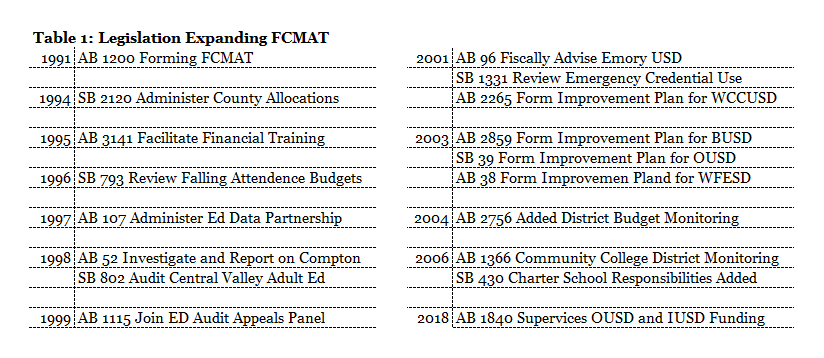
Besides the legislation listed in Table 1, there are many legislative edicts for FCMAT to audit specific school districts. The districts are charged a no-bid fee for the mandated audits; FCMAT contracts out much of the work. Local school districts that have had previous financial issues often must pay a consulting fee to obtain FCMAT’s blessing in order to implement a budget. In districts with financial problems, this agency has more power over district policy than voters.

Transparent California reveals that the top 2020 total salary at FCMAT, $313,780.72, went to CEO Michael Fine. Including Michael, there were thirteen FCMAT staff members who earned more than $214,000 that year. The data shows that FCMAT had seventeen employees on staff being paid a total salary of $3,568,008.

Is it really about Gentrification?

In 2018, two school districts in California requested emergency funding to maintain operations. Both Oakland Unified School District (OUSD) and Inglewood Unified School District (IUSD) arrived in this predicament due to incompetent (unethical?) administration during a state takeover.

California took over Inglewood’s schools in 2012 because of financial problems that should properly be credited to George Bush’s No Child Left Behind and the state of California’s almost unregulated charter school movement. In 2016, Secretary of Public Instruction (SPI) Tom Torlakson recruited Vincent Mathews to be IUSD’s forth state appointed Superintendent.  

At the beginning of the millennium, Mathews led the for-profit Edison school in San Francisco. Later, he went through training at the infamous Broad Academy which included studying their handbook for closing public schools. He also served for two years as the state appointed superintendent for OUSD (2007-2009).

Mathews stayed 18 months in Inglewood before accepting the Superintendents position in San Francisco. About his Inglewood tenure, the LA Times noted,

“A recent report by the state’s Fiscal Crisis and Management Assistance Team found that, under Matthews, Inglewood had left day-to-day tasks to consultants, hadn’t monitored its budget and had underestimated its salary costs by about $1 million. The district had also overestimated its revenue, in part by incorrectly counting the number of students.”

FCMAT was supervising that state loan given to IUSD and was charged with monitoring the district’s finances. However, they missed the bad budgeting practices implemented by the state appointed administrator.

In Oakland Antwan Wilson another Broad Academy graduate blew a hole in the Budget under FCMAT’s less than watchful eye. After two and a half years on the job, he left Oakland to be superintendent of schools in the nation’s capital. Soon after that, huge budget problems were discovered causing the school board to immediately order more than $15 million in mid-year budget cuts.

In an article detailing some of the mismanagement and greed in Oakland, Valerie Strauss of the Washington Post reported:

“Wilson brought in dozens of executive staff members from outside the Oakland district, creating new positions and departments that were not budgeted, and paying more than was customary in the district, …. In 2013, before Wilson arrived in Oakland, only four administrators earned more than $200,000; two years later, at least 26 did…

The 2018 solution to these financial issues from the state legislature was AB 1840 which dictated the terms under which OUSD and IUSD could receive emergency funding. It signified that in the budget acts for the coming years, Oakland and Inglewood could apply for emergency funding if they met certain criteria. It also meant that their respective counties – Alameda and Los Angeles – would assume control from the state and use FCMAT to financially supervise the districts.

In SB 74 the 2020 budget act, Oakland received $16 million with the law stipulating “affirmative action by the governing board to continue planning for, and timely implement, a school and facility closure and consolidation plan that supports the sale or lease of surplus property”.

The next year, the new school board turned down $10 million authorized in SB 129 which again required “Affirmative action by the governing board to continue planning for, and timely implementation of, a school and facility closure and consolidation plan that supports the sale or lease of surplus property.”

FCMAT explains on their web site how the governing power in OUSD was changed by AB 1840:

“Under the provisions of Assembly Bill (AB) 1840 (Chapter 426/2018), the trustee serves under the direction and supervision of L.K. Monroe, Alameda County Superintendent of Schools. Assembly Bill 1840 designates FCMAT as the agency to identify and vet candidates to serve as county trustee. The final selection of a candidate for Oakland Unified School District trustee will be made by Superintendent Monroe, with the concurrence of the State Superintendent of Public Instruction (SPI) and the president of the State Board of Education.”

In other words, OUSD no longer under state control is now under county control and their fiscal agent is FCMAT. Many people are wondering if the big push to sell off school properties from both the state and county is not motivated by gentrification and developer profits. It is well known that outside of a onetime cash infusion there are no significant savings associated with closing wholly owned school sites.

Working for the Bosses!

Sweetwater Union High School District (SUHSD) in San Diego County went through a grueling few years. In April of 2014, four of the five Sweetwater board members plus district Superintendent Jesus Gandara pled guilty to corruption charges and resigned. This is when the current SUHSD board of Trustees was originally elected. Unlike the previous board that got its financial support from the construction industry, the new board members were all supported by the teachers’ union. This was not greeted enthusiastically by some local political forces.

During their first three years, the district ran harmoniously. In 2018, trouble emerged. There was a transition in leadership within the SUHSD financial team. The CFO, her top assistant and two other members of her small team retired after submitting the budget for the 2018-19 school year. That summer the new CFO, Jenny Salkeld, discovered a $20 million dollar error. She immediately reported her discovery to the district and county.

After receiving Sweetwater’s alert about the accounting errors, the County Office of Education officially disapproved the 2018-19 budget the district had submitted. The reasons for disapproving the budget were the reasons Salkeld had reported.

Apparently someone at the county leaked the budget information to the Voice of San Diego. The district which was in the process of understanding the extent of the problem lost the opportunity. Instead they were faced with a withering public attack in both the San Diego Union and The Voice of San Diego. Headlines implied that a group of incompetent people at SUHSD were incapable of managing their affairs honestly.

Enter FCMAT. SUHSD was forced to pay them $50,000 to have finances reviewed. A preliminary report was delivered that December at a SUHSD district school board meeting. Voice of San Diego’s Will Huntsberry shared,

“FCMAT’s chief executive officer Michael Fine told board members that 302 entries in the district’s accounting system were doctored to create the impression the district had more money than it really did. ‘That my friends and colleagues, is a cover-up,’ …”

For weeks, local San Diego TV and Print media were filled with damning headlines like the NBC affiliate’s, “Audit of Sweetwater Union High School District Finds Evidence of Fraud” or the online publication Voice of San Diego’s “Audit Finds Sweetwater Officials Deliberately Manipulated Finances.” Every local news outlet published a story with some version of these headlines. There was speculation that the fraud had to do with a large school bond measure voters had approved and predicted multiple people were going to prison.

The following June FCMAT issued its completed report. It certainly weighed an ‘A’ (my mother’s satirical goal for a college research paper) but was not of great value. By the time the report arrived, SUHSD had already implemented a vast majority of the recommended fixes to their budgeting process. Eventually, the former SUHSD CFO was fined $28,000 for falsely attesting to the accuracy of the budget and the district agreed that they would bring in an independent consultant for any future bond offerings. Ironically, the district had used an independent consultant for the bond offering in question.

This April, the San Diego Union’s Kristin Tanaka reported, “Seventeen of San Diego County’s 42 school districts are projecting that they will spend more than they take in — not just in the current school year, but the next two years — as districts grapple with rising costs and lower enrollment, according to the latest batch of financial projections districts submitted to the county.” SUHSD was not one of the seventeen. The district survived the crisis and still has the same apparently popular school board in place.

It was a similar story in 2003 for OUSD. Then Superintendent Dennis Chaconas realized that the accounting system was dated and needed modernizing. EducationNext reported “New software, installed so that the school district could better understand its finances, had uncovered a $40 million deficit from the previous year.” Most sources say it was actually a $37 million dollar deficit but still big and shocking.

Ken Epstein shared, “OUSD had adequate money on hand in a construction fund that could have temporarily paid off the shortfall, but the state would not allow Oakland to tap into that fund, though the practice was allowed in other districts.”

Local political leaders like then Oakland Mayor Jerry Brown and influential state Senator Don Peralta wanted OUSD taken over by the state. They used FCMAT in an effort to make it happen. Online news source Majority reports that when OUSD proposed covering the shortfall with construction funds:

“Tom Henry, the CEO of California’s Fiscal Crisis and Management Team (FCMAT) opposed this plan, and Mayor Brown questioned it heavily. (During a state takeover, FCMAT would be responsible for monitoring the school district’s financial progress.) Phone records later obtained by the Oakland Tribune revealed over 40 phone calls on key dates between Brown, Henry, and Randolph Ward, who would end up in charge of OUSD when it was placed under state control, in the two months before the state takeover.”

During the same period, there were no phone calls to OUSD Superintendent Dennis Chaconas.

OUSD was forced to accept a $100 million dollar loan and taken over by the state instead of paying off the deficit with the $37 million dollars from their construction fund. After almost two decades of state and county control financially supervised by FCMAT, Oakland is still stuck with $6 million dollar yearly loan payments until at least 2026 and the state appointed administrator was allowed to create a new financial crisis.

….

At the very minimum, it is time to reign in and reform FCMAT. They have become an authoritarian lever used by people in power to enact their unpopular agendas. It is supposedly an “Assistance Team” but in reality FCMAT is causing more damage than their “assistance” is worth.

Fraud at Sweetwater; Maybe but Unlikely

1 Jul

By Thomas Ultican 7/1/2020

For the past week, local San Diego TV and Print media have been filled with damning headlines like the NBC affiliate’s, Audit of Sweetwater Union High School District Finds Evidence of Fraud” or the online publication Voice of San Diego’s “Audit Finds Sweetwater Officials Deliberately Manipulated Finances.” Every local news outlet published the story with some version of these headlines.

On Monday June 23, the Fiscal Crisis Management Assist Team (FCMAT) presented the results of its long awaited audit of Sweetwater Union High School District’s (SUHSD) finances. The report authors state,

“Based on the findings in this report, there is sufficient evidence to demonstrate that fraud, misappropriation of funds and/or assets, or other illegal fiscal practices may have occurred in the specific areas reviewed.”

How Did SUHSD Arrive Here?

For Sweetwater, this is really a continuation of the course set by corrupt leadership a decade earlier. It is also emblematic of the financial stress all California school districts are facing. Kristen Taketa reporting for the San Diego Union noted in November 2018:

At least 10 districts in the county are projecting that they will not be able to meet their financial commitments next school year, including Chula Vista Elementary, Jamul-Dulzura Union, Mountain Empire Unified, Oceanside Unified, San Diego Unified, San Marcos Unified, San Ysidro, Sweetwater and Vista Unified. More districts won’t be able to meet their financial commitments after next year.

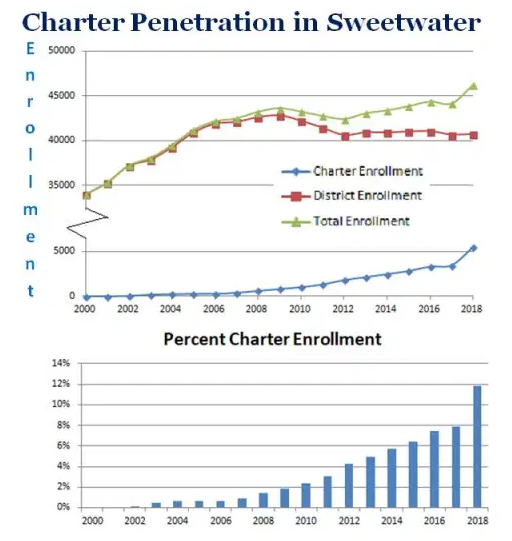
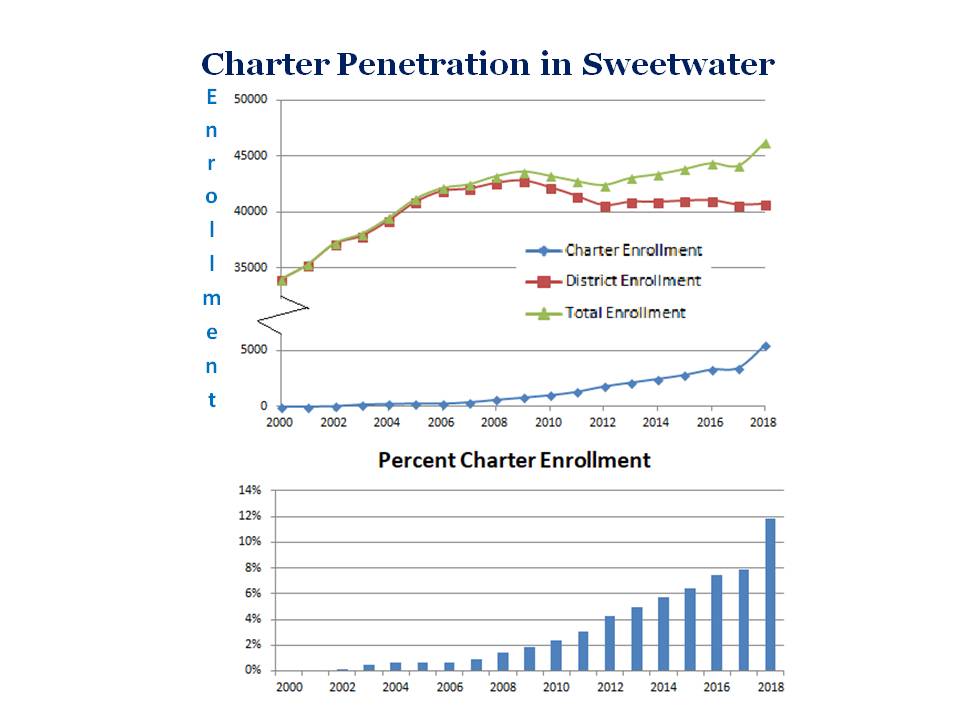
Three factors are mainly responsible for these growing financial stresses. The state has mandated a more than doubling of teacher retirement payments from 8.1% to 18.4% without providing extra assets. Special education costs have been soaring and enrollment has been shrinking due to an increase in state funded privately operated schools.

enrollment-graphs

The Drop in Attendance Accounts for a $20 Million Drop in Revenue

In April of 2014, four of the five Sweetwater board members (Jim Cartmill, Bertha Lopez, Pearl Quinones and Arlie Ricasa) plus Superintendent Jesus Gandara pled guilty to corruption charges and resigned. The fifth member of the five person board, John McCann left the board to run for a seat on the Chula Vista city council.

Cartmill and Lopez pled guilty to a misdemeanor charge of accepting gifts over the state limit. Quinones, Ricasa and Gandara were charged with felonies. Arlie Ricasa pled guilty receiving probation and a fine. Gandara was sentenced to 7-months jail time and fined $7,994.

Pearl Quinones also pled guilty and stated “I would have fought it to the very end if I had been able to afford to keep fighting it.” She received a three-year probation with the felony being reduced to a misdemeanor.

District Attorney Bonnie Dumanis called this a “pay-for-play” scheme stating,

“For years, public officials regularly accepted what amounted to bribes in exchange for their votes on multi-million dollar construction projects. This case is outrageous and shameful.”

In my opinion, Gandara was out of control and deserved the outcome. On the other hand, the school board members’ biggest mistake might have been being careless while the district attorney was planning to run for mayor.

I was politically opposed to the four indicted board members but never believed they were selling their votes and still don’t. I believe they did put the school district and the community first. Dumanis painted them with Superintendent Gandara’s malfeasance.

It is true that they all accepted a small number of free dinners and tickets to local sporting events and did not report some of them correctly. DA Dumanis over-charged them with misdemeanors and felonies that forced their resignations from the board. She could have more appropriately cited them with infractions which would have brought fines, however, the DA valued headlines over justice.

An entirely new five member school board was elected in November, 2014. After completing the school year with interim-superintendents, the board selected Karen Janney to be the new permanent Superintendent of SUHSD. That June 8, 2015 decision was a hailed by the board, the community and the teachers union.

In a 2019 interview, teacher’s union President Gene Chavira said he felt Janney made two critical errors. She rejected the expense of having a forensic audit performed on the district’s finances and she did not listen to board members and labor leaders when they encouraged her to bring in an outside leader for the finance department.

Janney had been a teacher, principal and assistant superintendent in the district. She evidently had formed a strong relationship with Karen Michel and wanted her to be the district’s Chief Financial Officer (CFO).

Michel and her number two, Douglas Martens, retired in June of 2018. There last official act was delivering the budget for school year 2018-19. The budget was approved by the board on June 25th and sent to the County Office of Education (COE) for final approval.

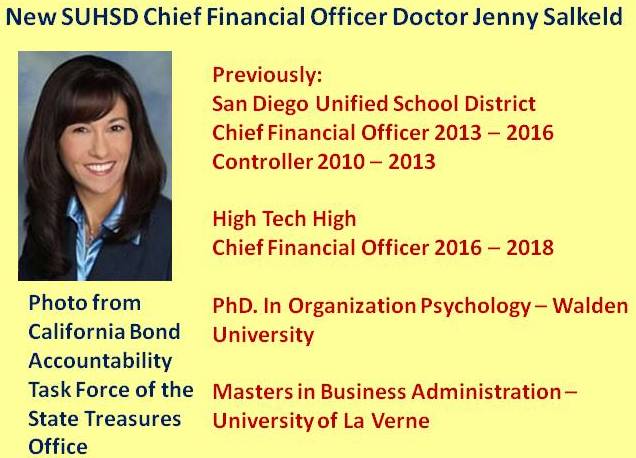
Jenny Salkeld was hired to replace Michel as CFO. In early September, Salkeld discovered a $20 million negative discrepancy in the budget and reported it to the Sweetwater leadership team which forwarded her report to the COE.

The County immediately disapproved of the SUHSD budget and brought in the Fiscal Crisis Management Assist Team (FCMAT) to investigate Sweetwater’s finances.

The FCMAT Audit

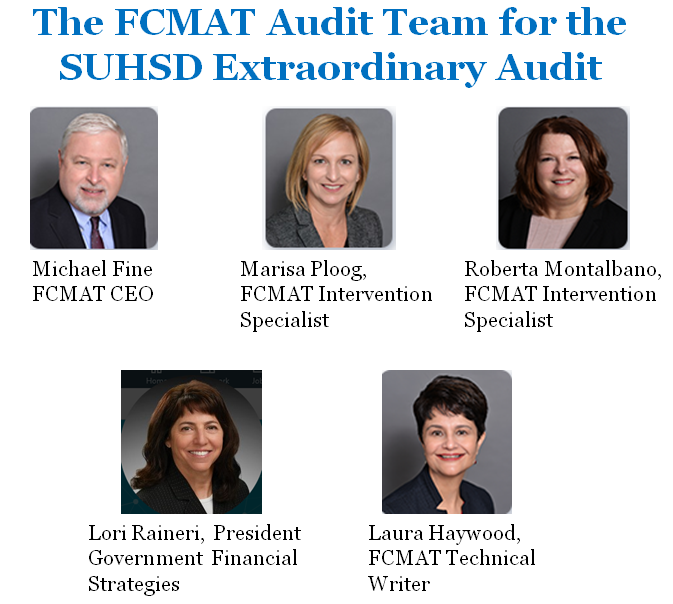
Audit Team

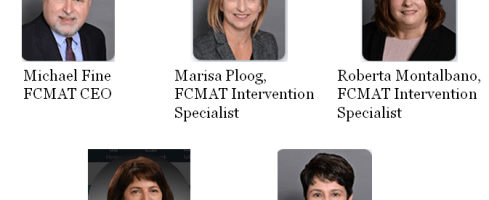
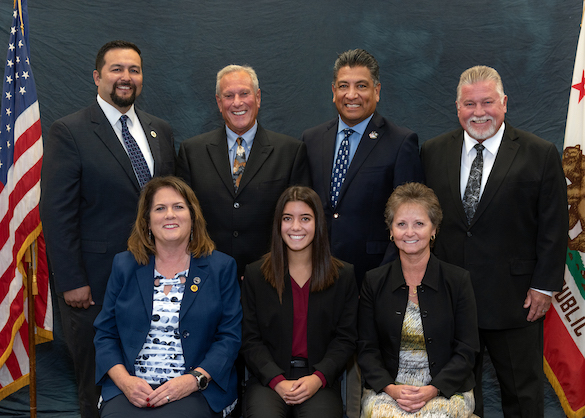
CEO Michael Fine and the Four Women Who Performed the SUHSD Extraordinary Audit

FCMAT was created and signed into law in 1991 by Governor Pete Wilson. The Kern County Superintendent of Schools office was selected as the administrative and fiscal agent for FCMAT. It is not a government entity but does receive financial support from the state.

FCMAT is organized as a non-profit. The purpose of FCMAT was to provide districts experiencing budget issues with professional leadership. However, they have developed a reputation for being more about helping political allies than struggling school districts.

The County’s official rejection of the 2018-19 budget was a trigger bringing in FCMAT to conduct a Fiscal Health Risk Analysis. On December 17th, 2018, the Analysis results were presented to Sweetwater’s board by FCMAT CEO Michael Fine. The Voice of San Diego reported,

“FCMAT’s chief executive officer Michael Fine told board members that 302 entries in the district’s accounting system were doctored to create the impression the district had more money than it really did. ‘That my friends and colleagues, is a cover-up,’ …”

Although Michael Fine’s charge of “cover-up” appears mistaken according to the new audit, it does point to a central problem that led to a bad budget. The audit revised the 302 “negative budget entry” count to 220 and explained the origin of these often inadequately documented inputs.

The auditors reported that SUHSD began the budgeting process by rolling the 2017-18 budget into the beginning template for the 2018-19 budget. This was not viewed as unusual, but projections concerning changing budget demands then needed to be inserted into the budget model and that was not satisfactorily done.

FCMAT states, “Interviews with staff … indicate that the district was not utilizing data from a position control system to project salaries and benefit obligations.”

Apparently the suspicious entries were the budget being updated based on actual costs when they arrived. These entries were suspicious because they were not documented in accordance with the California School Accounting Manuel.

I worked in SUHSD from 2002 – 2017 and these findings seem to confirm my own impression of unprofessionalism in the district office. It didn’t appear corrupt but there was little concern with meeting deadlines, crossing t’s and dotting i’s.

In the audit, FCMAT questioned delays in posting payroll transactions. They wondered if these delays were purposeful for hiding the understatement of salaries and benefits in the budget. They concluded it was not, but does give more evidence of the lack of professionalism in the financial department.

In the report, FCMAT says Superintendent Karen Janney, CFO Karen Michel, Director of Financial Services Douglas Martens and Financial Consultant Adam Bauer may be guilty of financial fraud over the February 2018 bond deal. However, much of the damning evidence comes down to the fact that they followed Bauer’s advice about the best path to guarantee a good bond rating.

Laws and methods had changed since the last time Sweetwater did a bond deal. It is difficult to understand why SUHSD not following previous processes with fidelity was considered suspicious.

FCMAT also claims Sweetwater officials should have known that the drop in ending revenue between 2016 and 2017 from $36,285,098 to $21,469,748 indicated deteriorating financial conditions. This was also part of FCMAT’s evidence for Sweetwater knowingly misleading the bond markets about the district’s financial health.

The “extraordinary audit” was triggered by FCMAT’s declaration in December 2018 of possible fraud and cover up. By agreement with the county the audit was quite limited and focused almost exclusively on the 2017-18 budget year and SUHSD internal budgeting processes.

By comparison, a forensic audit of SUHSD is estimated to cost as much as $2,000,000; the county cost for this “extraordinary audit” was estimated at $50,700.

The auditors did not look at data from previous years.

Going Forward

The audit was delivered Monday, 6/23/2020. The document reminds the district’s board, “Within 15 days of receipt of the report, the governing board is required to notify the county superintendent of its proposed actions regarding the county superintendent’s recommendations.”

Board member Paula Hall indicated this would not be a problem since they have already instituted many of the FCMAT suggestions. She also expressed how pleased she was with CFO Jenny Salkeld’s professionalism. Hall believes the district now has strong leadership in finance.

Governor Gavin Newsom signed the state budget on Monday, June 29th. Now Salkeld’s team needs to finish the 2020-21 budget and present it to the board.

Wednesday the 25th, the Sweetwater board met in a virtual executive session and put Karen Janney on paid administrative leave by a vote of 4-1. A board member said that in the uncertain legal climate they felt this move was needed to protect both the district and Janney.

The board also voted to lay off 223 employees and selected Dr. Moises Aguirre to serve as acting Superintendent.

Aguirre must now pick up the ball and continue the planning for opening school on August 3rd.

Dr. Aguirre faces the challenge of how to safely open schools in the Sars-CoV-2 era if that is even possible. If not, he and the Sweetwater team must find a way to make distance learning work for all 36,000 students.

My best guess is that there was no intentional fraud or purposeful financial misleading in SUHSD. It looks like there was a significant budget creation error that collided with state created structural deficits. I do not expect any prosecutions.

If meaningful changes are not made to California school financing, there are going to be many more districts running into these same structural deficits with no good solutions.

The Vicious Attack on Sweetwater Union High School District

14 Mar

By Thomas Ultican 3/14/2020

Chula Vista, California

Superintendent Karen Janney and the school board at Sweetwater Union High School District (SUHSD) have a target on their backs. In September 2018, new Chief Financial Officer, Jenny Salkeld, announced there was a $20 million dollar hole in the submitted 2018-2019 school year budget. Salkeld had discovered a long smoldering budget irregularity. Janney immediately reported the budget issue to the County Office of Education and informed the bargaining units with whom she was negotiating about the new uncertainties. Since then, journalists looking for readers and politicians looking for opportunities have robustly slimed the district and its leaders.

A Quadruple Whammy

Besides the mystery of going from a reported $17 million positive budget to an actual $10 million deficit, Janney and the board of trustees had to deal with the states increased pension payment requirements, a hike in special education costs and shrinking enrollment.

In the 2013-2014 school year, the state required school districts to pay 8% of teachers’ salaries to the California Teachers Retirement System (CalSTRS). In the just submitted Second Interim budget report, Salkeld revealed that the rate is now 17.1% and will increase to 18.4% in the 2020-2021 school year. In other words, the retirement costs have more than doubled.

This school year, spending on special education has zoomed to $62.5 million and is projected to reach almost $70 million in two years.

In addition, SUHSD is experiencing shrinking enrollment. Between 2014 and today the average daily attendance in the district has dropped from 38,302 to 36,023. That accounts for another $20 million in lost revenue. The drop is almost entirely fueled by the expanding charter school sector. In the 2018-2019 school year, 15% of 7th grade through 12th grade students in the Sweetwater service area were in charter schools; a total of 6,281 students. (Number of students derived by cross referencing county charter school data with state attendance records.)

With all of the turmoil, the fact that SUHSD has 13 high schools and 11 middle schools in excellent facilities with professional leadership and highly skilled educators is often overlooked. According to the state, 23% of the district’s students are English language learners and 60% are socioeconomically disadvantaged. What might surprise outsiders is that the professional educators in Sweetwater love their jobs, their students and their schools. They take great pride in the quality of education being provided and are not disturbed in the least by the learning challenges associated with these kinds of student demographics.

However the current situation has presented an opportunity for demagoguery. Chula Vista Elementary has for several years gotten around the law limiting them to grades K-6 by starting dependent charter schools. They now have five dependent charter schools educating 2,108 students who would otherwise be in SUHSD schools. A recent article in the San Diego Union reports “Chula Vista district leaders say they want to give parents more options for middle school as soon as this July.” They want to steal more students.

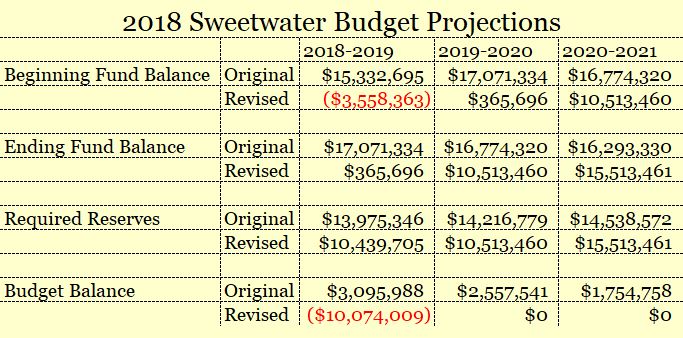
Sweetwater 2018 Budgets Compared

Comparing the June 2018 Budget with the Revised October 2018 Budget

Is it Time to Replace Karen Janney?

In April of 2014, four of the five Sweetwater board members (Jim Cartmill, Bertha Lopez, Pearl Quinones and Arlie Ricasa) plus Superintendent Jesus Gandara pled guilty to corruption charges and resigned. This is when the current SUHSD board of Trustees was originally elected. On June 8, 2015 the board selected Karen Janney to be the new permanent Superintendent of the district.

Janney was born and raised in the district. She began teaching in SUHSD in 1978 and soon became an administrator. When Jesus Gandara was appointed Superintendent in 2006, Janney was serving as Assistant Superintendent of schools. By 2009, she had completed her doctorate in Education Leadership and Administration at San Diego State University (SDSU) and had been forced out of the SUHSD by Superintendent Gandara.

Janney had many friends in the district who were excited by her selection as the new superintendent. I was working at Mar Vista High School at the time and vividly recall how two staff members that were taking her education leadership course at SDSU were absolutely thrilled. I was OK with her selection but had some unfounded reservations that I kept to myself.

I soon became troubled by three different Janney agendas. I was bothered when she found funding to buy tee-shirts for all staff. The shirts had “Sweetwater Union High School District Putting Students First” emblazoned across the front. Though not mandated, there was pressure applied to wear these corporate styled promotional tee-shirts on certain days. It reminded me of the corporate approach to leadership employed by large charter school chains.

IMG_20200312_125802

Corporate Type of Promotion Foisted on SUHSD Teachers

A second and more troubling policy change came a few months into her tenure. Janney announced that Sweetwater was joining the Core Districts. Originally conceived as an organization for leaders in urban school districts to share strategies, CORE gained notoriety when its eight districts led by John Deasy of Los Angeles Unified made a legally questionable side deal with US Secretary of Education Arne Duncan. They agreed to evaluate teachers using testing data for a chance at Race to the Top grants. Today, CORE is offering to conduct school evaluations for California districts using the residual-gain growth model as an alternative to the California Department of Education evaluation method.

Worse – in 2017, Janney scrapped the district’s expensive I-pad program and replaced it with another Ed Tech industry scheme for putting students at glowing screens. She purchased laptop computers for all students and staff. She had succumbed to the allure of education technology and its associated bad pedagogy. Janney also signed the Future Ready pledge making SUHSD a target for education technology salesmen.

Since the budget crisis began, it has become apparent that Janney is incapable of creating a good working relationship with the County Office of Education (COE). It may not be all her fault. She has been careful to legally comply with the COE but has not developed any visible cooperative relationships.

Superintendents are in charge. School boards only approve or disapprove of the agenda set before them by the Superintendent. From the beginning of her administration, board members, union leaders and community members recommended that she replace the financial department’s leadership. Janney refused and turned away calls in 2015 for a forensic audit of the district’s finances. She was not willing to accept the almost $2 million dollar price tag. These two decisions are central to the financial situation the district is in today. Many people were predicting financial issues would eventually be revealed.

When the crisis first manifested in September 2018, trustees and others encouraged Janney to utilize existing expertise within the district to run a messaging campaign making sure the district’s side of the story was being told. Janney chose instead to leave existing communications director, Manny Rubio, as the sole district spokesperson. During the first two months, there was no public response to the crisis by SUHSD. Rubio was content to wait and react to media questioning.

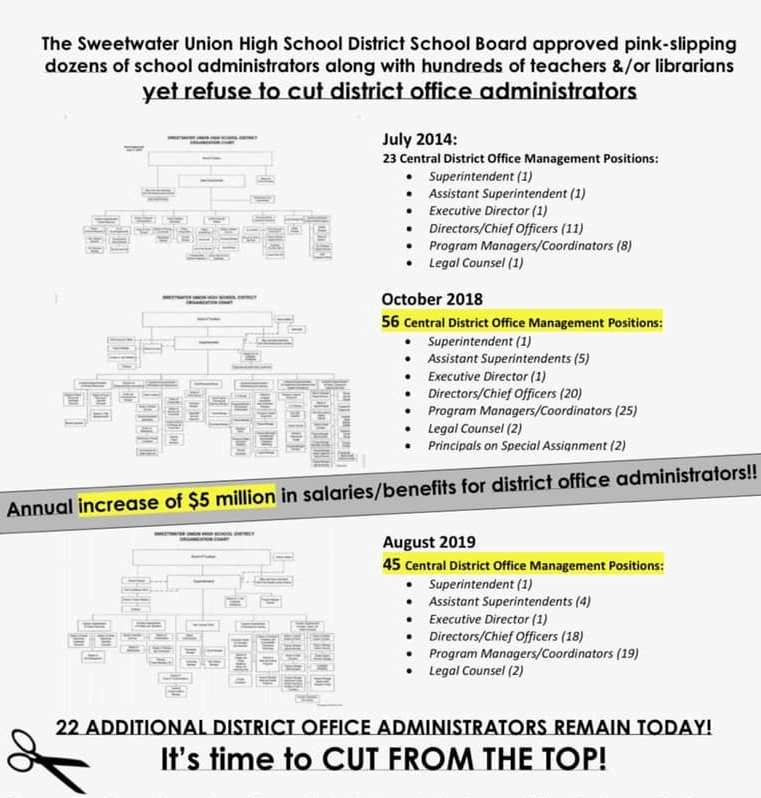
As the hidden $20 million dollar problem and growing structural issues created an urgent need for budget cuts, Janney made another critical error. Under her leadership the district’s central office staff has doubled. This is where cuts should be expected but Janney has rejected most cuts to her staff. To successfully solve the crisis she needs the cooperation of the Sweetwater Education Association (SEA – the teacher union), however, cutting teachers before district staff is undermining collaboration.

Union Chart of Sweetwater Staffing

An SEA Flyer for the March 10 School Board Meeting

FCMAT is a QUANGO and that’s Not Good

The Financial Crisis Management Assist Team (FCMAT) was summoned to Sweetwater to look at the budget. After a three day deep dive into SUHSD finances, FCMAT CEO Michael Fine delivered a report and some damning words. He said that 302 entries that made the district finances look better were not well documented. He concluded, “That my friends and colleagues, is a cover-up.” He also suggested the district was in danger of a state takeover.

FCMAT was created and signed into law in 1991 by Governor Pete Wilson. The Kern County Superintendent of Schools office was selected as the administrative and fiscal agent for FCMAT.  It is a QUANGO which Roland Watson describes as “a Quasi-Autonomous Non-Governmental Organization.” It is a neo-liberal construct common in the UK. Those of short duration are sometime called task forces; they are set up to look at an issue, report their recommendations and then disband. The purpose of FCMAT was to provide districts experiencing budget issues with professional leadership. However, they have developed a reputation for being more about helping political allies than struggling school districts.

It is eerie how closely the issue in SUHSD echoes the 2003 events in Oakland, California. In 2000, the School Board appointed Dennis Chaconas Superintendent over the objection of Oakland Mayor Jerry Brown, who had pushed a city hall official for the superintendent’s post. In 2003, Education Next Reported, “New software, installed so that the school district could better understand its finances, had uncovered a $40 million deficit from the previous year.”

Chaconas wanted a waiver from the state to allow use of existing construction funds to temporarily pay off the deficit. Instead State Schools’ Superintendent Jack O’Connell and influential Democratic politicians like State Senator Don Perata and Mayor Jerry Brown were instrumental in putting together a deal requiring the district to accept a $100 million loan, even though it was only $37 million in debt. Through apparent complicity with FCMAT, a state takeover of the district came about which gave Broad trained administrator Randolph Ward complete control.

The problem with a QUANGO is they carry out the political agenda of whoever is in power. An article in the Black Agenda Report stated,

“FCMAT did “hit” jobs for anyone willing to pay. Brown paid Tom Henry to prevent Oakland from solving its fiscal problem. FCMAT lobbied the State Attorney General, Bill Lockyer, the former Democratic Assemblyman from Alameda, to rule that Oakland’s plan to borrow construction funds was a violation of state and local law.” (Tom Henry was FCMAT CEO)

FCMAT is still draining money from Oakland. Former Oakland School District Public Information Officer, Ken Epstein writes,

“State appropriation for FCMAT in 2018-19 was about $6.3 million, plus the fees school districts are required to pay for the “aid” provided by FCMAT staff. This past school year, the district paid FCMAT and the county $1.4 million to oversee OUSD.”

“… The district loan payments are $6 million a year until 2026. The $100 million loan was spent unilaterally by the state Receiver Ward with no input from the community.”

In December 2018, FCMAT CEO Michael Fine accused SUHSD of the felonious offense of covering up bad financial information with no evidence. At the same time his team moved in to perform a forensic audit of Sweetwater’s finances. To this date no evidence of criminal malfeasance has been presented and no forensic audit has been conferred.

That has not stopped Will Huntsberry and the Voice of San Diego from running banner headlines like “State Investigators Say There’s Evidence of a Financial ‘Cover-Up’ in Sweetwater” and linking to these allegations repeatedly throughout the last year.

Another Huntsberry headline claims, “Docs, Interviews Show Sweetwater Officials Ignored Budget Warnings.” This article which Huntsberry repeatedly linked in latter reports says one unnamed employee went to Director of Finance Doug Martens and CFO Karen Michel to raise concerns. Huntsberry says both of them told the employee not to worry about it. Martens and Michel resigned from Sweetwater after the June 2018 budget was submitted. If there were legal or ethical problems with financial reports, they are the main suspects. Technically, the report is not false but it is purposefully misleading and sensationalized.

A Final Observation

I lived through the three superintendents’ tenures of Brand twice and Gandara once. They were perverse and unethical. At the same time, many Trustees serving on the board appeared to represent the construction industry more than parents, students or taxpayers. The present board and superintendent might not be perfect, but I do not believe they are corrupt. That is important.

At this point in time, billionaires throughout America are openly hostile toward public education including US Secretary of Education, Betsy DeVos. Many politicians who take money from them would be happy to facilitate the state taking over our school districts. It is in the best interest of the entire Sweetwater family to close ranks and solve this crisis before outside forces take advantage.


Manufactured Education Crisis Engenders Violence

18 Dec

By Thomas Ultican 12/17/2019

On October 23, the regularly scheduled Oakland Unified School District (OUSD) board meeting descended into chaos accompanied by violent reaction from school police. One parent received a broken rib; two elementary school teachers reported severe bruising and a small mother suffered two torn ligaments and a meniscus tear. They were protesting the closing of Kaiser elementary school which is the result of a manufactured crisis beyond the control of the local school board. Billionaire “philanthropists” and the state of California created and exacerbated Oakland’s chronic budget issues.

Today’s budget problems stem back to the state assuming control of OUSD in 2003. Ken Epstein of Oakland Crossings described the situation when the state installed an administrator. “At the time, State Schools’ Supt. O’Connell [Democrat] and influential State Senator Don Perata [Democrat] were instrumental in putting together a deal requiring the district to accept a $100 million loan, even though it was only $37 million in debt.”

The Alameda County Office of Education and the Fiscal Crisis and Management Assistance Team (FCMAT), a state-funded nonprofit that advises districts on financial matters, both played a large role in pushing OUSD into receivership (2003-2009) and forcing the district to take a $100 million state loan. OUSD did not ask for the loan. They had enough money in construction funds to cover the shortfall if the state would approve borrowing from that fund. The state had given other districts this kind of permission but refused it to Oakland.

Kathy Murphy reported in the 2009 East Bay Times, “Six years after the largest state loan ever made to a California school district, the Oakland school district is emerging from state receivership $89 million in debt.” After six years of state administration, the budget deficit grew from $37 million to $89 million.

O’Connell Selects Eli Broad’s Trainee as Administrator

In 2002, the multi-billionaire Eli Broad (rhythms with toad) decided to establish his own training academy for school administrators. With no background in education or experience other than attending public school in Detroit, Broad was so rich he could just do it. He did not believe schools had an education problem; he believed they had a management problem. It was his theory that large urban school districts did not need education leadership – consultants can be hired for that – they needed business management leadership.

One of the key management ideas taught at the Broad Academy is “right-sizing.” It is probably in the Broad School Closure Handbook; Closing Schools as a Means for Addressing Budgetary Challenges that the first use of the terminology “right sizing” is applied to a school district. Now this Broad construct has slipped into common usage by Oakland’s political and administrative leaders.

Another key component undermining OUSD was the state’s Fiscal Crisis Management Assistance Team (FCMAT). In 1991, new California, Governor Pete Wilson, signed the team into law. FCMAT (pronounced “fick-mat”) is a state sponsored non-profit located in Kearn County. It is supposed to help school districts identify and solve fiscal problems. However, FCMAT has developed a reputation as a neoliberal organization that has a racial bias against schools in Black and Brown neighborhoods. An Oakland school leader admitted they felt FCMAT was biased against Oakland.

When OUSD discovered its budget shortfall in 2003, FCMAT started pushing for a state takeover and Oakland Mayor, Jerry Brown, seemed to welcome it. Majority reports that when OUSD proposed covering the shortfall with construction funds,

“Tom Henry, the CEO of California’s Fiscal Crisis and Management Team (FCMAT) opposed this plan, and Mayor Brown questioned it heavily. (During a state takeover, FCMAT would be responsible for monitoring the school district’s financial progress.) Phone records later obtained by the Oakland Tribune revealed over 40 phone calls on key dates between Brown, Henry, and Randolph Ward, who would end up in charge of OUSD when it was placed under state control, in the two months before the state takeover.”

A California central coast politician named Jack O’Connell was elected California’s Superintendent of Public Instruction in 2002. He selected Randolph Ward, a Broad Academy graduate, to be Oakland’s state administrator. When O’Connell ran for state superintendent, his largest campaign donors had been Netflix CEO Reed Hastings ($250,000), venture capitalist John Doerr ($205,000), and Eli Broad ($100,000). Brown described the state takeover as a “total win” for Oakland.

The Broadies of Oakland

2003-2017 Broad Academy Graduates and Superintendents of OUSD

Broad Academy graduates are often disparagingly called Broadies.

The OUSD information officer in 2003 was Ken Epstein. He recounts a little of what it was like when Ward became the administrator:

“I remember a school board meeting where Ward and the board were on stage. Each item on the agenda was read aloud, and Ward would say, “passed.” Then the next item was read. In less than an hour, the agenda was completed. At that point, Ward said, “Meeting adjourned” and walked out of the board room and turned out the lights, leaving board members sitting in the dark.”

When Ward arrived in Oakland, the district was in the midst of implementing the Bill Gates sponsored small school initiative which is still causing problems. The recently closed Roots that caused so much discontent in January was one of the Gates small schools. Ward opened 24 of them (250-500 students) which in practice meant taking an existing facility and dividing it into two to five schools. He closed fourteen regularly sized schools.

Upon Ward’s arrival in Oakland there were 15 charter schools and when he left for San Diego three years later there were 28 charter schools.

Epstein related a story from attending a district leader’s cabinet meeting when Ward asked a Broad trained accountant to get numbers on how much money would be saved by closing a school. Three weeks later the accountant said no savings and Ward responded, “Then go back and figure out another reason for closing schools.”

Kimberly Statham who was a classmate of Ward’s at the Broad Academy took his place in 2006. The following year a third Broad Graduate, Vincent Mathews took her place.

After a short period of no Broadie in the superintendent’s seat, Antwan Wilson was hired in 2014. Shortly after that, the New York Times reported that the Broad Foundation had granted the district $6 million for staff development and other programs over the last decade. The Broad Center also subsidized the salaries of at least 10 ex-business managers who moved into administrative jobs at the district office.

Kyla Johnson-Trammell, an Oakland resident and educator with OUSD, was named to replace Antwan Wilson in 2017. When he exited to lead Washington DC’s schools, Wilson left a mess in Oakland. Mother Jones magazine said Wilson saddled the district with a $30 million deficit. The article continued, “A state financial risk report from August 2017 concluded that Oakland Unified, under Wilson, had ‘lost control of its spending, allowing school sites and departments to ignore and override board policies by spending beyond their budgets.”’

The preponderance of the problems in OUSD are related to the state takeover, FCMAT and the leadership provided by Broad Academy graduates.

School Board Under Attack from All Sides

A March Oakland Post article says,

“A new report from the Fiscal Crisis Management and Assistance Team (FCMAT) indicates that the State of California, represented by FCMAT and the Alameda County Superintendent of Education, is requiring the school district to make budget cuts of jobs and programs totaling about $30 million this year, regardless of any costs generated by increased salaries for teachers and other school employees.”

The Alameda Civil Grand Jury says the district has run a debt of $20 to $30 million for the past fifteen years. It states, “School occupancy must be assessed and painful decisions made regarding closure and consolidation as soon as possible.”

In 2018, the Alameda County Office of Education rejected OUSD’s three-year budget plan saying it did not adequately address needed budget reductions; prompting school activist Ahsan Nilofer to ask, “What will FCMAT and the County Office consider to be an adequate plan?”

Another drag on the district’s finances is this past school year; the district had to pay FCMAT and the county $1.4 million for their services.

At the same time the coalition “Oakland Not for Sale” demands:

  1. “Stop School Closures”
  2. “End the School to Prison Pipeline”
  3. “Stop the charter school takeover”
  4. “Let the people see the money”

This is the organization that led the demonstration at the board meeting in October that ended in violence and chaos.

Mike Hutchinson of the Oakland Public Education Network says that OUSD ended the 2018-2019 school year with a $21 million surplus not a deficit. He also has announced that he will be running for the district-5 board seat in 2020.

A board member explained that $4 million of that claimed surplus comes from the board purposely underestimating title 1 and title 4 money from the Department of Education because they did not trust the actions of the Trump administration. The rest of the money is thought to be in restricted funds that can only be spent of designated categories.

The board was forced to adopt the 2019-2020 budget without good numbers to rely upon. An EdSource article relates that “Board member Shanthi Gonzales said staff didn’t give the board enough details about department budgets, school budgets or even how many employees the district has, what they do and how much they earn.” However, the district’s state trustee said district operations would come to “a screeching halt” if the board didn’t meet its June 30 budget approval deadline.

In addition to all of these problems, billionaires and their school privatization organizations are attempting to purchase the school board. In Oakland the on the ground political organization leading the privatization agenda is GO Public Schools.

Go Political Spending Chart

Funding to GO Public School Independent Expenditures Effort

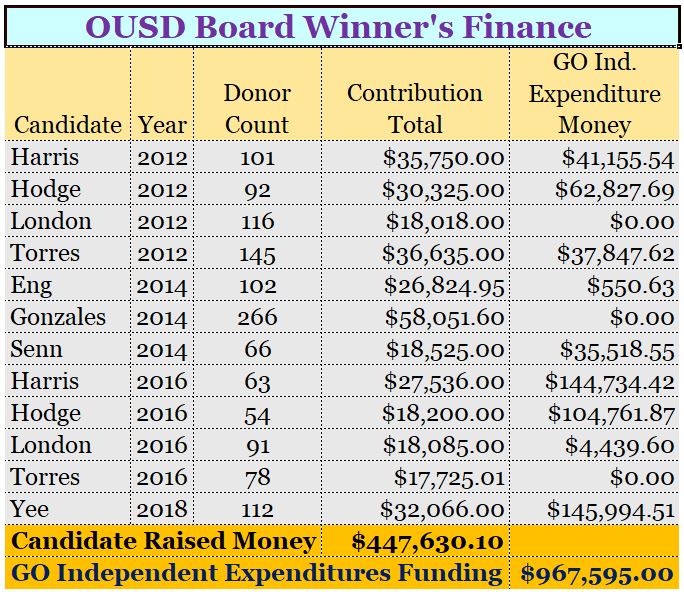
School Board Winners Finance Chart

Winning OUSD Board Member Campaign Support

In the 2018 election, Gary Yee was the recipient of almost $146,000 in independent expenditure support from mostly billionaires working to privatize public schools in Oakland. His victory makes him the third member of the seven seat board to owe their election to GO Public Schools.

FCMAT from the state of California, the Alameda County Office of Education and the Alameda County Grand Jury are all ordering the OUSD school board to make budget cuts and close schools. At the same time residents of the city don’t want to hear about schools being closed and with reason do not believe the state and county budget analysis. Unfortunately, the only place they can express their outrage is at the local school board. However, there are some really good people on this board who are being put through a ringer by forces beyond their control. No matter what they do, it is loudly criticized and they are personally demonized as selling out the city.

The fundamental problem is Oakland has a dual education system with 37,000 students in public schools and 15,000 in charter schools. It costs more to operate two systems. Every school district in California that has more than 10% of their students in charter schools has severe financial problems. Oakland has the largest percentage of charter school students in the state with 29% so financial issues should be the expectation.

This is an education crisis that was manufactured by the super wealthy and implemented by neoliberal politicians.

Twitter: @tultican

Sweetwater Schools Financial Problems Became Political Cudgel

9 Jan

By Thomas Ultican 1/19/2019

The newly hired Chief Financial Officer of Sweetwater Union High School District (SUHSD), Jenny Salkeld, discovered a significant problem with the budget she inherited. She presented her findings to the Sweetwater leadership team in early September which forwarded her report onto the County Office of Education (COE). The SUHSD board also called in all bargaining units to suspend contract negotiations and inform them of the budgetary uncertainties. Sensationalism and subterfuge became the new reality in Chula Vista, California.

An October San Diego Union article reported,

“On June 25, the school board approved a budget for this school year that assumed the district had spent $328 million in unrestricted funding last school year and had $17 million in reserves going into this school year. In September, Salkeld presented a report showing that the district actually had spent $20 million more than that and started this school year with a negative reserve balance of $4 million.

“On top of spending more than previously estimated, the district received $6 million less in one-time state funding than it had expected.”

salkeld brief bio

After receiving Sweetwater’s alert about the accounting errors, the COE officially disapproved the 2018-19 budget the district had submitted. The reasons for disapproving the budget were the reasons Salkeld had reported. The county’s September 18 letter stated,

“The disapproval of the adopted budget is based on an assessment and analysis of the following major components of the district’s budget.

  • Preliminary 2017-18 negative unrestricted General Fund ending balance
  • Projected 2018-19 revenues overstated
  • Projected 2018-19 expenditures understated
  • Structural deficit in current and upcoming fiscal years
  • Cash concerns”

Apparently someone at the county leaked the budget information to the Voice of San Diego. The district which was in the process of understanding the extent of the problem did not have that opportunity. Instead they were faced with a withering public attack in both the San Diego Union and The Voice of San Diego. The headlines implied that a group of incompetent people at SUHSD were incapable of managing their affairs and were involved in possible fraud.

In the more than twenty reports in these two publications from September through December, it was obscured that it was the Sweetwater District which found the problem and informed the county. It was also never pointed out that budget analysts at the COE failed in their oversight responsibilities.

In November, the county approved Sweetwater’s revised budget.

Budget Shortfalls Throughout the State

Kristen Taketa reporting for the San Diego Union noted,

At least 10 districts in the county are projecting that they will not be able to meet their financial commitments next school year, including Chula Vista Elementary, Jamul-Dulzura Union, Mountain Empire Unified, Oceanside Unified, San Diego Unified, San Marcos Unified, San Ysidro, Sweetwater and Vista Unified. More districts won’t be able to meet their financial commitments after next year.

Teketa provided three reasons for what is a statewide public school funding problem:

  1. Rising pension costs: To address looming pension debt, the state in 2014 started increasing school districts’ share of pension costs. In 2013-14, school districts paid 8 percent of their teachers’ salaries to the state’s teacher pension fund. This year, they had to pay 16 percent.
  2. Rising special education costs
  3. Declining enrollment: Oceanside officials estimate that they can only compensate for 40 percent of revenue lost when they lose students. The student enrollment losses are attributed mostly to charter schools. California, unlike some states, does not financially mitigate the burden caused by charter schools on public school districts. The only option districts have is to reduce services to the remaining students.

Last May, In the Public Interest published a paper by University of Oregon’s Professor Gordon Lafer called “Breaking Point: The Cost of Charter Schools for Public School Districts.” He looked specifically at the impact of charter schools on San Diego Unified School District. Lafer found that the annual impact of student losses was $65,902,809 and that the cost per charter school student was $4,913.

By taking the 5500 students in charter schools instead of Sweetwater schools and multiplying that number by a conservative estimate of $4,000 in cost per student the total is $22,000,000 in stranded costs for the district; more than the budget error Salkeld discovered.

enrollment graphs

Charter Student Growth Compared with District Enrollment

What Caused the Budget Error?

Gene Chavira, President of the Sweetwater Education Association (affiliate of the California Teachers Association) said he believes this budget problem has roots that stretch back to the early 2000’s when Ed Brand was serving his first term as Superintendent. Chavira referenced some strange land sales from that period. Later, during Brand’s second stint as Superintendent, he and SUHSD CFO Diana Russo established two charter schools; another move Gene found suspicious.

The two charter schools were elementary schools belonging to SUHSD. The neighboring elementary school districts were unhappy and reacted by expanding their own charter schools to include the grades 7 – 12 that were serviced by Sweetwater.

After Brand came Jesus Gandara. In 2006, two Sweetwater board members, Jim Cartmill and Arlie Ricasa, flew to Texas and personally interviewed Gandara before he was hired as the Superintendent of Sweetwater schools. It appears that the board members and their search firm ignored some obvious warning signs when they made the hire. In 2011, the board voted to fire Gandara for abuse and brought back Ed Brand to lead the district. Another odd decision, since he had just been forced out as Superintendent of San Marcos Unified under accusations of nepotism.

In April of 2014, four of the five Sweetwater board members (Jim Cartmill, Bertha Lopez, Pearl Quinones and Arlie Ricasa) plus Superintendent Jesus Gandara pled guilty to corruption charges and resigned.

In 2015, five new board members and a new superintendent took leadership of SUHSD. Chavira recalled vividly that he and many others called on the new board to conduct a forensic audit, but the board – though for it in principal – rejected spending the more than $1,000,000 required. Chavira feels that was one of two big mistakes made. The second was that they did not replace the existing finance team.

board group photo 2018

2018 SUHSD Board – Standing from the left: Arturo Solis, Frank Tarantino, Nicholas Segura, Kevin Pike. Seated from the Left: Paula Hall, Student Member Brenna Pangelinan, Superintendent Karen Janney. Photo from District

Throughout the lead up to this current budget problem, the new board has been extremely popular. In the 2018 election, Hall, Solis and Tarantino ran for reelection unopposed. Professor Karen Janney was a student, a teacher and an administrator in SUHSD. She was forced out of the district by then Superintendent Gandara. After which, she taught education leadership at San Diego State University.

This group has accumulated some amazing talent and support. The 2016 audit committee added two new members, Maricela Garcia-Centeno and Bill Kowba making this a power house committee. Existing committee member, Trustee Paula Hall, works as a financial analyst in San Diego Unified School District (SDUSD). Garcia-Centeno is a Certified Internal Auditor and Certified Fraud Examiner. Bill Kowba is a retired Rear Admiral who served both as Chief Financial Officer and Superintendent of SDUSD.

The audit committee’s 2016 report showed concerns regarding transparency and the need for more light shined on budget internals. They stated, “We are recommending the District direct the audit team so that work is not disproportionally focused on well regulated programs but performs a ‘deeper dive’ into areas that have potential of higher risk.

In 2017, the audit committee was recommendingdeeper testing for certain elements of the 2016-17 audit along with a recommendation for a special audit focusing on accounts payable, purchasing and contracts including ….” The implicit message was that the committee was not happy with the answers they were getting or perhaps not getting.

CFO Karen Michel and three members of her small team retired upon completion of the 2018-19 Sweetwater budget. All indications were that these were planned retirements.

After Salkeld’s report showing a $20,000,000 budget error, the county called in the state’s Fiscal Crisis and Management Assist Team (FCMAT). On December 17th the FCMAT study was presented to the Sweetwater board. The Voice of San Diego reported,

“FCMAT’s chief executive officer Michael Fine told board members that 302 entries in the district’s accounting system were doctored to create the impression the district had more money than it really did. ‘That my friends and colleagues, is a cover-up,’ he said, …”

This is a puzzling statement. In the report Fine says, “While the district prepares budget revisions throughout the fiscal year, detailed information provided by the district shows that budget revisions totaling millions of dollars include negative budget entries that lack sufficient supporting documentation.”  His study comes to several conclusions tending against Sweetwater that lack strong evidentiary basis and it has no details about what he later labeled “a cover-up.” Now, Fine will be conducting a fraud audit. If he does not find fraud, won’t he be open to a libel charge? Can his audit be trusted?

A December 21st Voice of San Diego headline states, “County Ed Office Takes Control of Sweetwater’s Board.” The county had issued a “stay and rescind” order which gives them veto power over some decisions made by the SUHSD board. This begs the question, why did the county which dropped the ball here jump so quickly into this drastic step when the district team which found the problem has been addressing it aggressively?

The SUHSD web-site has a response to the issues raised. The opening paragraph says,

“Over the past few months the Sweetwater Union High School District has faced significant challenges with respect to our organizational budget. … We realize that these issues may seem insurmountable at times, but we want to assure you that despite some of the doubts being cast in the public, we are moving forward with a stabilization plan that will ensure positive financial health.”

There is also a letter from Superintendent Janney about the “stay and rescind” order. She cites remarks by Dr. Mark Skvarna, a financial advisor from the county, about the limitations on the order. Janney writes, “This authority is specific to the actions that are ‘inconsistent with the district’s ability to meet its financial obligations.’”

The San Diego Union and the Voice of San Diego are Biased Against Public Education

Editorials in the San Diego Union continually attack teachers and their unions. An editorial leading up to the 2018 general election called for a former banker and charter school chief as Secretary of Public Instruction (SPI). Following a familiar destroy public education (DPE) script; another editorial created a false crisis as the predicate for an urgent plea to elect charter school executive, Marshall Tuck, over California State Assemblyman, Tony Thurmond.

In 2005, Buzz Woolley founded Voice of San Diego. It was the first digital nonprofit news organization to serve a local community in the country. Besides his interest in using new technologies for media, Woolley also is enthusiastic about education technology in the classroom. In 2013 Woolley’s Girard Foundation sent over $500,000 to companies developing software for “personalized” education and competency-based education.

The year before starting the Voice of San San Diego, Woolley and Gap Founder Don Fisher established the Charter School Growth Fund. John Walton (Walmart heir) and Greg Penner (Walmart heir) joined the board. In 2016, that fund had assets of $217,176,094 with a yearly income of $95,184,785.

A local media watch dog report tells the story of an education reporter losing her job while perusing a store about the COE. Blogger Maura Larkins wrote,

“Voice of San Diego dropped its coverage of SDCOE attorney shenanigans, and laid-off its stellar education reporter Emily Alpert.”

“Voice of San Diego benefactors Buzz Woolley and Irwin Jacobs [founded Qualcomm], who claim to care about education, could have easily paid Emily’s salary with their pocket change if they’d wanted her to stay.”

“It seems Buzz Woolley, Irwin Jacobs and Emily Alpert weren’t on the same page.”

Some Concluding Words

Superintendent Janney may have been wrong to retain the inherited financial team; however, in 2015 she had a lot on her plate. A Trustee said that Janney began by focusing on education leadership in the district. There was a widely shared belief that several administrators were in positions by dint of cronyism and that many of them were incompetent. When she was alerted to the budget issue, Janney reacted professionally. She immediately informed stakeholders and the COE.

The budget error appears to have originated within the financial department. FCMAT Director Fine claimed it was a “cover-up.” Maybe he is right but he did not present much convincing evidence; only reporting that some entries that subtracted from the deficit were not sufficiently documented. It is hard to see the motive for financial professionals engaging in this “cover-up,” but people sometimes make strange decisions.

Two mainstream media outlets in San Diego that have regularly promoted privatizing public education and “corporate education reform” have been ruthlessly attacking SUHSD. They have indicated that the leaders in Chula Vista are incompetent and corrupt. The obvious dog-whistle here is that there are too many non-whites in SUHSD leadership.

The truth is that the SUHSD team is highly competent and has delivered a refreshing era of ethics and openness to the South-bay. Karen Janney is an educator with deep knowledge and experience, plus she is a gifted leader and public speaker. The present financial team led by Jenny Salkald is much more impressive than the county or state teams who have been nothing short of unprofessional.

The real investigation should be into whom or what is motivating this unjust attack on SUHSD? Also, why are we paying all those bloated salaries at the San Diego County Office of Education and for what?

Twitter: @tultican