Tag Archives: E.D. Hirsch Jr.

Behaviorism as Cognitive Science

10 Aug

By Thomas Ultican 8/10/2025

Greg Toppo writes for ‘The 74’ which suggests he is a professional propagandist working for billionaires. In his July 24th article, “‘Cognitive Science,’ All the Rage in British Schools, Fails to Register in U.S”, he did not even attempt to be objective as he lionized a form of ‘Cognitive Science’ that is a euphemism for behaviorism. It is a corrupt approach that philosophically undermines a field of research exploring undeniably important ideas.

There are many definitions of cognitive science; this one is from Yale University:

“Cognitive science is an interdisciplinary field devoted to exploring the nature of cognitive processes such as perception, reasoning, memory, attention, language, imagery, motor control, and problem-solving. The goal of cognitive science is to understand (1) the representations and processes in our minds that underwrite these capacities, (2) how they are acquired, and how they develop, and (3) how they are implemented in underlying hardware (biological or otherwise). Stated more simply, the goal of cognitive science is to understand how the mind works!”

A cognitive science subset, Cognitive load theory, was developed in mid-1980s by Australian education psychologist John Sweller. His theory pays attention to human cognitive architecture: characteristics and relations between long-term memory and short term memory, and how load on memory affects learning.

The basic premise of cognitive load theory is that short term memory or working memory is limited and can be overloaded. Therefore, Sweller postulates that explicit instruction is superior to discovery approaches for teaching new content and skills. He claims that to think critically we need to know a lot of stuff; therefore critical thinking can only be actualized through copious amounts of content knowledge. He and colleagues say it is not possible to teach critical thinking because it is not a transferable skill.

Selling Cognitive Load Theory

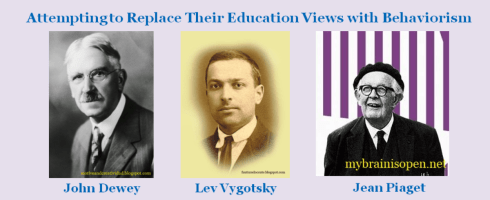
Toppo began his article by introducing his readers to Zack Groshell, a former Seattle-area fourth-grade teacher. His 2024 book, Just Tell Them, is a guide for delivering explicit instruction and adhering to the Cognitive Load Theory (CLT) premise of learning. Dewey, Vygotsky and Piaget would surely be saddened by this 21st century misunderstanding of student development.

The article also introduces Benjamin Riley, founder of Deans for Impact, a Texas-based group that has pushed to make cognitive science more central to U.S. teacher training programs. I find it instructive that his organization is financially supported by Besos, Gates, Dell, Schusterman, Zuckerberg and other billionaires.

Toppo cites the influence of E. D. Hirsch who wrote in his book, The Schools We Need, “Higher-level skills critically depend upon the automatic mastery of repeated lower-level activities.” He further called for tougher standards which prompted education writer, Alfie Kohn to note that Hirsch’s approach “reflects a particular model of learning—behaviorism.”

As Kohn stated, in the debate between behaviorism and constuctivism”, Hirch comes down squarely on the side of behaviorism. Kohn went on to observe that, “E. D. Hirsch’s Dictionary of Cultural Literacy, might be called the ‘bunch o’ facts’ approach to education.” (Page 11)

Like other behaviorists, E. D. Hirsch is calling for education material to be atomized and drilled.

Most of Toppo’s article is concentrated on education in the United Kingdom which might explain why he brought up the very unpopular education leader under former Prime Minister David Cameron, Michael Gove. Gove attempted to reform English education through privatization and testing. Gove’s associate Nick Gibbs said he first encountered Hirsch’s book in 2006 and that it formed the basis for all of their education reforms.

In 2013, more than 150 leading educator wrote and signed a piece for the Times of London calling Gove’s reforms dangerous. They stated in part:

“Sir, We, the undersigned academics and children’s authors, are gravely concerned at the impact that current developments in state education in England are likely to have on our children and their futures.”

“These damaging developments must stop. If they go ahead there will be devastating consequences for children’s mental health, for future opportunities and, most importantly, for the quality of childhood itself.”

At about the same time, England’s national teachers union held a unanimous vote of no confidence in Gove. General Secretary of the teachers union, Christine Blower, said teachers were not the “enemies of promise” that Gove said they were. “We just have the temerity to assert that the secretary of state is wrong.”

Meaningless Data Quoted

Besides citing people like Gove and Hirsch to sell this new behaviorist approach to education, Toppo writes, “From 2011 to 2021, English students’ average scores in the PIRLS International Benchmarks of Reading Achievement, a key global comparison, rose six points, placing them fourth worldwide, while U.S. students’ dropped eight points, ranking the U.S. just below England.”

This was weak sauce.
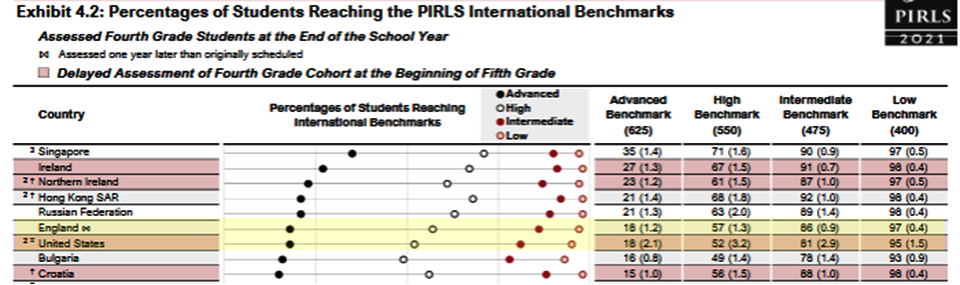
Top 8 scoring Nations in the 2021 PIRLS

For several years, education in England has been trying to get rid of the Gove stench, and they appear to be on track. The six point gain in a decade on a more than 500 point scale is not much to brag about. In 2011, the US score was 556 England’s was 552 in 2021 the US score was 548 England’s was 556. Even if I believed in standardized testing, which I don’t, I still do not see any real difference. Remember, we were just starting to come out of the COVID nightmare in 2021.

In 2022, the Programme for International Student Assessment (PISA), did its every three year assessment of 15 year olds one year late because of COVID. Of the 80 countries compared, the USA’s reading score of 504 was number 9 and the UK’s score of 494 was number 13. There is not a lot to brag about here either.

The testing data Toppo cites does not prove or even suggest that this new behaviorism is any kind of silver bullet.

Researchers and Educators Have Concerns

The lead sentence in the latest issue of UK’s Schools Week states, “Teachers need to be sceptical about applying popular but “untested” cognitive science theories to education, a panel of experts has warned.”

Noam Chomsky is the scientist-philosopher who more than any other contributor seriously undermined B.F. Skinner’s theories of behaviorism. A 2006 interview with Chomsky states, Chomsky’s (1959) review of Verbal Behavior (Skinner, 1957) has been hailed as the most influential document in the history of psychology.”

Importantly, behaviorism undermines the important works of William James and John Dewey. Chomsky’s 1959 review of Skinner’s book went a long way toward reviving Dewey’s theories and shutting down behaviorist ideology.

In 2022, Australian researcher Peter Ellerton published, On critical thinking and content knowledge: a critique of the assumptions of cognitive load theory [CLT].”  After presenting evidence from several papers, Ellerton asserts:

“The absolute claim of CLT that “critical thinking is unteachable” is clearly refuted by these studies. As is the claim that it is not transferable. The softer claim that it is best done through a context of engagement with deep content knowledge is also challenged by these findings. Claiming critical thinking is not directly susceptible to pedagogical influence beyond content development stands in contrast to a significant body of research and pedagogical practice that does not seem to be engaged with or addressed by CLT.

Why is CLT Promoted?

The application of CLT makes teaching children at digital screens more doable. Delivering on-line education is much easier if it is broken down into small chunks so the learner can work through menus of skills and assessments. It is bad education but the billionaires promoting it care more about profits than America. Besides, their children will attend pricey private schools that don’t employ behaviorism.
California Virtual Academies Spotlighted Again!

3 Dec

By Thomas Ultican 12/3/2023

California Virtual Academies (CAVA) received an unfair labor practices complaint from their teachers union. As part of contract negotiations, the union requested a “K12 product list with prices for our school for both the 2021-2022 and 2022-2023 school years.” CAVA lawyers declined, saying it was “confidential, proprietary information.” On 11/2/2023, union lawyers responded with a legal action, claiming the information was their legal right.

Kristen Taketa, reporting for the San Diego Union, noted the concern of teachers over how money is being spent and wrote they “echo more wide-ranging questions about CAVA’s finances and use of public dollars that have dogged the network for more than a decade.”    

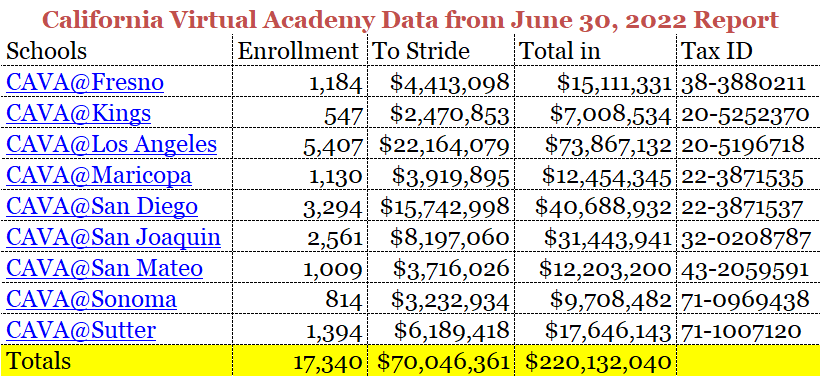
Financial records show Stride (formally known as K12) took in over $70 million from all nine CAVA schools in the 2021/22 school year. High costs, charged by Stride, kept the schools running deficits.

Who is CAVA

K12/Stride set up the CAVA network in 2002 that grew to nine charter schools, authorized by small districts. None of them had more than 15,000 students and four had less than 2,000. This means small cash-strapped districts get 1 to 2 percent of CAVA state funding to monitor the schools, with insufficient resources to do more than review some submitted paperwork.

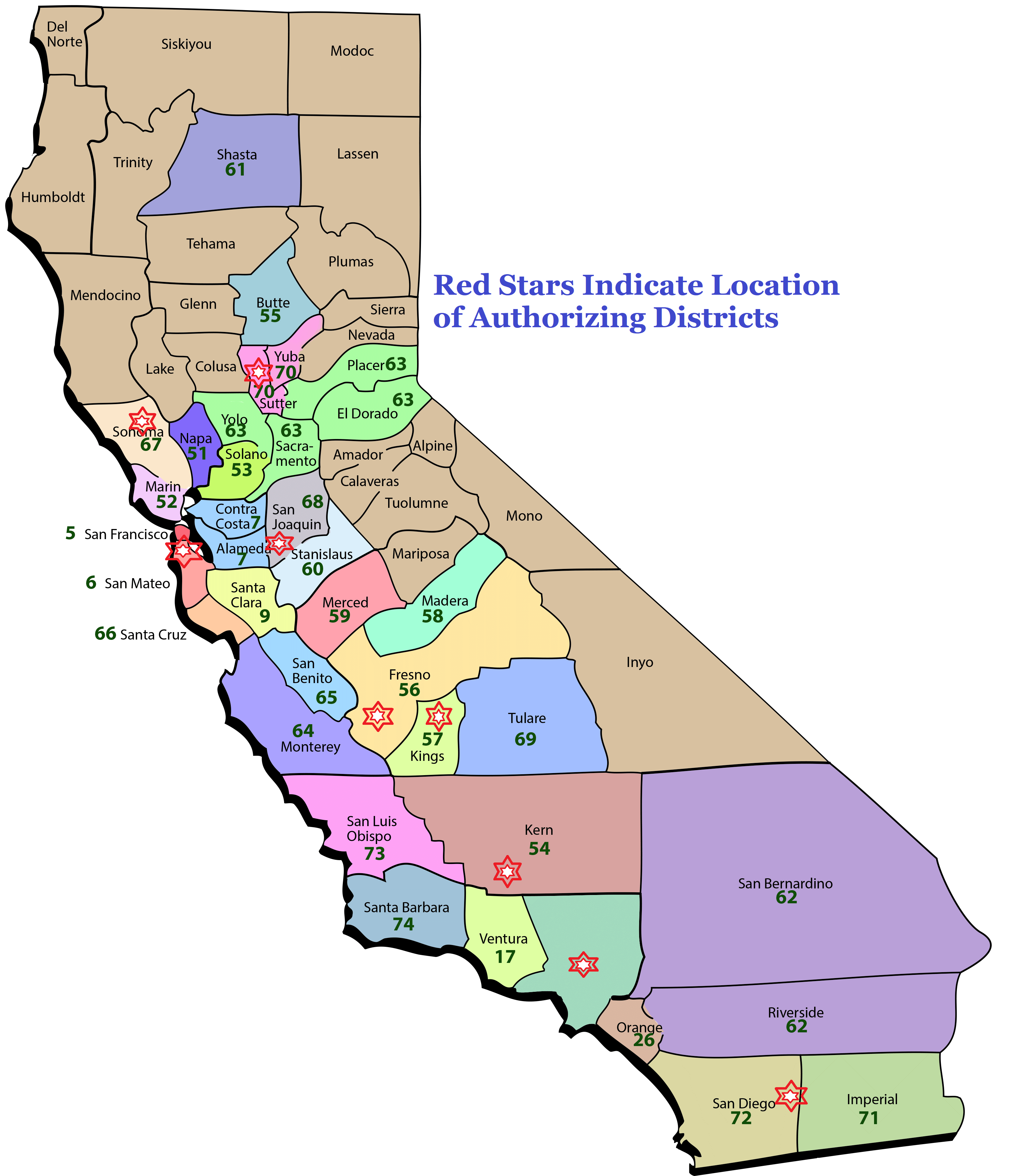
Red stars on the California county map indicate authorizing district locations. This is important because, under California law, a cyber charters can only service its authorizing county and the bordering counties. The map shows CAVA services almost all population centers in the state.

The nine CAVA schools are organized as non-profits with their own boards. California law says only non-profit organizations may operate charter schools.

A Wikipedia entry says, “California Virtual Academies follow the educational principles of E.D. Hirsch Jr.” In the debate between behaviorism and “constuctivism”, Hirch came down squarely on the side of behaviorism. Education writer, Alfie Kohn said, “E. D. Hirsch Jr.’s Dictionary of Cultural Literacy, which popularized what we might call the ‘bunch o’ facts’ approach to education, was enthusiastically endorsed in Phyllis Schlafly’s Eagle Forum newsletter.” (Page 11) In other words, the CAVA foundational philosophy of education is not widely embraced.

K12 was founded by former McKinsey & Co. consultant and banker, Ronald J. Packard. Discussions toward its founding began in 1999 and the company opened its doors in 2000, focusing on the homeschooling market. Original investors included “junk-bond king” and felon, Michael Milken, his brother Lowell, Andrew Tisch, Larry Ellison and others. Ronald Reagan’s Secretary of Education, William Bennett, was hired as the company’s first chairman of the board.

Legal and Labor Issues

Because of the close ties between K12 and CAVA, a loud objection was raised by activists, claiming the schools were little more than a front of the for-profit company. It was noted that K12 created the schools, chose the boards and holds exclusive no-bid contracts with CAVA. 

In early 2016, Jessica Calefati of San Jose’s The Mercury News reported, “Accountants and financial analysts interviewed by this newspaper, including several who specialize in school finance, say they’ve never seen anything quite like the arrangement between K12 and the public online academies.”

Many profit-minded companies in California have tried to sidestep the laws, requiring charters to be run by non-profits. LA Times reporter Howard Blume wrote:

“K12’s strategy allegedly involved driving the opening of nonprofit charters up and down the state. These schools then contracted with K12 for “substantially all of the management, technology and academic support services in addition to curriculum, learning systems and instructional services,” according to a state complaint filed last week.

“The CAVA nonprofits became shells for the activities of the for-profit corporation, according to allegations in a second, separate complaint, which was filed under the authority of the state in conjunction with whistleblower Susie Kaplar, a former CAVA teacher.”

In the same 2016 article, Blume quoted then California Attorney General, Kamala Harris, saying, “K12 and its schools misled parents and the state of California by claiming taxpayer dollars for questionable student attendance, misstating student success and parent satisfaction, and loading nonprofit charities with debt.” The non-profit charities referenced were the nine CAVA schools.

Later in July of 2016, Attorney General Harris reported:

“As part of the settlement, which is subject to court approval, K12 will provide approximately $160 million in debt relief to the non-profit schools it manages—“balanced budget credits” that were accrued by the schools as a result of the fee structure K12 used in its contracts—and will pay $8.5 million in settlement of all claims.  In addition, K12 has agreed to implement significant reforms of its contracts with the CAVA Schools, undergo independent reviews of its services for students with disabilities, ensure accuracy of all advertisements, provide teachers with sufficient information and training to prevent improper claiming of attendance dollars, and change policies and practices to prevent the kinds of conduct that led to this investigation and agreement.”

Rachel Cohen reporting in Atlantic magazine shared:

“K12 emphasized it had admitted no wrongdoing, and said the attorney general ‘grossly mischaracterized the value of the settlement just as it did with regard to the issues it investigated.’ In an email to The Atlantic, the K12 spokesperson Michael Kraft disputed the AG’s characterization of the schools as indebted.”

At the same time, the CAVA network and K12 were also developing growing dissatisfaction amongst their teacher ranks. Brianna Carroll, a fourth-year CAVA teacher, claimed, “Teachers were concerned about the instability their students were experiencing.” She said they began discussing the reality of low salaries and substandard working conditions, making it hard for CAVA to retain teachers and creating “an unstable environment for students.”

Sarah Vigrass, a 10-year CAVA teacher, observed:

“Changes in management at K12 and an increased emphasis on profits had led to changes at CAVA that shortchanged students. When I started teaching there, families would start the year getting these great boxes of art supplies, textbooks and curriculum, and teachers had time to build relationships with students and families. A lot of that went away.”

In 2013, CAVA teachers reached out to the California Teachers Association (CTA), an affiliate of the National Education Association, for help. With more than 700 teachers, working at nine campuses, spread out across California, bargaining with an anti-union K12 was tough. In 2014, despite management opposition, teachers voted overwhelmingly to be represented by California Virtual Educators United (CVEU)/CTA.

A 17-month legal battle followed, with CAVA claiming that each one of their campuses was a separate school and therefore, a separate bargaining unit. In October 2015, the Public Employment Relations Board (PERB) rejected CAVA’s arguments, granting CVEU exclusive recognition. CAVA again appealed but was rebuffed by PERB in June 2016. In September of that year, CVEU and CAVA began negotiations for their first contract. In April 2018, CVEU members voted by a 98 percent margin to ratify a contract agreement with CAVA.

One of the big concerns of teachers was the poor performance of their students. In a two-part investigationThe Mercury News reported that fewer than half of CAVA students graduate and “almost none” pass the courses required for admission to the California State University and the University of California.

John Fensterwald reporting for EdSource said:

“A study of online charters in California by the Center for Research on Education Outcomes, or CREDO, at Stanford University found that online students were far behind their classroom-based peers. Based on test scores, CAVA students on average fell a third of a year behind their peers in math.”

Even the California Charter Schools Association (CCSA) criticized K12, stating:

“CCSA condemns the predatory and dishonest practices employed by K12 Inc. to dupe parents using misleading marketing schemes, siphon taxpayer dollars with inflated student attendance data, and coerce CAVA School nonprofit employees into dubious contracting arrangements,”

Conclusion

Under a new name, Stride, K12 still profits wildly from California taxpayers. CAVA schools are the only cyber schools in America running deficits. They get full per-student money from the state, maintain and operate no buildings … why are they financially strapped???

The unfair labor practices claim filed by CVEU has potential to reveal Stride’s enormous greed and malfeasance.

California cyber charters ought to be run by large school districts with elected boards and not for-profit companies, located on the east coast.