
Tag Archives: Doug Harris

Charter Schools in a Racist Big Easy

8 Dec

By Thomas Ultican 12/8/2025

New Orleans was the site of the largest slave market in America. In the late 18th and early 19th centuries, more than 135,000 slaves were purchased in the Big Easy. This racist legacy has survived up until today in many of its White citizens, business leaders and politicians. The book William Frantz Public School states, “By the 1920s, Orleans Parish School Board members and district administrators vehemently voiced their belief that White supremacy should guide public policy and stated their willingness to employ any means, including the use of force, to maintain inequality between the two races.” (William Frantz Page 4) After the Supreme Court’s Brown decision, long-time state senator William Rainach headed a strategy committee that condemned integration as the work of communists and created the all-White Louisiana’s Citizens’ Councils (Overturning Brown page 34). Leading up to hurricane Katrina, many White citizens continued working to maintain the ideal of White supremacy.   

This summer, Tulane University’s Education Research Alliance (ERA) created and published The New Orleans Post-Katrina School Reforms: 20 Years of Lessons.” This report was published June 2, 2025 by authors Douglas Harris and Jamie Carroll. In an alliance with Network for Public Education (NPE), Kristen Buras PhD, who has been studying New Orleans schools since the hurricane, wrote a paper countering many of the claims made in the ERA paper.

There is reason to believe the two ERA writers are incapable of doing unbiased research in the education realm.

In 2023, Diane Ravitch disclosed that while serving as Secretary of Education, billionaire Betsy DeVos gave $10 million to establish a research center on school choice. The longtime advocate of school choice was not apt to give the money to academics likely to throw cold water on her life’s work. The grant went to Tulane University in the only American city that has no public schools. Ravitch noted, “The organization she funded is called the National Center for Research on Education Access and Choice (REACH), led by economist Douglas Harris.”

Jamie Carrol who attended an all-girls high school in Maryland was a Teach for America (TFA) teacher 2008-2010 in New Orleans. She went on to earn a Doctorate of Philosophy from the University of Texas. Today, she works as a researcher for Betsy DeVos’s REACH.

In her Paper, The Stories Behind the Statistics: Why a Report on “Large Achievement Gains” in Charter Schools Harms New Orleans’ Black Students”, Kristen Buras shares that the amazingly pro-charter school Arnold Foundation has spent lavishly to advance charter schools in New Orleans; in 2012 $15 million for “education reform” in New Orleans, then another $25 million to be managed by the Charter School Growth fund and New Schools for New Orleans (NSNO), and 2014-2017 grants to Tulane University and ERA of more than $5 million. Buras comments, “Grants from this consistently pro-charter foundation helped launch and sustain ERA’s work.”  (Buras Page 17) 

Recently, two of America’s most active funders of charter schools awarded nearly $1 Million to REACH: the Walton Foundation and the City Fund (Buras Page 18). The Walton family, who owns Walmart, is the wealthiest family in the world and the largest private funder of charter schools in the US. The City Fund was created by billionaires Reed Hastings and John Arnold. They each put in $100 million to create an organization specifically for spurring the spread of charter schools.

Do Not be Naïve

Even before hurricane Katrina, there were efforts for the state to take over New Orleans’s public schools. Tulane University President Scott Cowen was quite influential in the development of the state of Louisiana’s education policies. In 2003, Cowen was involved in the creation of the Recovery School District (RSD) that was to take control over “failing schools” in New Orleans and reform them. After Katrina, Cowen headed the education committee of Mayor Nagin’s Bring Back New Orleans Commission. In early 2006, Cowen’s committee released a report recommending that New Orleans become the nation’s first all-charter school district (Buras Page 18). 

Scott Cowen established Tulane University’s Cowen Institute, a predecessor of ERA. Buras reported on conducting interviews with Cowen’s staff in 2009 noting:

“I asked about the institute’s mission. Like ERA, they characterized their work as neutral. One staff member shared: ‘We don’t advocate for an all-charter system because we don’t feel there’s adequate research [at this point] to indicate that charters will outperform non-charters.’ Instead, the staff portrayed the Cowen Institute as an ‘honest broker’ and ‘objective observer.’ Yet, NSNO, TFA, and other pro-charter school groups were given free office space in the same suite as the Cowen Institute.” (Buras Page 18)

To this day, ERA shares office space on the seventh floor of 1555 Poydras Street with NSNO.

Since its inception, NSNO has been all about building the all-charter school system in New Orleans. A peak at their tax records (EIN: 02-0773717) shows Neerav Kinsland appearing on the board in 2010 and earning $117,000 as chief of strategy. In 2011 he became CEO earning $146,000 and over the next two years he was paid $207,000 and $223,000 as CEO. But that wasn’t good enough. Since then, he has worked for billionaires John Arnold and Reed Hastings, served on the California Charter School Association board and is now leading the City Fund.

After Katrina, Black teachers decreased from 71% in 2005 to 49% in 2014, then rose to 56% in recent years. They were paid less than white counterparts in the same teaching and administrative positions (Buras Page 13). Experienced Black teachers were replaced by mostly White college graduates from TFA with just 5 weeks of training as an educator.

Students in the Big Easy are forced to take long bus rides often past, within walking distance neighborhood schools, to get their assigned charter school. It is not unusual for them to soon be traumatized by one of New Orleans multiple school closures. Somehow, white children in New Orleans rarely experience school closures.

Ashana Bigard shared in her book “Beyond Resilience Katrina 20about the racist enrollment process in the all-charter school system. To enroll children, parents must use OneApp. It runs the school choice algorithm but strangely only white children get into the best schools, not even if you’re a Black family in the upper middle class do you get a seat. It is common to see White people move to the city and magically get their children into schools with 100 children on the waiting list. Ashana notes, “They didn’t even know the school existed prior to moving to the city, but racism and classism still existed heavily within the new system.” (Bigard Page 268)

Cheating Charters

The state cheated to create the conditions for developing the all-charter school system. Before Katrina, the cut point for school failure was 60 on a 200-point scale. After Katrina, through Act 35, the state legislature raised the cut point to 87.4, which was just below the state average. This maximized the number of public schools that the RSD could seize. Then, as charter schools were opened, the cut point for failure was lowered back to 60 (Buras Page 19).

The Times-Picayune reported that “data published by the Louisiana Department of Education vastly underreported the number of expulsions in charter schools.” For the 2007-2008 period, state data from a sample of 19 RSD charter schools listed only 4 students as having been expelled. The Lafayette Academy admitted to the Times-Picayune that 14 students were expelled that year; the state reported zero for Lafayette. (Buras Page 16)

In 2011-2012, 34% of schools in New Orleans had an out of school suspension (OSS) rate at or above 20%. Since 2009, charter schools have suspended students at rates sometimes double and triple the state average which was not that great to begin with. (Buras Page 15)

In 2015, SciTech Academy allowed students to take tests for one another, at home or multiple times (Buras Page 21).

Students coded as “transferred out of state” are excluded from the state’s metric. The inordinate use of the out of state code by charters seemed to be masking the true dropout figures which improved their state ratings (Buras Page 21).

At Landry-Walker, 78% of students scored “good” or “excellent” on the biology EOC and 78% on the geometry EOC. Only “good” or “excellent” scores earn points on the state’s metric. Yet, 52 of the 257 students who scored “good” or “excellent” on the EOC exam received a D or F in the class. By 2017, the Louisiana inspector general’s office had uncovered enough evidence of criminal wrongdoing at Landry-Walker that the local district attorney was alerted (Buras Page 21).

In her report, Buras says these are likely just the tip of the iceberg when it comes to charter school test cheating. Yet these inflated scores and school ratings are used by ERA to claim good academic results in New Orleans’s charter system. The willingness to ignore the cheating problem is appalling.
Education Cities is the National Organizer for the Destroy Public Education (DPE) Movement

20 Jan

By Thomas Ultican 1/20/2018

Update 1/27/2020: Later in 2018 both Doug Harris and Ethan Gray left their respective organizations to join The City Fund. The Mind Trust continued under new leadership and Education Cities was divided into two new school choice promoting organizations; School Board Partners and Community Engagement Partners.

The Mind Trust’s CEO Doug Harris and Vice President Ethan Gray were ready to take their Indianapolis school privatization methods on the road. In 2010, Harris and Gray founded CEE-Trust which became Education Cities in 2014. They were selling The Mind Trust’s secret sauce to DPE organizations nationwide.

Today the Education Cities web site defines the organization:

“An Education City is an aspiration – a vision for the future where all children can access great public schools. The Education Cities network includes 33 city-based organizations in 25 cities across the country working to improve public education.”

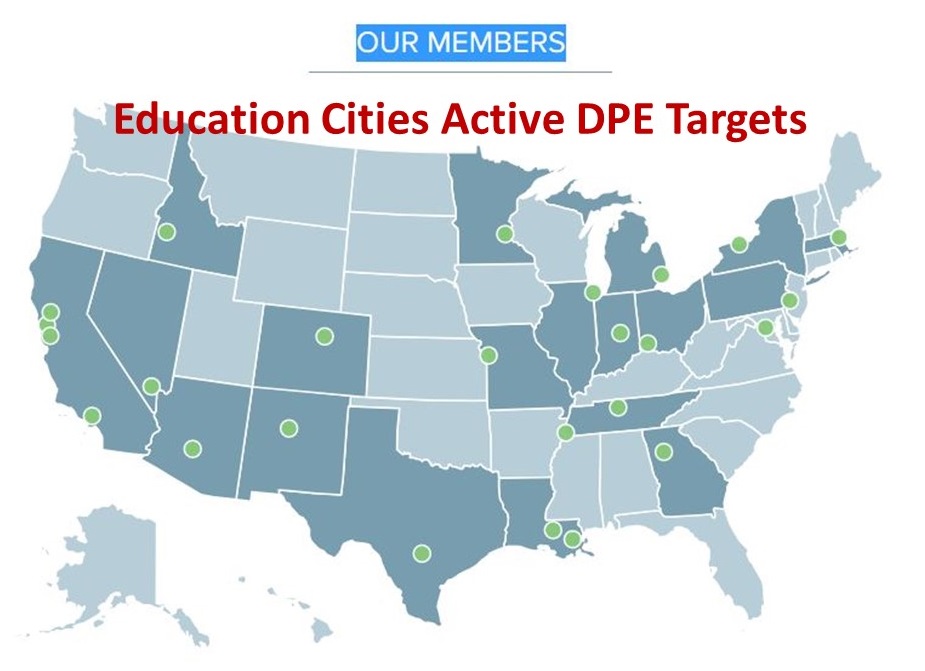
The following graphic was snipped from the Education Cities Site. The blood red lettering was added. If your city is on this map, there is an active DPE effort using a form of The Mind Trust playbook and it is well financed. A hyper-text list of these cities and the organizations is provided at the end of this post.

Our Members Map Fixed

Doug Harris is on the board at Education Cites and according to tax records, The Mind Trust has provided Education Cities with $1,582,769 in grants over the last three years. However, Ethan Gray is named as the CEO and Founder by the Education Cities official web site.

Gray is a seasoned DPE leaders. “Before his role at Education Cities, Ethan served as Vice President of The Mind Trust where he helped develop the ‘Opportunity Schools’ plan for transforming the Indianapolis Public Schools. …

“He is a past member of the Board of Directors for the STRIVE Prep network of charter schools in Colorado, as well as the National Advisory Boards of Families for Excellent Schools, EdFuel, and Innovative Schools in Wilmington, Delaware.”

The Mind Trust Spread Their Wings in 2010

The oldest available Education Cities cyber presence is from February 2011. Its original name was The Cities of Education Entrepreneurship Trust (CEE-Trust). The page stated:

“CEE-Trust is a network of city-based education reform organizations, initiatives, and foundations dedicated to accelerating the growth of entrepreneurial education ventures.

“Our Goals:

  • To help members attract, support, and expand the impact of entrepreneurial education ventures in their cities.
  • To facilitate the growth of both established and emerging entrepreneurial education initiatives.
  • To increase the number of city-based organizations that support and advocate on behalf of education entrepreneurs.”

“CEE-Trust is funded by the Bill & Melinda Gates Foundation and The Joyce Foundation. CEE-Trust is also grateful for the past support of the Carnegie Corporation of New York.”

Key Step for Destroying Public Education (DPE)

In 2012, CEE-Trust produced a paper called Kick-Starting Reform. In the forward, Ethan Gray writes:

“The Mind Trust has engaged in this kind of work in Indianapolis since 2006. We launched the CEE-Trust network in 2010 to connect with other, similarly focused city-based education reform organizations.”

“During these conversations we often hear a similar set of concerns and questions:”

  • How can we attract more talent to the education sector in our city?
  • How can we get more great charter schools in our city?
  • How can we leverage our resources to drive systemic change?
  • What would it take to start a CEE-Trust member organization in our city?

“The purpose of this paper is to answer these questions and help leaders in different cities identify the key elements to starting a new city-based education reform organization. We draw from the examples of three nationally noted CEE-Trust member organizations: The Mind Trust in Indianapolis, New Schools for New Orleans, and The Skillman Foundation in Detroit.”

A fair description of the New Orleans experience would be dismal. They fired 7,000 experience black educators and replaced them mostly with untrained TFA candidates. In the process of privatizing New Orleans’ schools, they lost over 10,000 students. Children are busing for hours every day even though there are schools within blocks of their home. Even the vaunted test scores that are manipulated to make public schools look like failures have not improved – no substantive improvement from pre-Katrina days.

Detroit is such a disaster, that they are hoping the formerly disparaged Detroit Public Schools can save the day.

However, “Kick-Starting Reform”, praises these as effective reform efforts and lists the secret formula that makes them wonderful.

All three local DPE organizations agree on three principals. (1) New school leaders are needed and the ready solution is TFA and TNTP or other equivalent groups. (2) Seeding the development of a portfolio of schools is seen as crucial to “success.” (3) Local school board had to be either disbanded, populated with right minded individuals or put under mayoral control.

Faux Scholarship and Data Deception

Early 2016, Education Cities released a paper called the “Education Equality Index.” On a separate Education equality Index web site, two cohort organizations are identified, Education Cities and Great Schools. The latter is a group that rates schools in America based on testing data. Evidently, Education Cities is providing Great Schools with the data analysis.

When the “Education Quality Index” was originally released, its results were immediately published in DPE friendly media.

JerseyCan, a group working to privatize Camden’s schools posted on their blog, “New Jersey has a massive achievement gap, new index confirms.”

Edsurge published an article called “Low Income and Looking For a Successful School. Study Shows Choices Are Slim.” They claimed,

“The results show that in major cities such as Chicago, New York and Los Angeles students from low-income communities are performing higher than their more affluent peers. And Texas stands out as a state with several cities that have high-performing students from low-income backgrounds.”

Chalkbeat Colorado headlined their article, “Denver and Aurora achievement gaps among nation’s widest, index finds.” They also stated, “The Education Equality Index, released Tuesday, is billed as a first-of-its kind comparative measure of achievement gaps on annual assessments in the 100 largest U.S. cities at the school, city and state level.”

Soon even the reliably DPE focused 74 was noting that their seemed to be issues with this non-peer-reviewed paper. The 74 reported,

“Scores were given for each state, based on comparing test scores of low-income students to all students, and states were ranked, but soon a puzzling anomaly was pointed out on social media: States with higher poverty rates scored surprisingly well. In fact, the higher the poverty, the better the equality score.”

“Three researchers consulted by The 74 were generally skeptical that the methodology could be used to contrast schools and cities across different states, but said it could still hold value when looking within a given state.”

The 74 article ended with a classic disclosure statement: “Education Cities, GreatSchools, and The 74 all receive funding from the Walton Family Foundation.”

The six authors of the Equity Quality Index seem compromised by big money. A brief overview of the authors follows.

Betheny Gross: Dr. Gross oversees CRPE’s research initiatives, including analysis of personalized learning initiatives, portfolio management strategies, and charter schools. CRPE is funded by the Gates Foundation.

George Prevelige is from the Michael & Susan Dell Foundation. His resume does not compare favorably to the other authors. Possibly a line from the paper’s acknowledgements explains his presence: “We would like to thank the Michael and Susan Dell Foundation for their generous support of this project…”

Matt Chingos from the Urban Institute is an executive editor for Education Next (a pro-school privatization publication). He earned a Ph.D. in Government from Harvard University in 2010.

Jake Vigdor, University of Washington; His research has been supported by several foundations including the Laura and John Arnold Foundation, and the Bill and Melinda Gates Foundation. His curriculum vitae shows he earned a Ph.D. in Economics at Harvard University in 1999. He was also a visiting scholar at the American Enterprise Institute in 2012.

Doug Lauen, University of North Carolina; “To date much of my academic research falls into three areas: 1) school and classroom poverty composition, 2) educational accountability, and 3) school choice and charter schools.” His curriculum vitae notes a Ph.D. in Sociology, University of Chicago, 2006.

Bruce Fuller, University of California, Berkeley; Professor of education and public policy. He is director of the Policy Analysis for California Education (PACE), an independent policy research center based at UC Berkeley and Stanford University. Following graduate school at Stanford University, Prof. Fuller worked as a research sociologist at the World Bank. He taught comparative policy at Harvard University, before returning to California. Fuller’s work at PACE is funded by:

  • The Bill and Melinda Gates Foundation
  • The Dirk and Charlene Kabcenell Foundation
  • The James Irvine Foundation
  • Silver Giving Foundation
  • Stuart Foundation
  • The William and Flora Hewlett Foundation
  • The David and Lucille Packard Foundation
  • The Evelyn and Walter Haas, Jr. Fund
  • D. Bechtel Jr. Foundation
  • Walter and Elise Haas Fund
  • The Walter S. Johnson Foundation

Clearly all the researchers credited on this paper have a financial stake in advancing concepts like portfolio districts, vouchers and charter schools.

The reports methodology can be fairly paraphrased as being 100% based on standardized testing data. They took state test data and tried to statistically align data between states by using National Assessment of Educational Progress (NAEP) data. They also used federal free and reduced lunch data as a proxy for poverty.

The claim is then made that a meaningful comparison of education quality for students living in poverty can be made between all schools across the United States. This comparison in used to create a scale they name the “education equality index.”

This is a fantasy.

The work of the highly praised education scholar, W. James Popham, shows that the starting point is meaningless. As does the work of testing experts like David Berliner and Noel Wilson. Popham wrote a peer reviewed paper in 1999 he called, “Why Standardized Tests Don’t Measure Educational Quality.” This points to the fundamental weakness of the Bush-Obama education reform policies. The measuring stick was useless.

Or as one of my favorite education bloggers Peter Green put so eloquently this week,

“The entire reform system, the entire house of policy built by both administrations, is built on the foundation of one single narrowly-focused standardized test, the results of which are supposed to measure student achievement, teacher effectiveness, and school quality. The entire policy structure is held together and activated by data, and that data is being generated by means no more reliable than a gerbil tossing dice onto shag carpet in the dark.”

An Existential Crisis

The lead in a December 2017 Chalkbeat article read, “In 2013, a plan to reshape Kansas City’s schools was essentially run out of town.” Unfortunately, the report continued, “Four years later, a group with a similar policy agenda, some of same key funders, and whose leaders get advice from the engineers of the first plan, is making inroads.”

Ethan Gray and CEE-Trust with the backing of the Kauffman and Hall foundations, influential Missouri philanthropies, was hired to analyze how state control could turn around the Kansas City, Missouri public schools. This contract seemed out of compliance with contract procedures for state agencies in Missouri. It created a public backlash lead by a group called More2 who filed a public records request. The Chalkbeat report continued:

“Emails detail a hidden plan for Kansas City Public Schools,” blared a headline in the Kansas City Star in December 2013, based on information from More2. The paper described “a rushed bidding process, now criticized, that ultimately landed Indianapolis-based CEE-Trust a $385,000 contract to develop a long-range overhaul for the district’s failing schools.”

Gray’s report was released in January 2014. It claimed that the schools were failing and called for the introduction of a portfolio model as a reform. Chalkbeat says, “It also drew substantially from a 2011 blueprint released by the Indianapolis-based Mind Trust, ….”

Local groups including the NAACP and school teachers defeated the plan. Now an indigenous group supported by the Hall and Kaufman foundations named SchoolsmartKC is leading the DPE effort in Kansas City.  Gray and Education Cities support in the background.

Chalkbeat says Gray and Education Cities “is not going to be a leading voice like that again.” They quote Gray as saying,

‘“It’s not a role we anticipate playing frequently in the future,’ he said. ‘We don’t want to be out in front of this conversation — we want to be supporting local leaders who are pursuing this kind of work.’

The article continues,

“Gray is now focused on a growing national network of over 30 loosely connected independent nonprofits — some in places like Denver, where the model is already established, and others in cities like Kansas City, where their task is to push for change.”

After Kansas City, CEE-Trust became Education Cities.

Now SchoolsmartKC is The Mind Trust of Missouri and CEE-Trust has reinvented itself. Not everyone in the show me state is sold on the new DPE leader. Chalkbeat reported,

“Meanwhile, some remain wary of who is funding SchoolSmart. In addition to local philanthropies, SchoolSmart identifies the Walton Foundation as one of its core investors. Sufi said Hall, Kaufman, and Walton had together made a 10-year funding commitment of over $50 million.”

Conclusion

As I continue researching the various DPE schemes and scams to steal education tax dollars, I am reminded of the words Arnold Toynbee wrote in his A Study of History: “The bread of universal education is no sooner cast upon the waters than a shoal of sharks arises from the depths and devours the children’s bread under the educator’s very eyes.”

If we do not stop the DPE movement, the right to a free public education will parish. We must turn away that “shoal of sharks.”

Twitter: @tultican

Current DPE Members of Education Cities

Albuquerque, NM Excellent Schools New Mexico

Atlanta, GA redefinED atlanta

Baton Rouge, LA New Schools for Baton Rouge

Boise, ID Bluum

Boston, MA Boston Schools Fund and Empower Schools

Chicago, IL New Schools for Chicago

Cincinnati, OH Accelerate Great Schools

Denver, CO Gates Family Foundation and Donnell-Kay Foundation

Detroit, MI Detroit Children’s Fund and The Skillman Foundation

Indianapolis, IN The Mind Trust

Kansas City, MO SchoolSmart Kansas City

Las Vegas, NV Opportunity 180

Los Angeles, CA Great Public Schools Now

Memphis, TN Memphis Education Fund

Minneapolis, MN Great MN Schools and Minnesota Comeback

Nashville, TN Project Renaissance

New Orleans, LA New Schools for New Orleans

Oakland, CA Educate78 and Great Oakland Public Schools Leadership Center and Rogers Family Foundation

Philadelphia, PA Philadelphia School Partnership

Phoenix, AZ New Schools for Phoenix

Richmond, CA Chamberlin Family Foundation

Rochester, NY E3 Rochester

San Antonio, TX City Education Partners

San Jose, CA Innovate Public Schools

Washington, DC Education Forward DC and CityBridge Education

Twitter: @tultican