Tag Archives: DIBELS

Billionaire Purchased Research Hawks Virtual Tutoring

12 Feb

By Thomas Ultican 2/12/2025

Billionaires have enlisted the aid of Universities in their push to sell kids-at-screens education. The latest effort, dutifully reported in The 74, claims that Johns Hopkins University has shown “Done Right, Virtual Tutoring Nearly Rivals In-Person Version.” They say two new studies performed there show “how high-quality virtual tutoring can help struggling students.” In Massachusetts, they are testing virtual tutoring programs on 6-year old students, which is morally repugnant.  

The 74 reports,

“In a quasi-experimental study published in December, Neitzel and her colleagues found that first-graders in Massachusetts who used Ignite Reading, a one-to-one virtual tutoring program, made substantial progress in reading, with the percentage of students reading on grade level rising from just 16% in the fall to about 50% by spring.”

Neitzel is Assistant Professor Amanda Neitzel, Deputy Director of Evidence Research at Johns Hopkins University. Ignite Reading is a for profit company specializing in science of reading (SoR) approaches to virtual tutoring. The bill for this program, which was run in 13 Massachusetts elementary schools, was paid by One8 Foundation (TIN: 04-6836735), a three-quarter-billion dollar Jewish centric foundation that regularly gives to privatizing organizations like Teach For America, KIPP and Success Academy.

The quasi-experimental study was published in December, 2024. Quasi-experimental research is research that resembles experimental research but is not true experimental research. While quasi-experimental designs don’t offer the same level of control as true experimental designs, they are still useful for studying situations where randomization is difficult or impossible. However, they can be misleading.

Page 4 of the study described Ignite Reading, as a one-to-one virtual tutoring program, fostering early literacy development. The paper states, “As part of the program, students attend daily 15-minute virtual tutoring sessions with specially paired Ignite Reading tutors who leverage a sequenced, research-based instructional plan designed to develop students’ early-literacy skills, related basic alphabetic knowledge, phonemic awareness, phonics, decoding, and fluency.” The SoR curriculum was assessed using DIBELS’s basic early literacy skills test.

The DIBELS use throws some shade on Neitzel’s research. Many educators and scholars loudly detest DIBELS. Berkley’s P. David Pearson wrote, “I have decided to join that group of scholars and teachers and parents who are convinced that DIBELS is the worst thing to happen to the teaching of reading since the development of flash cards.” DIBELS focuses on phonics and sounds and not words and meaning. Many of DIBELS assessment phrases are purposefully gibberish.

While I question the assessment methodology, I would think first graders who were forced to participate with an on-line tutor 15 minutes every day of the school year would improve somewhat. Even a bad methodology will produce some results though it might poison a baby’s mind about reading.

Billionaire Funded Air Reading

The second Johns Hopkins research article cited is about San Mateo, California’s Air Reading which was founded in 2021. Crunchbase reports that Air Reading’s last two rounds (2023 and 2024) of funding were financed by Accelerate which highlights how billionaires are bending research to their liking.

They self-claim, “Accelerate actively builds the country’s knowledge of tools and practices that significantly advance student learning.” The reality seems quite different. Accelerate appears more like a pass-through portal for billionaire dollars. The 2022 tax form 990 (TIN: 88-3207484) shows CEO Kevin Huffman’s Tennessee company has just over $14-million in assets yet they seem to be Air Reading’s main funding source. Accelerate’s funds were recently augmented with $10-million from John Arnold.

Accelerate’s Posted Funders

Arrow Impact is a $60-million dollar non-profit established by wealthy Stanford financial professor, Mark Wolfson (TIN 83-1423625). In 2023, Wolfson added another $7.5 million to Arrow Impact and he seems to be the poor guy here. Former Tennessee Governor and billionaire Bill Haslam with his wife Crissy operate a $100-million tax free foundation (TIN 62-1867423). Griffin Catalyst belongs to billionaire Ken Griffin founder of Citadel Financial. John Overdeck is the billionaire founder of Two Sigma Investments. His Overdeck Family Foundation has over $850-million in assets (TIN 26-4377643). Arnold Ventures (TIN 26-3241764), Gates Foundation (TIN 86-1065772) and the Walton Family Foundation (TIN 58-1766770) complete the list of billionaires putting investments through Accelerate.

The Johns Hopkins report informs:

“Air Reading is grounded in the Science of Reading. Comprehensive, one-on-one diagnostics identify students’ learning needs and inform group placement and bi-weekly assessments to track student progress.”

“During the 2023-24 school year, six elementary schools in a district in Texas took part in a randomized controlled trial to evaluate the impact of Air Reading on reading outcomes for first through sixth grade students.” (Page 4)

The fundamental outcome is they once again showed that students getting extra tutoring outperform students who do not. The study was monitored using the corporate supported NWEA MAP testing scheme. Neitzel et al explain that based on these outcomes, “the control group who scored at the 50th percentile would increase their score to the 55th percentile if they participate in the tutoring.” (Page 10) The report admits it was, “comparing the reading achievement of students receiving the Air Reading intervention to those receiving the standard classroom instruction.” (Page 11) In other words, the study compared those receiving 40-minutes of tutoring four days a week with those who were not.

This result is so unsurprising that it is difficult to fathom why they bothered other than billionaires want to sell putting “those people’s children” at screens.

SoR is key to putting kids a screens. That is why billionaires are pushing it down America’s throats.

Insights

Before billionaire education reform, education research was much more honest. Typically, an education researcher would study some aspect of teaching or learning, gather data, write up the study and submit it to some journal for publication. The study would go through a peer-review process in which several experts in the field would review the paper and then at a large gathering the researcher would defend the paper. If the defense went well, the respected journal would publish the paper.

Billionaires have to some extent eliminated the peer review process when their organizations like TNTP publish a paper that is promoted by billionaire funded media like The 74. Once the paper is published other billionaire funded organizations cite the sham papers in their reports or like the University of Arkansas’s School Demonstration Project financed by the Walton family, just cite their own previous bogus work.

The 74, claimed that Johns Hopkins has shown “Done Right, Virtual Tutoring Nearly Rivals In-Person Version.” If a school can convince students to log on to tutoring and pay for the online tutors, this might be true. However, the demonstrations that virtual tutoring can “nearly” rival the in person versions were extremely well resourced and had the ability to force children to log in. Even if the downside health problems associated with kids at screens are ignored and “nearly” rival is a good enough goal for your schools and their parents, it is unlikely they will get an equivalently well resourced program.

Billionaires like Laurene Powell Jobs and Bill Gates want to put kids at screens in the worst way. Unfortunately, it is a method that seriously degrades education. Their kids will never be subjected to this kind of diminished education and no other American student should be either.
Dyslexia Industry Scores California Court Victory

4 Aug

By Thomas Ultican 8/4/2021

In a court settlement, Berkeley Unified School District (BUSD) agreed to implement inappropriate dyslexia remedies. The Disability Rights Education & Defense Fund (DREDF) claimed the district failed to identify students with reading disorders, including dyslexia, and did not provide them adequate services. To end the litigation begun in 2016, district leaders agreed to implement a universal screening program for reading disorders and adopt new reading intervention programs. BUSD also agreed to hire a nationally recognized outside consultants. District representatives disagreed with the charges but said the legal fight was becoming too expensive.

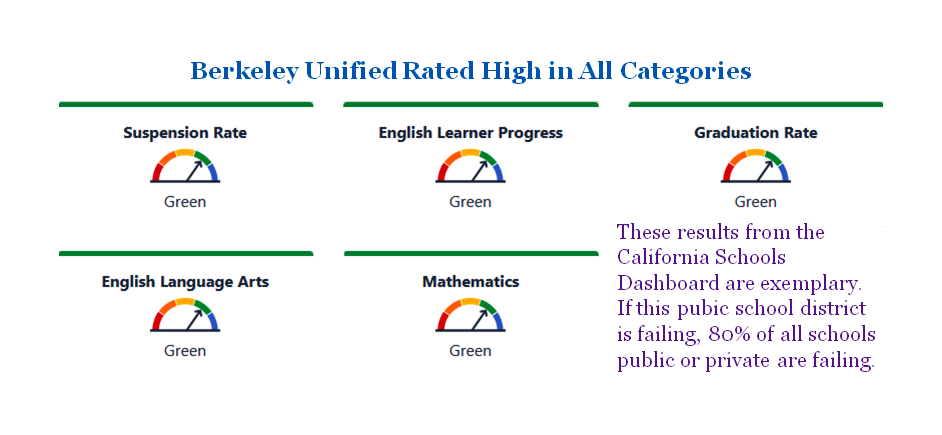
DREDF lawyers paint BUSD as a failing school system that makes no effort to identify students with learning disorders. They point out that only 70% of BUSD students are rated as proficient in reading by third grade. The lawyers cite the California School Dashboard’s 2017 data as evidence. However, the Dashboard which is a color coded evaluation of school performance shows BUSD performing at a high level.

From the 2017 California School Dashboard

Four students labeled A, B, C and D along with their parents or guardians are listed as plaintiffs. The DREDF filing states,

“When Student A started first grade, she was immediately placed in a Leveled Literacy Intervention (‘LLI’), a general reading intervention, since her reading abilities were significantly below her peers.  Student A’s teachers reported that she made some progress in LLI, but she continued to show emotional distress and displayed reading avoidant behaviors at home.”

The following year at age-7, student-A received average composite scores on several standardized tests and was put back in regular reading. Based on these results, the district turned down a special education declaration for the student.  DREDF lawyers claim that the “scores were too discrepant to calculate Student A’s processing speed and working memory …” In other words, they disagreed with the testing used.

Student-B came to BUSD in kindergarten. Within a few weeks, teachers recommended that his parents have a medical evaluation done. Later, his parents tried to home-school him and when that did not work out; they put him in a charter school. He was soon kicked out of the charter school and at age-6 he was back in BUSD. The school gave him a special education designation for ADHD. He was given a one-on-one tutor under the supervision of a special education teacher. DREDF found this inadequate because the tutor was not a trained special education teacher.

Student-B’s behavior deteriorated to the point of being suspended. BUSD placed him in a private school, Catalyst, which specialized in behavioral problems.  Catalyst gave up on student-B. In 2016 student-B was given a new medication for ADHD and his improved behavior allowed him to function in a regular classroom setting. DREDF claimed the district did not do enough.

Student-C was a ninth grader in 2015 when he transferred into BUSD from a private school. An independent evaluator had diagnosed him with dyslexia. BUSD concurred with the diagnosis and made a special education declaration. Student-C was given a 55-minute support class once a day, adaptive technology lessons 5-times a year and a weekly 15-minute meeting with his case manager. The student’s parents felt that he needed more and paid for some sort of private support services.

Student-D also came into ninth grade from a private school. During 3rd grade, the private school evaluated her as having reading difficulties. She was given several accommodations including extra time on tests. Student-D transferred in with all A’s and B’s on her report cards. Because she had such good grades BUSD determined that she did not qualify for special education services. Her grades remained high but she did poorly on the PSAT for which she was given no accommodations. Student-D was eventually given a 504 designation in time for her to take the SAT with accommodations. Her parents also paid for private support services.

Selling the Science of Reading

While it is true that experts estimate between 5 and 20 percent of all students have difficulties learning to read, this lawsuit is just another skirmish in the “science of reading” war. The dyslexia industry has adopted the position that phonics instruction is the only way to address reading difficulties. Further, they dismiss the expertise of school districts and teachers and strongly suggest only private companies have the elite expertise required to provide products that are capable of identifying and solving reading issues.

Professor Jim Horn has written extensively about the “science of reading” conflict and the bias of the National Reading Panel toward Alphabetics (phonemic awareness and phonics). In his 2003 review of Gerald Coles’ book Reading the Naked Truth: Literacy, Legislation, and Lies Horn shared,

“Coles concludes that the Panel’s ‘antipathy of anything that veers away from direct instruction model’ (p. 110) led them to the bizarre conclusion that there is not sustainable evidence, i.e, causal findings, to support the notion that children become better readers by reading and discussing books or by having encouragement and time provided to read books.”

In 2020, scholars at the National Education Policy Center addressed the still raging reading debate. They warned against, “Misrepresenting the ‘science of reading’ as settled science that purportedly prescribes systematic intensive phonics for all students.” And they stated that policy makers, “Should support the professionalism of K-12 teachers and teacher educators, and should acknowledge the teacher as the reading expert in the care of unique populations of students.” They also assert that David Pearson’s statement in a 2004 paper still rings true:

“For example, several scholars, in documenting the practices of highly effective, highly regarded teachers, found that these exemplary teachers employed a wide array of practices, some of which appear decidedly whole language in character (e.g., process writing, literature groups, and contextualized skills practice) and some of which appear remarkably skills oriented (explicit phonics lessons, sight word practice, and comprehension strategy instruction). Exemplary teachers appear to find an easier path to balance than either scholars or policy pundits.”

Inappropriate Solutions

The International Dyslexia Association and Decoding Dyslexia have been very successful at tapping into the emotions of parents over the issue of dyslexia. They routinely turn out hundreds of passionate people to legislative hearings trumpeting the dyslexia industry’s message which is to turn the problem over to private companies. In this linked video, Professor Rachael Gabriel discusses her research into how this consistent message has been created and delivered. It is a relatively new phenomenon with a large spate of dyslexia bills appearing in almost every state. 

To end the lawsuit, BUSD has agreed to test all students in kindergarten through 2nd grade with a DIBELS standardized assessment twice a year. The Berkeleyside reports, “For students in need of interventions, the district will implement Wilson Reading Systems or Slingerland, both of which are in line with standards set by the International Dyslexia Association.”

DIBELS, or Dynamic Indicators of Basic Early Literacy Skills, is a set of procedures and measures developed at the University of Oregon for assessing literacy development in students from kindergarten through sixth grade. Many educators and scholars loudly detest DIBELS. David Pearson wrote,

“I have decided to join that group of scholars and teachers and parents who are convinced that DIBELS is the worst thing to happen to the teaching of reading since the development of flash cards.

“I take this extreme position for a single reason—DIBELS shapes instruction in ways that are bad for students (they end up engaging in curricular activities that do not promote their progress as readers) and bad for teachers (it requires them to judge student progress and shape instruction based on criteria that are not consistent with our best knowledge about the nature of reading development).”

There are many more claims like this.

Both Slingerland and Wilson Reading Systems are based on the Orton-Gillingham approach. It was developmed in the 1930s and focused on phonics and sound decoding schemes. The International Literacy Association stated in 2016,

“As  yet,  there  is  no  certifiably  best  method  for  teaching  children  who  experience  reading  difficulty  (Mathes  et  al.,  2005).  For  instance,  research  does  not  support  the  common  belief that Orton-Gillingham–based approaches are necessary for students classified as dyslexic (Ritchey & Goeke, 2007; Turner, 2008;  Vaughn  &  Linan-Thompson,  2003).  Reviews  of  research  focusing  solely  on  decoding  interventions  have  shown  either  small  to  moderate  or  variable  effects  that  rarely  persist  over  time,  and  little  to  no  effects  on  more  global  reading  skills.” 

The US Department of Education established the What Works Clearing House which tried to establish a fair conclusion about education issues based on existing peer reviewed research. The three programs being replaced at BUSD, Read 180, LLI and Reading Recovery were evaluated as having positive results. Even though the Orton-Gillingham method has been around since the 1930’s there was not enough evidence to show a positive effect.

DREDF is not only the law firm that brought this case but they also are one of the organizations who officially supported SB237. This proposed state law mandates changes like those that DREDF was able to achieve in the law suit. Maybe DIBELS is not so bad and maybe the Orton-Gillingham approach is helpful for some students, but making these approaches a legal requirement is not rational. Trust education professionals and public schools over lawyers and private enterprise.

The U.S. District Court for the Northern District of California will hold a hearing for the case Nov. 4 to finalize the settlement.