Tag Archives: David Berliner

San Diego’s Edtech Lollapalooza

29 Apr

By Thomas Ultican 4/29/2025

Titans of the digital universe and their minions gathered at the ASU+GSV conference in San Diego April 6-9. There was a lot of self-promotion and proposals for creating new education paradigm based on personalized learning powered by artificial intelligence (AI) were everywhere. This year it is almost impossible to find any reporting from the event by “negative Nellies” like myself, on the other hand there are many positive references like Forbes calling it “the Davos of Education.”

MRCC advertises itself as having “25+ years of experience designing and deploying innovative eLearning solutions in collaboration with the brightest thinkers.” On April 21, their Senior Director, Learning Solutions, Kevin Schroeder, published Top Five EdTech Trends from ASU+GSV Summit 2025.” His list:

“1. AI Is a Fundamental Literacy”

“2. Equity in Educational Technology Must Be Intentional”

“3. The Shift to Skills-Based Credentialing”

“4. AI-Driven Storytelling Platforms Gaining Traction”

“5. Collaboration Drives Innovation”

Under point one, he says AI is “a basic literacy on a par with reading and math.” This is surprising to me. I did not realize math was a basic literacy and whatever makes AI a basic literacy is truly puzzling.

It seems like points 2, 4 and 5 were just thrown in with little purpose. I agree edtech should strive for equity but wealthy people are not likely to want their children burdened with it. AI is known for plagiarism so I guess it makes a small amount of sense as a storytelling platform. As far as point 5 goes, if they can get students, teachers and parents to collaborate, it will drive sales.

Point 3 is particularly concerning. Schroeder states:

“Traditional academic transcripts are being replaced and/or supplemented by digital credentials that recognize hands-on skills and real-world experience. Apprenticeships, internships, and project-based learning are now key markers of learner growth.”

At the 2023 ASU+GSV conference, Carnegie and ETS announced a new partnership to create functional testing for competency based education (CBE). The Wellspring Project is one of the entities angling to profit off this scheme.

A Cision PRWeb report states,

“The first phase of the Wellspring Project, led by IMS and funded by the Charles Koch Foundation, explored the feasibility of dynamic, shared competency frameworks for curriculum aligned to workforce needs. … Using learning tools that leverage the IMS Competencies and Academic Standards Exchange® (CASE®) standard, the cohorts mapped co-developed frameworks, digitally linking the data to connect educational program offerings with employer talent needs.”

Because of the limitations put on learning by digital screens, the only reasonable approach possible is CBE. Unfortunately there is a long negative history associated with CBE. The 1970’s “mastery learning” was detested and renamed “outcome based education” in the 1990s. It is now called “competency based education” (CBE). The name changes are due to a five-decade long record of failure. It is still the same mind-numbing approach that 1970s teachers began calling “seats and sheets.”

CBE has the potential to increase edtech profits and reduce education costs by eliminating many teacher salaries. Unfortunately, it remains awful education and children hate it.

One justification for CBE based education is a belief that the purpose of education is employment readiness. Philosophy, literature, art etc. are for children of the wealthy. It is a push toward skills based education which wastes no time on “useless” frills. Children study in isolation at digital screens earning badges as they move through the menu driven learning units.

In 1906, Carnegie foundation developed the Carnegie unit as a measure of student progress. It is based on a credit hour system that requires a minimum time in class. Schools all over America pay attention to the total number of instructional minutes scheduled. A 2015 Carnegie study concluded, “The Carnegie Unit continues to play a vital administrative function in education, organizing the work of students and faculty in a vast array of schools or colleges.” Now, Carnegie Foundation President, Tim Knowles, is calling for CBE to replace the Carnegie unit.

Education writer Derek Newton writing for Forbes opposed the Carnegie-EST turn to CBE for many reasons but the major one is cheating. It is easy to cheat with digital systems. Newton observed, “But because of the credit hour system, which is designed to measure classroom instruction time, it’s still relatively hard to cheat your way to a full college degree.”

The Conference and People

ASU is Arizona State University and GSV is the private equity firm, Global Silicon Valley. GSV advertises itself as “The sector’s preeminent collection of talent & experience—uniquely qualified to partner with, and to elevate, EdTech’s most important companies.” Under their joint leadership, the ASU+GSV annual event has become the world’s premier edtech sales gathering. Sadly, privatizing public education is espoused by many presenters at the conference.

The involvement of ASU marks a big change in direction for the institution. It was not that long ago that David C. Berliner a renowned education psychologist was the dean of the Mary Lou Fulton Teachers College at ASU. At the same time, his colleague and collaborator, Gene V. Glass a Professor emeritus in both Psychology in Education and Education Leadership and Policy Studies was working with him to stop the destruction of public education. Glass is the researcher who coined the term “meta-analysis.” Their spirit has completely disappeared.

Recently the Center for Reinventing Public Education relocated from their University of Washington home to ASU.  

There were over 1,000 speakers listed for this shindig. They were listed in twelve categories. The “startup” group was the largest with 188 speakers. The “Corporate Enterprise” cohort had 136 speakers listed. Microsoft, Google, Pearson, Amazon, Curriculum Associates and many more had speakers listed under Corporate Enterprise.

Scheduled speakers included Pedro Martinez from Chicago Public Schools, Randi Weingarten from the American Federation of Teachers and Arne Duncan representing the Emerson Collective. Of note, the list of speakers included:

  • Michael Cordona – former US Secretary of Education
  • Glen Youngkin – Governor of Virginia
  • Angélica Infante Green – Rhode Island Commissioner of Education
  • Robin Lake – Director of Center for Reinventing Public Education
  • David Steiner – Executive Director John Hopkins Institute of Education Policy
  • Ted Mitchell – President American Council on Education
  • Timothy Knowles – President Carnegie Foundation
  • Sal Khan – Founder Khan Academy
  • Derrick Johnson – President and CEO of NAACP

Secretary of Education, Linda McMahon, spoke at the summit. Besides confusing AI for A1 several times including when saying we are going to start making sure that first graders, or even pre-Ks, have “A1” teaching every year. She also slandered public schools claiming the nation’s low literacy and math scores show it has “gotten to a point that we just can’t keep going along doing what we’re doing.” She is so out of touch with education practices that she believes putting babies at screens is a good idea and does not know that America’s students were set back by COVID but are actually well on their way to recovery.

Opinion

The amount of money and political power at the annual ASU+GSV event is staggering. It has now gotten to the point that there is almost no push back heard. The voices of astute professional educators are completely drowned out.

I have met Randi Weingarten on a few occasions and been in the audience for a speech by Derrick Johnson. I really do like and respect these people but I find their participation in San Diego unwise. Having progressive voices speaking at this conference gives cover to the billionaires who are destroying public education.
Divider in Chief Shares Education Plan

21 Nov

By Thomas Ultican 11/22/2024

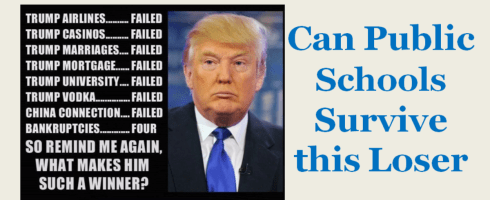
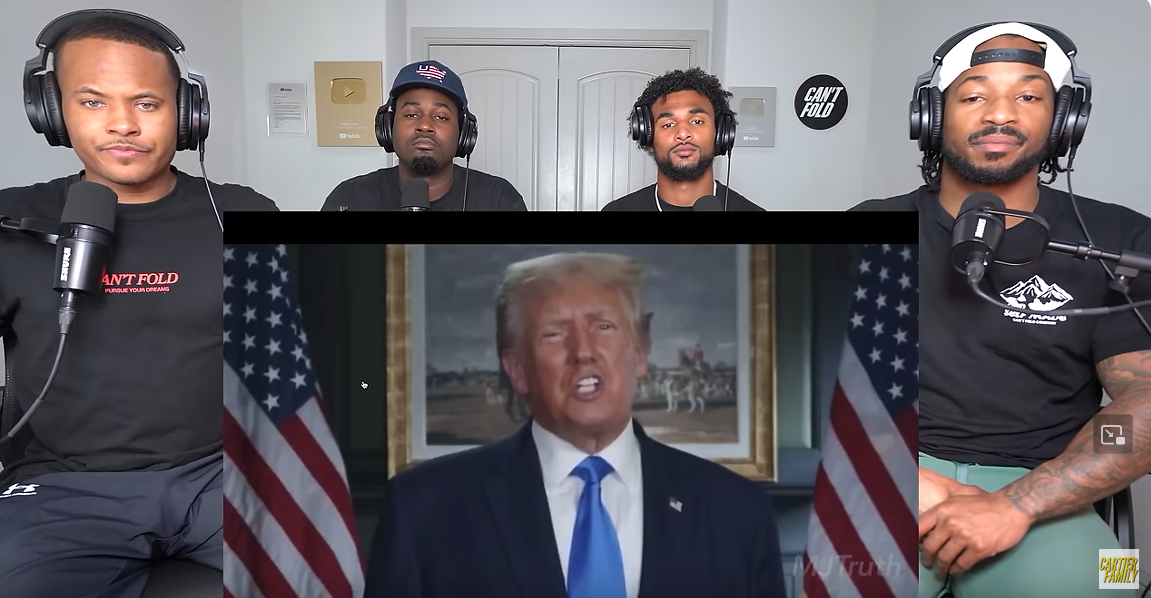
President Trump’s new video on the Carter Family’s YouTube channel lays out his ten points for public education. It is no surprise that the lies come immediately while he channels his inner Joe McCarthy, calling Biden and his administration communists. He also claims America is a failing nation.

Before kissing Trump’s ring recently, Joe Scarborough said his failing nation claim was wrong and stated:

We are also the strongest military power in the world. Even our enemies understand we’re not a nation in decline. Trump is always talking about Russian President Vladimir Putin and what a great leader he is. But the fact is, Texas has a higher GDP than the entirety of Russia.”

Politifact looked at the communist claims Trump has made about Biden and Harris:

“We sent the Trump campaign’s evidence to academics with expertise in Marxism or communism, including those with expertise in Latin America or the former Soviet Union. We noted examples we found of Harris showing support for people owning their own homes or businesses — basically the opposite of calling for government takeovers. No expert called her a communist or Marxist.” 

From Carter Family YouTube Channel

The lies cited above have been standard fare for Trump; so routine that most of us have accepted this as what he does. But in the opening paragraph of his education speech he tells a lie about public education that needs to be corrected. Trump claims:

“But instead of being at the top of the list, we are literally right. Smack. Guess what? At the bottom, rather than indoctrinating young people with inappropriate racial, sexual and political material, which is what we’re doing now, our schools must be totally refocused to prepare our children to succeed in the world of work and in life, and the world of keeping our country strong so they can grow up to be happy, prosperous and independent citizens.”

The indoctrination charge is baloney. The Hill noted:

“In the last two years, 15 states have adopted educational gag orders restricting ‘discussions of race, racism, gender, and American history’ in public schools, with seven states applying such orders to public higher education.

“Campaigns to eliminate diversity, equity, and inclusion programs, undermine tenure, ban or sanitize books, and appoint MAGA extremists to public university boards are well underway.

“Yet almost all the conservative claims about left-wing indoctrination are wrong.”

“The ‘patriotic education’ mandates pushed by anti-woke partisans, by contrast, are — practically by definition — indoctrination.”

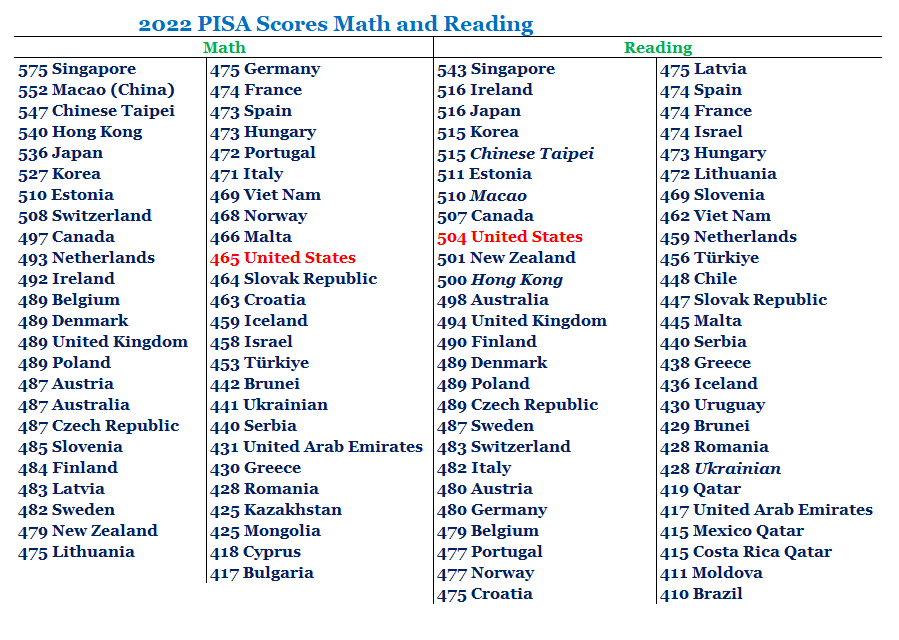
Trump’s claim that on international testing we are literally right. Smack. Guess what? At the bottom is an easily checked bald face lie. In 2022, the US participated in the international PISA testing. The following chart of data provided in the 2022 PISA report shows that the US was not nearly at the bottom.

Because America does not filter students from the academic system before high school, tested populations do not compare well internationally. However, since 2010, in the yearly International Math Olympiad, the USA team has come in first five times and never finished lower than fourth out of over 100 entrants.

One measuring stick demonstrating how successful the American system is would be Nobel Prize winners since 1949: America has 420 laureates; India 10; and China 8. The US has never won at standardized testing but leads the world in creative thinkers which is why a panicked China has been studying our system. They realize their test centric system is not developing innovation.

Diane Ravitch speculated that the new Common Corps standards might have been partly responsible for the drop in US scores on the 2016 international PIRLS testing. She sent her question to the distinguished social scientist David C. Berliner. He responded, “But before you or any others of us worry about our latest PIRLS scores, and the critics start the usual attacks on our public schools, remember this: Standardized Achievement Tests are quite responsive to demographics, and not very sensitive at all to what teachers and schools accomplish.”

Berliner shared the basic results:

  • USA 549
  • Singapore 576
  • Hong Kong 569
  • Finland 566

He then observed,

“First, we can note that Asian Americans scored 591. That is, our Asians beat the hell out of Asian Asians!”

Berliner also shared some other interesting US results broken into demographic groups:

  • White Kids (50% of our students) – 571
  • Upper Middle-Class Schools with 10% to 24 % Free and Reduced lunch – 592
  • Schools with 25% to 50% Free and Reduced Lunch – 566

It is obvious that the big drag on international testing data for US kids is childhood poverty and that the US education system is still the envy of the world.

Trump’s Ten Education Points

1) “First, we will respect the right of parents to control the education of their children.”

Writing in Forbes, Peter Greene reports, “advocates in the parents’ rights movement have not merely tried to opt their own children out of certain instruction and curricula, but have sought to ‘shape school curricula and policies for all students.”’ Scholar Vivian Hamilton, law professor at William and Mary notes, despite courts holding that parents have the right to decide whether or not to send their child to public school, “they do not have a fundamental right generally to direct how a public school teaches their child.”

2) “Second, we will empower parents and local school boards to hire and reward great principals and teachers, and also to fire the poor ones. The one whose performance is unsatisfactory. They will be fired. Like on The Apprentice, you’re fired.”

Even teachers have the protection of labor law and any firings must be justified. My experience was that within the first year, teachers who did not make the grade quit. They could not deal with the kids.

3) “Third, we will ensure our classrooms are focused not on political indoctrination, but on teaching the knowledge and skills needed to succeed. Reading, writing, math, science, arithmetic, and other truly useful subjects.”

I never met a classroom teacher focused on political indoctrination. It is not happening. However, the “patriotic education” mandates pushed by anti-woke partisans, by contrast, are — practically by definition — indoctrination.

4) “Forth, we will teach students to love their country, not to hate their country like they’re taught right now.”

Out of 1,000 teachers, there may be one that teaches this way but they will be gone soon. This is just not something even remotely occurring.

5) “Fifth, we will support bringing back prayer to our schools.”

This is a Christian Nationalist agenda that undermines the rule of law.

6) “Sixth, we will achieve schools that are safe, secure, and drug free with immediate expulsion for any student who harms a teacher or another student.

This sounds good but it should be a local decision and not a mandate by the President of the United States.

7) “Seventh, we will give all parents the right to choose another school for their children if they want. It’s called school choice.”

In Overturning Brown, Steve Suitts provides overwhelming evidence for the segregationist legacy of “school choice.” He shows that “Brown v Board” has been effectively gutted and “choice” proved to be the white supremacists’ most potent strategy to defeat it. In the 21st century, that same strategy is being wielded to maintain segregation while destroying the separation of church and state.

8) “Eighth we will ensure students have access to project based learning experiences inside the classroom to help train them for meaningful work outside the classroom.”

I am a fan of project base learning but curriculum design is not the business of the federal government.

9) “Ninth, we will strive to give all students access to internships and work experiences that can set them on a path to their first job. They’re going to be very, very successful. I want them to be more successful than Trump. Let them go out and be more successful. I will be the happiest person in the world. But we want our children to have a great life and be successful.”

This looks like another step in the ongoing Republican Party effort to undermine child labor laws.

10) “And tenth, we will ensure that all schools provide excellent jobs and career counseling so that high school and college students can get a head start on jobs and careers best suited to their God-given talents. This is how we will ensure a great education for every American child.”

OK but this is meaningless fluff that has little to do with great education.

“And one other thing I’ll be doing very early in the administration is closing up the Department of Education in Washington, DC and sending all education and education work and needs back to the states.”

Can we trust that the Trump administration will maintain civil rights enforcement and special education monitoring? Will they replace title one funding with something that is its equal? If the answer is no, then this is a horrible idea.

Conclusion

President Trump just announced that he disrespects teachers and will undermine public schools. He is so determined to end taxpayer funded free public education; he is trying to convince people that the greatest education system in the history of the world is a failure.

Choosing to End Public Education

25 Feb

By Thomas Ultican 2/25/2022

In 2017, the new President of the United States was explicit in his intention to end public education. He appointed a dominionist as secretary of education and regularly invoked the libertarian inspired pejorative “government schools” when referring to public schools. He loudly supported a movement to end public education which started in earnest five decades before he took office.

Its foundation was the economic theories of Milton Friedman and opposition to integration in the old south. Neoliberals, libertarians and their billionaire financiers have unsparingly attacked public education. Their fundamental weapon for ending the public school system is “choice.”

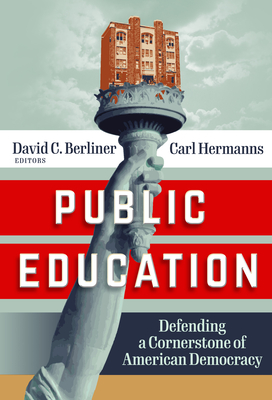
The newly published book Public Education: Defending a Cornerstone of American Democracy is a compilation of 29-essays edited by David C. Berliner and Carl Hermanns. All of the essays are written by accomplished award winning educators and historians. Gloria Ladson-Billings, known for her work on Culturally Relevant Pedagogy wrote,

“Some years ago, when the school choice movement began to gain attention, I argued that we were looking at the beginnings of the plan to destroy public education. There are those who declared I was being ‘alarmist.’ But I made this pronouncement after looking at the ways other aspects of public services have faced severe erosion.” (Education 226)

She also speculated that a contributing factor for the loss of consensus to support public schooling is the long-term campaign by powerful interest groups to portray public education as failing.

In another essay, Education Historian and former US Assistant Secretary of Education Diane Ravitch reported that in 1984 the Republican Party for the first time called for prayer in school and “choice.” She stated,

“Despite the sordid history of school choice and its origins in the segregationist movement, the term became a rallying cry for critics of public education. Right-wing think tanks, libertarian billionaires, and groups like the American Legislative Exchange Council – an organization that brought together far-right extremists, big corporate money, and other who wanted to reduce government regulation and unleash free enterprise – unleashed an unmodulated campaign of vilification against public schools.” (Education 27)

Duke University Professor of History and Public Policy Nancy MacLean, this past September published a new research paper at the Institute of New Economic Thinking – How Milton Friedman Exploited White Supremacy to Privatize Education.” She is the author of the must read book Democracy in Chains: The Deep History of the Radical Right’s Stealth Plan for America.” In her new paper MacLean states,

“This paper traces the origins of today’s campaigns for school vouchers and other modes of public funding for private education to efforts by Milton Friedman beginning in 1955. It reveals that the endgame of the “school choice” enterprise for libertarians was not then—and is not now–to enhance education for all children; it was a strategy, ultimately, to offload the full cost of schooling onto parents as part of a larger quest to privatize public services and resources.”

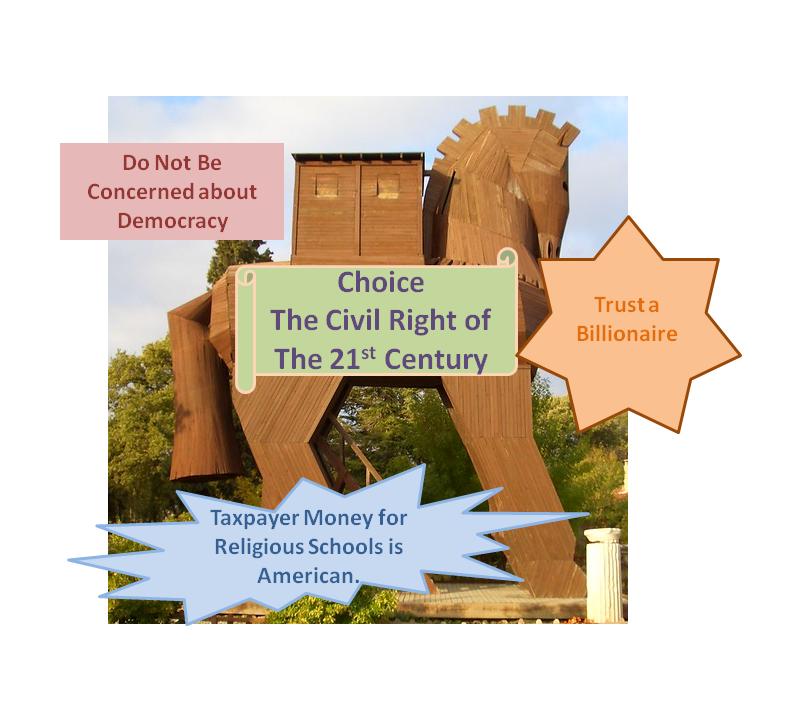
A New Trojan Horse

The Gateway Drug: Charter Schools

An article by the Education Law Center’s Wendy Lecker states,

“As noted in a 1996 Detroit Metro Times article, while the DeVos’ ultimate aim was to abolish public education and steer public funds to parochial schools, they knew not to be blatant about that goal. Thus, they chose a vehicle that blurred the lines between public and private schools- a “gateway drug” to privatizing public education: charter schools.”

After John Walton read the 1983 Reagan administration publication ‘“A Nation at Risk’ with its ominous warnings about the failings of public education,” he convinced his family to direct their philanthropy toward reforming public education. Throughout the 1990s he campaigned endlessly for new voucher legislation and saw his efforts repeatedly rebuffed. Shortly before his death in 2005, John joined Don Fisher and Buzz Woolley in establishing the Charter School Growth fund. Around the same time the Walton Family Foundation began financing charter school startups in communities across America.

Jeff Bryant interviewed Jeffry Henig of Teachers College about the Walton’s move to supporting charter schools. Bryant asserted,

“Henig believes many conservatives view charter schools as a way to ‘soften the ground’ for potentially more private options, though he isn’t entirely sure ‘the Waltons view charters as a Trojan Horse for eventually providing vouchers universally.’”

Former Secretary of Education Betsy DeVos has carried on a relentless attack on public education that continues today. One of the images she sells is viewing students as having a backpack full of taxpayer money which each school age child’s parents spends on education services. In her essay “Public Education at a Crossroads: Will Horace Mann’s Common School Survive the Era of Choice?” educator, administrator and public school advocate Carol Burris warns,

 “Given the anti-tax, anti-government proclivities of those who espouse this type of funding scheme, it is likely that fewer and fewer tax dollars would be place in the backpack over time. Parents once again would assume the sole responsibility for educating their children, buying what services they could afford, with the poor relying on charity.” (Education 239)

A Pillar of Democracy: Public Education

In the essay “Values and Education Policy” Edward Fiske and Helen Ladd tell us, “Good education policy making is rooted in coherent and enlightened educational values.” (Education 33) They begin by discussing the values expressed by Horace Mann who successfully implemented his vision of “common schools.” Today’s public school system is very much a result of that vision and his leadership. Some of the issues Mann addressed are the same issues driving “choice” today. Fisk and Ladd share,

“The idea of taxing all citizens, including those of the privileged classes who already enjoyed access to private education, in order to finance the education of poor and working-class children was viewed as both wasteful and as an infringement of property rights. Mann argued that free schooling served the collective interests of all citizens, rich and poor alike. ‘Jails and state prisons are the complement of schools,’ he wrote. ‘So many less as you have the latter, so many more you must have of the former.’”

“He famously declared, ‘Education, then, beyond all other devices of human origin, is the great equalizer of the conditions of men – the balance-wheel of the social machinery.’” (Education 34-36)

The authors conclude,

“Proponents of citizenship education are struggling to find a place in school curricula. Powerful private foundations and individuals, including the recent U.S. Secretary of Education, are raising millions of dollars to undermine the concept of universal education by privatizing public education and, by means of vouchers and charter schools, to break the link between publicly supported schools and democratically elected officials. Racial resegregation of schools is now pervasive, and courts are retreating from the notion that public funds should not be used to further sectarian religious instruction.” (Education 45)

For a long time, Richard and Betsy DeVos have been working to obliterate the separation of church and state, and privatize public education. In a 2001 interview conducted at the Gathering, Richard  lamented how awful it was that public schools had replaced churches as the center of communities. He did not identify whose church would be accepted as the new community center, but it seems certain to be some flavor of Christianity.

Public Education Shares Informed Discourse

Thirty-two of America’s most accomplished education thinkers and practitioners share their insights. All of them have more than two-decades of experience practicing, researching and debating education policy. None of them are billionaires trying to offload their tax burden or implement self-centered libertarian ideology.

In these pages, there is general respect for Horace Mann’s education advocacy and the public school system but also recognition of associated problems. The common schools were not just the “great equalizer” but also the great homogenizer. They indoctrinated students with a protestant Anglo-Saxon ethic. There is nuanced discussion here about the great foundation for democracy (public schools) needing to inspire not indoctrinate. And some of the authors reject the “great equalizer” belief as a myth.

Professor Ken Zeichner discusses the extreme segregation of public schooling in the United States, speculating they are “possibly more segregated today than it was in the 1960s.” (Education 178) He says in non-dominant communities, families and community members are excluded from real participation in school affairs. He recommends community centered engagement versus school centered engagement. Unfortunately he reports, “Both federal legislation and school practices have encouraged school-centric as opposed to community-centric family and community engagement, creating mutual distrust between families and schools.” (Education 179)

University of Georgia’s Peter Smagorinsky shares, “According to [Betsy] DeVos, those who direct the prevailing K-12 system are ‘trapped in an outdated education model,’ beholden to the ‘wrong and manipulative’ theories of Horace Mann and John Dewey.’” For people not on the extreme right this sounds like nonsense. However, Smagorinsky cautions that people’s positions “are largely emotional and the argumentative reasoning is used as a post hoc means of justifying an established position, … it’s unlikely the Culture Wars will end any time soon, because no one can win them with logic or facts.”

I will end my taste of what is in this wonderful compilation with a quote from one of the editors, David Berliner. He ran through a litany of the scandals arising from both the charter and voucher school movements fueled by unregulated taxpayer dollars. Then personally gratifying to me he wrote, “But Tom Ultican, a thoughtful and passionate defender of public schooling, has a reminder to Americans about the origins of the charter and voucher movement in our nation,”

“Birthed in the bowels of the 1950s segregationist south, school choice has never been about improving education. It is about white supremacy, profiting off taxpayers, cutting taxes, selling market-based solutions and financing religion. School choice ideology has a long dark history of dealing significant harm to public education.

“Milton Friedman first recommended school vouchers in a 1955 essay. In 2006, he was asked by a conservative group of legislators what he envisioned back then. PRWatch [published by the Center for Media and Democracy] reports that he said, ‘It had nothing whatsoever to do with helping ‘indigent’ children; no, he explained to thunderous applause, vouchers were all about ‘abolishing the public school system.’” (Education 280-281)