By Thomas Ultican 5/18/2025
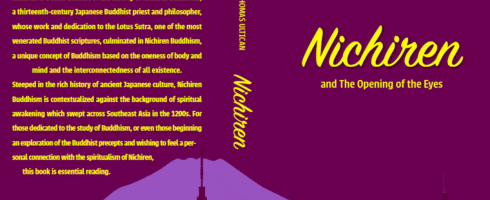
My just published book, Nichiren and the Opening of the Eyes, is probably a bit of a surprise for public education advocates. For the past 15-years, I have been one of the loudest voices fighting against the demise of taxpayer funded free universal public schooling. However, long before I became an education advocate, I embraced Nichiren’s philosophy.
Strangely enough, I have been working on this book the entire time that I have been an outspoken advocate for public education.
The first paragraph of the book’s introduction shares:
“In February 1969, I was walking down Broadway in San Diego, California when a Japanese woman approached me. She spoke almost no English, but I understood her to say, “World Tribune; Buddhist discussion meeting; you go.” That was my first encounter with Nichiren and his declaration that chanting Nam-myoho-renge-kyo opened the path to Buddhahood, personal happiness, and world harmony.“
In 1969, I was not the only one who had never heard of Nichiren Buddhism. Scholar Daniel Montgomery reported that in the 1930s, a Japanese monk chanted Nam-myoho-renge-kyo while his new friend Gandhi beat a chanting drum. Montgomery also stated that many self-help and new-age religious movements teach ideas that originated with Nichiren, but they often do not know the source.
My book is a biography of this 13th century Japanese monk whose tale rivals that of any historical figure. He came close to a violent end at least four times while spreading his message of Buddhist reform and human salvation. Living in a samurai-dominated society, this oracle once had an astronomical event save him from the executioner’s sword.
This is the most comprehensive biography of Nichiren ever produced in English.
I traced the life of a boy from his humble fishing village to his establishing what has become a world religion, now known as Nichiren Buddhism. Such a large percentage of the Japanese population started following Nichiren that rival Buddhist sects and governing authorities went to extraordinary lengths to thwart him.
In 13th century Japan, Nichiren joined Esai, Hōnen, Shinran and Dōgen as founders of new sectarian movements. Esai and Dogen established, respectively, Rinzan Zen and Sōtō Zen. Hōnen founded the Pure Land Sect and Shinran, the True Pure Land Sect. These schools founded by the five Buddhist monks, known as the “Kamakura reformers,” survived throughout the past 800 years.
Today, it is only Nichiren’s teachings that have moved past just surviving to stunning worldwide growth.
His philosophy was suppressed after he died, but along with all other Buddhist schools allowed to propagate with the advent of Meiji Imperialism in 1868.
Nichiren was a forward-thinking man with surprisingly modern views. It is remarkable to discover that many of this Dark Ages’ Japanese monk’s most important disciples were female, in a time when women were treated like property. He accepted the equality of the sexes as common sense and accorded women a respect equal to that given his male followers.
Nichiren was a prolific writer and his disciples went to considerable lengths to preserve his messages. Today, over four hundred of his letters and treatise are extant, including 146 in his own hand. These were the backbone documentation for this project.
After 15-years, the book has finally arrived.

A Personal Journey
A press release referred to me as a veteran student of the Soka Gakkai indicating my background in Buddhist study. They asked, “How did a guy who grew up on a ranch in Idaho become a Buddhist?”
I was a 19 year-old sailor just returned to San Diego from a 9-month Southeast Asia tour on a Destroyer. We mostly worked in the Tonkin Gulf off the coast of Viet Nam. When walking past a small long-gone downtown park, Horton Plaza, I encountered the Japanese woman mentioned above. I was a little interested and too young to go to the bars, so I went with her. We arrived at a small former church where I met a guy who told me that by chanting Nam-Myoho-Renge-Kyo he was able to get a driver’s license in spite of five drunken driving charges. At the time, I was thinking this does not sound like a good thing.
The timing was right for me. Most of my buddies from the ship were over 21 and out in the bars doing the kind of sailor things we used to do together in the Philippines, so I would go to that little church and hangout. I was pretty sure it was a cult but was inexpensive and friendly. Every night the members would chant for about an hour to be successful. I thought chanting was fun and would join in. It turns out that anyone who chants Nam-Myoho-Renge-Kyo for any reason will start experiencing its power.
That is how I became a Buddhist. I was having great luck finding parking spots and getting green lights. More importantly, I was struck by the sincerity of the local members.
Since that time, I have had many much more profound and eye opening personal experiences but those early parking spots near the main entrance at the 32nd street naval station were important for my Buddhist journey.
Motivating the Writing
In 2010, I was reading an article by our international president, Daisaku Ikeda, in the SGI-USA publication, World Tribune. Ikeda, who I viewed as my teacher, encouraged all youth division members to write about Nichiren Buddhism. I decided since I was only 60 that I qualified as a youth and would work on a paper about Nichiren’s amazing treatise, “The Opening of the Eyes.”
I was teaching 150-170 high school students in math and physics so my paper made slow progress, but after a year, I started expanding the context. The more I worked on the piece, the more I looked at Nichiren’s overall life. Finally it occurred to me that I had never seen a complete biography of him. That is when I decided to write this book.
Now that it is done and in print, I am pleasantly surprised by how much I like it. Whether Buddhist or non-Buddhist, readers of this book will learn a lot and enjoy the read.
To find the book, go to Amazon and type: Ultican

 tultican
Recent Comments