By Thomas Ultican 11/18/2025
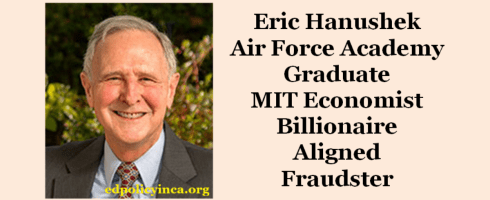
A propaganda rag, ‘The 74’, reported, “[R]esearch from Stanford estimates learning loss over the past decade has cost our country over $90 trillion in future growth.” The article was written by Eric Hanushek, a Stanford University economist, and Christy Hovanetz, an education researcher from Jeb Bush’s pro-school choice and pro-education technology organization, ExcelinEd. Unsurprisingly, the article linked above is a paper Hanushek wrote. Crazy-pants Eric has a long history of using his own papers to support new research which is typically long on assertions and short on convincing analysis.
Last year, he claimed COVID-19 “learning-loss” could cost America $31 trillion in future economic development. Hanushek’s latest paper asserts, “The present value of future lost growth would be approximately three times current GDP (which is $30 trillion).” The justification for this new assertion is more than uncertain. The new paper refers to a model from his 2011 paper written with Ludger Woessmann for the Organization of Economic Co-operation and Development. That paper was long on Arithmetic with several assumptions short on common sense. In his latest paper and this article, he is claiming that a small drop in the National Assessment of Education Progress (NAEP) scores added to what he calls “Covid learning loss” will cost America $90 trillion in future growth.
Eric Hanushek first gained notoriety with his 1981 paper, claiming “there is no relationship between expenditures and the achievement of students and that such traditional remedies as reducing class sizes or hiring better trained teachers are unlikely to improve matters.” This claim attracted conservative billionaires but had little relationship with reality. When providing solutions in ‘The 74’, Hanushek and Hovenetz contradict his 1981 paper writing:
“First, states need to invest in effective personnel. They can do this by incentivizing strong teaching and by supporting strong teaching through professional development in evidence-based practices such as use of high-quality instructional materials and assessment data to inform instruction.”
A few decades ago, a friend gifted me the book “An Incomplete Education” by Judy Jones and William Wilson. After my 1987 edition, Jones and Wilson have updated the book and republished several times. I fondly remembered their description of economists:
“Economists are fond of saying, with Thomas Carlyle, that economics is ‘the dismal science.’ As with much that economists say, this statement is half true. It is dismal.”
“Where once rulers relied on oracles to predict the future, today they use economists. Virtually every elected official, every political candidate, has a favorite economist to forecast economic benefits pinned to that official or candidate’s views.” (Incomplete Page 120)
It just so-happens that Eric Hanushek is an MIT trained economist who is good at creating reports that conform to the beliefs of conservative billionaires. His work is scientific propaganda masquerading as academic excellence.
Notices from Hanushek and Hovanetz
“No single event over the postwar period has had an impact on our educational system that comes close to that of the pandemic.” This statement from their article is hyperbole not fact.
The impact of vouchers in Washington DC and Ohio were worse than COVID-19. In his book, “The Privateers”, Josh Cowen shared that the losses due to COVID-19 were around -0.25 standard deviations while losses in DC due to vouchers were around -0.40 standard deviations and in Ohio they were as high as -0.50 standard deviations. (Privateers Page 6) However, these were not nationwide results. Unfortunately, we don’t have much information about the mumps, measles, flu and polio epidemics of the 1950s but there is every reason to believe their impact was close to that of the COVID-19 epidemic.
The authors hold up Mississippi, Tennessee and Louisiana as examples to emulate stating:
“Some states made noteworthy progress on NAEP this year: Mississippi, Louisiana and Tennessee. Each has a track record of high expectations and strong accountability.
“These states use an A–F school rating system that puts reading and math achievement front and center. They measure what matters — proficiency and growth — and they report results in a way families and educators can understand. Transparency and rigor are fueling their progress.”
The A—F school ratings system is worthless because it only measures parent income. As Diane Ravitch wrote on her blog:
“The highest rated schools have students with the highest income. The lowest rated schools have students with the lowest income.”
I wondered what Hanushek and friend were alluding to, so I graphed the average NAEP data for 4th and 8th grade reading and math since 2015 to see if it provided a clue.
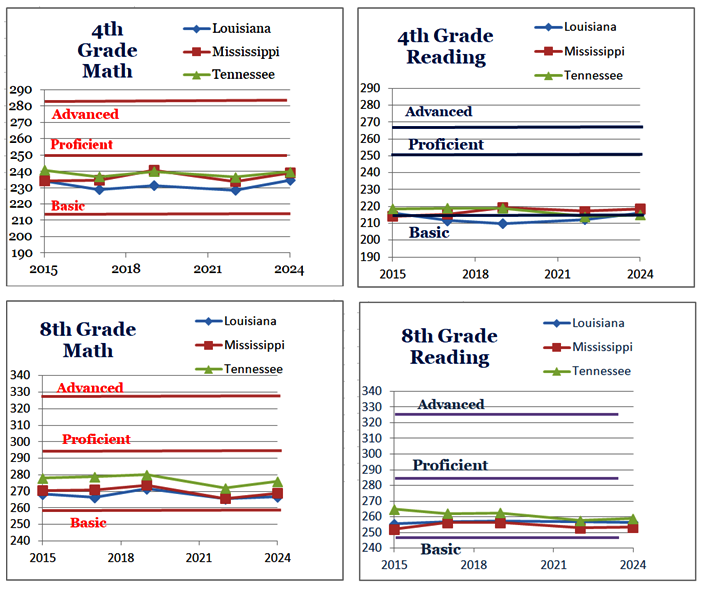
NAEP Data for Louisiana, Mississippi and Tennessee
I added a bar indicating the NAEP cut scores for the 2024 NAEP designations of basic, proficient and advanced as a reference. It is well known that NAEP’s proficiency level is set well above grade level which means 70% of students not being rated proficient is not a bad score. Furthermore, writing in Forbes, Peter Greene shared, “An NCES report back in 2007 showed that while NAEP considers “basic” students not college ready, 50% of those basic students had gone on to earn a degree.”
The data graphed here indicates to me that all three states have solid public education programs. It is noteworthy that in reading their 4th graders only averaged basic but by 8th grade their average results were above basic. However, all three states are among the bottom 15 scoring states in the US and as we would expect are in the bottom 15 states in family income. What I do not see is why they are held out by Hanushek and Hovanetz as exemplars.
Concluding Remarks
The first blogger to label Eric Hanushek crazy-pants was Peter Greene. I have found Peter’s creativity worth stealing.
Let’s be clear, there is no such thing as “learning loss” involving students. This is a complete misnomer. Students may not achieve some state provided targets but they are always learning; maybe not what we want them to learn but always learning.
Eric Hanushek is a huckster for conservative billionaires. This latest claim is beyond farcical. Claiming to have knowledge of economic development in 40 years is fantasy and then tying that fantasy to NAEP testing data is bizarre. His $90 trillion claim for loss of future economic development would embarrass a carnival barker.
Hanushek is the guy who thinks education can be measured in days of learning which means that students learn in a near linear fashion. They absolutely do not but even this bogus claim would seem prescient when compared to this latest assertion.
Standardized testing only correlates with family income. To evaluate education based on this fictitious instrument is fraudulent. By extension, this makes economist Eric Hanushek a con artist.

 tultican
Recent Comments