Tag Archives: Charter schools

Charter Schools in a Racist Big Easy

8 Dec

By Thomas Ultican 12/8/2025

New Orleans was the site of the largest slave market in America. In the late 18th and early 19th centuries, more than 135,000 slaves were purchased in the Big Easy. This racist legacy has survived up until today in many of its White citizens, business leaders and politicians. The book William Frantz Public School states, “By the 1920s, Orleans Parish School Board members and district administrators vehemently voiced their belief that White supremacy should guide public policy and stated their willingness to employ any means, including the use of force, to maintain inequality between the two races.” (William Frantz Page 4) After the Supreme Court’s Brown decision, long-time state senator William Rainach headed a strategy committee that condemned integration as the work of communists and created the all-White Louisiana’s Citizens’ Councils (Overturning Brown page 34). Leading up to hurricane Katrina, many White citizens continued working to maintain the ideal of White supremacy.   

This summer, Tulane University’s Education Research Alliance (ERA) created and published The New Orleans Post-Katrina School Reforms: 20 Years of Lessons.” This report was published June 2, 2025 by authors Douglas Harris and Jamie Carroll. In an alliance with Network for Public Education (NPE), Kristen Buras PhD, who has been studying New Orleans schools since the hurricane, wrote a paper countering many of the claims made in the ERA paper.

There is reason to believe the two ERA writers are incapable of doing unbiased research in the education realm.

In 2023, Diane Ravitch disclosed that while serving as Secretary of Education, billionaire Betsy DeVos gave $10 million to establish a research center on school choice. The longtime advocate of school choice was not apt to give the money to academics likely to throw cold water on her life’s work. The grant went to Tulane University in the only American city that has no public schools. Ravitch noted, “The organization she funded is called the National Center for Research on Education Access and Choice (REACH), led by economist Douglas Harris.”

Jamie Carrol who attended an all-girls high school in Maryland was a Teach for America (TFA) teacher 2008-2010 in New Orleans. She went on to earn a Doctorate of Philosophy from the University of Texas. Today, she works as a researcher for Betsy DeVos’s REACH.

In her Paper, The Stories Behind the Statistics: Why a Report on “Large Achievement Gains” in Charter Schools Harms New Orleans’ Black Students”, Kristen Buras shares that the amazingly pro-charter school Arnold Foundation has spent lavishly to advance charter schools in New Orleans; in 2012 $15 million for “education reform” in New Orleans, then another $25 million to be managed by the Charter School Growth fund and New Schools for New Orleans (NSNO), and 2014-2017 grants to Tulane University and ERA of more than $5 million. Buras comments, “Grants from this consistently pro-charter foundation helped launch and sustain ERA’s work.”  (Buras Page 17) 

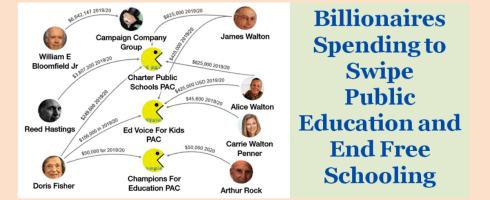
Recently, two of America’s most active funders of charter schools awarded nearly $1 Million to REACH: the Walton Foundation and the City Fund (Buras Page 18). The Walton family, who owns Walmart, is the wealthiest family in the world and the largest private funder of charter schools in the US. The City Fund was created by billionaires Reed Hastings and John Arnold. They each put in $100 million to create an organization specifically for spurring the spread of charter schools.

Do Not be Naïve

Even before hurricane Katrina, there were efforts for the state to take over New Orleans’s public schools. Tulane University President Scott Cowen was quite influential in the development of the state of Louisiana’s education policies. In 2003, Cowen was involved in the creation of the Recovery School District (RSD) that was to take control over “failing schools” in New Orleans and reform them. After Katrina, Cowen headed the education committee of Mayor Nagin’s Bring Back New Orleans Commission. In early 2006, Cowen’s committee released a report recommending that New Orleans become the nation’s first all-charter school district (Buras Page 18). 

Scott Cowen established Tulane University’s Cowen Institute, a predecessor of ERA. Buras reported on conducting interviews with Cowen’s staff in 2009 noting:

“I asked about the institute’s mission. Like ERA, they characterized their work as neutral. One staff member shared: ‘We don’t advocate for an all-charter system because we don’t feel there’s adequate research [at this point] to indicate that charters will outperform non-charters.’ Instead, the staff portrayed the Cowen Institute as an ‘honest broker’ and ‘objective observer.’ Yet, NSNO, TFA, and other pro-charter school groups were given free office space in the same suite as the Cowen Institute.” (Buras Page 18)

To this day, ERA shares office space on the seventh floor of 1555 Poydras Street with NSNO.

Since its inception, NSNO has been all about building the all-charter school system in New Orleans. A peak at their tax records (EIN: 02-0773717) shows Neerav Kinsland appearing on the board in 2010 and earning $117,000 as chief of strategy. In 2011 he became CEO earning $146,000 and over the next two years he was paid $207,000 and $223,000 as CEO. But that wasn’t good enough. Since then, he has worked for billionaires John Arnold and Reed Hastings, served on the California Charter School Association board and is now leading the City Fund.

After Katrina, Black teachers decreased from 71% in 2005 to 49% in 2014, then rose to 56% in recent years. They were paid less than white counterparts in the same teaching and administrative positions (Buras Page 13). Experienced Black teachers were replaced by mostly White college graduates from TFA with just 5 weeks of training as an educator.

Students in the Big Easy are forced to take long bus rides often past, within walking distance neighborhood schools, to get their assigned charter school. It is not unusual for them to soon be traumatized by one of New Orleans multiple school closures. Somehow, white children in New Orleans rarely experience school closures.

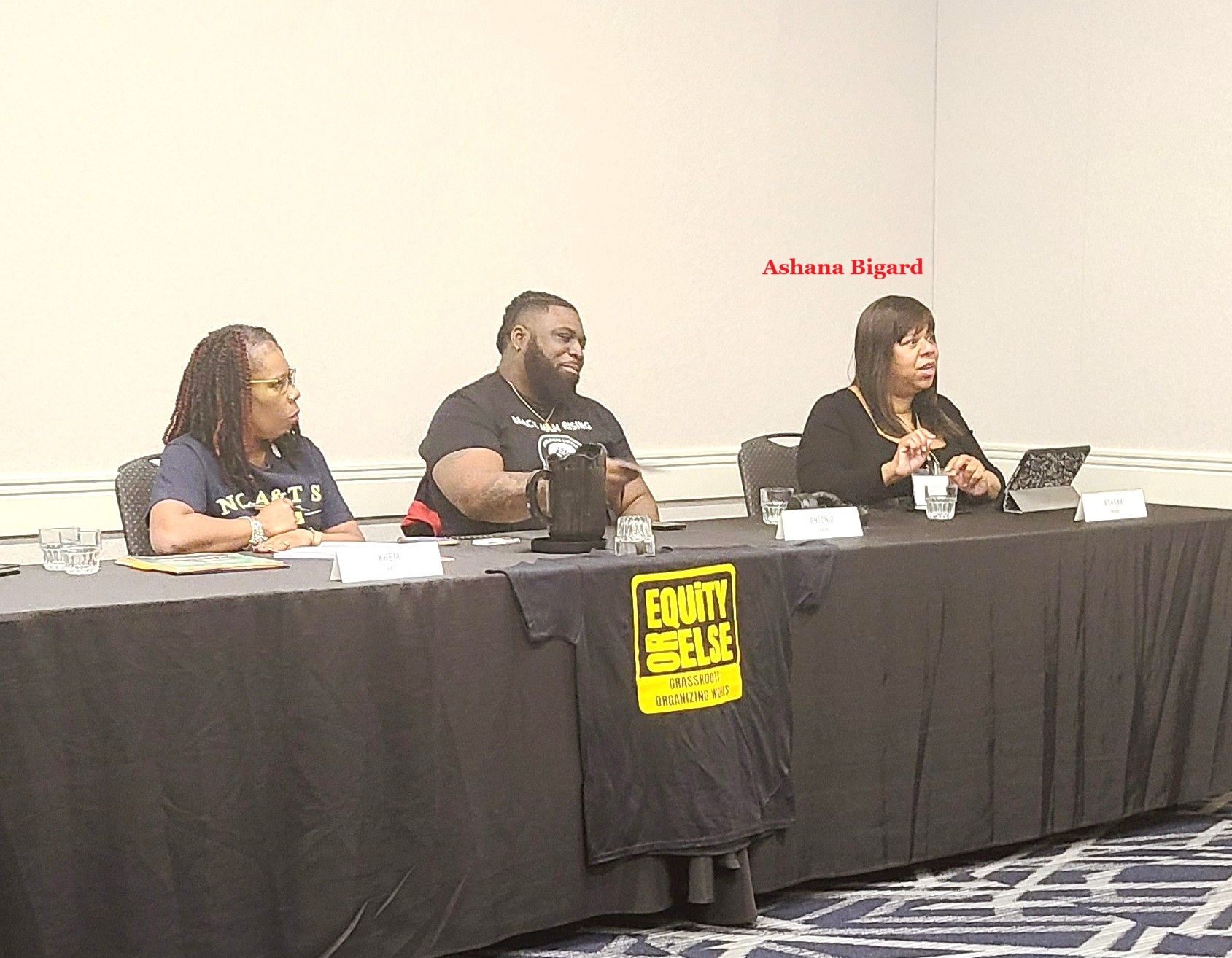
Ashana Bigard shared in her book “Beyond Resilience Katrina 20about the racist enrollment process in the all-charter school system. To enroll children, parents must use OneApp. It runs the school choice algorithm but strangely only white children get into the best schools, not even if you’re a Black family in the upper middle class do you get a seat. It is common to see White people move to the city and magically get their children into schools with 100 children on the waiting list. Ashana notes, “They didn’t even know the school existed prior to moving to the city, but racism and classism still existed heavily within the new system.” (Bigard Page 268)

Cheating Charters

The state cheated to create the conditions for developing the all-charter school system. Before Katrina, the cut point for school failure was 60 on a 200-point scale. After Katrina, through Act 35, the state legislature raised the cut point to 87.4, which was just below the state average. This maximized the number of public schools that the RSD could seize. Then, as charter schools were opened, the cut point for failure was lowered back to 60 (Buras Page 19).

The Times-Picayune reported that “data published by the Louisiana Department of Education vastly underreported the number of expulsions in charter schools.” For the 2007-2008 period, state data from a sample of 19 RSD charter schools listed only 4 students as having been expelled. The Lafayette Academy admitted to the Times-Picayune that 14 students were expelled that year; the state reported zero for Lafayette. (Buras Page 16)

In 2011-2012, 34% of schools in New Orleans had an out of school suspension (OSS) rate at or above 20%. Since 2009, charter schools have suspended students at rates sometimes double and triple the state average which was not that great to begin with. (Buras Page 15)

In 2015, SciTech Academy allowed students to take tests for one another, at home or multiple times (Buras Page 21).

Students coded as “transferred out of state” are excluded from the state’s metric. The inordinate use of the out of state code by charters seemed to be masking the true dropout figures which improved their state ratings (Buras Page 21).

At Landry-Walker, 78% of students scored “good” or “excellent” on the biology EOC and 78% on the geometry EOC. Only “good” or “excellent” scores earn points on the state’s metric. Yet, 52 of the 257 students who scored “good” or “excellent” on the EOC exam received a D or F in the class. By 2017, the Louisiana inspector general’s office had uncovered enough evidence of criminal wrongdoing at Landry-Walker that the local district attorney was alerted (Buras Page 21).

In her report, Buras says these are likely just the tip of the iceberg when it comes to charter school test cheating. Yet these inflated scores and school ratings are used by ERA to claim good academic results in New Orleans’s charter system. The willingness to ignore the cheating problem is appalling.
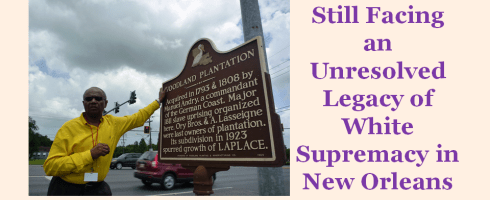
Beyond Resilience Katrina at 20

14 Oct

By Thomas Ultican 10/14/2025

The book William Franz Public School is a well documented work that shines a light on the deep racism in New Orleans and especially in its public schools. The title is the school where 6-years-old Ruby Bridges accompanied by federal officers desegregated New Orleans’ schools to the chagrin of the 1,000 plus protesters out front. “The message rang clear; Louisiana’s strong commitment to the education of its White, wealthier children paralleled an equally strong commitment to keep its Black, poor residents uneducated and isolated, and thus economically and politically powerless.” (WFPS 11) That ugly racism still permeates New Orleans which made me question what are their Black residents thinking and feeling. Ashana Bigard’s book, “Beyond Resilience Katrina 20, brilliantly provides some answers.

Bigard and her family have been in New Orleans forever; she is at least fifth generation. Her large family is a big part of the soul of New Orleans. Ashana takes her readers into the Black community that has refused to be beaten down and defeated by wealthy White supremacists.

After Katrina, the people in power stole the public community schools, fired the mostly Black teaching force and brought in predominantly white kids from Teach for America (TFA) to teach. Ashana shares that story beginning with running from the storm and then fighting against injustice for the last 20-years.

Katrina Arrived

Hurricane Katrina arrived about a week before payday for much of the New Orleans community. Like many others, Ashana and her family had experienced hurricanes before. They really could not afford to travel so they chose to wait it out at home. The storm came through and made a direct hit on the city, it was loud and intense but the next morning things seemed OK.

It was a tough night, but they had successfully ridden out the storm and it was beautiful outside. Ashana decided to walk to the old New Orleans community of Carrollton to check on a friend. Downed trees were everywhere. On the way an old man informed her that if she did not “have a boat in your pocket” she better get out of there because the levees had failed and the water was coming. (Bigard Page 11)

Some people in the community believed the levees had been purposefully blown up. Ashana and her family quickly got it together to load up and head out for Houston where they stayed until New Orleans opened again.

NPE 2025 Photo by Ultican

Back in New Orleans “the fraud was staggering” and media racism was appalling. Ashana noted:
“It seemed like every opportunity afforded to them, the media disparaged us calling us refugees and calling us looters. … White people getting food from stores to help each other … were described as ‘finding food.’ Black people doing the exact same thing were ‘looters’ and criminals who should be shot on sight, despite the fact that they had been left to die with no water, no food for days on end.” (Bigard Pages 32 and 33)

Rebuilding New Orleans

The work force in New Orleans is dominated by the Black community. However, when the rebuild started, local unions were frozen out. Wealthy carpetbaggers were running the show. Ashana sarcastically asks, “how could everybody get their money off the top if they were actually paying people real wages?”

There were no longer community schools that welcomed children or a city that was welcoming to its people. They soon began referring to their children’s schools as “test prep factories” and the kids called them “preparatory prison practice.” The youths of New Orleans named the new Knowledge is Power Program (KIPP) schools “kids in prison practice.” (Bigard Page 34)

Ashana worked at various non-profits as a student, parent and community counselor and advocate. She worked for families and friends of Louisiana’s incarcerated children where family members wanted to understand how their children first came into contact with the legal system.

Where were the arrests happening? Where were the summons coming from?” (Bigard Page 44)

The discovery didn’t take long. Ashana states, “The police inside the schools were arresting children for almost anything.” (Bigard Page 45) Best practices in adolescent development call for supportive environments, recognition of the biological realities of the teen years, and second chances not criminalization and punishment. This new school-to-prison pipeline was a complete abandonment of reason.

What developed in New Orleans was a harsh unforgiving no-excuses approach. This led to high expulsion rates and a 61% graduation rate.

Ben Kleban of College Prep charters told Ashana he would run his schools the way he wanted and if you don’t like it do what I did and start your own school. However, many PHDs, principals and academics from New Orleans applied to start schools almost none of them received a charter. (Bigard Page 54)

Ashana tells the story of counseling a teenage boy, a good student whose grades began falling for no apparent reason. Also he was becoming more and more despondent. After a week of discussion, he finally opened up about being sexually assaulted by a female TFA teacher. Apparently, the teacher succumbed to the adultification of young Black people. The student was blaming himself and tried to protect the teacher saying, “She came from Teach for America: they don’t give them much training.” (Bigard Page 98)

Ashana and her team were brought in to conduct a workshop on trauma: signs of trauma, solutions for trauma and how to deal with trauma in your classroom. Ten minutes into the workshop all 26 of the young White women were in tears. Ashana states:

“They were crying saying they were overwhelmed, suffering from secondary trauma, felt like they were crazy, and they all felt they were doing more harm than good. They had no support and when they went to Teach for America for support, they told them to try harder, and if they weren’t connecting, it was their fault because everyone else was doing a great job.”

The training developed into multiple unscheduled workshops that day as teachers went out and encouraged their colleagues to attend. Ashana says:

“I left the workshop understanding you never know all sides of the story and that there was a second wave of victims, and that was young, hopeful, starry-eyed white young people who thought this would be a great city to live in and a great opportunity and they could come and help out because of the teacher shortage which was caused by the firing of all our teachers and subsequently telling them that they had to take multiple tests to qualify to come back to teach while simultaneously telling young white children they only needed two weeks of training to do so.” (Bigard Pages 119-121)

The Legacy of Racism Lives On

To enroll children into the almost all charter system in New Orleans, parents must use OneApp. It runs the school choice algorithm but strangely only white children get into the best schools, not even if you’re a Black family in the upper middle class do you get a seat. It is common to see white people move to the city and magically get their children into schools with 100 children on the waiting list. Ashana notes, “They didn’t even know the school existed prior to moving to the city, but racism and classism still existed heavily within the new system.” (Bigard Page 268)

Ashana tells black people in New Orleans that poverty is not a moral failing. She says, “We start understanding that we are not broke we are stolen from.” (Bigard Page 318)

I have presented a few highlights in this delightful and insightful book. For me, Ashana’s book offers a rare view into the life of Black people fighting White supremacy and a story of love and family.

Bravo Ashana Bigard!

California Charter School Movement Update

25 May

By Thomas Ultican 5/25/2025

Charter schools continue grabbing larger percentages of California students and have surpassed 700,000 in total enrollment. Their existing in California for more than 30-years means it is probable that some charter school students have parents who went to charters. None of this is because charter schools are superior to public schools or that many California public schools are bad. It is the right wing ideology of “school choice” and massive spending by billionaires driving charter growth. Sadly, it means we are undermining democracy and increasing segregation.

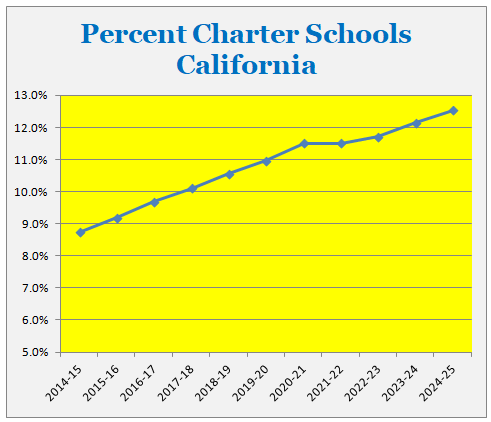
California enrollment data documents the continuing charter school growth. This first chart is of the percentage of charter school students in the state over the past decade.

As the chart shows, charter school students now make up 12.5% of publicly financed students in California.

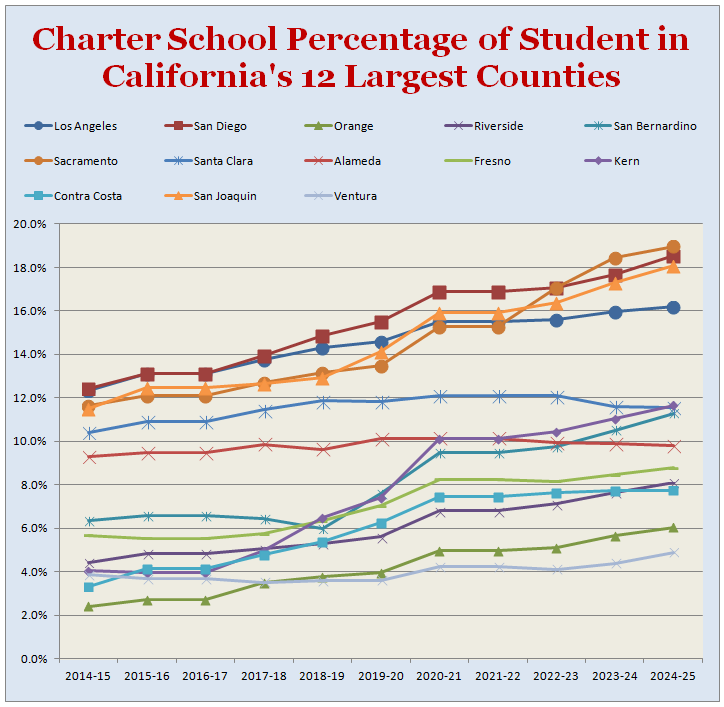
This next chart is of charter school growth in the 12 largest California counties. It provides insight into where the growth is occurring.

The four counties with more than 16% charter school students are Los Angeles, San Diego, Sacramento and San Joaquin. LA and San Diego are the two largest counties in the state but Sacramento is number six in size and San Joaquin is 11th. The third largest county in California is Orange and it only has a 6% charter enrollment. County population is not a good indicator for where charter schools will spread.

The growth in San Joaquin seems to have two important causes. The largest city, Stockton, is close to charter promoting organizations in Oakland and Sacramento. More importantly, Don Shalvey has always lived on his small ranch near Stockton. During his long education-centered career, he worked with billionaires including Reed Hastings, Bill Gates and Helen Schwab, to privatize public education. In 1993, Don’s San Carlos Learning Center became the first charter school in California and second in America. After retiring from his job at the Gates Foundation, he went to work for a small non-profit, San Joaquin A+, and turned it into a large well financed charter school promoting organization.

Massive Continuous Funding

Soon after legal means were provided for “school choice” by chartering, two organizations were developed to accelerate and sustain California charter schools; NewSchools Venture Fund (NSVF) and California Charter Schools Association (CCSA).

The history tab at the NSVF website states:

“NewSchools Venture Fund was created in 1998 by social entrepreneur Kim Smith and venture capitalists John Doerr and Brook Byers.” (Byers and Doerr are colleagues from the Kleiner Perkins venture fund.)

“We were among the first and largest investors in public charter schools and the first to identify and support multisite charter management organizations, which launch and operate integrated networks of public charter schools.”

Philanthropy Magazine notes that Reed Hastings helped “launch the NewSchools Venture Fund.”

Bill Gates and the Walton Family Foundation are the largest individual donors to NSVF with $226,881,394 of grants documented in Organized to Disrupt. However, this is only a fraction of the total billionaire largess. Besides receiving help from Reed Hastings over the last 20 years, billionaires John Doerr, Laurene Powell Jobs and John Sackler also served on the board.

CCSA is a charter school industry membership and support organization. In 2017, Executive Director of the Network for Public Education (NPE), Carol Burris, published Charter and Consequences. In this yearlong study of the charter school industry, she noted:

“CCSA does not disclose its funders on its website nor on its 990 form, but given its Board of Directors, who makes the list of big donors is not difficult to guess.

“The 2017 Board of Directors include New York’s DFER founder, Joe Williams, a director of the Walton Education Coalition; Gregory McGinty, the Executive Director of Policy for the Broad Foundation; Neerav Kingsland, the CEO of the Hastings Fund; and Christopher Nelson, the Managing Director of the Doris & Donald Fisher Fund. Prior Board members include Reed Hastings of Netflix and Carrie Walton Penner, heir to the Walmart fortune.

“The real power, however, sits in CCSA’s related organization, CCSA Advocates, a not-for-profit 501(c)(4) whose mission is to increase the political clout of charter schools on local school boards, on county boards, and in Sacramento.”

Beyond creating and financing organizations like NSVF and CCSA, a quick peek at any of the non-profit foundations these billionaires own reveals page after page of donations to individual charter schools and charter organizations.

Let’s not forget the $440 million federal dollars ticketed for charter school growth. Last year California’s share was $93 million and this year Secretary of Education, Linda McMahon, has raised that bribe to $500 million. California’s share will likely top $100 million.   

Buying Politicians

This morning the San Diego Union ran Kristen Taketa’s article about insider concerns over a small California charter school network, Elite Academic Academy. Former teacher Eric Shirley who taught home-school students there said he left after 5 years because he found several things fishy about the administration. That included Elite’s CEO, Meghan Freeman, living in a Montana resort town being paid more than $380,000 while founder Brent Woodward was still profiting from the academy.

Taketa shared,

“But Shirley’s biggest concern was that Elite was paying millions of dollars a year to an obscure third-party corporation — one created by Woodard. This corporation not only employs family members of Elite administrators in high-level jobs but also has paid him six-figure sums each year as a consultant.”

Shirley is one of three former Elite teachers who believe their charter network is the latest example of an operator of charter schools exploiting lax charter laws to misuse taxpayer funds.

In 2019, a San Diego Grand Jury indicted A3 charter school leaders for fraud and theft. The A3 Charter School conspirators fraudulently collected $400 million from the state of California, misappropriated more than $200 million and according to the Voice of San Diego’s Will Huntsberry outright stole $80 million. However, no effective measures have been taken since to remediate California’s laws.

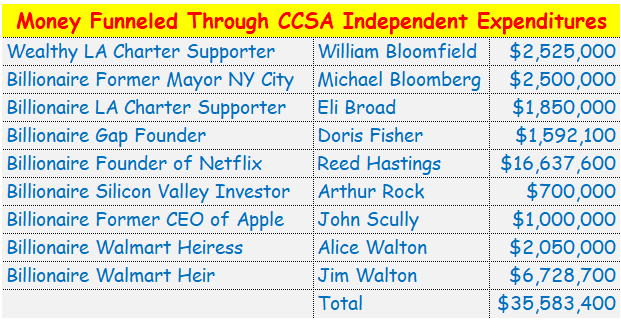
Taking advantage of the Supreme Court’s 2010 ruling in Citizens United v. Federal Election Commission case, billionaires have poured huge sums of money into California’s state and local elections. Most of this money hides in independent expenditure groups like EDVOICE FOR THE KIDS PAC; CALIFORNIA CHARTER SCHOOLS ASSOCIATION ADVOCATES INDEPENDENT EXPENDITURE COMMITTEE; CA CHARTER SCHOOL ASSOC INDEP EXP COMMITTEE; EDVOICE INDEPENDENT EXPENDITURE COMMITTEE; KIDS FIRST, SUPPORTING KELLY GONEZ, NICK MELVOIN, AND MARIA BRENES FOR LAUSD SCHOOL BOARD 2022 and KIDS FIRST, SUPPORTING TANYA ORTIZ FRANKLIN FOR LAUSD SCHOOL BOARD 2020.

Most of this Money went to LA School Board Elections

In 2019, James Walton of Arkansas made contributions to 29 California legislative candidates plus Reed Hastings provided contributions to 69 local and state political candidates. These are examples of billionaires buying influence.

A New Effort

California Assembly Bill 84 sponsored by Robert Garcia [D] and Al Muratsuchi [D] was voted out of the Assembly Committee on Education by a party line vote and forwarded to the Appropriations Committee on Friday (5/23/2025). The Assembly Appropriations Committee analysis summarizes:

“This bill establishes new requirements for charter schools and nonclassroom based (NCB) charter schools regarding auditing and accounting standards, and the funding determination process. This bill adds requirements to the contracting process, limits authorization of NCB charter schools by small school districts, makes changes to the authorizer oversight process, and clarifies that charter schools are subject to specified teacher credential and salary expense requirements.”

Since the criminality of the A3 charter organization, bills to solve the lack of charter school oversight in California have been proposed regularly. This time around, The Assembly Committee on Education Analysis lists almost 200 charter schools dutifully opposing the new bill.

The billionaire backers of “school choice” dislike lawmakers working to safeguard taxpayer supplied education dollars. Will the plutocrats win again or will Californians finally be protected from criminal education enterprises?

More Proof: Charter School Experiment FAILED

25 Oct

By Thomas Ultican 10/25/2024

Two new reports detail the high closure rates of charter schools and the negative effect of school closures on students. In 2020, Network for Public Education (NPE) produced Broken Promises,” the first ever comprehensive study of charter school closure rates. Their just released new report, Doomed to Fail,” updates “Broken Promises.” In May, Houston researcher, Jeonghyeok Kim, published The Long Shadow of School Closures: Impacts on Students’ Educational and Labor Market Outcomes.” Taken together these two new studies demonstrate why the charter school industry is a dangerous failure.

Since the inception of charter schools in the 1990s, billionaires and entrepreneurs have worked to sell these privatized schools. Under Bill Clinton’s leadership, the Democratic Leadership Council embraced school choice believing in the power of the entrepreneurial economy to reform schools (Left Behind Pages 122-127). The federal government started experimenting with charter schools. A rewrite of the 1994 Elementary and Secondary Education Act included a provision for a new federal Charter School Program. In 1995, the new program granted a total of $4,539,548 to nine states. Today, $400 million federal dollars are spent yearly to promote charter schools and oversight is relatively weak.

There is no denying that some charter schools are excellent, however, in general they are unstable. As NPE has documented their closure rates are so high as to be a big risk for parents and students.

Doomed to Fail

Reformers believed that a large-scale charter experiment would either prove or disprove the superiority of charter schools. In 2006, after Hurricane Katrina, Louisiana turned to the new Recovery School District (RSD) and all the schools in New Orleans became charter schools. However, because the students who returned to New Orleans were different from those in the city before, and there was an enormous influx of philanthropic funding, it was impossible to determine if the charter experiment worked.

Gary Rubenstein explained:

“Reformers needed a new experiment where the schools would keep the same students they already had, but the staff at those schools would be replaced with nonunion charter school educators, and charter chains or start-up charter boards would run the schools. Race to the Top provided Tennessee the funding and incentive to test the reformers’ hypotheses.” (Doomed page 19)

The theory was that “failing” schools in the bottom 5% of testing data would be taken over by charter schools. The goal was to show that these privatized schools would soon be in the top 25% of schools on testing results. It was a complete failure. None of the 33 charterized schools ever left the bottom.

This experiment demonstrated that it was not the public schools causing poor performance and privatizing them provided no improvement. The type of school, charter or public, made no difference. However, unstable schools are harmful and “Doomed to Fail” shows that charter schools induce a failure rate crap shoot.

The NPE report describes how professional marketing campaigns convince parents that the new charter school is different and better than the nearby public school. “Doomed to Fail” states:

“However, as hundreds of thousands of families have found, enrolling your child in a charter school comes with enormous risk. Charter schools close at far higher rates than public schools. And, unlike public school districts where infrequent closures are orderly with the district finding a new school for the child, charter school closures are often chaotic and abrupt, taking parents by surprise.” (Doomed Page 1)

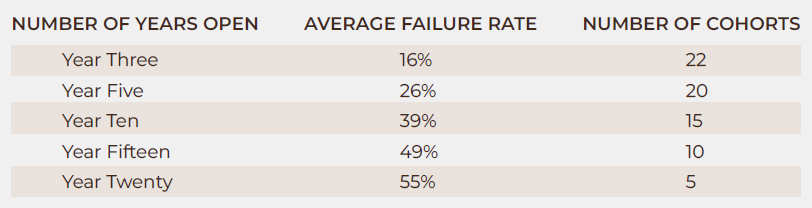
“Doomed to Fail” Page 11

Researcher Ryan Pfleger, Ph.D. used the federal Common Core of Data to create the table above. Each cohort is comprised of every year’s batch of new charter schools. The table informs us that 16% of new charter schools close their doors within the first three years. The ten 15-year cohorts failed at a 49% rate which is a 1% improvement over the 2020 “Broken Promises” report. However, the huge federal COVID payments of 2021 probably kept many schools in business that otherwise would have failed. The 20-year failure rate of 55% makes it clear that failure keeps happening and that more than half of all charter schools close their doors forcing families to make other arrangements.

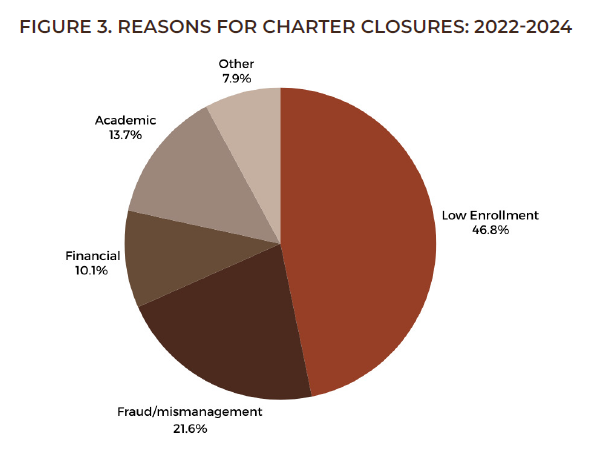
The charter industry says their schools are more academically accountable and are closed if they do not meet the agreed to goals. However, NPE’s research discovered that this was the cause for only a minority of the schools that closed. Not being able to maintain enough enrollment to be viable or corruption and mismanagement were the cause in more than 68% of closures. 

“Doomed to Fail” Page 13

Closures Bring Long Term Negative Effects

In 2019, Matt Barnum of Chalkbeat reported on 17 studies of the effect of school closures on students. There were differing results but in general reading and math scores suffered but after three years, the academic effects seemed to have disappeared.

Researcher Jeonghyeok Kim took a longer range look at the student outcomes and the results were surprising. Like other studies, Kim’s showed a short term academic decline and then recovery within three years. However, he also discovered long term discipline issues, lowered college completion rates and reduced incomes.

In EdWeek, Libby Stanford reported, “Kim centered his research around a dataset of 470 Texas schools that closed from 1998 to 2015.” Stanford also noted, “In a study of federal enrollment data from 2000 to 2018, researchers at the Stanford Graduate School of Education found that majority-Black schools were three times more likely to close than schools with smaller enrollments of Black students.” Since Kim associated the harshest closed school outcomes with economically disadvantaged families, this represents a double whammy.

The abstract from Kim’s paper states:

“Each year, over a thousand public schools in the US close due to declining enrollments and chronic low performance, displacing hundreds of thousands of students. Using Texas administrative data and empirical strategies that use within-student across-time and within-school across-cohort variation, I explore the impact of school closures on students’ educational and labor market outcomes. The findings indicate that experiencing school closures results in disruptions in both test scores and behavior. While the drop in test scores is recovered within three years, behavioral issues persist. This study further finds decreases in post-secondary education attainment, employment, and earnings at ages 25–27. These impacts are particularly pronounced among students in secondary education, Hispanic students, and those from originally low-performing schools and economically disadvantaged families.”

Kim’s ground breaking research shows that the negative effects of experiencing a school closure are not just short term, but appear to be a life long hindrance.

Conclusion

NPE’s new study, “Doomed to Fail,” makes it clear how unstable privatized schools are. The study also reports on charter skullduggery and specific school closures like Jubilee academy, sharing:

“On August 14, 2023, Jubilee Academies Highland Park in San Antonio, Texas, began the school year. Two weeks later, parents were informed that the school would close by mid-September. Families would have to find another school or agree to bus their child to another Jubilee school. Two hundred and ten students were displaced.” (Doomed Page 14)

When “Doomed to Fail” is combined with Jeonghyeok Kim’s new research, it is clear that parents are risking the future of their children when they enroll them in a charter school.

To be clear, trusting your child to a charter school is a bad idea.

That Way Madness Lies

4 Jul

By Thomas Ultican July 4, 2024

Valerie Strauss introduced America to Karen McKeegan Fraid and her That Way Madness Lies blog in 2013. In the pre-corporate billionaire-owned Washington Post, Strauss wrote the pro-public education Answer Sheet blog. Fraid created the “Reformy to English” dictionary as an aid for understanding the world of billionaire funded school-reform with her motivation being:

“I have done fairly extensive reading into their ideas as well as about their actions, and something struck me last week while I was rereading the Broad Foundation’s School Closure Guide (yes, It really exists): it is like an English-speaker reading Voltaire in the original French.”

The “Reformy to English” dictionary is still presented in three volumes:

  1. http://karenfraid.tumblr.com/post/52189780597/reformy-to-english-dictionary-volume-one
  2. https://karenfraid.tumblr.com/post/52356987097/reformy-to-english-dictionary-volume-two
  3. https://karenfraid.tumblr.com/post/53900029533/reformy-to-english-volume-three

The question is after more than a decade, how are Fraid’s translations doing? For example, her quote about the Broad Foundation lost some of its relevance when Eli Broad died in 2021, two years after he paid $100 million to establish the Broad Center at Yale University.

“Reformy to English” Translations Review

Market-Based Reform (noun): A school of thought that relies on the financial and social studies illiteracy of the general population in order to convince the public that codifying the market power of campaign donors and tying the invisible hand’s ability to expose shitty and overpriced products and services for what they are (and thus allowing the free market to eliminate those companies and products from the economy through a lack of demand) will somehow avoid the inevitable market failure in the form of corruption, decreased productivity and out of control wealth gaps and a resulting economic collapse.  Market-Based Reform is a euphemism for “Corporate Subsidy Disbursement,” “Economic Power Grab” and “Fear-Based Economic Policy.”

This translation seems spot-on today but not quite as central like in 2013. The charter school movement was the big dog in market-based reform; however, the effort to privatize schools with vouchers recently has taken on a central role in the effort to destroy public education.

In an 2016 article for AlterNet, Jeff Bryant shared about his conversation with Jeffry Henig of Teachers College:

“Henig believes many conservatives view charter schools as a way to ‘soften the ground’ for potentially more private options, though he isn’t entirely sure ‘the Waltons view charters as a Trojan Horse for eventually providing vouchers universally.’”

21st Century Skills (plural noun): These are what students gain when an educator is replaced with an iPad.  How else will kids ever get enough screen time if we don’t provide it in schools?

This definition is still 100% accurate.

 “School Choice (noun): This is when politicians choose to close a public school and instead choose to pay their campaign donors to operate a charter school.  School choice also refers to subsidizing upper-income families and religious institutions with tax dollars, often redirected from “failing schools.”  School choice also refers to the choice made by charter and private schools to discriminate against students with disabilities, students in extreme poverty and high-risk students by choosing policies guaranteed to skim only the students that they choose.  School choice is also used as a tool to stem the tide of white flight, without having to convince white folks to spend time with those unlike themselves.

Fraid’s school choice definition holds up pretty well, with a caveat. In 2013, charter school discrimination was slowed down by state accountability regulations. With the ascendance of vouchers, laws were written to make discrimination based on race, religion, sexual orientation, scholastic strength, etc. acceptable. In fact, voucher school accountability is generally against the law; seen as government interference.

Outcome-Based Learning (noun): (Synonyms include Proficiency-Based Learning, Standards-Based Reform, Performance-Based Education, and any combination of any of the previous words that include at least one hyphen and no awareness of irony.)  An education philosophy in which the outcome or performance on assessments is the goal in and of itself.  Any learning that does not assist the student immediately in test performance is a waste of time and resources, since Reformers know that they never use anything that they learned in school in their jobs today.”

Outcome-based learning is a renamed attempt to promote the 1970’s “mastery learning” theory, a major flop. Today, competency-based education (CBE) is a digital screen approach for replacing the often derided outcome-based learning. These schemes all posit that drilling and mastering small skills is the best way to teach. It has not worked yet.

CBE is required to get rid of teachers and further develop kids learning at screens.

Fraid’s 2013 definition can be updated with competency-based learning but would still be the same drill-and-skill bad pedagogy.

High-Stakes Test (noun): An assessment in which the margin of error is often greater than the desired gains; nevertheless, such assessments have the power to close schools, fire teachers, cause children to repeat a grade, defund districts or schools, cause states and municipalities to lose funding, fire administrators, shame communities, stifle economic growth, increase dropout rates, disenfranchise parents and children, increase race-based segregation, increase crime rates, raise taxes, burden local governments, increase poverty, pit neighbors against each other, determine which students can attend well-funded schools or institutes of higher learning.”

Since 2013, parents and educators have come out so strongly against these tests that their destructive power was reduced. The fact that these norm-referenced exams are incapable of identifying learning or good teaching has not caused them to go away. Big testing corporations like Pearson, College Board and ACT make too much money from parents, schools and states to let it go. Testing is still being used as metrics for comparing schools, judging college acceptance and evaluating teachers.

No Child Left Behind (NCLB) (noun): Landmark piece of bipartisan legislation which basically codified the Lake Wobegon mantra that all children need to be above average, while also starting the push to make percentiles reign supreme.  That would now serve as a phenomenal example in a lesson on irony, except the forced over-reliance on standardized tests in said legislation has resulted in 10 years of skipping extended lessons on literary devices and understanding of statistics in favor of test-prep reading and math exercises that suck all of the joy out of life as we know it.  That fact is also ironic, but the kids will never know that now.”

The reference to Garrison Keillor’s Lake Wobegon is dated but the claim that NCLB was mathematically-challenged is true. In 2001, many scholars and educators were looking to improve student learning and teaching. NCLB put an end to these scholarly efforts and replaced them with test-based accountability. The fundamental problem is standards-based testing only reveals the financial condition of people in a schools’ zip-code. Based on misunderstood data and erroneous testing regimes, many great schools were labeled failures and shuttered.

It was a tragedy that still plagues America.

In 2013, I wrote The Unwarranted Demise of Mar Vista Middles School.I had worked there for one year and knew it to be a solid school with an excellent staff. Unfortunately, the student demographics shifted to the point that 76% were from low social-economic families, 75% were Hispanic students and 44% were language learners. There was just no way MVMS could meet the ill-designed testing targets demanded by NCLB.

Karen McKeegan Fraid deserves high praise for her often funny and irreverent but mostly prescient definitions. Eleven years ago, she made fun of the scoundrels who worked to end free taxpayer supported public education, some just being drawn to the scam for the $$$.

But, billionaire financiers are in it to destroy America’s public school system.

All Charter District Opens Public School

9 Jun

By Thomas Ultican 6/9/2024

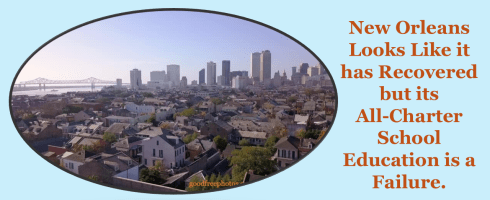
New Orleans Public Schools, aka Orleans Parish School District (OPSD), became America’s first and only all charter school district in 2017. After hurricane Katrina, the state took over all but five schools in the city. When management was transferred to charter organizations in 2017, OPSD officially became an all charter district. This August, the city will open district-operated Leah Chase K-8 School, ending the all charter legacy.

According to Superintendent Avis Williams, the infrastructure required for the district to run Leah Chase will make it easier to open future district-run schools. OPSD will become both a charter school authorizer and regular school district. There is hope that New Orleans, Louisiana (NOLA) is pulling out of an abyss and tending towards a healthy public school system.

All-Charter NOLA Doomed from the Beginning

Senator Joseph Bouie Jr. equated the NOLA school system to the “Tuskegee syphilis experiment.” Professor Bouie, former administrator of Southern University at New Orleans, had good reason for this analogy. At Tuskegee University, black men with syphilis were given no treatment even after penicillin was shown to be effective. Dozens of men died and their wives, children and untold number of others were infected. NOLA black residents had their community schools taken away and replaced by privatized schools, often miles away. This “experiment” stole their rights and bestowed the public schools to private actors.

The design of the privatized system was flawed. A 2018 study by Education Research Alliance found student’s average one-way school bus trip took 35 minutes and pickup times began at 5:30 AM.

Public investment in education is widely viewed as the key to America’s success. Since the 19th century, communities have developed around local public schools. This opportunity was taken from NOLA neighborhoods.

Rules for NOLA charter schools do not create the stability needed for establishing community schools. Louisiana set up the rules with ACT-91 when returning schools to the NOLA school board in 2014. Provisions concerning enrollment, funding and discipline are included in the act plus charter operators control staffing, curriculum and length of both school day and year. The OPSD Superintendent makes decisions on transferring charters to other operators, renewing or cancelling charters.

Louisiana’s state takeover law required schools scoring below average to be closed. If this were real, half of the schools in the state would be closed every year. Instead, arbitrary state performance scores based on testing data, attendance, dropout rates and graduation rates were established. Similar ratings are used to evaluate NOLA charter schools. The nature of privatized schools and testing results led to almost half of the charter schools created being closed.

The NOLA school enrollment system allows parents to research the 100 schools and apply for up to eight of them. The algorithm selects the school from one of the eight if space is available. It is not uncommon for students to ride a bus past schools within walking distance of their homes. This complicated system is driving segregation.

For many education professionals, this system looked like a sure failure from the beginning. Communities could not develop around their schools and the schools would not be stable; important aspects of quality public education.

Another problem coming out of the school privatization experiment is a large swath of the city, known as New Orleans East, has lots of students but few schools.

The All Charter District is a Failure

In 2021, Secretary of Education Miguel Cardona visited OPSD. He heard first-hand the growing disillusionment with the all charter system. Four of the six parents told him they wanted to go back to neighborhood schools. Parents complained about Teach for America, placing unqualified teachers in schools and the One App process for not offering school choice.

Senator Bouie wrote a two-page paper, A Moral Imperative and Case For Action”, stating: “After spending 6 Billion dollars of tax payers’ money to become the only all-Charter system in the State, a staggering 73% of our children are not functioning at grade level, compared to 63% in 2005, when the State took control of over 100 of our schools.”

He also shared:

“In other words, fellow citizens, this 15-year flawed experiment has yielded no best practices identified to improve student and school performance, no State protocol for Charter Law Compliance, and no student performance improvement. It has, however, yielded other devastating consequences for our children and our community.”

He mentioned the 26,000 students between the ages of 16 and 24 who went missing. The privatized charter school system was unable to account for them which is expected and natural for a public school district.

Bouie called for ending busing, “They are transported past a neighborhood school to attend a failing school across town” and eliminating the ineffective One App central enrollment system claiming, “It has created inequities by Race and Class and admissions by chance (lottery) and not choice.”

Raynard Sanders who has over forty years of experience in teaching, education administration and community development, said the charter experiment has “been a total disaster in every area.” He asserted NOLA had “the worst test scores since 2006, the lowest ACT scores, and the lowest NAEP (National Assessment of Educational Progress) scores.”

Based on a 2015 study by the Center for Popular Democracy, Sanders declared, “Charter schools have no accountability and, fiscally, charter schools in New Orleans have more fraud than existed in the OPSD (Orleans Parish School District).” The fraud claim was used by the state in 2003 against OPSD to begin taking schools.

Loyola University Law Professor Bill Quigley stated, “NOLA reforms have created a set of schools that are highly stratified by race, class, and educational advantage; this impacts the assignment to schools and discipline in the schools to which students are assigned.”

He contended, “There is also growing evidence that the reforms have come at the expense of the city’s most disadvantaged children, who often disappear from school entirely and, thus, are no longer included in the data.”

Professor of Economics, Doug Harris, and his team at Tulane University are contracted to study school performance in New Orleans. Harris claims schools have improved since Hurricane Katrina. However Professor Bruce Baker of Rutgers University disagrees. He noted that the school system is not only smaller but less impoverished. Many of the poorest families left and never returned. So the slightly improved testing results are not real evidence of school improvement.

The latest testing data from 2023 saw NOLA public schools receive failing grades but based on Louisiana’s new progress indicator, the district received a C, meaning an F for assessments and an A in growth.

In a letter to the editor, former OPSD superintendent, Barbara Ferguson, stated:

“The state took over 107 of New Orleans’ 120 public schools and turned them into charter schools. Last year, 56 of New Orleans’ 68 public schools had scores below the state average. Thus, after nearly 20 years, over 80% of New Orleans schools remain below the state average. This charter school experiment has been a failure.”

Final Words

In 2006, with the school board out of the road and RSD in charge, philanthropists Bill Gates, Eli Broad and others were ready to help.

Naomi Klien’s 2007 book, The Shock Doctrine, labeled these school reforms, a prime example of “disaster capitalism”, which she described as “orchestrated raids on the public sphere in the wake of catastrophic events, combined with the treatment of disasters as exciting market opportunities.” She also observed, “In sharp contrast to the glacial pace with which the levees were repaired and the electricity grid brought back online, the auctioning-off of New Orleans’ school system took place with military speed and precision.”

Desires of New Orleans residents were ignored. Neoliberal billionaires were in charge. In all the excitement, few noticed that these oligarchs had no understanding of how public education functions. They threw away 200 years of public school development and replaced it with an experiment. The mostly black residents in the city were stripped of their rights.

Thousands of experienced black educators were fired and replaced by mostly white Teach For America teachers with 5 weeks of training. Instead of stable public schools, people were forced into unstable charter schools. Instead of professional administration, market forces drove the bus!

Clearly, the all charter school system is a failure.

Goodbye Doo Wop Don

27 Mar

By Thomas Ultican 3/27/2024

Don Shalvey, with his self-selected twitter handle @dooWopDon, passed away March 16th, succumbing to a lengthy battle with brain cancer. During his long education-centered career, he worked with billionaires including Reed Hastings, Bill Gates and Helen Schwab, to privatize public education. In 1993, Don’s San Carlos Learning Center became the first charter school in California and second in America.

Before he was a charter school founder and before he was a school teacher, he was a disc jockey. That is why his twitter was @dooWopDon.

When founding the charter in San Carlos, he was superintendent of a small K-8 district, a third of the way up the peninsula between San Jose and San Francisco. This event made an obscure education administrator into a rock star in the movement.

Don Shalvey September 14, 1944 – March 16, 2024

Lily Geismer writes about the Clinton administration and its embrace of education choice in her book Left Behind (page 244). In 1997, Bill and Hilary dropped off their daughter, Chelsea, for her freshman year at Stanford. The next morning they were in the gymnasium at Don’s San Carlos Learning Center for a roundtable discussion about charter schools (page 248). Geismer claimed, “The San Carlos event galvanized momentum for charter schools.”

At the time, there was a cap of 100 charter schools in California. Afterwards, “a thirty-something man with a goatee and Birkenstocks”, Reed Hastings, approached Shalvey, asking, “Do you ever think that there’ll be more than a hundred charter schools in California?” He talked Shalvey into helping to get rid of the charter school cap (page 249). “The combination of Don as Mr. Charming Establishment and me as a wealthy provocateur presented a unique challenge to the teachers union,” Hastings remembers in an interview.

Together, they successfully campaigned to end the charter school cap. At the same time, Hastings was starting his new company, Netflix. The two soon hooked up with John Doerr and NewSchools Venture Fund to invent the charter management organization (CMO). With $400,000 left from their campaign, they used it to create America’s first CMO, University Public Schools which later became Aspire.

Shalvey did most of the leg work.

The first Aspire charter school opened in 1999 in Stockton, California. During his career in education, Shalvey’s home was always a ranch in Linden, California about 10 miles from Stockton.

The Gates Foundation

From 2009 to 2020, Shalvey served as Deputy Director for K-12 Education at the Bill & Melinda Gates Foundation.

While he was at the Foundation, charter school enrollments grew by a half-million students, fueled in large part by the Charter School Growth Fund supported by Gates, the Walton family and other billionaires. The Fund was founded in 2004 by Buzz Woolley and Don Fisher (Tax ID 05-0620063). In 2005, John Walton replaced Buzz Woolley as president, indicating his privatization focus changed from vouchers to charter schools.

Gates gave Shalvey two big jobs. He was to implement Common Core standards and target teacher preparation. Unfortunately the standards were installed with no field testing. There were many good ideas within them but much of it was improperly aligned and had no buy-in from educators. There were also political issues. People saw this as Gates’ effort to take control of public education and create a centralized US education marketplace.

Focus on teacher preparation became another effort at privatizing every aspect of the education industry. Instead of working with established institutions like Columbia University or the University of California system, Shalvey and Gates looked toward private companies like the Teach for America (TFA) spinoff, TNTP.

Wendy Kopp founded TNTP (originally called The New Teachers Project) in 1997 and assigned Michelle Rhee, who had just finished a two-year TFA tour, to run it. Under Rhee’s leadership, TNTP became noted for teacher bashing.

Soon after Shalvey went to work for Gates in 2009, he became a member of the EdSource board. Gates was perhaps their largest funder and Don, his representative, remaining a board member until his passing.

Returns to Stockton

June 30 2020 was Shalvey’s last day at the Gates Foundation. For the entire time he worked for Gates, he commuted from the home he shared with wife, Sue, in Linden, California. He stated:

“For the past 50 years, the San Joaquin Valley has been my home. I’m thrilled to spend the final years of my career working to improve education for the young people in our wonderful Valley.”

The 75 year-old Shalvey was not ready to retire. He became CEO of a local non-profit called San Joaquin A+. There must have been secret negotiations before he left Gates because it is probably not a coincident that at the same time billionaire, Helen Schwab, made a $400,000 donation to the non-profit.

Shalvey’s new job was part-time, committing 20 hours a week to his CEO position. Tax records indicate San Joaquin A+ (Tax ID: 51-0536117) became tax-exempt in 2005. It was a relatively low key organization until his arrival. In 2019, they had net assets of $39,266. Shalvey was compensated $160,225 that first year and in 2021, $332,782. In the three years prior to his arrival, A+ had taken in $15,169. The haul in 2020 was $3,176,833 and in 2021, $3,942,790.

He was definitely a rainmaker and the question is what did his billionaire supporters expect back?

Don Shalvey was known to be a good guy with a big smile and able to work with people but some locals in Stockton disagree. Founder of Facebook news report 209 Times, Motecuzoma (Motec) Sanchez, wrote:

“Every time one of these devils dies, like with Alex Spanos, you see their legacy media puppets try to brainwash the public into believing what they did in their lifetime was admirable. Shalvey exploited poor Brown and Black kids in my hometown of Stockton, Modesto and beyond. And his creations, like a monster, continue to do so.”

The late Alex Spanos was a very successful real-estate developer from Stockton who purchased the San Diego Chargers in 1984. Motec felt Spanos was ruthless and that just the way his life story was glorified is how Don Shalvey’s life is being embellished today. From his ranch in Linden, Shalvey consistently ingratiated himself with billionaires, denigrated public schools and made profits. 

In 2022, two grand jury reports seemed out to demonize the local school districts board and leadership. A report in The 74 quoted Shalvey saying, “I think Stockton Unified might be the worst system in the country.” That was typical of the hyperbolic anti-public school statements he often made.

It is true that during John Deasy’s two years as Superintendent, the district had some financial issues which have been solved. With 82% of K-12 students coming from families of poverty, it is little wonder they did not test well but their graduation rates were reasonable and English language progress rates, among the best in the state. It is one more example of good schools in poor neighborhoods having test results used to unfairly undermine them.

Shalvey made a lot of money working to destroy public education but that money is not helping him now. He raised an admirable family and seemed to have many good traits. I feel bad about writing critically of the dead but he, unwittingly or not, made many bad choices, harming countless children.

I agree with Motec.

Don Shalvey should never be lionized.

Stalled California Charter Schools

29 Feb

By Thomas Ultican 2/29/2024

In California, from 2021 to 2023, 31 new charter schools opened but 63 closed. Since inception in 1994, charter school enrollment grew ever year until 2021. For the first time, charter school enrollment fell. This December, KIPP SoCal announced they were closing three of their 23 Los Angeles County schools. Alliance for College-Ready Public Schools and Green Dot Public Schools have also closed LA area schools.

The charter industry is struggling…

California State Enrollment Data

Los Angeles Unified School District

Los Angeles Unified School District (LAUSD) charter petitions used to arrive by the dozens but there were none this year. The 74 reported:

“Enrollment in the schools peaked in 2021, when the city’s charters enrolled nearly 168,000 students. Since then admissions have declined by nearly 11%, although not as fast as district schools.”

The “although not as fast as district schools” remark is disingenuous. In 2016, LAUSD enrollment was 639,337 and by 2023, had fallen to 538,295. This was a drop of almost 16% but over a much longer time period.

Since 2019, student enrollment in California declined by 5% and in Los Angeles County, the drop was 8.5% (California Data).

Howard Blum, reporting for the LA Times, stated:

Twenty years ago, L.A. Unified had close to 740,000 students and was building schools as fast as it could. District-operated schools currently enroll about 420,000 students — a decline caused by reduced immigration, families moving out of L.A., lower birthrates — and, until recently, the growth of charter schools.”

Carol Burris and Network for Public Education (NPE) published Broken Promises in 2020. A stunning find was that almost 50% of charter schools had closed their doors within the first 15 years of operation (Broken Page 19).

About 50% of Charter Schools Closures by Year 15

Parents, sold a story about superior charter schools, often end up dismayed. A typical response to the closing of KIPP Poder comes from parent Gina Alonzo:

“I was very angry — very, very upset — disappointed, because we didn’t get a warning. We didn’t get a notification of what was going on — the issues that they were having.”

“We were grown as a community here. Everybody knows each other. This is all my son knows. So I’m upset and I’m thinking about the trauma that this is going to cause him.”

Besides new state policies and falling student populations, people in the choice community see the LAUSD board as hostile to charter schools. In 2022, Rocio Rivas won the district-2 seat in a tightly fought battle, not called until two weeks after the election. With a pro-public school board member, replacing termed-out Monica Garcia, the board shifted away from school choice.

In 2017, billionaires (Hastings, Broad, Rock, Fisher and, multiple Waltons) poured huge dollars into the LAUSD election, outspending their opponents 2 to 1 in America’s most expensive school board election ever. They spent more than $6 million in just the 2020 district-7 race to maintain control of the board. The 2022 results flipped the script and billionaires lost control.

John Angeli is executive director of the Los Angeles Coalition for Excellent Public Schools, a group that represents some of the city’s largest charter operators. He points out that in 2024, two incumbent school board members are running for reelection with two retiring board members, leaving open seats. Angeli believes the board could tip back to his favor in November.

School Choice – A Bad Choice

Some charter schools are abominations but most of them are reasonable. Like public schools, they are staffed with excellent or mostly decent teachers and a few who should not be in the profession. Their standardized testing results are similar to those of public schools with two deficiencies. They are likely to close their doors anytime while a public school never closes mid-school year, with no notice. Also public schools unify communities while charter schools divide them.

Birthed in the bowels of the 1950’s segregationist south, school choice has never been about improving education. It is founded on white supremacy, profiting off taxpayers, cutting taxes, selling market based solutions and financing religion. School choice ideology has a long dark history of dealing significant harm to public education.

Steve Suitts’ book, Overturning Brown, provides overwhelming evidence for the segregationist legacy of “school choice.” “Brown v Board” has been effectively gutted with “choice” as the white supremacists’ most potent strategy. In the 21st century, choice is being wielded to maintain segregation and destroy separation of church and state.

Southern segregationists often condemned “integration as the work of communists” (Suitts 32). Adopting the language of University of Chicago libertarian economist, Milton Friedman, they began denouncing the “monopoly of government schools”, calling it “socialism in its purest form” (Suitts 59). This is the basis of so-called school choice.

A Brookings Institute study of segregation in schools reported:

“Charter schools are more segregated than TPS [traditional public school] at national, state, and metro levels. Black students in charter schools are far more likely than their traditional public school counterparts to be educated in intensely segregated settings. At the national level, 70 percent of black charter school students attend intensely segregated minority charter schools (which enroll 90-100 percent of students from under-represented minority backgrounds), or twice as many as the share of intensely segregated black students in traditional public schools”.

This is a big problem concerning all races. Professors Linda R. Tropp and Suchi Saxena along with many other sociologists and educators have conducted research identifying the clear benefit of and need for school integration. They state, “New social science research demonstrates the importance of fostering sustained interracial contact between youth in order to prepare them to thrive in a multiracial society”.

UCLA Professor Gary Orfield coined the phrase “apartheid schools” for schools with a White student enrollment of 1% or less. A personal 2019 study of Washington DC charter schools revealed that 64 of the 116 charter schools could be classified as “apartheid schools”.

Yesterday, Peter Greene posted an insightful article about the coalition-promoting school choice and their splintering. One of the points he made was:

“But what the alliance didn’t produce was results. Choice did not provide a sudden lifting of all boats, despite some data-torturing attempts to show otherwise. Data-driven instruction didn’t improve the data generated by either students or teachers. Underserved communities that were supposed to be rescued from failing schools by charters and choice too often had education policies done to them rather than with them. And then there was the gross miscalculation that was Common Core, which drew attack from all across the political spectrum”.

For the Catholic Church and Evangelical Christians, like Betsy DeVos, publicly provided vouchers for private religious schools open a path to taxpayer support for their organizations. It is lamentable for their cause that every recent large scale study of vouchers showed students perform worse when transferred to voucher schools.

What is the main motive behind mega-rich spending to undermine public education? Professor Maurice Cunningham of the University of Massachusetts claimed they really want “lower state and local taxes.”

John Arnold is the billionaire Enron trader who did not go to prison when that company collapsed. He has joined forces with the billionaire CEO of Netflix, Reed Hastings, to sell the nation on the portfolio model of school management.  To achieve their goal, they created The City Fund. After its founding in 2018, billionaires Bill Gates, Michael Dell and Steve Ballmer all made significant contributions.

In brief, the portfolio model directs closing schools that score in the bottom 5% on standardized testing and reopening them as charter schools or Innovation schools. In either case, they will no longer come under the purview of an elected school board. It is a march to oblivion for public schools because there will always be a bottom 5%.

Two central ideologies behind school choice are markets always make superior decisions and the cost of local control of schools is poor outcomes. Both ideas are demonstrably untrue but big money and power politics keep them alive.

It is good for America that charter schools are starting to struggle but it is heartbreaking for parents, hornswaggled by billionaires. Americans have always had school choice. If taxpayer funded public school are not wanted, there are always private schools, without the choice encumbering taxpayers.

Let’s join with the Network for Public Education and thoughtfully role back choice schools and put them under democratic control.

Stop fleecing taxpayers to finance privatized schools.

NPE Throws Cold Water on CREDO Paper

23 Jul

By Thomas Ultican 7/23/2023

The Center for Research on Education Outcomes (CREDO) just released another pro-charter school study, “CREDO also acknowledges the Walton Family Foundation and The City Fund for supporting this research.” It is not a study submitted for peer review and so opaque that real scholars find the methodology and data sets difficult to understand. Carol Burris and her public school defenders at the Network for Public Education (NPE) have provided an in-depth critical review.

With the new CREDO study, Education Week’s Libby Stanford said that “charters have drastically improved, producing better reading and math scores than traditional public schools.’’  Rupert Murdoch’s Wall Street Journal declared charter schools are now “blowing away their traditional school competition.” Burris retorted with “despite the headlines, the only thing ‘blown away’ is the truth.” (Page 3)

Putting a CREDO Thumb on the Scale

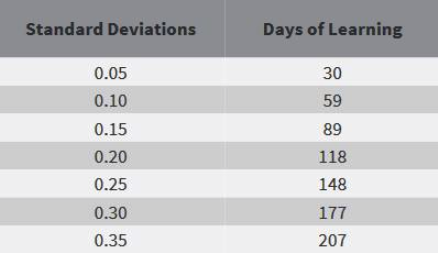
CREDO uses massive data sets, unavailable to other researchers, getting minuscule differences which are statistically significant. No one can check their work. They employ a unique and highly discredited statistical approach called “virtual twins” to compare public school with charter school testing outcomes. Instead of reporting the statistical results in standard deviations, CREDO uses their “crazy pants” days of learning scheme.

NPE discovered that the “blowing away” public school results amounted to 0.011 standard deviations in math and 0.028 standard deviations in reading. The minuscule difference is “significant statistically but is meaningless from a practical standpoint” according to CREDO. In a 2009 report showing public schools with a small advantage, CREDO declared, “Differences of the magnitude described here could arise simply from the measurement error in the state achievement tests that make up the growth score, so considerable caution is needed in the use of these results.”

To give these almost non-existent differences more relevance, CREDO reports them as “days of learning” instead of standard deviation. “Days of learning” is a method unique to CREDO and generally not accepted by scholars. They claim charter school math students get 6 more “days of learning” and English students, 16 days.

CREDO Days of Learning Conversions

The above chart comes from the Technical Appendix of a previous CREDO study, which reveals that Eric Hanushek and Macke Raymond used NAEP data from 2017 to create the table. No justifications for the conversions are given. It appears to be sloppy science and headlines generated by its use are unfounded propaganda.

Bad Methodology

The CREDO method does not compare charter school performance to actual public schools. It creates mathematical simulations. Professor Andrew Maul of UC Santa-Barbara stated, “The study’s ‘virtual twin’ technique is insufficiently documented, and it remains unclear and puzzling why the researchers use this approach rather than the more accepted approach of propensity score matching.”

CREDO’s stipulation that “virtual twins” comes from “feeder schools,” favors charter schools. Management expert, Andrea Gabor, explained that CREDO used less than five student transfers to a charter school as the cutoff for a particular public school’s data. She notes the “study excludes public schools that do NOT send students to charters, thus introducing a bias against the best urban public schools, especially small public schools that may send few, if any, students to charters.”

This study is singularly focused on test results as determinate of school quality. Many charter systems, like IDEA and Success Academy, spend an inordinate amount of time preparing for standardized tests. This biases results.

Professor Mark Weber of Rutgers University adds a few more observations:

The NPE report highlights another source of bias for charter schools:

“In addition to their presence in a CREDO-identified feeder school, students are matched by gender, grade level, scores, race, and special education and English language learner status. Yet special education students are not a monolith. Research has consistently shown that charters take fewer special education students and enroll fewer students with more challenging disabilities than public schools.” (Page 9)

The combination of rejected methodologies, murky data studies and biases toward charter schools render the CREDO study useless. Minuscule advantages reported, favoring charter schools, indicate that in reality, public schools outperform charters.

The CREDO Story

In 1981, Massachusetts Institute of Technology trained economist, Eric Hanushek, wrote “Throwing Money at Schools.” Right-leaning philanthropies and institutions were drawn to his declaration:

“The conventional wisdom about public schools is that they face serious problems in terms of performance and that improving schools requires additional money. However, the available evidence suggests that there is no relationship between expenditures and the achievement of students and that such traditional remedies as reducing class sizes or hiring better trained teachers are unlikely to improve matters.”

In a 1981 Ed Week commentary referencing this paper, Hanushek points to SAT testing as the gold standard for judging school performance. He claims, “Advanced statistical techniques are employed to disentangle the influences on achievement of schools and teachers from those of other factors such as family backgrounds and student abilities.” This motivated him to push for teachers to be evaluated, using “value added measures”, that since have been thoroughly discredited.

At the time, he was teaching political science and economics at Rochester University and meeting his future wife, a significantly younger student, named Margret (Macke) Raymond. She completed her Rochester University political science PhD in 1985.

A 1999 announcement from the school said, “The Center for Research on Education Outcomes has been established at the University of Rochester’s Wallis Institute of Political Economy…” In the same posting, it revealed, “Two foundations have committed $1.25 million to fund a three-and one-half year initiative to address the current shortage of evaluation research in education policy matters.” CREDO never made the names of the two foundations public but a knowledgeable academic disclosed one of them was the Walton Family Foundation. It is documented that the Waltons give generously to CREDO.

The announcement listed Eric Hanushek first and Macke Raymond as founding Director.

CREDO moved to Stanford University’s Hoover Institute in July 2000 which made networking in conservative circles much easier.  Their 2nd year report stated that moving to the Hoover Institute brought many new contacts, including the New Schools Venture Fund, the District of Columbia Charter School Board, the Teacher Union Reform Network and others.

Public Schools are Superior to Charter Schools

Staffing in public schools is made up of mostly college graduates with certified state teaching credentials. Before the appearance of the billionaire-created Teach For America (TFA), nearly 100% of public school teachers had a year of teacher training and a bachelors degree or higher. A significant percentage of charter school teachers come from TFA with just five weeks of education training. Charters are typically not required to use certificated teachers.

The depth of experience in the public school teaching corps is larger than that of charter schools. A Fordham Institute article states:

“That being said, there is a bona fide but often unaddressed teacher shortage: experienced teachers in charter schools. In the United States, a third of charter teachers have fewer than three years of teaching experience, compared to only a fifth of public school teachers.”

“Comparative inexperience and youth in front of classrooms carries costs. More than any other school-related factor, a teacher’s efficacy matters most to student learning. And especially in the early years, nothing improves a teacher’s efficacy quite like experience.

Stability is important for school-aged children and especially for those growing up in difficult home environments. In 2020, NPE conducted an in-depth look at charter schools since their inception. They discovered that charters were closing at extremely high rates; 18% by year 3, 25% by year 5, 40% by year 10 and 50% by year 15. In some cases, charters closed their doors mid-semester without warning; this never happens in public schools.

Management in public schools must meet state credentialing requirements. They focus on good pedagogy, safe schools and parent engagement. In charter schools, supervisors are often untrained in education and make return on investment, a key goal.

Safety in public schools is state-mandated but charter schools can ignore some rules. In California, all public schools must be earthquake-safe facilities. Charter schools may not heed this requirement.

In 2013, Christopher A. Lubienski and Sarah Theule Lubienski published The Public School Advantage – Why Public Schools Outperform Private Schools. Nothing has happened over the last ten years that invalidates this scholarly work. Charter schools are private schools with a state contract, similar to garbage collection companies, contracting with a city. They are private companies, paid with taxpayer funds.

Charters are substandard education organizations that only survive because of marketing.

Chartered to Indoctrinate

3 Jul

By Thomas Ultican 7/3/2023

Carol Burris and team at Network for Public Education (NPE) just published, A Sharp Turn Right(STR). NPE President Diane Ravitch noted there are several problems associated with charter schools’ profiteering, high closure rates, no accountability…

“This new report, A Sharp Turn Right, exposes yet one more problem — the creation of a new breed of charter schools that are imbued with the ideas of right-wing Christian nationalism. These charter schools have become weapons of the Right as they seek to destroy democratically governed public schools while turning back the clock of education and social progress by a century.” (STR Pages 3 and 4)

STR focuses on two types of charter schools. One characterizes themselves as “classical academies” and the other touts “back to basics,” without noting they also employ the same “classical” curriculum. Both provide right-wing clues on their web-sites, alerting parents of alignment with Christian nationalism. Marketing is often red, white and blue, with pictures of the American founding fathers, and discussions on patriotism and virtue. Some schools include direct references to religion like Advantage Academy’s claim of educating students in afaith-friendly environment.”

STR further clarifies,

“These schools are distinguished by a classical “virtuous” curriculum combined with hyper-patriotism for Christian nationalist appeal. They are exemplified by charters that adopt The Hillsdale College 1776 Curriculum…” (STR Page 7)

Using keyword searches, NPE identified 273 active charter schools fitting this description and noted they surely missed more. Nearly 30% of them were for-profit; about double the rate for the charter sector in general. Almost 50% of them have opened since Donald Trump was inaugurated president in 2017. (STR Page 7)

Apparently the school founders want to turn the clock back to the nineteenth century. STR states,

“Founders of classical charters view the rejection of modern instructional practices as a selling point. Proponents of classical education vilify the progressive movement, accusing John Dewey and his followers of removing Christian ideals and redesigning schools to achieve social goals.” (STR Page 9)

It identifies the largest charter school systems indoctrinating students with Christian nationalist ideology and discloses where they are operating. Discussing, in some depth, Hillsdale College with its Barney charter schools and the large number of new charter affiliates, the report asserts:

“What they all have in common is teaching Hillsdale’s prescriptive 1776 curriculum, which disparages the New Deal and affirmative action while downplaying the effects of slavery. Climate change is not mentioned in the science curriculum; sixth-grade studies include a single reference to global warming.” (STR Page 15)

The reality is today’s taxpayers are forced to pay for schools teaching a form of Christianity associated with white superiority; politically indoctrinating students with specific rightist orthodoxy. What happened to the principal of separation of church and state? This charter schools for indoctrination movement must be stopped before American democracy is sundered.

Church and State

James Madison proposed the Bill of Rights to codify protections not addressed in the constitution. In the first article, four freedoms are guaranteed – freedom of speech, freedom the press, freedom of peaceable assembly and freedom of religion.

In an 1802 letter to the Danbury Baptist association of Connecticut, Thomas Jefferson explained,

“Believing with you that religion is a matter which lies solely between Man & his God, that he owes account to none other for his faith or his worship, that the legitimate powers of government reach actions only, & not opinions, I contemplate with sovereign reverence that act of the whole American people which declared that their legislature should ‘make no law respecting an establishment of religion, or prohibiting the free exercise thereof,’ thus building a wall of separation between Church & State.” (Emphasis added)

Katherine Stewart’s deeply researched book, The Good News Club, shares that tensions between Protestants and Catholics became fever-pitched in the 19th century. A student in Boston, named Thomas Whall, refused to recite the Protestant version of the Ten Commandments and was beaten for thirty minutes. In 1869, the Cincinnati Bible War over classroom Bible use raged in the streets. (Good News Pages 72 and 73)

Stress over religion in school mounted to the point that President Ulysses S. Grant in an 1876 speech counseled,

“Leave the matter of religion to the family altar, the church, and the private school, supported entirely by private contributions. Keep the church and state forever separate.” (Good News Pages 73-74)

Clarification of the Establishment Clause came in a 1947 Supreme Court decision over a New Jersey school board providing transportation costs for schools run by the Catholic Diocese. In Everson v. Board of Education, Justice Hugo Black stated in his majority opinion:

“The ‘establishment of religion’ clause of the First Amendment means at least this: Neither a state nor the Federal Government can set up a church. Neither can pass laws which aid one religion, aid all religions or prefer one religion over another. Neither can force nor influence a person to go to or remain away from church against his will or force him to profess a belief or disbelief in any religion. No person can be punished for entertaining of professing religious beliefs or disbeliefs, for church attendance or non-attendance. No tax in any amount, large or small, can be levied to support any religious activities or institutions, whatever they may be called or whatever form they may adopt to teach or practice religion.” (Emphasis added)

The 1962 Supreme Court decision in Engle v. Vitale ended prayer in school. This was not a particularly close call, with only Justice Potter in descent. Justice Black, writing for the majority, stated:

“We think that, by using its public school system to encourage recitation of the Regents’ prayer, the State of New York has adopted a practice wholly inconsistent with the Establishment Clause. There can, of course, be no doubt that New York’s program of daily classroom invocation of God’s blessings as prescribed in the Regents’ prayer is a religious activity.”

By the time Ronald Reagan was elected the 40th president of the United States, the “separation of church and state” had been firmly established.

America’s Riven Rights

Reagan’s nomination of the proclaimed originalist, Anthony Scalia, to the Supreme Court began the attack on the Establishment Clause. According to Jeffrey Toobin, author of The Nine: Inside the Secret World of the Supreme Court, Scalia maintained that the Constitution not only permits entanglement between church and state, but encourages it. (Good News Page 85) 

Katherine Stewart observed,

“According to Scalia, the secularism of today’s liberals is really just another religion – and an unattractive one at that, suitable for the weak of mind and character. It is the creed of relativism, which says that no belief is better than any other, and no value is better than any other. This philosophy of religion is the genuinely immovable part of Scalia’s judicial philosophy in cases involving religion, and it has proven to be the real source of his disdain for the Establishment Clause.” (Good News Page 86)

Scalia was a lonely voice on the court until 1991 when President Bush appointed Clarence Thomas.

The first big break for the anti-establishment forces came in the case of the LAX Board of Airport Commissioners v. Jews for Jesus. In the case, Jay Sekulow defended the constitutional right to stand in an Airport and hand out tracks about Jesus. The case was not controversial. Sekulow achieved a unanimous victory but more importantly, the new legal concept of speech from a religious viewpoint being protected was created.

Stewart writes, “Henceforth, Sekulow would appear repeatedly before the Supreme Court, playing a song with just one note: religious activity is really just speech from a religious viewpoint; therefore, any attempt to exclude religious activity is an infringement of the freedom of speech.” (Good News Page 90)

When Center Moriches Union School District turned down James Dobson’s request to use their facilities for a religious film series based on a no religious groups policy, Dobson sued. Sekulow claimed they were engaging in speech from a religious viewpoint and in 1991, the court ruled for Dobson, based on freedom of speech.

The Rosenberger v. University of Virginia case was decided in 1995, favoring Rosenberger with a split 5-4 decision. University student Rosenberger had asked for several thousand dollars from a student activity fund to subsidize the cost of “Wide Awake”, a Christian magazine. The court ruled that denial of funding based on the religious message amounted to viewpoint discrimination. Justice Souter noted that the University of Virginia was directly subsidizing religion by paying for a magazine that exhorts its readers to convert to Christianity.

In 1996, the Child Evangelism Fellowship applied to establish a Good News Club at the K-12 Milford Central School. The New York school had a policy of restricting the use of its property by organizations and individuals for religious purposes. In 2001, the Supreme Court ruled 6-3 in favor of the plaintiffs in Good News Club v. Milford Central School.

Stewart reports, “In his majority opinion, Justice Thomas laid out a philosophy that essentially destroyed the postwar consensus on the separation of church and state.” Scalia conquered with Thomas’s reasoning and said religion is such a complicated thing that the court should refrain from even attempting to define it. (Good News Page 95)

With their newfound allegiance, to the Free Speech clause the court majority created a dubious attack on the Establishment Clause. In Widmar v. Vincent, Justice Byron White observed:

“A large part of respondents’ argument … is founded on the proposition that, because religious worship uses speech, it is protected by the Free Speech Clause of the First Amendment. Not only is it protected, they argue, but religious worship qua speech is not different from any other variety of protected speech as a matter of constitutional principle. I believe that this proposition is plainly wrong. Were it right, the Religion Clauses would be emptied of any independent meaning in circumstances in which religious practice took the form of speech.”

In this light, Stewart asks the obvious question, “Was it the intention of the country’s founders to include redundant or meaningless clauses in the Constitution?”

Conclusion

Time to wake up and smell the coffee; the modern Supreme Court is corrupt and needs reformation. Instead of deciding issues based on law and precedence, they create theories designed to support a political philosophy rather than showing fidelity to the constitution. This reflects a complete degradation of jurisprudence. The poorly formed decisions regularly undermine the rights and protections the founders bestowed on citizens; all while some Justices appear to be ethically compromised.

For the first time in American history, billions of taxpayer dollars are flowing to private religious schools.  The STR report shines a light on charter schools with religious agendas. Even more disturbing, these new taxpayer funded privatized schools are literally indoctrination centers, teaching a depraved political ideology.

This cannot stand!