Tag Archives: Benjamin Riley

Behaviorism as Cognitive Science

10 Aug

By Thomas Ultican 8/10/2025

Greg Toppo writes for ‘The 74’ which suggests he is a professional propagandist working for billionaires. In his July 24th article, “‘Cognitive Science,’ All the Rage in British Schools, Fails to Register in U.S”, he did not even attempt to be objective as he lionized a form of ‘Cognitive Science’ that is a euphemism for behaviorism. It is a corrupt approach that philosophically undermines a field of research exploring undeniably important ideas.

There are many definitions of cognitive science; this one is from Yale University:

“Cognitive science is an interdisciplinary field devoted to exploring the nature of cognitive processes such as perception, reasoning, memory, attention, language, imagery, motor control, and problem-solving. The goal of cognitive science is to understand (1) the representations and processes in our minds that underwrite these capacities, (2) how they are acquired, and how they develop, and (3) how they are implemented in underlying hardware (biological or otherwise). Stated more simply, the goal of cognitive science is to understand how the mind works!”

A cognitive science subset, Cognitive load theory, was developed in mid-1980s by Australian education psychologist John Sweller. His theory pays attention to human cognitive architecture: characteristics and relations between long-term memory and short term memory, and how load on memory affects learning.

The basic premise of cognitive load theory is that short term memory or working memory is limited and can be overloaded. Therefore, Sweller postulates that explicit instruction is superior to discovery approaches for teaching new content and skills. He claims that to think critically we need to know a lot of stuff; therefore critical thinking can only be actualized through copious amounts of content knowledge. He and colleagues say it is not possible to teach critical thinking because it is not a transferable skill.

Selling Cognitive Load Theory

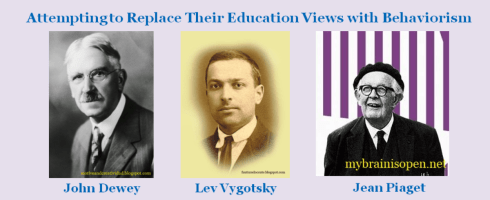
Toppo began his article by introducing his readers to Zack Groshell, a former Seattle-area fourth-grade teacher. His 2024 book, Just Tell Them, is a guide for delivering explicit instruction and adhering to the Cognitive Load Theory (CLT) premise of learning. Dewey, Vygotsky and Piaget would surely be saddened by this 21st century misunderstanding of student development.

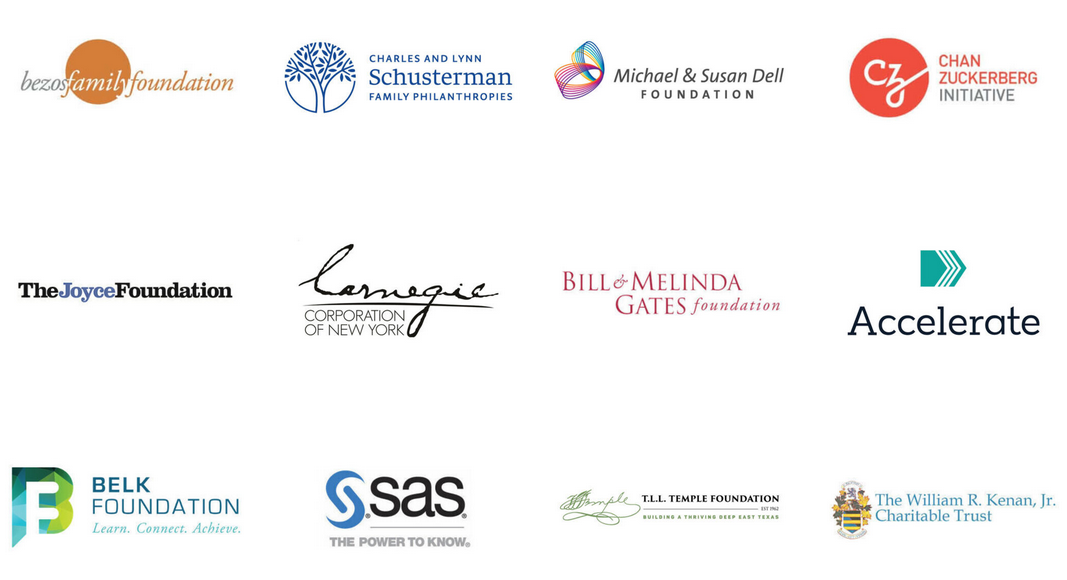
The article also introduces Benjamin Riley, founder of Deans for Impact, a Texas-based group that has pushed to make cognitive science more central to U.S. teacher training programs. I find it instructive that his organization is financially supported by Besos, Gates, Dell, Schusterman, Zuckerberg and other billionaires.

Toppo cites the influence of E. D. Hirsch who wrote in his book, The Schools We Need, “Higher-level skills critically depend upon the automatic mastery of repeated lower-level activities.” He further called for tougher standards which prompted education writer, Alfie Kohn to note that Hirsch’s approach “reflects a particular model of learning—behaviorism.”

As Kohn stated, in the debate between behaviorism and constuctivism”, Hirch comes down squarely on the side of behaviorism. Kohn went on to observe that, “E. D. Hirsch’s Dictionary of Cultural Literacy, might be called the ‘bunch o’ facts’ approach to education.” (Page 11)

Like other behaviorists, E. D. Hirsch is calling for education material to be atomized and drilled.

Most of Toppo’s article is concentrated on education in the United Kingdom which might explain why he brought up the very unpopular education leader under former Prime Minister David Cameron, Michael Gove. Gove attempted to reform English education through privatization and testing. Gove’s associate Nick Gibbs said he first encountered Hirsch’s book in 2006 and that it formed the basis for all of their education reforms.

In 2013, more than 150 leading educator wrote and signed a piece for the Times of London calling Gove’s reforms dangerous. They stated in part:

“Sir, We, the undersigned academics and children’s authors, are gravely concerned at the impact that current developments in state education in England are likely to have on our children and their futures.”

“These damaging developments must stop. If they go ahead there will be devastating consequences for children’s mental health, for future opportunities and, most importantly, for the quality of childhood itself.”

At about the same time, England’s national teachers union held a unanimous vote of no confidence in Gove. General Secretary of the teachers union, Christine Blower, said teachers were not the “enemies of promise” that Gove said they were. “We just have the temerity to assert that the secretary of state is wrong.”

Meaningless Data Quoted

Besides citing people like Gove and Hirsch to sell this new behaviorist approach to education, Toppo writes, “From 2011 to 2021, English students’ average scores in the PIRLS International Benchmarks of Reading Achievement, a key global comparison, rose six points, placing them fourth worldwide, while U.S. students’ dropped eight points, ranking the U.S. just below England.”

This was weak sauce.
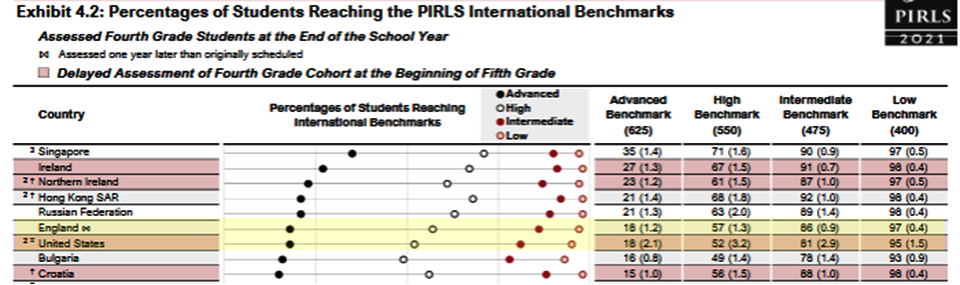
Top 8 scoring Nations in the 2021 PIRLS

For several years, education in England has been trying to get rid of the Gove stench, and they appear to be on track. The six point gain in a decade on a more than 500 point scale is not much to brag about. In 2011, the US score was 556 England’s was 552 in 2021 the US score was 548 England’s was 556. Even if I believed in standardized testing, which I don’t, I still do not see any real difference. Remember, we were just starting to come out of the COVID nightmare in 2021.

In 2022, the Programme for International Student Assessment (PISA), did its every three year assessment of 15 year olds one year late because of COVID. Of the 80 countries compared, the USA’s reading score of 504 was number 9 and the UK’s score of 494 was number 13. There is not a lot to brag about here either.

The testing data Toppo cites does not prove or even suggest that this new behaviorism is any kind of silver bullet.

Researchers and Educators Have Concerns

The lead sentence in the latest issue of UK’s Schools Week states, “Teachers need to be sceptical about applying popular but “untested” cognitive science theories to education, a panel of experts has warned.”

Noam Chomsky is the scientist-philosopher who more than any other contributor seriously undermined B.F. Skinner’s theories of behaviorism. A 2006 interview with Chomsky states, Chomsky’s (1959) review of Verbal Behavior (Skinner, 1957) has been hailed as the most influential document in the history of psychology.”

Importantly, behaviorism undermines the important works of William James and John Dewey. Chomsky’s 1959 review of Skinner’s book went a long way toward reviving Dewey’s theories and shutting down behaviorist ideology.

In 2022, Australian researcher Peter Ellerton published, On critical thinking and content knowledge: a critique of the assumptions of cognitive load theory [CLT].”  After presenting evidence from several papers, Ellerton asserts:

“The absolute claim of CLT that “critical thinking is unteachable” is clearly refuted by these studies. As is the claim that it is not transferable. The softer claim that it is best done through a context of engagement with deep content knowledge is also challenged by these findings. Claiming critical thinking is not directly susceptible to pedagogical influence beyond content development stands in contrast to a significant body of research and pedagogical practice that does not seem to be engaged with or addressed by CLT.

Why is CLT Promoted?

The application of CLT makes teaching children at digital screens more doable. Delivering on-line education is much easier if it is broken down into small chunks so the learner can work through menus of skills and assessments. It is bad education but the billionaires promoting it care more about profits than America. Besides, their children will attend pricey private schools that don’t employ behaviorism.


AI in School is the Latest Edtech Scam

30 Mar

By Thomas Ultican 3/30/2025

For more than thirty years, technology companies have looked to score big in the education sector. Instead of providing useful tools, they have schemed to take control of public education. At the onset of the twenty-first century, technologists claimed putting kids at computers was a game changer that would fix everything. They followed that up by promoting tablets with algorithmic lessons replacing teachers and claiming they provide better education. Today’s hoax is that artificial intelligence (AI) will make all these failed efforts work. What it actually does is undermine authentic learning. 

The release of ChatGPT in November 2022 is responsible for the Edtech sales-forces switching their sales pitches from personalized learning to AI. However, AI has always been at the root of personalized learning. It just did not have the advantage of large language models (LLM) that emulate writing in English. However, AI expert Yann LeCun notes:

“LLMs are really good at retrieval. They’re not good at solving new problems, [or] finding new solutions to new problems.”

Artificial Intelligence is a misnomer. There is no intelligence; just algorithms. The term, “Artificial Intelligence”, was first coined by Professor John McCarthy at a Dartmouth College conference in 1956. That same year AI became an academic discipline.

Machine-learning has been part of AI since its 1950s beginning. Algorithms are created to allow a machine to automatically improve its performance on a given task. For almost two decades, Netflix has used machine-learning to create personalized recommendations, based on a customer’s previous viewing history. Deep-learning is an advancement in machine-learning. It layers algorithms into computer units ridiculously referred to as neurons. Google Translate uses it for translation from one language to another.

With the advent of LLMs, the energy use associated with AI has risen dramatically. Professor Jonathan Koomey, who founded the End-Use Forecasting group at Lawrence Berkley National Laboratory, worked on a report funded by the US Department of Energy. He estimated that data centers currently use 176 TWh of our country’s electricity which is about 4.4% of it. Koomey forecasts that this consumption might double or even triple by 2028 to between 7% and 12% of our electricity usage.

Selling to Schools

For serious educators, AI is a set of computer algorithms, making cheating easy. It is another tool for creating an easier to control and more profitable education system. Billionaire Laurene Powell Jobs is a leader in the AI-revolution in education. Her Amplify digital lessons liberally apply AI and her XQ Institute is working to integrate AI into classrooms. Edward Montalvo, XQ institute’s senior education writer has claimed:

‘“The future of AI in education is not just about adopting new technologies; it’s about reshaping our approach to teaching and learning in a way that is as dynamic and diverse as the students we serve,’ XQ Institute Senior Advisor Laurence Holt said. … Through AI, we can also transcend the limitations of the Carnegie Unit — a century-old system in which a high school diploma is based on how much time students spend in specific subject classes.

“Changing that rigid system is our mission at XQ.”

The advocates of computer learning in K-12 classrooms need to get rid on the Carnegie Unit to maximize profits. The “unit” is a minimum requirement creating a nationwide agreed-upon structure. It does not control pedagogy or assessments but insures a minimum amount of time on task.

Education writer, Derek Newton’s article for Forbes, opposed ending the Carnegie unit for a host of reasons but the major one is cheating:

“Cheating, academic misconduct as the insiders know it, is so pervasive and so easy that it makes a complete mockery of any effort to build an entire education system around testing.” (See here)

“But because of the credit hour system, which is designed to measure classroom instruction time, it’s still relatively hard to cheat your way to a full college degree.”

The system XQ is trumpeting has students doing online lessons and then testing to receive a credit. It eliminates class levels and also undermines student socialization.

In a recent interview Kristen DiCerbo, Khan Academy’s chief leaning officer, mentioned that when ChatGPT was seeking more funding, they needed the Academy’s help. Bill Gates wanted improved performance as a condition for his support. Khan Academy helped train the new startup to pass the AP Biology exam which was a Gates requirement. This probably means that Khan gave ChatGPT access to his data base so they could feed the information into their LLM.

Earlier this year, an American Psychological Association (APA) magazine article claimed, “Much of the conversation so far about AI in education centers around how to prevent cheating—and ensure learning is actually happening—now that so many students are turning to ChatGPT for help.” The big downsides to AI includes students not thanking through problems and rampant cheating. In the AP physics classroom, I started seeing students turning in perfectly done assignments while being unable to solve the problems on an exam.

The APA article noted that for several years AI was powering learning management tools, such as Google Classroom, Canvas, and Turnitin. I experimented with Canvas for a few years and found two downsides and no upside. The front end of Canvas was terrible and they claimed ownership of all my work posted to Canvas. APA sees it as a positive that “educators are increasingly relying on AI products such as Curipod, Gradescope, and Twee to automate certain tasks and lighten their workload.”

Curipod is an AI edtech product from Norway focused on test prep.

Gradescope is an AI grading tool from Turnitin LLC.

Twee is an English language arts AI application that aids with lesson development and assessment.

These products are selling the fact that they use AI. However, they appear to be a waste of time that may marginally help a first or second year teacher.

Benjamin Riley is a uniquely free thinker. He spent five years as policy director at NewSchool Venture Fund and founded Deans for Impact. His new effort is Cognitive Resonance which recently published Education Hazards of Generative AI.” With his background, I was surprised to learn he does not parrot the party line. In an article this month Riley states:

“Using AI chatbots to tutor children is a terrible idea—yet here’s NewSchool Venture Fund and the Gates Foundation choosing to light their money on fire. There are education hazards of AI anywhere and everywhere you might choose to look—yet organization after organization within the Philanthro-Edu Industrial Complex continue to ignore or diminish this very present reality in favor of AI’s alleged “transformative potential” in the future. The notion that AI “democratizes” expertise is laughable as a technological proposition and offensive as a political aspiration, given the current neo-fascist activities of the American tech oligarchs—yet here’s John Bailey and friends still fighting to personalize learning using AI as rocket fuel.”

John Bailey is American Enterprise Institute’s AI guy. He has worked under Virginia Governor Glenn Youngkin, done some White House stints, was vice president of policy at Jeb Bush’s Foundation for Excellence in Education and is a member of the Aspen Global Leadership Network. In other words, he and his friends disdain public education and are true believers in big-tech.

Every time big-tech claims its new technology will be a game changer for public education they have either lied or are deluded by their own rhetoric. According to technology writer, Audrey Watters, generative AI is built on plagiarism. Besides being unethical, AI is also unhealthy. A new joint study by Open AI and MIT found that the more students ask questions of ChatGPT the more likely they are to become emotionally dependent on it.

The way AI is presently being marketed to schools obscures the reality it is another big-tech product that is both unhealthy and retards learning.

Science of Learning; an Education Fraud

2 Oct

By Thomas Ultican 10/2/2024

On September 24, The 74 headline read, “What Happens When a 48K-Student District Commits to the ‘Science of Learning’ – In Frederick County, Maryland, test scores rose, achievement gaps shrank and even veteran educators slowly embraced the decidedly not-faddish fix.” This statement is mostly baloney used to sell the “science of learning.”

The article opens with a new first grade teacher discussing her next day’s math lesson with the school’s principal, Tracy Poquette. The third paragraph says,

“Poquette recommended the whiteboards. ‘You’re going to ask them to hold them up,’ Poquette coached Able, miming holding a whiteboard in the air. Then you can see their answers, and how they got to that. Every student is responding.”’

This seems fine but it is hardly innovative. This technique comes from the 20th century or maybe even the 19th century. The next paragraph states, “The sessions are meant to accelerate student learning and take some of the guesswork out of becoming an effective teacher, part of a larger district plan to incorporate research from the fields of neuroscience, educational psychology and cognitive science — often referred together broadly as the ‘science of learning.’”

They are selling baseless malarkey. Neuroscience and cognitive science still do not provide much usable insight into how students learn or what the best teaching methods are.

The claim of rising test scores is deliberately misleading. The scores may have risen a little but this is a case in which the cause is pretty clear. In statistics, the r-value correlation has a value between o and 1 for determining the effects of different inputs on education testing results. An r = 0 means there in no relationship and an r = 1 means the input is 100% determinative. Inputs like teacher, curriculum design, class size, etc. can be evaluated. The only input ever found with more than o.3 r-value is family wealth at a 0.9 r-value. Between 2021 and 2022, Frederick County, Maryland had “the largest net positive change in total income in the state.” As indicated by statistical analysis, of course test scores raised some.

These fraudulent claims about the “science of learning” are being financed by wealthy people wanting to implement competency based education (CBE). With its concentration on developing mastery of small discrete information bites, CBE makes kids learning at screens more possible. Since 2010, the annual GSV+ASU conference, which is a big deal with tech billionaires, has been striving toward this goal. At their 2023 conference in San Diego, Carnegie and ETS announced a new partnership to create functional testing for competency based education (CBE).

GSV (Global Silicon Valley) appears to have convinced Tim Knowles and the Carnegie Foundation to abandon the Carnegie Unit to open the way for CBE based testing and badges.

The Claims and Propaganda

The proponents of the “science of learning” claim that Pestalozzi, Herbart and Dewey, the fathers of progressive education, were wrong. They tell us that “problem based education” is counterproductive and that discovery approaches are harming children. They claim that direct instruction and drilling small bits of information to mastery are what children need.

Trish Jha, a research fellow at the Center for Independent Studies in Australia, just published a more than 15,000 word essay explaining why the “science of learning” is needed. She claims:

“Australian education needs to position the science of learning as the foundation for policy and practice.”

“Unfortunately, key pillars of Australian education policy do not reflect the science of learning, due to the far-reaching impacts of progressive educational beliefs dating back to the 18th century.”

These beliefs include that:

    • Students learn best when they themselves guide their learning and it aligns with their interest;
    • Rote learning is harmful;
    • Learning should be based on projects or experiences, and that doing this will result in critical and creative thinkers.”

But these beliefs are contradicted by the science of learning.”

Ms. Jha asserts, “The teaching approach best supported by the evidence is explicit instruction of a well-sequenced, knowledge-focused curriculum.” She sites E. D. Hirsh as one of her experts supporting this thinking.

It is part of a worldwide effort by wealthy people to digitized education under the cover of “science of learning”. In 2018, the Center for American Progress (CAP) wrote:

“This brief builds on the growing momentum for both the science of learning and school redesign. Last month, for instance, the XQ Institute released a policy guide for states on how best to redesign their schools. The document argued, among other things, that students should be able to learn at their own pace, progressing as they demonstrate mastery of key concepts.”

And CAP went on to quote XQ:

“[Competency-based education] isn’t about replacing what goes on in the classroom with less-demanding experiences outside of it. This is about integrating innovative approaches to teaching in the classroom with opportunities for students to develop practical, concrete skills in real world settings. And it’s about awarding credit for learning—demonstrated learning—no matter where or when the learning takes place.”

The XQ institute is the creation of noted anti-public school and teacher disparaging billionaire, Laurene Powell Jobs.

For 50 years, mastery-based education now called CBE has been a major flop. Established on the mind-numbing drill and skill approach, CBE undermines authentic learning. It has never worked.

Deans for Impact, a Billionaire Created Example

The Deans for Impact Supporters Page

Teach for America (TFA) is viewed by many people as the billionaires’ army for school privatization and the New Schools Venture Fund (NSVF) is the Swiss army knife of public school privatization. Deans for Impact (DFI) was created in 2015 with personnel from TFA and NSVF.

DFI founder, Benjamin Riley, was a policy director at NSVF. Riley stepped down as executive director of DFI in August 2022 and was replaced by another NSVF alumnus, Valarie Sakimura. Francesca Forzani, the current board president, spent 4 years as a TFA teacher in Greenville, Mississippi. The list of people from public school privatization promoting organizations who have served on the DFI board of directors is extensive:

Supporters of DFI have been very generous since the founding in 2015. The last year for which tax records are available was 2022. Federal tax forms 990-PF show:

  • Bill and Melinda Gate Foundation (TIN: 56-2618866)  $3,482,504
  • Charles and Lynn Schusterman Family Foundation (TIN: 73-1312965)  $2,135,000
  • Michael & Susan Dell Foundation (TIN: 36-4336415)  $2,375,000
  • The Joyce Foundation (TIN: 36-6079185)  $2,400,000
  • Carnegie Corporation of New York (TIN: 13-1628151) $875,000

These are huge sums of money but not for billionaires.

The Carnegie Corporation did not contribute to DFI until Timothy Knowles became president of the Carnegie Foundation for the Advancement of Teaching in 2021; probably not a coincidence.

Deans for Impact states:

“DFI believes all teacher-candidates should know the cognitive-science principles explored in The Science of Learning. And all educators, including new teachers, should be able to connect those principles to their practical implications for the classroom.”

Of course cognitive scientists do not agree on these principles and the neuroscience pitch is fantasy, but DFI is coming through with its deliverables.

Deans for Impact is just one small example of the many organizations billionaires have created to do their bidding.

Conclusions

The “science of learning” is another scam to defeat progressive education and replace it with kids at screens earning badges. Unfortunately, billionaire money distorts reality. “Science of learning” and “science of reading” are frauds not science. They are oligarch created deceptions bringing bad pedagogy and the end of free universal public education.