Tag Archives: Angelica Infante-Green

The Undermining of Rhode Island Public Schools

23 Jul

By Thomas Ultican 7/23/2024

Gina Raimondo, Rhode Island’s unpopular governor, appointed the clearly unqualified Angélica Infante-Green as Commissioner of Education, in 2019. That was the year before Joe Biden selected Raimondo as Secretary of the Treasury. Infante-Green’s qualifications amounted to recommendations from New York’s Joel Klein and Jeb Bush. She was a former Teach For America (TFA) teacher in New York city who had never led a district nor been a school principal. Her first action on the job was to take over the Providence school district, the state’s largest.

Like all corporate sponsored “reformers,” Infante-Green took to propaganda rag, The 74, and updated on when, if ever, Providence will exit state control. However, Rhode Island exiting state control matters less than in most states with elected school boards because Mayors run schools. Providence Mayor Jorge Elorza officially petitioned the state to take over his schools, one of the poorer school districts in America. Politicos decided that schools were “failing” because of poor test scores.

Besides poverty, Providence’s schools are almost 70% latinx with 40% language learners. Famous educators like Pestalozzi, Herbert and Dewey would not have gotten test scores acceptable to the local business community. It was a case of testing to privatize, without care for public education and little comprehension of teaching or learning.
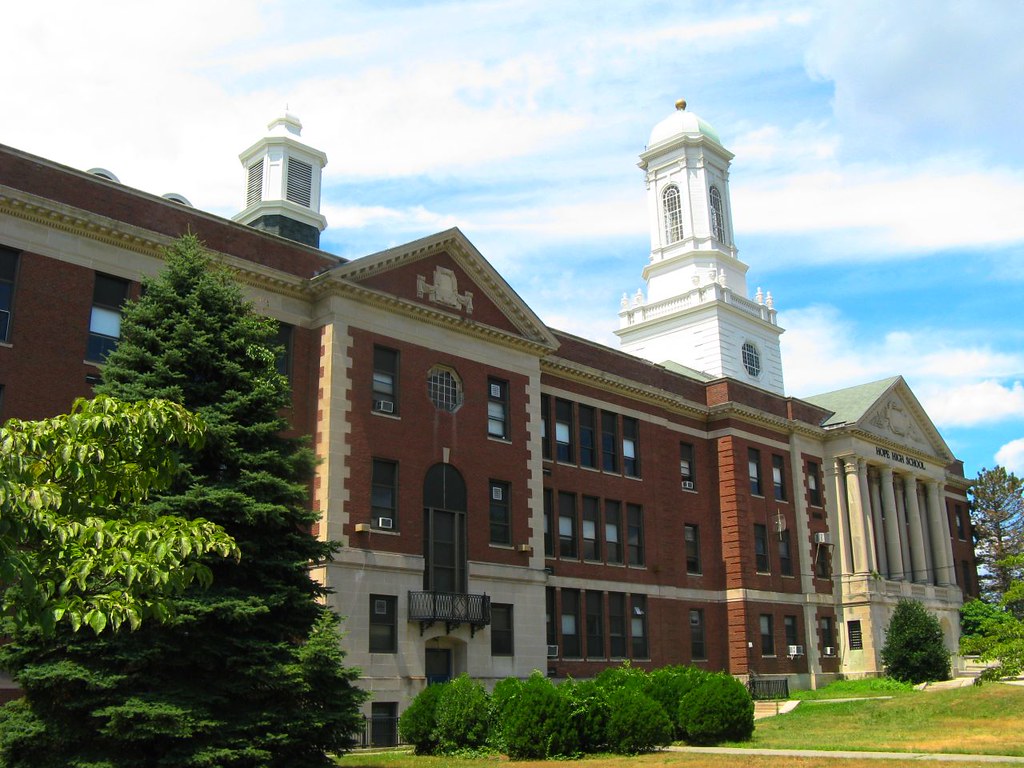
Hope High School in Providence

Infante-Green did not actually give much information about her plans for turning over management of the Providence school district to the city. She only shared:

“We said that in 2024, we’d look at how much progress has been made. But when that was decided in 2019, nobody anticipated a pandemic.”

Does she envision semi-permanent state control?

Feeding Corporate Friends

Part of the requirements in Rhode Island for a school to exit state receivership is an independent review. Of course, Infante-Green did not ask Brown University, Providence College or University of Rhode Island to conduct the review. She contracted with Massachusetts-based consulting firm, SchoolWorks, to lead an independent review.

SchoolWorks has a long history of supporting charter schools and privatization of public education. A tab on their web page advertises the only two categories of training they offer: For Charter School Authorizers and For Charter School Founders.

About For Charter School Founders, SchoolWorks says:

“Behind every successful charter school is a passionate group of individuals who dedicated their time and talent to envisioning a new school, garnering community support, and crafting a thoughtful and comprehensive charter school application. These are challenging, time-consuming tasks; and we celebrate pioneers like you for your commitment to innovating education.”

A link on the LittleSis data base provides some historical background for SchoolWorks. The CEO in 2016, Scott Blasdale, was a founding board member of the Massachusetts Charter School Association. He also was executive director and founding teacher of Academy of the Pacific Rim Charter Public School.

In the period that Richard Daley and Rham Emanuel were mayors of Chicago, SchoolWorks held consulting contracts for local public schools. They also consulted for KIPP schools, the Ewing Marion Kauffman Foundation and National Heritage Academies. The billion dollar Kauffman Foundation’s (EIN: 43-6064859) spending aligns with funding by Arnold, Dell, Gates and Walton, including generous gifts to TFA, Thomas B. Fordham Foundation, TNTP and Digital Promise.

Testing to Privatize

Johns Hopkins University was integral to the attack on public schools in Providence, Rhode Island. In May 2019, at the invitation of Infante-Green, Johns Hopkins Institute for Education Policy led a review of the Providence Public School District. The Partnership for Rhode Island, a group of local business leaders, funded the review.

The Johns Hopkins study was commissioned in May and presented in June. Based on the report, Providence Mayor Elorza officially petitioned the state to takeover Providence Public School District on July 19, 2019.

This request was based on testing data and Johns Hopkins not so unbiased report. In 2020, the Institute for Education policy at Johns Hopkins joined Jeb Bush’s Chiefs for Change to write a paper, calling for more standardized testing. This collaboration clearly indicated a penchant for school privatization and a tilt against public schools.

Adopting the Science of Reading

Infante-Green defended her school takeover methods stating:

“We have something called the Right to Read Act [which requires teachers to be trained in the science of reading]. By 2025, our K-8 teachers will all be trained, but we’re at about 75 percent.”

Science of Reading (SoR) is much more about profits and control than good teaching. SoR is not based on sound science and, more accurately, should be called “How to Use Anecdotes to Sell Reading Products.”

Professor Maren Aukerman, currently Werklund Research Professor at the University of Calgary, focuses on literacy education and democratic citizenship. She previously served on the faculty at Stanford University and University of Pennsylvania. Her recently published paper in the Literary Research Association on work by Goldstein, Hanford and others promoting SoR noted:

“The problem is not with recognizing that teaching phonics can play a facilitative role in having children learn to read; that insight is, indeed, important, if not particularly new. The problem is that this narrative distorts the picture to the point that readers are easily left with a highly inaccurate understanding of the so-called ‘science of reading.”’

Professor Paul Thomas of Furman University, with a deep background in teaching and education research, criticized of American Public Media’s Emily Hanford writing:

“As I have pointed out numerous times, there is a singular message to Hanford’s work; she has never covered research that contradicts that singular message.

“For example, not a peep about the major study out of England that found the country’s systematic phonics-first policy to be flawed, suggesting a balanced approach instead.

“And not a peep about schools having success with one of Hanford’s favorite reading programs to demonize.”

Nancy Bailey is an expert in special education and early reading instruction. In a recent posting, she declared:

“A troubling feature of the Science of Reading (SoR) is the connection between those who believe in the power of phonemes (and more) and those who want to privatize public schools. The old NCLB crowd has been rejuvenated and seems onboard with digital instruction replacing public schools and teachers.

Infante-Green’s claim that SoR is something wonderful and positive for public schools in Rhode Island is malarkey. It is a giveaway to corporations that harms students and undermines educators.

An Intriguingly Strange Claim

Infante-Green is quoted by The 74 stating:

“What’s interesting about Providence is that about 19,000 children apply to charter schools and there are only 22,000 students in the district. So they want charter schools.”

This assertion makes no sense. While it is not surprising that charter school enrollment in Rhode Island increased, the most recent (2021) available enrollment data showed 10,547 charter students. Claiming 19,000 student applications for privatized schools in Providence alone strains credibility.

Rhode Island’s Commissioner of Education promotes privatization.

It is true that since the pandemic, student enrollments have dropped and chronic absenteeism has grown throughout the nation. In Providence, both of these have soared. Even Central Falls, the most impoverished school district in Rhode Island, had a significantly lower absentee rates and better attendance than Providence. Commissioner of Education, Angelica Infante-Green, took over Providence schools five years ago, making no effective action while dropout rates climbed, students disappeared and many scholars coming to class sporadically.

Clearly, these schools would be in a better state if her takeover never happened.

It is time to quit playing privatization games with the public school system and return them to professionals in the district.

State takeovers have a nationwide record of failure and Providence is adhering to that history.
Providence Public Schools Threatened

13 Jan

By Thomas Ultican 1/13/2020

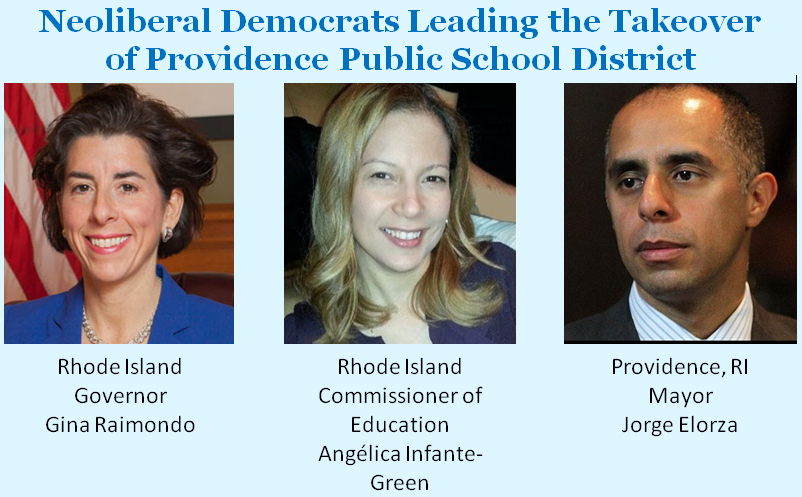
November 1, 2019, Angélica Infante-Green, Rhode Island’s new Commissioner of Education, announced the state was taking over Providence Public Schools. A neoliberal Democratic governor, a like minded mayor and the chamber of commerce appear to be instituting a school privatization agenda.

All power over schools in the state is held by the governor and mayors. Citizens do not have the right vote for local school leaders and school system leaders are subordinates of mayors. This structural weakness in Rhode Island has left public education vulnerable to the whims of a governor or mayor that does not respect professional educators and public education.

In 2011, Mayor Angel Taveras fired all of the teachers of Providence. In a recent article, Go Local Providence called it a “big bold idea” and seemed to lament that the teachers union got the firings reversed within a few days. This prompted Diane Ravitch to comment,

“Apparently the News Team wants the state commissioner to fire all the teachers now and is egging her on to do so.”

“Who will want to teach in a district where teachers are disposable, like tissues?

“Will Teach for America supply the new teachers after the existing workforce has been fired? Will they agree to stay longer than two years?”

Setting Up Providence Public Schools

Latino Public Radio reported on March 26, 2019, “The Council on Elementary and Secondary Education voted unanimously this evening, with the support of the full Rhode Island Board of Education, to appoint Angélica Infante-Green as the next Commissioner of Education.” This was really a pro forma vote. Governor Gina Raimondo selected Infante-Green as well as all of the state school board. Once Raimondo made her choice, it was a done deal.

RI Neoliberals

Recently Raimondo was judged to be the most unpopular governor in America. The Providence Journal reported in October:

“The second-term Democrat’s job performance is viewed unfavorably by 56% of registered voters, according to website Morning Consult, the most negative response during her time in office and the highest in the country. Only 36% of poll respondents, surveyed between July 1 and Sept. 30, viewed her favorably.”

Gina attended private school while growing up in Providence. She studied economics at Harvard and sociology at Oxford University. Following Oxford she earned a juris doctorate from Yale Law.

Raimondo worked in Massachusetts at the venture capital firm Village Ventures which was backed by Bain Capital before she ran to be Rhode Island State Treasurer in 2010. A puff piece in News Week describes how Gina defeated labor union opposition to roll back pension funds. The piece states, “The changes she persuaded the Democrat-controlled Legislature to pass over union opposition will save about $3 billion by delaying retirement, suspending cost-of-living increases and offering workers 401(k)-type savings plans.”

Her neoliberal pension reform plan matches the thinking of Charles Koch and the Cato Institute. The corporate supported American Legislative Exchange Council provides legal templates for reforming pension funds that look very much like Raimondo’s Rhode Island pension reforms.

Following her first term election in 2014, Raimondo selected Ken Wagner, a deputy of John King’s in the New York State Department of Education, to be Rhode Island’s Commissioner of Education. The New York Regents Chancellor, Merryl Tisch, praised Wagner and said he would be a big loss but was a great choice for Rhode Island. Wagner replaced Deborah Gist who left for the superintendent’s job in Tulsa, Oklahoma.

Last year, the governor was faced with making another education commissioner choice. While it is unclear why Wagner resigned the position in March 2019, Raimondo was prepared to immediately select Angélica Infante-Green who trained under Joel Klien and Michael Bloomberg in New York City. Infante-Green is a former Teach for America Corp member who began her career in New York City.

According to Angélica’s LinkedIn page, she taught at PS 4M, CS 77X, and South Park High School between 1994 and 1998. All of her administrative experience appears to revolve around bilingual education. She has never been a superintendent or a principal, which makes her an odd choice to lead Rhode Island’s schools.

However, she was in the first cohort of future chiefs at Jeb Bush’s Chief’s for Change. Their official comment on Angélica’s hiring came from Chief’s for Change board member Pedro Martinez. He said, “We applaud Gov. Gina Raimondo for selecting a commissioner with a deep commitment to creating and expanding opportunities for all students.” Martinez is the Broad trained administrator who is instituting the billionaire financed portfolio model of education reform in San Antonio, Texas; a model that posits disruption as good and democracy as a hindrance.

Researchers from John Hopkins University conducted a review of Providence Public Schools. Their report begins,

“In May 2019, the Johns Hopkins Institute for Education Policy led a review of the Providence Public School District (PPSD). We did so at the invitation of the Rhode Island Department of Education (RIDE) Commissioner, Ms. Angélica Infante-Green, with the support of Governor Gina Raimondo and Mayor Jorge Elorza. The Partnership for Rhode Island funded the review.”

Infante-Green officially assumed her position on April 29 and in May she already had arranged for corporate money to finance a study of PPSD.

The corporate money came from The Partnership for Rhode Island, a group of leading CEO’s in the state. The Governor and the Mayor supported the new Commissioner of Education’s invitation for the study to be done. When the report was released, media, politicians and business executive started vehemently denouncing PPSD as a dysfunctional failure.

Parnership for Rhode Island

Corporations Represented by the Partnership’s Chief Executives Officers

Mayor Jorge Elorza is a product of PPSD where he claims to have barely graduated. He went to community college then studied accounting at University of Rhode Island which led to an auditing position at PricewaterhouseCooper in New York. He obtained a law degree from Harvard in 2003. After the death of a friend in 2005, Elorza said he was motivated to leave Wall Street and return to Providence where he taught Law at Roger Williams University School of Law. He first ran for Mayor of Providence and won in 2014.

The Johns Hopkins study was commissioned in May and presented in June and by July 19th Mayor Elorza officially petitioned the state to takeover PPSD.

In June, the PPSD Superintendent, Christopher N. Maher stepped down. He said it was for family reasons but admitted that the layers of bureaucracy, which have been identified by previous superintendents as the reason for leaving was a factor. He is cited in the Johns Hopkins report saying the Mayor micro-manages the district and that he had to get city council permission to spend more than $5,000. He felt powerless.

In a clear indication that the teachers union was going to be targeted, the new interim superintendent hired to replace Maher was the former Central Falls School District Superintendent, Frances Gallo. She was the administrator praised by Arne Duncan in 2010 for firing all of the teachers at Central Falls High School.

Poverty and Language Learners Underlie PPSD’s Testing Data Struggles

The Johns Hopkins report was based on interviews with the mayor, the city council, the superintendent plus students, teachers and parents from 12 of PPSD’s 41 schools. The report notes, “While we scrupulously report what our team heard and observed, it is very important to note that it was not within our purview to confirm, through further research, the veracity of what we were told by different leaders and district stakeholders.” In other words, this was a very limited review, but it has been widely cited as proof the school district is a disaster.

There are many interesting comments and claims in the report, but the main proof of failure at PPSD is testing data. The report states,

“We know from existing data that student achievement in Providence has been low for decades. Despite the hard work of countless teachers, administrators, and city employees, the latest RICAS scores show that, across the grade levels, a full 90 percent of students are not proficient in math, and a full 86 percent are not proficient in English Language Arts.”

The district’s web page description of the student body makes it obvious why the students are struggling on standardized tests. PPSD reports,

“Our schools are diverse learning communities. Approximately 65% of our students are Latinx, 16% Black, 9% White, 5% Asian, 4% Multi-racial and 1% Native American.

“Approximately 31% of students are multilingual learners, and about 16% of students receive special education services. Approximately 55% of students come from homes where English is not the primary language spoken. Combined, our students and families speak 55 different languages and hail from 91 countries of origin.”

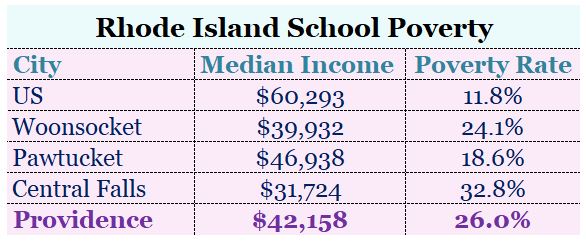
Providence is also one of the poorest urban areas in Rhode Island.

Poverty Comparison

US Census Data Showing Income and Poverty Rates

The cities listed on the chart above all have school districts that the Rhode Island Department of Education calls ”CSI” Comprehensive Support and Improvement Schools.

Professor Noliwe Rooks writes in her book Cutting Schools, “While the standardized testing gap between people of color and whites and Asian Americans is bad, it’s nothing compared to the gap between the poor and the wealthy.”

Professor Rooks also coined the term “segrenomics” to describe the business strategy of profiting specifically from high levels of racial and economic segregation. It appears that this is the plan for Providence.

The Johns Hopkins report states, “We note one particular success that consistently emerged across all constituencies: Every group noted the presence of many devoted teachers, principals, and some district leaders who go above and beyond to support student success.” The best hope for PPSD is they have a teachers union that will stand against the Mayor’s love affair with often useless education technology and the forces working to privatize public education.

Twitter: @tultican