
Tag Archives: Al Gore

California Charter Schools Heading for 2026

11 Nov

By Thomas Ultican 11/11/2025

There was another major effort in Sacramento to reform charter school laws in order to head off a repeat of the A3 disaster. In May 2019, the San Diego District Attorney charged 11-people with scheming to use non-classroom based charter schools to steal more than $400 million from the state education budget. Eventually the A3 grifters all plead guilty, but shockingly no-one spent a day in jail. This year, state legislators failed again to reform purposefully weak charter school laws meanwhile the privatization movement is still infested with graft.

Billionaires have been the wind beneath the charter school movement’s wings.

The first California charter school was authorized in 1994. The original charter school law capped the number of schools at 100; however Netflix CEO, Reed Hastings, successfully campaigned to end that limitation.

The California Charter Schools Association (CCSA) was founded in 2003. John Walton, a billionaire member of America’s richest family, was on the first CCSA board. He died in a plane crash in 2005 and his billionaire niece, Carrie Walton Penner, assumed his seat on the board. She served on the CCSA board from 2005-2015. (TIN: 51-0465703)

Billionaire Reed Hastings was a CCSA board member from 2007 until 2015.

In Executive Director of the Network for Public Education (NPE) Carol Burris’s yearlong study of charter schools, she admits not knowing how much billionaire money goes to the CCSA but noted:

“The 2017 Board of Directors include New York’s DFER founder, Joe Williams, a director of the Walton Education Coalition; Gregory McGinty, the Executive Director of Policy for the Broad Foundation; Neerav Kingsland, the CEO of the Hastings Fund; and Christopher Nelson, the Managing Director of the Doris & Donald Fisher Fund. Prior Board members include Reed Hastings of Netflix and Carrie Walton Penner, heir to the Walmart fortune.

Other billionaires were also busy supporting the charter school movement. The history tab at the NewSchools Venture Fund (NSVF) website states:

“NewSchools Venture Fund was created in 1998 by social entrepreneur Kim Smith and venture capitalists John Doerr and Brook Byers.” (Byers and Doerr are colleagues from the Kleiner Perkins venture fund.)

“We were among the first and largest investors in public charter schools and the first to identify and support multisite charter management organizations, which launch and operate integrated networks of public charter schools.”

At the time, “entrepreneur Kim Smith” was a graduate student at Stanford. She was co-chair of the Stanford business school’s entrepreneur club and wanted to get Amazon founder Jeff Bezos as a speaker for the club. She asked an acquaintance, John Doerr, to help and he agreed on one condition. In an education session at Al Gore’s house, the name NewSchools had been created. Doerr wanted her to come up with a use for the name.

Bezos spoke at her club and she wrote a two page paper outlining NSVF.

The push by billionaires to privatize public education using charter schools has become clear. It makes little sense for the future of education in America but billionaires don’t care. Bill Gates and the Walton Family Foundation are the largest individual donors to NSVF totaling $226,881,394 in grants as documented in the 2020 article Organized to Disrupt. However, this is only a fraction of the total billionaire largess. Over the last 20 years, billionaires John Doerr, Laurene Powell Jobs and John Sackler have served on the NSVF board.

The billions of dollars invested in growing the charter school movement has lead to steady growth.

However, the rate of growth is decreasing. From 2014 to 2020 the California charter school growth averaged 5% a year. From 2021 to 2025 the growth has fallen to 1% a year.

Research by NPE revealed the Achilles heel plaguing charter schools; they are not stable. In the first three years of operation, more than 15% of charter schools close their doors and eventually half of all charter schools go out of business. Charter promoting organizations like CCSA and NSVF counter that charter schools get better test results, but testing by California’s Department of Education shows the opposite.

Results Posted by California Department of Education

Reforming the Charter School Law

More charter schools appear to be following the A3 path. Highlands Community Charter and Technical schools received the results of a scathing audit on June 24 this year. Auditors found that the school improperly received over $180 million in state funds. The entire 7-person board has resigned or been forced out.

The audit identified millions of dollars in over-payments stemming from inflated attendance figures. Investigators noted conflicts of interest, questionable expenditures, gifts and the hiring of unqualified individuals. A high-ranking employee earned $145,860 annually but lacked an expected bachelor’s degree. She is alleged to have secured the position through her mother, who served on the board at the time.

Inspire, another non-classroom based charter school system using a similar model to A3, was the subject of a state audit in 2019. The founder and CEO, Nick Nichols, had to resign and pay back $1,055,834 for advances he took. The 12 charter schools, which made up the system, all remained in business independently after the demise of Inspire.

Required 2022 tax forms show that at three former Inspire schools, 15 people are averaging $157,000 in salaries to supervise 7806 students. When I asked what has changed, a teacher at one of the schools responded, “Now we have multiple Inspires with each school being a location where families and friends are being hired into high paying jobs that they are not qualified to hold.”

Chair of the California Assembly Education Committee, Al Muratsuchi, introduced Assembly Bill 84 in response to the reports about charter school fraud. The Torrance Democrat, who intends to run for superintendent of public instruction in 2026, declared he has no intention of “going after the charter schools that are acting responsibly and providing good educational services for their kids.” He added, “AB 84 is about going after the bad actors that are committing fraud and engaging in corruption through the current lack of transparency and accountability that we have with our statewide charter oversight system.”

CCSA CEO Myrna Castrejón came out swinging. She claimed the anti-charter school forces have brought a “bare-knuckle” fight. The highly paid Castrejón asserted, “Make no mistake, we still have opponents who are not going to stop until they strip out our autonomy entirely and/or cripple us.”

I noticed when looking through CCSA tax documents that Castrejón received $199,128 in total salary and benefits in 2009. Since then she has continued to make huge money fighting to advance charter schools and keep them as unregulated as possible. She set out to destroy AB 84.

Muratsuchi introduced AB 84 on December 20th, 2024. In February 2025, Castrejón’s launched her counter attack. She got Sacramento Democratic Senator Angelique Ashby to introduce Senate Bill 414, which claimed, “This bill makes a broad set of changes to charter school law related to audit procedures, financial oversight, governance, and funding determinations.” The political fight became about which reform bill is better, with the charter school industry supporting SB 414 and public school educators supporting AB 84.

Interestingly, a perusal of Ashby’s campaign contributions listed Reed Hastings and his wife, Pat Quillin as big donors. It also shows a large contribution from a charter school PAC belonging to the California Charter Schools Association Advocates, the political arm of CCSA.  

After a protracted fight, Muratsuchi withdrew AB 84 with the expectation that Ashby would withdraw SB 414. However, there was a feeling among legislators that they needed to deliver something for the governor to sign. On 9/13/2025, SB 414 achieve final passage with 22 Democratic senators not voting.

In an email to EdSource, California Teachers Association President David Goldberg declared:

“SB 414 not only fails to address the issues that have led to massive cases of fraud in some charter schools, but it also significantly weakens existing requirements for non-classroom-based charter schools to prioritize spending on student learning. We urge the governor to veto this legislation and are dedicated to our fight for meaningful reform next year.”

Governor Newsom concurred. In his veto message, the governor wrote:

“I deeply appreciate the efforts of the author and the negotiating parties to develop legislation that builds on these recommendations and the findings from the State Controller. However, this bill falls short. While the oversight and auditing provisions are meaningful, other sections are unworkable, would face legal challenges, and require hundreds of millions of dollars to implement. Additionally, provisions added late in the legislative process undermine important agreements my Administration made during my first term.”

Myrna Castrejón and her billionaire supporters won this round and California’s charter school laws remain extremely vulnerable to the scofflaws that she represents.
Best Book of 2022 – Left Behind

24 Aug

By Thomas Ultican 8/24/2022

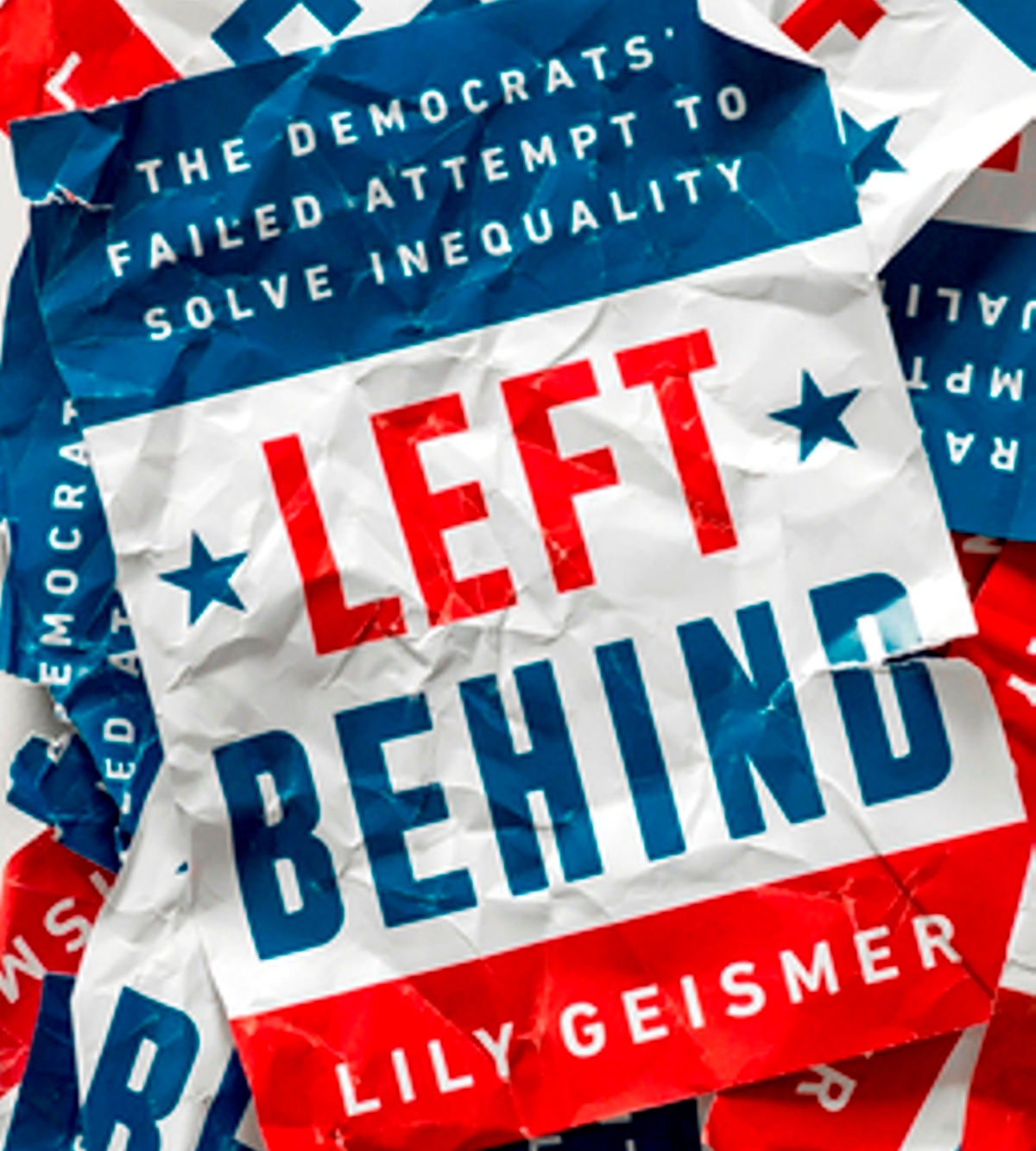
Lily Geismer has performed a great service to America. The Claremont McKenna College associate professor of history has documented the neoliberal takeover of the Democratic Party in the 1980’s and 1990’s. In her book, Left Behind: The Democrats Failed Attempt to Solve Inequality she demonstrates how Bill Clinton “ultimately did more to sell free-market thinking than even Friedman and his acolytes.” (Left Behind Page 13)

When in the 1970’s, Gary Hart, Bill Bradley, Michael Dukakis, Al Gore, Paul Tsongas, and Tim Wirth arrived on the scene in Washington DC they were dubbed “Watergate Babies.” By the 1980’s Tip O’Neill’s aid Chris Mathews labeled them “Atari Democrats” an illusion to the popular video game company because of their relentless hi-tech focus. Geismer reports,

“Journalist Charles Peters averred that ‘neoliberal’ was a better descriptor. Peters meant it not as a pejorative but as a positive. … Neoliberals, he observed, ‘still believe in liberty and justice and a fair chance for all, in mercy for the afflicted and help for the down and out,’ but ‘no longer automatically favor unions and big government.’” (Left Behind Pages 17-18) [Emphasis added]

Founding the DLC

In 1984, Lyndon Johnson’s son-in-law Charles Robb was the Democratic Governor of Virginia. He hosted a series of meetings in Washington and Virginia to develop a strategy for going forward. The meetings occurred shortly after Mondale’s huge loss to Ronald Reagan. It was decided they needed a new structure outside of the Democratic Party and Al From was tasked with writing the initial plan.

From’s scheme called for establishing the Democratic Leadership Council (DLC) to give the party a winning direction. Robb convinced From to become executive director of the nascent organization. From hired Will Marshal to be policy director. Geismer reveals,

“The architects recruited as founding members a lineup of fourteen senators, including Nunn, Chiles and Gore (who had just moved chambers); seventeen representatives, like Wirth, Gephardt, Leon Panetta of California, and Les Aspin of Wisconsin; and ten governors, such as Robb, Babbitt, James Blanchard of Michigan, Richard Lamm of Colorado, and Bill Clinton of Arkansas. … Of the total forty-one inaugural members, there were no women, two were men of color, and only four came from outside the Sunbelt.” (Left Behind Page 45)

Historian Arthur Schlesinger labeled the DLC “a quasi-Reaganite formation” and accused them of “worshiping at the shrine of the free market.”

Union pollster Victor Fingerhut called them “crypto-Republicans.”

Douglas Wilder a black Virginia politician criticized their “demeaning appeal to Southern white males.”

Others called them the “conservative white caucus” or the “southern white boys’ caucus.”

Jesse Jackson said its members “didn’t march in the ‘60s and won’t stand up in the ‘80s.” (Left Behind Pages 46-47)

In 1989, From convinced Bill Clinton to become the chairman of the DLC. That same year the DLC founded the Progressive Policy Institute to be their think tank competing with the Heritage Foundation and the CATO Institute. Today, it still spreads the neoliberal gospel.

The next year, the DLC issued the New Orleans statement which stated the “fundamental mission of the Democratic Party is to expand opportunity, not government.” The statement also claimed that a “free market regulated in the public interest, is the best engine of general prosperity.” (Left Behind Page 107)

At the DLC convention in early 1991, Clinton rejected criticism from people like Jesse Jackson and Ohio Senator Howard Metzenbaum (D-Ohio) stating, “choice is not a code word for elitism and racism.” Geismer notes that in his speech, “He then listed off the DLC proposals to address the problems of poverty with programs like childcare vouchers, public school choice, job training programs, and community policing.” (Left Behind Page 127) [Emphasis added]

It was at their 1991 convention that the DLC urged Congress to give President Bush fast track trade authority to negotiate the North American Free Trade Agreement (NAFTA). The Democratic establishment had not been warm to the idea and labor strongly objected.

After Clinton won the Democratic nomination, labor unions were in a difficult position. Geismer explained,

“Labor officials and the rank and file both had strong objections with Clinton’s position on free trade and were well aware of the New Democrats’ long-standing hostility toward unions. … Even though union members had gained more than a quarter of the delegate seats at the 1992 Democratic Convention, labor leaders made a conscious decision not to demand that Clinton openly advocate for unions in the platform or to temper his support for free trade. This calculation rested on their sense that Bush was a bigger threat to unions, and the movement should focus their energy on defeating him.” (Left Behind Page 133)

Once elected, Clinton turned away from New Deal liberalism and Johnson’s Great Society. He claimed that by increasing private sector activity in blighted urban areas and providing more credit these communities of poverty would be lifted up. He proposed creating enterprise zones “to create a small-business entrepreneurial economy in every underclass urban area …” (Left Behind Page 144)

Geismer describes a 1996 speech given by Hillary Clinton:

“Hillary Clinton took pains to emphasize the potential of micro-credit not just internationally but in the United States as well. The speech came just as states were implementing the requirements in the 1996 welfare reform act, which fulfilled Bill Clinton’s campaign pledge to ‘end welfare as we know it.’ The law terminated the assistance for women and children in place since the Roosevelt administration and served as a potent symbol of the Clinton administration’s attempt to put a nail in the coffin of New Deal liberalism.” (Left Behind Page 170)

In the fall of 1999, the Clinton administration negotiated with Senator Phil Gram (R-Texas) to end the Glass-Steagall act. This was the culmination of the administration’s support for deregulating the banking industry, which unleashed an historic wave of consolidations. The 2:45 AM deal ended the bank reforms President Roosevelt enacted to insure banks would never again make dangerous deals that led to failure and losing their depositors assets. (Left Behind Pages 309-312)

In retrospect, a good case can be made that the neoliberal agenda has been a disaster. The bank failures of 2008 almost brought down the entire World’s economy. Economic inequality has grown along with the creation of hundreds of billionaires both of which harm democracy. America’s childhood poverty rates are the highest in the developed world and homelessness plagues every moderately large city in America. It truly is “The Democrats’ Failed Attempt to Solve Inequality.”

The Attack on Public Education

The philosophy that guides people can also blind them. Neoliberals are so convinced by the magic of markets that they have fallen for the illusion that public education is failing. They are convinced that a business type accountability and market based competition are needed. It seems not to have occurred to them that the foundation for America becoming the economic, scientific and cultural leader of the world is public education. How can they overlook the fact that America’s public education system has produced by far the most Nobel Prize winners in the world? Evidently they believe that since it is not a market based system it must be failing. However, even the conservative publication Education Next just produced a study showing that public education results have been steadily improving for the last 50 years.

Vice President Al Gore was convinced public schools were failing and needed a new direction. During a monthly “Gore-Tech session”, the Vice President asked venture capitalist John Doerr, “If you Silicon Valley types are so smart, why can’t you do something to create new schools?” Doerr who had scored big with investments in Netscape, Amazon and Google, like Gore, was certain public schools required radical change. He wanted “better schools based on Silicon Valley’s principles of accountability, choice and competition.” (Left Behind Pages 233-234)

Two big results came from this conversation. Doerr, a notoriously successful venture capitalist, went home where he was integral to establishing the NewSchools Venture Fund which was one of the first venture philanthropies. It was dedicated to promoting charter schools and education technology. NewSchools collaborated with Reed Hastings and Don Shalvey to create America’s first Charter School Management organization. 

Geismer notes,

“Computer companies had long understood that getting a foothold in the nation’s schools was a potential goldmine. … As the participants at the Gore-Tech sessions took up education reform, the conversation quickly turned to the topic of charter schools, which were a favorite reform tool of the president.” (Left Behind Page 239)

Like other venture capitalists, NewSchools’ founders expect a return on investment. This return would be measured in test score gains rather than dollars. (Left Behind Page 255)

Al From told Clinton that in order to win reelection in 1996 he need to “grab the mantle” of charters and school choice for Democrats. Geismer avers,

“The 1996 State of the Union was most notable for Clinton’s declaration that the ‘era of big government is over.’ Elaborating on the theme, he also dared ‘every state to give all parents the right to choose which public school their children will attend; and to let teachers form new schools with a charter they can keep only if they do a good job.’” (Left Behind Page 244)

Some Parting Notes

Lily Geismer’s book is special. The scholarship is above reproach and she solidified my personal opinion about the neoliberal ideology and its implementation. I hope as many people as possible read this edifying book. It provides profound insight into the source of the stupefying inequality plaguing American society.

The book and this post put the neoliberal faction of the Democratic Party in an extremely bad light. However, it is important to remember that the neoliberal market driven agenda is embraced even more tenaciously by America’s conservative community and they don’t seem concerned about “a fair chance for all, in mercy for the afflicted and help for the down and out.”