Billionaire Sponsored Malarkey from Education Trust

3 Dec

By Thomas Ultican 12/3/2024

Education Trust (aka EdTrust), using what it calls equity analysis, critiqued various states’ Every Student Succeeds Act (ESSA) required accountability plans. University of Northern Colorado’s Derek Gottlieb reviewed their study for the National Education Policy Center. An unimpressed Gottlieb claimed, “Despite the language of ‘equity’ and attention to ‘asset-based’ framings of educational data, the vision of what high-quality accountability structures would look like and would do simply recycles the naïve hopes that fueled the original push for NCLB.” EdTrust’s non-peer-reviewed study might also be opening the way for a new version of the Elementary and Secondary Education Act to replace the now ten-year-old ESSA.

EdTrust rings a preponderance of No Child Left Behind’s (NCLB) greatest hits in its one paragraph explaining why we need federal oversight:

“The purpose of public education is to provide students with the knowledge and skills they will need to succeed after high school; the ability to access and complete a postsecondary education, pursue a fulfilling career that earns a living wage, and meaningfully participate in our democracy. All students can succeed when provided with the resources and supports to achieve. Yet, generations of students — particularly students of color, students from low-income backgrounds, students with disabilities, and multilingual learners — have been systematically denied equitable access to these educational opportunities — inequities illuminated and exacerbated by the pandemic. Federal accountability requirements are designed to ensure parents, communities, system leaders, and policymakers can better understand which schools and districts are struggling to meet students’ needs and have student group disparities, and — most importantly — use this information to target additional resources and supports to address these needs.

They are saying that through testing we can identify “struggling schools,” which is similar to NCLB’s “failing schools” but not as harsh. They claim it will allow targeting those schools with “additional resources and support.” Honestly, that sounds a lot better than NCLB’s fire the staff and close the schools but EdTrust’s plan to pay for the “additional resources and support.” is not workable. To achieve the goal, they suggest using federal school improvement funds, a 7% set-aside from Title I funding.

Typically, Title I funding represents about 2% of a state’s education budget. Unfortunately, a 7% set-aside from a relatively small amount of money is not going to be sufficient. Even if we accept that “all students can succeed,” these amounts of additional resources will not do the job.

EdTrust makes a series of recommendations that cause many of us teaching in the first decade of the 21st century to shudder.

They advocate, lowering the minimum student sample size from 20 to 10 so certain subgroups are included in school ratings. When teaching statistics, most instructors would warn that population sizes less than 20 have too large of error ranges to be statistically useful. It is odd that known data wonks would make this absurd recommendation.

EdTrust advocates using growth and proficiency with similar weighting for school accountability measurements. The standardized testing data used to assign proficiency are extremely noisy and unreliable. The famed Australian researcher Noel Wilson wrote a seminal work in 1998 called Educational Standards and the Problem of Error.” His peer reviewed paper states standardized testing error is so large that meaningful inferences are impossible. Growth models use standardized testing data and run it through opaque mathematical regimes. It is literally garbage in garbage out.

Another EdTrust recommendation says, “Increase federal monitoring and require state reporting of ESSA school improvement provisions,” which echoes the old NCLB test and punish regime.  The report adds:

“Strong actions such as state takeovers have mixed evidence of success and when done need to be undertaken in collaboration with communities. However, having these state actions as options can help motivate school and district leaders to make strategic, systematic changes to policy and practice to raise performance.”

Which means, if you are in the wrong zip code, your school is going to be a closure victim.

Professor Gottlieb concluded his review of the EdTrust report:

“Without substantially increasing the resources to be targeted for distribution, there are real and hard limits on the productive value of monitoring and reporting, no matter how good or robust our measurements are. It is one thing to have imagined, in the late 1990s, that federal accountability policy alone could transform public education across the country to finally make good on national promises of equal opportunity. It is quite another thing to pitch a wonkier version of the same approach three decades later, with so many tweaks and nuances and consistently underwhelming “successes” in our rearview mirror.”

Education Trust and the Billionaires

Kati Haycock founded EdTrust in 1990 according to the organization’s 1997 web posting. In 1973, with her newly earned bachelor’s degree in political science, University of California President, Charles J. Hitch, made her director of affirmative action for the entire UC system. By 1989, she had earned a master’s in education from UC-Berkeley and was gaining trust in neoliberal Democratic circles as shown by her becoming Executive-Vice President of the Children’s Defense Fund. It appears EdTrust was not a standalone independent organization until 1996. It was originally founded as a unit of the American Association of Higher Education.  That is probably why the National Assessment Governing Board says EdTrust was founded in 1996. (Common Core Dilemma Pages 45-48)

Haycock, who was never a teacher, became influential in education policy by promoting test-score centered American school rooms. Concerning Haycock’s expertise, Mercedes Schneider declared, “It’s like writing a cookbook without ever having prepared a meal.” (Common Core Dilemma Page 48)

EdTrust was always a diehard test based education improvement supporter. In 2008, Republican Sam Graves and Democrat Tim Waltz introduce HR 6239 to suspend temporarily the school punishments required by NCLB. Haycock and EdTrust swung into action to fight the bill. They stated in a letter to congress:

“HR 6239 would turn back the clock to a time when our country simply ignored troubled schools. That approach, the norm for generations of federal education policy, failed miserably and has wasted billions of dollars and squandered the potential of millions of our fellow citizens.  As imperfect as NCLB may be and as uncomfortable as the law may make some adults, we can’t afford—not even for a moment—to turn away from the law’s commitment to identify and intervene in schools that are not making the grade.”

At about this same time, Education Trust joined with Achieve and the Thomas B. Fordham Foundation to promote IBM CEO, Louis Gerstner’s American Diploma Project (ADP). Gerstner never studied education nor taught but he went to school and hired many people who also went to school so he considered himself an education expert. His big thing was the need for education standards. In 2008, his ADP was subsumed into Bill Gates Common Core State Standards. Interestingly, Gates had even less education background than Gerstner, but he was really rich.

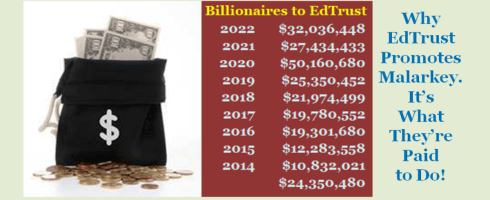
Since their inception, EdTrust has been very successful at attracting billionaire dollars. On their webpage, they list 50 entities that send them money which are mostly billionaires or billionaire financed. For tax purposes, EdTrust (TIN 52-1982223) is a tax deductible charity. Since 2014, they have received more than $24 million a year in deductible contributions.

That is a huge amount of money so I picked out four organizations to review in a little bit of detail. I chose the Gates Foundation because they send money to anyone undermining public schools, the Broad foundation out of nostalgia and curiosity, the Walton Family Foundation for the same reason as Gates and the Barr Foundation because of my friend Maurice Cunningham’s interest in them.

Amos Barr Hostetter, a cable company billionaire, founded the Barr Foundation in 1991 along with his wife Barbara but they made all of their contributions anonymously until 2010. Before then, Hostetter’s giving was hidden behind a veil of secrecy.

Conclusion

Having billions of dollars in private hands undermines democracy. The public likes their public schools, but enormous billionaire spending is driving down this regard. Propaganda like the EdTrust report is hard to counter.

If the common person is going to maintain any democratic control or rights, billionaires need to be taxed back to being millionaires.

Divider in Chief Shares Education Plan

21 Nov

By Thomas Ultican 11/22/2024

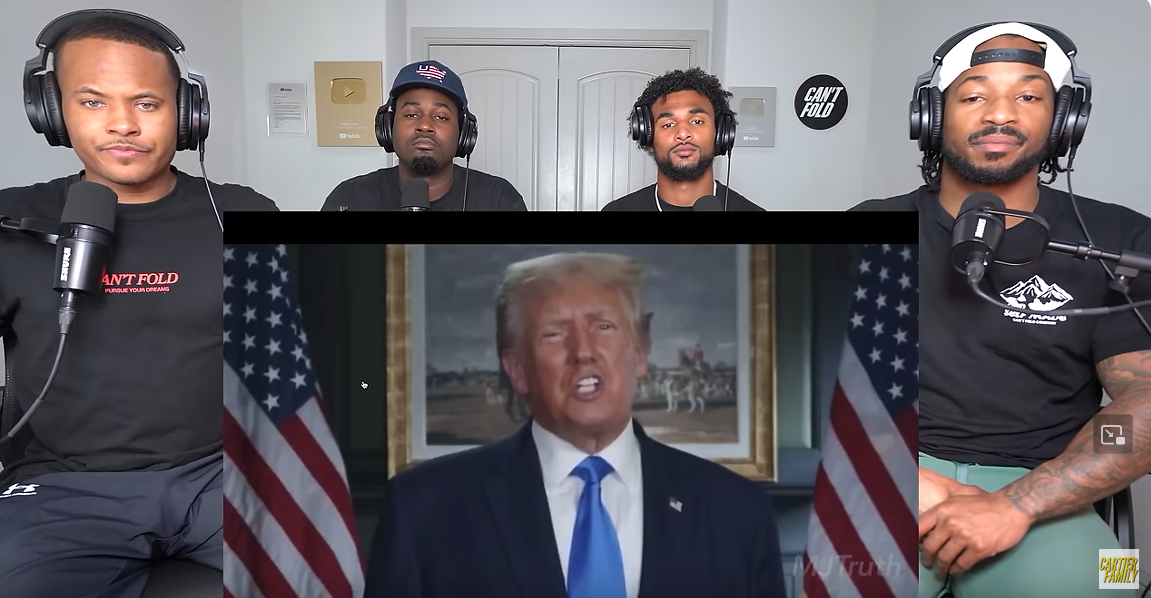
President Trump’s new video on the Carter Family’s YouTube channel lays out his ten points for public education. It is no surprise that the lies come immediately while he channels his inner Joe McCarthy, calling Biden and his administration communists. He also claims America is a failing nation.

Before kissing Trump’s ring recently, Joe Scarborough said his failing nation claim was wrong and stated:

We are also the strongest military power in the world. Even our enemies understand we’re not a nation in decline. Trump is always talking about Russian President Vladimir Putin and what a great leader he is. But the fact is, Texas has a higher GDP than the entirety of Russia.”

Politifact looked at the communist claims Trump has made about Biden and Harris:

“We sent the Trump campaign’s evidence to academics with expertise in Marxism or communism, including those with expertise in Latin America or the former Soviet Union. We noted examples we found of Harris showing support for people owning their own homes or businesses — basically the opposite of calling for government takeovers. No expert called her a communist or Marxist.” 

From Carter Family YouTube Channel

The lies cited above have been standard fare for Trump; so routine that most of us have accepted this as what he does. But in the opening paragraph of his education speech he tells a lie about public education that needs to be corrected. Trump claims:

“But instead of being at the top of the list, we are literally right. Smack. Guess what? At the bottom, rather than indoctrinating young people with inappropriate racial, sexual and political material, which is what we’re doing now, our schools must be totally refocused to prepare our children to succeed in the world of work and in life, and the world of keeping our country strong so they can grow up to be happy, prosperous and independent citizens.”

The indoctrination charge is baloney. The Hill noted:

“In the last two years, 15 states have adopted educational gag orders restricting ‘discussions of race, racism, gender, and American history’ in public schools, with seven states applying such orders to public higher education.

“Campaigns to eliminate diversity, equity, and inclusion programs, undermine tenure, ban or sanitize books, and appoint MAGA extremists to public university boards are well underway.

“Yet almost all the conservative claims about left-wing indoctrination are wrong.”

“The ‘patriotic education’ mandates pushed by anti-woke partisans, by contrast, are — practically by definition — indoctrination.”

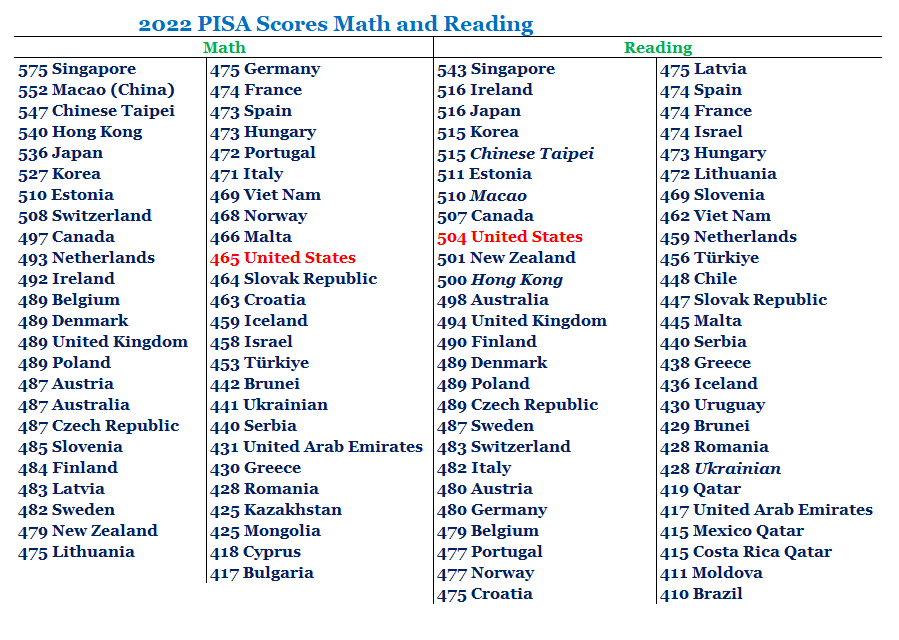
Trump’s claim that on international testing we are literally right. Smack. Guess what? At the bottom is an easily checked bald face lie. In 2022, the US participated in the international PISA testing. The following chart of data provided in the 2022 PISA report shows that the US was not nearly at the bottom.

Because America does not filter students from the academic system before high school, tested populations do not compare well internationally. However, since 2010, in the yearly International Math Olympiad, the USA team has come in first five times and never finished lower than fourth out of over 100 entrants.

One measuring stick demonstrating how successful the American system is would be Nobel Prize winners since 1949: America has 420 laureates; India 10; and China 8. The US has never won at standardized testing but leads the world in creative thinkers which is why a panicked China has been studying our system. They realize their test centric system is not developing innovation.

Diane Ravitch speculated that the new Common Corps standards might have been partly responsible for the drop in US scores on the 2016 international PIRLS testing. She sent her question to the distinguished social scientist David C. Berliner. He responded, “But before you or any others of us worry about our latest PIRLS scores, and the critics start the usual attacks on our public schools, remember this: Standardized Achievement Tests are quite responsive to demographics, and not very sensitive at all to what teachers and schools accomplish.”

Berliner shared the basic results:

  • USA 549
  • Singapore 576
  • Hong Kong 569
  • Finland 566

He then observed,

“First, we can note that Asian Americans scored 591. That is, our Asians beat the hell out of Asian Asians!”

Berliner also shared some other interesting US results broken into demographic groups:

  • White Kids (50% of our students) – 571
  • Upper Middle-Class Schools with 10% to 24 % Free and Reduced lunch – 592
  • Schools with 25% to 50% Free and Reduced Lunch – 566

It is obvious that the big drag on international testing data for US kids is childhood poverty and that the US education system is still the envy of the world.

Trump’s Ten Education Points

1) “First, we will respect the right of parents to control the education of their children.”

Writing in Forbes, Peter Greene reports, “advocates in the parents’ rights movement have not merely tried to opt their own children out of certain instruction and curricula, but have sought to ‘shape school curricula and policies for all students.”’ Scholar Vivian Hamilton, law professor at William and Mary notes, despite courts holding that parents have the right to decide whether or not to send their child to public school, “they do not have a fundamental right generally to direct how a public school teaches their child.”

2) “Second, we will empower parents and local school boards to hire and reward great principals and teachers, and also to fire the poor ones. The one whose performance is unsatisfactory. They will be fired. Like on The Apprentice, you’re fired.”

Even teachers have the protection of labor law and any firings must be justified. My experience was that within the first year, teachers who did not make the grade quit. They could not deal with the kids.

3) “Third, we will ensure our classrooms are focused not on political indoctrination, but on teaching the knowledge and skills needed to succeed. Reading, writing, math, science, arithmetic, and other truly useful subjects.”

I never met a classroom teacher focused on political indoctrination. It is not happening. However, the “patriotic education” mandates pushed by anti-woke partisans, by contrast, are — practically by definition — indoctrination.

4) “Forth, we will teach students to love their country, not to hate their country like they’re taught right now.”

Out of 1,000 teachers, there may be one that teaches this way but they will be gone soon. This is just not something even remotely occurring.

5) “Fifth, we will support bringing back prayer to our schools.”

This is a Christian Nationalist agenda that undermines the rule of law.

6) “Sixth, we will achieve schools that are safe, secure, and drug free with immediate expulsion for any student who harms a teacher or another student.

This sounds good but it should be a local decision and not a mandate by the President of the United States.

7) “Seventh, we will give all parents the right to choose another school for their children if they want. It’s called school choice.”

In Overturning Brown, Steve Suitts provides overwhelming evidence for the segregationist legacy of “school choice.” He shows that “Brown v Board” has been effectively gutted and “choice” proved to be the white supremacists’ most potent strategy to defeat it. In the 21st century, that same strategy is being wielded to maintain segregation while destroying the separation of church and state.

8) “Eighth we will ensure students have access to project based learning experiences inside the classroom to help train them for meaningful work outside the classroom.”

I am a fan of project base learning but curriculum design is not the business of the federal government.

9) “Ninth, we will strive to give all students access to internships and work experiences that can set them on a path to their first job. They’re going to be very, very successful. I want them to be more successful than Trump. Let them go out and be more successful. I will be the happiest person in the world. But we want our children to have a great life and be successful.”

This looks like another step in the ongoing Republican Party effort to undermine child labor laws.

10) “And tenth, we will ensure that all schools provide excellent jobs and career counseling so that high school and college students can get a head start on jobs and careers best suited to their God-given talents. This is how we will ensure a great education for every American child.”

OK but this is meaningless fluff that has little to do with great education.

“And one other thing I’ll be doing very early in the administration is closing up the Department of Education in Washington, DC and sending all education and education work and needs back to the states.”

Can we trust that the Trump administration will maintain civil rights enforcement and special education monitoring? Will they replace title one funding with something that is its equal? If the answer is no, then this is a horrible idea.

Conclusion

President Trump just announced that he disrespects teachers and will undermine public schools. He is so determined to end taxpayer funded free public education; he is trying to convince people that the greatest education system in the history of the world is a failure.

Scam Education Study from Denver

16 Nov

By Thomas Ultican 11/16/2024

Another education study financed by Arnold Ventures and the Walton Family Foundation blurs education reality. Their 2022 model did not pass the laugh test so “researchers” from the University of Colorado Denver tried again. Unfortunately their claims still confuse correlation with causation. This error seems purposeful.

The study of school reform in Denver was conducted by the Center for Education Policy Analysis (CEPA). They state, “For the past three years CEPA has partnered with the Center on Reinventing Public Education to consider a paradigm-shifting approach to family and community engagement efforts in school districts.” It is a study apparently to justify and promote the portfolio model of school management, a system first proposed in 2009 by the founder of the Center for Reinventing Public Education (CRPE), Paul Hill.

In their 2022 study, this same team also used state testing data from years 2004/5 through 2018/19. They explained that the first 4-years of the research employed pre-reform data and the final 10-years were from the portfolio model reform period. The authors reported, “During the study period, the district opened 65 new schools, and closed, replaced, and restarted over 35 others.” (Page 7)

The National Education Policy Center contracted with Robert Shand to review the 2022 Denver study. Dr. Shand is Assistant Professor of Education Policy and Leadership at American University and an affiliated researcher with the Center for Benefit-Cost Studies of Education at Teachers College, Columbia University. Shand also did a review of the new 2024 study.

In his 2022 review, Shand agreed that the test scores for Denver Public Schools had gone up but he noted a few reasons why claiming these gains were because of the portfolio model was unreasonable:

  • Demographics shifting to a larger percentage of white students in Denver coincided with the reforms.
  • Per-student revenues increased in Denver by 22% but only 13% across Colorado.
  • Student-to-teacher ratio in Denver dropped from 17.9 to 14.9.
  • DPS was already showing academic improvement before implementation of the portfolio reforms.
  • Black and Hispanic/Latinx students were growing at approximately 0.06 standard deviations per year pre-reform and 0.03-0.04 standard deviations per year post-reform. (Page 7)

The 2024 Redo

Professor Shand’s summary response to the 2024 report states:

“While the new report does convincingly demonstrate that the gains are not significantly due to changing demographics, it fails to address other critiques of the prior study, including (1) that the portfolio model was undertheorized, with unclear mechanisms of action and insufficient attention to potential drawbacks; and (2) that circumstances, events, and resources besides the portfolio reform and student demographics were changing concurrently with the reform. Additionally, the report’s sweeping conclusion—that Denver’s reform is the most effective in U.S. history—is unsupported. The improved outcomes in Denver during this time period are impressive, but the authors seem overly determined to cite a package of favored reforms as the cause.” (Page 3)

While Shand agrees that demographic changes are not the whole reason for the improved test scores, they are a significant input. The chart above from USAFacts.org shows the typically higher scoring groups Asians and Whites going from 54.2% of the population to 58.9% in the 14 years from 2005 to 2019. During the same period, the Hispanic and Black population shrunk from 42.9% to 38.1% which resulted in a 9.5% shift in the population from a lower scoring to a higher scoring racial mix.

An even bigger impact on the scoring in Denver was the change in economic circumstances. Standardized testing is useless because the results are dependent on one variable, family wealth. Statisticians assign r values between -1 and +1 to results tested. Plus 1 signifies certainty, zero shows no influence and -1 indicates certainty in the opposite direction of expectations. The only input ever found with more than 0.3 r-value is family wealth at 0.9 r-value. The median family income in Denver is up significantly.

Two sources show how strongly Denver’s family income has grown. Neilsberg research shares that between 2010 and 2020 the median income grew from $61,394 to $82,335, a 25% growth. City-Data states:

“The median household income in Denver, CO in 2022 was $88,213, which was about the same as the median annual income of $89,302 across the entire state of Colorado. Compared to the median income of $39,500 in 2000 this represents an increase of 55.2%”

This kind of wealth growth over the 14 years the Denver researchers studied was bound to have a significant impact on testing results, but they ignored it. Add this to the 9% greater revenue for Denver schools and three less students per teacher compared to the rest of the state and of course Denver’s student made comparative testing gains.

Professor Shand mentions the damage caused by school turnaround efforts and closing schools noting the research indicates these are especially harmful events for students in low income or marginalized neighborhoods. (Page 6 and 7)  Shand concluded:

“In sum, this report provides some additional supporting evidence in favor of the tentative conclusion that Denver’s portfolio reform was positive. Importantly, the report also grossly exaggerates both the magnitude of the success and certainty behind the evidence for it. The findings should thus be interpreted with extreme caution. (Page 8)

He is being nice. He should have concluded that this report is school choice propaganda.

About the Report Authors

The lead author, Parker Baxter, is Director of the Center for Education Policy Analysis at the University Of Colorado Denver School Of Public Affairs. He previously was Director of Knowledge at the National Association of Charter School Authorizers. Parker is also a Senior Research Affiliate at the CRPE, where he worked on the District-Charter Collaboration Compact Project and the Portfolio School District Project. He is a former alumnus of Teach for America.

Anna Nicotera is a Senior Researcher at Basis Policy Research specializing in quantitative and qualitative applied research methods. She worked six years as Senior Director, Research and Evaluation for the National Alliance for Public Charter Schools. Nicotera was a Graduate Research Assistant at the National Center on School Choice, Vanderbilt University for four years.

David Stuit holds a Ph.D. in Leadership and Policy Studies from Vanderbilt University. He is a former Emerging Education Policy Scholar at the Thomas B. Fordham Institute, fellow at the Friedman Foundation for Educational Choice (Rebranded EdChoice), and member of the American Enterprise Institute’s K–12 working group. He began his career as a classroom teacher in Denver, Colorado.

Expecting an unbiased piece of research from this group is like learning about the dangers of smoking from Phillip-Morris.

Conclusion

The report by Baxter et al. was dutifully promoted by The 74. It is dangerous propaganda in favor of school choice. This report is another example of using arithmetic and titles to sell a farce.

Christian Nationalists Oppose Separation of Church and State

7 Nov

By Thomas Ultican 11/7/2024

Christian Nationalists are hard at work ridding the US of that pesky first Amendment or as Thomas Jefferson stated it, “A wall of separation between church and state.” We have gone from the admonitions of Jefferson and Madison to witnessing a year in which Lawmakers in 29 states proposed at least 91 bills promoting religion in public schools. Reuters reports, “The movement is fueled by opposition to what conservatives call liberal curriculums, including a focus on diversity and LGBT rights, and by the U.S. Supreme Court’s willingness to overturn precedent as it moves American law rightward.”

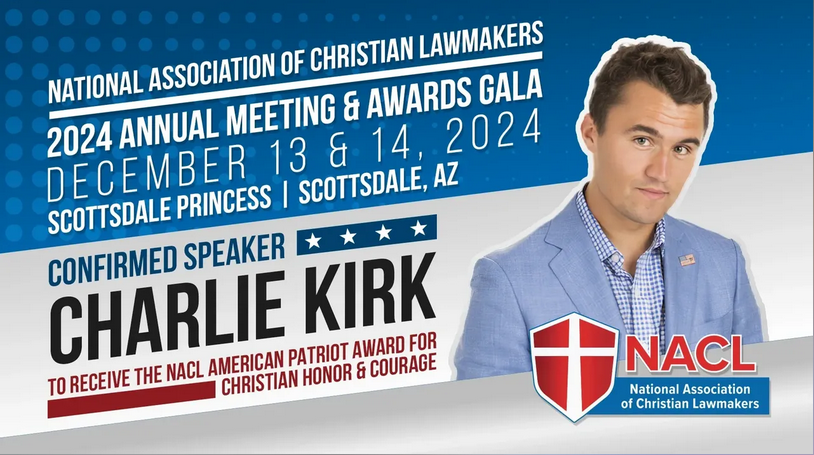
Central to this attack on the first amendment is a fairly new organization with powerful connections, National Association of Christian Lawmakers (NACL). The chemical symbol for salt, NACL, is why they chose the name. It symbolizes their Christian members being the salt of the earth.

An Arkansas politician and Christian preacher, Jason Rapter, founded NACL in 2019 and soon recruited influential figures of the Christian right, including Mike Huckabee, Bob McEwen, and Tony Perkins, to join the group’s advisory board. Their 2021 and 2022 tax form 990s (TIN 84-1804670) both indicated multiple hundreds of thousands of dollars in donations. All proceeds going toward supporting their Christian nationalist agenda. At their coming December gathering, the featured honoree and speaker will be Charlie Kirk.

To Arizona’s News21, Rapert stated, “We believe that with all the troubles facing our country, with Democrats and leftists that are advocating cutting penises off of little boys and breasts off of little girls, we have reached a level of debauchery and immorality that is at biblical proportions.” Preacher Rapert is clearly sincere about his faith but someone like him from Crazy-Town should not be designing model legislation.

New Texas Christian Curriculum

A new Texas program called Bluebonnet Learning containing multiple stories from the Bible is generating negative waves in non-evangelical circles. At September’s Texas State Board of Education (SBOE) meeting taking public comments on the new curriculum, parent Sharyn Vane called Bluebonnet Learning, “wildly problematic in its depictions of Jews and Judaism.” She pointed to the second grade lesson on Queen Esther in which Haman, a Persian official, cast lots to decide when to kill Jews. Part of the lesson includes students playing a game with dice. Vane declared:

“This is shocking, offensive and just plain wrong. Do we ask elementary schoolers to pretend to be Hitler?”

Many parents and Texas residents see Bluebonnet Learning as an unhealthily effort to promote a particular Christian philosophy. However evangelical Christians have encouraged their networks to bombard school board members with emails calling for approval:

“The TX State Board of Education is trying to adopt a new curriculum that replaces secular humanism with the Christian values upon which our nation was founded. Email them at SBOEsupport@tea.texas.gov with this message: Please adopt HB 1605 Curriculum without any amendments.”

It seems that some school board members came into the meeting having already decided to support Bluebonnet Learning. Andrea Young a member from Houston wrote in her summer newsletter:

“Much of Western Literature is woven with references to people, characters, metaphors, and themes from the Bible. Texas students will experience a richer reading experience if they have a passing acquaintance with stories and vocabulary from the Bible.”

Bluebonnet Learning was adapted from Amplify’s Core Knowledge Language Arts reading program. Billionaire Laurene Powell Jobs controls Amplify which seems to have a corrupt connection with the Texas Education Agency (TEA). Amplify recently was awarded a $50 million dollar contract by TEA.

The new curriculum was released amid a broader push by Texas Republicans, who control state government, to put more Christianity in public schools. During the Texas GOP convention last month, delegates voted on a platform that calls on lawmakers and the SBOE to “require instruction on the Bible, servant leadership and Christian self-governance.”

Rice University scholar, David Brockman, notes that Texas is home to a litany of well-known purveyors of Christian nationalism or related ideologies, including Glenn Beck, Ted Cruz’s father, Rafael Cruz and Lt. Gov. Dan Patrick, who claims the United States, is “a Christian nation” and that “there is no separation of church and state. It was not in the constitution.”

The Texas GOP or at least much of it is opposed to “godless secular education.” Secular education is a system of teaching not affiliated with any religious doctrines, focusing instead on academic subjects and critical thinking. This approach emphasizes neutrality in matters of religion, ensuring that students receive an education based on reason, science, and humanistic principles. The web site Fivable makes five points about secular education:

  1. “Secular education emerged in the United States during the 19th century as a response to the growing need for a system that could accommodate a diverse population with varying religious beliefs.
  2. “The establishment of public schools as secular institutions aimed to provide a common educational experience free from religious influence, which was seen as crucial for social cohesion.
  3. “Supreme Court rulings, such as Engel v. Vitale (1962), reinforced the idea of secular education by prohibiting school-sponsored prayer and other religious activities in public schools.
  4. “Secular education promotes critical thinking skills, encouraging students to question and analyze information rather than accepting beliefs based solely on tradition or authority.
  5. “Many educators argue that secular education helps prepare students for a democratic society by fostering tolerance, respect for different beliefs, and an understanding of civic responsibilities.”

This is the education model that Christian Nationalists are striving to overturn.

Not Just Texas

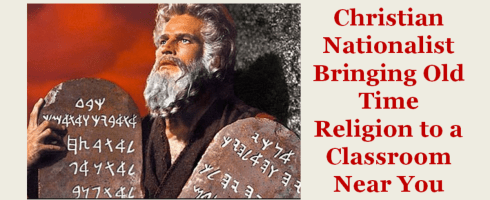
This summer, Louisiana Governor Jeff Landry signed a bill that requires the Ten Commandments to be posted in every public school classroom. Governor Landry stated, “If you want to respect the rule of law, you’ve got to start from the original law-giver, which was Moses.”

In addition, Landry signed laws that authorize the hiring of chaplains in schools, restrict teachers from mentioning sexual orientation or gender identity and prevent schools from using a transgender student’s preferred names or pronouns unless granted permission by parents.

The American Civil Liberties Union, Americans United for Separation of Church and State and the Freedom of Religion Foundation announced plans to challenge the law that requires a specific text of the Ten Commandments to be prominently displayed. Their joint statement stated, “Politicians have no business imposing their preferred religious doctrine on students and families in public schools.”

In June, Oklahoma’s Statewide Virtual Charter School Board approved a plan to create the St. Isidore of Seville Catholic Virtual School in a 3-2 vote. This plan was rejected by the Oklahoma Supreme Court but the Catholic Church and supporters of publicly supported Christian schools are pinning their hopes on the United States Supreme Court to override Oklahoma’s court.

A few weeks later, Ryan Walters, Oklahoma’s Superintendent of Public Instruction, announced that every teacher in the state will have a Bible in their classroom and teach from it. He said, “”Every teacher, every classroom in the state will have a Bible in the classroom, and will be teaching from the Bible in the classroom to ensure that this historical understanding is there for every student in the state of Oklahoma.” The Oklahoma Education Association claimed the order was illegal and stated, “Public schools cannot indoctrinate students with a particular religious belief or religious curriculum.”

Conclusion

In order to meet the demands of the anti-federalists and ratify the constitution, the Bill of Rights was added as constitutional amendments one thru ten. Amendment one states:

“Congress shall make no law respecting an establishment of religion, or prohibiting the free exercise thereof; or abridging the freedom of speech, or of the press; or the right of the people peaceably to assemble, and to petition the Government for a redress of grievances.”

Replying to a question about the establishment clause from Danbury Baptists, Jefferson wrote:

“Believing with you that religion is a matter which lies solely between Man & his God, that he owes account to none other for his faith or his worship, that the legitimate powers of government reach actions only, and not opinions, I contemplate with sovereign reverence that act of the whole American people which declared that their legislature should “make no law respecting an establishment of religion, or prohibiting the free exercise thereof”, thus building a wall of separation between Church & State. Adhering to this expression of the supreme will of the nation in behalf of the rights of conscience, I shall see with sincere satisfaction the progress of those sentiments which tend to restore to man all his natural rights, convinced he has no natural right in opposition to his social duties.”

It is clear that the people who wrote and enacted the first amendment believed it divided government from religion. Current speaker of the house, Mike Johnson, who is a Christian Nationalist, believes Americas’ rights come from “God himself” and claims that the separation of church and state is a relic of the 1960s. It is unlikely that he will defend the constitution of the United States or secular education and I would not expect much help from President elect Donald Trump either.

Privatized Schools Will End Democracy

30 Oct

By Thomas Ultican 10/30/2024

America’s founders believed in a need to educate the populace, especially second and third presidents, John Adams and Thomas Jefferson. They believed that the only way a self-governing society could be sustained is with an educated population. Adams penned to his wife, Abigail, “And liberty cannot be preserved without a general knowledge among the people who have a right from the frame of their nature to knowledge, as their great Creator who does nothing in vain, has given them understandings and a desire to know.” In a 1786 letter to scholar and fellow signatory to the Declaration of Independence, George Wythe, Jefferson wrote:

“I think by far the most important bill in our whole code is that for the diffusion of knowledge among the people. No other sure foundation can be devised for the preservation of peace and happiness.” (School and Society 1995, Page 25)

In the antebellum era, two types of schools flourished, common schools and academies. Common schools were supported by local and state governments. They were free for students. Academies may have received some governmental support but they charged students tuition. The common schools dominated towns and cities while the rural areas without enough population to support a common school turned to academies which were often boarding schools.

After the Civil War, common schools became more dominant. As the school system developed throughout America, the public structure took root.

In the 1930’s, the fact of an educated population that could read, write and do some math probably saved America from authoritarianism. During World War II, the high rates of literacy among American troops had a lot to do with their success on the battlefield.

The 1960s and 70s witnessed civil rights coming to public education and the development of a pluralistic system. Unfortunately, in the late 1970s, Washington DC politicians began to interfere with public education by proposing education standards, a harmful error.

In 1983, the Reagan administration published a deceitful attack on public schools, “Nation at Risk.” Since then public schools have been under relentless attack financed by billionaires.

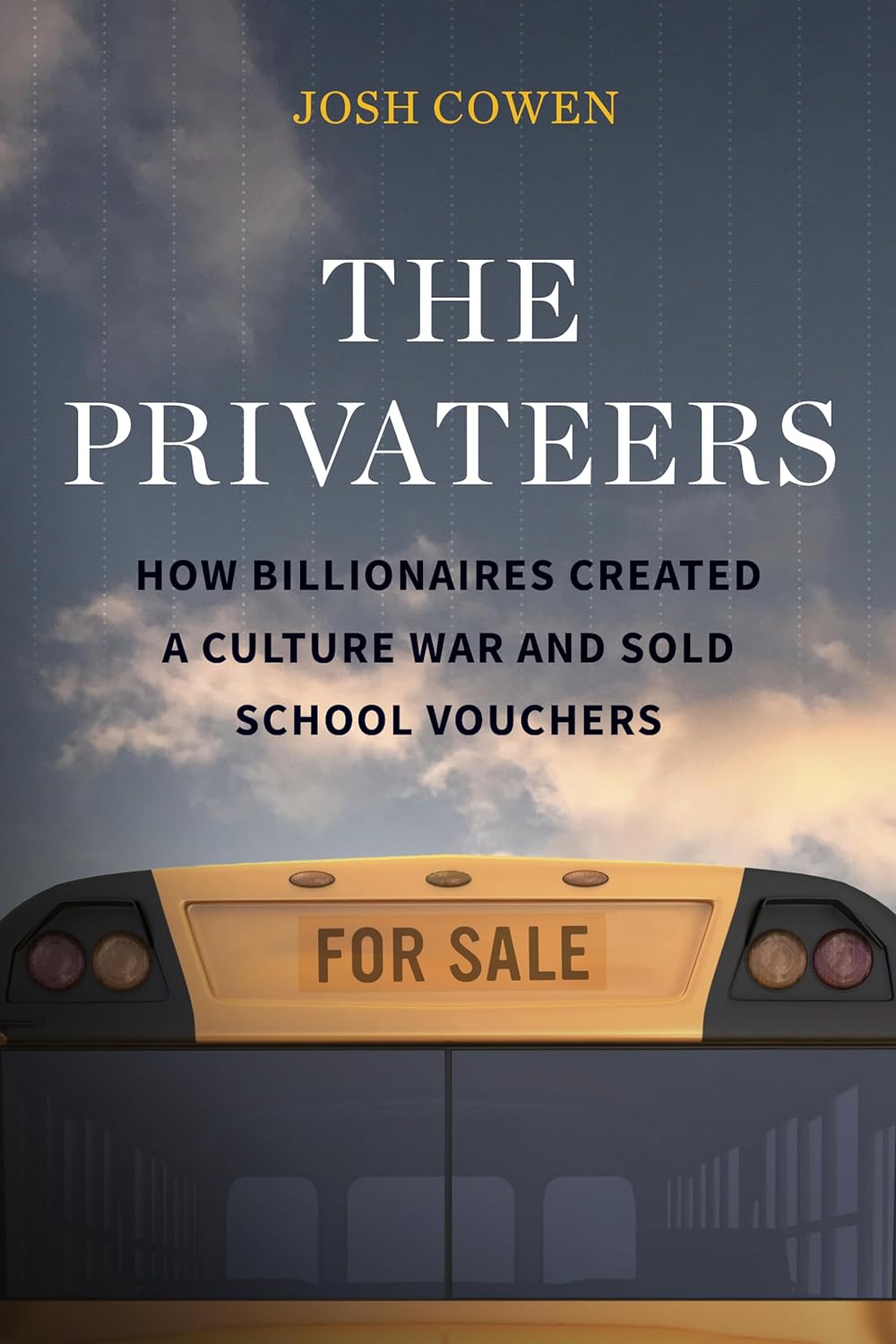
A key weapon in this attack has been forcing school vouchers on communities and states. Vouchers have never survived a popular vote, but in areas dominated by the Republican Party they have been enacted by legislatures. Researcher Joshua Cowen’s new book, The Privateers; How Billionaires Created a Culture War and Sold School Vouchers,” documents the way rightwing billionaires advanced a public education killing agenda.

The Privateers

Milwaukee, Wisconsin brought us America’s first voucher program in 1991. Cowen claims with evidence that the driving force behind the program was the Lynde and Harry Bradley Foundation.

In 1901, the brothers founded the Allen Bradley Company with a $1,000 investment by local Milwaukee doctor Stanton Allen. The older brother Lynde died in 1942 and the younger brother Harry succumbed in 1965. In 1985, Rockwell International bought the Allen Bradley Company for $1.65 billion and overnight the Bradley Foundation ballooned from $14 million to $300 million. The faceless people in control of this giant pile of cash pushed through America’s first voucher program.

Joshua Cowen is a Professor of Education Policy at the University of Wisconsin, Madison.  From 2015-2018, he served as co-editor of Educational Evaluation and Policy Analysis, the flagship peer-reviewed education policy journal in the United States. He was previously Associate Editor of Education Finance and Policy, and remains on the editorial boards of both journals. Since 2009, his research has been funded by an array of philanthropist and organizations including The University of Arkansas Foundation, the Walton Family Foundation and John Arnold.

Cowen being in the research trenches working directly with scholars that had an ideological predisposition to support vouchers makes his information powerful.

Billionaires Charles Koch, Betsy DeVos and other holders of extreme wealth have financed the fight to move funding away from public education and toward private schools. Cowen explains, “The purpose was and is to do away with schools existing as a core function of democracy and stand up instead a privately held, sectarian and theocratic version of publicly funded education.” (Privateers Page 30)

When the nation’s first voucher program was enacted, Wisconsin lawmakers included a requirement for an outside evaluation. University of Wisconsin professor of political science, John F. Witte, was given the assignment. Cowen reports, “Although the evaluation found the parents of voucher users indicated greater levels of satisfaction with their children’s educational experiences over time, Witte also found little consistent evidence that vouchers improved test scores or attendance rates and found that students gave up the vouchers at high rates to return to Milwaukee Public Schools.” (Privateers Page 36)

Paul Peterson, a Harvard professor who thirty years earlier earned a PhD in political science from the University of Chicago, was not having it. He blasted Witte’s report in the New York Times and in academic papers. Peterson was known mostly for his 1990 book, “Welfare Magnets.” However, in 1995, he received funding from both the Olin foundation and the Bradley foundation. Some of that funding was to evaluate Witte’s report. Peterson and his then graduate-student Jay P. Greene (now at the Heritage Foundation) attacked Witte’s study with a shocking level of vitriol and ferocity. (Privateers Page 38)

The next voucher program popped up in Cleveland, Ohio. It was the Peterson-Greene evaluation of the program that caused researchers concern about a hidden agenda and sloppy scholarship. Cowen writes:

‘“Even when he has limited data, he’s always squeezing out whatever data he can to arrive at a predetermined answer,’ said Professor Bruce Fuller, an early voucher critic at University of California, Berkeley. Fuller noted that with Olin and Bradley funding Peterson’s work, ‘That’s like the tobacco companies sponsoring studies on the effects of smoking.’ A later textbook for future evaluators would cite the Peterson Milwaukee work as a cautionary example of ideologically predisposed research and ‘a hidden agenda,’ particularly in Peterson and Greene’s willingness to use lower-than-conventional standards of statistical inference to make their case. Even Paul T. Hill, an otherwise prominent school choice supporter, singled out the Peterson Cleveland work as ‘not a persuasive study.’” (Privateers Page 42)

The central role of the Bradley Foundation was brought home with a quote from the New Yorker’s Jane Mayer:

“The Bradley Foundation virtually drove the early national ‘school choice’ movement, waging an all-out assault on teachers’ unions and traditional public schools. In an effort to ‘wean’ Americans from government, the foundation militated for parents to be able to use public funds to send their children to private and parochial schools.” (Privateers Page 46/7)

The wheels on the voucher bandwagon flew off. Patrick Wolf, another Peterson acolyte at Harvard who is now at the University of Arkansas, presented a paper with results Cowen described as “shocking.” The evaluation of Louisiana’s statewide voucher program showed unprecedented large negative impacts on students. Martin West, a former Peterson student and now Harvard Professor, wrote about the results calling them “as large as any I’ve seen” in the history of American Education.(Privateers Page 89)

Since that Louisiana study, two studies in Washington DC also showed large academic losses. The same thing occurred in both Ohio and Indiana. The largest academic declines ever recorded were from these voucher programs; larger than the losses due to Katrina or the Covid pandemic.

Conclusion

 If you have not read Privateers, I strongly recommend you do. In it, Joshua Cowen documents the massive spending by Charles Koch, Betsy DeVos, the Walton family and other wealthy conservatives to undermine public education by selling school choice. Public education is expensive and does not allow for religious indoctrination. Good private schools cost a lot more than the vouchers offered. This creates two benefits for conservative billionaires, overall education costs are reduced and the public is forced to fund religious schools. Those who are not wealthy will get an enfeebled education if the billionaires succeed in destroying public education.

Koch, DeVos and other billionaires run wealthy foundations that are tax exempt charities. In reality, they are not charities. They are political organizations spending to advance school privatization and other political agendas. The laws governing tax exempt foundations are being ignored because no one wants to face the wrath of the supper wealthy.

America can no longer afford billionaires. They undermine democracy. I have two recommendations. Tax billionaires back to being millionaires and cleanup tax free giving.

More Proof: Charter School Experiment FAILED

25 Oct

By Thomas Ultican 10/25/2024

Two new reports detail the high closure rates of charter schools and the negative effect of school closures on students. In 2020, Network for Public Education (NPE) produced Broken Promises,” the first ever comprehensive study of charter school closure rates. Their just released new report, Doomed to Fail,” updates “Broken Promises.” In May, Houston researcher, Jeonghyeok Kim, published The Long Shadow of School Closures: Impacts on Students’ Educational and Labor Market Outcomes.” Taken together these two new studies demonstrate why the charter school industry is a dangerous failure.

Since the inception of charter schools in the 1990s, billionaires and entrepreneurs have worked to sell these privatized schools. Under Bill Clinton’s leadership, the Democratic Leadership Council embraced school choice believing in the power of the entrepreneurial economy to reform schools (Left Behind Pages 122-127). The federal government started experimenting with charter schools. A rewrite of the 1994 Elementary and Secondary Education Act included a provision for a new federal Charter School Program. In 1995, the new program granted a total of $4,539,548 to nine states. Today, $400 million federal dollars are spent yearly to promote charter schools and oversight is relatively weak.

There is no denying that some charter schools are excellent, however, in general they are unstable. As NPE has documented their closure rates are so high as to be a big risk for parents and students.

Doomed to Fail

Reformers believed that a large-scale charter experiment would either prove or disprove the superiority of charter schools. In 2006, after Hurricane Katrina, Louisiana turned to the new Recovery School District (RSD) and all the schools in New Orleans became charter schools. However, because the students who returned to New Orleans were different from those in the city before, and there was an enormous influx of philanthropic funding, it was impossible to determine if the charter experiment worked.

Gary Rubenstein explained:

“Reformers needed a new experiment where the schools would keep the same students they already had, but the staff at those schools would be replaced with nonunion charter school educators, and charter chains or start-up charter boards would run the schools. Race to the Top provided Tennessee the funding and incentive to test the reformers’ hypotheses.” (Doomed page 19)

The theory was that “failing” schools in the bottom 5% of testing data would be taken over by charter schools. The goal was to show that these privatized schools would soon be in the top 25% of schools on testing results. It was a complete failure. None of the 33 charterized schools ever left the bottom.

This experiment demonstrated that it was not the public schools causing poor performance and privatizing them provided no improvement. The type of school, charter or public, made no difference. However, unstable schools are harmful and “Doomed to Fail” shows that charter schools induce a failure rate crap shoot.

The NPE report describes how professional marketing campaigns convince parents that the new charter school is different and better than the nearby public school. “Doomed to Fail” states:

“However, as hundreds of thousands of families have found, enrolling your child in a charter school comes with enormous risk. Charter schools close at far higher rates than public schools. And, unlike public school districts where infrequent closures are orderly with the district finding a new school for the child, charter school closures are often chaotic and abrupt, taking parents by surprise.” (Doomed Page 1)

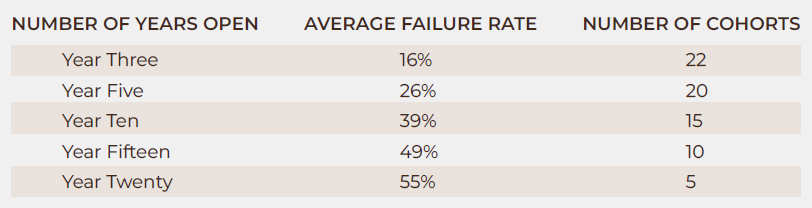
“Doomed to Fail” Page 11

Researcher Ryan Pfleger, Ph.D. used the federal Common Core of Data to create the table above. Each cohort is comprised of every year’s batch of new charter schools. The table informs us that 16% of new charter schools close their doors within the first three years. The ten 15-year cohorts failed at a 49% rate which is a 1% improvement over the 2020 “Broken Promises” report. However, the huge federal COVID payments of 2021 probably kept many schools in business that otherwise would have failed. The 20-year failure rate of 55% makes it clear that failure keeps happening and that more than half of all charter schools close their doors forcing families to make other arrangements.

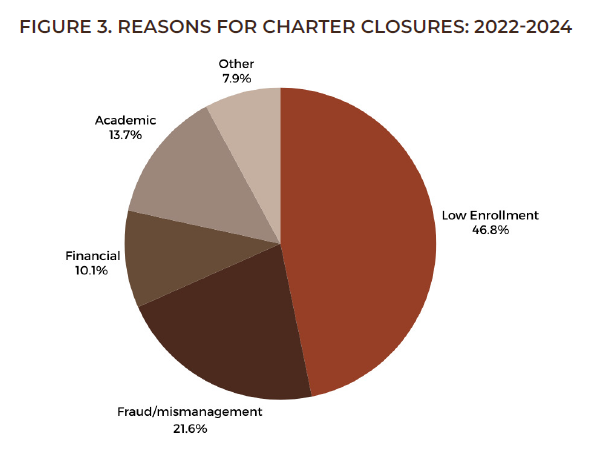
The charter industry says their schools are more academically accountable and are closed if they do not meet the agreed to goals. However, NPE’s research discovered that this was the cause for only a minority of the schools that closed. Not being able to maintain enough enrollment to be viable or corruption and mismanagement were the cause in more than 68% of closures. 

“Doomed to Fail” Page 13

Closures Bring Long Term Negative Effects

In 2019, Matt Barnum of Chalkbeat reported on 17 studies of the effect of school closures on students. There were differing results but in general reading and math scores suffered but after three years, the academic effects seemed to have disappeared.

Researcher Jeonghyeok Kim took a longer range look at the student outcomes and the results were surprising. Like other studies, Kim’s showed a short term academic decline and then recovery within three years. However, he also discovered long term discipline issues, lowered college completion rates and reduced incomes.

In EdWeek, Libby Stanford reported, “Kim centered his research around a dataset of 470 Texas schools that closed from 1998 to 2015.” Stanford also noted, “In a study of federal enrollment data from 2000 to 2018, researchers at the Stanford Graduate School of Education found that majority-Black schools were three times more likely to close than schools with smaller enrollments of Black students.” Since Kim associated the harshest closed school outcomes with economically disadvantaged families, this represents a double whammy.

The abstract from Kim’s paper states:

“Each year, over a thousand public schools in the US close due to declining enrollments and chronic low performance, displacing hundreds of thousands of students. Using Texas administrative data and empirical strategies that use within-student across-time and within-school across-cohort variation, I explore the impact of school closures on students’ educational and labor market outcomes. The findings indicate that experiencing school closures results in disruptions in both test scores and behavior. While the drop in test scores is recovered within three years, behavioral issues persist. This study further finds decreases in post-secondary education attainment, employment, and earnings at ages 25–27. These impacts are particularly pronounced among students in secondary education, Hispanic students, and those from originally low-performing schools and economically disadvantaged families.”

Kim’s ground breaking research shows that the negative effects of experiencing a school closure are not just short term, but appear to be a life long hindrance.

Conclusion

NPE’s new study, “Doomed to Fail,” makes it clear how unstable privatized schools are. The study also reports on charter skullduggery and specific school closures like Jubilee academy, sharing:

“On August 14, 2023, Jubilee Academies Highland Park in San Antonio, Texas, began the school year. Two weeks later, parents were informed that the school would close by mid-September. Families would have to find another school or agree to bus their child to another Jubilee school. Two hundred and ten students were displaced.” (Doomed Page 14)

When “Doomed to Fail” is combined with Jeonghyeok Kim’s new research, it is clear that parents are risking the future of their children when they enroll them in a charter school.

To be clear, trusting your child to a charter school is a bad idea.

Lying to Sell School Choice

20 Oct

By Thomas Ultican 10/20/2024

Progressive Policy Institute (PPI) and The 74 are lying about education gaps to promote “school choice.” The 74’s October 10 headline says, “In Cities With School Choice, Low-Income Kids Catching up to Wealthier Peers.” The article is based on a report from the PPI’s Reinventing America’s Schools. The non-peer reviewed report assaults scholarship and is based on other billionaire paid nonsense.

Progressive Policy Institute

Tressa Pankovits, the Co-director of PPI’s Reinventing America’s Public Schools, authored the propagandistic report. She came to PPI after 10 years as CEO of Vallas Group inc. Her PPI bio says the Vallas Group was, “led by esteemed education and public finance expert Paul Vallas.”  It should be noted Vallas is not universally esteemed in New Orleans, Philadelphia or Chicago where he did his best to privatize their schools and demean teachers.

PPI pushes conservative ideology while dressing it up like progressive philosophy. The biography of its founder, Will Marshal, states, “Founded in 1989, PPI started as the intellectual birthplace of the New Democrat and ‘Third Way’ movements, earning a reputation as President Bill Clinton’s ‘idea mill.”’

Lily Geismer’s book, Left Behind, claims that the Democrats failed attempt to solve inequality demonstrates how Bill Clinton “ultimately did more to sell free-market thinking than even Friedman and his acolytes” (Left Behind Page 13). She went on to note that Journalist Charles Peters called Clinton and his core supporters, neoliberals. Geismer noted:

“Peters meant it not as a pejorative but as a positive. … Neoliberals, he observed, ‘still believe in liberty and justice and a fair chance for all, in mercy for the afflicted and help for the down and out,’ but ‘no longer automatically favor unions and big government’” (Left Behind Page 18). [Emphasis added]

Historian Arthur Schlesinger labeled the DLC “a quasi-Reaganite formation” and accused them of “worshiping at the shrine of the free market” (Left Behind Page 46). DLC stands for Democratic Leadership Council which is also referred to as “New Democrats.”

David Osborne was an early fellow at PPI. He developed his view of entrepreneurial government into a 1992 book written with Ted Gaebler, called Reinventing Government: How the Entrepreneurial Spirit is Transforming the Public Sector.” In their book the authors “made the case for what they called ‘entrepreneurial schools,’ which would compete among each other for customers” (A Wolf at the School House Door Page 84).  Under Osborne’s influence, “the DLC became one of the first political organizations to explore charter schools as a means of improving public education” (Left Behind Page 118). Osbourn became a senior advisor for Vice President Al Gore and founded PPI’s Reinventing America’s Public Schools. He is still its Director Emeritus.

Reinventing America’s Public Schools is aggressively for school privatization through charter schools. They are funded by the Walton Family Foundation (TIN: 13-3441466), the Broad Foundation (TIN: 95-4686318), and the Arnold Foundation (TIN: 26-3241764). These are the billionaires paying the freight and they want their deliverables.

Propaganda Masquerading as Research

There are two main claims being asserted in the report. One is that achievement gaps are shrinking in areas with significant school choice. The second claim is that charter schools do not negatively impact public schools. The 74 quotes Brandon Brown, CEO of the Mind Trust in Indianapolis, saying, “[A] lot of the evidence shows that the growth of high-quality charter schools does not come at the expense of the school district.” Both of these claims are farcical.

The PPI report claims:

“Stanford University’s Center for Research on Education Outcomes (CREDO) has undertaken many local studies and, in 2023, released its third major national report in a series spread out over the past 30 years. In that massive study, CREDO researchers assessed the performance of students at 6,200 charter schools in 29 states between 2014 and 2019, confirming that charter-school students, on average, outperformed their peers in demographically-matched traditional public schools” (Report Page 6).

If we believed the CREDO results, the differences of 0.011 standard deviations in math and 0.028 standard deviations in reading are so small as to be meaningless. In addition, the CREDO methodology is highly suspect. Professor Andrew Maul of UC Santa-Barbara stated, “The study’s ‘virtual twin’ technique is insufficiently documented, and it remains unclear and puzzling why the researchers use this approach rather than the more accepted approach of propensity score matching.”

Economics writer, Andrea Gabor, noted the “study excludes public schools that do NOT send students to charters, thus introducing a bias against the best urban public schools, especially small public schools that may send few, if any, students to charters.” Schools sending less than 5 students to charters are excluded from the study. In addition, the CREDO study makes no adjustment for charter schools creaming students which means charters teach fewer special education and language learner students than do public schools.

Macke Raymond is the current director of CREDO. In 2015, her Hoover Institute Fellow’s profile said, “In partnership with the Walton Family Foundation and Pearson Learning Systems, Raymond is leading a national study of the effectiveness of public charter schools.” The 2023 report was their third in this series of studies. Her partners have too much skin in the game to be viewed as unbiased.

The PPI report looks at 10 cities “with more than one-third of students enrolled in bricks-and-mortar charter or charter-like schools.” PPI claims, “In every one of these cities, students have significantly closed the gap in outcomes between low-income students and all students statewide between 2010-11 and 2022-23” (Report Page 10). (Emphasis added)

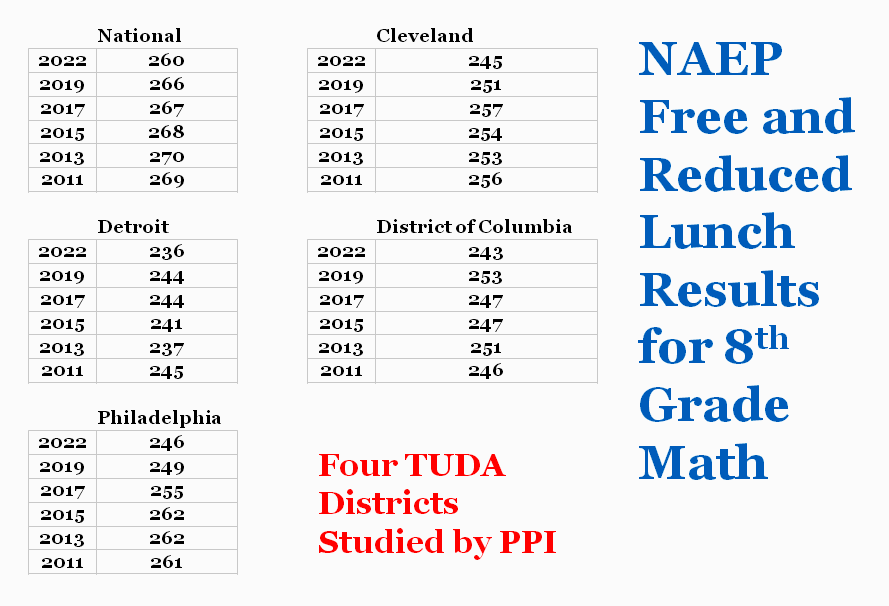
In the beginning of the standardized testing craze, outcome gaps between racial groups were a big concern. Then Sean Reardon and his team at Stanford discovered that these gaps in testing results were more likely poverty driven. There is almost no information about where PPI got the data to support their claims. Most of the 10 cities studied are in states that have changed test types and venders since 2011. This makes the state tests somewhat difficult to use for comparing gap changes if the data required could be attained. However four of the cities PPI studied are in the NAEP (National Assessment of Education Progress) Trial Urban District Assessment (TUDA) group; Cleveland, District of Columbia, Detroit and Philadelphia.

Using the NAEP data explorer to look at 8th grade math, the results for students receiving free or reduced lunch was found. Free and reduced lunch is generally believed to be a good indicator of poverty and 8th grade math is a subject that all students take. There was almost no change over the 12 years cited.

Only the national results saw a 3% improvement and the four studied cities saw testing declines of more that 1%. The PPI report states, “In all of these 10 cities, the data show that in the last decade (school years 2010-2011 through 2022-2023), low-income urban students closed the gap with statewide test score averages by 25-40% (Report Page 10). This is a surprising and difficult claim to accept. In fact, it looks like an outright lie.

Conclusion

It has been clear that The 74 was a billionaire propaganda rag ever since its original funding was provided by the Dick and Betsy DeVos Family Foundation, the Walton Family Foundation, the Doris and Donald Fisher Fund and Bloomberg Philanthropies.

PPI appears to be an organization stuck in its 1990s neoliberal ideology with their misguided belief that markets are always the superior path to improvement.

Both organizations seem to be missing out on ethics. Here they have joined in a lie to sell school choice.

Education Support, More Harm than Help

10 Oct

By Thomas Ultican 10/10/2024

In California, we have the Fiscal Crisis and Management Assist Team (FCMAT – pronounced fick-mat) which is more often the bane of its clients than a help. It is a quasi-autonomous non-governmental organization signed into law in 1992 by Governor Pete Wilson. FCMAT was a response to the financial collapse of the Richmond school district. Unfortunately organizations with this structure become bureaucratic and overtly support the political agenda of whoever is in power. The unhelpful nature of FCMAT recently reared its ugly head in Stockton Unified Schools District (SUSD).

The story of Stockton is that of a small city less than 50 miles south of Sacramento whose school district has become the target of unrelenting attacks by billionaires. It is a minority majority city of about 321,000 people. The demographic makeup is 45.2% Hispanic, 20.9% Asian, 31.3% White and 11.6% Black. The city has a little more than a 15.6% poverty rate; however, SUSD reports that 77% of their students live in poverty.

California’s Data Quest enrollment data for the 2023-24 school year shows charter schools with 6,282 students, public schools with 32,448. That means charter school enrollment is 16% of the 38,730 total publicly supported students in Stockton.

The two biggest problems for the schools is massive spending by billionaires to privatize them and an unrelenting superintendent of schools turnover. Since 2005, there has been a revolving door for superintendents. The longest serving one in that period was John Deasy and he resigned June 15, 2020 serving just 2 weeks more than 2 years.

Deasy was succeeded by Brian Beiderman who already worked in the district and appeared to have been Deasy’s choice. Beiderman was interim superintendent for 8 months and then resigned. He was replaced by John Ramirez Jr., who resigned under a cloud just over one year from being appointed interim superintendent. Going into the 2022-23 school year, the SUSD board settled on Dr. Traci E. Miller as interim superintendent.

In December 2022, Superintendent Miller was informed that “we have decided to go in another direction” six months before her contract was allowed to expire. She says the call was from Don Shalvey, CEO of San Joaquin A+, and Fritz Grupe a real estate developer, who leases charter facilities. It is of note that neither of these gentlemen had any actual standing in SUSD.

June 30 2020, was the 75 year old Shalvey’s last day at the Gates’ Foundation. For the entire 11 years he worked for Bill Gates, Shalvey commuted from his ranch in Linwood, California where he lived with his wife Sue. Linwood is 10 miles outside of Stockton.

San Joaquin A+ was a small non-profit (TIN: 51-0536117) supporting education initiative with modest holdings of less than $40,000. Coincident with Shalvey’s availability, Helen Schwab, a San Francisco billionaire, donated $400,000 to A+ and Shalvey was named CEO. In the three years prior to his arrival, A+ had taken in $15,169. The haul in 2020 was $3,176,833 and in 2021, $3,942,790. Shalvey’s new part-time job was paying him a high six-figure salary and billionaire dollars were flooding Stockton.

FCMAT Arrived

FCMAT Main Web-Page

John Ramirez, who was interim superintendent in 2021, appeared concerned about the reliability of his district’s budget. He contacted FCMAT for help. In June 2022, an odd Stockton grand jury reported on the district. Local news group Stocktonia briefed:

“The biggest concern: SUSD is “headed toward at least a $30 million deficit by `the fiscal year 2024-2025.” And if the current management practices continue, that deficit will “likely escalate.”’

Despite Ramirez having called on FCMAT months before this grand jury report, the San Joaquin County office of Education stated:

“The SJCOE can confirm that it has contracted with the Fiscal Crisis Management Assistance Team (FCMAT) in order to conduct a comprehensive review of the school district.  The San Joaquin County Superintendent of Schools initiated the AB139 Extraordinary Audit earlier this year.”  (An AB139 audit gets its name from the assembly bill 139 that authorized these audits of school district budgets.)

In 2023, FCMAT issued two reports. February saw the release of their Extraordinary Audit which was a bureaucratic nightmare. On page 33, the report states, “Based on the findings in this report, there is sufficient evidence to demonstrate that fraud, misappropriation of funds and/or assets, or other illegal fiscal practices may have occurred in the specific areas reviewed.” The audit cost the district $50,000 and provided no insight into the looming $30 million dollar deficit or what evidence of fraud and illegal fiscal practices had been unearthed.

The same unfounded claims of criminality were lobbed by FCMAT CEO Michael Fine at Sweetwater Union High School District where I worked. No serious legal charges were ever made and the district finally got FCMAT off their back.

The final report, Fiscal Health Risk Analysis, was presented in August. FCMAT has developed a group of tables with a series of questions having three possible responses, yes, no or N/A. They then use some secret formula to turn these answers into numbers which guides the conclusion. They determined that SUSD’s solvency risk factor was high. The report is not that convincing.

These reports were responses that provided little to no help for SUSD, who originally asked for the audit. The Extraordinary audit seemed to be a regurgitation of the grand jury findings. FCMAT trashed the board and management of the school but offered few insights. During COVID, the school board received federal money to do things like improve ventilation in schools. The audit spent five of 45 pages on the air purifier purchase from IAQ that the board made. It seems some people wanted a different company to get the contract and felt the school board froze them out. However, this was a – spend the money or lose it – purchase, and did not affect the viability of the budget.

An interesting character in this episode is financial expert Susan Montoya. She was chief financial officer when John Ramirez was superintendent of the district. Supposedly she informed Ramirez that she would be away for a while, but would have the 2021-2022 budget ready. She did return with the budget in hand and then resigned. Later, Montoya was hired by San Joaquin County school superintendent, Troy Brown, to be the counties “Fiscal Expert.”

Before Montoya’s hiring, SUSD interim superintendent, Traci Miller, wrote Brown sternly warning against the hiring. Miller stated that Montoya was unprofessional and many of the district’s “current fiscal problems can be traced back to Montoya.” Miller feared she “will sabotage our progress and our implementation of new and improved processes.” Miller was ignored.

When FCMAT was conducting its audit, the county’s “Fiscal Expert,” Susan Montoya, was a primary source. The person Traci Miller blamed for the district’s fiscal problems was part of the team doing the audit. In effect, grading her own home work. In the extraordinary audit, FCMAT writes, “Limiting the possibility of any personal influence, either directly or indirectly, is about avoiding even the appearance of a conflict.” (Page 10) Their statement seems a little hypocritical.

To put a cherry on the top, SUSD has discovered that the $30 million budget deficit was rouge. Supposedly, Montoya had created phantom positions that were being funded and that was the source of the apparent deficit that never existed.

Public Schools are Resilient

After years of turbulence and leadership turnover, it could be that SUSD is on a better path. Traci Miller took over a mess and improved the district’s functioning. In 2003, the district hired Michelle Rodriguez to be superintendent. After one year on the job, her contract was extended from three to five years.

Rodriguez studied at Chico State University and upon graduation went to Spain for further study. She is fully bilingual. Rodriguez earned a PhD from University of Southern California, was a principal in San Diego, became chief academic officer in Santa Ana and was Superintendent of Pajaro Unified School District in Watsonville for 7 years prior to accepting the Stockton job. Michelle stated she expects to be in Stockton for 7 years declaring, “I plan to retire here. I plan to stay here and affect change.” 

SUSD has been demeaned because it does not have good standardized test scores. In statistics, the r-value correlation has a value between o and 1 for determining the effects of different inputs on education testing results. An r = 0 means there in no relationship and an r = 1 means the input is 100% determinative. Inputs like teacher, curriculum design, class size, etc. can be evaluated. The only input ever found with more than 0.3 r-value is family wealth at a 0.9 r-value. Stockton parents are poor and many of the students are language learners; for them to perform as well on standardized tests as wealthy students would show statistical evaluations to be meaningless.

The California dashboard reveals that Stockton has no academic areas in crisis and meets all professional standards. It has a relatively low graduation rate of 82% but is improving the rates of chronic absenteeism. Public schools are very resilient. With the constant leadership turnover, high poverty rates, billionaire attacks and widespread belief the district is corrupt, schools are still functioning at a high level. With a little stability and professionalism at the top, the future looks bright.

On the other hand, FCMAT needs to be defunded. Programs aiding districts should be in the California Department of Education and not be in some semi-private organization in Bakersfield, California.

Science of Learning; an Education Fraud

2 Oct

By Thomas Ultican 10/2/2024

On September 24, The 74 headline read, “What Happens When a 48K-Student District Commits to the ‘Science of Learning’ – In Frederick County, Maryland, test scores rose, achievement gaps shrank and even veteran educators slowly embraced the decidedly not-faddish fix.” This statement is mostly baloney used to sell the “science of learning.”

The article opens with a new first grade teacher discussing her next day’s math lesson with the school’s principal, Tracy Poquette. The third paragraph says,

“Poquette recommended the whiteboards. ‘You’re going to ask them to hold them up,’ Poquette coached Able, miming holding a whiteboard in the air. Then you can see their answers, and how they got to that. Every student is responding.”’

This seems fine but it is hardly innovative. This technique comes from the 20th century or maybe even the 19th century. The next paragraph states, “The sessions are meant to accelerate student learning and take some of the guesswork out of becoming an effective teacher, part of a larger district plan to incorporate research from the fields of neuroscience, educational psychology and cognitive science — often referred together broadly as the ‘science of learning.’”

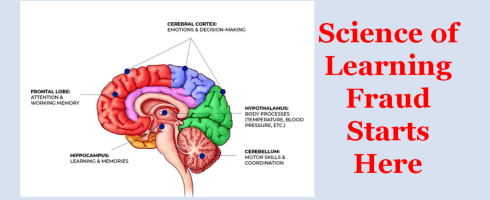
They are selling baseless malarkey. Neuroscience and cognitive science still do not provide much usable insight into how students learn or what the best teaching methods are.

The claim of rising test scores is deliberately misleading. The scores may have risen a little but this is a case in which the cause is pretty clear. In statistics, the r-value correlation has a value between o and 1 for determining the effects of different inputs on education testing results. An r = 0 means there in no relationship and an r = 1 means the input is 100% determinative. Inputs like teacher, curriculum design, class size, etc. can be evaluated. The only input ever found with more than o.3 r-value is family wealth at a 0.9 r-value. Between 2021 and 2022, Frederick County, Maryland had “the largest net positive change in total income in the state.” As indicated by statistical analysis, of course test scores raised some.

These fraudulent claims about the “science of learning” are being financed by wealthy people wanting to implement competency based education (CBE). With its concentration on developing mastery of small discrete information bites, CBE makes kids learning at screens more possible. Since 2010, the annual GSV+ASU conference, which is a big deal with tech billionaires, has been striving toward this goal. At their 2023 conference in San Diego, Carnegie and ETS announced a new partnership to create functional testing for competency based education (CBE).

GSV (Global Silicon Valley) appears to have convinced Tim Knowles and the Carnegie Foundation to abandon the Carnegie Unit to open the way for CBE based testing and badges.

The Claims and Propaganda

The proponents of the “science of learning” claim that Pestalozzi, Herbart and Dewey, the fathers of progressive education, were wrong. They tell us that “problem based education” is counterproductive and that discovery approaches are harming children. They claim that direct instruction and drilling small bits of information to mastery are what children need.

Trish Jha, a research fellow at the Center for Independent Studies in Australia, just published a more than 15,000 word essay explaining why the “science of learning” is needed. She claims:

“Australian education needs to position the science of learning as the foundation for policy and practice.”

“Unfortunately, key pillars of Australian education policy do not reflect the science of learning, due to the far-reaching impacts of progressive educational beliefs dating back to the 18th century.”

These beliefs include that:

    • Students learn best when they themselves guide their learning and it aligns with their interest;
    • Rote learning is harmful;
    • Learning should be based on projects or experiences, and that doing this will result in critical and creative thinkers.”

But these beliefs are contradicted by the science of learning.”

Ms. Jha asserts, “The teaching approach best supported by the evidence is explicit instruction of a well-sequenced, knowledge-focused curriculum.” She sites E. D. Hirsh as one of her experts supporting this thinking.

It is part of a worldwide effort by wealthy people to digitized education under the cover of “science of learning”. In 2018, the Center for American Progress (CAP) wrote:

“This brief builds on the growing momentum for both the science of learning and school redesign. Last month, for instance, the XQ Institute released a policy guide for states on how best to redesign their schools. The document argued, among other things, that students should be able to learn at their own pace, progressing as they demonstrate mastery of key concepts.”

And CAP went on to quote XQ:

“[Competency-based education] isn’t about replacing what goes on in the classroom with less-demanding experiences outside of it. This is about integrating innovative approaches to teaching in the classroom with opportunities for students to develop practical, concrete skills in real world settings. And it’s about awarding credit for learning—demonstrated learning—no matter where or when the learning takes place.”

The XQ institute is the creation of noted anti-public school and teacher disparaging billionaire, Laurene Powell Jobs.

For 50 years, mastery-based education now called CBE has been a major flop. Established on the mind-numbing drill and skill approach, CBE undermines authentic learning. It has never worked.

Deans for Impact, a Billionaire Created Example

The Deans for Impact Supporters Page

Teach for America (TFA) is viewed by many people as the billionaires’ army for school privatization and the New Schools Venture Fund (NSVF) is the Swiss army knife of public school privatization. Deans for Impact (DFI) was created in 2015 with personnel from TFA and NSVF.

DFI founder, Benjamin Riley, was a policy director at NSVF. Riley stepped down as executive director of DFI in August 2022 and was replaced by another NSVF alumnus, Valarie Sakimura. Francesca Forzani, the current board president, spent 4 years as a TFA teacher in Greenville, Mississippi. The list of people from public school privatization promoting organizations who have served on the DFI board of directors is extensive:

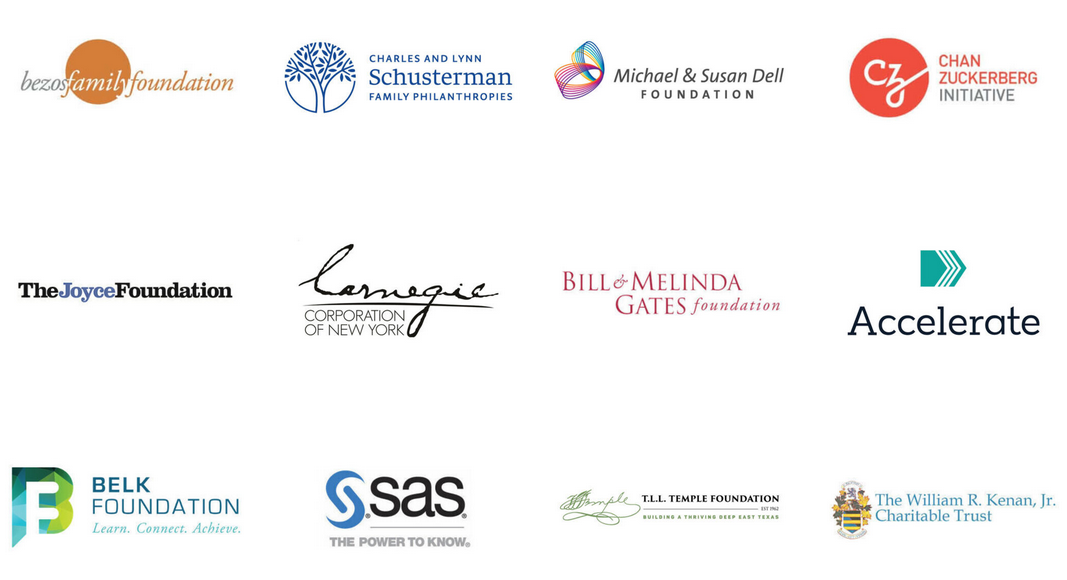
Supporters of DFI have been very generous since the founding in 2015. The last year for which tax records are available was 2022. Federal tax forms 990-PF show:

  • Bill and Melinda Gate Foundation (TIN: 56-2618866)  $3,482,504
  • Charles and Lynn Schusterman Family Foundation (TIN: 73-1312965)  $2,135,000
  • Michael & Susan Dell Foundation (TIN: 36-4336415)  $2,375,000
  • The Joyce Foundation (TIN: 36-6079185)  $2,400,000
  • Carnegie Corporation of New York (TIN: 13-1628151) $875,000

These are huge sums of money but not for billionaires.

The Carnegie Corporation did not contribute to DFI until Timothy Knowles became president of the Carnegie Foundation for the Advancement of Teaching in 2021; probably not a coincidence.

Deans for Impact states:

“DFI believes all teacher-candidates should know the cognitive-science principles explored in The Science of Learning. And all educators, including new teachers, should be able to connect those principles to their practical implications for the classroom.”

Of course cognitive scientists do not agree on these principles and the neuroscience pitch is fantasy, but DFI is coming through with its deliverables.

Deans for Impact is just one small example of the many organizations billionaires have created to do their bidding.

Conclusions

The “science of learning” is another scam to defeat progressive education and replace it with kids at screens earning badges. Unfortunately, billionaire money distorts reality. “Science of learning” and “science of reading” are frauds not science. They are oligarch created deceptions bringing bad pedagogy and the end of free universal public education.

Moneyed People Attack Wilmington Schools

23 Sep

By Thomas Ultican 9/23/2024

July 10th the Christina school board voted, at 2:45 AM, to remove popular Superintendent Dan Shelton. The seven member board split 4 to 3. It seems that Shelton’s opposition to allowing charter schools to take over the district motivated the vote. The Christina school district serves the small Delaware cities of Wilmington, Newark and their outskirts. It is a modest sized district with about 14,000 students. The unseen force behind the ouster was the DuPont family.

The attack by billionaires on schools in Delaware is similar to harm visiting public education throughout the nation. The local rich guy sets up tax exempt “charities” and uses them to undermine local schools. The “charities” hire young ambitious and talented people to lead the effort. Looking behind the scenes in Delaware illuminates the undermining of public schools nationwide.

Board President Donald Patton was joined by Vice President Alethea Smith-Tucker, Y.F. Lou, and Dr. Naveed Baqir in voting to oust the Superintendent two months before the new school year begins. It is alleged that they are the compromised four. In a local pod cast, Highland Bunker, board member Doug Manley reported that Matt Clifford, who dropped out of the recent school board election, was offered support if he agreed to vote with Board President Patton. Manley also speculated that Y. F. Lou received the same offer.

Trustee Manley stated that in his view the only reason Shelton was removed from office was because of his opposition to letting charter schools parcel out the district. It is notable that in 2022, Shelton was named Delaware State Superintendent of the Year.

Longwood Foundation

The Longwood Foundation is not called the DuPont Foundation because it was originally established in 1937 by Pierre DuPont to support Longwood Gardens. A tax reform act in 1969 caused a change and, Longwood Gardens, Inc. was formed to finance the gardens. The Longwood Foundation remained in existence to “principally support charitable organizations” and push forward the DuPont agenda.

Over the last decade, the foundation has spent $1,812,200 to support Reading Assist Inc. whose web page says:

“Reading Assist provides high-dosage tutoring for students in grades K-3 in the lowest 25% for reading proficiency, with a focus on serving in schools where there is the highest need.

“We recruit, train, and embed AmeriCorps members – known as Reading Assist Fellows – willing to commit a school year of service to provide our accredited, one-on-one intervention program to struggling readers.”

Reading Assist is a science of reading (SoR) advocate whose founder has ties to the dyslexia community. AmeriCorps has helped provide Teach for America (TFA) training and recruits. In other words, these organizations come with privatization blemishes. Many researchers believe SoR is bad science promoted by wealthy people and publishing companies while TFA is their army.

Longwood is still a DuPont family run organization. According to the 2022 tax form 990PF (TIN: 51-0066734), John DuPont is the current president and Margaret DuPont is Vice President. The tax records also show that in the last decade they have provided the fake education graduate school, Relay Graduate School, $1,300,000.

The Foundation concentrates its spending into the Wilmington area and does very little spending nationally. So their spending of more than $15,000,000 on charter schools in the last decade has made a huge impact locally. Margaret and one other DuPont family member also sit on the board of the smaller Chelsea Foundation (TIN: 51-6015638) which also provides grants to charter schools. It is this drive to privatize the Christina School District that seems to have led to firing a respected and popular administrator.

In 2017, Indiana scholars Jim Scheurich, Gayle Cosby, and Nathanial Williams posted an article on Diane Ravitch’s blog that outlined the model used by billionaires to gain control of local schools.  Point five of their rich guy privatization model is, “Development of a network of local organizations or affiliates that all collaborate closely on the same local agenda.”

First State Educate, Inc.

First State Educate’s 2019 form 990 (TIN: 84-2554991) reports its founding officers as President: John DuPont, Treasure: James Kelly and Secretary: Jocelyn Stewart. Since then, the Longwood Foundation has gifted it $731,100. In other words, First State Educate is fueled by DuPont money.

Their documents reveal:

“First State Educate/Action Fund (FSE/AF) were founded in 2019 to catalyze radical change in education by activating the power of Delawareans. In the four years since its founding, FSE/AF has helped 16 game-changing leaders be elected to school boards throughout the state, including five school board members enrolling 45,000 students who now serve in leadership positions. FSE/AF also helped propel numerous initiatives to change the conditions of teaching and learning, including the Wilmington Learning Collaborative, RISE UP Delaware and FaCE coalitions.

The reason there are two organizations is that First State Educate is the tax exempt “charity” and Action Fund is a political organizations that is not tax exempt.

There was only one change in the board leadership shown on the 2023 tax report; Jocelyn Stewarts position became Interim Executive Director. The form says she put in 40 hours a week in this position with no pay. She is a busy person. When she was appointed to the board of trustees for Delaware State University, the school reported, “Ms. Stewart is the chair of the board chairperson (sic) for Teach for America Delaware, the vice chair of the East Side Charter School, a trustee for Christiana Care Health Services and has served on a number of State of Delaware committees.”

Stewart comes from the banking industry where she worked in the Events Marketing Department of First USA Bank. In 2000, when Barclaycard US was founded she developed their community strategies.

This picture from the NPR affiliate Delawarepublic.org shows Delaware Senator, Chris Coons, on the left and Jocelyn Stewart on the right holding Barclay’s gift to EastSide Charter School. It is unknown why the Democratic senator is supporting public education privatization but he clearly is.

Stewart was replaced as director of First State Educate in July 2023 by Julia Keleher.

While serving as Secretary of Education in Puerto Rico, Keleher who is not Puerto Rican, secured a new law allowing for charter schools and vouchers plus the closure of hundreds of schools.

On December 28, 2016, Keleher was appointed Puerto Rico Secretary of Education by Governor-elect Ricardo Rosselló who became so hated he was driven from office in 2019. The appointment was just a few months before hurricane Maria hit. Keleher also became disliked as was demonstrated by San Juan protesters loudly chanting, “Julia go home!”

Things went sideways for Keleher. December 17, 2021, a federal judge in Puerto Rico sentenced her with six months prison, 12 months house arrest and a $21,000 fine. She plead guilty in June to two felony counts involving conspiracies to commit fraud. Almost as soon as she finished her prison term, she was hired by First State Educate. Now she is the executive director.

Conclusion

Rich people in Delaware are working to privatize the public schools in Wilmington and environs. The school board voting 4-3 to fire Dan Shelton is a result these efforts. It appears the school board has been completely corrupted with a compromised four.

WHYY reported, [Naveed] Baqir and the private school he co-founded are under scrutiny concerning invoices submitted to the school district.”

Delawarpublic.org noted that in June the Department of Justice (DOJ) stated “that the board has made repeated Freedom of Information Act (FOIA) violations …”

On top of the state (DOJ) ruling, it seems that Dan Shelton has firm grounds for a lawsuit. The former Christina School District Attorney, James McMakin, severed ties with the board and said his firm is working to finalize a lawsuit against the district on the superintendent’s behalf. Shelton’s attorneys claim that he was discharged without a pre-determination hearing and he has constitutional rights. When still representing the district, McMakin told them “they’re acting lawlessly.”

It appears that the board members who voted to oust the superintendent are not protected from the lawsuit.

There is a good chance some of this injustice will be righted but damage has been done to the Christina School District. The people of Wilmington and Newark are in jeopardy of having their schools stolen by wealth neighbors including the DuPont family.