Archive | technology RSS feed for this section

San Diego Schools Awash in Technology Malpractice

5 Nov

By Thomas Ultican 11/6/2016

Every year, school districts in San Diego County are wasting $10’s of millions on technology. This spending binge harms education and is difficult for school boards to oppose. Worst of all children and good pedagogy are being harmed.

ESSA Promotes Technology over Good Pedagogy

When congress passed the new education law (ESSA), the United States Department of Education (USED) was transformed into the nation’s leading education technology sales force. Secretary of Education John King has effectively become a shill for a group of corporations and their “non-profit” foundations working to sell “blended learning”; “competency based education”; “personalized learning”; “linked learning”; etc. These initiatives have at least four things in common; they all profit technology companies; they all are unproven; they all promote unhealthy education practices; and they overturn a student’s right to privacy.

The former governor of West Virginia, Bob Wise, has been leading the Alliance for Excellence in Education since 2005. On their web presence the Alliance lists this group of supporters: Anonymous, AT&T Foundation, Bill & Melinda Gates Foundation, Carnegie Corporation of New York, GE Foundation, James Irvine Foundation, Kern Family Foundation, National Public Education Support Fund, Nellie Mae Education Foundation, State Farm, Stuart Foundation, and William & Flora Hewlett Foundation. For unknown reasons, the biggest dollars appear to come from anonymous. This foundation is just one example, there are hundreds of non-profits like this supported by many of these same groups. They sound well-intentioned but their main motive is monetizing and controlling education in a way that supports corporate desires.

Bob Wise’s organization sponsors Future Ready which says, “The Alliance for Excellent Education leads Future Ready in partnership with the U.S. Department of Education and a vast coalition of both national and regional organizations.” Pictured below are 3 of the 12 rows of sponsors advertised on their web site. It is disturbing that the two major teachers’ unions, American Federation of Teachers and the National Education Association are there along with the national PTA.
future-ready

Future Ready asks every superintendent of schools in the United States to take its pledge in exchange for some sort of support. Here is the opening statement for the Future Ready pledge:
future-ready-pledge

Signing up for this pledge is a bit arduous, however, almost every school superintendent in San Diego County has signed it; including Sweetwater’s Karen Janney and San Diego Unified’s Cindy Marten.

Practically speaking, the pledge means giving every child a device capable of providing both their lessons and their assessments. The Future Ready vision is for lessons delivered by software packages from various vendors including Microsoft, Pearson and Google. Students will then be awarded digital badges recorded in their profile in the cloud. The vision is to eliminate school as we know it (except for high end private schools).

Another of the ubiquitous non-profits working to monetize schools, ACT Foundation, teamed with the Institute for the Future to produce a video called “Learning is Earning”. It imagines a dystopian future for all Americans provided by technology companies.

A recent Texas study found that “there was no evidence linking technology immersion with student self-directed learning or their general satisfaction with schoolwork.” And the New York Times reported recently on classroom use of technology in Arizona, where “The digital push aims to go far beyond gadgets to transform the very nature of the classroom.” As the Times reported, “schools are spending billions on technology, even as they cut budgets and lay off teachers, with little proof that this approach is improving basic learning.”

A blogger who goes by the name Wrenchinthegears has created a series of posts about the digital education being promulgated by Silicon Valley billionaires, politicians and federal bureaucrats: From Neighborhood Schools to Learning Eco-Systems, A Dangerous Trade and Questions We Should be asking about “Future Ready” Schools plus Wrenchinthegears has provide an amazing slide show analyzing the threat we face. He/she concludes in Trade You a Backpack of Badges for a Caring Teacher & Well-resourced School:

“In this brave new world, education will no longer be defined as an organic, interdisciplinary process where children and educators collaborate in real-time, face-to-face, as a community of learners. Instead, 21st century education is about unbundling and tagging discrete skill sets that will be accumulated NOT with the goal of becoming a thoughtful, curious member of society, but rather for attaining a productive economic niche with as little time “wasted” on “extraneous” knowledge as possible. The problem, of course, is that we know our children’s futures will depend on flexibility, a broad base of knowledge, the ability to work with others, and creative, interdisciplinary thinking, none of which are rewarded in this new ‘personalized pathway/badging’ approach to education.”

A school teacher in Maine named Emily Talmage was one of the first educators to realize the seriousness of this current attack on public education. While the rest of us were focused on limiting the damage from standardized testing, she saw that the monetizing groups had moved on to “Ed Reform 2.0” and were actually leveraging opposition to testing to advance their agenda. In her most recent post, she writes:

“Lately, the MacArthur Foundation has been everywhere that Ed Reform 2.0 (personalized, competency-based, digital learning) has been – sponsoring conferences at the U.S. Department of Education on the merits of Social Impact Bonds, awarding grants to promote digital learning efforts, and even gaining recognition for their work with Mozilla and HASTAC in advancing the competency-based “digital badging” agenda from the Clinton Global Initiative. (Yeah – the Clinton’s are involved in this too, in a big way.)”

In this same post Ms. Talmage reports on the use of digital education in China:

“Under the auspices of corporate giants Tencent and Alibaba, Chinese citizens will be required by 2020 to earn a character credit score based on their actions on social media. If you post government-approved articles, for example, you’ll earn points that you can then show off to your friends.  [It gets even creepier than that, watch this video she linked into her post.]

“And if you’re now thinking: but that’s China! That could never happen here! Consider the fact that Facebook CEO Mark Zuckerberg – now a major investor in personalized learning initiatives across the country – is quite fond of Sesame Credit’s sponsor, Jack Ma of Alibaba.

“According to the Wall Street Journal, ‘Mr. Zuckerberg said he was optimistic about China’s future development because the country focused on science and technology education.’”

 San Diego Schools Buy In

 The Sweetwater Union High School District (SUHSD) is a 7th through 12th grade school system serving 40,000 students in south San Diego, Chula Vista, National City and Imperial Beach. SUHSD’s 2014 technology plan says;

“According to Project RED, ‘The daily use of technology in core classes correlates highly to desirable Education Success Measures [and] was one of the top five indicators of better discipline, better attendance, and increased college attendance.’ And yet, many 1:1 schools reported using the technology only weekly or less frequently for many classes. In fact, the researchers concluded that 80 percent of schools under-utilize technologies they have already purchased.”

 The official SUHSD technology plan is highly influenced by the research of Project Red. So, what is Project Red? Is this a well-known education research center led by the most well respected education professionals in America? It is not! It’s a non-profit financed by Intel, HP, Pearson and Smart. In other words, it is a group of ‘vulture philanthropists’ tilling the soil for sales. To paraphrase Peter Greene, it is like Ford’s PR firm reporting that their new Focus is the most advanced car in the world.

SUHSD embraced 1:1 digital learning first by rolling out I-pads for all students beginning with 7th graders in 2012. This year, they have changed course; are retrieving the I-pads and replacing them with Chinese laptops from Lenov running on the Microsoft Windows operating system 10.1. It is widely believed this operating system is harvesting vast amounts of data from users, which means student’s privacy is sundered.

San Diego Unified School District (SDUSD) is a k-12 district serving more the 100,000 students. It too has succumbed to the under researched but very profitable 21st century digital learning agenda. In their July 2014 i21 report, the committee charged with mapping SDUSD’s technology future recommended:

  • “Provide equity of access to all students with individual devices and 24/7 connectivity”
  • “Evaluate a blended model of district-supplied and student-owned devices “
  • “Implement competency-based learning and problem-solving-based assessments, aligned with Common Core standards”

On October, 5 2016, a San Diego Union Tribune article announced that SDUSD has agreed to purchase and distribute to students 16,000 Google Chromebooks. It stated, “Google announced a collaboration with the San Diego Unified School District this week, and sent its ‘chief education evangelist’ to tour campuses and meet with teachers and students to see first-hand how the company’s equipment, apps and search engines are used.”

In January 2016, Senator Al Franken wrote a letter to Google expressing his concerns about student privacy. The Electronic Frontier Foundation reported:

“After we filed our complaint with the Federal Trade Commission (FTC) about Google’s unauthorized collection of personal information from school children using Chromebooks and the company’s educational apps, we heard from hundreds of parents around the country concerned about K-12 student privacy. This week, an important voice in Washington joined their growing chorus.

“On Wednesday, Senator Al Franken (D-MN) wrote a letter to Google CEO Sundar Pichai asking for information about the privacy practices of Google Apps for Education (GAFE). Several of his questions reflect concern over the issues we raised with the FTC. Sen. Franken is the ranking member of the Senate Judiciary Subcommittee on Privacy, Technology and the Law.”

SUHSD and SDUSD are purchasing more than 30,000 laptops this year, which means they must also have the infrastructure to support these devices. In addition, all of the education applications require the school districts to purchase licenses that must be periodically renewed. That is a lot of money to spend on technology.

Both SUHSD and SDUSD have embraced blended learning. To start the school year, the teaching staff at Sweetwater was solicited to apply for the new blended learning specialist position; now there is a blended learning specialist at every school. Blended learning means children working independently at screens with some teacher instruction. It is the preferred method of the infamous mall charter schools which have been revealed as not just producing substandard education but too often are obvious frauds.

The August 31, 2016 issue of Time Magazine carried an article by Dr. Nicholas Kardaras called “Screens In Schools Are a $60 Billion Hoax.” In this article, he argues that putting children in front of digital devices is bad learning strategy which has known deleterious health effects. The paragraph quoted below outlines some of these health problems and provides a powerful and diverse set of linked references supporting his arguments.

“Tech in the classroom not only leads to worse educational outcomes for kids, which I will explain shortly, it can also clinically hurt them. I’ve worked with over a thousand teens in the past 15 years and have observed that students who have been raised on a high-tech diet not only appear to struggle more with attention and focus, but also seem to suffer from an adolescent malaise that appears to be a direct byproduct of their digital immersion. Indeed, over two hundred peer-reviewed studies point to screen time correlating to increased ADHD, screen addiction, increased aggression, depression, anxiety and even psychosis.”

 What is a Better Alternative for Good Education?

I just finished reading Samuel Abrams book Education and the Commercial Mindset (see review here). In his reporting on the ill-fated Edison Project, Abrams discussed their troubled high end private school in New York City, Avenues. For financial reasons, Avenues had to raise class sizes to an average of 18 students, while their competitors in the high-end education market like Dalton maintained class sizes of 14 to 15 (page 145). The wealthy are not putting their children in front of screens and they do value smaller class sizes.

If we truly want 21st century education in America, there are three simple strategies that have been proven to work. They are the strategies implemented by the unambiguously most successful education system in the Western Hemisphere, the public-school system in Finland.

1) Require a master’s degree, thorough pedagogical training, and licensing before allowing a teacher into a classroom. This requires educators to be paid commensurate with other professionals, however, if we truly want the best, we must pay for the best.

2) Reduce average class sizes to less than 20 students. Bill Gates has said class size is not so important, but he sent his children to a high-end private school with class sizes of less than 20.

3) Make trained experienced educators the leading voices in education policy. Bill Gates, Reed Hastings, Louis Gerstner and their ilk are arrogant uninformed amateurs whose vast power due to wealth makes them dangerous.
Better Together Corporate Teacher’s Summit

2 Aug

By Thomas Ultican 8/2/2016

My wonderful friend, Dr. Larry Lawrence, sent me a message last March alerting me to a free teacher’s conference that he was going to attend. He had attended the first Better Together conference in 2015 and was sure I would love to see the common core love fest in action.

On Friday, July 29, National University hosted the San Diego “Better Together California Teacher’s Summit.” I like National University and have nothing but praise for the wonderful job Dr. Judy Mantel and her excellent staff did. However, the conference underwriter was the Bill and Melinda Gates foundation. That gave the proceedings a darker hue.

During the 2016 NPE conference in Raleigh, North Carolina, Diane Ravitch mentioned how much easier it would be if we got a deep pocket sponsor for our movement, but she jokingly lamented that Anthony Cody would not stand for it. When I arrived at the Town and Country Convention Center in San Diego’s hotel circle, I saw what she meant. They had breakfast prepared for all 700 of us. The ballroom was plushly appointed and there appeared to be hotel staff everywhere. Twenty event staff were already on duty when I arrived.

Unfortunately, I had not read the agenda closely enough and had already eaten. I was only hoping for free coffee.

The following graphic was periodically displayed while we were awaiting the proceedings.

Better TogetherVideo link connected us with a simultaneous event being held at California State University, Fullerton. Three massive screens projected keynote speaker, Ernie Hudson who was in Fullerton. Besides being a popular actor, Hudson is a wonderful speaker. His speech was moving and entertaining.
However, I wondered if an accomplished professional educator speaking would have been more appropriate. For example, I will never forget the address Professor Yong Zhao gave at NPE Chicago but then he didn’t blame teachers for his son’s problems and he doesn’t support standards based testing. Hard to imagine Gates’ money being spent on a speaker that does not support Gates’ ideology.

The Sponsors

The money came mainly from the Gates Foundation, however, the official sponsors were AICCU, the California State University and the New Teacher Center. The sponsors page of the Better Together California web presence lists many corporate supports including: TFA, The S.D. Bechtel Foundation, the David and Lucille Packard Foundation, the California Charter Schools Association, Chevron….

The New Teachers Center seemed to be the key organization overall in charge. Their funders page lists the Bill & Melinda Gates Foundation and The William and Flora Hewlett Foundation as $10,000,000 plus patrons. Thirty listed entities are credited with donating between $1,000,000 and $9,999,999 including: Carnegie Corporation of New York; The Joyce Foundation; The David and Lucile Packard Foundation; SeaChange Capital Partners; The Goldman Sachs Foundation; Leona M. and Harry B. Helmsley Charitable Trust; National Education Association; and NewSchools Venture Fund.

In addition to New Teacher’s Foundation, Edcamp was another major force present at the summit. Started by the George Lucas Foundation Edcamp has a small presence in communities across the country. There are two Edcamp groups in San Diego County according to the Edcamp representative from Baltimore.

On his Edutopia internet page Lucas is quoted, “When I was in high school, I felt like I was in a vacuum, biding time. I was curious, but bored. It was not an atmosphere conducive to learning. Once I had the means to effect change in this arena, it became my passion to do so.” Sounds like another rich guy education “expert” with no training or experience, but he has a boat load of money so his opinion is important.

On the good side, Edutopia and George Lucas do not appear to have a pecuniary interests in privatizing public education.

I realize many people may wonder why I am not pleased that all of these rich people love kids so much. There is an insidious side. For example, instead of questioning the idea of adding engineering standards to basic science education, the conversation is shaped so all we discuss is how to best implement engineering principles into science education.

Before students reach approximately their junior year in college, they are not ready to study engineering. I am for shop class, cooking and pottery projects, but these are not engineering. There is no useful purpose in confusing teachers and students by larding a bunch of inappropriate engineering standers onto seventh graders. Unfortunately, there appears to be no room for dialog that does not support the philosophy of the wealthy CEO that demanded engineering standards.

We know that the Common Core was written hastily – in secret – by a group of 21 people, 19 of whom worked in the testing industry. As Peter Greene writes, “The Core were rushed together by a bunch of educational amateurs, who were sure we couldn’t wait another second to implement them because they would improve education immediately. They didn’t, and there’s no reason to believe that there will ever be actual improvement to come from the standards– only the illusion of improvement if teachers continue to come up with newer, better techniques and give the Core credit for them.” I think that is exactly the purpose of this corporate supported conference. It is for teachers to create the illusion.

I am annoyed every time I hear the phrase “common core math”. There is no such thing and mostly what people are calling “common core math” are the cooperative learning and constructivist ideas that John Dewey proposed in the early twentieth century.

Two Presentations of Note

Shortly after I arrived, the head of the science department in my district introduced me to a fairly new teacher from the middle school that feeds my high school. The conference used the Ted talk format calling them Edtalks. I was quite surprised that the first Edtalk was by this teacher, Alicia Johal.

Alicia is obviously bright and poised. Her talk featuring the underwater robotics team she is coaching was well presented and her PowerPoint slides made things look as amazing as possible.

Unfortunately, while Alicia was speaking Ciedie Aech’s book Why Is You Always Got To Be Trippin’ possessed my mind. Ciedie is from Denver, Colorado home some of our nation’s most pernicious and destructive education reform. In her book, she reported on a conversation she overheard about the kind of teachers we need. Ciedie tends to sarcasm.

 “’Wouldn’t you,’ he stated, leering suggestively at the five other males seated around his educational table. ‘Well, wouldn’t you rather have had young teachers; teachers who were young, perky and vivacious?’

“My.

“Not just young, but perky.

“And vivacious.

“Golly.”

The main afternoon presentation was by Kelly Galiagher from Magnolia High School in the Anaheim School District. He spoke about the importance of writing. He is a gifted speaker and even though the subject area is not new – he gave it life. However, one of his five points supporting the importance of writing was discordant.  His point four was that writing prepared students for common core testing. This obviously well considered individual cannot believe that test preparation is a worthy justification for his main point.

If this had not been a Gates funded event would Kelly have actually mentioned common core and testing as reasons for writing? I don’t think so.

Charter Schools

Charter school teachers were among the conference goers. They seemed like any other teachers; some impressive and some not. All of the charter school teachers I met were from schools that were locally formed and led. There were no teachers from KIPP, Magnolia (Gulen) or Aspire. I also did not meet a charter school teacher from a school run by a charter management organization.

The story I heard repeated was “I used to teach in public schools but when NCLB came along I was no longer able to do the right thing in the classroom. I have taken a pay cut but I love my school because I can teach the way I know it should be done.” From my personal experience, I found that to be a powerful argument.

I hope that a way is found to bring some of these schools under an umbrella of democratic control. The charter industry has developed into a demonic tool used to purloin public education dollars and destroy the public education system. As this trend continues to worsen, quality charter schools like Einstein Academy will be crushed right along with public schools. It is becoming clear that the market competition that would make schools improve is not a competition to better educate; it’s a competition to better market. Mom and pop charter schools will never survive that battle.

Personalized Learning

On every table in the conference ballroom was an invitation to a CUE Tech Fair. CUE’s web presence says, “CUE inspires innovative learners by fostering community, personalizing learning, infusing technology, developing leadership, and advocating educational opportunities for all.”

CUE, originally a sincere organization, has been corrupted. The personalized learnSDCCU Tech Fair Partnersing they call for is competency based education (CBE) delivered by computers and scored by a corporations. Instead of credits, students will earn badges from testing giants like Pearson Corporation. This graphic is from their web page.
Emily Talmage’s warnings about the CBE threat to the teaching profession, America’s culture and good education is well founded. From her latest post on this subject:

“Knowledgeworks recently described the new learning system as an ‘ecosystem,’ in which the role of the traditional teacher will soon be obsolete.

“With major investments from Wall Street, leaders in the online learning, ed-tech, and student loan industries, and even celebrity billionaires like Mark Zuckerberg of Facebook and Reed Hastings of Netflix, the transformation has recently been picking up speed. Meanwhile, political groups on both the left and right are moving the system forward by lobbying for ‘personalized,’ competency-based policies and “innovative” assessment systems.

 “(The American Legislative Exchange Council and the major teacher’s unions and their associated networks are encouraging states join the innovative assessment pilot program designed by the International Association of K-12 Online Learning and the Gates-funded Knowledgeworks Foundation and now allowed by the reauthorization of the Elementary and Secondary Education Act.)”

 This is a real and present danger to the teaching profession, quality public education and democracy in America. As enjoyable as lunch paid for by Bill Gates and conversations with fellow educators was, I feel the hidden purpose behind the Better Together California Teacher’s Summit was the end of the teaching profession and public education as we know it. That is not a good thing!

Memo on Education to My Congressman, Scott Peters

24 Jul

By Thomas Ultican 7/24/2016

In 2000, you became my city councilman. Then in 2012, you became my Congressman in the 52nd District. I have always respected your work and integrity. However, when it comes to education, I see the Democratic Party as part of the problem and not the solution. Your latest response to me further reinforced my belief that politicians are being so propagandized by big money interests that they do not know what is real concerning education policy.

America’s Public Education System Trails No-One

Your last message to me contained several statements that I consider misguided. This paragraph is verbatim to one I received from you in July, 2015 and it is not defensible. Your office wrote:

“In an increasingly global economy, it is critical that we make educational investments that put our students in a position to compete with the rest of the world. For years, the United States has trailed China, India, and others not just in investment in education, but in student achievement. When making changes to education policy, Congress should be sure that it is closing that gap.”

It is well known that the United States spends far more on education than China and India combined, but more importantly the United States has never trailed China or India in education. On international testing some cities and countries around the world have achieved spectacular scores. However, these scores are averages and because our education system is much more universal we test all our students; they don’t. Plus, we have a huge number of students living in poverty.

But, on an even playing field, the team from the United States just won the world’s oldest international math and science competition for the second year in a row. In The International Mathematical Olympiad team USA came in first ahead of Korea, China, Taiwan, Russia, Singapore and the rest of the field from 109 countries.

Last year in response to my comments about HR 5 the pre-cursor to the new federal education law, ESSA, you made the same claim as above. At that time, I informed you of America’s continued unparalleled achievement in Nobel Prize winners:

 “Student achievement measures depend upon what you want. If the goal is creative students who can innovate and lead happy lives, then our system is clearly out producing India and China. One measuring stick might be Nobel Prize winners since 1949: America had 313 laureates; India 7; and China 8. Of the 8 Chinese, the Dalai Lama and Liu Xiaobo who won peace prizes both are considered criminals – Xiaobo is still in a Chinese prison; four are scientists who earned their degrees in the United States or Great Britain; and only the two literature recipients were educated in China. To recap, since 1949 two international and widely recognized citations for Chinese educated students compared to 313 such citations from our world’s best American education system.”

To wrap up the point I am making here, it is a slander of the world’s greatest education system to say that it is lagging any other country. It is just not true. When establishing policy in any field one must deal with reality not illusion.

STEAM and STEM are Frauds

Your message continued:

“That’s one of the reasons I support making key investments in Science, Technology, Engineering, Arts and Design, and Math (STEAM) education programs. STEAM programs prepare our students to be innovators, put them in position to add to San Diego’s rich legacy of scientific discovery and entrepreneurship, and close the achievement gap between ourselves and are largest global competitors.”

STEAM is derived from the fraudulent idea that the US is falling behind in STEM education. When I was working in Silicon Valley in the 1990’s, newspaper reports were full of baloney about the STEM shortage in America undermining our economic viability in the world. Congresswoman, Zoe Lofgren was championing the need for H1-B visas so American corporations could compete. The result is that there are less opportunities for America’s STEM educated students and here in your district all of the large apartment complexes are filled with Indian people working at QUALCOMM.

There was no shortage, but the STEM field wages were driven down. Here is a quote from a 2013 article in the Columbia Journalism Review and this is not an outlier; there are a host of articles with this same message.

“According to Miller, Neill told them this is not the argument “she normally encounters on this issue.” The conventional wisdom is that tech companies and universities can’t find enough homegrown scientists to hire, so they need to import them from China and India. Neill suggested to Miller and Shah that “we would have more impact if we represented a large, organized group.

“Miller and Shah are, in fact, part of a large group. Figures from the National Institutes of Health, the National Academies, the National Science Foundation, and other sources indicate that hundreds of thousands of STEM workers in the US are unemployed or underemployed. But they are not organized, and their story is being largely ignored in the debate over immigration reform.”

The point is that we do not need ill formed education policies paired with bad immigration policy based on false premises. Instead of STEM or the more politically acceptable STEAM education policies driven from capital cities, we need K-12 schools to provide solid liberal arts programs that will be the foundation for future student growth. Diane Ravitch, the former Assistant Secretary of Education from Bush 41’s administration, put it well in today’s (7/24/2016) New York Times:

“If we really cared about improving the education of all students, we would give teachers the autonomy to tailor instruction to meet the needs of the children in front of them and to write their own tests. We would insist that students in every school had an equal opportunity to learn in well-maintained schools, in classes of reasonable size taught by expert teachers. Anyone who wants to know how students in one state compare with students in other states can get that information from the N.A.E.P., the existing federal test.”

 ESSA May Be Worse Than NCLB

One more paragraph from your message to me says:

“Earlier in 2015, the House passed a version of the education bill – a much-needed update to No Child Left Behind – that did not achieve these goals so I did not support it. Since then, I have advocated to make it better. Through negotiations between the House and Senate, Congress came to an agreement on an update, called the Every Student Succeeds Act, which was a significant improvement. I was joined by over 350 Representatives in supporting the updated bill and the President signed it into law in early December.”

While there is little doubt that ESSA is better than the original house version it is still bad law. Daisaku Ikeda in a book called Unforgettable Friends, writes, “Having been driven from the lectern by the government in the past, Dr. Delich [Francisco J. Delich, Former Rector of the National University of Córdoba, Argentina] is very deeply and personally aware of the evil of allowing government to control education. He wants to build a society in which political leaders respect educators. Education, he believes, is the very foundation of the nation.” ESSA ergates power over schools away from parents and teachers and to the federal government.

This allows the uninformed and the corrupt too much opportunity to harm students nationwide. For example, large sums of money are earmarked for promoting the development of charter schools. Charter schools have not improved education in the least, but they have opened the door for fraud and profiteering at the expense of students.

Democracy is an important principle and no money should be spent on schools by the federal government if that money is not controlled by an elected body. Parents and teachers should control education using democratic processes to govern schools in their local community; not federal or state bureaucrats wielding authoritarian power.

ESSA also mandates standardized testing of all students in grades 3 – 8 and 11. This is a massive waste of money and harmful. For the first time ever student testing results on the nations report card, NAEP, stayed flat of fell during the last 10 years. Massive testing with punitive consequences has harmed not improved schools.

ESSA also provides money for competency based education (CBE) also known as personalize learning. The basic idea behind CBE is to have children sit at computers earning badges for demonstrating a learning competency. It is the worst kind of fill up the student with knowledge pedagogy imaginable but it does have huge profit potential. Emily Talmage a teacher and education writer from Maine has been sounding the alarm about this terrible idea. She writes:

“Although we were assured that the reauthorization of the Elementary and Secondary Education Act was intended to restore control to states and local districts, the truth is that much of the document was carefully crafted to enable a proliferation of “personalized learning.”

“KnowledgeWorks highlights the many ways that ESSA “opens the door” for personalized learning, including its Innovative Assessment Zones, resources for ‘21st Century Community Learning Centers,’ and grant money for technology available in virtually every section of the document.”

ESSA has made students and communities more vulnerable to being fleeced by corporate carpetbaggers and it increases the role of the federal government in local education policy.

America’s public school system is the foundation that made our great democratic experiment a resounding success. Allowing our schools to be stolen by profiteers actually creates a “Nation at Risk.” The federalized destruction of the public education system has become real. Please be alert to self-serving corporate actors and fight for the survival of the public education system in America.

San Diego Foundation Biased Toward Privatizing Schools

13 Jul

By Thomas Ultican 7/13/2016

San Diego Foundation was established in 1975 and has grown to almost $700 million in assets. It’s self-described purpose: “As one of the nation’s leading community foundations, The San Diego Foundation strives to improve San Diegans’ quality of life by creating equity and ensuring opportunities to be WELL (Work, Enjoy, Live & Learn).” In 2014, they gave over $10 million to educational endeavors. The following table illustrates the spending bias against public education.

 Category of Giving Amount Granted
University and College Grants and Scholarships $6,106,052
Civic education – Libraries, Camps, etc. $1,333,266
Charter School and Competency Based Education (CBE) $1,339,802
Private K-12 Schools $1,129,225
Public K-12 Schools (Not including charters) $373,628

Competency Based Education (CBE)

Peter Greene an education expert from Pennsylvania discussed CBE in terms of education reform ideas that should die. He wrote:

“Two years ago, CBE was barely on my radar, and honestly, having lived through the early-nineties disastrous fiasco that was Outcome Based Education, I’m still kind of amazed that we’re back here. But we are. What has changed since 1991? Computers, the internet, the cloud, the sheer raw data collecting and crunching power that a company like Pearson now has at its command. In a CBE world, neither teachers nor schools are necessary– just students at their computer terminal being put through their software-controlled paces, each keystroke and answer filed away (and put to all manner of uses) in their new lifelong data record. Public education and citizen privacy would all be washed away. CBE fans are ju-jitsuing themselves some support for the approach (Quick! Run away from the evil test and take refuge in this CBE sanctuary over here!) and ESSA has opened the door wide for new “personalized” and non-BSTest-based measures of student achievement. I still think there are some serious hurdles in CBE’s path, but if it clears those obstacles, we’ll be looking at a huge threat to public education in this country (and the absolute end of teaching as a career).”

The SD Foundation granted the Girard Foundation of La Jolla $550,415 which they promptly spent on CBE development. They gave Gooru $300,000 and $105,850 went to Make It Matter LLC. Gooru is creating technology that enables CBE and Make it Matter specializes in marketing computer based “1:1” education. Personalized one to one education means a child is stuck in front of a computer with no real human exchange involved. It is terrible education policy with a huge profit potential.

SD Foundation also gave Kid Spark Education of Solana Beach $550,000 dollars to work on CBE development.

Foundations Join Forces and Support Privatizing Schools

Besides sending over $200,000 to seven charter schools in San Diego County, SD Foundation gave $30,000 to Teach for America (TFA). TFA is a program that give college graduates 5 weeks of summer training and then state education leaders allow them to teach classes mostly in charter schools. They are inexpensive unqualified teachers.

SD Foundation spending on Universities is surprising. Almost 40% of that spending is on schools outside of San Diego County totaling $2,409,711. Grants and scholarships given in the county totaled $3,696,341. One would expect an organization that “strives to improve San Diegans’ quality of life by creating equity and ensuring opportunities” would spend a greater share of their education dollars in San Diego.

The largest single grant bestowed by the SD Foundation was $2,6 5 0,7 0 9 to the Jewish Community Foundation of San Diego. The JC Foundation had net assets at the end of 2014 of $171,593,990.

The Jewish Community Foundation spending on education follows a similar pattern as the San Diego Foundation. They spent $466,830 for groups working to privatize public education most of which went to TFA ($406,330). They also spent lavishly on private schools including $146,000 to La Jolla Country Day, a decidedly upscale K-12 private school.

By far the largest grant by the Jewish Community Foundation was the $25,817,228 bequeathed to University of California San Diego. A major patron of both the Jewish Community Foundation and UCSD is the Qualcomm founder and billionaire, Irwin Jacobs.

Three more grants from the Jewish Community Foundation were interesting. They gave Cornell University $5,511,000. They also gave the Goldman Sachs Philanthropy Fund $6,362,171.  The Goldman Sachs fund asset total at the end of 2013 was $1,500,395,380. And the JC Foundation gave the SD Foundation $1,515,800. Why give money back? It is like the Charter School Growth Fund giving their benefactors from Walmart $15,000,000 in 2013. Why?

Do They Understand What They Are Supporting?

There is no denying that both of these funds contribute to a host of worthy efforts. However, are these large concentrations of wealth undermining democratic governance? Are the people making grants to advance the privatization of public schools and promotion of CBE even aware of the ramifications of their grants?

The reality is that these two funds are large but not in comparison with many other funds around California and the US. Yet, they did put a combined almost $2,000,000 towards privatizing public schools in 2014 and only about $425,000 toward support for public schools which went mostly to wealthy neighborhoods.

Our neighbors up in Los Angeles have multiple huge funds. The table below lists the seven largest.

Fund Name Asset Total
Getty Trust, J. Paul $11,982,862,131
California Endowment, The $3,668,459,217
Hilton Foundation, Conrad N. $2,576,376,157
Broad Foundation, Eli & Edythe, The $1,941,410,735
Annenberg Foundation $1,663,095,893
California Community Foundation $1,457,110,000
Simon Foundation, Norton, The $1,349,804,152

The motives for today’s education reform ideology are complicated by greed and lack of understanding. Some people truly believe that America’s public schools are failing and need disruptive reform. They are wrong. For the past, 30-years public schools have been steadily improving. In a recent Atlantic Magazine article Jack Schneider wrote:

 “Finally, consider the outcomes produced by the educational system. Critics are right that achievement scores aren’t overwhelmingly impressive and that troubling gaps persist across racial, ethnic, and income groups. Yet scores are up over the past 40 years, and the greatest gains over that period have been made by black and Hispanic students. They’re right that the U.S. finishes well behind exam-oriented countries like Taiwan and Korea on international tests. But scores are roughly on par with countries like Norway, which was named by the United Nations the best place in the world to live; and students from low-poverty states like Massachusetts outscore most of their global peers. Critics are right that 40 percent of college students still don’t graduate. But almost half of all American high-school students now head off to college each year—an all-time high. And whatever the doom-and-gloom about schools failing to address workforce needs, it’s worth remembering that the U.S has the strongest economy in the world—by an enormous margin.”

 Save Public Schools and Taxpayers

It is time to support public education and stop tax dollar scammers. The main weapons in the drive to privatize schools and create new corporate profit centers are charter schools, standardized testing and CBE.

The charter industry has become fraud riddled. Being able to innovate by removing accountability has led to uncertified teachers, unsafe schools and unprofessional schools. California’s earthquake safety laws do not apply to charter schools. Many charter schools are basically publicly supported private schools. Charter schools have no accountability to taxpayers and no curricular accountability. It is time to end this dangerous, destructive and expensive experiment by immediately moving all charter schools under the management of publicly elected boards and state education laws. Anything less is to support this continued wanton and growing fraud.

Standardized testing is worthless. It does not measure student, school or teacher competence. Colleges are all well aware that the SAT is not a good indicator of student success; high school grades are better. The only valid outcomes from standardized testing are it correlates well to family wealth and it makes for good propaganda when taking over schools in poor communities. Other than that it is expensive and harmful.

CBE is the latest scheme to sell technology to schools, mine student data and sell testing services for outcome verification. It is a terrible idea if you want children to be well educated, creative and lifelong learners.

It is clear that all recent education agendas coming from corporate entities have been about what is good for the adults at those corporations. Reform has become almost exclusively about fleecing taxpayers at the expense of their children.

California’s Charter School Led CBE Invasion

29 Jun

By Thomas Ultican 6/29/2016

This January (2016), Fortune Magazine announced that Netflix CEO, Reed Hastings, has launched a new $100-million-dollar fund to support education initiatives and other groups. The notice goes on to state:

“Hastings is the fund’s sole trustee while Neerav Kingsland, the former CEO of charter school supporter New Schools for New Orleans, is serving as CEO. The fund’s website explains its philanthropic mission: “Currently, too many children do not have access to amazing schools. Our aim is to partner with communities to significantly increase the number of students who have access to rich and holistic educational experiences.”

The “rich and holistic educational experience” is to be delivered by charter schools employing competency based education (CBE).

Competency Based Education

The United States Department of Education promotes and describes CBE:

 “Transitioning away from seat time, in favor of a structure that creates flexibility, allows students to progress as they demonstrate mastery of academic content, regardless of time, place, or pace of learning. Competency-based strategies provide flexibility in the way that credit can be earned or awarded, and provide students with personalized learning opportunities. These strategies include online and blended learning, dual enrollment and early college high schools, project-based and community-based learning, and credit recovery, among others.”

 Instead of a structured course with a teacher, students will log into a computer and earn badges for demonstrating competencies in an online environment. “Personalized learning opportunities” is a euphemism for a computer based course delivered in isolation.

It is a terrible idea! The last thing a 21st Century student needs is to be shoved in front of another inert digital device. Students need to interact with “highly qualified” certificated teachers, adults who they can trust. Students need to; measure, calculate, weight, work in small groups, discuss ideas, write, and get professional feedback. Students need structure, stability and direction. None of this is provided online.

Technology in education is more of an expensive mirage than a useful tool and competency based education (CBE) is fool’s gold.

In 2003, I took the state of California’s 52-hour life insurance course. That meant 52 hours of seat time with an insurance industry veteran who made the subject come alive. Today that insurance course is online with an online exam. No real industry context is imparted and cheating on the exam is rampant.

This is the kind of education Hastings and his ilk are vigorously promoting. CBE means lower quality education delivered at great profit to corporate providers and testing companies.

CBE learning is embraced by President Obama, Bill Gates, Eli Broad, Reed Hastings, Education Secretary John King, The Walton family, the new federal education law, Pearson Corporation and many business executives. Few experienced education professionals not profiting from one of these entities support it.

Computers are good at drilling information and conducting fact checks. However, educators have known for more than a century that this kind of teaching is destructive. To create understanding, all of the modes of learning must be actively engaged. Drill and skill destroys the desire to learn and undermines development of creativity.

Big Money Being Poured into CBE

 In 2004, the Don and Doris Fisher Foundation along with the Schools Future Research Foundation each provided $100,000 to start the Charter Schools Growth Fund in Broomfield, Colorado. The Fisher Foundation is based on profits from GAP Inc. and the School Future Research Foundation was a Walton Family Foundation supported fund that seems to have disappeared. The original elected board of directors for the Charter School Growth Fund was comprised of John Walton, Don Fisher, and John Lock.

In 2010, the President-CEO of the Charter School Growth Fund, Kevin Hall, decided to purchase the struggling Dreambox Inc. of Bellevue, Washington for $15,000,000. By then the fund was so large and he could do it. He subsequently invested another $10,138,500 into Dreambox. [data from 2014 form 990]

A recent National Public Radio report on the Rocketship schools reported:

 “Rocketship students often use adaptive math software from a company called Dreambox Learning. The company was struggling when Reed Hastings, the Netflix founder turned education philanthropist and investor, observed it in action at a Rocketship school several years ago. His investment allowed Dreambox to become one of the leading providers of math software in North America, currently used by about 2 million students.”

 Kevin Hall left his $465,000 a year position at the Charter School Growth Fund to join Hastings on the board of Dreambox Inc. This company is now positioned to be the dominant supplier of software products into the CBE market. Pearson corporation has positioning itself to be the company that tests students and issues completion badges. If the big standardized test goes away, Pearson will do just fine supporting CBE.

In March, Emily Talmadge wrote a very interesting piece about CBE from a more national prospective. She reported:

“Since at least 2009, the Nellie Mae Education Foundation has poured millions of dollars into the latest ed reform craze that has made headlines recently due to investments of billionaires like Mark Zuckerberg of Facebook and Reed Hastings of Netflix.  When stripped of the misleading rhetoric that often surrounds it, “personalized learning” is the digital, data-driven system of schooling designed to trigger giant corporate profits along with tightly controlled, work-forced aligned learning outcomes.”

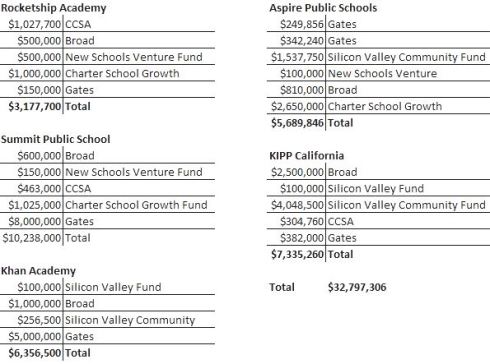
The foundations working to privatize public schools are almost all organized under IRS tax code 501(c)(3), which means they cannot engage in direct or even indirect support of political candidates and they must file an IRS form 990 every year. These forms detail who they gave money to and how much they pay top fund administrators. For following these and other rules, they become a tax free entity. The latest complete set of form 990’s is from tax year 2014 which details spending in 2013. The chart below is based on an analysis of selected 2014 form 990’s

Fund Totals

Fund Spending on Organizations Implementing CBE

 The 2013 spending of the following list of seven funds was analyzed: California Charter Schools Association (CCSA), The Edythe and Eli Broad Foundation (Broad), New Schools Venture Fund, Charter School Growth Fund, The Bill and Melinda Gates Foundation (Gates), The Silicon Valley Fund, The Silicon Valley Community Foundation. Other than the data for the Gates fund, the information all comes from 2014 form 990’s. The Gates data came from his foundation web site.

The spending on these five schools was extraordinary in that the amounts given are far greater than the amounts these organizations typically give to other charter schools. Most grants to charter schools from these funds are significantly less than $50,000 unless it is for startup purposes. So what made these five schools worthy of $33,000,000 in 2013? They are all testing CBE principles on their students.

A look at some of the key board members of these funds reveals a small community of wealthy true believers.

 KIPP Foundation: Doris Fisher, John Fisher, Reed Hastings, Carrie Walton Penner

Silicon Valley Fund: John Fisher, Ted Mitchell

New Schools Venture Fund: Lauren Powell Jobs, Ted Mitchell

Edythe and Eli Broad Foundation: Eli Broad, Gregory Mcginity

Charter School Growth Fund: Kevin Hall, John Fisher, Carrie Walton Penner

California Charter Schools Assoc.: Reed Hastings, Carrie Walton Penner, Gregory Mcginity

 The Silicon Valley Community Foundation is a little different than the other six organizations. It is not significantly about privatizing schools. There are many large community funds in California like this one and they support things ranging from community art to homeless shelters. However, funds like the San Diego Foundation and the Los Angeles Community Foundation have huge assets and they support charter schools at a much higher rate than they support public schools. A little light shined on these community foundations might make it less likely that they continue spending patterns that many of their board members probably do not understand.

All of this spending to undermine the present public education system is predicated on an article of faith held by wealthy (amateur education policy experts) reformers – “public schools are failing.”

In a June Atlantic Magazine article, Jack Schneider put it this way:

 “Thus, despite the fact that there is often little evidence in support of utopian schemes like “personalized online learning,” which would use software to create a custom curriculum for each student, or “value-added measures” of teachers, which would determine educator effectiveness by running student test scores through an algorithm, many people are willing to suspend disbelief. Why? Because they have been convinced that the alternative—a status quo in precipitous decline—is worse. But what if the schools aren’t in a downward spiral? What if, instead, things are slowly but steadily improving? In that light, disruption—a buzzword if ever there was one—doesn’t sound like such a great idea.”

 The evidence says America’s public schools are indeed continuously improving. But, misguided “do-gooders” are threatening to destroy the system and charter schools are the vehicle implementing their schemes. It is time for an OPT OUT of charter schools movement and a halt to CBE.

Competency Based Education and San Diego

15 May

By Thomas Ultican 5/15/2016

A May 4 San Diego Unified School District  press release “announced a significant reduction in the amount of high-stakes standardized testing at local schools.” The next day, May 5, former Assistant Secretary of Education, Diane Ravitch, wrote on her blog, “I met [SDUSD] Superintendent Cindy Marten when she was a principal. I could see her love for the children and her respect for teachers. For her courage in doing what is best for children, I add her to the honor roll of the blog.” Two days later, May 7, Emily Talmage (educator and blogger from Maine who has notable expertise regarding Competency Based Education, {CBE}) wrote, “A closer look at San Diego Unified’s agenda reveals that instead of shedding corporate-driven, top-down reforms as Ravitch claims, the district is instead embracing the highly profitable yet woefully under-researched 21st century version of ed reform that is rapidly sweeping the nation.” Talmage was referring to CBE.

Looking into the matter myself, I have concluded that both of these women are correct. Cindy Marten has been wonderful and the reduction in testing is real and significant. I work in a school district adjacent to Cindy’s and we too have recently selected a true professional leader who works for good, Karen Janney. Even though both of these women are extraordinary leaders, their school districts are targeted by corporate sponsors of what Emily insightfully labeled “the highly profitable yet woefully under-researched 21st century version of ed reform.”

Cindy Marten and StriveTogether

Talmage implies that Cindy Marten is in league with Bill Gates and his ilk because she is listed as hosting a StriveTogether conference in San Diego, October 2014. StriveTogether uses the creepy subtitle “Every Child. Cradle to Career.” Its parent organization is KnowledgeWorks whose self described purpose is; “Every student experiences meaningful personalized learning that enables him or her to thrive in college, career and civic life.” This means a software driven curriculum delivered by a digital device. KnowledgeWorks has a large corporate sponsorship comprised mainly of companies associated with technology and testing. But I don’t think Marten intended to align herself with StriveTogether or Bill Gates.

In 2011, the Sol Price Foundation started the City Heights Partnership for Children where Marten was serving as principal of Central Elementary. In 2013 the United Way took over management of City Heights Partnership for Children. Marten’s relationship with StriveTogether is through Partnership for Children and United Way. Talmage is correct about StriveTogether being a terrible front for corporate raiders targeting education dollars and Marten should rethink representing Partnership for Children at any events associated with StriveTogether. However, Gates money is ubiquitous and it is difficult to be socially engaged and not have some relationship with organizations that Gates supports; for example the PTA, AFT and NEA.

The 70-person committee tasked with creating a plan for San Diego Unified’s digital path forward last reported in December 2014. One of their goals that they provided to Marten and the school board was “implement competency-based learning and problem-solving-based assessment, aligned with Common Core standards.” This also can be correctly interpreted to mean a software driven curriculum delivered by a digital device and tested on-line.

As a classroom teacher for the past fifteen years, I find these goals reprehensible. Common Core is a set of standards paid for by Bill Gates, copyrighted by a non-profit Bill Gates finances and written by testing corporation employees (mostly College Board and ACT). The standards are poorly written and horribly aligned. Competency Base Education is one of those awful agendas that will facilitate purloining education dollars but sounds reasonable to people who have no significant time in a classroom or have been out of the classroom so long they have forgotten how important the human connection is for a successful learning process.

Daisaku Ikeda, the founder of the Soka Schools, touches on this subject in his book Soka Education, “Recognizing each student as a unique personality and transmitting something through contacts between that personality and the personality of the instructor is more than a way of implanting knowledge: it is the essence of education.” Ikeda also mentioned that Socrates likened this to being “kindled by a leaping spark” between teacher and student. Low cost on-line learning is spiritless, amoral and dead.

Why so much Spending on Technology?

 Education is my fifth career. My previous career was as a researcher in Silicon Valley developing advanced recording devices. I wrote code to run test equipment and take data. The database I developed would handle automatic data inputs and produce presentable reports. I evolved into a technology loving geek. When I became a teacher, it was clear to me that technology was the wave of the future which would significantly improve teaching. I was wrong.

Technologists who are often entrepreneurs; government organizations under the influence of these entrepreneurs; school information technology leaders; and fans of technology form a formidable vanguard of support for the untested belief in the efficacy of digital based education. And when these groups meet, they easily succumb to the dangers of group think.

On October 23, 2015, most of the top technologists in San Diego County schools gathered to brief each other on what they were doing and to learn about new education technologies. The event was billed as a “Market Briefing.” The news release by The Center for Digital Education said. “The Center for Digital Education hosted a Market Briefing event in San Diego, CA. IT leaders from some of the largest districts in San Diego were [on] hand for a special briefing on their technology plans, priorities and focus for the coming years.”

The Center for Digital Education belongs to eRepublic. Take a quick look at the eRepublic web pages and you will learn how eRepublic can help you create and market digital products to all levels of government. They are not education specialist. They are sales facilitators, who understand how to co-opt government employees and make them allies. At conferences like “Market Briefing,” digital tools are seen as unquestionably essential to the path forward for 21st century education.

The Obama administration is 100% on board with Competency Based Education. His department of education has literally hundreds of citations from reports, mostly by think tanks supported by technology companies, which sell the virtues of CBE. The department’s stance on CBE is made clear here:

 “Transitioning away from seat time, in favor of a structure that creates flexibility, allows students to progress as they demonstrate mastery of academic content, regardless of time, place, or pace of learning. Competency-based strategies provide flexibility in the way that credit can be earned or awarded, and provide students with personalized learning opportunities. These strategies include online and blended learning, dual enrollment and early college high schools, project-based and community-based learning, and credit recovery, among others. This type of learning leads to better student engagement because the content is relevant to each student and tailored to their unique needs. It also leads to better student outcomes because the pace of learning is customized to each student.”

This statement is typical of the statements supporting CBE and other digital learning schemes. It is all assertion with no evidence. The Achilles heel of “corporate education reform” continues to be that the evidence does not support the claims.

When the government and corporate America is applying so much pressure for schools to embrace CBE and other digital strategies, it is little wonder that school boards and superintendents acquiesce. This week, the leadership (which I like and respect) in my school district (Sweetwater) announced that the board voted to: “Accept the technology task force recommendation to continue purchasing student devices for grades 9-10, and direct staff to enter into contracts and execute lease agreements for such purchase, and to maintain the iPad program at middle schools for the 2016-2017 school year, and allow the technology task force to continue its work for the 2016-2017 school year.” If they had conducted a more thorough cost benefit analysis, they might have hired more teachers or janitors instead of purchasing I-pads and laptops.

The Sweetwater Union High School District’s technology plan was published in 2014 before the present leadership took the helm. However, it is clear that the push for a 1:1 digital device ratio and facilitating online learning are still being pursued. The evidence supporting these policies in the Technology plan is provided by corporate America. Here is an example:

 “’Schools with a 1:1 student/computer ratio are cutting the dropout rate and reaping this broader benefit.’ On another front, there are the cost-savings associated with reduced printing, copying and paper usage. According to Project RED, ‘It is estimated that high schools where every student has a computer and which use an LMS [learning management system] could cut copy budgets in half. On a national basis that would equate to savings of $400M a year for high schools alone.’” (page 81)

 This is just one of many statements citing Project Red as evidence for these policies. The problem is Project Red in not an independent research organization without an agenda. They are funded by some of the largest companies in the world including Pearson Corporation, a company that hopes to dominate the online education world.

Technology does have a place in education and online learning is possible. But, it cannot be done on the cheap. Computer learning systems that are little more than drill and skill systems are terrible. School leaders need informed educators and constituents to help them protect community schools from corporate greed and government malfeasance. One to one digital policies do not pass a rigorous cost-benefit analysis and Competency Based Education appears to be more scam than legitimate education policy.

iPads in School – Not Even if Free

1 Mar

Last November I trudged over to Chula Vista High School for the mandatory get trained up on the iPad or else session. A harsh cold front had dropped the local temperatures into the low 50’s and I actually had to wear a sweater (something we San Diegan’s rarely do) which I forgot because it was so warm when I left. It’s tough working in San Diego County, but I digress.

When I left Silicon Valley to become a teacher in San Diego, I was a big technophile. As each year passes, I become less enthralled with technology in the classroom. I teach some physics classes so I would like carts of laptops loaded with digital acquisition systems and I certainly like photo-gate timers that allow students to meaningfully investigate kinematics. I could see spending on high speed video equipment and electron microscopes but not on toys like the iPads.

I also teach mathematics. Before digital boards were installed, I had whiteboards all around a very shabby classroom. I could send multiple students to the boards which increased engagement and provided me with real time assessment. Now I have less board space to accommodate the expensive equipment. Spending on the digital whiteboards has dubious value. They make the teacher more dependent on a fragile technology that does not significantly enhance teaching and lessons are undermined when the technology fails and technology does fail. iPads are wonderful for checking social media, or email, or looking up restaurants, or playing games, but they do not solve any pedagogical problems. They are a technology that fails from time to time and unlike electronic whiteboards they introduce management nightmares to the classroom.

The number one application of the iPad at schools is – by far – gaming. Students quickly figure out ways to load games and play them instead of engaging in the learning. One of the major points of emphasis at my training was learning how to quickly assess what off-task things the students are doing with their iPads.

These devices have relatively small screens but school districts are buying licenses to load e-books on iPads instead of buying printed textbooks. Seven years ago, my math students were given the opportunity to check out an e-text instead of a printed book. Printed texts are heavy and we have no lockers at my school, so many students opted for the e-books. Within the first six-week grading period every student who opted for an e-text went to the library to get a printed book. In general, math textbooks from the giant publishers are poor, but they are wonderful when compared to studying mathematics from a giant publisher’s e-book. Of course on an iPad, e-texts are even worse, because the screen is too small.

To nurture the use of iPads in classrooms a learning management system must be in place. The system in my school district is called Canvas. Canvas may have the worst interface of any program I have ever used and that is saying a lot. One of the reasons this system has such a difficult interface is that it is designed to facilitate online education. Maybe this explains why schools are being pressured into buying iPads and learning management systems. The real purpose may be to put public schools on line, profit corporations that sell into the system and reduce the need for teachers.

That is a recipe for substandard education, but elites in this country do not seem to value quality education for common people. Bill Gates and his children went to Lakeside School, Barak Obama’s children go to Sidwell Friends School and wealthy people where I live send their children to schools like La Jolla Country Day. All of these pricey private schools have small class sizes ranging from 10 to 20 students and they do not give their students textbooks on iPads.

During my training in November, the youthful teacher who was leading the session was clearly excited by the possibilities with iPads. We were all required to make a video, use an app called Prezi and take a Kahoot quiz. Videos made with an iPad are of less quality than existing technology from those deprived pre-iPad days. Prezi is an app that has similar but reduced capabilities to PowerPoint which is a tool often associated with boring didactic lessons. Kahoot is an interactive group quiz facility that has limited application but could be used to start a conversation.

A colleague mentioned that some bright young teachers have made a few creative lessons with iPads. I am sure that is true, but I bet those same teachers could make creative lessons that do not involve iPads. iPads are not the seed of creativity. That seed exists in the person with a desire to bring teaching and learning alive.

Even if iPads were free, I would recommend against introducing them into the classroom and they are definitely not free. Spending on technology in public schools is straining budgets and causing class sizes to balloon. For fifty iPads and the support infrastructure required for their use in a classroom, another teacher could be hired and class sizes reduced.

Is it ethical to give these devices to students? Recently I read in the New York Times that Steve Jobs limited his children’s use of technology and that other hi-tech leaders like Chris Anderson were concerned about the danger to their children from these devices. An excerpt from the article:

 ’“So, your kids must love the iPad?” I asked Mr. Jobs, trying to change the subject. The company’s first tablet was just hitting the shelves. “They haven’t used it,” he told me. “We limit how much technology our kids use at home.”

“Since then, I’ve met a number of technology chief executives and venture capitalists who say similar things: they strictly limit their children’s screen time, often banning all gadgets on school nights, and allocating ascetic time limits on weekends. …

“The dangers he [Anderson] is referring to include exposure to harmful content like pornography, bullying from other kids, and perhaps worse of all, becoming addicted to their devices, just like their parents.”[1]

The BBC has been conducting surveys about the dangers of internet enabled devices and the awareness that parents have of these dangers. They report:

 “Many children aged nine to 11 are indulging in very risky behaviour online, suggests a survey. Many are sharing personal information and playing games rated for much older children, found the survey drawn up by the ISC2 IT security education group. In addition, 18% of the 1,162 children queried said they had arranged offline meetings with friends made via the web.

“Meanwhile, a second survey suggests 55% of young people in England accept cyberbullying as part of everyday life. Security experts have urged parents to help their offspring stay safe by being more involved with what they do online.” [2]

With schools giving cyber-space enabled devices to their children, parents lose the ability to control their child’s exposure to the dangers of the World Wide Web. Children become more sedentary and device addiction is a real threat. Giving every student these devices is probably not pedagogically helpful, fails any reasonable cost-benefit analysis, and is not ethical.

1) Bilton, Nick, “Steve Jobs Was a Low-Tech Parent”, http://www.nytimes.com/2014/09/11/fashion/steve-jobs-apple-was-a-low-tech-parent.html?_r=0

2) BBC, Technology News, http://www.bbc.com/news/technology-24580139