Archive | Corporate Education Reform RSS feed for this section

Promoting Vouchers to Destroy Public Education

15 May

By Thomas Ultican 5/15/2025

It is clear that the motive for financing voucher adoption has never been about improved education or democratic principles. Pro-voucher billionaires are using their stolen opulence to end taxpayer funded education for all. Vouchers are their most effective tool in this venture.

The latest mania is a wild scheme to give parents bank accounts from which to pay for their children’s education. These so called education savings accounts (ESA) are not really vouchers. They just directly transfer public money to private citizens while shunning accountability measures.

What could possibly go wrong?

ESAs used to be systems like the Coverdell ESA or the 529 tax advantaged plans where a parent put money in an account for their child’s higher education. Today, ESAs are states giving money directly to individuals and telling them to use it to educate their children almost any way they see fit. Wealthy people, who send their children to private schools, now get a nice chunk of change from the state.

Writing in the billionaire funded education propaganda channel, The 74, Jeb Bush is ecstatic about the new ESA voucher program just arm twisted into existence by the Texas governor. Bush declares:

“After decades of debating private school choice, Texas has delivered a monumental victory for its students and families. With the passage of a $1 billion education savings account (ESA) program, Texas joins a growing list of states giving parents real power to customize their children’s education. But this is more than just a win for Texas families — it is a moment of national significance that can reshape how ESA programs work across the country.”

All of the hyperlinks, in Bush’s declaration, are to former articles from The 74 pushing school privatization.

Abbott Lying to Texans about Vouchers

Why is it that when given a chance to vote on vouchers, people always vote against these “monumental” victories? Before billionaires destroyed their political careers, even Republican politicians from rural Texas opposed vouchers. They could see that the only winners would be wealthy people in cities like Dallas. Where rural people live, there were no privates schools to take vouchers. The ESA scheme transfers wealth from rural areas to urban areas by underfunding public education to pay for vouchers.

The Economic Policy Institute reported in 2023, “An analysis of voucher programs in seven states found an unmistakable trend of decreased funding for public schools as a result of voucher expansion.”

Texas Can Expect a Fraud Fest

The right-wing Texas Policy Research champions ESAs and informs:

“Education Savings Accounts (ESAs) represent a more flexible alternative to vouchers. Instead of directing public funds solely toward private school tuition, ESAs allow parents to use the money for a variety of educational expenses. ESAs function like a debit account that parents can use to pay for tuition as well as other approved education-related costs, such as tutoring, online courses, special education services, and homeschooling resources.”

There are two big problems with this approach. Instead of the school, private or public, managing their child’s education now parents who normally have no training or expertise in education must do it. Secondly, handing out money to thousands of parents for their children’s education is a giant management problem. Fraud and abuse are guaranteed.

In February, two Phoenix men 21 and 20 years-old were convicted of voucher fraud. They pleaded guilty to money laundering, agreed to pay $196,526.33 in restitution and were given supervised probation. 

Two Colorado residents, Bowers and Hewitt, were recently indicted for submitting fraudulent applications for 43 “ghost” children.

Just over a year ago, three employees of the Arizona Department of Education and two others were indicted for fraud, conspiracy, computer tampering, illegally conducting an enterprise, money laundering and forgery related to the ESA Program.

The defendants approved ESA applications for minor students, both real and fictitious, and admitted them into the program by using false, forged or fraudulent documentation such as fake birth certificates, and falsified special education evaluations. The defendants approved and funded these fictitious student’ ESA accounts and expenses for reimbursement which went to their own benefit.

Save Our Schools Arizona summarized an ABC15 receipts study documenting extravagant ESA spending by parents:

  • $3,400 for one purchase at a golf store
  • $10,000 for one purchase at a sewing machine company 
  • $19,000 for more than 100 passes to Arizona Snowbowl Ski Resort
  • $100,000 for extravagant appliances that freeze dry food which cost $3,000 each
  • $350,000 for “Ninja Warrior” training centers, trampoline parks & climbing gyms
  • $400,000 for trendy, indoor hydroponic tower gardens that cost $1,000 each
  • $1.2 million for martial arts instruction

Save Our Schools Arizona also reported on ESA Director John Ward’s explanation:

“Even a $4000 piano for a single family? Director John Ward explained, ‘These are absolutely allowable. Now, if it was a luxury piano, some type of grand piano, baby grand, we may not approve that as a luxury item.’ So, ‘luxury’ pianos aren’t approved, but what about ‘luxury’ driving lessons in BMWs and Teslas? According to Ward, ‘while you may think this may not be a good use of that family’s ESA funding, at the end of the day, they get a fixed amount of money, and if that’s how they’re going to choose to use it, that’s their prerogative.”’

Most people hope that responsible public servants would not create this kind of unaccountable taxpayer funded system but that is the nature of the ESA voucher scheme. Arizona’s ESA program, which now serves over 70,000 students across the state, is staffed by 32 employees. 

Failed Policy

Josh Cowen writing about vouchers in his book, The Privateers states, “The purpose was and is to do away with schools existing as a core function of democracy and stand up instead a privately held, sectarian, and theocratic version of publicly funded education.” The results with vouchers the past 20-years have been abysmal. From an education policy standpoint, no one would recommend continuing with them.

In February 2017, Kevin Carey’s article in the New York Times was a rude awakening for voucher hawking billionaires. He reported on three voucher studies.

The first was a 2015 voucher study in Indiana that showed significant drops in math results.

This was followed by results from a Louisiana study showing voucher students having huge comparative losses in both English and Math. Carey wrote, “Martin West, a professor at the Harvard Graduate School of Education, calls the negative effects in Louisiana ‘as large as any I’ve seen in the literature’ — not just compared with other voucher studies, but in the history of American education research.”

Finally the conservative think tank, Thomas B. Fordham Institute that is a proponent of school choice, did a Walton Family Foundation financed study of a large voucher program in Ohio. They reported, “Students who use vouchers to attend private schools have fared worse academically compared to their closely matched peers attending public schools.”

Reviewing these and other results prompted Professor Cowen to remark, “… the evidence against vouchers is actually overwhelming.”

Conclusion

The only reason vouchers schemes are gaining ground is because billionaires like the Walton Family, Betsy DeVos and Charles Koch are spending lavishly to make it happen. They target Republican politicians, who oppose vouchers, by funding primary challengers. They have created and funded the state policy network (SPN).  Influence Watch reports, “The SPN has close ties to the American Legislative Exchange Council (ALEC) with the two organizations sharing many members, and the SPN supporting policies formulated by ALEC and its members.” SPN is a network of 167 conservative and libertarian think tanks throughout the United States and Canada which coordinate efforts to support billionaire policy goals, raise funds, and amplify the influence of its members.

One billionaire policy goal is to end free universal public education.

SPN is an anti-democratic movement created to subvert the will of people. There has never been a voucher program to win an election. Vouchers only occur where Republican politicians can ram them through state legislatures and then fight tooth and nail to keep them off ballots.

The billionaire created voucher movement is harming American students and undermining democracy.

San Diego’s Edtech Lollapalooza

29 Apr

By Thomas Ultican 4/29/2025

Titans of the digital universe and their minions gathered at the ASU+GSV conference in San Diego April 6-9. There was a lot of self-promotion and proposals for creating new education paradigm based on personalized learning powered by artificial intelligence (AI) were everywhere. This year it is almost impossible to find any reporting from the event by “negative Nellies” like myself, on the other hand there are many positive references like Forbes calling it “the Davos of Education.”

MRCC advertises itself as having “25+ years of experience designing and deploying innovative eLearning solutions in collaboration with the brightest thinkers.” On April 21, their Senior Director, Learning Solutions, Kevin Schroeder, published Top Five EdTech Trends from ASU+GSV Summit 2025.” His list:

“1. AI Is a Fundamental Literacy”

“2. Equity in Educational Technology Must Be Intentional”

“3. The Shift to Skills-Based Credentialing”

“4. AI-Driven Storytelling Platforms Gaining Traction”

“5. Collaboration Drives Innovation”

Under point one, he says AI is “a basic literacy on a par with reading and math.” This is surprising to me. I did not realize math was a basic literacy and whatever makes AI a basic literacy is truly puzzling.

It seems like points 2, 4 and 5 were just thrown in with little purpose. I agree edtech should strive for equity but wealthy people are not likely to want their children burdened with it. AI is known for plagiarism so I guess it makes a small amount of sense as a storytelling platform. As far as point 5 goes, if they can get students, teachers and parents to collaborate, it will drive sales.

Point 3 is particularly concerning. Schroeder states:

“Traditional academic transcripts are being replaced and/or supplemented by digital credentials that recognize hands-on skills and real-world experience. Apprenticeships, internships, and project-based learning are now key markers of learner growth.”

At the 2023 ASU+GSV conference, Carnegie and ETS announced a new partnership to create functional testing for competency based education (CBE). The Wellspring Project is one of the entities angling to profit off this scheme.

A Cision PRWeb report states,

“The first phase of the Wellspring Project, led by IMS and funded by the Charles Koch Foundation, explored the feasibility of dynamic, shared competency frameworks for curriculum aligned to workforce needs. … Using learning tools that leverage the IMS Competencies and Academic Standards Exchange® (CASE®) standard, the cohorts mapped co-developed frameworks, digitally linking the data to connect educational program offerings with employer talent needs.”

Because of the limitations put on learning by digital screens, the only reasonable approach possible is CBE. Unfortunately there is a long negative history associated with CBE. The 1970’s “mastery learning” was detested and renamed “outcome based education” in the 1990s. It is now called “competency based education” (CBE). The name changes are due to a five-decade long record of failure. It is still the same mind-numbing approach that 1970s teachers began calling “seats and sheets.”

CBE has the potential to increase edtech profits and reduce education costs by eliminating many teacher salaries. Unfortunately, it remains awful education and children hate it.

One justification for CBE based education is a belief that the purpose of education is employment readiness. Philosophy, literature, art etc. are for children of the wealthy. It is a push toward skills based education which wastes no time on “useless” frills. Children study in isolation at digital screens earning badges as they move through the menu driven learning units.

In 1906, Carnegie foundation developed the Carnegie unit as a measure of student progress. It is based on a credit hour system that requires a minimum time in class. Schools all over America pay attention to the total number of instructional minutes scheduled. A 2015 Carnegie study concluded, “The Carnegie Unit continues to play a vital administrative function in education, organizing the work of students and faculty in a vast array of schools or colleges.” Now, Carnegie Foundation President, Tim Knowles, is calling for CBE to replace the Carnegie unit.

Education writer Derek Newton writing for Forbes opposed the Carnegie-EST turn to CBE for many reasons but the major one is cheating. It is easy to cheat with digital systems. Newton observed, “But because of the credit hour system, which is designed to measure classroom instruction time, it’s still relatively hard to cheat your way to a full college degree.”

The Conference and People

ASU is Arizona State University and GSV is the private equity firm, Global Silicon Valley. GSV advertises itself as “The sector’s preeminent collection of talent & experience—uniquely qualified to partner with, and to elevate, EdTech’s most important companies.” Under their joint leadership, the ASU+GSV annual event has become the world’s premier edtech sales gathering. Sadly, privatizing public education is espoused by many presenters at the conference.

The involvement of ASU marks a big change in direction for the institution. It was not that long ago that David C. Berliner a renowned education psychologist was the dean of the Mary Lou Fulton Teachers College at ASU. At the same time, his colleague and collaborator, Gene V. Glass a Professor emeritus in both Psychology in Education and Education Leadership and Policy Studies was working with him to stop the destruction of public education. Glass is the researcher who coined the term “meta-analysis.” Their spirit has completely disappeared.

Recently the Center for Reinventing Public Education relocated from their University of Washington home to ASU.  

There were over 1,000 speakers listed for this shindig. They were listed in twelve categories. The “startup” group was the largest with 188 speakers. The “Corporate Enterprise” cohort had 136 speakers listed. Microsoft, Google, Pearson, Amazon, Curriculum Associates and many more had speakers listed under Corporate Enterprise.

Scheduled speakers included Pedro Martinez from Chicago Public Schools, Randi Weingarten from the American Federation of Teachers and Arne Duncan representing the Emerson Collective. Of note, the list of speakers included:

  • Michael Cordona – former US Secretary of Education
  • Glen Youngkin – Governor of Virginia
  • Angélica Infante Green – Rhode Island Commissioner of Education
  • Robin Lake – Director of Center for Reinventing Public Education
  • David Steiner – Executive Director John Hopkins Institute of Education Policy
  • Ted Mitchell – President American Council on Education
  • Timothy Knowles – President Carnegie Foundation
  • Sal Khan – Founder Khan Academy
  • Derrick Johnson – President and CEO of NAACP

Secretary of Education, Linda McMahon, spoke at the summit. Besides confusing AI for A1 several times including when saying we are going to start making sure that first graders, or even pre-Ks, have “A1” teaching every year. She also slandered public schools claiming the nation’s low literacy and math scores show it has “gotten to a point that we just can’t keep going along doing what we’re doing.” She is so out of touch with education practices that she believes putting babies at screens is a good idea and does not know that America’s students were set back by COVID but are actually well on their way to recovery.

Opinion

The amount of money and political power at the annual ASU+GSV event is staggering. It has now gotten to the point that there is almost no push back heard. The voices of astute professional educators are completely drowned out.

I have met Randi Weingarten on a few occasions and been in the audience for a speech by Derrick Johnson. I really do like and respect these people but I find their participation in San Diego unwise. Having progressive voices speaking at this conference gives cover to the billionaires who are destroying public education.

Student Outcome Focused Governance is Impuissant

21 Apr

By Thomas Ultican 4/21/2025

The night NPE2025 in Columbus ended; I ate dinner with two ladies from Pittsburgh. They informed me about Student Outcome Focused Governance (SOFG) which I had ignored but they were right to be concerned. It is one of those things like No Child Left Behind or Race to the Top that sounds so good but is really bad. Similar to these schemes, it uses standardized testing to undermine democratic control.

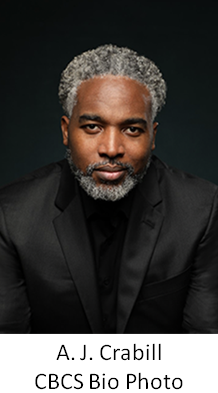
SOFG was created by The Council of the Great City Schools. Specifically, it was the brainchild of their director of Governance A. J. Crabill. Harvard University has created a training course to teach board members how to implement it.

The SOFG idea is school boards should be solely focused on student outcomes. They are supposed to create 3 to 5 SMART goals for improving student outcomes. SMART is an acronym that has been around in education circles for a few decades meaning specific, measurable, attainable, results-focused and time-bound. The measurable part of this is normally based on testing.

Here is an SOFG framework example SMART goal, “The percentage of free and reduced lunch-eligible students in kindergarten through 2nd grade who are reading/writing on or above grade level on the school system’s summative assessment will increase from W% on X to Y% by Z.”

The superintendent is the professional in the school who is to run all things and deal with non-student outcome items like school safety, transportation, maintenance, discipline and more. He is also tasked with achieving the boards 3 to 5 SMART goals. If something is not strictly student outcome focused, the board should not waste their time on it. That is the superintendent’s job.

The former Senior Campaign Manager of Democracy for America, Robert Cruickshank, reported on how SOFG is working in Seattle. His 2023 article begins:

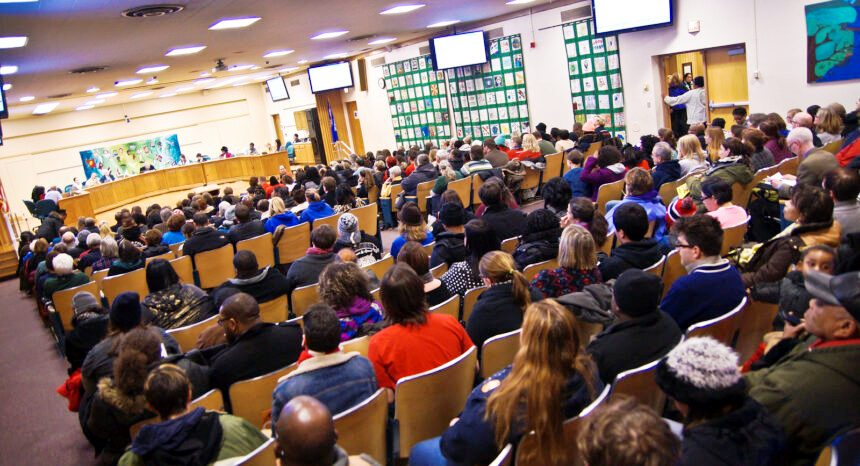
“Parents and students from Franklin High School in Southeast Seattle packed the Seattle Public Schools (SPS) board of directors meeting on Wednesday, June 21, urging the board and the district to save the school’s beloved mock trial program from budget cuts. A few weeks earlier, families from nearby Washington Middle School had filled the room to oppose cuts to the school’s jazz band. Both schools are majority BIPOC; nearly a third of their students are Black.

“The board did not vote to save either program. Instead, board directors deferred to administrators, referencing the Student Outcome Focused Governance (SOFG) model as part of their discussion.”

Amazingly, mock trial programs and jazz band are not viewed as having anything to do with student outcomes. Therefore, instead of being able to petition elected representative on the school board, the parent’s only recourse was the superintendent who had already decided to cut these two programs.

This past October, Uriah Ward, a school board member from Saint Paul, Minnesota, went to SOFG training in Texas.  Writing in Medium he noted, “SOFG is anti-democratic.” He went on to say:

“One of us asked if we could create a goal about making schools safer for students. We were told no, because school safety is not a student outcome.

“Under Monitoring & Accountability, boards are supposed to spend no less than 50% of their time monitoring student outcomes, and are only allowed to evaluate the performance of the superintendent based on whether or not they have met the student outcomes goals.

“School safety isn’t a student outcome. Culturally-welcoming schools aren’t a student outcome. Small class sizes aren’t a student outcome. Healthy school lunches aren’t a student outcome. So many things that our community will ask us for are not considered student outcomes.

“The unelected district employees are the ultimate authority on all things outside of the 3–5 student outcomes goals. Even then, administrators are given complete autonomy to figure out how to meet those goals, with school board input or direction being banned.”

School Board in Action

The Genesis of the SOFG Model

The Council of the Great City Schools has tremendous influence with America’s urban school districts. Since its founding in 1956, the Council has grown from ten urban school districts to 78. It is a 501 C3 non-profit [TIN: 36-2481232] that has an unusual structure. Most non-profits have between 5 and 20 members on their boards; Great City Schools has 153 on its board. The member urban schools districts typically have a least two voting members on the board.

A. J. Crabill, The Council of the Great City Schools director of governance, is credited with developing the SOFG scheme. He also travels extensively training school boards to use it.

Interestingly, Crabill does not have a college education. Born in Kansas City, Missouri in 1979, Crabill spent time in and out of foster care.

In 2008, he won a seat on the Kansas City school board. The schools were in danger of losing accreditation and needed a superintendent. In 2009, Crabill and his board hired new Broad Superintendents Academy graduate John Covington to run the schools. During the first year of leadership by Covington and Crabill, they solved a looming budget deficit by closing 29 schools and laying-off 285 teachers.

In 2011, Covington resigned and the Kansas City School District lost its accreditation. He went to Detroit while many people in Kansas City blamed Crabill for Covington leaving. They claimed he had been too involved in district operations. It was not until 2016 that the Kansas City Star reported Covington did not want to leave Kansas City but Eli Broad called saying, “John, I need you to go to Detroit.” Two days later, on Aug. 26, 2011, Covington was introduced as the first superintendent of Michigan’s new Education Achievement Authority.

While serving on the school board, Crabill’s name was Airick Leonard West but in 2016 he changed it to Airick Journey Crabill. The new surname came from his childhood foster parents.  

That same year, Crabill left Kansas City to work for Mike Morath and the Texas Education Agency (TEA) as a deputy commissioner. When the Austin ISD needed help understanding the new Lone Star Governance (LSG) system they hired Ashley Paz. The Austin Chronicle reports:

“Paz was trained by one of the people most involved in the formation of LSG – a former TEA deputy commissioner, A.J. Crabill. The agency’s boss, Mike Morath, hired Crabill in 2016 to help create and administer Lone Star Governance. He was an LSG coach for years, and in 2020 he became a conservator sent by the TEA to deal with the DeSoto school district, south of Dallas.”

Crabill states on his website, “School systems do not exist to have great buildings, have happy parents, have balanced budgets, have satisfied teachers, provide student lunches, provide employment in the county/city, or anything else.” It seems to me that great schools need all those things.

Crabill recently suggested there ought to be “automatic recalls if student scores drop dramatically.” He is pushing the NCLB test and punish scheme. The big difference, it is delivered by a private institution and not a government entity.

Of course there is a billionaire behind The Council of the Great City Schools and A.J. Crabill. Bill Gates [TIN 56-2618866] has sent them more than $3 million in 2021 – 2023. This is almost half their recent grant dollars.

Opinion

In many ways, America’s school boards are the training ground and foundation for democratic ideals. Student Outcome Focused Governance is an anti-democratic attack on that structure. I recently checked the San Diego Unified School Districts web site and found to my dismay that they are supporting SOFG.  

Please join me in opposing this outrageously bad public policy.

NPE2025 Columbus Impressions

8 Apr

By Thomas Ultican 4/8/2025

Last weekend, it was a rainy sad environment greeting the 2025 Network for Public Education (NPE) conference but inside the Columbus Hyatt it was blue-skies. When I left Ohio Monday morning, the local environment matched the hope and determination generated for three days.

The first conference event was a Friday evening session with Diane Ravitch and Professor Josh Cowen discussing vouchers. They made three things abundantly clear. As Cowen noted, “By every standard of the policy debate, vouchers have failed.” They always get defeated by voters at the poles and have become welfare for the wealthy. Funding for vouchers is wrecking state budgets.

As people were exiting the room, I got Diane and Pastor Charles Foster to pose for a picture. This created a wonderful example of tolerance and communication needed today. Ravitch is a Jew from New York City, Charles is a devout Baptist from Texas and I am a Nichiren Buddhist from California; yet we are all three genuine friends.

Charles and Diane

Day 2, Saturday

It was a marathon of sharing. At 8 AM, participants gathered in a large room for breakfast and speeches. Ravitch shared that “The Department of Education was not created to raise test scores but to raise equity.” She noted that America is a diverse country and that we must live with diversity and not deny it.

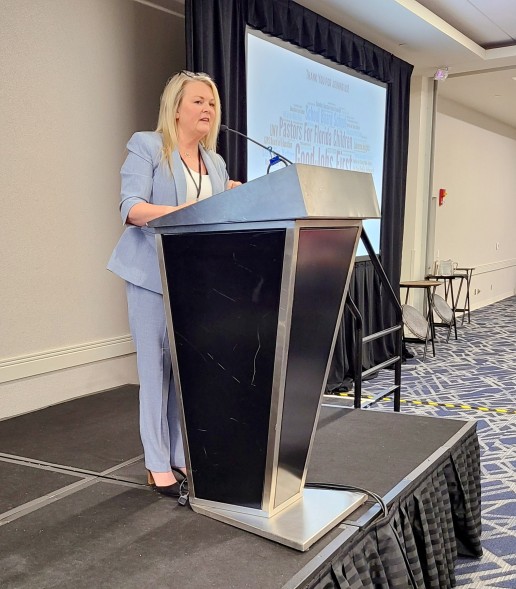
Jesse Piper, an NPE board member from rural Missouri, passionately ended the breakfast meeting claiming that when you start defunding schools, the community goes next. Jesse used the demise of her on small town as an example. Piper also stated, “Christian nationalism is teaching women to be submissive to their husbands and husbands to be submissive to their bosses.” She concluded by asserting to this large room full of public school educators, “You’re not indoctrinating students, that is what religious and private schools do.”

Jesse Piper

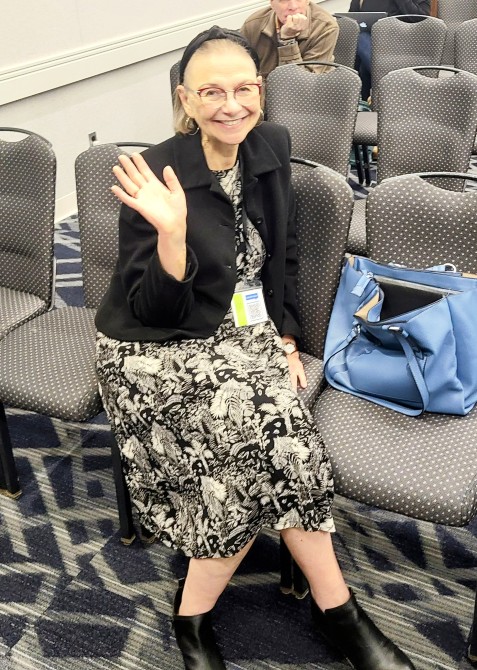
From there we broke into sessions in several rooms. Unfortunately, wonderful sessions were occurring at the same time making it hard to pick which one to attend. I presented on Science of Reading (SoR) in the first breakout presentations of the day. Nancy Bailey and Elena Aydarova PhD joined in the sharing. We had a large audience and people kindly told us they liked the presentations. (I am willing to share the Power Point file I used.)

Nancy Bailey

After lunch and a wonderful speech by John H. Jackson president of the Schott Foundation, I went to learn about Lifewise. I had no idea how fast that organization is growing. It was founded in 2018 in Ohio. There are now organizations in 26 states including California. Lifewise promotes RTRI (Release Time for Religious Instruction). Schools that participate must release children during the school day for a bus trip to the Lifewise facility where they learn a benighted form of Christianity based on the ancient Nicene Creed.

There are two types of states that authorize Lifewise, may-states and shall-states. Ohio just became a shall-state that mandates schools to participate if it is offered.

Lifewise wants kids younger than 14 because they are more successfully indoctrinated. When the kids come back to class, they show their presents and tell stories of ice cream parties. Kids that are at Lifewise often miss out on important learning. An Ohio science teacher showed pictures of his kids getting ready for the total eclipse that the Lifewise students missed.

That evening, we enjoyed a speech by the 2022 national teacher of the year, Kurt Russell. Russell says he no longer thinks of public education as important. Rather because it is the foundation of our democracy, it is vital, it is essential and “it is bigger than that; it is life.” Usually I am not impressed by someone being named teacher year whether it is of the school, district, county, state or the country. In this instance, he seemed totally deserving of the accolade.

Kurt Russell

Day 3, Sunday

I was really moved by the New Orleans presentation. We heard from a former charter school student and a brilliant mom. They made it clear that control is the byword in the district’s charter schools. The young man, a former charter school student, described a hair-raising ordeal which sounded like child abuse designed to keep the black community in its place.

Last year, when a charter school failed the superintendent replaced it with the first New Orleans public school since 2017. She was fired, but that is what the mom speaking to us claimed parents want. She said they desire that every time a charter school fails it is replaced by a more stable public school. Charter schools have become a revolving door with a large percentage of schools going out of business every year. Unfortunately, those in power want to maintain their portfolio model school district that does not include public schools.

She also said that charters in New Orleans are being sued regularly for some of their practices with children. However, there is almost no reporting about the suits because the settlements always include a non-disclosure agreement (NDA). She told the story of asking a KIPP administrator how many NDA’s they had created. He said none but when she retorted that she was in court just the week before and saw a KIPP NDA created, he backed off and promised to get back to her. She is not holding her breath.

The New Orleans Panel

The brunch time speaker was state representative from Texas, Gina Hinojosa, who has been in an all out battle with Texas Governor Greg Abbott to stop his universal voucher scheme. She says private equity is the plan that is causing billionaires Dunn, Wilks, Yass, Musk and others to finance vouchers in Texas. Hinajosa stresses that the most sinister aspect of the voucher plan is profiting through finance. She reports that a Texas Catholic Credit Union has already been established.

Gina Hinohosa

The last event on Sunday afternoon was special. American Federation of Teachers President, Randi Weingarten, presented us with a fiery speech when she introduced the final keynote speaker of the conference, Governor Tim Waltz of Minnesota.

Waltz was definitely not a disappointment. He made many vintage Waltz type statements:

“I know in this room I’m preaching to the choir. The choir needs to sing louder.”

“Some people say ‘I’m just not into politics.’ Well too damn bad, politics is into you.”

“We should not call them oligarchs, we should call them what they are greedy bastards.”

He was proud of the fact of being cited as the least wealthy person ever to run for Vice-President of the United States.

Waltz asserted that the middle class was built by public education and labor unions. As for what we are going through now, he speculates that it will get worse; so be ready for it.

Governor Waltz surprised us by staying in the room and taking picture with hundreds of us.

Tom and Tim

My impression was that this was the best NPE event to date. The breakout sessions that I attended were amazing and I did not hear of any disappointments. The keynote speakers were excellent and finishing with Governor Waltz was the cherry on top.

Questioning the Mississippi Miracle Again

21 Mar

By Thomas Ultican 3/21/2025

The national assessment of education progress (NAEP) is a biennial effort of the Department of Education. At the end of February, Chad Aldeman of The 74 – a billionaire created propaganda rag – asks, “How did Mississippi go from 49th in the country a decade ago to near the top today?” The simple answer is they didn’t. Still Aldeman’s article carries the title, “There Really Was a ‘Mississippi Miracle’ in Reading. States Should Learn From It.”

Australian, Noel Wilson, published his dissertation Educational Standards and the Problem of Error in 1997. This work, which has never been refuted, says that error in standardized testing is too large to reliably compare student outcomes. Psychologist Donald Campbell observed, “The more any quantitative social indicator is used for social decision-making, the more subject it will be to corruption pressures and the more apt it will be to distort and corrupt the social processes it is intended to monitor.” This is known as Campbell’s Law. Together, these two seminal works tell us that standardized testing to monitor and evaluate education is both unreliable and bad policy.

I have finally found something positive coming out of our felonious president’s administration. ABC News reports that he has ended the agency that compiles the “Nation’s Report Card” also known as NAEP. He eliminated the National Center for Education Statistics (NCES) which had existed for more than 150 years. Now, we won’t know how many students or schools our nation has or other important data about them, but we will no longer be wasting money on standardized testing.

This may be the last time we get a chance to look at billionaire sponsored deceptions based on NAEP testing.

Not a Miracle

Aldeman states:

“… [W]hen the Urban Institute adjusted NAEP scores based on each state’s demographics, Mississippi’s fourth-grade reading scores came out on top.”

“Some people have even tried to cast doubt on Mississippi’s NAEP gains by arguing they’re merely a function of testing older kids. But this has been debunked: Mississippi does hold back more kids than other states, but it always has, and the average age of Mississippi’s NAEP test-takers has barely budged over time.”

The Urban Institute and every other report that shows reading scores surging in Mississippi are based on 4th grade NAEP scores. It is remarkable how well Mississippi fourth graders have performed on NAEP reading tests since 2013. In 2024, they moved all the way up to 10th in comparison to the 49 other states, the District of Columbia, Department of Defense schools and Puerto Rico.

The first link in the second paragraph quoted above is a post by Diane Ravitch. She did not say anything about student ages but did state, “The surest path to success in fourth-grade reading on NAEP is to hold back third-graders who did not pass the third-grade reading test.” She also linked to a post from the right-wing Fordham Institute which posits, “A partial explanation for its NAEP improvement is that it holds students back.”

The second link in the paragraph is from a Fordham Institute article refuting Michael Hiltzik of the Los Angeles Times. Fordham asserts, “His claims about Mississippi’s NAEP scores and retention policy are based on a debunked theory and are demonstrably wrong in ways that he should have known.” This latest link is to a Magnolia Times article by Carey Wright, who as secretary of education in Mississippi instituted its reading program including third grade retention. Ms. Wright has too much skin in the game to be a powerful source that “demonstrably” sets the LA opinion writer straight.

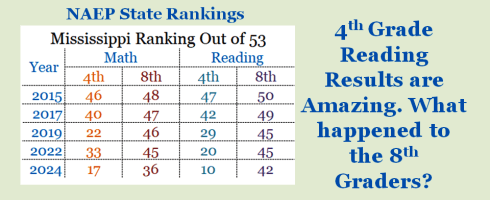
If Mississippi’s reading program is really working not just 4th graders but 8th graders should also be showing gains. They do not. NCES publishes comparison lists of state results.

Using the 2024 data, we see that indeed Mississippi’s 4th graders were number ten in the country but why are their 8th graders still number 43? The Mississippi reading program has been in effect since 2013 which means the 8th graders have been subjected to it their entire school life.

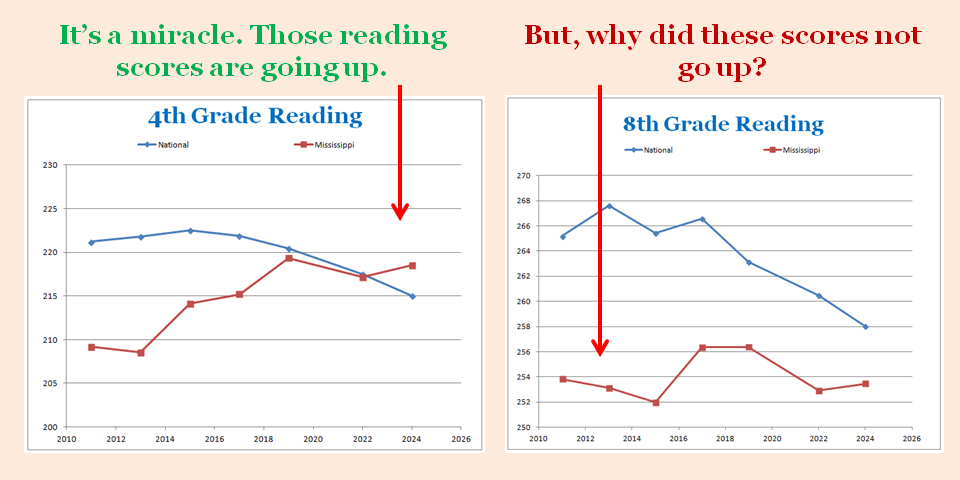
Another way to look at this is by plotting Mississippi reading scores against national averages.

This data shows us there is something fishy about the Mississippi’s 4th grade reading scores. They are hardly miracles but seem more like subterfuges.

It does not conclusively prove anything but science of reading, which is employed by Mississippi, started to be widely implemented in 2013 at the same time national reading scores started getting worse.

Carey Wright and the Right-wing

Carey Wright began her education career in 1972 as a teacher in Maryland.

In 2010, Michelle Rhee hired her to be chief academic officer for Washington DC public schools. Wright was an administrator in the DC schools during the height of their cheating scandals. Besides working with some of the most callus and harmful education leaders in American history, she is a member of Jeb Bush’s Chiefs for Change and a graduate of the late Eli Broad’s superintendent training academy. Both organizations are or were widely seen as enemies of public education.

In a 2023 Magnolia Times article, Wright claimed:

“Students who are retained in third grade because of reading deficiencies are provided with intensive interventions and support throughout the school year so they will be successful in later grades. 

“A recent report from Boston University’s Wheelock Educational Policy Center found this strategy is working. The report reviewed English Language Arts scores and later academic outcomes from the first cohort of third graders promoted and retained under Mississippi’s Literacy-Based Promotion Act of 2013.”

Upon opening the link Wright provided, we discover that the cited report was commissioned by the Foundation for Excellence in Education, which is Jeb Bush’s non-profit. He is chairman of the board and his girl Friday, Patricia Levesque, is the CEO. Their organization is known for working to privatize public schools and promoting Edtech.

Evidently ExcelinEd’s researchers discovered that the 6th grade results do not look as bad as the 8th grade results. The reports first key finding states, “For students who were in the third grade in 2014-15, being retained under Mississippi’s policy led to substantially higher ELA scores in the sixth grade.” This appears to be an example of looking for data to sell your ideology.

After spending four years in the classroom, Wright transitioned to various administrative roles. When leading special education services in Montgomery County during the early 2000s, she was serving in the middle of a corporate education reform triumvirate. John Deasy was promoting charter schools and teacher “pay for performance” in Prince George County. Baltimore had Andres Alonzo firing teachers and closing schools. Just a few miles away, Michelle Rhee was promising to “fix” Washington DC’s schools by firing teachers and principals.

Unfortunately, Carey Wright was drawn into this kind of billionaire school reform. She was probably a talented administrator, but many of her decisions were tainted by her friends in education.

The data does suggest that there has been some education progress in Mississippi. That improvement is most likely due to the dedication of poorly compensated public school educators.

Billionaire Purchased Research Hawks Virtual Tutoring

12 Feb

By Thomas Ultican 2/12/2025

Billionaires have enlisted the aid of Universities in their push to sell kids-at-screens education. The latest effort, dutifully reported in The 74, claims that Johns Hopkins University has shown “Done Right, Virtual Tutoring Nearly Rivals In-Person Version.” They say two new studies performed there show “how high-quality virtual tutoring can help struggling students.” In Massachusetts, they are testing virtual tutoring programs on 6-year old students, which is morally repugnant.  

The 74 reports,

“In a quasi-experimental study published in December, Neitzel and her colleagues found that first-graders in Massachusetts who used Ignite Reading, a one-to-one virtual tutoring program, made substantial progress in reading, with the percentage of students reading on grade level rising from just 16% in the fall to about 50% by spring.”

Neitzel is Assistant Professor Amanda Neitzel, Deputy Director of Evidence Research at Johns Hopkins University. Ignite Reading is a for profit company specializing in science of reading (SoR) approaches to virtual tutoring. The bill for this program, which was run in 13 Massachusetts elementary schools, was paid by One8 Foundation (TIN: 04-6836735), a three-quarter-billion dollar Jewish centric foundation that regularly gives to privatizing organizations like Teach For America, KIPP and Success Academy.

The quasi-experimental study was published in December, 2024. Quasi-experimental research is research that resembles experimental research but is not true experimental research. While quasi-experimental designs don’t offer the same level of control as true experimental designs, they are still useful for studying situations where randomization is difficult or impossible. However, they can be misleading.

Page 4 of the study described Ignite Reading, as a one-to-one virtual tutoring program, fostering early literacy development. The paper states, “As part of the program, students attend daily 15-minute virtual tutoring sessions with specially paired Ignite Reading tutors who leverage a sequenced, research-based instructional plan designed to develop students’ early-literacy skills, related basic alphabetic knowledge, phonemic awareness, phonics, decoding, and fluency.” The SoR curriculum was assessed using DIBELS’s basic early literacy skills test.

The DIBELS use throws some shade on Neitzel’s research. Many educators and scholars loudly detest DIBELS. Berkley’s P. David Pearson wrote, “I have decided to join that group of scholars and teachers and parents who are convinced that DIBELS is the worst thing to happen to the teaching of reading since the development of flash cards.” DIBELS focuses on phonics and sounds and not words and meaning. Many of DIBELS assessment phrases are purposefully gibberish.

While I question the assessment methodology, I would think first graders who were forced to participate with an on-line tutor 15 minutes every day of the school year would improve somewhat. Even a bad methodology will produce some results though it might poison a baby’s mind about reading.

Billionaire Funded Air Reading

The second Johns Hopkins research article cited is about San Mateo, California’s Air Reading which was founded in 2021. Crunchbase reports that Air Reading’s last two rounds (2023 and 2024) of funding were financed by Accelerate which highlights how billionaires are bending research to their liking.

They self-claim, “Accelerate actively builds the country’s knowledge of tools and practices that significantly advance student learning.” The reality seems quite different. Accelerate appears more like a pass-through portal for billionaire dollars. The 2022 tax form 990 (TIN: 88-3207484) shows CEO Kevin Huffman’s Tennessee company has just over $14-million in assets yet they seem to be Air Reading’s main funding source. Accelerate’s funds were recently augmented with $10-million from John Arnold.

Accelerate’s Posted Funders

Arrow Impact is a $60-million dollar non-profit established by wealthy Stanford financial professor, Mark Wolfson (TIN 83-1423625). In 2023, Wolfson added another $7.5 million to Arrow Impact and he seems to be the poor guy here. Former Tennessee Governor and billionaire Bill Haslam with his wife Crissy operate a $100-million tax free foundation (TIN 62-1867423). Griffin Catalyst belongs to billionaire Ken Griffin founder of Citadel Financial. John Overdeck is the billionaire founder of Two Sigma Investments. His Overdeck Family Foundation has over $850-million in assets (TIN 26-4377643). Arnold Ventures (TIN 26-3241764), Gates Foundation (TIN 86-1065772) and the Walton Family Foundation (TIN 58-1766770) complete the list of billionaires putting investments through Accelerate.

The Johns Hopkins report informs:

“Air Reading is grounded in the Science of Reading. Comprehensive, one-on-one diagnostics identify students’ learning needs and inform group placement and bi-weekly assessments to track student progress.”

“During the 2023-24 school year, six elementary schools in a district in Texas took part in a randomized controlled trial to evaluate the impact of Air Reading on reading outcomes for first through sixth grade students.” (Page 4)

The fundamental outcome is they once again showed that students getting extra tutoring outperform students who do not. The study was monitored using the corporate supported NWEA MAP testing scheme. Neitzel et al explain that based on these outcomes, “the control group who scored at the 50th percentile would increase their score to the 55th percentile if they participate in the tutoring.” (Page 10) The report admits it was, “comparing the reading achievement of students receiving the Air Reading intervention to those receiving the standard classroom instruction.” (Page 11) In other words, the study compared those receiving 40-minutes of tutoring four days a week with those who were not.

This result is so unsurprising that it is difficult to fathom why they bothered other than billionaires want to sell putting “those people’s children” at screens.

SoR is key to putting kids a screens. That is why billionaires are pushing it down America’s throats.

Insights

Before billionaire education reform, education research was much more honest. Typically, an education researcher would study some aspect of teaching or learning, gather data, write up the study and submit it to some journal for publication. The study would go through a peer-review process in which several experts in the field would review the paper and then at a large gathering the researcher would defend the paper. If the defense went well, the respected journal would publish the paper.

Billionaires have to some extent eliminated the peer review process when their organizations like TNTP publish a paper that is promoted by billionaire funded media like The 74. Once the paper is published other billionaire funded organizations cite the sham papers in their reports or like the University of Arkansas’s School Demonstration Project financed by the Walton family, just cite their own previous bogus work.

The 74, claimed that Johns Hopkins has shown “Done Right, Virtual Tutoring Nearly Rivals In-Person Version.” If a school can convince students to log on to tutoring and pay for the online tutors, this might be true. However, the demonstrations that virtual tutoring can “nearly” rival the in person versions were extremely well resourced and had the ability to force children to log in. Even if the downside health problems associated with kids at screens are ignored and “nearly” rival is a good enough goal for your schools and their parents, it is unlikely they will get an equivalently well resourced program.

Billionaires like Laurene Powell Jobs and Bill Gates want to put kids at screens in the worst way. Unfortunately, it is a method that seriously degrades education. Their kids will never be subjected to this kind of diminished education and no other American student should be either.

New NAEP Scores No Reason to Panic

4 Feb

By Thomas Ultican 2/4/2025

Billed as the Nations Report Card, the National Assessment of Education Progress (NAEP) just released data from the 2024 testing window. The first NAEP assessments occurred in 1969 and in 1996 school testing in all states became mandatory every two years. Almost since the beginning, the testing results have been treated as a crisis moment. This year, both math and reading data came in lower than pre-pandemic levels. To the reform group, Education Trust, this is a time for action but it seems more likely that less action might be in order. The last two decades of education reform have been a harmful disaster. So prudence in our response is a better course.

The problem with all this data is summed up nicely by Peter Greene:

“As long time readers know …, I’m not one to get excited about scores on the Big Standardized Test, despite the claims that it will tell us How Schools Are Doing. There are lots of reasons to suspect that America’s Gold Standard of Testing is not all the gold standardy. And there is one serious lesson to be learned, which is that having all this cold hard data doesn’t actually change a damned thing— everyone just “interprets” it to support whatever it is they wanted to do anyway.

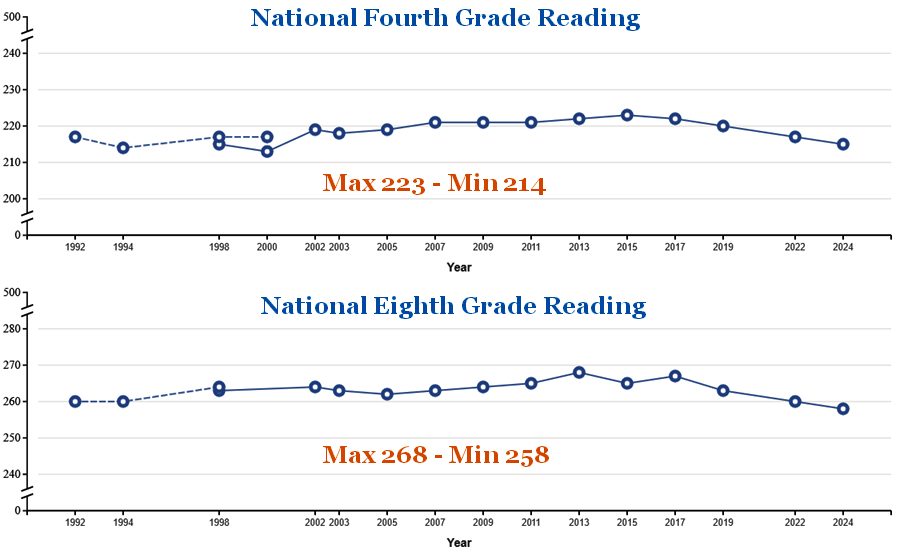
Plots of the average testing results covering math and reading for the past 32-years do not inspire much insight even if you believe in standardized testing.

The plots above were created from NAEP Data. Since 1992, both sets, which are plotted on a 500 point scale, wiggled up and down within a 10 point range.

In 2020, COVID-19 happened and this year’s 4th graders joined in-school classes a year or more late. The 8th graders missed at least their 5th grade in-school classes and some of them missed significantly more. During that year or more out of school, a tendency for truancy developed. So it is not surprising that their testing scores are not stellar, but they are still within the 10-point historical range.

Reading Scores Down

Peggy Carr, Commissioner of the National Center for Education Statistics (NCES) said, “Student achievement has not returned to pre-pandemic levels, reading scores continue to decline, and our lowest performing students are reading at historically low levels.”

For the past decade, there has been a major dispute over how to teach reading in the United States. Dozens of states have overhauled their reading instruction to adopt so called science of reading (SoR) methods. These changes came about largely due to a well financed corporate driven campaign that has drowned out literary experts.

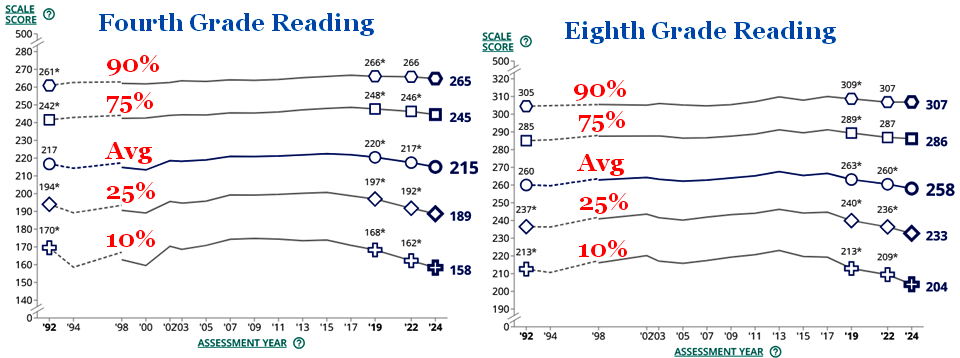
NAEP created charts based on reading data disaggregated by scoring percentiles are shown below.

In both the 4th grade and 8th grade charts reading scores started declining about 2015 and have fallen every testing window since. At about the same time, balanced literacy, which was the nation’s most popular method for teaching reading, started being replaced by SoR. The correlation between SoR and the dip in reading scores is obvious but may be misleading. Chalkbeat reports,And while federal education officials are usually reticent to explain what caused a particular increase or decrease in scores, Carr cautioned that the near-universal dips in reading should not be taken as evidence that reading reforms have not worked.”

I have believed for some time that SoR is less about good teaching and more about profits, so it is tempting to discount Dr. Carr’s warning. Standardized testing has serious limitations and it would be hypocritical to discount it only when I did not like the results and then hale the outcomes that I liked.

However, the NAEP data since 2017 certainly provides NO support for SoR.

Math Staying Steady

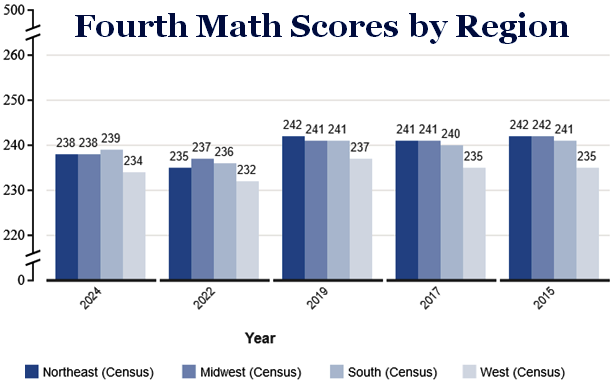
The 2024 math results for fourth-grade improve by 3% over 2022 but were still 2% lower than the pre-pandemic 2019 testing. Eighth-graders treaded water in 2024 with scores that were not significantly different from 2022 and were 8% lower than 2019.

NAEP allows researchers to break down scores by region. I created this bar graph of fourth grade math for the last five testing windows. The South, Midwest and Northeast had almost identical scores while the west lagged by 4-6 percent. Would we all like to see better scores? of course. On the other hand, there is nothing here that looks dire. In 2022, there was a small drop in scores and in 2024 about half of the drop was overcome.

Absenteeism is probably holding back score recovery in both math and reading. It is generally considered that when a student misses more than 10% of the school year they are chronically absent. National Public Radio (NPR) has reported, the rates of chronic absenteeism doubled during the pandemic. NAEP also asked students, during this last testing cycle, how many days they had missed in the previous month. NPR notes that, “Across the board, lower-performing students were more likely to report missing five or more days of school in the previous month, compared with higher-performing students.”

Some Final Observations

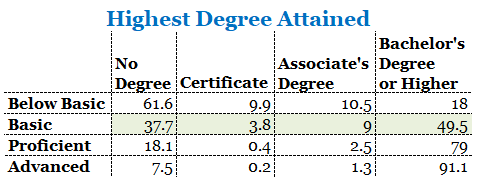
 In 2007, NCES performed a study on what happened to the 1992 NAEP participants. They were interested in how the four attainment level, Below Basic, Basic, Proficient and Advanced, matched student outcomes.

The key results are shown in the table above. It looks like the levels have misleading names. Half of the students in the Basic group achieved a bachelor’s degree or higher. This means that they were college ready and academically proficient. The NAEP labels are aligned too high; therefore misleading.

In 2019, Diane Ravitch commented on that year’s NAEP data: “After a generation of disruptive reforms—No Child Left Behind and Race to the Top, VAM and Common Core—after a decade or more of disinvestment in education, after years of bashing and demoralizing teachers, the National Assessment of Educational Progress (NAEP) for 2019 shows the results:

‘“Over the past decade, there has been no progress in either mathematics or reading performance, and the lowest-performing students are doing worse,”’ said Peggy Carr, the associate commissioner of the National Center for Education Statistics, which administers the NAEP. ‘“In fact, over the long term in reading, the lowest-performing students—those readers who struggle the most—have made no progress from the first NAEP administration almost 30 years ago.”’

SoR became the billionaire reform de jure in 2019. No Child Left Behind, Race to the Top, VAM and Common Core had come to be seen as either failures or frauds. Profiteers hoped the new SoR strategy would lead to privatizing and controlling all aspects of education and they made great efforts to promote it. Will the 2024 NAEP results be the beginning of the end for their greedy dreams?

Whatever the case, Ravitch’s 2019 NAEP analysis still holds true. The 2024 NAEP results are nothing to celebrate but certainly are not a crisis. After all, they are based on standardized testing that is not capable of measuring learning or teaching. Family wealth is about the only thing to which NAEP data correlates.

Billionaires Driving Science of Reading

21 Jan

By Thomas Ultican 1/21/2025

On January 2nd, billionaire created education news source, The 74, declared there is a reading crisis in Los Angeles Unified School District (LAUSD). This was based on an LA School Report article stating that on the 2023-24 California assessments “43.1% of all LAUSD students met state proficiency targets in reading, compared with 44.1% in the 2018-19 school year, the last before the pandemic.” In math, 32.8% met standards, compared to 33.5% in 2018-19. It seems ludicrous to believe that a 1% drop in testing results, that are known to wiggle up and down, is a crisis. Furthermore, in 2021-22 those proficiency numbers were 41.7% ELA and 28.5% math and in 2022-23 were 41.2% ELA and 30.5% math which suggests that school district testing results are on an upswing.

The 74 was founded in 2015 by former CNN news anchor, Campbell Brown, along with Michael Bloomberg’s education advisor, Romy Drucker. Its original funding came from billionaires via the Dick and Betsy DeVos Family Foundation, the Walton Family Foundation, the Doris and Donald Fisher Fund and Bloomberg Philanthropies. Since then, it has been the vehicle for spreading their message of school privatization. In 2016, The 74 took over the LA School Report.

Creating an Expert

The title of The 74’s crisis article isReading Crisis in LAUSD: ‘This is… a Problem With a Responsibility That Falls on All of Us’. And it has the subtitle, “Literacy Activist Olga de la Cruz says the science of reading is the will solve (sic) literacy losses suffered mostly by poor kids of color in the pandemic.” Literary activist Olga has a BA from UCLA and a Masters of Public Administration from USC. What makes her a literary expert is mystifying. She is also senior campaign director at Families In Schools.

“Reading Crisis in LAUSD …” is an edited version of The LA School Reports interview with Olga. She states, “We need to be more intentional about listening to families, collaborating with community leaders, designing programs that directly support the needs of our students.” The LA School Report asked, “Why is the science of reading important as part of that effort?” Olga answered:

“Science of reading is not a method nor a curriculum nor an approach. It is a body of evidence based on decades of research that explains how the brain learns to read and the foundational skills that students need to become proficient readers.

“It’s about how the brain works and how children learn to read. So this requires explicit, systematic instruction, what are called the foundational skills, which are phonics, phonemic awareness, vocabulary, comprehension, fluency and oral language.”

Olga’s employers, Families In Schools, just published a report which reads more like propaganda for the Science of Reading (SoR) than a scientific review of reading education methodologies. They claim:

“Unfortunately, in many classrooms, students are still receiving reading instruction that is not based on evidence about what works …. For example, the ‘whole language’ approach is based on the idea that students learn to read naturally through exposure to literacy-rich environments, the use of context clues, and word memorization. “Balanced literacy” is a variation thereof that embraces elements of multiple approaches, including small doses of phonics instruction while retaining ineffective elements from the whole language approach.”

Last year, two highly regarded literary professors, P David Pearson of UC Berkeley and Robert J. Tierney of University of British Columbia, published Fact-Checking the Science of Reading. Unlike Olga de la Cruz, these are two actual literary experts.

In looking at the charges against balanced literacy, they detect bad testing science and assert, “As current policy pundits and reporters have done, we ask more of these assessments than they were designed to accomplish, as they spread unwarranted—and potentially harmful—claims about both the positive (phonics first will solve our woes) and negative (Balanced Literacy is the culprit) effects of curricular change.” (Page 78)

Person and Tierney also addressed Olga’s claim about “research that explains how the brain learns to read”. The professors noted, “Many fail to understand that the contribution of neuroscience to the practical task of assessment and intervention in reading disability is still rudimentary, and scientific understandings continue to be undermined by methodological difficulties and the selective use of evidence.” (Page 97)

Maren Aukerman is currently a Werklund Research Professor at the University of Calgary who focuses on literacy education and formerly served on the faculties at Stanford University and the University of Pennsylvania. She warns of journalists using logical fallacies to promote science of reading (SoR). For example, not reporting research showing students taught to read without systematic phonics “read more fluently.”

The Orwellian labeled SoR is not based on sound science. In 1997, congress passed legislation, calling for a reading study. Establishment of the National Reading Panel (NRP) was a doomed effort. They were given limited time for the study (18 months), which was a massive undertaking, conducted by twenty-one unpaid volunteers. NRP fundamentally did a meta-analysis in five reading domains, ignoring 10 other important domains. They did not review everything and there was no new research. Their search for reading studies and averaged results is the basis for “science of reading.”

SoR’s real motivation is to sell products, not helping children struggling to read. Scholars like Pearson and Tierney are ignored while pseudo-experts with limited credentials are trumpeted.

 In 2021, EdReports, which rates curricula for their alignment to Common Core or similar standards, gave both Lucy Calkins’s Units of Study and Fountas and Pinnell’s curriculum its lowest ratings. In January 2020, Student Achievement Partners (SAP) issued a report finding that Calkins’ approach to phonics was “in direct opposition to an enormous body of settled research.” Both EdReports and SAP are billionaire founded and financed companies.

Billionaire Financed Companies Selling SOR

The Families In Schools report was funded by the following philanthropies.

Supporting Families In Schools Report

The Ballmer Group is financed by the former Microsoft CEO Steve Ballmer.

Sobrato is a Silicon Valley real estate developer’s philanthropy.

Heising-Simons is also a bay area foundation which last year co-created the Early Educator Investment Collaborative, a group of early-childhood funders that also includes the Ballmer Group, the Bezos Family Foundation, the Bill & Melinda Gates Foundation, the Buffett Early Childhood Fund, the David and Lucile Packard Foundation, the Foundation for Child Development and the Stranahan Foundation.

EdVoice was established in 2003 by Eli Broad, John Walton, John Doerr, Don Fisher, Reed Hasting, Laurene Jobs Powell, Buzz Woolley and others to advance their billionaire public school privatization agenda. (See 2003 form 990 TIN 94-3284817)

GPSN is led by former charter school executives and Eli Broad employees.

Billionaires are the main support driving SoR. One of the reasons for that is having a tightly defined curriculum makes it much easier to develop a software-driven-kids-at-screens program and profit while reducing costs; think iReady or Amplify.

Conclusion

SoR advocates are trying to force everyone to use a reading education approach that is not proven and failed miserably in England. Authoritarians want to take over public education and turn it into a profit center, claiming it’s based on decades of research. That is not true and it is more likely to harm children than help. Forty states have already adopted laws that comply with billionaire wishes and in California legislation has been written and submitted. It was tabled this year but it is sure to come up again.

This is a billionaire sponsored tragedy requiring as many people as possible to become aware and oppose it.

Billionaire Sponsored Malarkey from Education Trust

3 Dec

By Thomas Ultican 12/3/2024

Education Trust (aka EdTrust), using what it calls equity analysis, critiqued various states’ Every Student Succeeds Act (ESSA) required accountability plans. University of Northern Colorado’s Derek Gottlieb reviewed their study for the National Education Policy Center. An unimpressed Gottlieb claimed, “Despite the language of ‘equity’ and attention to ‘asset-based’ framings of educational data, the vision of what high-quality accountability structures would look like and would do simply recycles the naïve hopes that fueled the original push for NCLB.” EdTrust’s non-peer-reviewed study might also be opening the way for a new version of the Elementary and Secondary Education Act to replace the now ten-year-old ESSA.

EdTrust rings a preponderance of No Child Left Behind’s (NCLB) greatest hits in its one paragraph explaining why we need federal oversight:

“The purpose of public education is to provide students with the knowledge and skills they will need to succeed after high school; the ability to access and complete a postsecondary education, pursue a fulfilling career that earns a living wage, and meaningfully participate in our democracy. All students can succeed when provided with the resources and supports to achieve. Yet, generations of students — particularly students of color, students from low-income backgrounds, students with disabilities, and multilingual learners — have been systematically denied equitable access to these educational opportunities — inequities illuminated and exacerbated by the pandemic. Federal accountability requirements are designed to ensure parents, communities, system leaders, and policymakers can better understand which schools and districts are struggling to meet students’ needs and have student group disparities, and — most importantly — use this information to target additional resources and supports to address these needs.
They are saying that through testing we can identify “struggling schools,” which is similar to NCLB’s “failing schools” but not as harsh. They claim it will allow targeting those schools with “additional resources and support.” Honestly, that sounds a lot better than NCLB’s fire the staff and close the schools but EdTrust’s plan to pay for the “additional resources and support.” is not workable. To achieve the goal, they suggest using federal school improvement funds, a 7% set-aside from Title I funding.

Typically, Title I funding represents about 2% of a state’s education budget. Unfortunately, a 7% set-aside from a relatively small amount of money is not going to be sufficient. Even if we accept that “all students can succeed,” these amounts of additional resources will not do the job.

EdTrust makes a series of recommendations that cause many of us teaching in the first decade of the 21st century to shudder.

They advocate, lowering the minimum student sample size from 20 to 10 so certain subgroups are included in school ratings. When teaching statistics, most instructors would warn that population sizes less than 20 have too large of error ranges to be statistically useful. It is odd that known data wonks would make this absurd recommendation.

EdTrust advocates using growth and proficiency with similar weighting for school accountability measurements. The standardized testing data used to assign proficiency are extremely noisy and unreliable. The famed Australian researcher Noel Wilson wrote a seminal work in 1998 called Educational Standards and the Problem of Error.” His peer reviewed paper states standardized testing error is so large that meaningful inferences are impossible. Growth models use standardized testing data and run it through opaque mathematical regimes. It is literally garbage in garbage out.

Another EdTrust recommendation says, “Increase federal monitoring and require state reporting of ESSA school improvement provisions,” which echoes the old NCLB test and punish regime.  The report adds:

“Strong actions such as state takeovers have mixed evidence of success and when done need to be undertaken in collaboration with communities. However, having these state actions as options can help motivate school and district leaders to make strategic, systematic changes to policy and practice to raise performance.”

Which means, if you are in the wrong zip code, your school is going to be a closure victim.

Professor Gottlieb concluded his review of the EdTrust report:

“Without substantially increasing the resources to be targeted for distribution, there are real and hard limits on the productive value of monitoring and reporting, no matter how good or robust our measurements are. It is one thing to have imagined, in the late 1990s, that federal accountability policy alone could transform public education across the country to finally make good on national promises of equal opportunity. It is quite another thing to pitch a wonkier version of the same approach three decades later, with so many tweaks and nuances and consistently underwhelming “successes” in our rearview mirror.”

Education Trust and the Billionaires

Kati Haycock founded EdTrust in 1990 according to the organization’s 1997 web posting. In 1973, with her newly earned bachelor’s degree in political science, University of California President, Charles J. Hitch, made her director of affirmative action for the entire UC system. By 1989, she had earned a master’s in education from UC-Berkeley and was gaining trust in neoliberal Democratic circles as shown by her becoming Executive-Vice President of the Children’s Defense Fund. It appears EdTrust was not a standalone independent organization until 1996. It was originally founded as a unit of the American Association of Higher Education.  That is probably why the National Assessment Governing Board says EdTrust was founded in 1996. (Common Core Dilemma Pages 45-48)

Haycock, who was never a teacher, became influential in education policy by promoting test-score centered American school rooms. Concerning Haycock’s expertise, Mercedes Schneider declared, “It’s like writing a cookbook without ever having prepared a meal.” (Common Core Dilemma Page 48)

EdTrust was always a diehard test based education improvement supporter. In 2008, Republican Sam Graves and Democrat Tim Waltz introduce HR 6239 to suspend temporarily the school punishments required by NCLB. Haycock and EdTrust swung into action to fight the bill. They stated in a letter to congress:

“HR 6239 would turn back the clock to a time when our country simply ignored troubled schools. That approach, the norm for generations of federal education policy, failed miserably and has wasted billions of dollars and squandered the potential of millions of our fellow citizens.  As imperfect as NCLB may be and as uncomfortable as the law may make some adults, we can’t afford—not even for a moment—to turn away from the law’s commitment to identify and intervene in schools that are not making the grade.”

At about this same time, Education Trust joined with Achieve and the Thomas B. Fordham Foundation to promote IBM CEO, Louis Gerstner’s American Diploma Project (ADP). Gerstner never studied education nor taught but he went to school and hired many people who also went to school so he considered himself an education expert. His big thing was the need for education standards. In 2008, his ADP was subsumed into Bill Gates Common Core State Standards. Interestingly, Gates had even less education background than Gerstner, but he was really rich.

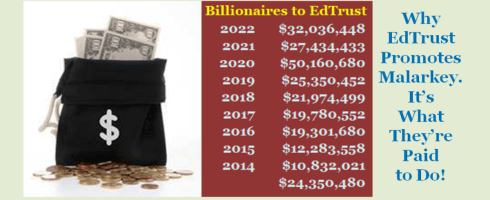
Since their inception, EdTrust has been very successful at attracting billionaire dollars. On their webpage, they list 50 entities that send them money which are mostly billionaires or billionaire financed. For tax purposes, EdTrust (TIN 52-1982223) is a tax deductible charity. Since 2014, they have received more than $24 million a year in deductible contributions.

That is a huge amount of money so I picked out four organizations to review in a little bit of detail. I chose the Gates Foundation because they send money to anyone undermining public schools, the Broad foundation out of nostalgia and curiosity, the Walton Family Foundation for the same reason as Gates and the Barr Foundation because of my friend Maurice Cunningham’s interest in them.

Amos Barr Hostetter, a cable company billionaire, founded the Barr Foundation in 1991 along with his wife Barbara but they made all of their contributions anonymously until 2010. Before then, Hostetter’s giving was hidden behind a veil of secrecy.

Conclusion

Having billions of dollars in private hands undermines democracy. The public likes their public schools, but enormous billionaire spending is driving down this regard. Propaganda like the EdTrust report is hard to counter.

If the common person is going to maintain any democratic control or rights, billionaires need to be taxed back to being millionaires.

Privatized Schools Will End Democracy

30 Oct

By Thomas Ultican 10/30/2024

America’s founders believed in a need to educate the populace, especially second and third presidents, John Adams and Thomas Jefferson. They believed that the only way a self-governing society could be sustained is with an educated population. Adams penned to his wife, Abigail, “And liberty cannot be preserved without a general knowledge among the people who have a right from the frame of their nature to knowledge, as their great Creator who does nothing in vain, has given them understandings and a desire to know.” In a 1786 letter to scholar and fellow signatory to the Declaration of Independence, George Wythe, Jefferson wrote:

“I think by far the most important bill in our whole code is that for the diffusion of knowledge among the people. No other sure foundation can be devised for the preservation of peace and happiness.” (School and Society 1995, Page 25)

In the antebellum era, two types of schools flourished, common schools and academies. Common schools were supported by local and state governments. They were free for students. Academies may have received some governmental support but they charged students tuition. The common schools dominated towns and cities while the rural areas without enough population to support a common school turned to academies which were often boarding schools.

After the Civil War, common schools became more dominant. As the school system developed throughout America, the public structure took root.

In the 1930’s, the fact of an educated population that could read, write and do some math probably saved America from authoritarianism. During World War II, the high rates of literacy among American troops had a lot to do with their success on the battlefield.

The 1960s and 70s witnessed civil rights coming to public education and the development of a pluralistic system. Unfortunately, in the late 1970s, Washington DC politicians began to interfere with public education by proposing education standards, a harmful error.

In 1983, the Reagan administration published a deceitful attack on public schools, “Nation at Risk.” Since then public schools have been under relentless attack financed by billionaires.

A key weapon in this attack has been forcing school vouchers on communities and states. Vouchers have never survived a popular vote, but in areas dominated by the Republican Party they have been enacted by legislatures. Researcher Joshua Cowen’s new book, The Privateers; How Billionaires Created a Culture War and Sold School Vouchers,” documents the way rightwing billionaires advanced a public education killing agenda.

The Privateers

Milwaukee, Wisconsin brought us America’s first voucher program in 1991. Cowen claims with evidence that the driving force behind the program was the Lynde and Harry Bradley Foundation.

In 1901, the brothers founded the Allen Bradley Company with a $1,000 investment by local Milwaukee doctor Stanton Allen. The older brother Lynde died in 1942 and the younger brother Harry succumbed in 1965. In 1985, Rockwell International bought the Allen Bradley Company for $1.65 billion and overnight the Bradley Foundation ballooned from $14 million to $300 million. The faceless people in control of this giant pile of cash pushed through America’s first voucher program.

Joshua Cowen is a Professor of Education Policy at the University of Wisconsin, Madison.  From 2015-2018, he served as co-editor of Educational Evaluation and Policy Analysis, the flagship peer-reviewed education policy journal in the United States. He was previously Associate Editor of Education Finance and Policy, and remains on the editorial boards of both journals. Since 2009, his research has been funded by an array of philanthropist and organizations including The University of Arkansas Foundation, the Walton Family Foundation and John Arnold.

Cowen being in the research trenches working directly with scholars that had an ideological predisposition to support vouchers makes his information powerful.

Billionaires Charles Koch, Betsy DeVos and other holders of extreme wealth have financed the fight to move funding away from public education and toward private schools. Cowen explains, “The purpose was and is to do away with schools existing as a core function of democracy and stand up instead a privately held, sectarian and theocratic version of publicly funded education.” (Privateers Page 30)

When the nation’s first voucher program was enacted, Wisconsin lawmakers included a requirement for an outside evaluation. University of Wisconsin professor of political science, John F. Witte, was given the assignment. Cowen reports, “Although the evaluation found the parents of voucher users indicated greater levels of satisfaction with their children’s educational experiences over time, Witte also found little consistent evidence that vouchers improved test scores or attendance rates and found that students gave up the vouchers at high rates to return to Milwaukee Public Schools.” (Privateers Page 36)

Paul Peterson, a Harvard professor who thirty years earlier earned a PhD in political science from the University of Chicago, was not having it. He blasted Witte’s report in the New York Times and in academic papers. Peterson was known mostly for his 1990 book, “Welfare Magnets.” However, in 1995, he received funding from both the Olin foundation and the Bradley foundation. Some of that funding was to evaluate Witte’s report. Peterson and his then graduate-student Jay P. Greene (now at the Heritage Foundation) attacked Witte’s study with a shocking level of vitriol and ferocity. (Privateers Page 38)

The next voucher program popped up in Cleveland, Ohio. It was the Peterson-Greene evaluation of the program that caused researchers concern about a hidden agenda and sloppy scholarship. Cowen writes:

‘“Even when he has limited data, he’s always squeezing out whatever data he can to arrive at a predetermined answer,’ said Professor Bruce Fuller, an early voucher critic at University of California, Berkeley. Fuller noted that with Olin and Bradley funding Peterson’s work, ‘That’s like the tobacco companies sponsoring studies on the effects of smoking.’ A later textbook for future evaluators would cite the Peterson Milwaukee work as a cautionary example of ideologically predisposed research and ‘a hidden agenda,’ particularly in Peterson and Greene’s willingness to use lower-than-conventional standards of statistical inference to make their case. Even Paul T. Hill, an otherwise prominent school choice supporter, singled out the Peterson Cleveland work as ‘not a persuasive study.’” (Privateers Page 42)

The central role of the Bradley Foundation was brought home with a quote from the New Yorker’s Jane Mayer:

“The Bradley Foundation virtually drove the early national ‘school choice’ movement, waging an all-out assault on teachers’ unions and traditional public schools. In an effort to ‘wean’ Americans from government, the foundation militated for parents to be able to use public funds to send their children to private and parochial schools.” (Privateers Page 46/7)

The wheels on the voucher bandwagon flew off. Patrick Wolf, another Peterson acolyte at Harvard who is now at the University of Arkansas, presented a paper with results Cowen described as “shocking.” The evaluation of Louisiana’s statewide voucher program showed unprecedented large negative impacts on students. Martin West, a former Peterson student and now Harvard Professor, wrote about the results calling them “as large as any I’ve seen” in the history of American Education.(Privateers Page 89)

Since that Louisiana study, two studies in Washington DC also showed large academic losses. The same thing occurred in both Ohio and Indiana. The largest academic declines ever recorded were from these voucher programs; larger than the losses due to Katrina or the Covid pandemic.

Conclusion

 If you have not read Privateers, I strongly recommend you do. In it, Joshua Cowen documents the massive spending by Charles Koch, Betsy DeVos, the Walton family and other wealthy conservatives to undermine public education by selling school choice. Public education is expensive and does not allow for religious indoctrination. Good private schools cost a lot more than the vouchers offered. This creates two benefits for conservative billionaires, overall education costs are reduced and the public is forced to fund religious schools. Those who are not wealthy will get an enfeebled education if the billionaires succeed in destroying public education.

Koch, DeVos and other billionaires run wealthy foundations that are tax exempt charities. In reality, they are not charities. They are political organizations spending to advance school privatization and other political agendas. The laws governing tax exempt foundations are being ignored because no one wants to face the wrath of the supper wealthy.

America can no longer afford billionaires. They undermine democracy. I have two recommendations. Tax billionaires back to being millionaires and cleanup tax free giving.