By Thomas Ultican 4/10/2026
Trump’s billionaire education leader, Linda McMahon, claimed on Fox News, “We’re doing terribly, I mean, our education system’s failed our kids.” Like a typical oligarch, she bolstered her point by mischaracterizing NAEP assessment levels stating, “only about 30% of high school and eighth graders can read proficiently or do math proficiently.” Maybe that sounds bad, but the reality is those numbers indicate that 30% of students are achieving at a high B or low A grade-level which sounds pretty good to me.
McMahon was promoting her nonpartisan “History Rocks!” tour. The sponsors of the tour are certainly not nonpartisan. They include America 250 Civics Education Coalition, led by pro-Trump America First Policy Institute which is composed of right-wing organizations such as Turning Point USA, Moms for Liberty and the Heritage Foundation.
However, even though standardized testing is a terrible method for evaluating schools and students, it is notable that the National Assessment of Education Progress (NAEP) results have been falling since 2013.
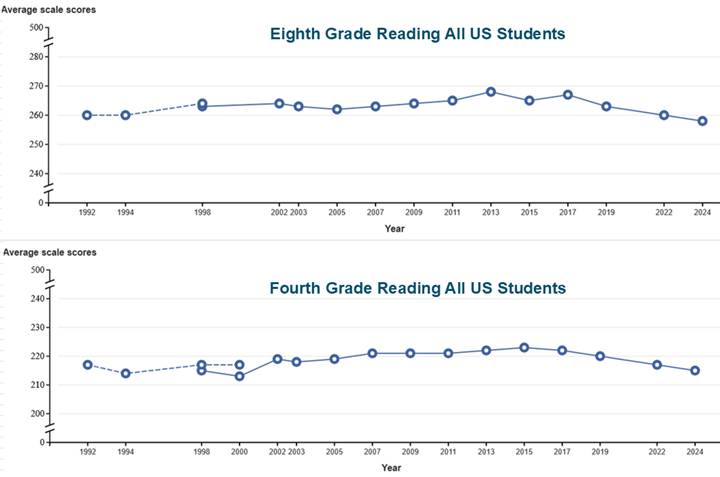
The NAEP data plotted above is for all tested US students in 8th grade and 4th grade reading. Around 2013, results started dropping. Data for math also shows this same trend. Because education has so many variables, establishing a solid cause and effect relationship for this decline is impossible.
Based on my personal experience in the classroom and my years of observing education outcomes, I have developed a theory that at least partially explains the decline.
Education Technology
In the 1990s, I worked in Silicon Valley researching friction problems associated with computer equipment. Part of my assignment was to develop software that ran testing devices, gathered massive data sets and loaded them into a Microsoft data base which created reports that I shared with customers. Once the testing was setup and started, everything from then on was automated. I loved pushing technology and making it do things no one else had.
In 1999, I got tired of Silicon Valley. That is when I returned to San Diego and sought a teaching credential. At the time, I imagined being able to use my technology expertise in future classrooms. I had become genuinely excited about education technology (edtech).
I wish I could say my expectations were met but I cannot.
I discovered that instead of edtech driving exploration, it was aimed at controlling and replacing teachers.
As part of the master of education program at UCSD, we were sent to local schools to work with students. I went to a local high school to work with struggling math students in a recovery class. Students were assigned to work on computer presented math problems which were then graded by the computer.
As the education technology critique Audre Watters has observed:
“Just because it’s a worksheet on an iPad doesn’t mean it’s transformational or exciting. It’s still a worksheet.”
In retrospect, this experience was an early effort to replace teachers with computer screens. Instead of working on making edtech an exciting addition to education, the effort was pointed toward putting kids at screens instead learning from teachers. The technology industry was promising to reduce the need for costly teachers.
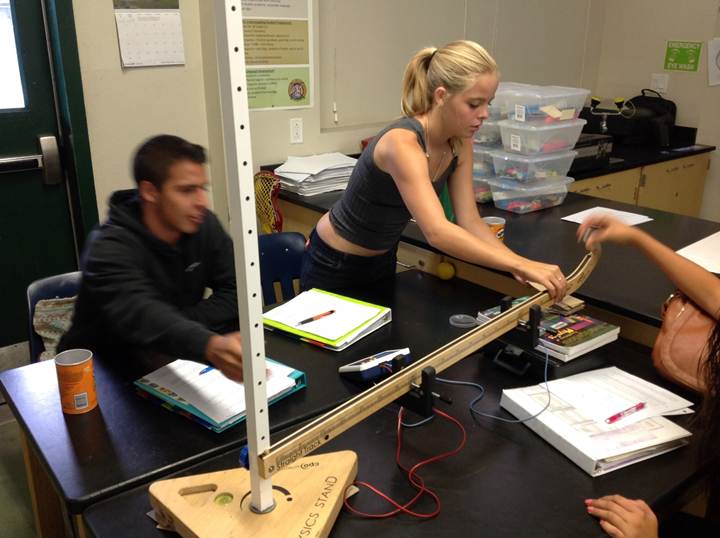
Physics Lab Class
This picture shows an example of using technology to engage students in authentic learning. Two photogates affixed to the ramp were accurate to + or – 0.001 seconds. Here the students were adjusting the ramp to achieve constant velocity when a marble rolled down the ramp. The photogates provided data including the time for test object to roll through the gate and the time between gates. Since students new the diameter of the test ball and the distance between the gates, they were able to calculate three velocities. Once the three velocities were all equal, they changed to a test ball with identical geometry but significantly less mass. They were then able to observe that the mass of the ball did not change the velocity which accords with Galileo Galilei’s 1589 experiment testing mass and gravity.
Unfortunately, only small companies were working to develop engaging technology for learning. Larger companies were developing school management systems that gathered large data sets on all students and teachers. Or they were creating schemes where teachers created lessons on their platforms which then claimed ownership of the lessons.
The school district I was in bought every student an I-pad and then three years later replaced those I-pads with laptop computers. Because these devices were such a classroom distraction, teachers often required students to put them in their backpacks and store them under their desks.
It was worse than a waste of money. It was undermining learning.
In my AP physics classes, students were not working through the assigned problems. They discovered that almost all physics problems had a worked-out example on line. I was getting the most beautiful work I had ever seen but the students were clueless when tested.
It seems fair to identify edtech as a possible cause for declining test scores. Artificial intelligence will likely make — not working or thinking — an even bigger problem.
Science of Reading
The Orwellian labeled science of reading (SoR) is not based on sound science. In 1997, congress passed legislation calling for a reading study. Establishment of the National Reading Panel (NRP) was a doomed effort from the beginning. It was a massive undertaking, conducted by twenty-one unpaid volunteers over 18-months. NRP fundamentally did a meta-analysis in five reading domains, ignoring 10 other important domains. They did not review everything and there was no new research. Their report is the basis for SoR.
In Fact-Checking the Science of Reading, professors Robert J. Tierney and P David Pearson share that science is a natural commitment to modesty “is always provisional; ever-ready to be tweaked, revised, or replaced by the next theoretical insight or empirical findings.” As Reinking, Hruby and Risko (2023) stated “settled science is an oxymoron.” In the case of SoR, not only is it not settled science, many literacy researchers believe it is a substandard approach to teaching reading.
SoR is a dressed-up version of George W. Bush’s Reading First Initiative from 2001. In 2008, The Center for Public Integrity reported, “An April 2008 study revealed the general ineffectiveness of Reading First and found that students in schools receiving funds for the program had no better reading skills than children in schools that did not.”
Unfortunately, the spending on SoR by people like Laurene Powell Jobs is causing benighted legislators to mandate it. Forty states have already adopted reading education laws complying with billionaire wishes.
The real reason for promoting SoR is resting control of education away from universities and ending democratically run schools. The agenda is for all teacher education and training to be privatized. Organizations like TNTP and Relay Graduate School are substandard oligarch financed entities with political clout. They are designed to replace public institutions.
SoR advocates are trying to force everyone to use a reading education approach that is not proven and failed miserably in England.
Nancy Bailey opened her recent post:
“Today’s Science of Reading (SOR) was born of a right-wing conservative phonics focus. A Nation at Risk helped advance that messaging….”
“As the country mandates the Science of Reading (SOR) and invests heavily in unproven programs, marketing disputes flourish over which best align with so-called evidence. These programs control teachers’ instruction through one-size-fits-all directives, delivered with manuals or online. It’s easy to see where this is going. States could spend millions more on reading programs that don’t appear to improve learning as teachers are driven out with tech.”
Since around 2011 or 2012, the reading industry has been spending to change how reading is taught. Sarah Schwartz wrote in EducationWeek:
“The shifts in reading teaching that many states are asking schools to make go beyond simply adding a few new practices to teachers’ toolboxes. Instead, the “science of reading” asks teachers and leaders to adopt a new framework of how skilled reading develops—and what educators need to do to support that process.”
As more and more private companies produce reading materials that are mandated for use in many states, NAEP reading scores have continuously slid down. This is not a clearly known cause and effect occurrence but it does seem to be a reasonable conjecture that SoR is harming student learning.
Conclusion
The more teachers are scripted, the more they have their autonomy diminished, the more private companies are selling education reading products into schools, the more kids are put at screens to learn, the worse the outcomes. This is why I believe NAEP scores have been falling since 2013.


 tultican
What a surprise. Bullionaire thinking is always like, “How can I make a killing by inserting myself in the pipeline between something people need and the resources for providing it?” And a killing is what they always make.
LikeLike