Archive | November, 2025

Just Finished Diane Ravitch’s New Book

25 Nov

By Thomas Ultican 11/25/2025

An Education; How I Changed My Mind About Schools and Almost Everything Else, is highly recommended especially for the thousands of us who consider her a friend. Diane is a very generous person with both her time and resources. I first met Diane through her blog in 2014, then in person at the 2015 NPE conference in Chicago. It was in this time period that she started posting some of my articles on her blog while simultaneously informing me about who was working to destroy public education. At the time, I did not realize what a privilege this was. Her latest book is an intimate memoir that introduces us to Diane Rose Silverstein of Houston, Texas born July 1, 1938. It tells the story of a Jewish Texan from of large struggling family becoming politically influential and a national treasure.

On a page following the dedication page, she quotes Ralph Waldo Emerson:

“Foolish consistency is the hobgoblin of little minds, adored by little statesmen and philosophers and devines.”

I knew that Diane had made a big change and reversed herself on test based accountability and other school reform agendas driven by conservatives and neoliberals. However, the courage this change took and the depth of her reversal were profoundly illuminated by reading this book.

Although growing up in a Roosevelt supporting family and being a registered Democrat, she became deeply conservative. Diane served on the board of the Thomas B. Fordham foundation, contributed to the Manhattan Institute and was a member of the Koret Task Force with the likes of Eric Hanushek and E. D. Hirsch Jr. Her best friends personally and politically all supported the ideas she abandoned. By reversing herself, she walked away from professional security and long held personal friendships. It was courageously principled but must have been a personally daunting move.

Me and Diane

The best part of “An Education” for me was Diane’s recounting growing up in Houston and going to a segregated public school. Her experience was just so relatable. She liked all the music my oldest sister liked. Cheating was rampant in her school just like mine and like her; I let my classmates copy my work. My rural Idaho school was kind of segregated but that was because only white people and a few Mexican families lived in the community. The Mexican kids were very popular in our school. I never met a Black person until I was a senior in high school and had only seen a few through a car window when vacationing in Kansas City. It was wonderful to find some commonalities.

I had studied engineering, worked in Silicon Valley and pretty much ignored education. But I did hear from Diane and her friends about what a failure public education had become. By 1999, I became tired of hearing about people becoming rich off their stock options, working on the next greatest hard drive or dealing with the atrocious San Jose traffic. I decided to return to San Diego and do something to help public education by enlisting in a master of education program at the University of California San Diego (UCSD).

The UCSD program was oriented toward constructivist education which I really liked. I read books by Alfie Kohn and papers by Lisa Delpit and was ready to revolutionize public education. Then I got to my first job at Bell Jr. High School and discovered that the teachers there were well informed pros with lots of experience. By comparison, I was not nearly as competent as most of them.

It was then that I started to see that I had been bamboozled about how bad public schools were and began looking for like minded people. Two books, David Beliner’s and Eugene Glass’s “50 Myths and Lies that Threaten America’s Public Schools” and Diane Ravitch’s “The Death and Life of the Great American School System” were like water for the thirsty. Soon after that, I found Diane’s blog and joined the Network for Public Education (NPE) along with many other public school advocates.

I saw Diane at the 2015 NPE conference in Chicago’s Drake Hotel. It was an absolutely inspiring event with a keynote by the amazing Yong Zhao. Although we started communicating a little by email, I did not meet Diane personally until NPE 2016 in Raleigh, North Carolina. It was there that the Reverend William Barber gave a truly inspiring speech.
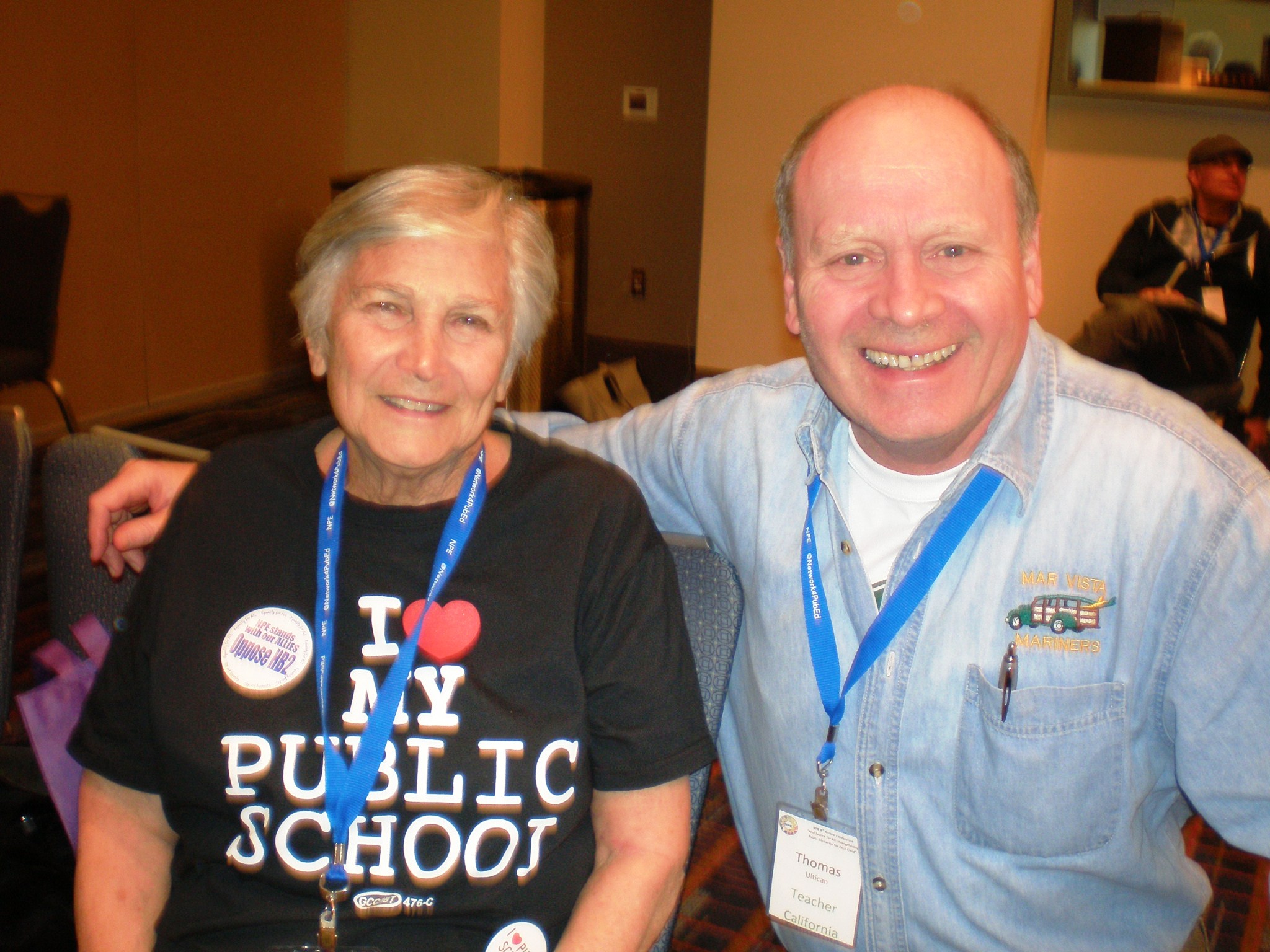
Tom Ultican and Diane Ravitch in Raleigh (by Ultican)

Over the years since, I have developed an ever growing admiration for this woman. She outworks everyone and never gives up. In 2021, Diane had a really difficult open heart surgery. In the book, she notes going into surgery on April 7 and waking up a week later. I wrote her that my chanting Nam-myoho-renge-kyo for her health and recovery had saved her life but she foolishly gave some credit to the other hundreds of people who were sending prayers and to her skilled doctors.

A year later, we had an NPE conference in Philadelphia. Diane was there and leading the proceeding but she was still weak. It was hardly noticeable but when she went to conduct an interview with Little Steven Van Zandt, he had to help her negotiate the two steps up to the platform.

Diane and Little Steven Van Zandt (by Ultican)

During my several trips to NPE conferences, I have met a Baptist preacher from Texas named Charles Foster Johnson. Charles has been a tireless fighter protecting public education and has developed an organization called Pastors for Children. I remember asking Diane if she ever thought she would be a friend and political ally with a Baptist preacher? She said, “No, never!” Earlier this year at NPE 2025 Diane and Charles asked me to take their picture. So there it was a Buddhist, a Jew and a Baptist working together and sharing friendship.
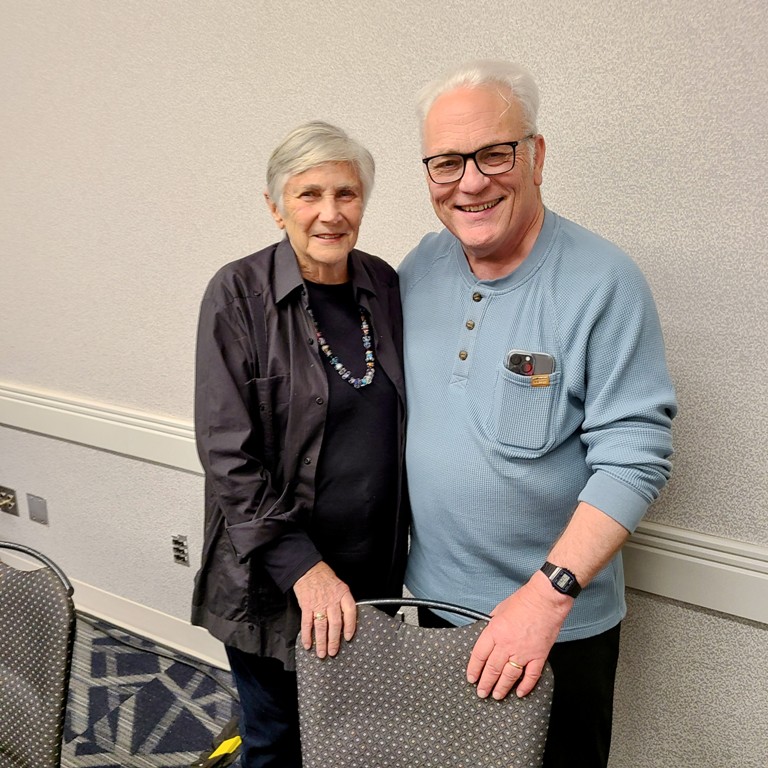
Diane Ravitch and Charles Foster Johnson 2025 (by Ultican)

Conclusion

Like I noted above, I had not paid any attention to public education so when I became aware of Diane, her blog and her book “The Death and Life of the Great American School System”, I was surprised to find how much seasoned educators despised Diane and could not trust her. Still to this day, I see education professionals taking shots at her and NPE. It is impossible for them to believe she changed her mind which brings to mind the words of Emerson, “Foolish consistency is the hobgoblin of little minds…” They just cannot accept new evidence.

I really enjoyed Diane’s latest book and encourage everyone to read it. She probably thinks this is her last book a sort of swan song. Somehow, I don’t think so. She is relentless and will almost certainly want to teach all of us about something in the future. I expect that in two or three years we will see another powerful book by Diane Ravitch.
Crazy-Pants Makes Crazy Prediction

19 Nov

By Thomas Ultican 11/18/2025

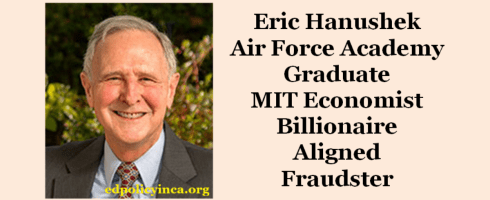
A propaganda rag, ‘The 74’, reported, “[R]esearch from Stanford estimates learning loss over the past decade has cost our country over $90 trillion in future growth.” The article was written by Eric Hanushek, a Stanford University economist, and Christy Hovanetz, an education researcher from Jeb Bush’s pro-school choice and pro-education technology organization, ExcelinEd. Unsurprisingly, the article linked above is a paper Hanushek wrote. Crazy-pants Eric has a long history of using his own papers to support new research which is typically long on assertions and short on convincing analysis.

Last year, he claimed COVID-19 “learning-loss” could cost America $31 trillion in future economic development. Hanushek’s latest paper asserts, “The present value of future lost growth would be approximately three times current GDP (which is $30 trillion).” The justification for this new assertion is more than uncertain. The new paper refers to a model from his 2011 paper written with Ludger Woessmann­ for the Organization of Economic Co-operation and Development. That paper was long on Arithmetic with several assumptions short on common sense. In his latest paper and this article, he is claiming that a small drop in the National Assessment of Education Progress (NAEP) scores added to what he calls “Covid learning loss” will cost America $90 trillion in future growth.

Eric Hanushek first gained notoriety with his 1981 paper, claiming “there is no relationship between expenditures and the achievement of students and that such traditional remedies as reducing class sizes or hiring better trained teachers are unlikely to improve matters.” This claim attracted conservative billionaires but had little relationship with reality. When providing solutions in ‘The 74’, Hanushek and Hovenetz contradict his 1981 paper writing:

“First, states need to invest in effective personnel. They can do this by incentivizing strong teaching and by supporting strong teaching through professional development in evidence-based practices such as use of high-quality instructional materials and assessment data to inform instruction.”

A few decades ago, a friend gifted me the book “An Incomplete Education” by Judy Jones and William Wilson. After my 1987 edition, Jones and Wilson have updated the book and republished several times. I fondly remembered their description of economists:

“Economists are fond of saying, with Thomas Carlyle, that economics is ‘the dismal science.’ As with much that economists say, this statement is half true. It is dismal.”

“Where once rulers relied on oracles to predict the future, today they use economists. Virtually every elected official, every political candidate, has a favorite economist to forecast economic benefits pinned to that official or candidate’s views.” (Incomplete Page 120)

It just so-happens that Eric Hanushek is an MIT trained economist who is good at creating reports that conform to the beliefs of conservative billionaires. His work is scientific propaganda masquerading as academic excellence.

Notices from Hanushek and Hovanetz

“No single event over the postwar period has had an impact on our educational system that comes close to that of the pandemic.” This statement from their article is hyperbole not fact.

The impact of vouchers in Washington DC and Ohio were worse than COVID-19. In his book, The Privateers, Josh Cowen shared that the losses due to COVID-19 were around -0.25 standard deviations while losses in DC due to vouchers were around -0.40 standard deviations and in Ohio they were as high as -0.50 standard deviations. (Privateers Page 6) However, these were not nationwide results. Unfortunately, we don’t have much information about the mumps, measles, flu and polio epidemics of the 1950s but there is every reason to believe their impact was close to that of the COVID-19 epidemic.

The authors hold up Mississippi, Tennessee and Louisiana as examples to emulate stating:

“Some states made noteworthy progress on NAEP this year: Mississippi, Louisiana and Tennessee. Each has a track record of high expectations and strong accountability.

“These states use an A–F school rating system that puts reading and math achievement front and center. They measure what matters — proficiency and growth — and they report results in a way families and educators can understand. Transparency and rigor are fueling their progress.”

The A—F school ratings system is worthless because it only measures parent income. As Diane Ravitch wrote on her blog:

“The highest rated schools have students with the highest income. The lowest rated schools have students with the lowest income.”

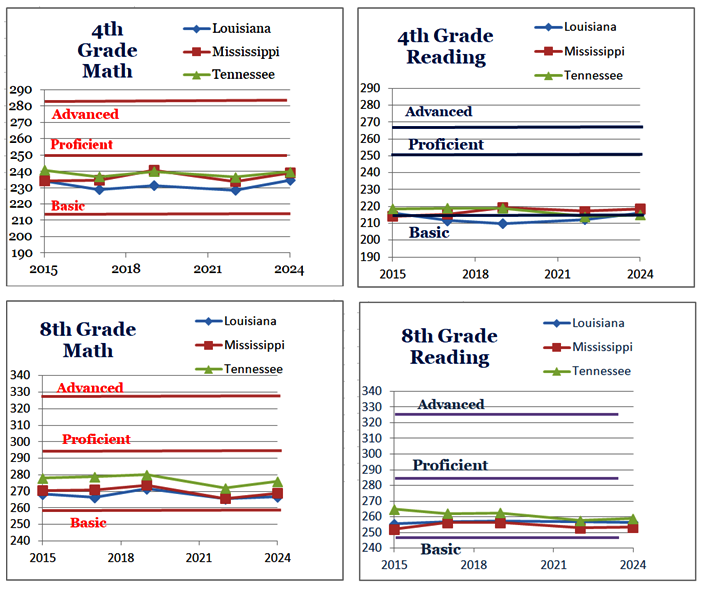
I wondered what Hanushek and friend were alluding to, so I graphed the average NAEP data for 4th and 8th grade reading and math since 2015 to see if it provided a clue.

NAEP Data for Louisiana, Mississippi and Tennessee

I added a bar indicating the NAEP cut scores for the 2024 NAEP designations of basic, proficient and advanced as a reference. It is well known that NAEP’s proficiency level is set well above grade level which means 70% of students not being rated proficient is not a bad score. Furthermore, writing in Forbes, Peter Greene shared, “An NCES report back in 2007 showed that while NAEP considers “basic” students not college ready, 50% of those basic students had gone on to earn a degree.”

The data graphed here indicates to me that all three states have solid public education programs. It is noteworthy that in reading their 4th graders only averaged basic but by 8th grade their average results were above basic. However, all three states are among the bottom 15 scoring states in the US and as we would expect are in the bottom 15 states in family income. What I do not see is why they are held out by Hanushek and Hovanetz as exemplars.

Concluding Remarks

The first blogger to label Eric Hanushek crazy-pants was Peter Greene. I have found Peter’s creativity worth stealing.

Let’s be clear, there is no such thing as learning loss involving students. This is a complete misnomer. Students may not achieve some state provided targets but they are always learning; maybe not what we want them to learn but always learning.

Eric Hanushek is a huckster for conservative billionaires. This latest claim is beyond farcical. Claiming to have knowledge of economic development in 40 years is fantasy and then tying that fantasy to NAEP testing data is bizarre. His $90 trillion claim for loss of future economic development would embarrass a carnival barker.

Hanushek is the guy who thinks education can be measured in days of learning which means that students learn in a near linear fashion. They absolutely do not but even this bogus claim would seem prescient when compared to this latest assertion.

Standardized testing only correlates with family income. To evaluate education based on this fictitious instrument is fraudulent. By extension, this makes economist Eric Hanushek a con artist.

California Charter Schools Heading for 2026

11 Nov

By Thomas Ultican 11/11/2025

There was another major effort in Sacramento to reform charter school laws in order to head off a repeat of the A3 disaster. In May 2019, the San Diego District Attorney charged 11-people with scheming to use non-classroom based charter schools to steal more than $400 million from the state education budget. Eventually the A3 grifters all plead guilty, but shockingly no-one spent a day in jail. This year, state legislators failed again to reform purposefully weak charter school laws meanwhile the privatization movement is still infested with graft.

Billionaires have been the wind beneath the charter school movement’s wings.

The first California charter school was authorized in 1994. The original charter school law capped the number of schools at 100; however Netflix CEO, Reed Hastings, successfully campaigned to end that limitation.

The California Charter Schools Association (CCSA) was founded in 2003. John Walton, a billionaire member of America’s richest family, was on the first CCSA board. He died in a plane crash in 2005 and his billionaire niece, Carrie Walton Penner, assumed his seat on the board. She served on the CCSA board from 2005-2015. (TIN: 51-0465703)

Billionaire Reed Hastings was a CCSA board member from 2007 until 2015.

In Executive Director of the Network for Public Education (NPE) Carol Burris’s yearlong study of charter schools, she admits not knowing how much billionaire money goes to the CCSA but noted:

“The 2017 Board of Directors include New York’s DFER founder, Joe Williams, a director of the Walton Education Coalition; Gregory McGinty, the Executive Director of Policy for the Broad Foundation; Neerav Kingsland, the CEO of the Hastings Fund; and Christopher Nelson, the Managing Director of the Doris & Donald Fisher Fund. Prior Board members include Reed Hastings of Netflix and Carrie Walton Penner, heir to the Walmart fortune.

Other billionaires were also busy supporting the charter school movement. The history tab at the NewSchools Venture Fund (NSVF) website states:

“NewSchools Venture Fund was created in 1998 by social entrepreneur Kim Smith and venture capitalists John Doerr and Brook Byers.” (Byers and Doerr are colleagues from the Kleiner Perkins venture fund.)

“We were among the first and largest investors in public charter schools and the first to identify and support multisite charter management organizations, which launch and operate integrated networks of public charter schools.”

At the time, “entrepreneur Kim Smith” was a graduate student at Stanford. She was co-chair of the Stanford business school’s entrepreneur club and wanted to get Amazon founder Jeff Bezos as a speaker for the club. She asked an acquaintance, John Doerr, to help and he agreed on one condition. In an education session at Al Gore’s house, the name NewSchools had been created. Doerr wanted her to come up with a use for the name.

Bezos spoke at her club and she wrote a two page paper outlining NSVF.

The push by billionaires to privatize public education using charter schools has become clear. It makes little sense for the future of education in America but billionaires don’t care. Bill Gates and the Walton Family Foundation are the largest individual donors to NSVF totaling $226,881,394 in grants as documented in the 2020 article Organized to Disrupt. However, this is only a fraction of the total billionaire largess. Over the last 20 years, billionaires John Doerr, Laurene Powell Jobs and John Sackler have served on the NSVF board.

The billions of dollars invested in growing the charter school movement has lead to steady growth.

However, the rate of growth is decreasing. From 2014 to 2020 the California charter school growth averaged 5% a year. From 2021 to 2025 the growth has fallen to 1% a year.

Research by NPE revealed the Achilles heel plaguing charter schools; they are not stable. In the first three years of operation, more than 15% of charter schools close their doors and eventually half of all charter schools go out of business. Charter promoting organizations like CCSA and NSVF counter that charter schools get better test results, but testing by California’s Department of Education shows the opposite.

Results Posted by California Department of Education

Reforming the Charter School Law

More charter schools appear to be following the A3 path. Highlands Community Charter and Technical schools received the results of a scathing audit on June 24 this year. Auditors found that the school improperly received over $180 million in state funds. The entire 7-person board has resigned or been forced out.

The audit identified millions of dollars in over-payments stemming from inflated attendance figures. Investigators noted conflicts of interest, questionable expenditures, gifts and the hiring of unqualified individuals. A high-ranking employee earned $145,860 annually but lacked an expected bachelor’s degree. She is alleged to have secured the position through her mother, who served on the board at the time.

Inspire, another non-classroom based charter school system using a similar model to A3, was the subject of a state audit in 2019. The founder and CEO, Nick Nichols, had to resign and pay back $1,055,834 for advances he took. The 12 charter schools, which made up the system, all remained in business independently after the demise of Inspire.

Required 2022 tax forms show that at three former Inspire schools, 15 people are averaging $157,000 in salaries to supervise 7806 students. When I asked what has changed, a teacher at one of the schools responded, “Now we have multiple Inspires with each school being a location where families and friends are being hired into high paying jobs that they are not qualified to hold.”

Chair of the California Assembly Education Committee, Al Muratsuchi, introduced Assembly Bill 84 in response to the reports about charter school fraud. The Torrance Democrat, who intends to run for superintendent of public instruction in 2026, declared he has no intention of “going after the charter schools that are acting responsibly and providing good educational services for their kids.” He added, “AB 84 is about going after the bad actors that are committing fraud and engaging in corruption through the current lack of transparency and accountability that we have with our statewide charter oversight system.”

CCSA CEO Myrna Castrejón came out swinging. She claimed the anti-charter school forces have brought a “bare-knuckle” fight. The highly paid Castrejón asserted, “Make no mistake, we still have opponents who are not going to stop until they strip out our autonomy entirely and/or cripple us.”

I noticed when looking through CCSA tax documents that Castrejón received $199,128 in total salary and benefits in 2009. Since then she has continued to make huge money fighting to advance charter schools and keep them as unregulated as possible. She set out to destroy AB 84.

Muratsuchi introduced AB 84 on December 20th, 2024. In February 2025, Castrejón’s launched her counter attack. She got Sacramento Democratic Senator Angelique Ashby to introduce Senate Bill 414, which claimed, “This bill makes a broad set of changes to charter school law related to audit procedures, financial oversight, governance, and funding determinations.” The political fight became about which reform bill is better, with the charter school industry supporting SB 414 and public school educators supporting AB 84.

Interestingly, a perusal of Ashby’s campaign contributions listed Reed Hastings and his wife, Pat Quillin as big donors. It also shows a large contribution from a charter school PAC belonging to the California Charter Schools Association Advocates, the political arm of CCSA.  

After a protracted fight, Muratsuchi withdrew AB 84 with the expectation that Ashby would withdraw SB 414. However, there was a feeling among legislators that they needed to deliver something for the governor to sign. On 9/13/2025, SB 414 achieve final passage with 22 Democratic senators not voting.

In an email to EdSource, California Teachers Association President David Goldberg declared:

“SB 414 not only fails to address the issues that have led to massive cases of fraud in some charter schools, but it also significantly weakens existing requirements for non-classroom-based charter schools to prioritize spending on student learning. We urge the governor to veto this legislation and are dedicated to our fight for meaningful reform next year.”

Governor Newsom concurred. In his veto message, the governor wrote:

“I deeply appreciate the efforts of the author and the negotiating parties to develop legislation that builds on these recommendations and the findings from the State Controller. However, this bill falls short. While the oversight and auditing provisions are meaningful, other sections are unworkable, would face legal challenges, and require hundreds of millions of dollars to implement. Additionally, provisions added late in the legislative process undermine important agreements my Administration made during my first term.”

Myrna Castrejón and her billionaire supporters won this round and California’s charter school laws remain extremely vulnerable to the scofflaws that she represents.